Key Takeaways
1. Emma Gatewood's Historic First Thru-Hike at 67
In September 1955, having survived a rattlesnake strike, two hurricanes, and a run-in with gangsters from Harlem, she stood atop Maine’s Mount Katahdin.
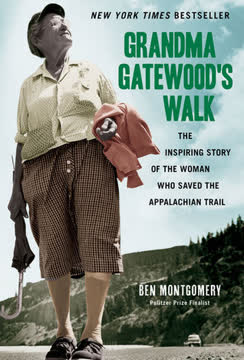
Defying expectations. In May 1955, 67-year-old Emma Gatewood, a great-grandmother from Ohio, quietly left home for a "walk." With minimal supplies—a change of clothes, less than $200, and a drawstring denim sack—she embarked on the 2,050-mile Appalachian Trail. Her family was unaware of the astonishing, impossible particulars of her journey.
Unprepared yet determined. Gatewood, standing five-foot-two and weighing 150 pounds, had no map, sleeping bag, or tent. Her only survival training came from a lifetime of farm work, and she was nearly blind without her glasses. Despite these challenges, she had prepared by walking ten miles a day in the months leading up to her trek, fueled by an unwavering resolve.
A monumental achievement. After 146 days, Emma Gatewood reached Mount Katahdin, becoming the first woman to hike the entire Appalachian Trail alone. Her journey, which began on Mount Oglethorpe, Georgia, captured national attention, transforming her into "Grandma Gatewood," a hiking celebrity who inspired countless others.
2. A Life Forged in Hardship and Domestic Abuse
I have suffered enough at his hands to last me for the next hundred years.
Hidden torment. Emma's public persona as a cheerful, determined hiker masked a deeply painful past. For 35 years, she endured severe domestic abuse from her husband, P.C. Gatewood, who subjected her to repeated beatings, broken bones, and emotional manipulation, often convincing others she was "not in her right mind."
Seeking escape. The woods became Emma's sanctuary, a place where she could find temporary respite from her tyrannical husband. She would sometimes disappear for entire days, returning only when his mood had shifted. Her children witnessed the violence, carrying the trauma into their own old age, remembering her seeking haven in their beds at night.
A final stand. In September 1939, after a particularly brutal beating that left her with broken teeth and a cracked rib, Emma's endurance ended. With her son Nelson's help, she escaped into the woods. She later filed for divorce, gaining custody of her younger children and the farm, finally achieving the freedom she had longed for.
3. The Unconventional, Minimalist Hiker
She boasted that she was the only one of the thru-hikers of the Trail that really roughed it, and she was probably right.
Bare essentials. Emma Gatewood's approach to thru-hiking was remarkably minimalist, contrasting sharply with the elaborate gear of other hikers. Her "little sack weighed seventeen pounds," containing only:
- Vienna Sausage, raisins, peanuts, bouillon cubes, powdered milk
- Band-Aids, iodine, bobby pins, Vicks salve
- Slippers, a gingham dress, a warm coat, a shower curtain
- Drinking water, a Swiss Army knife, a flashlight, candy mints, a memo book
Tennis shoes over boots. Instead of sturdy hiking boots, Emma wore canvas Keds, which she often had to replace or mend with string and tape. She even sliced the sides of her shoes to accommodate her bunions. This unconventional footwear choice became a hallmark of her rugged, no-frills style.
Resourceful survival. Lacking a tent or sleeping bag, Emma relied on ingenuity to survive the elements. She heated flat rocks over fires for warmth on cold nights, fashioned a bed from leaves or grass, and once even slept inside a large pasteboard box. Her resourcefulness allowed her to adapt to whatever the wilderness threw her way.
4. Battling Nature's Fury and Trail Neglect
This is no trail. This is a nightmare.
A trail in disrepair. Emma's first hike in 1955 revealed a stark contrast to the "beautiful trail, how well marked it was" described in the National Geographic article that inspired her. She encountered:
- Terrible blowdowns and burnt-over areas
- Gravel and sand washouts
- Weeds and brush "to your neck"
- Shelters that were "blown down, burned down, or so filthy I chose to sleep out of doors"
Facing the elements. Her journey was a constant battle against nature's unpredictability. She survived a rattlesnake strike, two hurricanes (Connie and Diane), and freezing temperatures, often without adequate shelter. Her determination was tested by torrential rains, strong winds, and treacherous terrain, particularly in the White Mountains of New Hampshire.
Physical toll. The rugged conditions took a significant toll on her body. She wore out seven pairs of shoes, lost thirty pounds, and suffered from a sprained ankle, bruised eye, and broken glasses. Despite these injuries and the trail's poor state, Emma refused to quit, pushing through pain and discomfort to reach her goal.
5. Finding Solace and Freedom in the Wilderness
The stillness and quiet of the forests has always seemed so wonderful and I like the peacefulness.
Escape and renewal. For Emma, the wilderness was more than just a physical challenge; it was a profound escape from the "petty entanglements of life." Away from the grit and ash of civilization, she found a deep sense of peace and contentment that had been absent in her tumultuous home life.
A spiritual connection. Emma often spoke of the "lovely works our Maker / Displays on forest floors," finding spiritual solace in nature's beauty. She wrote poetry about springtime, rills, zephyrs, and wildflowers, seeing the wild as a gift that brought context and healing to her spirit.
"Aloneness more complete than ever." While she enjoyed company, Emma also embraced the profound solitude of the trail. This "aloneness" allowed her to explore her own mind, process her past, and find a sense of self-reliance and inner strength that had been suppressed for decades.
6. Challenging 1950s Societal Expectations for Women
If those men can do it, I can do it.
Breaking barriers. In an era when women were largely confined to domestic roles, Emma Gatewood's solo thru-hike was a radical act of independence. She defied the prevailing notion that such arduous feats were exclusively for men, proving that a 67-year-old great-grandmother could conquer the longest continuous footpath in the world.
Inspiring a generation. Her journey resonated deeply, particularly with women. Her story challenged the perception of what an "old woman" could or should do, inspiring countless individuals to pursue their own adventures and push beyond perceived limitations. She became a symbol of female strength and determination.
A quiet rebellion. Emma's decision to hike was a personal rebellion against a life of subservience and abuse. By choosing to walk, she asserted her autonomy and demonstrated a fierce independence that transcended the societal norms of the 1950s, paving the way for future generations of female adventurers.
7. The Elusive "Why" and Public Fascination
I want to see what’s on the other side of the hill, then what’s beyond that.
A captivating mystery. As Emma's story spread, reporters and the public alike clamored to understand her motivation. Her answers were often playful and varied, ranging from "Because it was there" to "Seemed like a good lark," or simply, "I didn’t have anything else to do." This elusive "why" only deepened the public's fascination.
A celebrity by chance. Emma never sought fame, yet her improbable journey made her a national celebrity. She appeared on TV shows like "Today with Dave Garroway" and "You Bet Your Life with Groucho Marx," and was featured in "Sports Illustrated." She found the constant attention both amusing and, at times, vexing, calling herself a "sideshow freak."
A universal appeal. Despite her coy responses, Emma's story resonated because it tapped into a universal desire for freedom, challenge, and self-discovery. Her varied explanations allowed people to project their own aspirations onto her journey, making her a relatable figure for anyone seeking to break free from routine or overcome personal obstacles.
8. A Catalyst for Appalachian Trail Improvement
Her vocal criticism of the lousy, difficult stretches led to bolstered maintenance, and very likely saved the trail from extinction.
Unvarnished truth. Emma Gatewood was not shy about her criticisms of the Appalachian Trail's condition. She openly described it as a "nightmare" with "terrible blowdowns" and "filthy" shelters, directly contradicting the romanticized descriptions in popular magazines. Her honest accounts highlighted the urgent need for better upkeep.
Prompting action. Her celebrity status amplified her complaints, forcing the Appalachian Trail Conference and local hiking clubs to take notice. Her vocal advocacy directly contributed to:
- Bolstered maintenance efforts
- Improved trail marking
- Restoration of neglected sections
- Increased public awareness and volunteer engagement
Saving the trail. Many credit Emma's outspokenness with saving the Appalachian Trail from further disrepair and potential abandonment. Her repeated hikes, and the attention they garnered, ensured that the "People's Path" received the care and resources necessary to preserve it for future generations of hikers.
9. Repeated Feats: The First to Hike the AT Twice and Thrice
In 1957, she became the first person—man or woman—to walk the world’s longest trail twice.
The "Queen of the Forest" returns. Just 19 months after her first historic thru-hike, Emma, then 69, embarked on the Appalachian Trail again in April 1957. She completed her second continuous thru-hike in fewer days, demonstrating improved trail conditions and her own seasoned expertise.
A triple crown. In 1964, at the age of 77, Emma Gatewood completed her third Appalachian Trail hike, this time in sections. This made her the first person ever to traverse the entire trail three times, solidifying her legendary status in the hiking community and further inspiring a growing number of outdoor enthusiasts.
Continued advocacy. Even in her later hikes, Emma continued to offer constructive criticism, noting that while the trail was still "bad in a few spots," it was "fewer than the last time." Her persistent engagement ensured ongoing improvements and reinforced her role as a guardian of the Appalachian Trail.
10. The Enduring Legacy of "Grandma Gatewood"
Her hikes brought attention to the trail like none before.
A living legend. Emma Gatewood's story transcended her lifetime, becoming a powerful legend in the hiking community and beyond. Her name is synonymous with grit, determination, and the spirit of adventure, inspiring countless individuals to embark on their own journeys, whether on the trail or in life.
Motivating generations. Hikers today, from seasoned thru-hikers to young Boy Scouts, continue to draw inspiration from Grandma Gatewood. Her ability to overcome physical limitations, harsh conditions, and personal adversity serves as a powerful reminder that "if she did it, I can, too," breaking down psychological barriers to ambitious goals.
Trailblazer for pedestrianism. At a time when America was rapidly embracing car culture, Emma Gatewood became an evangelist for walking and experiencing nature. Her story, widely publicized, helped re-ignite interest in pedestrianism and outdoor recreation, leaving an indelible mark on the Appalachian Trail and the broader American consciousness.
Last updated:
Review Summary
Grandma Gatewood's Walk tells the inspiring story of Emma Gatewood, who at 67 became the first woman to solo thru-hike the 2,050-mile Appalachian Trail in 1955, later completing it three times. Carrying minimal supplies in a homemade sack, she hiked in tennis shoes without tent or sleeping bag. Reviews praise Emma's determination and inspiring story, noting she survived an abusive marriage before finding freedom on the trail. While readers universally admire Emma, opinions on the writing vary—some find it well-researched and engaging, others criticize the structure, authorial intrusions, and melodramatic elements, suggesting the story deserved better telling.