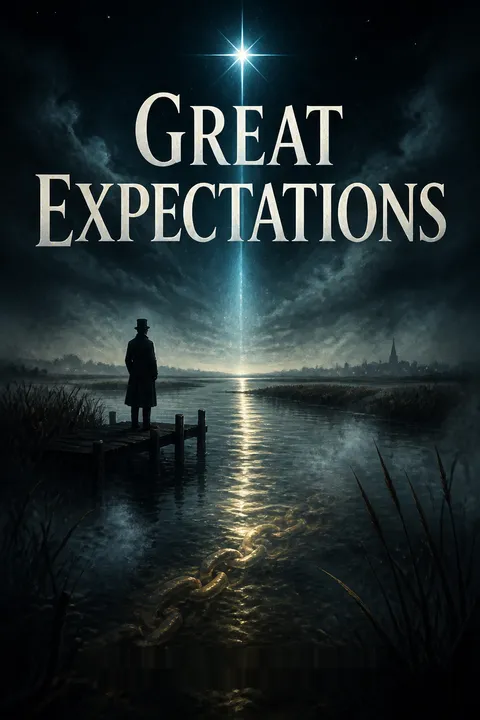


Plot Summary
The Marshes Demand a File
Orphaned Pip visits his parents’ graves on the bleak marshes, where an escaped convict seizes him and demands food and a file for his leg iron. Terrified by threats of a hidden accomplice, Pip steals from his sister Mrs. Joe and blacksmith Joe Gargery, then brings the convict a feast on Christmas morning.
There he glimpses a second escaped prisoner, badly bruised, before soldiers arrive to hunt both men. In a ditch, the first convict fights the other and insists he captured him rather than let him escape. The soldiers return them to the prison ship. Joe welcomes the hungry man’s admission that he stole the food, sparing Pip exposure, but Pip keeps his own part in the theft secret.
Pip’s first moral choice is made under coercion, but Dickens makes its consequences intimate rather than abstract: the boy steals from the household that shelters him, then feels more guilt about deceiving Joe than about depriving Mrs. Joe. The convict is frightening, yet his desperate hunger and later refusal to let his rival escape complicate Pip’s childish categories of criminal and decent person. The marsh setting makes law feel both immense and arbitrary, embodied in cannons, irons, and a distant prison ship. Pip’s silence begins a pattern: he hides shame instead of seeking help, and the concealed act will shape how he reads later generosity.
Satis House Stops Time
Uncle Pumblechook takes Pip to Miss Havisham, a wealthy recluse dressed in a decayed bridal gown inside a house where the clocks have stopped. Her adopted ward Estella deals cards with him, mocks his rough hands and thick boots, and serves his meal as if he were an animal. Pip cries in the abandoned brewery yard, then leaves convinced that his home and blacksmith future are shameful.
On a later visit, Estella’s pale young relative challenges Pip to fight and loses; afterward, she allows Pip to kiss her cheek, an act he experiences as both reward and insult. Miss Havisham watches his humiliation with keen interest, while Pip mistakes her attention for the beginning of a future she has never promised.
Satis House turns class into a bodily sensation. Estella’s contempt makes Pip notice his hands and boots as if they were evidence against him, and he carries that judgment home until affection itself begins to look common. Miss Havisham’s frozen bridal room offers a misleading model of time: Pip thinks he has entered a story whose next chapter must fulfill his wishes, while its owner is repeating an old injury. The kiss after the fight sharpens the confusion. It looks intimate, but Pip senses its transactional chill, learning to value signs of favor more than the person offering them.
The Forge Becomes a Sentence
Miss Havisham eventually asks Joe to bring Pip’s indentures and gives him twenty-five guineas, making Pip Joe’s apprentice. Joe accepts the arrangement without demanding more, but Pip feels shame rather than gratitude as village acquaintances celebrate the money and Pumblechook claims credit. He studies with Biddy, the orphan who had first helped teach him, then asks her whether he can become a gentleman.
Biddy warns that ambition built around Estella will not make him happier; Pip admits that her beauty and disdain drive his wish. At the forge, he keeps working, but imagines Estella watching him in soot-stained clothes. His expectations remain only a fantasy, yet they have already made an honest livelihood feel like failure.
Pip’s apprenticeship is not imposed as a punishment; Joe makes room for him in the trade and treats the small payment as enough. The pain comes from Pip’s new interpretation of that life. Estella’s judgment becomes an internal audience, so even the forge fire that once suggested independence now seems to illuminate his supposed inferiority. Biddy offers a counter-model of education grounded in patience and mutual care, but Pip can understand her counsel without choosing it. Dickens locates the beginning of self-betrayal not in wealth, which has not arrived, but in the habit of measuring love and work by imagined social rank.
Orlick Leaves His Mark
Journeyman blacksmith Dolge Orlick quarrels with Mrs. Joe after she objects to a half-holiday, and Joe beats him in the ensuing fight. That night, someone strikes Mrs. Joe down with a heavy object and leaves a filed convict’s leg iron beside her. She survives with lasting disabilities and cannot explain the attack.
Biddy joins the household to care for her; when Mrs. Joe repeatedly draws a hammer on her slate, Biddy recognizes it as a sign for Orlick. Pip suspects the leg iron came from the convict he once helped, but cannot prove who used it. He grows closer to Biddy, yet still dreams of Estella and a higher station, leaving both Joe and Biddy to bear the cost of his divided loyalties.
The assault binds Pip’s childhood secret to a new, unresolved injury. The filed iron is a physical remnant of the marshes, but it does not provide the certainty Pip craves; his guilt fills the evidentiary gap, even though he did not attack his sister. Mrs. Joe’s changed condition softens the household, and Biddy’s practical intelligence becomes indispensable, but Pip does not turn that intimacy into a choice of his own. He can recognize Biddy’s goodness and still prefer the distant promise embodied by Estella. His divided attention is already consequential: he measures care by what it might mean for his advancement.
Jaggers Names a Fortune
Four years into his apprenticeship, Pip meets London lawyer Mr. Jaggers, who announces that an unnamed benefactor will finance his education and raise him as a gentleman. Pip assumes Miss Havisham arranged it, and Jaggers neither confirms nor corrects the guess.
Joe refuses compensation for losing his apprentice, though Pip is too dazzled by the prospect to understand the tenderness of that refusal. He leaves the forge for London, embarrassed by Joe’s awkward goodbye and by the village that watched him grow up.
Even before he has earned anything, Pip begins to imagine that money has lifted him beyond his former home. His departure starts the long separation between his new ambitions and the people who gave him affection without conditions.
The offer converts Pip’s fantasy into a contract, but its secrecy allows him to supply the explanation he most wants. Because Miss Havisham seems to control the story of his rise, he reads fortune as evidence that Estella is intended for him. Jaggers’s precision gives the arrangement legal solidity while withholding the personal truth that might challenge Pip’s interpretation. Joe’s refusal of compensation exposes a different economy, one in which care cannot be priced. Pip sees the money and misses the moral gift. His departure is therefore both escape and self-deception: he moves toward opportunity while recasting loyalty as an embarrassment.
London Offers a Mirror
In London, Pip finds Mr. Jaggers surrounded by clients seeking legal help and meets his clerk Wemmick, who keeps his working life separate from a homemade castle where he cares for his deaf father. At Barnard’s Inn, Pip recognizes Herbert Pocket as the pale young gentleman he once fought at Satis House.
Herbert welcomes him, explains Miss Havisham’s history as a jilted bride, and describes how her half-brother and a smooth-talking lover exploited her.
Pip studies with Herbert’s father, Matthew Pocket, and sees that the gentleman’s household is disorderly, not elegant. He also meets the gloomy Bentley Drummle and lively Startop. London gives Pip education and companions, but its polished surfaces do not reliably signal wisdom, kindness, or success.
Herbert’s return changes Pip’s memory of the garden fight: the boy he once treated as an enemy becomes a generous friend who can teach him manners without humiliating him. London then complicates the very status Pip has pursued. Wemmick survives by separating professional calculation from domestic affection, while Matthew Pocket’s learning coexists with household chaos. Drummle, meanwhile, possesses inherited standing without the qualities Pip associates with refinement. These contrasts do not immediately free Pip from class ambition, but they give the reader evidence that gentility is not a dependable measure of character. Pip’s education begins socially as much as academically.
A Friend’s Hidden Fortune
When Joe visits London, Pip feels ashamed of his blacksmith clothes and awkward manners, then regrets his coldness after Joe conveys that Estella has returned and wishes to see him.
Pip meets her again and takes her to Richmond, where her beauty renews his hopes even as she treats their connection as something arranged by others. As Pip comes of age, Jaggers gives him five hundred pounds and a fixed allowance, not the identity of his patron. Wemmick privately helps Pip invest part of the money in Herbert’s future partnership with the merchant Clarriker.
Pip and Herbert meanwhile accumulate debts and indulge in expensive habits. Pip’s secret generosity is real, but he is still spending heavily to perform the gentleman he thinks Estella might love.
This section places Pip’s best impulse beside his most self-serving one. He uses money to protect Herbert’s prospects, arranging the gift so his friend can accept it without humiliation; the kindness shows that Pip can imagine another person’s future. Yet his own spending remains theatrical, a bid to make class identity visible through clothes, rooms, and social ease. Joe’s visit makes the cost of that performance audible: Pip is not simply embarrassed by the past, he behaves as if affection from that past might contaminate his new standing. His moral life is not absent, but it is divided between private loyalty and public vanity.
Estella Chooses Drummle
Estella settles among society in Richmond and draws admirers, including Bentley Drummle, whose wealth and persistence make him a frequent presence. Pip protests that she encourages a man he despises; Estella admits she misleads other suitors and warns Pip not to confuse her attention with love.
During visits to Satis House, Miss Havisham urges Pip to adore Estella whether she wounds him or not, revealing how completely she has shaped the girl around her own heartbreak.
Estella later tells Pip that she will marry Drummle, despite Pip’s plea that she choose someone kinder. Miss Havisham watches Pip’s pain, but the sight no longer looks like triumph. Pip leaves still attached to Estella, now with no credible promise that she will ever return his love.
Estella is both an agent and a product of Miss Havisham’s design. She can manipulate admirers, yet her emotional hardness is not presented as a natural gift; she identifies it as the condition in which she was raised. Pip, however, continues to turn suffering into proof of devotion. Miss Havisham’s instruction that he love Estella through injury makes this pattern sound noble while exposing its coercive structure. Drummle’s courtship adds a practical danger to Pip’s romantic idealization: he can accurately judge Drummle’s cruelty and still imagine that Estella’s choice should be governed by his love. His insight has not yet become freedom.
The Benefactor Comes Home
On a stormy night, a weathered stranger climbs the stairs to Pip’s Temple rooms and reveals himself as the convict from the churchyard. Abel Magwitch has prospered as a sheep farmer overseas and secretly sent money through Jaggers, determined to make the child who fed him into a gentleman. Pip’s imagined inheritance from Miss Havisham collapses.
He is horrified not only by Magwitch’s criminal past, but by the years of neglect he has directed toward Joe while chasing a fortune supplied by a hunted man. Magwitch has returned illegally and faces death if recognized. Pip hides him in Herbert’s spare room, but his first response is recoil, not gratitude, as the benefactor’s fierce affection makes the distance between them harder to bear.
The revelation reverses the emotional direction of Pip’s story without erasing the benefits he has already enjoyed. His money came not from aristocratic approval but from a convict’s long memory of a child’s kindness. That origin unsettles Pip because it exposes the class fantasy he has built: he wanted wealth to certify that he belonged above the forge, yet the wealth comes from someone society has marked as permanently beneath it. Magwitch’s love is sincere and possessive at once. Pip cannot simply receive it as a moral reward; he must confront the fact that his prosperity and his shame have the same source.
Two Histories Become One
Herbert hears Magwitch’s life story: poverty and repeated imprisonment led him into crime with Compeyson, a polished swindler who used his education and respectability to secure the lighter sentence. Magwitch escaped the prison ship to confront him, then was sentenced to transportation for life.
Herbert also describes Magwitch’s lost young daughter and the child’s mother, Molly, whom Jaggers defended in a murder trial before taking her into his household. Pip recognizes Molly’s hands and eyes in Estella and realizes that Magwitch is her father.
He confirms the parentage with Jaggers, who explains that he had arranged Estella’s adoption while protecting Molly from renewed suspicion. Pip keeps the discovery from Magwitch, understanding that the truth could expose the family and crush his benefactor’s remaining hopes.
Dickens makes identity emerge through converging evidence rather than a single melodramatic confession. Herbert’s account of Magwitch and Compeyson explains how social polish can disguise exploitation; Jaggers’s legal defense of Molly shows how the law can protect someone while also making her dependent on the lawyer who controls her story. Pip’s recognition of Estella in Molly’s gestures turns earlier intuitions into knowledge, but knowledge creates an ethical problem: disclosure might offer Magwitch emotional comfort while endangering all three. Pip’s decision to wait is compassionate, though it also reflects his old tendency to manage painful truths rather than face their consequences openly.
Satis House Catches Fire
Pip tells Estella that he loves her, and she calmly explains that she cannot return a feeling she was never taught to possess; she also confirms that her marriage to Drummle is her own choice.
Pip then tells Miss Havisham how her silence let him mistake his prospects, though he does not ask her to repair his disappointments. He asks instead for money to complete Herbert’s partnership. Miss Havisham gives him the needed nine hundred pounds, admits she trained Estella to be emotionally hard, and asks Pip to forgive her.
As Pip leaves, her bridal dress catches fire. He smothers the flames with his coat and a table covering, saving her but burning his hands and arm. Miss Havisham survives with grave injuries and repeatedly grieves over what she has done.
The fire literalizes the danger of treating grief as a permanent environment. Miss Havisham has preserved the wedding day so completely that the old wound has become the structure of her life and Estella’s upbringing. Pip’s appeal on Herbert’s behalf marks a shift in his priorities: he asks for practical help for a friend rather than compensation for his own romantic injury. His rescue of Miss Havisham does not erase her harm, nor does her remorse undo Estella’s conditioning. It does, however, allow a more complicated moral response than revenge. Pip acts to preserve a person whose choices have hurt him.
Orlick Sets the Marsh Trap
With Magwitch hiding in a riverside lodging, Wemmick warns Pip that someone may be watching his rooms and urges caution. Herbert moves Magwitch to a safer house, while he, Pip, and Startop prepare a quiet river escape. Before the planned departure, Pip receives an anonymous summons to a ruined sluice house on the marshes, supposedly offering information about Magwitch.
He goes alone and is seized by Orlick, who binds his injured arm and boasts that he attacked Mrs. Joe with the same convict iron Pip had once helped obtain. Orlick intends to kill Pip and burn the body in a limekiln. Herbert, Startop, and Trabb’s boy follow after Herbert finds Pip’s hurried note, and they break in before Orlick can strike. Orlick escapes into the night.
Orlick’s ambush brings together the novel’s two forms of concealed violence: the unpunished assault on Mrs. Joe and the wider criminal network now threatening Magwitch. His grievance is real in the limited sense that he resents Pip’s favored position, but he converts that resentment into a claim of ownership over the harm he intends to do. Pip’s decision to go alone repeats his childhood secrecy, while Herbert’s suspicion and quick action provide the counterforce. The rescue depends not on Pip’s social status or money, but on relationships he has built through trust. Even Trabb’s boy, usually a nuisance, becomes useful when others take his knowledge seriously.
The River Closes In
After Pip recovers enough to travel, he, Herbert, and Startop take Magwitch aboard their boat and row downriver toward a Hamburg steamer. A four-oared galley intercepts them near the vessel and identifies Magwitch as a returned transport.
Its officers have brought Compeyson, who has been tracking Magwitch and Pip through criminal contacts. Magwitch recognizes his old partner and pulls away the cloak hiding his face. The two men struggle; their boats capsize, and Compeyson disappears beneath the water while Magwitch survives with a serious chest injury and a cut head.
The authorities shackle him and take him toward London. Pip’s escape plan fails, but his feelings change: seeing Magwitch wounded and still reaching for him, he feels compassion instead of revulsion.
The river, which had offered Pip a route toward safety, becomes the place where past and present collide. Compeyson’s polished criminality has driven both the old trial and the current pursuit; his final struggle with Magwitch ends the rivalry but cannot free Magwitch from the law. The failed escape also strips away Pip’s last practical distance from his benefactor. He can no longer treat Magwitch as an embarrassing source of money, because the injured man is now dependent on him and facing punishment. Pip’s compassion arrives through proximity and care, not through a change in Magwitch’s history.
A Sentence Without Wealth
Magwitch is tried for returning from transportation and sentenced to death. His property will be forfeited to the Crown, leaving Pip with no legal claim to the fortune that financed his life. Magwitch is already gravely ill from his injuries, and Pip visits him in prison, holds his hand during the trial, and petitions officials for mercy.
While the case proceeds, Herbert leaves for the East to manage Clarriker’s branch, and Wemmick takes a rare holiday to marry Miss Skiffins at Walworth, away from Jaggers’s office. Magwitch weakens in the infirmary. Before he dies, Pip tells him that his lost daughter survived, became a beautiful lady, and is loved by Pip. Magwitch dies holding Pip’s hand, comforted by the knowledge that Estella lived.
The legal loss of Magwitch’s wealth makes Pip’s moral choice unmistakable: he remains at the bedside when the fortune has ceased to be available. Yet the court’s verdict treats Magwitch primarily as a returned convict, not as a man whose life changed overseas or whose generosity shaped Pip. Pip’s petitions cannot undo the law, but his daily presence resists its reduction of Magwitch to a sentence. Revealing Estella’s survival gives Magwitch a final human connection beyond his criminal record. Wemmick’s private wedding offers a small counter-image to the prison court, showing affection protected from the machinery of public judgment.
Joe Brings Pip Back
After Magwitch’s death, Pip falls ill with fever and debt, and creditors move to arrest him. Joe arrives from the village, nurses him through a long recovery, and pays the debt without asking for repayment. He also tells Pip that Miss Havisham died after the fire and left money to Matthew Pocket, partly because Pip had defended him.
As Pip regains strength, Joe becomes formal again, sensing that his place may be slipping away. Joe leaves quietly, and Pip travels home intending to confess his gratitude and ask Biddy to build a life with him. He arrives on her wedding day and finds her married to Joe. Pip blesses their marriage, asks their forgiveness, and leaves to join Herbert’s firm abroad, determined to repay his debts through work.
Joe’s care reverses the direction of obligation. Pip once imagined that money could raise Joe into a more respectable life; now Joe spends his modest savings to keep Pip from prison, without accepting the role of a dependent. His departure is not punishment but self-protection, a quiet recognition that Pip’s prosperity once made him ashamed of their closeness. Biddy and Joe’s marriage closes the romantic possibility Pip had postponed, but it does not humiliate him. Instead, it forces him to see that affection cannot be kept waiting while he resolves his ambitions. His choice to work with Herbert begins a life grounded in earned responsibility.
The Ruins Give Way
After years abroad, Pip returns to Joe and Biddy’s home and meets the young child they have named Pip. He later visits the remains of Satis House, where only the garden wall and low mounds of ruin remain. Estella appears there too, having kept the grounds as her one lasting possession.
Her marriage to Drummle brought cruelty and suffering; she tells Pip that hardship has changed her and taught her to value what she once rejected. Pip does not claim that their old love has returned in its former shape.
He accepts her wish that they part as friends, and they leave the ruined garden together beneath the rising moon. The ending offers companionship rather than a promised marriage, allowing both of them to meet without the old roles of worshipper and prize.
The final meeting does not reward Pip with the fantasy that first drew him to Satis House. Estella has changed through suffering, but the text does not present pain as a deserved cure or make her transformation a debt owed to Pip. She names friendship, and he accepts a relation based on mutual recognition rather than possession. The child named Pip reconnects the adult narrator with the boy at the graves without simply repeating his life: this time he does not rumple the child’s hair or impose his own shame upon him. The ruined estate remains a memory, but no longer dictates what the future must be.
Analysis
Great Expectations follows Pip’s education in moral perception, not simply his rise and fall in fortune. Its central mechanism is misreading: Pip sees Estella’s beauty as a promise, Miss Havisham’s attention as a plan, wealth as proof of worth, and Joe’s plainness as evidence of inferiority. Each assumption changes his behavior before he knows it is an assumption. Dickens makes social class powerful precisely because it enters private feeling. Pip does not only want better clothes; he learns to feel ashamed of the hands that made his home possible.
The novel sets two kinds of inheritance against each other. Magwitch gives Pip money, but Joe gives him dependable care; one inheritance can be calculated and confiscated, while the other is visible only in conduct. Pip’s secret investment in Herbert shows that he is capable of generosity, yet he remains compromised by display and debt. His growth requires no sudden moral purification. It comes through repeated recognition of harm, especially the harm he has done by treating affection as something he can postpone until after success.
Miss Havisham and Estella deepen this account of damage across generations. Miss Havisham turns betrayal into a system of instruction, and Estella becomes both its instrument and its casualty. Estella’s later change does not erase her earlier cruelty or guarantee romantic reward. Their final meeting matters because it permits recognition without possession. Pip no longer needs Estella to validate his life, and she can meet him without the old arrangement of contempt and adoration.
The book also questions institutions that claim to measure character. Compeyson’s polish helps him evade blame; Magwitch’s roughness makes him easy to condemn; Jaggers can manipulate the law but cannot make it merciful. Against those public judgments, Dickens places practical acts: Joe nursing Pip, Herbert sharing his friendship, and Pip staying beside Magwitch when the money is gone. The final moral measure is not what a person possesses or appears to be, but whether they can recognize another person’s need and answer it without demanding a reward.
Review Summary
Great Expectations is widely praised as one of Dickens' finest works, with memorable characters and themes of social class, wealth, and personal growth. Many readers find it initially challenging but ultimately rewarding, appreciating its humor, intricate plot, and vivid prose. The novel's exploration of ambition, loyalty, and redemption resonates with readers across generations. While some criticize its length and coincidences, most consider it a masterful bildungsroman that offers both entertainment and profound insights into human nature and Victorian society.
People Also Read






Characters
Pip
Ambitious orphan narratorPip grows up poor and orphaned in a marsh village, raised by his severe older sister and sustained by Joe’s gentleness. His keen imagination helps him interpret the world, but it also encourages him to turn a few signs of wealth and attention into a story about his own importance. Estella’s contempt awakens his class shame; later, money gives that shame room to govern his conduct. Pip is neither a steady hero nor a simple victim of bad influence. He can act generously, particularly toward Herbert, while remaining blind to the kindness nearest him. His retrospective narration makes that blindness part of the book’s moral texture: the older Pip can identify the younger one’s errors without pretending he never made them.
Joe Gargery
The steadfast blacksmithJoe is Pip’s brother-in-law, guardian, and closest childhood companion. Strong enough to work iron and gentle enough to shelter a frightened boy, he offers care without turning it into a debt. His limited schooling comes from a violent childhood, yet he has a practical moral intelligence that Pip repeatedly underestimates. Joe avoids humiliating Pip even when Pip’s behavior wounds him, and he does not confuse education or polished manners with goodness. His simple language sometimes makes him seem foolish to people seeking status, but his restraint is deliberate and compassionate. Through Joe, the novel distinguishes a lack of social polish from a lack of judgment.
Estella
The guarded beautyEstella is Miss Havisham’s beautiful adopted daughter, raised in isolation and presented to the world with poise, pride, and emotional reserve. As a child, she exposes Pip to class contempt by mocking his hands and boots; as a young woman, she can charm admirers while warning Pip not to mistake attention for tenderness. Her coolness is not merely personal cruelty. She has been taught to treat feeling as a vulnerability and to understand relationships through control. Estella’s composure often unsettles Pip because it gives him little to interpret, yet she is more self-aware than he first understands. Her character raises the question of how much a person can be blamed for qualities deliberately cultivated in her.
Miss Havisham
The frozen brideMiss Havisham is a wealthy recluse who has shut herself away in the bridal clothes and decaying rooms associated with her abandoned wedding. She uses money, ritual, and attention to make Satis House a world apart from ordinary time. Her intelligence is sharp, but grief has narrowed its use: she reads other people through the injury she suffered and tries to shape the young around that interpretation. Estella becomes the focus of her intense affection, while Pip is drawn into the atmosphere of longing she has created. Miss Havisham is both a figure of power and a person trapped by her own methods, making compassion for her inseparable from recognition of the harm she causes.
Abel Magwitch
The marshes’ escaped convictMagwitch first appears as a ragged, desperate escaped convict, hardened by poverty and repeated punishment. He is suspicious, forceful, and accustomed to surviving through physical strength, but his behavior also shows an intense capacity for loyalty. Pip’s childhood kindness makes a lasting impression on him, and he carries the memory across years and oceans. Magwitch has learned to measure safety through money and to express attachment through material provision, partly because his own life has offered few gentler forms of security. His rough manner can obscure the depth of his feeling, while his criminal record makes others ready to dismiss it. He embodies the possibility of moral feeling in someone society has reduced to a label.
Herbert Pocket
Pip’s openhearted friendHerbert first meets Pip as the pale young gentleman who challenges him to a fight, then becomes his closest companion in London. He is cheerful, candid, and generous, with an optimism that survives financial uncertainty. Herbert understands that professional success requires persistence, though he is not naturally forceful in pursuing it. His manners help Pip navigate London, but their friendship is reciprocal: Herbert offers instruction without condescension, and Pip eventually finds a way to support Herbert’s ambitions without making him feel indebted. Herbert’s future with Clara gives him a private aim beyond status. He contrasts with Pip’s self-conscious striving because he can imagine success without pretending it has already arrived.
Biddy
The village’s clear-eyed teacherBiddy is an orphan who shares Pip’s experience of being raised harshly, but meets hardship with patience, curiosity, and practical skill. She helps him learn to read, later cares for Mrs. Joe, and understands the household better than those with greater formal authority. Biddy gives Pip honest advice about his desire to become a gentleman, yet she does not try to control him when he refuses it. Her affection is quiet and self-respecting; she does not make herself a prize for Pip to claim whenever his first ambitions disappoint him. Through her, the book presents learning as mutual attention and care, not simply a route upward.
Mr. Jaggers
The formidable London lawyerJaggers is a successful criminal lawyer whose authority draws clients and intimidates witnesses. He speaks and acts in the language of evidence, contracts, and professional limits, protecting himself from emotional entanglement even when he makes decisions with significant human consequences. His office, crowded with reminders of criminal cases, reflects a world in which people approach him at moments of danger and dependence. Jaggers is capable of rescuing and sheltering people, but he does so through control of information rather than intimacy. His relationship with Wemmick reveals how thoroughly he keeps private life outside professional view. He complicates Pip’s faith in appearances by insisting that evidence matters more than a convincing story.
John Wemmick
The lawyer with two livesWemmick is Jaggers’s clerk, an efficient man who treats legal work as a hard, separate sphere. At home in Walworth, he builds a small castle, tends a garden, and devotes himself to his deaf father. His division between office and home allows him to remain humane in a profession that rewards suspicion. He gives Pip practical advice and discreet help, while insisting that his private generosity not be confused with official judgment. His habits reveal that emotional life can persist even inside an institutional world that seems to punish it.
Dolge Orlick
The resentful journeymanOrlick works at Joe’s forge and resents the household’s authority, especially when Joe protects Pip. Slow-moving and taciturn, he lets grudges gather rather than confronting them openly. His strength makes him dangerous, while his habit of presenting himself as a victim lets him excuse his aggression. Orlick’s interest in Biddy and hostility toward Pip turn ordinary village conflicts into lasting threats. He represents resentment made habitual, a disposition that treats another person’s good fortune as a personal injury.
Compeyson
The polished swindlerCompeyson is a smooth, educated criminal whose appearance and social manner help him escape the consequences borne by his rougher partner. He understands how class prejudice shapes a courtroom and uses that knowledge to present himself as respectable. His relationship with Magwitch is exploitative, and his later actions keep old grievances dangerous. Compeyson is not powerful because he is stronger than others, but because he knows how to make institutions see the people he uses as more blameworthy than himself.
Mrs. Joe Gargery
Pip’s hard-handed sisterMrs. Joe is Pip’s much older sister, who raises him through discipline and resents the labor of caring for him. Her sharp temper dominates the household, and she often treats Joe and Pip as dependents who owe her gratitude. Yet her life is also constrained by work and by the narrow authority available to a blacksmith’s wife. Her later vulnerability exposes the limits of Pip’s childhood view of her as simply a tyrant. She is difficult to love, but the household’s history is more complicated than Pip’s resentment first allows.
Bentley Drummle
The brutish young gentlemanDrummle is wealthy, idle, and socially secure, with little curiosity about other people. His slow manner and sour pride make him a poor companion, yet his inherited position gives him access to circles Pip longs to enter. He treats money and family standing as proof of superiority, while others mistake his persistence for strength. Drummle serves as a test of the values that govern Pip’s world: status can command attention without earning respect.
Matthew Pocket
Pip’s patient tutorMatthew Pocket is a learned tutor and Herbert’s father, with sound judgment and a household that often defeats his efforts to manage it. His wife’s aristocratic fantasies and the servants’ control of daily affairs leave him distracted, but he remains serious about teaching Pip. He does not flatter Pip’s expectations or treat education as a mere decoration. His quiet integrity distinguishes him from relatives who regard wealth and family connection as the main measures of worth.
Molly
Jaggers’s guarded housekeeperMolly is Jaggers’s housekeeper, a strong, watchful woman whose scarred wrists and controlled movements suggest a past she does not discuss. She lives under Jaggers’s authority and follows his household routines with anxious attention. Her history is known only in fragments, and she resists easy interpretation. Molly’s physical strength stands in contrast to the delicate appearance she can present, making her a reminder that evidence, reputation, and a person’s actual capacities do not always align.
Clara Barley
Herbert’s devoted sweetheartClara is a gentle young woman who cares for her ailing father while building a quiet relationship with Herbert. She has little family support and few resources, but she shows practical courage in difficult domestic circumstances. Her modesty and warmth offer Herbert a kind of home life unlike the Pocket household. Clara’s affection is not ornamental: it depends on sustained patience, shared work, and loyalty.
Startop
The loyal rowing companionStartop is a thoughtful young gentleman who is more considerate and energetic than Drummle. His close bond with his mother has made him gentle without making him timid. He becomes one of Pip and Herbert’s companions in boating and is willing to help when their plans require skill and discretion. Startop’s steadiness makes him valuable in moments when Pip’s anxiety threatens to overtake his judgment.
Pumblechook
The self-appointed benefactorPumblechook is Joe’s uncle and a prosperous cornchandler who enjoys directing other people’s lives. He lectures Pip about gratitude, claims influence over Pip’s future, and is quick to accept credit for events he did not cause. His bluster often disguises self-interest, yet he is treated by the village as a respectable authority. Pumblechook shows how easily public reputation can be built from confident repetition rather than truth.
Trabb’s boy
The irrepressible tailor’s apprenticeTrabb’s boy is a mischievous apprentice who mocks Pip’s new status and turns the town’s attention into a joke. His irreverence makes him an irritant to Pip, who has become unusually sensitive to public judgment. He also knows the local streets and people better than Pip expects.
Mr. Wopsle
The village actorWopsle is the village church clerk who longs for a theatrical life and takes himself more seriously than audiences do. His performances provide comic relief, but one of them unexpectedly gives Pip information about a dangerous pursuer. He illustrates the gap between a person’s ambition and the response of the world.
Mrs. Pocket
The helpless aristocratBelinda Pocket is Matthew’s wife, raised to expect a title and shielded from ordinary domestic skills. She clings to the status of her ancestry while leaving practical responsibility to servants and children. Her helplessness is comic, but it is also the consequence of an upbringing that treated usefulness as beneath her.
Mrs. Whimple
Clara’s steady landladyMrs. Whimple is a capable, warm-hearted landlady who helps Clara manage an unsettled home life. She offers quiet support without insisting on recognition, creating a small refuge for Herbert and Clara.
Old Bill Barley
Clara’s difficult fatherMr. Barley is Clara’s gout-ridden, rum-drinking father, whose demands make her daily life difficult. His dependence on her is often expressed through noise and complaints, but Clara continues to care for him.
Miss Skiffins
Wemmick’s practical companionMiss Skiffins works in the same professional world as Wemmick and shares his affection for the Aged. Her calm, practical manner fits the private routines of the Walworth home, where she is a frequent visitor.
Plot Devices
The unknown benefactor
A fortune with a hidden sourceJaggers tells Pip that an unnamed patron will finance his education and gentlemanly life, while forbidding him to investigate the source. Pip assumes Miss Havisham is responsible because her house and Estella already dominate his imagination. The secrecy lets him convert a financial arrangement into a romantic promise, while readers see how easily his wishes fill the gaps in what he knows. When the patron finally appears, the money’s origin changes Pip’s understanding of class, gratitude, and his own past. The device is not merely a mystery about wealth; it tests whether Pip can distinguish evidence from desire.
The stopped clocks
A house trapped in one woundMiss Havisham leaves the clocks stopped at the moment she learned her wedding had been abandoned. Her bridal clothes, untouched cake, sealed rooms, and neglected brewery make the same moment visible throughout Satis House. Pip reads the setting as a promise that his own story will somehow repair it, while Estella grows up inside its lessons. The stopped clocks therefore shape both atmosphere and action: they preserve Miss Havisham’s grievance, frame Pip’s meetings with Estella, and show how an unprocessed injury can become an environment imposed on other people.
The file and leg iron
A childhood theft returns as evidencePip steals Joe’s file to help an escaped convict remove his fetter, linking the child’s first act of pity to the criminal world he fears. Years later, a filed leg iron is found beside Mrs. Joe after her assault. Pip recognizes the connection but cannot prove who used it, and his guilt makes him suspect that his small act helped create the later violence. Orlick’s eventual confession clarifies the weapon’s role without making Pip responsible for the attack. The objects carry the weight of a secret across the novel, turning a simple tool into a reminder that consequences can outlast intention.
Names and disguises
Identity held behind false appearancesMagwitch adopts the name Provis and disguises his appearance to remain in England, while Jaggers protects identities through carefully limited information. The false name gives Magwitch a temporary chance to see Pip, but it also makes their household a place of constant risk. Elsewhere, Estella’s unknown parentage and Molly’s concealed past show how social identity can be assigned by people with power. These devices of concealment are practical rather than magical: they work because characters control what others are allowed to know. Their cost is emotional, since protection and deception become difficult to separate.
The river escape
A route toward freedomPip, Herbert, and Startop use an ordinary rowing routine to hide their plan to take Magwitch downriver and transfer him to a foreign steamer. The Thames provides cover through its traffic, tides, and secluded stretches, while the changing current dictates when the party can move. The scheme depends on quiet coordination, local knowledge, and the assumption that Magwitch’s pursuers have not found them. The river therefore turns freedom into a practical problem of timing and navigation. Its eventual failure forces Pip to choose care for Magwitch even when escape and wealth are both lost.
FAQ
Synopsis & Basic Details
What is Great Expectations about?
- A young boy's journey: The story follows Pip, an orphan, as he navigates life from his humble beginnings in the marsh country to his experiences as a gentleman in London.
- Expectations and disillusionment: Pip's life is dramatically altered by an anonymous benefactor, leading him to pursue wealth and social status, only to discover the true meaning of love and loyalty.
- Themes of class and identity: The novel explores themes of social class, ambition, and the search for identity, as Pip grapples with his changing circumstances and the people he encounters.
Why should I read Great Expectations?
- Complex character development: Dickens masterfully crafts characters with depth and nuance, exploring their motivations and flaws, making them both relatable and compelling.
- Exploration of universal themes: The novel delves into timeless themes of love, ambition, social class, and redemption, offering insights into the human condition that resonate with readers today.
- Rich and evocative prose: Dickens's vivid descriptions and powerful storytelling create a captivating reading experience, immersing readers in the world of the novel.
What is the background of Great Expectations?
- Victorian England setting: The novel is set in 19th-century England, reflecting the social and economic realities of the time, including class divisions and the impact of industrialization.
- Social commentary: Dickens uses the story to critique the rigid class structure of Victorian society, exposing the hypocrisy and superficiality of the upper classes.
- Personal experiences: Dickens's own experiences with poverty and social mobility likely influenced the novel's themes and characters, adding a layer of authenticity to the narrative.
What are the most memorable quotes in Great Expectations?
- "Pause you who read this, and think for a moment of the long chain of iron or gold, of thorns or flowers, that would never have bound you, but for the formation of the first link on one memorable day.": This quote highlights the significance of pivotal moments and their lasting impact on one's life, a central theme in the novel.
- "I loved her against reason, against promise, against peace, against hope, against happiness, against all discouragement that could be.": This quote encapsulates Pip's obsessive and irrational love for Estella, revealing the depth of his emotional turmoil.
- "We are not free to follow our own devices, you and I.": This quote, spoken by Estella, reflects the theme of fate and the limitations imposed by social expectations and external forces, highlighting the characters' lack of agency.
What writing style, narrative choices, and literary techniques does Charles Dickens use?
- First-person narration: The story is told from Pip's perspective, allowing readers to intimately experience his thoughts, feelings, and evolving understanding of the world.
- Vivid imagery and symbolism: Dickens uses rich descriptions and recurring symbols (e.g., Satis House, the marshes) to create atmosphere and enhance the novel's themes.
- Foreshadowing and irony: Dickens employs foreshadowing to hint at future events and uses irony to highlight the contrast between appearance and reality, adding layers of complexity to the narrative.
Hidden Details & Subtle Connections
What are some minor details that add significant meaning?
- The stopped clocks at Satis House: The clocks frozen at twenty minutes to nine symbolize Miss Havisham's arrested emotional development and her desire to halt time, reflecting her obsession with the past.
- The recurring motif of hands: Hands are frequently described throughout the novel, often revealing character traits or foreshadowing events, such as the strength of Magwitch's hands or the delicate hands of Estella.
- The use of light and darkness: Dickens uses light and darkness to symbolize knowledge and ignorance, good and evil, and the characters' emotional states, creating a powerful visual and thematic contrast.
What are some subtle foreshadowing and callbacks?
- The file and the leg iron: The file Pip provides to Magwitch in the beginning reappears later, connecting Pip's early act of kindness to his later fortunes and highlighting the cyclical nature of the plot.
- The "tickler": Mrs. Joe's use of the "tickler" as a form of punishment foreshadows the harshness and violence that Pip will encounter in his life, and the physical and emotional abuse he will endure.
- The mention of the "young man": Magwitch's mention of a "young man" who is more dangerous than himself foreshadows the later revelation of Compeyson's true nature and his connection to Magwitch's past.
What are some unexpected character connections?
- Magwitch and Estella: The revelation that Magwitch is Estella's father creates a complex web of connections, challenging Pip's understanding of his own life and the social hierarchy he has come to value.
- Miss Havisham and Mr. Jaggers: The connection between Miss Havisham and Mr. Jaggers as client and lawyer reveals the extent of their influence on Pip's life and the manipulative nature of their relationship.
- Orlick and the attack on Mrs. Joe: Orlick's involvement in the attack on Mrs. Joe, though not explicitly stated, is heavily implied, highlighting his resentment towards Pip and his connection to the darker elements of the story.
Who are the most significant supporting characters?
- Wemmick: Wemmick's dual nature as a pragmatic lawyer and a warm-hearted family man provides a contrasting perspective on the themes of the novel, and his loyalty to Pip is a source of comfort.
- Biddy: Biddy's wisdom, kindness, and unwavering loyalty serve as a moral compass for Pip, highlighting the importance of genuine affection and humility.
- Herbert Pocket: Herbert's cheerful optimism and unwavering friendship provide a counterpoint to Pip's internal struggles, and his loyalty and support are crucial to Pip's journey.
Psychological, Emotional, & Relational Analysis
What are some unspoken motivations of the characters?
- Miss Havisham's desire for revenge: Miss Havisham's actions are driven by a deep-seated desire for revenge against men, stemming from her own heartbreak, which she projects onto Estella and manipulates Pip to fulfill.
- Magwitch's need for redemption: Magwitch's actions are motivated by a desire to atone for his past crimes and to find redemption through his generosity towards Pip, seeking to create a gentleman out of the boy he once terrorized.
- Estella's struggle with her identity: Estella's coldness and detachment stem from her upbringing, but she also struggles with her own identity and her inability to feel genuine emotions, leading to internal conflict.
What psychological complexities do the characters exhibit?
- Pip's internal conflict: Pip's journey is marked by a constant internal struggle between his desire for social advancement and his longing for genuine connection, highlighting the psychological toll of ambition and social climbing.
- Miss Havisham's arrested development: Miss Havisham's obsession with the past and her inability to move on from her jilting reveal a deep psychological wound that has warped her perception of love and relationships.
- Magwitch's duality: Magwitch's character is complex, exhibiting both a violent past and a deep capacity for love and loyalty, highlighting the duality of human nature and the possibility of redemption.
What are the major emotional turning points?
- Pip's discovery of his benefactor: The revelation that Magwitch is his benefactor shatters Pip's illusions and forces him to confront the true nature of his expectations, leading to a profound emotional crisis.
- Estella's confession of her inability to love: Estella's admission that she has no heart and cannot love Pip is a major emotional blow, forcing him to confront the reality of their relationship and his own unrequited love.
- Pip's reconciliation with Joe: Pip's illness and Joe's unwavering care lead to a reconciliation that allows Pip to recognize the true value of Joe's love and loyalty, marking a turning point in his emotional journey.
How do relationship dynamics evolve?
- Pip and Joe's relationship: Pip and Joe's relationship evolves from a simple bond of affection to a complex dynamic marked by Pip's shame and Joe's unwavering loyalty, ultimately leading to a reconciliation based on mutual respect and understanding.
- Pip and Estella's relationship: Pip and Estella's relationship is characterized by unrequited love and manipulation, evolving from a childhood infatuation to a complex dynamic of attraction and rejection, ultimately leading to a bittersweet reunion.
- Pip and Herbert's relationship: Pip and Herbert's relationship is a constant source of support and friendship, evolving from a chance encounter to a deep bond based on mutual respect and understanding, highlighting the importance of genuine connection.
Interpretation & Debate
Which parts of the story remain ambiguous or open-ended?
- The true nature of Estella's feelings: While Estella acknowledges her inability to love, the extent of her emotional capacity and her true feelings for Pip remain somewhat ambiguous, leaving room for interpretation.
- The ultimate fate of Compeyson: The novel does not explicitly state whether Compeyson survives his encounter with Magwitch, leaving his fate open to speculation and adding to the sense of unresolved conflict.
- The long-term impact of Pip's experiences: While Pip achieves a degree of personal growth and redemption, the long-term impact of his experiences on his character and his future remains somewhat open-ended, inviting readers to consider the lasting effects of his journey.
What are some debatable, controversial scenes or moments in Great Expectations?
- Pip's treatment of Joe and Biddy: Pip's shame and neglect of Joe and Biddy, particularly during his time in London, are often debated, with some readers finding his behavior unforgivable, while others see it as a realistic portrayal of human fallibility.
- Miss Havisham's manipulation of Estella: Miss Havisham's deliberate attempt to mold Estella into a heartbreaker is a controversial aspect of the novel, raising questions about the ethics of manipulation and the impact of childhood trauma.
- The ending of the novel: The ending, with Pip and Estella's reunion, is often debated, with some readers finding it a satisfying conclusion, while others view it as a sentimental and unrealistic resolution to their complex relationship.
Great Expectations Ending Explained: How It Ends & What It Means
- Reunion and reconciliation: The novel concludes with Pip and Estella reuniting at the ruins of Satis House, where they acknowledge their past mistakes and find a sense of peace and understanding.
- Transformation and growth: Both Pip and Estella have undergone significant personal growth, shedding their former arrogance and embracing humility and compassion, signifying the possibility of redemption and new beginnings.
- Ambiguous hope for the future: While the ending offers a sense of closure, it also leaves room for interpretation, suggesting that their future together is not guaranteed, but rather a possibility based on their shared experiences and newfound understanding.
About the Author
Other books by Charles Dickens





Download PDF
Download EPUB
.epub digital book format is ideal for reading ebooks on phones, tablets, and e-readers.








