

Plot Summary
A House Splits Open
Stepan Oblonsky's6 easygoing habits have consequences when his wife,7 Dolly,7 discovers his affair with their children's governess. The household unravels: Dolly7 refuses to see him, the children are left adrift, and servants threaten to leave. Oblonsky6 regrets being caught more than betraying her, but summons his sister1 Anna1 from Petersburg, hoping she can mediate.
Anna1 arrives, listens to Dolly's7 account without offering easy consolation, and helps her see a possible distinction between her husband's6 sexual betrayal and his affection for his family. Dolly7 does not forget the injury, but she softens enough to let daily life continue. Anna1 also urges her brother6 to approach his wife7 with remorse, making a fragile reconciliation possible.
The novel opens by setting two kinds of marital failure beside each other. Oblonsky treats desire as a private indulgence and assumes Dolly will absorb the cost; Dolly experiences the betrayal through years of work, childbearing, and trust. Anna's intervention is effective because she listens rather than preaching, yet her defense of Stiva's love for his family anticipates the danger of separating affection from accountability. The household's return to routine is not a cure. It is a negotiated suspension of pain, achieved partly because Dolly's duties leave her few practical alternatives.
Levin Risks Rejection
Konstantin Levin2 comes to Moscow intending to ask Kitty Shcherbatskaya4 to marry him. His friend6 Oblonsky6 confirms that Kitty4 is being courted by Count Alexey Vronsky,3 but Levin2 still makes his offer.
Kitty4 refuses, believing Vronsky3 will choose her, while Levin2 leaves crushed and ashamed of having exposed his hopes. At a ball, Kitty4 expects Vronsky3 to claim the mazurka, but he gives his attention to Anna1 instead. Watching their absorbed exchange, Kitty4 understands that the officer's3 pursuit of her was not a promise of marriage.
She goes home humiliated and physically ill. Levin,2 meanwhile, visits his dissolute brother9 Nikolay,9 whose poverty and failing health make Levin2 confront the suffering he had tried to set aside while pursuing happiness.
Levin's proposal and Kitty's choice expose how courtship is shaped by unequal information. Levin believes he must decide whether he is worthy to ask; Kitty must infer a man's intentions from attention that he never defines. Vronsky's social assurance makes his ambiguity look like seriousness, while Levin's awkwardness makes his seriousness look uncertain. Kitty's mistake is not mere vanity: she is responding to the marriage market her family inhabits. Levin's visit to Nikolay interrupts romantic disappointment with a harder moral claim, showing that his inward life is already divided between desire for a home and responsibility toward someone he fears he cannot save.
The Station's Bad Omen
Anna1 arrives by train to help Dolly,7 and Vronsky,3 who is meeting his mother, notices her before they are properly introduced. At the station, a guard is crushed beneath a moving train. Vronsky3 gives money to the dead man's widow, while Anna1 is shaken by the spectacle and calls it an omen. At the Oblonskys' home, Anna1 comforts Dolly7 and charms Kitty,4 whose family has invited her to a ball.
There, Anna's1 poise and black gown draw every eye. Vronsky3 dances and speaks with her instead of keeping faith with Kitty's4 expectations. Kitty4 watches his attention settle on Anna,1 then sees Anna1 return it. Her hopes collapse in the crowded ballroom, and Anna1 leaves Moscow early the next morning, unsettled by the attraction she has helped awaken.
The railway accident binds intimacy to danger before Anna and Vronsky have chosen each other. Anna responds to the guard's death with moral imagination, noticing the widow and the family left behind; Vronsky's donation is generous, but it also reveals how quickly he can act without reckoning with consequences. At the ball, Kitty's loss is visible to her alone, while the same scene feels exhilarating to Anna and Vronsky. The contrast establishes a recurring pattern: one person's private turning point can occur inside a public ritual that continues as if nothing has changed.
The Secret Becomes Love
On the train back to Petersburg, Anna1 tries to treat Vronsky's3 pursuit as a passing flirtation. During a storm, he appears at a station and tells her he has followed because he cannot bear to be apart from her.
The encounter leaves her shaken, but she returns to her husband,5 Alexey Karenin,5 and their son, Seryozha, determined to resume ordinary life. Vronsky3 continues seeking her in society. At a gathering, Anna1 tells him his conduct is wrong, yet her attention and affection betray her words.
Karenin5 notices that their intimacy has become conspicuous and warns Anna1 to protect appearances. She answers with evasions, then begins lying to her husband5 naturally. When she and Vronsky3 consummate their affair, the new happiness arrives joined to shame and the knowledge that their lives have changed.
Anna's effort to return to routine does not restore her marriage; instead, it sharpens her awareness of its emotional distance. Karenin approaches the danger through public decorum, treating the visible signs of intimacy as a problem to manage rather than asking what Anna wants. Vronsky, meanwhile, mistakes the intensity of desire for a complete moral claim. Their affair is therefore not simply a contest between passion and duty. It begins in a gap where each character uses a different language: Anna's language is feeling, Karenin's is propriety, and Vronsky's is possession presented as devotion.
Kitty Leaves the Ballroom
Kitty's4 rejection of Levin2 and Vronsky's3 failure to propose leave her ill and withdrawn. Doctors send her abroad, where she meets Varenka,10 a reserved young woman who cares for Madame Stahl and helps sick people at the spa.
Kitty4 admires Varenka's10 apparent calm and tries to imitate her charitable life, visiting an invalid painter's family and reading religious texts. She is drawn to a new ideal of goodness beyond society and marriage. Yet her kindness becomes entangled with pride: she takes satisfaction in being useful, and the painter's wife grows jealous of her closeness to him.
When Kitty's father13 arrives and sees through Madame Stahl's theatrical piety, Kitty's4 borrowed certainty falters. She returns to Russia healthier and more composed, but not transformed into the flawless saint she had imagined.
Kitty's recovery is a developmental counterpoint to Anna's surrender to passion. Abroad, Kitty seeks an identity that will not depend on being chosen by a man, and Varenka offers a compelling model of attention to others. Yet Kitty's imitation reveals how easily virtue can become another performance, especially when she measures herself against an ideal rather than attending to actual people. Her father's irreverence punctures her image of Madame Stahl, while Varenka's own history makes goodness less theatrical and more humane. Kitty returns with greater steadiness, not certainty, and that modesty prepares her for a less imagined form of love.
Frou-Frou's Fatal Fall
Anna1 tells Vronsky3 she is pregnant and asks him not to force her to choose between him and Seryozha. Vronsky3 urges her to leave Karenin,5 but she cannot face abandoning her son. At the officers' steeplechase, Vronsky3 rides Frou-Frou, his beloved mare. Near the final jump, he makes a fatal mistake in the saddle; Frou-Frou falls and breaks her back, and the race is lost.
Anna's1 anguish in the spectators' pavilion exposes her feelings to Karenin.5 In the carriage home, she admits that she loves Vronsky3 and is his mistress. Karenin,5 humiliated but controlled, tells her he will preserve appearances only until he can take measures to protect his honour. Anna1 has made concealment impossible, but neither lover knows what their next life can be.
Frou-Frou's fall gives physical form to Vronsky's failure to master the consequences of his own momentum. He loves the mare and believes his confidence can guide her through danger, yet one careless movement destroys what he values. Anna's visible distress performs a parallel exposure: her body declares what her social manners have concealed. Karenin's reaction is not a duel or an emotional plea, but an administrative threat to control the scandal. The scene shows three incompatible responses to vulnerability: Vronsky grieves over damage he caused, Anna speaks truth under pressure, and Karenin seeks to restore a public order that cannot contain private feeling.
Forgiveness at the Sickbed
After deciding that divorce would bring scandal and surrender Anna1 to Vronsky,3 Karenin5 writes that their household must continue as before. Anna1 briefly plans to flee with Seryozha, but when Karenin's5 letter arrives she cannot abandon her son or her social position.
Later, while giving birth to Vronsky's3 daughter, she becomes dangerously ill and begs Karenin's5 forgiveness. Seeing her near death, he forgives her and offers Vronsky3 his hand as well. Vronsky3 is overwhelmed by Karenin's5 generosity and by his own shame.
Believing Anna1 will die and that he has lost her, he shoots himself, but survives. Anna1 recovers, and she and Vronsky3 leave Petersburg together without a divorce. Karenin5 remains with Seryozha and the baby, unable to make the new family arrangement intelligible to the world.
The childbirth crisis briefly rearranges the triangle. Karenin's capacity for compassion emerges when his wife's suffering becomes immediate, but that mercy does not resolve the legal or emotional structure that made her desperate. Vronsky, whose personal code once made him feel invulnerable, cannot endure being both forgiven and morally diminished. His suicide attempt is less a coherent choice than a collapse of the identity he had built around honour and control. Anna's survival returns the characters to an unresolved social arrangement: love has been acknowledged, but the child, the law, and the public world remain divided among them.
A Field Tests Levin
Back at his estate, Levin2 tries to make farming more efficient but repeatedly finds that his plans conflict with the peasants' habits and interests. He distrusts local councils and argues with his educated brother8 Sergey8 about whether public institutions actually help ordinary people.
When Levin2 joins the peasants in mowing, the work first exhausts him, then draws him into a shared rhythm that quiets his self-consciousness. Watching the mowers sing and work through the night, and seeing a young couple labour together in the hayfield, he glimpses a life organized around common work rather than individual ambition. The vision does not give him a practical answer, but it changes the question he is asking about land, labour, and his own abundance.
Levin's agricultural plot is not a pastoral escape from social conflict. His estate makes him confront the fact that ownership and labour pull in different directions: he wants efficiency and profit, while workers want control over the pace and terms of their work. Mowing briefly suspends that antagonism because he participates bodily rather than issuing instructions from above. Yet the harmony he sees is not a ready-made political program. Its force lies in exposing what his abstractions omit: labour is a human relationship, shaped by habit, trust, fatigue, and the distribution of risk.
Chalk Writes Yes
After returning from abroad, Kitty4 encounters Levin2 again at a dinner hosted by Dolly7 and Stiva.6 The two communicate by writing initials in chalk, and Kitty4 clarifies that her earlier refusal belonged to a moment of confusion, not a lasting rejection. Levin2 asks her to marry him; she accepts.
Before the wedding, he gives her a diary that records his past sexual conduct and disbelief. Kitty4 is wounded by what she reads, but forgives him rather than pretending she is unhurt. Their wedding is delayed by Levin's2 missing shirt and the resulting scramble, then proceeds amid the family's excitement.
Married life quickly proves less effortless than Levin2 imagined: Kitty4 takes charge of practical household work, and the couple quarrel over small matters before learning how tightly each one's distress affects the other.
The chalk exchange turns courtship into a shared act of interpretation. Unlike Kitty's earlier reliance on Vronsky's social signals, she and Levin make uncertainty explicit and correct each other's reading in real time. Their marriage begins not with ideal purity but with disclosure: Levin offers evidence against his own romantic image, and Kitty must decide whether honesty can coexist with pain. The domestic quarrels that follow are not proof that their love has failed. They reveal the marriage as a system of reciprocal influence, where one person's mood immediately changes the other's world and repair matters more than the fantasy of never being wounded.
An Exile in Italy
Anna1 and Vronsky3 spend months abroad, trying to shape a life together without a divorce. Vronsky3 turns to painting and Italian history, while Anna1 enjoys his attention but watches for signs that his devotion is cooling. They meet Golenishtchev,20 a former schoolmate of Vronsky's,20 who treats their situation without open condemnation.
Vronsky's3 portrait of Anna1 succeeds, but his own artistic ambitions soon lose their force. The palazzo and its cultivated routine begin to feel like a stage set rather than a durable home. They return to Russia, where Vronsky3 hopes to manage his estate and Anna1 hopes to see Seryozha. Their private happiness remains dependent on a freedom that the law and Russian society have not granted them.
Italy offers distance from judgment, not a solution to the structure of the lovers' lives. Vronsky's artistic role provides a temporary identity outside military ambition, but it is borrowed from the culture he admires and cannot sustain his attention. Anna's happiness is more relational: she values being loved, yet keeps measuring his attention for evidence of abandonment. Their elegant surroundings conceal a fragile arrangement. The return to Russia makes the limits plain, because the son's absence and the unresolved marriage travel with them. Escape changes the scenery, but not the underlying dependence on secrecy.
Nikolay's Last Visit
Levin's elder brother9 Nikolay,9 consumptive and increasingly frail, comes to stay after years of poverty, quarrels, and estrangement. Levin2 longs to comfort him but cannot speak honestly about the approaching death, so their conversations drift into arguments about work and social reform.
Nikolay9 attacks Levin's2 plans for reorganizing his estate, while Levin2 struggles to answer without turning affection into debate. Kitty's4 practical care briefly eases the sick man's discomfort, but Nikolay9 dies after days of worsening pain.
Levin2 is left unable to reconcile the certainty of death with the life he is trying to build. He returns to his agricultural project and reads widely, searching for a system that can make labour fairer without pretending he has solved the larger mystery.
Nikolay's death forces Levin to encounter mortality not as a philosophical proposition but as a body he loves and cannot rescue. His failure to speak openly with his brother is partly a failure of language: their true subject is death, yet they retreat into politics, money, and reproach. Kitty's practical attention offers a form of knowledge Levin lacks, because she can act where he can only speculate. The loss does not cure Levin's doubt. It intensifies it, making his search for a just way to live both more urgent and more vulnerable to the temptation of abstract answers.
The Son Behind the Door
Back in Petersburg, Anna1 cannot stop thinking about her son, whom Karenin5 keeps from her. On Seryozha's birthday she secretly enters his room while Karenin5 is away. The boy wakes, recognizes her, and clings to her; Anna's1 happiness is brief but complete, and she leaves before her husband5 returns. The reunion deepens her need to see Seryozha, even as it increases the danger of being discovered.
Karenin,5 meanwhile, has become closely guided by Countess Lidia Ivanovna,11 who urges him to treat Anna's1 return as a threat to the child's moral life. When Anna1 later asks for a divorce so she can marry Vronsky,3 Karenin5 refuses, leaving her without legal access to her son or a legitimate future with her lover.
The birthday visit condenses Anna's conflict into a single, concrete encounter. Seryozha's spontaneous embrace confirms that their bond survives the adults' arrangements, but it cannot make that bond secure. Anna's secrecy protects the moment and also makes it unsustainable. Karenin's refusal is framed as guardianship and religious duty, yet it preserves his power over the family while denying Anna a way to repair the harm. The scene does not make either parent simply right or wrong; it shows how a child's attachment becomes the territory on which adult shame, law, and love compete.
A Home Under Judgment
On Vronsky's3 estate, Anna1 tries to make their shared household feel permanent, but she remains excluded from public society and dependent on his presence. Vronsky's3 projects, including the hospital and his local political ambitions, give him interests beyond their relationship.
Anna1 follows his activities closely and grows uneasy when he is absent, while Vronsky3 increasingly resents the way her fear and jealousy narrow his freedom. A visit from Dolly7 briefly offers Anna1 a trusted listener; she admits how hard it is to live without a recognized place as wife or mother.
Dolly7 cannot resolve the problem, and Anna's1 temporary warmth with her does not last. The couple's country life is comfortable, but its comfort cannot answer Anna's1 need for legitimacy or her fear of being left.
The estate looks like an answer to social exile, but its domestic order is built on an unstable division of freedom. Vronsky can act in public as a landowner and political figure; Anna's role remains private and contingent on him. Her jealousy is not merely possessiveness, but a response to the absence of protections that marriage and motherhood once supplied. Vronsky experiences the same intimacy as constraint. Their conflict grows because each interprets the other's need through a different threat: she fears abandonment, while he fears the loss of an independent life.
The Platform's Last Choice
After returning to Petersburg, Anna1 attends an opera despite Vronsky's3 warning that society will treat her appearance as a provocation. A prominent woman publicly snubs her, making the hostility around Anna1 unmistakable.
Vronsky's3 political ambitions and social connections continue to draw him away, while Anna1 grows convinced that his love is weakening. She returns home convinced that every relationship has become a contest in which she is either used or rejected.
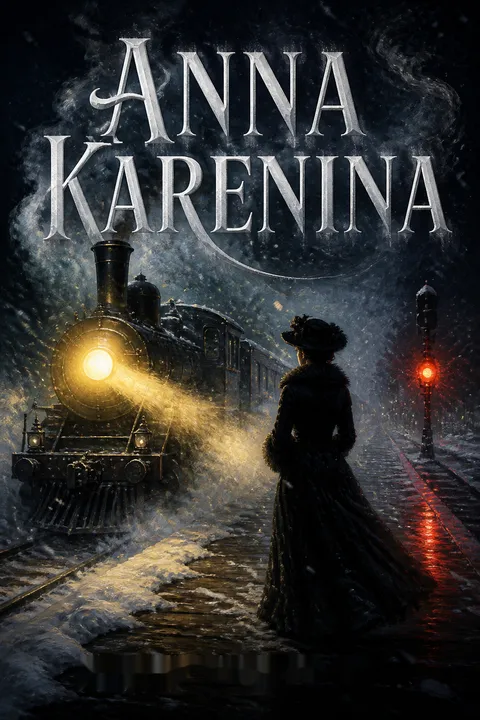
On a railway platform, amid crowds and the mechanical clatter she has associated with catastrophe since her first meeting with Vronsky,3 she decides to end her life and throws herself beneath a train. Her death is deliberate, following months in which jealousy, isolation, and morphine have narrowed her sense of what remains possible.
The railway motif, introduced with a worker's accidental death, returns as the machinery Anna chooses to make final. The opera scene matters because it transforms private transgression into public spectacle: Anna can no longer control how others name her, while she still believes she can control the meaning of her own ending. Her decision is not reducible to jealousy or to a single quarrel. It follows the collapse of several forms of belonging at once, including marriage, motherhood, friendship, and social identity. The train gives her a means of action, but not genuine freedom; it is the last choice available inside a life she experiences as closed.
Levin Finds His Measure
After Anna's1 death, Levin2 is shaken by the news and worries that Kitty4 will be distressed. Their baby, Mitya, has already made fatherhood a new source of fear and tenderness, while Levin's2 work and marriage continue without resolving his old questions.
He has tried to organize farming around cooperation with the peasants, but the arrangements remain imperfect and difficult to sustain. Alone, he realizes that no argument has erased death or guaranteed goodness. What changes is his willingness to live by the moral knowledge he already recognizes: care for others, honesty, and responsibility.
He understands that doubt may return and that he will still fail, yet his life no longer needs a grand theory to justify it. Kitty4 does not know of this inward change; Levin2 accepts that he must practice it in ordinary life.
Levin's ending does not offer a philosophical proof that cancels grief. Instead, it shifts the standard by which he judges a life. He has spent much of the novel demanding a system that makes work, society, and belief intellectually coherent; the answer arrives as a practical obligation to act well even without certainty. This is not a retreat from thought, since he remains aware of his contradictions, but a refusal to let unresolved questions excuse passivity. The contrast with Anna is not that one character thinks and the other feels. Both are acutely conscious of suffering; Levin finds a livable relation to it through daily responsibility.
Analysis
The novel's central design is a collision between private feeling and the systems that claim to organize it. Anna's1 desire is not condemned simply because it breaks a rule; the story shows how the rule's unequal enforcement, her husband's5 authority, her loss of access to Seryozha, and society's appetite for scandal shape the consequences. Vronsky's3 devotion is genuine, but his early confidence that love can define its own terms fails to account for Anna's1 social and maternal vulnerability. Karenin's5 procedural mind, meanwhile, is not devoid of feeling; it becomes cruel when he tries to make emotional life obey institutional form.
Levin's2 plot offers no uncomplicated alternative. Farming makes him confront the conflict between the landowner's interests and the worker's, while marriage teaches him that love creates practical obligations and recurring friction rather than permanent bliss. His search for faith moves through intellectual failure, grief, and the ordinary ethical demand to act well. The parallel stories resist a tidy moral verdict: Dolly's7 endurance is both loving and costly; Anna's1 longing is understandable and destructive; Levin's2 domestic happiness is real without becoming immunity from suffering.
Tolstoy's sharpest insight is that people often mistake a coherent account of life for life itself. Karenin5 tries to manage a marriage through decorum; Vronsky3 treats passion as a sufficient code; Kitty4 once mistakes charitable imitation for moral clarity; Levin2 seeks a system that will abolish uncertainty. Each is forced to confront facts that do not fit the preferred account. The novel locates moral change not in perfect consistency, but in the difficult work of recognizing another person's reality and accepting responsibility for what one's choices do to them.
Review Summary
Anna Karenina is widely praised as a masterpiece of literature, with readers appreciating Tolstoy's complex characters, psychological insights, and exploration of themes like love, marriage, and society. Many found the novel emotionally powerful and praised Tolstoy's writing style. Some readers struggled with the length and political discussions but still found the core story compelling. The book's exploration of women's roles in 19th century Russia resonated with many. Overall, most reviewers considered it a profound and influential work that left a lasting impact.
People Also Read









Characters
Anna Karenina
The divided society wifeAnna is a perceptive, socially gifted woman married to the senior official Alexey Karenin5 and devoted to her son, Seryozha. She reads other people with unusual sensitivity and can bring warmth into strained rooms, as she does when helping Dolly7. Yet she longs for a life that feels emotionally real, and her attraction to Vronsky3 tests the limits of the roles available to her. She wants love without deception, but also fears losing the child and social identity that anchor her. Her intelligence does not protect her from self-deception; it often helps her construct persuasive reasons for what her heart already wants.
Konstantin Levin
The searching country landownerLevin is an introspective landowner who distrusts empty social forms and wants work to have a clear, human purpose. His love for Kitty4 makes him vulnerable to humiliation because he idealizes her and judges himself harshly. On his estate he tests theories about farming against the actual habits and needs of peasants, while his brother Nikolay's9 suffering forces him to confront mortality. Levin's mind seeks certainty, but his life keeps teaching him through labour, intimacy, grief, and responsibility. His central struggle is not simply whether to believe, but how to act when thought cannot settle every question.
Alexey Vronsky
The admired cavalry officerVronsky is a wealthy, handsome officer accustomed to social success and to a code of conduct that prizes courage, loyalty to comrades, and personal honour. His attraction to Anna1 begins as a powerful private passion, but he does not initially understand the obligations it creates for her or for himself. He is capable of generosity and tenderness, yet he often assumes that his own intentions define a situation. His ambition, military identity, love of horses, and desire for independence all compete with his wish to build a life with Anna1.
Kitty Shcherbatskaya
The young hopeful daughterKitty is the youngest Shcherbatskaya daughter, raised amid family affection and the expectations surrounding a young woman's marriage. Her beauty and popularity make it easy for her to confuse a suitor's attention with commitment. She feels deeply, is quick to admire others, and can mistake imitation of virtue for virtue itself. Her tenderness toward children and her capacity to forgive reveal a more grounded strength than her early social confidence. Kitty wants love, but also searches for a meaningful identity beyond being chosen.
Alexey Karenin
The disciplined state officialKarenin is Anna's husband1, a senior official whose life is arranged around work, reputation, religion, and procedure. He is intelligent and conscientious within public institutions, but he has little practice interpreting intimate emotional needs. When his marriage is threatened, he initially treats the problem as one of decorum and authority. He is not simply cold: the sight of suffering can move him deeply, though his compassion often competes with pride and fear of public humiliation. His governing instinct is to make life orderly, even when human feeling refuses to fit his rules.
Stepan Oblonsky
The charming unfaithful brotherStepan, called Stiva, is Anna's brother1 and Dolly's husband7. His easy charm opens doors in both society and government, and his instinct is to smooth conflict rather than confront its causes. He is generous in small encounters, affectionate with children, and careless with money and fidelity. He does not experience his affair as a betrayal of his whole family, which lets him move quickly from remorse to ordinary pleasures. His warmth is real, but so is the burden his wife7 carries because he expects her warmth to absorb his mistakes.
Darya Oblonsky
The burdened family motherDolly is Stiva's wife6 and the mother of a large family. Her days are governed by children's needs, household shortages, illness, and her husband's6 unreliable support. She is practical, emotionally perceptive, and capable of deep loyalty, but repeated betrayals have made her less trusting and less hopeful. She tries to preserve the family because she loves her children and remembers loving Stiva6, not because she mistakes their marriage for an easy one. Dolly's care for others can be generous, though it often leaves little room for her own desires.
Sergey Koznishev
The polished public thinkerSergey is Levin's older half-brother2, a celebrated writer and advocate of public improvement. He argues fluently for education, local government, and the common good, and he approaches debate as an intellectual craft. Levin2 respects his intelligence but suspects that abstract concern does not always arise from lived attachment. Their disagreements expose the gap between ideas about the people and work alongside them. Sergey is not malicious; he represents a mode of reform that trusts institutions and coherent argument more than Levin2 can.
Nikolay Levin
The estranged elder brotherNikolay is Levin's older brother2, a proud and volatile man whose squandered inheritance, illness, and social isolation have estranged him from his family. He speaks passionately about the exploitation of workers and imagines cooperative forms of ownership, but his ideals are entangled with anger and self-defence. His relationship with Levin2 is marked by affection that neither man knows how to express without conflict. Nikolay's vulnerability reveals the costs of temperament, poverty, and failed ideals without reducing him to a moral lesson.
Varenka
The quiet charitable friendVarenka is a young Russian woman brought up by Madame Stahl and known for caring for invalids at a European spa. She is gentle, capable, and modest about her work, qualities that make her a powerful example to Kitty4. Her own history includes an interrupted love, but she does not define herself by it. Varenka's calm is not a complete answer to Kitty's4 questions; her presence instead offers a lived alternative to the marriage-market anxieties that have consumed Kitty4.
Countess Lidia Ivanovna
Karenin's pious confidanteCountess Lidia Ivanovna is a prominent Petersburg society woman and Karenin's5 confidante. She organizes charitable and religious causes and sincerely believes that faith can govern private life. Her influence grows when Karenin5 becomes isolated, but her certainty can harden into control: she decides what is spiritually safe for him and for Seryozha. Lidia's compassion is real, yet she is more comfortable with moral categories than with the disorder of people whose needs conflict.
Princess Betsy Tverskoy
The fashionable social brokerBetsy is Anna's cousin1 and a leading hostess in the fashionable Petersburg world. She understands how reputations are managed and makes room for people whose private lives would be judged elsewhere. Her salon gives Anna1 and Vronsky3 opportunities to meet, while Betsy treats their connection as exciting social material. She is neither a simple villain nor a true guardian: she values charm, access, and social ease more than the consequences that those freedoms impose on others.
Prince Shcherbatsky
Kitty's bluntly loving fatherThe old prince is Kitty's affectionate, outspoken father4 and the counterweight to his wife's14 matchmaking anxiety. He distrusts polished young men and prefers steadiness and character to rank. His jokes can wound, but he is quick to soften when he sees that he has hurt his daughters. His attention to Kitty4 is protective without being entirely controlling, and his warmth gives Levin2 a glimpse of the family life he longs for.
Princess Shcherbatskaya
The anxious marriage-minded motherKitty's mother4 wants her daughter4 to make a brilliant and secure match, and she sees Vronsky's3 wealth and rank as assurances of a bright future. Her anxiety reflects the limited choices available to women of her class, but it can make her misread courtship and overlook character. She loves Kitty4 and worries constantly about her prospects, even when her practical ambition increases Kitty's4 pressure.
Marya Nikolaevna
Nikolay's loyal companionMarya Nikolaevna lives with Nikolay9 and cares for him despite his illness, drinking, and volatile moods. She is plainspoken and protective, and she can calm him when his brothers cannot. Her loyalty gives Levin2 a glimpse of the intimate, imperfect world Nikolay9 has built outside respectable society.
Nikolay Sviazhsky
The capable district marshalSviazhsky is an educated landowner and local official whom Levin2 visits to discuss agriculture. His opinions are liberal and polished, but his practical life does not always align with his principles. He can converse gracefully across subjects and prefers arguments that remain within familiar intellectual boundaries. Levin2 is drawn to him and frustrated by him, sensing that his confidence rests on assumptions he does not care to examine.
Katavasov
The teasing science professorKatavasov is Levin's university friend2 and a professor of natural science. He is sociable, irreverent, and fond of exposing what he sees as Levin's2 self-deception. His scientific outlook offers a counterpoint to Levin's2 spiritual and agricultural questions, while his jokes keep serious conversations from becoming solemn. He is a friend, not a guide, and his confidence in material explanations does not settle Levin's2 unease.
Vassenka Veslovsky
The charming young visitorVeslovsky is a well-connected young man who visits the Levins2 and quickly becomes a source of tension. He is cheerful, sociable, and physically at ease, with an instinctive ease around women that Levin2 finds hard to read. His manners are not overtly malicious, but his attentions expose Levin's2 insecurity and Kitty's4 difficulty in navigating social expectations.
Princess Varvara
Anna's dependent companionPrincess Varvara is a relative who attaches herself to Anna1 and Vronsky's3 household after losing her place in respectable society. She is socially convenient company, but her dependence and lack of standing make her an awkward presence. Anna1 accepts her partly because she offers a companion without demanding moral explanations.
Golenishtchev
The exiled Russian intellectualGolenishtchev is a former schoolmate of Vronsky3, living abroad and working on a book about Russian culture. He presents himself as a serious intellectual and speaks passionately about art and public ideas. His theories interest Vronsky3 briefly, but his irritability and narrow certainties complicate the cultivated persona he projects.
Plot Devices
The railway
Motion toward catastropheRailways repeatedly bring characters into contact and make private choices feel caught in a larger, impersonal movement. Anna1 first encounters Vronsky3 at a station where a worker is killed, an event she takes as an omen. Later the railway returns at the end of her story as the means of her suicide. The device links modern speed and social mobility to the characters' inability to stop consequences once they are in motion.
Marriage law and reputation
A domestic trapThe legal and social conditions surrounding marriage shape what Anna1, Karenin5, and Vronsky3 can do. Karenin5 can refuse divorce, retain Seryozha, and insist on public propriety, while Anna1 must live without a recognized place as wife or mother. Society's judgments also determine who will receive her and who will not. This device turns intimate feeling into questions of property, legitimacy, child custody, and public standing.
The estate and the fields
Work made visibleLevin's2 estate grounds his philosophical questions in specific labour: mowing, planting, managing cattle, bargaining over hay, and negotiating with peasants. His experiments with cooperative farming expose the gap between landowners' plans and workers' own habits and interests. The fields are not an escape from society; they make the relations of class and work impossible to treat as abstractions.
Parallel households
Two marriages, contrasting termsThe Oblonsky6, Karenin5, and Levin2 households let the novel test different forms of marriage and domestic life. Dolly7 and Stiva6 preserve a family under the pressure of betrayal; Anna1 and Karenin5 remain legally joined while emotionally estranged; Levin2 and Kitty4 discover that love does not remove ordinary work or conflict. Their parallel experiences complicate any simple division between respectable marriage and romantic passion.
Death and spiritual doubt
The unanswered questionThe death of a railway worker, Nikolay's9 decline, and the birth of Levin2 and Kitty's4 child keep mortality close to the characters' daily lives. Levin2 tries to solve the problem through reason, agricultural theory, and philosophy, while Kitty4 responds through care and religious practice. The recurring pressure of death eventually forces Levin2 to ask whether a life can be morally meaningful without certainty.
FAQ
Synopsis & Basic Details
What is Anna Karenina about?
- Tragic love and societal pressures: Anna Karenina explores the destructive power of passionate love when it clashes with the rigid social conventions of 19th-century Russia. It follows the story of Anna, a married woman, who embarks on an affair with a dashing officer, Count Vronsky, and the devastating consequences that follow.
- Parallel stories of love and life: The novel also intertwines the story of Konstantin Levin, a landowner searching for meaning in life, love, and family. His journey contrasts with Anna's, highlighting different paths to happiness and fulfillment.
- Exploration of Russian society: Through these characters, Tolstoy provides a panoramic view of Russian society, examining themes of family, marriage, adultery, social class, and the search for personal and spiritual truth.
Why should I read Anna Karenina?
- Complex characters and relationships: Tolstoy masterfully crafts characters with deep psychological complexity, whose motivations and actions are both compelling and relatable. The novel explores the nuances of human relationships, from passionate love to familial duty.
- Profound themes and insights: The novel delves into timeless themes of love, morality, social expectations, and the search for meaning, offering profound insights into the human condition. It raises questions about the nature of happiness, the consequences of choices, and the individual's place in society.
- Rich historical and cultural context: Set in 19th-century Russia, the novel provides a vivid portrayal of the social, political, and cultural landscape of the time. It offers a glimpse into the lives of the Russian aristocracy and peasantry, and the societal pressures that shaped their experiences.
What is the background of Anna Karenina?
- 19th-century Russia: The novel is set against the backdrop of 19th-century Russia, a time of social and political change. The aristocracy, with its rigid social codes and expectations, is a central focus, as are the lives of the peasantry and the emerging middle class.
- Social and political context: The novel reflects the social and political issues of the time, including the debate over serfdom, the role of women in society, and the influence of Western ideas on Russian culture. These issues provide a rich context for the characters' personal struggles and choices.
- Cultural and intellectual influences: Tolstoy's work is influenced by the intellectual and philosophical currents of his time, including realism, existentialism, and the search for spiritual truth. These influences are reflected in the novel's exploration of human nature and the meaning of life.
What are the most memorable quotes in Anna Karenina?
- "Happy families are all alike; every unhappy family is unhappy in its own way.": This opening line encapsulates the novel's exploration of the complexities of family life and the unique nature of individual suffering. It sets the stage for the contrasting stories of the Oblonskys and the Karenins.
- "If you love me, as you say, do so that I may be at peace.": This quote reveals Anna's desperate desire for stability and acceptance in her relationship with Vronsky. It highlights her internal conflict and her yearning for a love that can provide her with peace.
- "It's not love. I've been in love, but it's not that. It's not my feeling, but a sort of force outside me has taken possession of me.": This quote captures Levin's intense and overwhelming feelings for Kitty, highlighting the powerful and often irrational nature of love. It also reflects his struggle to understand his own emotions and their impact on his life.
What writing style, narrative choices, and literary techniques does Leo Tolstoy use?
- Realism and psychological depth: Tolstoy's writing is characterized by its realism and its deep exploration of the characters' inner lives. He uses detailed descriptions and interior monologues to reveal their thoughts, feelings, and motivations, creating a sense of psychological depth and complexity.
- Multiple perspectives and narrative shifts: The novel employs multiple points of view, shifting between the perspectives of Anna, Levin, and other characters. This technique allows Tolstoy to explore different facets of the story and to provide a more comprehensive view of the social and emotional landscape.
- Symbolism and motifs: Tolstoy uses recurring symbols and motifs, such as trains, horses, and the color red, to enhance the novel's themes and to foreshadow future events. These elements add layers of meaning to the narrative and contribute to its overall richness and complexity.
Hidden Details & Subtle Connections
What are some minor details that add significant meaning?
- The broken paper-knife: Early in the novel, Anna plays with a paper-knife, a seemingly insignificant detail. Later, this same paper-knife is clutched in her hands as she grapples with her emotions, symbolizing her internal turmoil and the sharp edges of her situation.
- The red bag: Anna's red bag, which she carries with her, becomes a recurring symbol of her passionate nature and her desire for freedom. It is present at key moments in her story, such as her first meeting with Vronsky and her final moments at the train station.
- The music of the decanter-women: Stepan Arkadyevitch's dream of decanter-women singing "Il mio tesoro" foreshadows the seductive and ultimately destructive nature of his desires. The music, initially delightful, becomes a symbol of his inability to find true happiness.
What are some subtle foreshadowing and callbacks?
- The crushed railway worker: The accidental death of a railway worker at the beginning of the novel foreshadows Anna's tragic end. The incident, initially presented as a minor event, becomes a chilling reminder of the destructive forces at play in the story.
- Levin's dream of a peasant: Levin's dream of a peasant who is both repulsive and familiar foreshadows his later spiritual awakening. The dream, initially unsettling, becomes a symbol of his connection to the land and the simple truths he seeks.
- The mention of "come round": Matvey's phrase "she will come round" when referring to Dolly's anger becomes a recurring motif, highlighting the cyclical nature of relationships and the possibility of reconciliation, even in the face of conflict.
What are some unexpected character connections?
- Levin and Vronsky: Despite their vastly different backgrounds and values, Levin and Vronsky share a common thread of passion and a desire for authenticity. Their brief encounter at the skating rink reveals a mutual respect and a sense of shared humanity, despite their rivalry for Kitty's affection.
- Anna and Dolly: Though their lives take different paths, Anna and Dolly share a deep bond as sisters-in-law. Their conversations reveal a mutual understanding of the challenges and complexities of marriage and motherhood, highlighting the shared experiences of women in 19th-century Russia.
- Stepan Arkadyevitch and Levin: Despite their contrasting personalities and lifestyles, Stepan and Levin share a genuine friendship. Their conversations reveal a mutual respect and a sense of shared humanity, despite their differing views on life and society.
Who are the most significant supporting characters?
- Darya Alexandrovna (Dolly) Oblonskaya: As Stepan's wife, Dolly provides a counterpoint to Anna's passionate nature. Her struggles with infidelity and family life highlight the challenges faced by women in 19th-century Russia. She serves as a voice of reason and compassion, offering a grounded perspective on the novel's exploration of love and marriage.
- Sergey Ivanovitch Koznishev: Levin's intellectual half-brother, Sergey, represents the world of ideas and public service. His conversations with Levin highlight the tension between intellectual pursuits and practical concerns, and his involvement in the Slavonic movement reflects the political and social issues of the time.
- Princess Betsy Tverskoy: A fashionable socialite and Anna's cousin, Betsy embodies the superficiality and hypocrisy of Petersburg society. Her interactions with Anna reveal the social pressures and expectations that contribute to Anna's tragic fate.
Psychological, Emotional, & Relational Analysis
What are some unspoken motivations of the characters?
- Anna's desire for freedom: Beneath her passionate love for Vronsky, Anna yearns for freedom from the constraints of her marriage and societal expectations. Her actions are driven by a desire to live authentically and to experience love without the limitations imposed on her.
- Levin's search for meaning: Levin's immersion in rural life and his intellectual pursuits are driven by a deep-seated desire to find meaning and purpose in a world that often seems chaotic and meaningless. His actions are motivated by a longing for authenticity and a connection to something larger than himself.
- Karenin's need for control: Karenin's rigid adherence to social norms and his desire to maintain control over his life and his family stem from a deep-seated fear of vulnerability and a need to preserve his public image. His actions are driven by a desire to maintain order and to avoid any hint of scandal.
What psychological complexities do the characters exhibit?
- Anna's self-destructive tendencies: Anna's passionate nature and her inability to reconcile her desires with societal expectations lead her down a path of self-destruction. Her internal conflict and her growing sense of despair contribute to her tragic fate.
- Levin's intellectual and emotional struggles: Levin's intellectual curiosity and his deep-seated emotional needs often clash, leading to internal conflict and a sense of dissatisfaction. His journey is marked by a constant struggle to reconcile his reason with his emotions and his spiritual beliefs.
- Vronsky's internal conflict: Vronsky's desire for love and his ambition for social success create an internal conflict that he struggles to resolve. His actions are often driven by a need to maintain his social standing and to avoid any hint of weakness or vulnerability.
What are the major emotional turning points?
- Anna's confession to Karenin: Anna's confession to her husband marks a turning point in her life, as it forces her to confront the consequences of her actions and to acknowledge the impossibility of her situation. This moment sets the stage for her descent into despair and her eventual tragic end.
- Levin's experience mowing with the peasants: Levin's experience mowing with the peasants marks a turning point in his spiritual journey, as he finds a sense of peace and connection to the land. This experience leads him to question his previous assumptions about life and to seek a more authentic path.
- Vronsky's realization of Anna's despair: Vronsky's realization of Anna's despair and her fear of death marks a turning point in his understanding of their relationship. He is forced to confront the consequences of his actions and to acknowledge the depth of her suffering.
How do relationship dynamics evolve?
- Anna and Vronsky's relationship: Their relationship evolves from passionate love to a complex web of dependence, jealousy, and resentment. The initial intensity of their feelings is gradually replaced by a sense of entrapment and a growing awareness of the impossibility of their situation.
- Levin and Kitty's relationship: Their relationship evolves from a tentative courtship to a deep and enduring love. They learn to navigate the challenges of marriage and parenthood, finding strength and solace in their shared experiences and mutual understanding.
- Stepan and Dolly's relationship: Their relationship evolves from a state of turmoil and infidelity to a fragile reconciliation. They learn to coexist, but their relationship is marked by a sense of resignation and a lack of genuine intimacy.
Interpretation & Debate
Which parts of the story remain ambiguous or open-ended?
- Anna's motivations: While the novel provides insight into Anna's thoughts and feelings, her motivations remain complex and open to interpretation. Her actions are driven by a combination of passion, despair, and a desire for freedom, but the precise nature of her inner turmoil remains ambiguous.
- Levin's spiritual journey: Levin's spiritual awakening is presented as a personal and subjective experience, leaving the reader to question the nature of his faith and its implications for his life. The novel does not offer a definitive answer to his existential questions, but rather presents a complex and nuanced exploration of his search for meaning.
- The ending: The novel's ending, with Anna's tragic death and Levin's newfound peace, leaves the reader to ponder the ultimate meaning of their lives and the consequences of their choices. The open-ended nature of the conclusion invites multiple interpretations and encourages reflection on the novel's central themes.
What are some debatable, controversial scenes or moments in Anna Karenina?
- Anna's adultery: Anna's affair with Vronsky is a central point of controversy, raising questions about morality, fidelity, and the nature of love. Readers often debate whether Anna is a victim of societal constraints or a flawed individual who makes destructive choices.
- Karenin's forgiveness: Karenin's decision to forgive Anna is a complex and controversial moment, raising questions about the nature of forgiveness, religious piety, and the limits of human compassion. Some readers see his actions as a sign of genuine magnanimity, while others view them as a form of self-serving control.
- Levin's views on society and progress: Levin's criticisms of modern society and his embrace of traditional values are often debated, raising questions about the nature of progress, the role of the individual in society, and the value of tradition. His views are often seen as a reflection of Tolstoy's own conservative beliefs.
Anna Karenina Ending Explained: How It Ends & What It Means
- Anna's suicide: Anna's suicide is a tragic culmination of her internal struggles and the societal pressures she faced. It is an act of despair and a final attempt to escape the impossible situation in which she finds herself. Her death serves as a powerful commentary on the destructive nature of passion and the limitations imposed on women in 19th-century Russia.
- Levin's spiritual awakening: In contrast to Anna's tragic end, Levin's spiritual awakening offers a glimmer of hope and a path towards personal fulfillment. His newfound faith and his commitment to family and rural life suggest that meaning and purpose can be found in simple, authentic experiences.
- The contrast between Anna and Levin: The contrasting fates of Anna and Levin highlight the different paths available to individuals in the face of life's challenges. Anna's story serves as a cautionary tale about the dangers of defying societal norms, while Levin's journey offers a more optimistic vision of personal growth and spiritual fulfillment.
About the Author
Other books by Leo Tolstoy






Download PDF
Download EPUB
.epub digital book format is ideal for reading ebooks on phones, tablets, and e-readers.








