

Key Takeaways
Build markets for Green Swans, not merely greener business as usual.
Aim for system-wide gains. Elkington uses Green Swan for a major market transformation that produces fast, reinforcing progress in economic, social, and environmental well-being. It may emerge from a crisis, a shift in public values, new policy, or a breakthrough technology, and it usually requires deliberate preparation rather than arriving as a surprise. Solar and wind power illustrate the possibility: technologies once treated as marginal became increasingly competitive and reshaped energy markets.
Expect mixed consequences. Electric vehicles can reduce emissions, yet their batteries rely on materials such as cobalt, much of it sourced from the Democratic Republic of Congo under troubling conditions. A genuine breakthrough must therefore be judged across its full chain of effects, not by one impressive metric. The goal is not simply to do less harm, but to restore the systems on which economies and societies depend.
What's powerful about this definition is that it makes success a property of the system, not a company’s branding. It also resists the comforting idea that a promising technology is automatically good: benefits and burdens can land in different places. That is a useful corrective to innovation culture, which often celebrates adoption before tracing supply chains or asking who gains. The demanding part is measurement. Economic, social, and ecological outcomes unfold on different timelines, so a single score can conceal trade-offs rather than resolve them.
Map wicked problems across sectors before treating symptoms one company at a time.
Problems interlock. A wicked problem is difficult to define and has no final, uncontested solution. Its causes and consequences connect to other problems, so an intervention may help one group while worsening conditions elsewhere. Elkington illustrates this with five challenges: plastic pollution, unhealthy diets, antibiotic resistance, climate disruption, and orbital debris. Plastic, for example, moves from short-lived packaging into waterways, fragments into microplastics, and intersects with waste systems, consumer habits, and ocean health.
Super wicked adds urgency. These problems become especially hard when time is short, no central authority can coordinate a response, the people trying to fix the issue also contribute to it, and current decisions undervalue future generations. The book’s point is practical: conventional plans designed for tidy, isolated problems will miss feedback loops and may make the underlying situation worse.
This systems view helps explain why good intentions can produce disappointing results. A local fix may shift a cost to another community, industry, or generation, while leaving the incentives that created the problem intact. It also suggests a useful discipline: before choosing a solution, identify who has power, who bears the costs, and where feedback might reverse the intended effect. The framing should not become an excuse for paralysis. Wickedness makes perfect solutions unlikely, but it does not erase the value of measurable improvements and ongoing revision.
Count damage outside the ledger before calling a company profitable.
Accounting can hide costs. Elkington coined the triple bottom line to push companies to examine economic, social, and environmental effects, rather than financial results alone. He later warned that the idea could become a reassuring reporting ritual if firms tracked multiple impacts but continued prioritizing financial targets. PUMA’s early Environmental Profit and Loss analysis put this tension in numbers: its supply-chain environmental impacts were valued at €145 million, compared with net earnings of €202.2 million. About 85 percent of those impacts arose beyond the company’s direct operations and immediate suppliers.
Look past the factory gate. The example shows why a company’s own facilities can be a poor proxy for its total footprint. It also clarifies why impact measures matter only when they change decisions, incentives, and prices. The triple bottom line is useful as a prompt, Elkington argues, but not as proof that a business is sustainable or that its surrounding market is changing.
The underlying accounting problem is a boundary problem: what gets counted depends on where an organization draws its perimeter. Supply-chain analysis expands that perimeter, while impact valuation tries to make hidden costs legible to decision-makers. But pricing an impact does not automatically repair it, and monetary estimates can create false precision around harms that are difficult to compare. The strongest use of these tools is diagnostic. They can reveal where responsibility sits and expose false profitability, but accountability still requires rules and consequences.
Judge success by system value, not a firm's isolated scorecard.
Put business in context. The Future-Fit approach begins from a simple dependency: companies need healthy societies, and societies depend on functioning natural systems. System value means evaluating business activity within these connected conditions instead of treating social, environmental, and financial performance as separate boxes. Its practical starting point is an extra-financial break-even point, where a company’s harmful impacts are balanced by positive ones. Reaching that point is only the beginning; the ambition is to contribute to restoration.
Novo Nordisk offers a case. The Danish health company adopted the triple bottom line and, under CEO Lars Rebien Sørensen, framed curing diabetes as a purpose worth pursuing even if it undermined the company’s existing market. Its foundation ownership supported a longer-term outlook. This example makes the framework concrete: a business can define value around meeting a social need, while still recognizing that survival requires financial viability.
The nested-systems idea is stronger than a simple balance among three equally weighted goals. It recognizes that economic activity cannot persist if the social and ecological foundations beneath it fail. Novo Nordisk also makes purpose more demanding than a mission statement: it asks whether the organization would accept success even when success disrupts its current revenue model. Still, good intentions and a long-term owner do not guarantee broad system change. A company’s purpose matters most when governance, investment, and public rules reinforce it.
Move from corporate responsibility toward resilience, then regeneration.
Progress has stages. Elkington describes organizational change as a movement from denying emerging evidence, to accepting responsibility, copying promising practices, preparing for disruption, and finally restoring the systems business depends on. The path is not linear, and many firms stop at the point where they can report responsible conduct. But responsibility alone cannot protect a company or community from cascading shocks.
Efficiency can create fragility. The 2011 floods in Thailand disrupted factories supplying car and electronics makers around the world. Lean, tightly coupled supply chains had little slack, so damage in one place interrupted production far away. Resilience requires the capacity to absorb shocks and adapt, which may mean preserving diversity, redundancy, and room to respond. Regeneration goes further: it aims to repair and renew natural and social systems, rather than merely making operations less damaging.
This progression is useful because it separates ethical intent from systemic capacity. Responsibility asks whether harm is acknowledged; resilience asks whether the organization can survive disruption; regeneration asks whether it helps replenish what its operations rely on. The supply-chain example shows why efficiency is not an unconditional virtue. Yet slack and redundancy have costs, and firms facing short-term competition may resist paying them. Public standards and coordinated purchasing can make resilience less of a private penalty and more of a shared operating norm.
Protect odd early innovations from neglect and reckless scaling.
Early signals look strange. Elkington calls an embryonic idea, technology, or venture an Ugly Duckling because its future direction is hard to judge. It may become a regenerative breakthrough or a source of new harm. The danger is two-sided: society can starve useful experiments because they appear impractical, or scale a technology before understanding its consequences.
Innovation needs scrutiny. Chemist Thomas Midgley Jr. developed leaded gasoline and early CFCs, technologies that solved immediate problems but caused serious wider damage. The story warns against assuming that technical ingenuity equals social progress. Elkington points to the former US Office of Technology Assessment, which conducted hundreds of studies on emerging technologies, as a model for stronger public foresight. He also urges leaders to look beyond incremental improvement and consider technologies capable of producing much larger changes.
The challenge is not to predict every consequence, an impossible standard, but to build institutions that notice risks early and update decisions as evidence arrives. Midgley’s innovations show how expertise can be narrow: a product may perform exactly as intended while creating harm outside the inventor’s frame. Public assessment, testing, and monitoring can widen that frame. But oversight can also become a gatekeeping tool that protects incumbents, so governance needs transparency, independent scrutiny, and room for responsible experimentation.
Use public policy and private investment to make better markets viable.
Scale needs coordination. Individual companies can test what is possible, but systemic problems cannot be solved by isolated firms alone. Elkington highlights initiatives such as RE100, which brings companies together around renewable electricity commitments and helps build demand for clean power. Shared targets can encourage suppliers and investors to move, while reducing the risk that early adopters act alone.
Rules shape returns. Norway’s electric-vehicle uptake illustrates how policy can alter the economics of a choice through purchase tax breaks and practical benefits. Elkington argues that businesses should also use their political influence to support stronger rules, rather than publicly endorsing sustainability while lobbying against it. Large public missions, including the European Union’s Green Deal, can direct investment and innovation toward shared goals. Market change depends on both entrepreneurial action and governments that set incentives and enforce standards.
The book’s central institutional insight is that markets are designed, not natural weather systems. Procurement, regulation, subsidies, and public infrastructure can reduce the risks of investing in new solutions and make the costs of pollution harder to ignore. This connects private initiative to public capacity without pretending either sector can act alone. A real tension remains: governments can misallocate resources, while companies can capture policy for their own advantage. Democratic oversight and public accountability are therefore part of market design, not optional additions.
Reinvent capitalism and democracy together, because neither works alone.
The systems are linked. Elkington argues that capitalism depends on functioning societies and political institutions, while democracy needs an economy that does not concentrate wealth and power beyond public accountability. He challenges the idea that business purpose should be reduced to profit within existing rules, especially when governments fail to update or enforce those rules. The book’s remedy is not to hand political choices to corporations, but to coordinate business, government, and civil society around clear missions.
Think beyond the quarter. The author contrasts short-term financial measures with longer horizons that include future generations and ecological limits. Green New Deal proposals represent one attempt to combine climate action, investment, and social needs. The specific policies may be contested, but the broader principle is that economic transformation requires political legitimacy, public direction, and private innovation working together.
This is a valuable correction to both anti-business and business-saves-the-world narratives. Companies control substantial resources and can innovate quickly, but they lack the democratic mandate to decide whose needs should take priority. Public institutions can define collective goals, yet often struggle to sustain long-term action across electoral cycles. The design question is how to align those different strengths while limiting capture and ensuring affected communities have voice. Treating democracy as infrastructure for economic transition makes political participation central to sustainability.
Lead exponentially while confronting hard facts, not selling easy optimism.
Pair possibility with realism. Elkington’s final leadership message combines bold imagination with disciplined attention to danger. He draws on the Stockdale Paradox: maintain commitment to a better outcome while refusing to deny present constraints. Exponential leaders need to imagine futures, experiment with ideas, understand technology, and judge its human consequences. That mix matters because technological change can accelerate benefits and damage alike.
Give breakthroughs a destination. The book closes with a Stanford proposal to move 143 countries toward fully renewable energy by 2050. Its projected investment is $73 trillion, a scale that sounds implausible if judged by current habits, but the proposal offers one pathway rather than a guaranteed forecast. Elkington’s point is to make ambitious options visible, then build the policies, capital, and cooperation needed to test and scale them.
The combination of optimism and clear-eyed risk is more intellectually honest than either techno-utopian confidence or fatalism. It gives leaders permission to pursue ambitious goals without treating projections as promises. The four leadership capacities also broaden the job description: foresight without ethics can become reckless, while ethical concern without technical understanding can remain symbolic. The test is institutional follow-through. A compelling vision earns credibility only when milestones, accountability, and learning mechanisms make it possible to change course as results emerge.
Analysis
Green Swans is a sustainability argument told through the author’s long engagement with business, not a neutral forecast or a detailed policy manual. Its central move is to shift the unit of analysis from the responsible company to the market and political systems that shape corporate conduct. This explains the book’s unusual combination of personal anecdotes, corporate case studies, ecological warnings, and proposed tools. The recalled triple bottom line becomes a narrative hinge: it was influential, yet too easy to convert into a reporting exercise that left the underlying incentives intact.
The Swan vocabulary is memorable because it makes divergent trajectories imaginable. It also carries a risk: “Green” can sound like a label of virtue, though the book itself emphasizes unintended harm, uneven costs, and technologies that change character as they scale. The distinction works best as a prompt for investigation, not as a reliable classification system. Solar power or electric mobility cannot be judged by their headline benefits alone; supply chains, distributional effects, and total system impacts matter.
The strongest practical insight is institutional. Firms can pioneer, but collective outcomes depend on policy, capital allocation, and public legitimacy. The Future-Fit approach gives organizations a destination and a way to examine impacts beyond financial accounts, while the book also admits the difficulty of comparable data and broad adoption. That tension is productive: frameworks can orient action, but they cannot substitute for enforcement or political choice.
The argument is hopeful without promising a painless transition. Regenerative change can strand assets, disrupt livelihoods, and provoke resistance. A serious implementation therefore needs not only innovation and ambitious targets, but also transparent decisions about who bears transition costs and who shares new value. Green Swan thinking is most useful when optimism becomes a testable strategy, grounded in evidence, public accountability, and continual correction.
Review Summary
Green Swans receives mostly positive reviews for its thought-provoking ideas on sustainable business practices and regenerative capitalism. Readers appreciate Elkington's expertise and insights into corporate responsibility. Some praise the book's readability and inspiring concepts, while others find it repetitive or lacking cohesion. Critics note the author's tendency to name-drop and question the audience's clarity. Overall, reviewers value the book's exploration of economic transformation and sustainability, though opinions vary on its effectiveness in conveying these ideas.
People Also Read







Glossary
Green Swan
Regenerative market transformationA major market shift that generates rapid progress in economic, social, and environmental well-being. It is generally shaped by a mix of crises, changing values, policy, technologies, and business models. Green Swans are usually pursued deliberately, and their effects must be assessed across all three dimensions because a promising solution can also create new harms.
Ugly Duckling
Early-stage uncertain innovationAn early concept, technology, mindset, or venture whose eventual effects are difficult to predict. It may develop into a regenerative breakthrough or into a source of serious harm. Because its potential is unclear at first, it can receive too little support or scale without enough scrutiny.
Black Swan
High-impact disruptive eventIn Elkington’s adapted usage, a disruptive event or trajectory that causes severe, often degenerative effects and may be difficult to anticipate before its consequences become clear. The term includes events that shock people and destabilize interconnected systems, even when some warnings existed beforehand.
Gray Swan
Anticipatable major riskA major risk that can be anticipated to some degree, even if its full effects remain difficult to understand or manage. The concept highlights threats that are visible enough to prepare for but are often ignored until their consequences become disruptive.
wicked problem
Interconnected, hard-to-solve challengeA problem that is difficult to define, has multiple plausible explanations, and lacks a single final solution. Its causes and effects connect with other problems, and interventions can create unintended consequences. Climate change, plastic pollution, and antibiotic resistance are examples discussed in the book.
super wicked problem
Urgent systemic challengeA particularly difficult wicked problem marked by four conditions: time is running out, no central authority can direct a complete response, the actors seeking solutions also contribute to the problem, and current policies undervalue future consequences. Climate change is presented as a leading example.
triple bottom line
Three-part impact frameworkA management framework coined by Elkington to examine a company’s economic, social, and environmental value creation or destruction. It was intended to challenge financial-only accounting and prompt deeper change in business thinking. The book cautions that it can be reduced to a reporting device unless it influences strategy and system-wide incentives.
Future-Fit Business Benchmark
System-oriented business assessmentA framework that translates sustainability principles into business goals and practical guidance. It asks companies to assess whether their activities undermine social and ecological systems, and defines an extra-financial break-even point where negative impacts are balanced by positive ones. The longer-term ambition is to move beyond balance toward restorative contributions.
Breakthrough Compass
Impact and scale mapA framework developed by Volans and PA Consulting that maps business outcomes along two dimensions: whether their impact is negative or positive, and whether change is incremental or exponential. It distinguishes breakdown trajectories from breakthrough opportunities, helping identify where innovations may create broad benefits or widespread harm.
FAQ
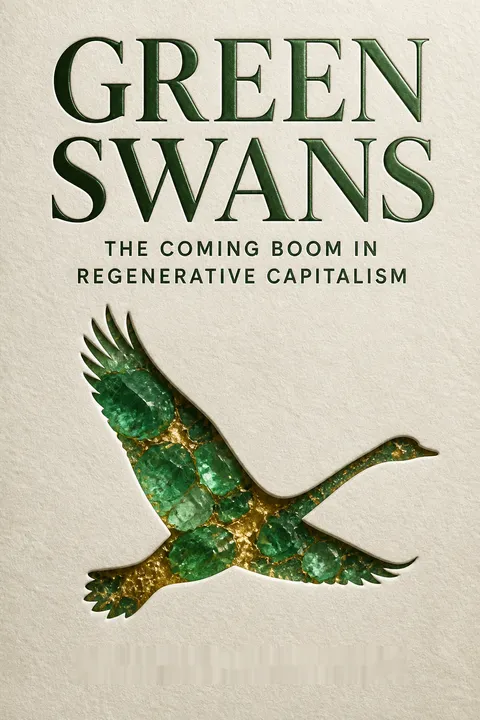
What's Green Swans: The Coming Boom In Regenerative Capitalism about?
- Regenerative Capitalism Focus: The book by John Elkington explores transforming capitalism into a system that benefits society and the environment. It argues that current practices are unsustainable and need evolution to tackle global challenges.
- Green Swans Concept: Elkington introduces "Green Swans" as positive, systemic solutions to global challenges, contrasting them with "Black Swans," which are unpredictable negative events.
- Call to Action: The author urges business leaders and policymakers to adopt innovative solutions for exponential sustainability progress, shifting from profit-driven models to those prioritizing system value.
Why should I read Green Swans: The Coming Boom In Regenerative Capitalism?
- Insightful Perspectives: The book synthesizes ideas from sustainability thought leaders, offering valuable insights into capitalism's future. Elkington's experience adds depth to the discussion.
- Practical Frameworks: It provides actionable frameworks like the "triple bottom line" and "system value," helping organizations navigate sustainability complexities.
- Urgent Relevance: Addressing climate crisis and social inequalities, the book is critical for business leaders, investors, and policymakers aiming for meaningful organizational and community impact.
What are the key takeaways of Green Swans: The Coming Boom In Regenerative Capitalism?
- Transformative Change Needed: Capitalism must be restructured to become regenerative and sustainable, or society will face dire consequences.
- Emergence of Green Swans: Identifying and nurturing Green Swans—innovative solutions for positive change—is crucial, often arising in response to Black Swan challenges.
- System Value Over Shareholder Value: A shift from prioritizing shareholder value to focusing on system value is essential for long-term success and sustainability.
What is the concept of Green Swans in Green Swans: The Coming Boom In Regenerative Capitalism?
- Definition of Green Swans: They are systemic solutions to global challenges, leveraging positive exponentials for economic, social, and environmental wealth creation.
- Contrast with Black Swans: Unlike unpredictable negative events, Green Swans are proactive and can be cultivated through innovation and collaboration.
- Examples of Green Swans: Renewable energy technologies and circular economy initiatives are discussed as models for businesses to adapt and thrive in a regenerative economy.
How does Green Swans: The Coming Boom In Regenerative Capitalism define the triple bottom line?
- Original Concept: Coined by Elkington, it evaluates a company's social, environmental, and economic performance, considering impacts on people, planet, and profit.
- Product Recall: Elkington suggests a "product recall" of the concept, needing re-engineering to integrate system value and regenerative practices.
- Future Fit: The updated triple bottom line should focus on creating integrated value supporting regeneration across economic, social, and environmental dimensions.
What is the "extra-financial break-even point" in Green Swans: The Coming Boom In Regenerative Capitalism?
- Definition: It is the point where a company's positive and negative impacts are balanced, extending beyond traditional financial metrics.
- Significance: Achieving this point is crucial for developing responsible and regenerative business strategies, shifting focus from avoiding losses to creating positive impacts.
- Implementation: Companies are encouraged to adopt extra-financial accounting practices, integrating ethical, social, and environmental considerations into decision-making.
How does Green Swans: The Coming Boom In Regenerative Capitalism define a "future-fit" company?
- Holistic Approach: A future-fit company integrates sustainability into core operations, balancing economic, social, and environmental goals.
- Key Characteristics: These companies deliver value to the world, act responsibly, and anticipate market opportunities, positioning themselves as sustainability leaders.
- Framework for Action: The book provides a framework for assessing current practices and identifying improvement areas, including setting clear sustainability goals.
What role does technology play in Green Swans: The Coming Boom In Regenerative Capitalism?
- Catalyst for Change: Technology is a crucial driver of change, creating innovative solutions for sustainability challenges.
- Disruptive Innovations: Technologies like AI and blockchain can transform industries and promote sustainability, optimizing operations and reducing environmental footprints.
- Ethical Considerations: The book highlights the ethical implications of emerging technologies, urging businesses to consider potential unintended consequences.
What are some examples of companies mentioned in Green Swans: The Coming Boom In Regenerative Capitalism?
- Novo Nordisk: Highlighted for its commitment to the triple bottom line and proactive sustainability approach, demonstrating responsible business practices.
- Tesla: A leader in the electric vehicle market, showcasing how technology innovation can drive sustainability and align with regenerative capitalism principles.
- Beyond Meat: Known for plant-based meat alternatives, addressing environmental impacts of traditional farming and exemplifying Green Swan solutions.
What are the best quotes from Green Swans: The Coming Boom In Regenerative Capitalism and what do they mean?
- “Capitalism is entering a new phase.”: Reflects the challenge to traditional models, suggesting businesses must adapt to survive in a changing world.
- “Miracles can be impossible within one paradigm, inevitable in the next.”: Highlights transformative change potential when new paradigms are embraced.
- “We are headed into a hellish world of systemic breakdowns.”: A stark warning about the urgency of addressing interconnected crises facing humanity.
How does Green Swans: The Coming Boom In Regenerative Capitalism address the concept of "wicked problems"?
- Definition of Wicked Problems: Complex issues difficult to define and solve, involving multiple stakeholders and conflicting interests.
- Examples of Wicked Problems: Climate change, plastic pollution, and social inequality are interconnected issues requiring systemic solutions.
- Call for Systemic Change: Addressing wicked problems necessitates a shift in business and government operations, advocating for a holistic approach.
What is the significance of the "three Rs" in Green Swans: The Coming Boom In Regenerative Capitalism?
- Responsibility, Resilience, Regeneration: Central to the book's vision for future-fit companies, emphasizing responsible actions, resilience, and system regeneration.
- Guiding Principles: Encourages companies to evaluate impacts and strive for continuous improvement, aligning practices with sustainability goals.
- Holistic Approach: Focusing on the three Rs helps create integrated strategies addressing economic, social, and environmental dimensions, fostering a regenerative economy.
Download PDF
Download EPUB
.epub digital book format is ideal for reading ebooks on phones, tablets, and e-readers.








