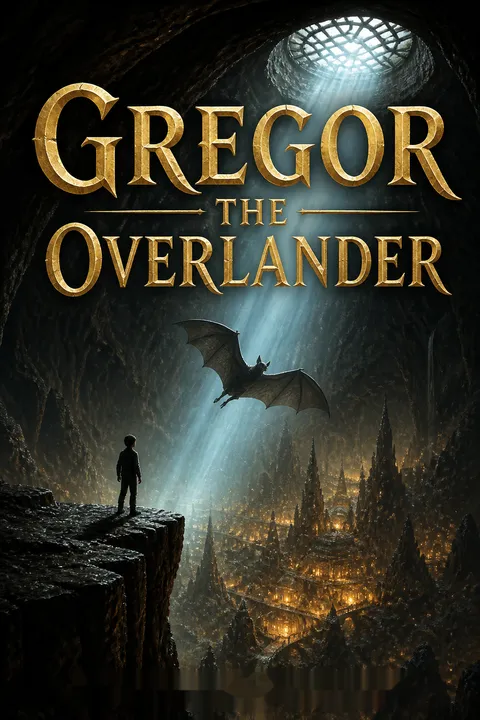


Plot Summary
The Laundry Room Fall
Eleven-year-old Gregor is spending a sweltering summer caring for his two-year-old sister, Boots, while their mother works. His father vanished years earlier, and Gregor has made a private rule against imagining a future that might never arrive. In the basement laundry room, Boots slips behind a dryer and disappears through an opening in the wall.
Gregor follows, plunging with her through darkness and mist. Their fall ends not in another part of the building but in a vast underground world. A cluster of enormous cockroaches gathers around Boots, captivated by the toddler, and mistakes the pair for human visitors from above. Gregor has no way back and no idea what waits beyond the tunnel.
The fall gives physical form to the rupture already shaping Gregor's life. He has been living in suspended time, caring for others while refusing to build expectations around his missing father. Following Boots is not a chosen adventure so much as an extension of his oldest habit: when she wanders into danger, he goes after her. The Underland makes that protective reflex costly. The domestic chores and the impossible descent occupy the same space, suggesting that responsibility, not grand ambition, is what carries Gregor across the threshold.
A Stadium of Bats
The cockroaches carry Gregor and Boots through winding tunnels to a cavern stadium, where giant bats circle above a crowd of pale, violet-eyed people. Boots dashes after a ball, and a girl riding a golden bat swoops down to retrieve it. The girl is Luxa, a young queen who tests Boots for the ball and is promptly outsmarted when the toddler pokes her in the eye.
An older man, Vikus, intervenes before Luxa and Gregor can turn their first meeting into a contest of pride. He explains that the pair have fallen into the Underland, where even the roaches' peaceful escort has made them conspicuous. When Gregor tries to leave, bats surround him and block the exit.
The stadium overturns Gregor's assumptions in stages: the creatures he fears can speak, the apparently primitive setting contains a sophisticated city, and the people who shelter him also control his freedom. Boots disarms the formal hierarchy simply by treating everyone as approachable, while Gregor meets uncertainty with jokes and defiance. That contrast establishes their different forms of courage. Vikus's courtesy softens the threat without erasing it, leaving Gregor to recognize that being welcomed as a guest does not mean he can choose to go home.
A Keychain From Home
Vikus leads Gregor through Regalia, a stone city lit by torches, then into the palace, where attendants bathe the children and burn their clothes because the scent of the Overland could attract predators. Gregor studies the palace's running water and slips out at night, following its current to a river. He launches a small boat into the torrent with Boots asleep on his back.
On the shore, two enormous rats, Fangor and Shed, corner them and discuss eating them. A rescue party arrives on bats. Gregor drives Fangor toward Henry's sword with a torch, and Luxa kills Shed. Back in Regalia, Vikus produces a keychain Gregor made for his missing father, proof that his father once reached the Underland.
This escape is a costly lesson in the difference between independence and informed choice. Gregor's resourcefulness gets him out of the palace, but his incomplete understanding of the Underland nearly delivers him and Boots to predators. His defense of Perdita's injured party makes the rescue more than a simple extraction: he accepts risk for people he barely knows. The keychain then transforms an old absence into a present danger. Gregor's hope is no longer only a private wish that his father might return; it has evidence, and evidence demands action.
The Warrior Prophecy
Vikus explains that the rats have kept Gregor's father alive, possibly because the former science teacher can help them make weapons or tools. He takes Gregor and Luxa to a chamber covered in prophecies carved by Bartholomew of Sandwich, the Underland's founder. One poem foretells a war, a quest led by an Overland warrior, and a party of twelve drawn from several species.
It predicts that only eight will survive. Vikus suspects Gregor is the warrior, partly because surviving the fall is so rare and because Gregor's father also arrived from above. Gregor rejects the idea that destiny has selected him, but the possibility of finding his father makes the prophecy difficult to dismiss.
The prophecy converts a family rescue into a political obligation, placing Gregor's intimate need inside a conflict he did not choose. His skepticism protects him from being used as a symbol, yet it cannot protect his father from the rats. The poem's exact count of future deaths gives destiny a bureaucratic chill: individual lives appear already entered in a ledger. Vikus reads the survival of the two Overlanders as evidence of purpose; Gregor sees coincidence and responsibility. Their disagreement captures the book's central tension between inherited narratives and choices made under pressure.
The Quest Takes Flight
At the council, most members declare Gregor the warrior and promise to help him recover his father. They debate leaving Boots behind because the prophecy may not include her, but Gregor refuses to go without her, and Luxa backs his decision. Before the council can settle the matter, a wounded messenger reports that rats have begun marching on Regalia.
Vikus calls the attack part of the foretold war and sends Gregor to choose supplies from a museum of objects fallen from the Overland. Gregor takes a flashlight, batteries, a lighted hard hat, and a can of root beer. Luxa, Henry, Vikus, Solovet, and others prepare to travel, while Boots says goodbye to her caretaker, Dulcet.
Gregor's first decisive act is not accepting the title of warrior but refusing a version of the quest that sacrifices his sister for efficiency. His insistence makes kinship a practical constraint on strategy, forcing adults to account for the person he is actually responsible for. The attack narrows the space for debate: prophecy may be uncertain, but the rats are not. The museum supplies tools that look mundane beside swords, yet Gregor chooses what he understands, not what looks heroic. The root beer, saved as a taste of home, will later become an unlikely instrument of survival.
Boots Wins the Crawlers
The party visits the cockroaches, hoping to recruit two representatives named in the prophecy. Boots recognizes Temp, the roach who carried her earlier, and treats him as a friend; the other crawlers are astonished that she can distinguish him from the crowd. They refuse the quest at first, wary of angering the rats.
Overnight, however, they perform a secret ceremonial dance around Boots, whom they regard as specially chosen. The next morning Temp and Tick agree to travel with her. On the way to the spiders' land, a rat patrol attacks beside a river. Vikus and the others engage the soldiers while Gregor, Boots, and the roaches flee into a tunnel, where the crawlers form a living barricade behind them.
Boots changes the political calculation without understanding that she is doing so. Her recognition of Temp and her easy affection challenge the hierarchy that treats the crawlers as interchangeable and expendable. The roaches do not join because Gregor argues their strategic value; they choose to follow a child who has made them feel individually seen. Their barricade then makes that choice material, turning affection into bodily risk. The episode also complicates the adults' language of sacrifice: the species they dismiss as weak are willing to spend their own safety to protect the future they have attached to Boots.
The Root Beer Rescue
The tunnel ends in the spiders' territory, where webs bind Gregor and Boots before they can reach the others. When Vikus arrives, the spiders hold the party inside a tall silk enclosure while they decide what to do. Solovet devises an escape: Luxa and her golden bat, Aurora, will spin upward as Luxa cuts the web apart, while the others follow and Boots's tantrum distracts the spiders.
A spinner catches Luxa by the sword arm. Gregor shakes open his saved root beer and sprays it into the spider's face, freeing her. The group escapes in a spinning formation of bats and blades. Afterward Vikus, Solovet, and Mareth return to defend Regalia, leaving the remaining questers with a guide.
The escape binds each character's strengths to another's vulnerability. Luxa's practiced aerial maneuver creates the route out, but Gregor's apparently frivolous keepsake buys the seconds needed to save her. Boots's anger, usually a caregiving challenge, becomes useful because the group listens to her rather than trying to silence her. The comic reversal does not make the danger trivial; it shows that survival depends on improvisation across differences in age, skill, and status. Vikus's departure removes the adult buffer Gregor has relied on, making the next stage a test of whether the younger group can act without borrowed authority.
Ripred Joins the Party
The guide waiting in the darkness is Ripred, the scarred rat Vikus once knocked into the river. He says he intends to challenge the rats' king and agrees to lead the quest toward Gregor's father. Luxa and Henry distrust him, but the prophecy requires a rat among the travelers, and the tunnels are unmapped.
After the party enters a cramped passage, two spiders arrive from Vikus with news: rats have attacked their territory. The wounded Gox survives, while Treflex dies and Gox feeds on her. Gox joins the quest. Later, Henry tries to kill Ripred in his sleep. Gregor steps between them and stops the fight. Soon afterward, Boots develops a fever, and Ripred identifies the right medicine.
Ripred makes moral judgment harder without making it irrelevant. His usefulness is undeniable, but so are his danger and his contempt for sentiment; Gregor must cooperate without pretending trust is already earned. The spider episode similarly refuses a comforting picture of alliance: the quest depends on species whose survival practices disturb human feeling. Henry's attack brings the group's internal danger into view, and Gregor's intervention marks a shift from reluctant passenger to mediator. Yet the cost of the journey is immediate and personal when Boots falls ill, leaving Gregor dependent on the very companions he cannot fully understand.
Tick Holds the Bridge
As the party nears the rats' territory, a patrol ambushes them at a bridge above a violent river. Gregor crosses with Ripred, but turns back when he realizes Boots is still on Temp's back. Tick stays between the rats and the others, revealing wings as she launches herself at the attackers. Temp gets Boots across, and Gox reaches the far bank.
Tick is killed, and the bridge collapses, carrying many rats into the water. Gregor mourns her not as a faceless creature but as the companion who shared food and gave her life to protect his sister. After the survivors move into cover, Ripred tells Gregor that his father is less than an hour away.
Tick's death breaks through Gregor's habit of sorting danger into things he can manage and things he must endure. He has already risked himself for strangers, but this loss is different because it exposes the hidden moral cost of treating small, quiet beings as expendable. His grief recognizes Tick as a particular person within the story's imagined ecology, not merely a member of a species. The bridge becomes both escape route and threshold: Gregor cannot retrieve everyone, yet Tick's action gives Boots a chance to reach their father. Hope arrives beside grief, not after it.
Henry Chooses the Rats
Ripred's party reaches a pit where Gregor's father is imprisoned, feverish and barely recognizable after years with the rats. Before they can escape, Henry whistles for a rat force and reveals that he has allied himself with King Gorger, hoping to rule beside him. King Gorger arrives wearing a crown taken from Luxa's family. He kills Gox and threatens Boots.
Gregor realizes that the prophecy's final warning concerns the choices people make about where they stand. He races away to draw the rats from the others and leaps into a deep canyon. The unstable ground collapses under the pursuing army. Ares catches Gregor before he reaches the bottom, while Henry and King Gorger fall to their deaths.
The climax turns the prophecy from a script into a moral problem. Henry's betrayal is not presented as simple irrationality: he believes power will produce safety, but his alliance requires him to help destroy the very network of neighbors on which survival depends. Gregor's leap answers that logic with an act that risks his own life to preserve others. He cannot control who follows or how the earth gives way, so courage here is not mastery but a deliberate acceptance of exposure. The prophecy's authority matters less than the choices its characters make under its shadow.
A Compass in the Dark
The surviving travelers land on a ledge above a waterfall, lost and nearly out of light. Gregor's father is still feverish and confused, Boots is weak, Luxa is in shock, and Aurora has a torn wing. Gregor sews the wing with spider silk and treats his own wounds. As rats begin climbing toward them, his father recognizes Gregor and regains enough clarity to act.
Using a lodestone to magnetize Gregor's sewing needle, he floats it in a bowl of water and makes a rough compass. The needle points north, giving Ares and Aurora a direction toward Regalia. They escape just before the rats reach the ledge and fly through a landscape scarred by the war.
Gregor's competence now includes care that once belonged to adults: he repairs Aurora's wing, watches Boots, and keeps the group functioning while fear threatens to stop them. His father's return to clarity does not erase Gregor's responsibility; it restores a partner who can contribute knowledge. The improvised compass is an especially apt reunion gift. Science, which Gregor associates with his father, becomes useful not as abstract explanation but as a way to orient vulnerable bodies in a world without familiar landmarks. Direction itself is shared work.
Ares Finds a Bond
When the travelers reach Regalia, the death of King Gorger has thrown the rat armies into disorder, and Underlanders are pushing them back toward the Dead Land. Gregor learns that Ares may be banished because he was bonded to Henry and failed to save him. Gregor publicly declares his trust in Ares and forms a new bond with him, preventing the bat from being condemned for Henry's treachery.
Gregor then visits Boots and his recovering father. His father explains that the rats kept him alive because they wanted him to build weapons, and that he survived by delaying them with inventions that failed. Gregor refuses a ceremonial sword, telling Vikus he would rather learn to seek peace and hope.
The tribunal makes responsibility a question of association: Ares is nearly punished for the person he was bound to, even though he did not know Henry's plan. Gregor answers by choosing a bond freely, transforming loyalty from a rule imposed by tradition into a commitment he accepts with knowledge of the risk. His refusal of the sword also clarifies what the journey has taught him. He has fought when necessary, but he does not confuse survival with a desire to rule through force. Hope, in this context, is a discipline against letting violence define every future choice.
The Family Comes Home
Ares carries Gregor, Boots, and their father through the Waterway and back toward New York. Before they leave, Luxa hints that another old prophecy exists, but Gregor is more concerned with getting his family home. They emerge in Central Park beneath the moon, and Gregor helps his weakened father to a cab.
At the apartment, Lizzie is asleep and their grandmother is safe in bed. Their mother sits alone in the kitchen, still caught in the long vigil that began when her husband vanished. Gregor steps into the light and tells her they have returned. The reunion does not undo the years of uncertainty, but the family is together again, and Gregor allows himself to imagine a future.
The return answers the opening's central wound without pretending that recovery is instantaneous. Gregor's mother has lived in the same suspended time he has, and his arrival changes the room before it changes the family. The moon and the apartment's familiar details restore ordinary life as something newly precious rather than dull. Gregor's decision to imagine the future is the deepest resolution of his arc: he no longer treats hope as a superstition that might jinx events. He has learned that loving people means risking the thought of what life with them could become.
Analysis
Gregor the Overlander places a child's family crisis inside a war story, then refuses to let either scale cancel the other. Gregor's search for his father is personal, but the Underland makes every rescue political: a human's arrival can alter alliances, and the survival of one child may determine whether a city endures. The prophecy intensifies that pressure by appearing to predetermine the cast and the death toll. Yet it never removes agency. Its words require interpretation, and the characters' decisions, especially Henry's pursuit of safety through domination and Gregor's willingness to risk himself for others, give those words their force.
The story's moral imagination depends on encounters across difference. Gregor initially reads the Underland through surface categories: pests, predators, royalty, prisoners. Boots disrupts those categories by offering affection without calculation, and Gregor gradually learns to see the crawlers and spinners as particular beings with their own forms of loyalty and survival. The book does not pretend every species is harmless or every custom compatible. Its alliances are uncomfortable, provisional, and necessary. Ethical growth means learning to cooperate without demanding sameness.
Family care is the book's emotional infrastructure. Gregor's competence begins at home, where he looks after Boots and absorbs the consequences of his father's absence. That care becomes leadership underground, but the journey also forces him to accept help, grieve strangers, and let his father be vulnerable. His refusal of the ceremonial sword rejects the idea that surviving violence must turn him into a warrior by temperament. The final return to his mother resolves the immediate separation while changing Gregor's relationship to hope. He no longer treats imagining happiness as a danger; the future becomes something he can acknowledge without pretending the present has been easy.
Review Summary
Gregor the Outlander is a captivating middle-grade fantasy novel that follows an 11-year-old boy who falls into an underground world filled with giant creatures. Readers praised Collins' imaginative world-building, fast-paced storytelling, and well-developed characters. Many found the book surprisingly emotional and engaging for both children and adults. While some felt it lacked the complexity of The Hunger Games, most reviewers enjoyed the adventure and recommended it for young readers. The story's themes of family, responsibility, and courage resonated with many readers.
People Also Read



Characters
Gregor
Reluctant young protectorAn eleven-year-old New Yorker, Gregor has become a practical caretaker since his father disappeared. He watches his younger sisters, helps his mother, and hides grief behind humor and self-control. His instinct is to protect people, though he doubts that instinct makes him brave or qualified to lead. Gregor is observant and adaptable, drawing on ordinary skills and scraps of scientific knowledge when the Underland offers no familiar answers. His reluctance to think about the future is a defense against disappointment, not indifference. As he forms relationships with people and creatures unlike himself, he begins to see courage as responsibility shared with others rather than a heroic identity he must claim.
Boots
Fearless little diplomatBoots, whose given name is Margaret, is Gregor's two-year-old sister. Curious, cheerful, and direct, she treats enormous insects, bats, and strangers with the same open friendliness she gives her family. Her toddler habits create practical complications for Gregor, who must carry, feed, and protect her through dangerous travel. Yet Boots's attention to individuals and lack of prejudice affect the creatures around her in ways the older travelers cannot reproduce. She is not a miniature hero with adult understanding; her influence comes precisely from responding to the world without inherited assumptions about who deserves affection or respect.
Gregor's father
Missing science teacherGregor's father is a science teacher and a loving parent whose sudden disappearance reshapes the family's life. Before he vanished, he shared his curiosity with Gregor through museum visits, music, and explanations of the natural world. His absence leaves Gregor unable to reconcile the evidence of loss with his conviction that his father would not abandon them. In the Underland, his scientific knowledge becomes a means of survival, while his vulnerability reveals that a parent can need care as much as a child does. His relationship with Gregor is built on affection, curiosity, and the ordinary rituals that make a family feel secure.
Luxa
Grieving young queenLuxa is the young queen of Regalia, proud, skilled in the air, and accustomed to command. Her sharp manner can make her seem dismissive, especially toward those she considers weak or unprepared. Beneath that confidence lies the grief of a child who lost her parents to the rats and learned to treat danger as an everyday condition. Her bond with the golden bat Aurora gives her companionship and a sense of safety. Gregor's bluntness irritates her, but it also challenges assumptions she has rarely needed to question. Luxa's responsibilities are complicated by her youth: she must learn to lead before she has finished mourning.
Vikus
Patient royal counselorVikus is an elder statesman of Regalia, a diplomat who believes alliances and careful counsel can prevent catastrophe. He is Luxa's grandfather and a trusted mentor to the younger generation, though his decisions sometimes require withholding information or asking painful sacrifices. His warmth makes Gregor feel seen, while his political judgment keeps the quest tied to a larger struggle than one family's reunion. Vikus understands the power of prophecy but does not treat leadership as mere obedience to it. He tries to teach prudence, listens across species, and accepts that others may have to make choices he cannot make for them.
Solovet
Regalia's battle strategistSolovet, Vikus's wife, is an experienced military leader whose gentle manner conceals a sharp strategic mind. She plans defenses, assesses threats, and understands the cost of keeping a city alive during war. Unlike Gregor, she is accustomed to treating sacrifice as part of command, but she also tends wounds and instructs younger fighters in practical care. Her authority comes from competence rather than display. She represents the difficult burden of leaders who must protect a community while knowing that no plan can protect everyone.
Henry
Restless royal cousinHenry is Luxa's cousin, a confident young bat rider with a quick sense of humor and a taste for daring. His royal position gives him status, while the loss of his parents to the rats has shaped his view of safety and strength. He can be playful with Luxa and welcoming toward Gregor, but his easy charm does not make him simple to read. Henry's family history binds him closely to Regalia's conflict, and his ambition is inseparable from the question of what kind of security a threatened society should seek.
Ripred
Strategic rat guideRipred is a scarred, formidable rat with a sharp mind, a caustic wit, and a command of the Underland's hidden routes. He is dangerous enough to frighten both humans and rats, but his motives cannot be reduced to the appetites of the predators Gregor first encounters. Ripred tests others with mockery and values usefulness, yet he also understands political consequences and the possibility of changing how enemies live beside one another. Gregor is forced to cooperate with him before trust is possible. Their uneasy relationship asks whether shared purpose can begin without affection or moral certainty.
Mareth
Steady palace guardMareth is a Regalian guard who accompanies Gregor through the early dangers of the Underland. Initially reserved, he proves dependable in combat and patient with Gregor's questions. He is willing to explain customs without pretending that the humans and creatures are equals in every respect. His concern for injured companions and his practical steadiness help Gregor understand that courage in the Underland often looks like continuing to care for others after danger has passed.
Perdita
Regalian sword fighterPerdita is one of the guards who helps receive Gregor and Boots in Regalia. She joins the rescue party and fights the rats beside Mareth and Henry. Her presence shows that the Underland's apparent formality rests on people who routinely take physical risks to defend one another.
Dulcet
Gentle palace caretakerDulcet cares for the young children of Regalia and quickly earns Gregor's trust by treating Boots with warmth and practical attention. She helps prepare Boots for the journey and sends her off with supplies, toys, and tenderness. Her care is quiet but consequential: it gives Gregor a moment of relief in a place where he must constantly anticipate danger.
Temp
Boots's crawler friendTemp is a cockroach who first carries Boots through the tunnels and becomes one of her devoted companions. He is cautious and easily frightened by the hazards of travel, but his loyalty to Boots draws him into the quest. His bond with her helps the human party see the crawlers as individuals rather than a uniform mass of insects.
Tick
Courageous crawler companionTick is a cockroach who joins the quest alongside Temp. She is quiet, attentive, and prepared to act when the party is in danger. Gregor initially understands little about her, but her place among the travelers makes the emotional and practical value of the crawlers increasingly clear.
Gox
Spider questerGox is a spider from the spinners' territory who joins the quest after surviving a rat attack. She is a capable weaver and a practical traveler whose customs differ sharply from Gregor's. Her presence forces the group to confront how easily fear and disgust can obscure the value of an ally.
Ares
Black bat allyAres is Henry's black bat, powerful in flight and sparing with speech. He takes part in the quest under a bond that links his life to his rider's, making loyalty a concrete danger rather than a sentiment. Ares is sensitive to betrayal and grief, yet his judgment cannot be assumed from his association with another person. Gregor's relationship with him grows from shared peril and the question of whether a creature should be held responsible for choices made by someone else.
Aurora
Luxa's golden batAurora is Luxa's golden bat and closest companion. Their bond gives Luxa confidence in the air and emotional security after loss. Aurora is agile, loyal, and capable of communicating with the humans, though she is not merely a mount or instrument of royal power. Her relationship with Luxa demonstrates the Underlanders' idea that survival can depend on a deep alliance between different kinds of beings.
Nerissa
Prophetic royal sisterNerissa is Henry's sister, a frail young woman known for having prophetic visions. She warns Henry that danger awaits him and gives Gregor a copy of the prophecy he needs on the journey. Her foreknowledge offers no easy escape from fear; it makes her care for others more urgent.
King Gorger
Rats' conquering kingKing Gorger rules the rats and seeks dominance over the other peoples of the Underland. He treats force as the surest instrument of order and expects obedience from those around him. His conflict with Regalia is not a misunderstanding that can be solved by courtesy: his ambitions threaten the survival of neighboring species.
Boots and Gregor's mother
Overworked family anchorGregor and Boots's mother works to support the family and depends on Gregor to help care for his sisters and grandmother. Her quiet sorrow after her husband's disappearance shapes Gregor's sense of responsibility. She is loving but stretched thin, and her absence during the children's journey reminds Gregor that his choices affect a family already carrying more than it can easily bear.
Lizzie
Gregor's younger sisterLizzie is Gregor's seven-year-old sister, perceptive and imaginative. She loves puzzles and often notices patterns adults overlook. Gregor protects her by letting her go to summer camp rather than remain home to keep him company. Her ordinary place in the family helps define what Gregor longs to return to.
Grandma
Family's fading memoryGregor's grandmother lives with the family and has increasingly lucid and confused moments. Her memories of her Virginia childhood give Gregor glimpses of a life beyond the city, while her needs are one reason he must stay home during summer camp.
Plot Devices
The laundry gateway
Hidden world passageAn opening behind the laundry-room dryer drops Gregor and Boots into the Underland, linking the ordinary pressure of family life to the book's adventure. The fall is shaped by powerful currents that can carry a person safely or kill them. The same underground routes later connect the river, the Waterway, and the path back to New York. The gateway is not a chosen portal with a clear threshold or instructions; it is a dangerous feature of the world that Gregor must learn to navigate.
The Prophecy of Gray
Quest and death forecastCarved by Bartholomew of Sandwich, the prophecy describes an Overland warrior, an interspecies quest, a coming rat assault, and a final choice that will determine who survives. Vikus interprets Gregor's arrival and his father's disappearance as signs that Gregor is the prophesied warrior. The prophecy recruits the other travelers and gives the journey its structure, but its ambiguous final lines cannot make choices for them. Its predictions become meaningful only as the characters act under pressure.
Light in the Underland
Limited survival resourceHumans depend on illumination in a world where many other creatures navigate without it. Gregor chooses a flashlight, batteries, and a lighted hard hat from the museum, then rations their power as the quest moves into dark tunnels. Light helps him read the prophecy, detect danger, and guide the group, but it is never an unlimited solution. The hard hat's remaining beam becomes especially important when Gregor must run through darkness and when his father helps the group find a direction home.
Bonds between bats and riders
Loyalty made bindingA human and a bat can swear a bond to protect one another through danger, creating a relationship understood as both emotional and civic. Luxa and Aurora exemplify the bond's companionship, while Henry and Ares show how it can become entangled with another person's choices. Because breaking a bond carries severe consequences, the custom turns loyalty into a matter of law as well as affection. Gregor must decide what the bond means when judging a bat whose rider's actions are not his own.
Boots's crawler affinity
Unexpected alliance catalystBoots's instinctive affection for the cockroaches changes the way they respond to the human travelers. She recognizes Temp among a crowd, plays with the crawlers, and treats them as companions rather than pests. Their reaction helps persuade two of them to join the quest when political caution would otherwise keep them away. This device works through specific acts of attention, not a special power: Boots notices and welcomes creatures whom the older characters are inclined to dismiss.
FAQ
Synopsis & Basic Details
What is Gregor the Overlander about?
- Accidental Underworld Discovery: Eleven-year-old Gregor, while caring for his younger sister Boots in their New York City apartment building's laundry room, falls through a grate and discovers a hidden world beneath the city called the Underland.
- Prophecy and Missing Father: Gregor learns about a prophecy foretelling the arrival of an "Overlander warrior" and discovers that his father, who disappeared two years prior, may be alive and held captive in this subterranean world.
- Quest for Rescue and Survival: Driven by the hope of reuniting with his father, Gregor embarks on a perilous quest, accompanied by Boots and a diverse group of Underland inhabitants, to rescue his father and navigate the dangers of this strange new world.
Why should I read Gregor the Overlander?
- Unique World-Building: Suzanne Collins creates a vividly imagined world beneath New York City, filled with unique creatures, intricate societies, and compelling mysteries, offering readers an immersive and imaginative experience.
- Compelling Characters: The story features a diverse cast of characters, each with their own motivations and complexities, fostering emotional investment and exploring themes of friendship, loyalty, and betrayal.
- Exploration of Timeless Themes: The novel delves into universal themes of family, courage, responsibility, and the impact of war, providing thought-provoking insights and resonating with readers of all ages.
What is the background of Gregor the Overlander?
- Mythological and Literary Allusions: The Underland setting and its inhabitants draw inspiration from mythology and classic literature, creating a rich tapestry of familiar and fantastical elements. The prophecies echo ancient oracles, while the creatures and societies reflect classic underworld narratives.
- Urban Fantasy Setting: The story cleverly juxtaposes the mundane reality of a New York City apartment building with the extraordinary world hidden beneath it, grounding the fantasy in a relatable and accessible setting.
- Exploration of Social and Political Themes: The novel explores themes of social inequality, political power struggles, and the consequences of war, reflecting real-world issues within a fantastical context. The relationship between humans and other species in the Underland mirrors historical and contemporary social dynamics.
What are the most memorable quotes in Gregor the Overlander?
- "It is simple to fall down, but the going up requires much giving.": This quote, spoken by Vikus, highlights the difficulty and sacrifice involved in overcoming challenges and achieving goals, foreshadowing the trials Gregor will face on his quest.
- "Courage without caution makes for early death, or so you tell me daily.": This exchange between Luxa and Vikus encapsulates the tension between bravery and recklessness, a central theme in the story. It underscores the importance of strategic thinking and careful planning in the face of danger.
- "Overlander," he gurgled, "we hunt you to the last rat.": Shed's dying words reveal the deep-seated animosity between the rats and Overlanders, emphasizing the stakes of the conflict and the personal danger Gregor faces. This quote foreshadows the relentless pursuit and challenges Gregor will encounter.
What writing style, narrative choices, and literary techniques does Suzanne Collins use?
- Fast-Paced and Engaging Narrative: Collins employs a fast-paced narrative style with plenty of action and suspense, drawing readers into the story and keeping them engaged from beginning to end. The use of cliffhangers and unexpected twists creates a sense of urgency and excitement.
- Third-Person Limited Perspective: The story is told from Gregor's point of view, allowing readers to experience the Underland through his eyes and connect with his thoughts and emotions. This limited perspective creates a sense of mystery and suspense, as readers only know what Gregor knows.
- Foreshadowing and Symbolism: Collins uses foreshadowing to hint at future events and create a sense of unease. Recurring symbols, such as light and darkness, add depth and meaning to the story, reinforcing its central themes.
Hidden Details & Subtle Connections
What are some minor details that add significant meaning?
- Grandma's Quilt: The quilt made of patches from her old dresses symbolizes her connection to the past and her longing for a simpler life on the farm. It also foreshadows the importance of family history and heritage in the Underland.
- Boots's Purple Hands: Boots's purple-stained hands from the washable markers foreshadow her connection to Luxa through the color purple, which is significant in the Underland. It also highlights her innocence and childlike wonder in a dangerous world.
- The Useless Peephole: The mention of the peephole being useless for forty years subtly hints at the long-standing history of the Underland and its disconnect from the Overland. It emphasizes the isolation and self-reliance of the Underland inhabitants.
What are some subtle foreshadowing and callbacks?
- Mrs. Cormaci's Tarot Cards: Mrs. Cormaci's offer to read Gregor's tarot cards foreshadows the importance of prophecy and fate in the story. It also hints at the hidden knowledge and unseen forces at play in Gregor's life.
- Gregor's Track Skills: Gregor's experience in track is subtly foreshadowed early on and becomes crucial when he needs to keep up with the fast-moving roaches in the tunnels. This seemingly minor detail highlights the importance of his physical abilities in the Underland.
- The Eyeless Fish: The mention of the eyeless fish in the museum foreshadows the Underland creatures' adaptation to their environment. It also subtly hints at the potential for change and adaptation within the Underland society.
What are some unexpected character connections?
- Vikus and Judith: The revelation that Luxa's mother was Vikus's daughter, Judith, creates a deeper emotional connection between Vikus and Luxa. It also adds a layer of complexity to Vikus's concern for Luxa's well-being and his desire to guide her.
- Henry and Luxa's Shared Trauma: The shared trauma of losing their parents to the rats creates a strong bond between Henry and Luxa, despite their differing personalities and motivations. This connection makes Henry's betrayal all the more shocking and heartbreaking.
- Ripred and the Overlanders: Ripred's knowledge of the Overland, including its books and customs, suggests a deeper connection to the surface world than initially revealed. This connection hints at a more complex history and motivations for the rat.
Who are the most significant supporting characters?
- Vikus: As a wise and diplomatic leader, Vikus provides guidance and support to Gregor, helping him navigate the complexities of the Underland. His belief in the prophecy and his understanding of the Underland's history are crucial to the quest's success.
- Solovet: As a skilled warrior and strategist, Solovet provides strength and protection to the group. Her healing abilities and her knowledge of the Underland's dangers are essential to their survival.
- Temp: As a loyal and selfless cockroach, Temp embodies the importance of unity and cooperation among the Underland's diverse inhabitants. His willingness to risk his life for Boots highlights the power of friendship and compassion.
Psychological, Emotional, & Relational Analysis
What are some unspoken motivations of the characters?
- Gregor's Need for Control: Gregor's rule about not thinking about the future stems from a deep-seated need for control in a world where he feels powerless. It's a coping mechanism to avoid the pain of disappointment and maintain a sense of stability in the face of uncertainty.
- Luxa's Fear of Vulnerability: Luxa's haughty demeanor and initial resistance to Gregor stem from a fear of vulnerability and a desire to maintain control in a world where she has experienced great loss. Her emotional distance is a defense mechanism to protect herself from further pain.
- Ripred's Desire for Redemption: Ripred's willingness to help Gregor, despite his reputation and the animosity between rats and humans, suggests a desire for redemption and a chance to atone for past actions. His complex moral code and his willingness to fight for what he believes in hint at a deeper, more nuanced character.
What psychological complexities do the characters exhibit?
- Gregor's Survivor's Guilt: Gregor grapples with survivor's guilt, feeling responsible for the dangers and losses the Underlanders face as a result of his presence. This guilt fuels his determination to succeed in the quest and protect those around him.
- Luxa's Internal Conflict: Luxa experiences internal conflict between her duty to her people and her growing feelings for Gregor. Her struggle to reconcile these conflicting emotions highlights the challenges of leadership and the complexities of personal relationships.
- Henry's Twisted Logic: Henry's betrayal stems from a twisted logic that prioritizes power and security above all else. His belief that allying with the rats is the only way to ensure the Underland's survival reveals a deep-seated fear and a willingness to sacrifice his own values for what he perceives as the greater good.
What are the major emotional turning points?
- Gregor Finds His Father's Key Chain: Gregor's discovery of his father's key chain is a major emotional turning point, shifting his focus from simply escaping the Underland to actively seeking out his father. This discovery fuels his hope and determination, driving him to embrace his role in the prophecy.
- Tick's Sacrifice: Tick's selfless sacrifice to save Boots is a powerful emotional moment that underscores the value of compassion and selflessness. This event deeply affects Gregor, solidifying his commitment to protecting those around him and challenging his prejudices.
- Henry's Betrayal: Henry's betrayal is a devastating emotional blow that shatters the group's trust and forces them to confront the darkness within their own ranks. This event tests Gregor's leadership and challenges his ability to maintain hope in the face of adversity.
How do relationship dynamics evolve?
- Gregor and Luxa's Evolving Relationship: Gregor and Luxa's relationship evolves from initial animosity to mutual respect and a grudging friendship. Their shared experiences and their growing understanding of each other's strengths and weaknesses lead to a deeper connection.
- Gregor and Ripred's Complex Alliance: Gregor and Ripred's relationship is characterized by mistrust and tension, but also by a grudging respect and a shared goal. Their alliance highlights the complexities of navigating moral ambiguities and the potential for unlikely partnerships.
- Gregor and Boots's Unbreakable Bond: Gregor and Boots's relationship is the emotional core of the story. Gregor's unwavering love and protectiveness towards Boots drive his actions and provide him with strength in the face of adversity. Their bond serves as a reminder of the importance of family and the power of love in a dark world.
Interpretation & Debate
Which parts of the story remain ambiguous or open-ended?
- The Meaning of "Bringing Back Light": The exact nature of the "light" that Gregor is supposed to bring back remains somewhat ambiguous. While it is interpreted as bringing hope and peace to the Underland, the specific actions that achieve this goal are open to interpretation.
- The Long-Term Impact of Henry's Actions: The long-term consequences of Henry's betrayal on the Underland society are not fully explored. The story leaves open the question of whether his actions will lead to lasting divisions or whether the Underlanders will be able to heal and rebuild.
- The Future of the Overland-Underland Relationship: The story does not fully resolve the question of whether the Overlanders and Underlanders will ever be able to coexist peacefully. The potential for future conflict or cooperation between the two worlds remains open-ended.
What are some debatable, controversial scenes or moments in Gregor the Overlander?
- The Decision to Include Boots on the Quest: The decision to bring Boots on the quest is a controversial one, as it puts her in constant danger. Some readers may argue that Gregor is reckless and irresponsible for bringing a toddler into such a perilous situation.
- The Treatment of the Roaches: The Underlanders' low opinion of the roaches and their willingness to exploit them for their own purposes raises ethical questions. Some readers may find the treatment of the roaches to be problematic and reflective of real-world social inequalities.
- Ripred's Methods: Ripred's often brutal and ruthless methods raise questions about the morality of using violence to achieve peace. Some readers may find his actions to be justified in the context of the Underland's harsh realities, while others may find them to be morally reprehensible.
Gregor the Overlander Ending Explained: How It Ends & What It Means
- The Fulfillment of the Prophecy: The ending sees the fulfillment of "The Prophecy of Gray," with Gregor making a sacrifice that saves the remaining questers and weakens the rats' power. This highlights the importance of individual choices in shaping destiny and the potential for good to emerge from even the darkest circumstances.
- The Return to the Overland: Gregor's return to the Overland with his father and sister symbolizes a restoration of family and a return to normalcy. However, the experience has changed him, instilling a sense of responsibility and a deeper understanding of the world's complexities.
- The Lingering Threat and Unresolved Future: The ending leaves open the possibility of future conflict in the Underland, as well as the question of Gregor's role in it. This open-endedness suggests that the challenges and responsibilities he has embraced will continue to shape his life, even after he returns home.
Underland Chronicles Series
About the Author
Other books by Suzanne Collins




Download PDF
Download EPUB
.epub digital book format is ideal for reading ebooks on phones, tablets, and e-readers.








