

Key Takeaways
Treat depression as a serious signal, not proof that you are broken
A label is not a cause. Depression is diagnosed through a cluster of reported symptoms, not a definitive blood test or brain scan. The book cites estimates of about 15 percent lifetime prevalence and 5 percent current prevalence, while stressing that estimates depend on where diagnostic criteria draw the line. A diagnosis can name real suffering and open a route to care, but it does not explain what caused it. Some distress may also be an understandable response to loss, stress, or an unsatisfying life situation.
Question the easy story. The author presents depressed people as potentially honest and sensitive, not weak. He also describes depressive realism, the contested idea that people with depression may judge some situations more accurately than people buoyed by positive illusions, or optimistic views of themselves and their control. This is not a claim that depression always reveals the truth.
The distinction between a useful diagnosis and a complete explanation is valuable. A label can help organize care without proving that every case shares one biological cause. The same distinction guards against the opposite mistake: treating depression as merely a philosophical insight or a message to decode. Symptoms can distort judgment, impair daily life, and require clinical treatment. The strongest reading is pluralistic: take the distress seriously, investigate its medical and personal dimensions, and avoid turning either diagnosis or skepticism into a verdict about the person.
Map vulnerability and stress instead of blaming genes or willpower
Risk meets circumstance. The stress-vulnerability model describes depression as emerging when a person's load of stress exceeds their capacity to cope. Family patterns matter, but genes are not destiny. In the twin comparisons cited by the book, when one identical twin developed depression, the other did so about 46 percent of the time; for non-identical twins, the figure was about 20 percent. The gap suggests inherited vulnerability, while the fact that identical twins do not always share the condition points to other influences.
Count the quiet pressures. Stress includes major events such as bereavement or divorce, but also accumulated strains: isolation, difficult relationships, housing problems, discrimination, and constant deadlines. Alcohol and drugs can become part of a loop, briefly masking distress while worsening it over time. Mapping stressors can reveal changes or support worth seeking, without implying that hardship is a personal failure.
This model avoids the false choice between biology and biography. It also makes room for prevention: reduce avoidable strain, strengthen support, and treat conditions that increase vulnerability. Yet a focus on coping skills can unintentionally individualize structural problems. Unpaid bills, discrimination, or unsafe housing are not simply errors in perspective. The model is most useful when it asks both what resources a person can build and what pressures families, workplaces, or institutions could remove.
Match treatment to severity, and pair relief with practical change
Care has several forms. Supportive therapy offers explanation and encouragement; counselling can focus on life problems; psychodynamic therapy explores how past experiences shape current distress; and cognitive behavioural therapy, or CBT, works with patterns of thought and action. The book presents talking treatments as useful options, not rivals to medication. Severe depression, psychosis, or immediate danger calls for professional assessment, and medication changes should be discussed with a prescriber rather than made alone.
Read drug claims carefully. The author cites 2008 analyses suggesting that published antidepressant results overstated the evidence and that average benefits over placebo were small except in very severe cases. These are the book's cited findings, not a reason to stop prescribed medication. It also describes electroconvulsive therapy as a specialist option for some severe or treatment-resistant cases, with potential benefit and risks including memory problems.
The useful principle is informed choice, not a blanket endorsement or rejection of medication. A treatment's average effect does not predict every individual's response, and a limited evidence base does not make distress imaginary. Equally, symptom relief alone may leave relationship, work, or financial problems untouched. Clinical care works best when it takes both dimensions seriously and tracks benefits and harms over time. The book's skepticism is a prompt to ask good questions with a clinician, not to substitute a general argument for individualized medical advice.
Test depressed conclusions as hypotheses, not verdicts
Thoughts can amplify pain. The book calls recurring irrational patterns thinking errors, also known as cognitive distortions. Examples include assuming rejection without evidence, generalizing from one setback, focusing only on a negative detail, taking unrelated events personally, and predicting catastrophe. These thoughts can deepen low mood, while low mood can make the thoughts more convincing.
Use questions, not scolding. CBT treats a painful conclusion as a claim to examine. Ask what evidence supports it, what evidence complicates it, whether another explanation fits, and what outcome is most likely rather than merely imaginable. For instance, one missed visit does not prove that nobody cares. The aim is not forced positivity. It is a more proportionate reading of the evidence, paired with small actions that test whether a less bleak possibility is true.
The hypothesis-testing approach connects clinical practice to scientific reasoning: beliefs become revisable models rather than unquestionable facts. That can restore agency without demanding that someone feel cheerful. A crucial nuance is that not every negative judgment is distorted. Some workplaces, relationships, and living conditions really are harmful. Cognitive tools are most respectful when they test both the interpretation and the surrounding reality, rather than coaching a person to accommodate circumstances that need to change.
Build recovery from small routines, not heroic bursts
Let change be gradual. In a story about King Solomon, a plain ring bears a reminder that both joy and sorrow pass. The king is unexpectedly sobered by it during a celebration. The lesson is not to dismiss pain, but to remember that a mood is not a permanent forecast. Recovery may be uneven, so a difficult day after a better one need not mean that progress has vanished.
Give the day a frame. The book recommends sympathetic company, manageable tasks, time outdoors, enjoyable activities even when they feel less rewarding, and enough sleep. A 15-to-30-minute walk is presented as a reasonable start, not a test of fitness. Music, cooking, and exercise can offer structure and engagement. Simplifying demands and postponing major decisions while judgment is impaired can also prevent avoidable damage.
Small routines matter partly because they lower the cost of starting. In depression, waiting to feel motivated can leave the day with no structure, while modest action can create an opportunity for mood to shift. This resembles behavioural activation, a therapeutic approach that schedules meaningful or rewarding activity rather than waiting for desire to return. Still, routines are scaffolding, not a cure-all. If functioning remains severely impaired, or safety is at risk, practical habits should sit alongside professional care.
Approach feared situations in steps instead of letting avoidance decide
Anxiety grows around escape. Anxiety is the mind and body's response to a perceived threat. Avoiding a feared situation may bring immediate relief, but can make it harder to face next time. For a spider phobia, the book suggests building a ladder of tasks, beginning with thinking about spiders, then viewing pictures, and eventually observing one from a safe distance. Each step is repeated until it feels more manageable before moving on.
Make the next step small. Deep, controlled breathing can help with the body's alarm response, and learning how anxiety works may make it less mysterious. For bad news, the author offers three perspective checks: place the event beside other facts in life, consider worst, best, and most likely outcomes, and look for constructive responses without pretending the event is good. Severe or persistent anxiety merits professional help.
Gradual exposure works against the short-term logic of avoidance: immediate relief can reinforce the very pattern that keeps a fear powerful. Breaking a task into steps makes courage less theatrical and more repeatable. The approach needs care, however. Exposure should be tolerable and appropriately planned, particularly when trauma or severe symptoms are involved. The book's perspective exercises are also best used to widen attention, not to minimize real danger or rush someone into forgiveness or optimism.
Face mortality and ask what makes this life worth inhabiting
Anxiety has an existential edge. Existential anxiety is unease about life's limits, including death, freedom, and the possibility that life lacks meaning. The book turns to Epicurus, who reasoned that death cannot be experienced by the person who has died, and to Viktor Frankl, who wrote about finding meaning amid extreme suffering. Frankl's logotherapy is an approach that helps people identify meaning through experience, creative contribution, or their attitude toward circumstances they cannot change.
Meaning is not a slogan. Frankl's account suggests that even constrained circumstances may leave room for some choice in how one responds. It does not show that meaning makes terrible conditions harmless, or that anyone can think their way out of illness or injustice. The practical question is narrower: what matters enough to guide the next action, and what part of the situation can actually be changed?
Existential thought can turn vague dread into questions about commitments, loss, and unrealized possibility. This gives the book's philosophical approach depth beyond symptom management. It also needs a boundary: meaning-making should never become a demand that suffering produce wisdom. Frankl's experience is powerful as testimony, not a universal formula for survival. Psychological, social, and medical interventions remain essential when symptoms are severe; reflection can complement them by clarifying what a person wants those interventions to protect.
Choose flourishing over the consumer's checklist for happiness
Happiness is not a shopping list. The book argues that advertising and comparison can make well-being seem to require ideal looks, possessions, relationships, holidays, and status. Rising prosperity has not, in the author's account, guaranteed greater happiness, partly because people compare their circumstances with those of peers. Chasing an imagined perfect future can also make the imperfect present feel like failure.
Aim for eudaimonia. This Greek term means flourishing or living well, rather than simply feeling pleased. For Aristotle, it involves developing the distinctively human capacity for reason and living by considered principles. That makes it a practice and a way of being, not a mood delivered by luck or a purchase. The book's test is whether a choice supports a worthwhile life, not whether it supplies a brief lift or looks impressive from outside.
This distinction separates momentary affect from the quality of a life, a useful move in a culture that often treats satisfaction as a product to optimize. Aristotle's emphasis on reasoning and action also makes flourishing more durable than waiting for a good mood. The account can sound overly dependent on rational control, though: health, disability, caregiving, and material security shape what choices are available. A humane ideal of flourishing should include those constraints rather than treat them as failures of character.
Turn attention outward when rumination makes the world disappear
Look closely at what is here. Phenomenology is the direct examination of things as they appear in experience, before abstract assumptions take over. The book suggests looking carefully at a plant, bird, or garden for longer than usual. Gardening, walking in nature, drawing, and savouring a meal can return attention to the immediate world. Gratitude works similarly by shifting attention from what is missing toward what is already sustaining life.
Do not flee every quiet moment. Boredom can signal unmet needs or a life that feels poorly used, but constant entertainment may prevent reflection. The author argues that idleness can create space for observation and focused work. This is not a call to endure every dull or harmful situation; it is an invitation to notice whether a moment needs a change, or simply more attention.
Outward attention offers a counterweight to the self-referential loop of rumination. Describing what is actually seen or heard can interrupt automatic interpretation without requiring a person to argue themselves into a better mood. The idea also connects with mindfulness, though the book emphasizes objects and surroundings more than internal states. Such practices are accessible, but their accessibility should not be mistaken for universal sufficiency: severe depression may make concentration and pleasure difficult, so support and treatment remain important.
Cultivate friendship, care, and self-respect alongside romantic love
Love has more than one shape. The book describes seven Greek categories: eros, passionate or sexual love; philia, friendship; storge, familial attachment; agape, universal or altruistic concern; ludus, playful affection; pragma, practical partnership; and philautia, self-love. These forms can overlap and change. Treating romance as the only meaningful bond can obscure friendship, family ties, community, and care for others.
Make connection honest. The author recommends authenticity, respect, clear communication, and attention to tensions before they harden into resentment. Relationships can provide emotional and practical support, but they require boundaries and reciprocity. Healthy self-respect is not arrogance: it allows a person to invest in relationships without making personal worth depend entirely on status, approval, or romantic success.
The taxonomy is useful because it loosens the cultural monopoly of romantic love and helps people notice which forms of connection are already available. It also resists the idea that intimacy is merely passion: friendship and dependable care often carry a different kind of stability. Categories are maps, not boxes, and real relationships can be mixed or unequal in ways that require negotiation. The emphasis on authenticity is strongest when paired with safety, since openness is not wise in every relationship.
Treat suicidal danger as urgent, practical, and shareable
Reduce danger now. The book identifies three elements that can combine to heighten immediate suicide risk: suicidal thoughts, access to a means, and opportunity to act. It advises involving a trusted person, reducing access to dangerous items, avoiding alcohol and drugs, and contacting a clinician or crisis service. If someone may act soon, contact emergency services or go to an emergency department. A written safety plan made with a health professional can help organize support and next steps.
Do not manage psychosis alone. For distressing voices or delusions, the book recommends involving the care team and following the treatment plan. Supporters can acknowledge that the experience is frightening without confirming a belief they do not share. A trusted conversation, music, or another absorbing activity may reduce distress, but these are not substitutes for urgent professional care when safety is in question.
This section appropriately turns a philosophical book toward concrete protection. Suicidal crises narrow attention and can make temporary states feel final, so adding other people and professional help is more reliable than relying on private resolve. The same principle applies to psychosis: compassion does not require endorsing a delusion, and disagreement need not become confrontation. Clear escalation steps matter because self-help has limits. Imminent danger calls for emergency support, not further interpretation of the crisis.
Analysis
The book's central move is to hold two claims together: depression can be a disabling clinical condition, and distress can also carry information about a person's life. That tension gives the work its distinctive force. It rejects the idea that a diagnosis automatically explains a person's suffering, then offers a broad set of practical and philosophical tools, from sleep and activity to CBT, relationships, and meaning. Its modular structure suits readers whose concentration and motivation may be limited, while the stories of Solomon's ring, Frankl, and the Taoist farmer make abstract lessons easier to retain.
The most valuable contemporary reading is neither purely medical nor purely existential. Diagnostic categories can help people access treatment and communicate distress, even when they do not settle questions of cause. Conversely, examining work, relationships, isolation, or social conditions can complement care without making symptoms less real. The book is right to resist reducing every low mood to a chemical defect, but its broad suggestion that many diagnosed people are principally experiencing an existential crisis is stronger than its evidence establishes. Depression is heterogeneous, and severe symptoms may compromise the very reflection the book invites.
Its practical advice is strongest when modest and specific: lower demands, reconnect with others, sleep, move, test thoughts, and seek help. Its philosophical claims are most helpful as invitations rather than prescriptions. Meaning cannot be demanded from suffering, and optimism should not be used to silence accurate perceptions of hardship. Read this work as a toolkit for asking better questions and building a more livable day, not as a substitute for medical assessment or as a universal theory of why depression occurs.
Review Summary
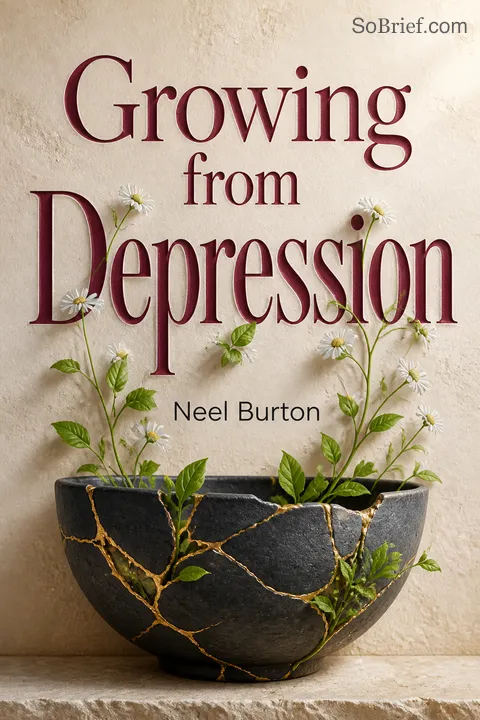
Growing From Depression receives mostly positive reviews, with readers praising its accessible format, practical advice, and comprehensive coverage of depression-related topics. Many find it helpful for understanding and managing depression, appreciating its short chapters and wide range of self-help strategies. Some readers note its philosophical approach and emphasis on personal growth. Critical reviews mention that it may be better suited for those new to depression literature or living in the UK, as some resources are region-specific. Overall, readers find it a valuable resource for both those experiencing depression and their supporters.
People Also Read


Glossary
stress-vulnerability model
Stress meets personal susceptibilityA model in which depression can develop when stress exceeds a person's capacity to cope. Vulnerability may reflect inherited, psychological, and social influences, while stress includes both major life events and persistent everyday pressures. The model explains why similar events can affect people differently and why genetic risk does not determine an outcome.
Thinking errors
Habitual distorted interpretationsPatterns of thought that can arise with depression and reinforce it. Examples include drawing conclusions without evidence, generalizing from one event, focusing selectively on negative details, personalizing unrelated events, and imagining catastrophic outcomes. In cognitive behavioural therapy, these patterns are examined as hypotheses that can be tested and revised.
Positive illusions
Optimistic self and world beliefsFavourable beliefs people may hold about their abilities, control, or future prospects, sometimes beyond what evidence warrants. The book presents these beliefs as common features of ordinary thinking that may support risk-taking and hope, while also warning that excessive optimism can impair judgment and lead to disappointment.
Depressive realism
Potentially more accurate judgmentsA controversial hypothesis that some people with depressed mood make more accurate judgments than non-depressed people in certain tasks, particularly about control or likely outcomes. The term comes from research discussed in the book. It does not imply that depression generally improves judgment or that every bleak interpretation is correct.
Existential anxiety
Anxiety about life's limitsUnease rooted in awareness of mortality, freedom, and the possibility that life lacks inherent meaning. The book distinguishes it from anxiety about an immediate, concrete threat. It argues that facing such questions can be painful but may also prompt a person to reconsider priorities and live more deliberately.
Logotherapy
Therapy focused on meaningA form of psychotherapy associated with Viktor Frankl that aims to help people uncover or discover meaning in their lives. The book describes three routes: engaging authentically with experience and other people, contributing through creative work or self-expression, and choosing an attitude toward circumstances that cannot be changed.
Eudaimonia
Flourishing through worthwhile livingAn ancient Greek idea often translated as happiness, but used in the book to mean a deeper form of flourishing. In Aristotle's account, it involves developing human capacities, especially reason, and living according to considered principles. It is a way of living and acting, not simply a pleasant emotional state.
Phenomenology
Close attention to experienceA method of examining and describing things as they appear in conscious experience, rather than relying only on assumptions or abstract theories. In the book, looking closely at a plant, animal, or other ordinary object is presented as a way to reconnect with the world outside personal worries.
Ataraxia
Freedom from mental disturbanceAn ancient Greek term for a state of tranquillity or freedom from disturbance. The book presents it as a shared aim of several philosophical traditions, despite their different methods. It is closely connected with the author's broader interest in mental mastery and flourishing, rather than merely the absence of diagnosed illness.
The 7 types of love
A map of love's formsThe book's guide to seven overlapping forms of love drawn from classical Greek vocabulary: eros, passionate love; philia, friendship; storge, familial attachment; agape, universal concern; ludus, playful love; pragma, practical partnership; and philautia, self-love. The categories highlight forms of connection beyond romance and are not rigid boundaries.
About the Author


Download PDF
Download EPUB
.epub digital book format is ideal for reading ebooks on phones, tablets, and e-readers.








