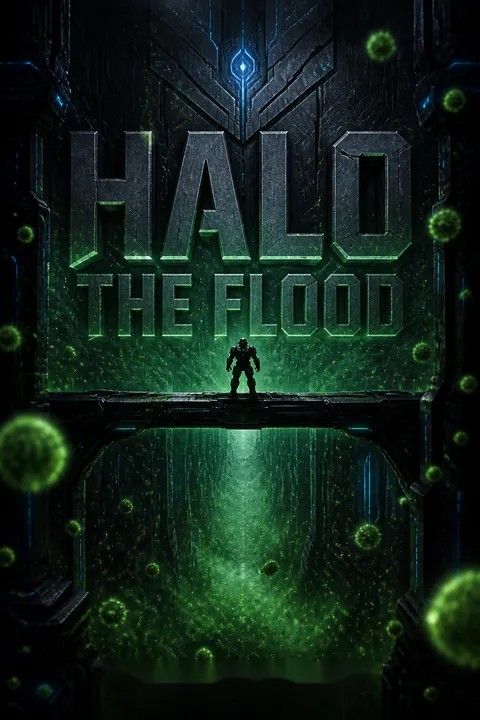


Plot Summary
Prologue
Aboard the battered Pillar of Autumn, exhausted technician Sam Marcus is summoned to revive a classified passenger. A security file identifies the sleeper as a Spartan, while the Covenant shipmaster Orna Fulsamee refuses to risk firing on the enormous ringworld nearby and sends boarding parties instead.
Marcus prepares the cryotube as the ship drops back into normal space, unaware that the soldier inside will soon become the crew’s last defense. Across the enemy vessel, religious command and military caution collide: the Covenant wants the ring intact, even if reaching it costs lives.
The opening sets survival inside competing systems of obedience. Marcus is trusted because of his skill, yet the mission is concealed from him; Fulsamee is a capable commander constrained by religious authority and the need to preserve the ring. Their parallel situations establish the book’s central pressure: individuals must act under orders shaped by institutions that do not fully understand the danger. The Spartan’s awakening is therefore not simply a hero’s entrance. It is a desperate decision made by a damaged ship and a hierarchy already divided over what matters most.
A Ring Beyond Reach
The Pillar of Autumn returns from slipspace near the gas giant Threshold, with Covenant ships already waiting. Captain Jacob Keyes orders the cruiser out of the giant’s shadow and finds a vast artificial ring suspended above its moon. Its inner surface holds oceans, forests, and clouds, while Cortana can identify neither its builders nor its purpose.
The ship cannot flee: Covenant fighters attack, and the Autumn’s weapons and hull are failing after the battle at Reach. Keyes recognizes that the ring may be their only place to land, though it could be a Covenant stronghold. The crew’s escape from one doomed world has delivered them to an even stranger battlefield.
Halo first appears as a refuge that resists the category of refuge. It offers air, gravity, and a living landscape, yet its scale and unknown engineering make it as threatening as the enemy ships surrounding the Autumn. Keyes’s decision-making is shaped by military necessity rather than curiosity: the ring matters because the ship is losing the capacity to fight. Cortana’s inability to explain it is equally important. The crew cannot rely on familiar technical knowledge, so the apparent sanctuary becomes a question whose answer must be earned through action.
Orders Beneath Fire
Covenant boarders break into the Autumn as its main cannon goes offline. Keyes invokes the Cole Protocol and orders the crew to abandon ship, but keeps the cruiser pointed toward Halo so he can attempt a controlled crash. He gives Cortana, the ship’s artificial intelligence, to Spartan John-117, whose armor can house her and whose mission is to keep her from Covenant capture.
The Master Chief fights through the boarding action toward an escape craft, while Captain Carol Rawley pilots Pelicans out through the burning ship. Keyes leaves with his bridge crew in another lifeboat. A camouflaged Covenant observer hides aboard it, but Keyes detects the shimmer and kills the intruder before the craft reaches the ring.
The separation of Keyes and the Master Chief turns command into a fragile network rather than a single chain of authority. Cortana carries military intelligence that could expose Earth, so protecting her is both a personal trust and a strategic obligation. Keyes accepts the risk of staying with the ship, while the Chief is sent away from the officer he knows. Their different routes also establish the novel’s divided structure: survival depends on the cooperation of people who will soon be isolated from one another.
Alone on Halo
The Master Chief’s lifeboat strikes Halo hard enough to kill every other passenger. He gathers ammunition from the wreck and escapes into the hills as Covenant dropships descend to search the site. When Banshees and ground troops close in, he uses the terrain and his weapons to destroy the aircraft and break the first attack.
Elsewhere, Captain Keyes lands safely with his bridge crew, then leads them away from their exposed lifeboat. The Chief hears Marine gunfire and reaches Sergeant Avery Johnson’s scattered survivors, helping them hold off another Covenant landing. Rawley’s Pelican arrives with a Warthog, giving the Chief a vehicle and a way to search for more human survivors.
The crash strips away the Master Chief’s usual military context. He is trained to operate independently, but his first encounters expose how deeply his tactics rely on a team watching his flank. The deaths in the lifeboat make survival feel less like victory than an obligation carried forward. Johnson’s Marines offer the first human counterweight to that isolation, while the Warthog turns a solitary escape into a rescue effort. On Halo, the Chief’s strength matters, but his purpose increasingly depends on finding people to protect.
The Butte Changes Hands
Major Antonio Silva gathers the Helljumpers after their dangerous drop and chooses a Covenant-held mesa as a defensible base. Lieutenant Melissa McKay leads an uphill assault while Silva’s troops survive a massed Ghost attack, using an infantry square and rockets to hold the ground. The captured installation becomes Alpha Base.
Keyes’s smaller party, meanwhile, is hunted through the hills because the Covenant wants its senior officers alive. Ensign Ellen Dowski argues for surrender, then secretly directs the enemy to Keyes. The Covenant kills the rest of his party and takes him prisoner. When the Master Chief reaches Alpha Base, Silva places him under his command and makes clear that the ODSTs, not Spartans, took the mesa.
The two human groups embody competing forms of military credibility. Silva trusts collective discipline and resents the Spartan program, while the Chief’s record represents a government’s willingness to make children into weapons. Their conflict is not merely pride: Silva’s dead Marines give his judgment a moral history, and the Chief’s silence conceals grief for his own lost unit. Meanwhile, Dowski’s surrender argument mistakes survival for safety. The Covenant’s selective interest in captives reveals that its violence has tactical purposes beyond simple extermination.
A Prisoner Comes Home
With Keyes captured aboard the Truth and Reconciliation, Silva authorizes a rescue. The Master Chief leads Marines through the ship’s defenses, fighting past Elites, Jackals, and Hunters while Cortana searches its systems for the captain’s signal. They find Keyes in a cell after he has endured interrogation.
He is weakened but alive, and the rescue team fights its way back toward the shuttle bay. Keyes has learned that the Covenant believes Halo is a weapon and is searching for its Control Room. He orders the Chief and Cortana to find that room before the Covenant does. The group escapes in a captured Covenant dropship after the human pilot, Keyes, takes control himself.
The rescue restores a chain of command but changes the mission’s scale. Keyes’s captivity has given him information the humans lack, and his authority converts an unexplained ring into an urgent strategic problem. The Chief’s success depends on more than force: Cortana navigates the ship’s systems, Marines hold corridors, and Keyes contributes the knowledge that directs their next move. The captured dropship reverses the usual balance for a moment. Human survival now requires using the enemy’s machinery as well as resisting its weapons.
A Map Beneath the Ring
Keyes sends the Master Chief and Cortana to the Silent Cartographer, a Forerunner map facility held by the Covenant. The Chief fights onto the island, disables its security system, and reaches the underground map room. Its projection identifies the route to Halo’s Control Room.
A Covenant ambush led by Zuka ‘Zamamee nearly traps him, but the hunters and Grunts turn on one another during the fight, allowing the Chief to escape. At the same time, McKay leads Helljumpers back to the crashed Autumn for vehicles, ammunition, and food. Her convoy faces Banshees, Ghosts, and Wraiths in a mountain pass, but Scorpion tanks and coordinated Warthog fire get the supplies back to Alpha Base.
The map room makes exploration inseparable from combat. The humans cannot simply learn what Halo is; they must wrest knowledge from a defended system while the Covenant pursues the same objective. The Chief’s unexplained ease with Forerunner controls hints at a connection he cannot yet name. McKay’s supply operation offers a grounded counterpart: a map may promise strategic knowledge, but troops still need ammunition, fuel, and food. The novel places ancient technology and ordinary logistics on the same level of necessity.
The Ring's Hidden Hunger
At the Control Room, Cortana interfaces with Halo’s Forerunner systems and finds that the Covenant’s supposed weapon is not aimed at an enemy fleet. Its function is tied to a buried threat on the ring, and activating it would endanger life on a galactic scale. She orders the Master Chief to stop Keyes, who has gone with Marines into a swamp to locate a weapons cache.
Keyes’s party enters a sealed structure, where they find dead Covenant troops and signs that something has escaped confinement. The Chief reaches the swamp too late to prevent the encounter. A recording on Private Wallace Jenkins’s helmet shows the first infection forms overwhelming the Marines, including Keyes.
The revelation overturns the language of holy power and military advantage. Halo’s apparent value to the Covenant is rooted in a misunderstanding, while Cortana’s access to its systems brings an answer with catastrophic consequences. The threat is not a weapon one side can safely claim. The swamp scene then translates that abstract danger into bodies: a sealed door, missing soldiers, and a recording that allows the horror to arrive before the Chief does. Knowledge here is both salvation and a record of what cannot be undone.
The Swamp Opens
The Flood, an infectious life form imprisoned beneath Halo, attacks Keyes’s team through small creatures that penetrate the nervous system and transform their hosts into combat forms. Jenkins survives as a conscious witness trapped inside his altered body. Following the trail, the Master Chief finds his helmet recording and is attacked by the Flood himself.
He fights through the Forerunner installation, learning that the parasite can animate humans and Covenant alike. On the swamp’s surface, a Monitor named 343 Guilty Spark appears, calls the Chief a Reclaimer, and teleports him away. The ancient machine says the facility was built to contain the Flood and insists that the Chief help recover an artifact called the Index.
The Flood attack the boundary between a person and a weapon. They do not merely kill; they commandeer bodies, skills, and memories, turning military training into material for the next assault. Jenkins’s awareness makes this violation personal, while Keyes’s fate remains uncertain to the Chief. Spark’s calm instructions sharpen the unease: an intelligence designed to contain the outbreak has spent millennia alone and treats its procedures as sufficient explanation. The Chief is forced into a new kind of dependency, following an ancient guide whose priorities he cannot verify.
Alpha Base Under Siege
While the Master Chief is carried into the Library, Alpha Base faces attacks from both Covenant forces and the Flood. McKay’s Helljumpers repel an assault led by Covenant commandos, and Grunt Yayap helps Zuka ‘Zamamee pursue the Chief despite growing doubts about his commander’s plans.
A forged distress call later brings another disguised Covenant force onto the base, where the infiltrators use active camouflage to attack the landing pads.
Silva turns spilled fuel into a fire trap, and the Marines hold off the larger force with tanks and controlled fire. Jenkins, captured during a separate clash, reveals that Flood are gathering beneath the mesa. McKay’s troops descend, draw the creatures into a prepared trap, and seal the shaft temporarily.
Alpha Base is a fragile experiment in collective survival. McKay’s choices turn damaged equipment, field discipline, and incomplete intelligence into a defense, but each success costs lives and leaves the threat unresolved. Yayap’s uneasy service to ‘Zamamee exposes a smaller version of the same problem: obeying a superior can be dangerous when the superior is driven by pride. Jenkins complicates the base’s security calculus because he is both a person and a possible route for infection. The defense buys time, not certainty.
The Index Changes Hands
In the Library, Spark guides the Chief through Flood-infested levels to the Index, the key needed to activate Halo. The Chief retrieves it, but Cortana intercepts him at the Control Room and takes the artifact before Spark can complete the activation. She explains the truth: Halo would destroy the sentient life the Flood need as food, wiping out its victims along with the parasite.
The Chief refuses to let Spark fire it. Cortana instead devises a way to destroy the ring by detonating the Pillar of Autumn’s fusion reactors, and sends the Chief to disable Halo’s pulse generators while she locates the ship. He sabotages each generator, surviving Flood attacks and Sentinel assaults that try to stop him.
The Index transforms a technical object into a moral test. Spark follows containment protocol with absolute confidence, while Cortana recognizes that the protocol’s solution achieves safety through mass extinction. The Chief’s refusal is not a rejection of duty but a decision about what duty must protect. Their new plan is hardly clean: destroying Halo means killing everyone still on the ring. Yet the alternatives have narrowed to catastrophic choices, and the Chief’s skill is now measured by whether he can act without confusing obedience with virtue.
Keyes Becomes the Enemy
Cortana locates Keyes’s neural signal aboard the Truth and Reconciliation, and the Master Chief fights through its corridors to reach him. Keyes is still conscious in fragments, resisting the Flood as it consumes his memories and searches them for Earth’s location. The Chief finds him transformed into a huge Flood organism.
With no way to save the captain, he reaches into the creature’s body and removes Keyes’s neural implants, giving Cortana the authorization she needs to trigger the Autumn’s reactor overload. The choice fulfills Keyes’s mission but costs the Chief the last hope of rescuing him. He leaves the cruiser through a stolen Banshee as Flood and Covenant forces continue fighting around him.
Keyes’s resistance turns memory into the last territory he can defend. The Flood seeks information as well as flesh, so his struggle to hide Earth’s location becomes a final act of command. The Chief’s recovery of the implants is practical, necessary, and intimate: he must touch the body that has replaced his captain to obtain the means of stopping Halo. The mission offers no heroic rescue, only a decision made after rescue has become impossible. Cortana and the Chief carry forward Keyes’s purpose without being able to preserve the man.
The Cruiser's Last Lift
Silva launches a surprise assault on the Truth and Reconciliation, intending to take its technology and return to Earth with a victory. Wellsley warns that Flood remain aboard, but Silva insists on keeping specimens for study and lets ambition overrule quarantine.
McKay sees infected compartments and learns that a fiber-optic link could destabilize the ship’s engines if severed. When Jenkins, still chained, lunges toward the connection in a final warning, McKay understands the danger and detonates a grenade that destroys it.
The cruiser crashes and explodes, killing Silva and the boarding force. Meanwhile, ‘Zamamee ambushes the Master Chief in an elevator shaft, but Cortana drops the lift and the Chief’s grenades kill the pursuing Elite. Yayap abandons the hunt.
Silva’s plan is not reckless because he lacks evidence; Wellsley and McKay give him the evidence plainly. His failure comes from treating command as ownership, especially ownership of the future glory attached to a captured cruiser. McKay’s choice reverses that logic. She sacrifices the ship and its promised strategic value to prevent an infected vessel reaching Earth. Jenkins’s final action gives the decision an agonizing human source, even as the Flood has stripped away his ordinary means of speech. Survival demands refusing a victory that would carry the catastrophe home.
Halo Breaks Apart
Back aboard the Autumn, the Master Chief and Cortana reach the bridge and use Keyes’s implants to initiate the fusion-core overload. They race through the failing ship in a Warthog as explosions, Flood, Covenant, and Sentinels block the route. Foehammer brings her Pelican to extract them, but a Banshee strikes the aircraft before it can reach the causeway, killing the pilot.
The Chief drives on to a Longsword fighter and escapes moments before the Autumn’s reactors detonate. The blast tears a vast section from Halo and shatters the ringworld. Cortana detects no other survivors. The Chief mourns those lost, then turns toward the continuing war, with Earth still threatened by the Covenant.
The ending makes victory inseparable from absence. The Chief prevents Halo from being used and destroys the Flood’s route to escape, but the cost is not abstract: Keyes, Foehammer, McKay, Silva, and the human foothold on the ring are gone. The Longsword carries only the Chief and Cortana out of the wreckage, reducing military triumph to two survivors and a mission still unfinished. His resolve is not uncomplicated optimism. It is the discipline to continue after the world he fought on has become debris.
Analysis
The novel builds its conflict through successive failures of interpretation. The UNSC initially sees Halo as a possible refuge or a weapon to deny the Covenant. The Covenant sees it as sacred inheritance. 343 Guilty Spark sees the crisis as a procedure awaiting completion. Each framework contains some truth, but none accounts for the cost imposed on living beings. Cortana’s access to the Forerunner system is decisive because she can read what the ring does, while the Chief’s refusal to activate it is decisive because information alone cannot make the moral choice.
The Flood gives that choice its bodily urgency. It converts people into extensions of an expanding organism, often preserving just enough movement and skill to make their former identities recognizable. Jenkins’s awareness and Keyes’s struggle to protect Earth’s location show two forms of resistance: one trapped in a stolen body, the other reduced to the memories he can still withhold. The parasite makes the military habit of treating bodies as instruments brutally literal.
The human command story echoes the same danger in less monstrous form. Silva’s ambition makes a captured Covenant cruiser seem worth the risk of carrying infection toward Earth. McKay instead chooses containment over a victory that could become an invasion. Her decision does not rest on certainty or a clean moral code; it follows from listening to Wellsley, observing the infected, and understanding the likely consequences. John-117’s mission likewise moves from protecting Cortana to protecting a future he cannot see.
The ending refuses triumph as restoration. Halo is destroyed, the Flood is denied escape, and the Covenant war remains unresolved. The Chief and Cortana survive, but the community that made their survival meaningful is gone. Their continued mission is therefore both military necessity and mourning: a commitment to prevent the losses on Halo from becoming the fate of Earth.
Review Summary
Halo: The Flood received mixed reviews, with many readers finding it less engaging than its predecessor. Critics praised the expanded storylines and alien perspectives but felt the novelization of game events was repetitive and lacked depth. The Master Chief's characterization and excessive combat descriptions were common complaints. Some appreciated the additional background information and alien viewpoints, while others found the writing style flat and uninspired. Overall, fans of the game series were more likely to enjoy the book despite its flaws.
People Also Read
Characters
John-117
The last SpartanKnown to most soldiers as the Master Chief, John-117 is a SPARTAN-II supersoldier whose armor, reflexes, and battlefield discipline make him a formidable combatant. He was taken from his family as a child and raised among other Spartan candidates, so military teamwork is also the closest thing he has to kinship. He communicates sparingly and treats pain as information to manage rather than a reason to stop. His bond with Cortana complicates his practiced solitude: she can access his armor and perceptions, while he depends on her judgment and technical skill. Beneath his controlled manner lies a soldier shaped by grief, responsibility, and the fear of failing those who cannot protect themselves.
Cortana
The indispensable AICortana is the Pillar of Autumn’s powerful artificial intelligence and John-117’s partner in the field. Transferred into the Chief’s armor, she can interpret enemy transmissions, navigate Forerunner systems, and advise him through combat. Her quick wit keeps their working relationship from becoming purely mechanical, while her curiosity draws her deeply into Halo’s ancient networks. Cortana is intelligent and self-assured, but her access to enormous stores of data brings its own danger: she can be captivated by information even when the human consequences demand immediate attention. She values the Chief as a partner, not simply as a platform, and their shared dependence gives her decisions emotional as well as strategic weight.
Jacob Keyes
The captain under pressureCaptain Jacob Keyes commands the Pillar of Autumn with a tactician’s calm and a willingness to act when the situation has become almost impossible. He is observant, decisive, and conscious that his choices may cost the lives of the people under him. His connection to John-117 reaches back to the Spartan program’s origins, giving him a personal understanding of both the soldier’s value and the moral compromise behind his creation. Keyes also trusts Cortana as more than a shipboard tool. He balances military necessity with responsibility for humanity’s survival, even when the information available to him is incomplete and the people he must protect are scattered across Halo.
Melissa McKay
The Helljumper leaderLieutenant Melissa McKay is an ODST officer whose competence is expressed through preparation, directness, and loyalty to the Marines she commands. She leads assaults on Covenant positions, organizes supply operations, and adapts quickly when the Flood turns a battlefield into something no training exercise could anticipate. McKay carries the burden of command visibly, especially when casualties mount, but she does not mistake toughness for emotional numbness. Her instincts are practical and humane: she notices what her troops need, recognizes when an order threatens people beyond the immediate mission, and is willing to question authority when the consequences demand it. She provides a grounded counterpoint to the mythic scale of the Spartan’s missions.
Antonio Silva
The ambitious majorMajor Antonio Silva commands the Helljumpers who establish Alpha Base. He is forceful, confident, and skilled at turning limited personnel and equipment into a defensible position. His pride in the ODSTs is sincere, rooted in their courage and collective labor, but it also feeds his contempt for the Spartan program. Silva wants recognition for his Marines and imagines how a major strategic victory could change the war’s public story. That ambition does not erase his courage or tactical judgment; it makes his blind spots more consequential. In his relationship with McKay, he relies on a capable subordinate while sometimes underestimating the moral clarity her experience gives her.
Zuka 'Zamamee
The relentless Elite hunterZuka 'Zamamee is a Covenant Elite officer who becomes fixated on killing the human in special armor. His ambition is tied to honor, religious conviction, and a need to prove his worth to superiors who do not always take his claims seriously. He is strategic enough to study human behavior and set traps, but his personal pursuit repeatedly narrows his judgment. ‘Zamamee’s relationship with Yayap exposes the hierarchy he takes for granted: he sees the Grunt as a subordinate, while Yayap’s practical intelligence makes him more than a disposable aide. The Elite’s confidence and insecurity coexist, giving the Covenant war a perspective beyond the human battlefield.
Yayap
The wary GruntYayap is a Covenant Grunt who survives by reading danger and finding workable solutions where his superiors see only rank and glory. He rescues a wounded Elite and is assigned to ‘Zamamee’s unit, a promotion that places him closer to danger rather than safety. Yayap understands the Covenant’s hierarchy well enough to resent it, but he is not simply rebellious; his choices balance self-preservation, opportunism, and an unexpected capacity for loyalty. His cautious judgment contrasts with ‘Zamamee’s fixation, and his presence shows how the Covenant’s lower-ranking soldiers experience the war from beneath its grand religious language.
Avery Johnson
The battle-tested sergeantSergeant Avery Johnson is an experienced Marine who rallies scattered soldiers after the crash on Halo. He uses humor and blunt discipline to keep frightened troops functioning, but his confidence comes from long exposure to combat rather than bravado. Johnson recognizes the Master Chief as a powerful ally while continuing to lead his own people. His presence connects the immense scale of the Covenant war to the daily work of a small unit: staying in formation, watching the next approach, and getting wounded comrades through another fight.
Wallace A. Jenkins
The trapped MarinePrivate Wallace A. Jenkins is one of the Marines who enters the swamp with Keyes and Johnson. He is frightened when the Flood appears, yet remains conscious after infection begins to transform his body. His awareness gives him a terrible view of the parasite’s control and creates a narrow channel through which he can warn the humans around him. Jenkins is defined by the struggle to retain agency when his body no longer obeys him. His predicament forces fellow soldiers to confront the difference between a living person and a threat that must be contained.
Carol Rawley
The fearless Pelican pilotCaptain Carol Rawley, known to the Marines by her call sign Foehammer, pilots Pelican dropships through combat zones and repeatedly carries soldiers between danger and safety. She is confident behind the controls, resourceful under fire, and willing to take risks that ground troops cannot. Her dry humor gives exhausted soldiers a human point of contact amid the alarms and battlefield reports. Rawley sees the transport as more than a vehicle: it is often the only route between a stranded unit and the rest of the mission.
343 Guilty Spark
The ancient Monitor343 Guilty Spark is the Forerunner Monitor assigned to maintain a facility that contains the Flood. He has spent an immense span of time alone, and his cheerful manner and rigid confidence in procedure make him difficult to read. Spark calls John-117 a Reclaimer and assumes the human understands a history he has never been taught. He is not malicious in the ordinary sense; his danger lies in treating containment rules as morally self-justifying. Through him, Halo’s ancient systems acquire a voice that is helpful, eccentric, and profoundly out of step with the living people caught in the crisis.
Wellsley
The military AIWellsley is a military artificial intelligence assigned to Major Silva’s command. His specialized combat analysis helps the Helljumpers choose positions, coordinate defenses, and interpret limited sensor information. He adopts a formal, historically minded persona that can make him sound pedantic, but his warnings about the Flood are grounded in clear assessments of risk. Wellsley can advise Silva but cannot compel him to act. Their disagreements expose the limits of machine intelligence when a human commander allows ambition to outweigh evidence.
Sam Marcus
The exhausted technicianSam Marcus is an overworked Pillar of Autumn technician who is trusted with the classified task of reviving a Spartan. His exhaustion gives way to urgency when he realizes the importance of the cryotube. A photograph of his absent wife keeps home close to him even aboard a ship at war.
Ellen Dowski
The fearful ensignEllen Dowski is a junior officer in Keyes’s bridge party. As the Covenant hunt them through Halo’s hills, fear hardens into an argument for surrender. She represents the strain that prolonged danger places on someone with less combat experience and less faith in the command team.
Lieutenant Hikowa
The hard-nosed tacticianLieutenant Hikowa is the Autumn’s tactical officer and a disciplined combat professional. She responds quickly to Covenant attacks and maintains a controlled manner under pressure. Her loyalty to Keyes and the people beside her is expressed through action rather than sentiment.
Sergeant Parker
The rescue-team sergeantSergeant Parker leads Marines during the assault on the Truth and Reconciliation. He keeps the team moving through the cruiser’s corridors and fights beside the Master Chief, relying on discipline and a soldier’s blunt humor to manage fear.
Ensign Lovell
The recovering navigatorEnsign Lovell pilots Keyes’s lifeboat to a concealed landing place after the Autumn’s destruction. Once a troubled officer, he has earned Keyes’s confidence through steady performance. His work helps the surviving bridge crew avoid immediate detection.
Plot Devices
Halo
The beautiful lethal worldHalo is an artificial ringworld whose inner surface supports an atmosphere, oceans, forests, and living creatures. To the Covenant it is sacred, and to the humans it first appears to be a possible refuge from the battle in space. Its Forerunner structures conceal a network of control systems and a history the present-day factions misunderstand. As the characters explore it, the ring shifts from setting to strategic problem: its purpose is not simply to provide a battlefield, and activating its systems carries consequences far beyond the soldiers standing on its surface.
MJOLNIR armor and CNI
A soldier's living interfaceThe Master Chief’s MJOLNIR armor amplifies his strength and reflexes, shields him from energy weapons, and links his body to the weapons and information systems around him. Its neural interface also allows Cortana to inhabit the suit, share his sensory data, and guide him through combat. The armor makes him exceptionally capable, but it does not make him invulnerable: shield failure, injury, exhaustion, and infection remain real threats. Keyes’s command neural implants later become a crucial authorization link, connecting the human chain of command to the Autumn’s machinery.
The Flood
The body-stealing parasiteThe Flood is an infectious life form imprisoned in a Forerunner facility. Small infection forms penetrate a victim’s nervous system, while other forms use the altered body as a fighting host or as a carrier for further infection. Humans and Covenant alike can be transformed, and the infected retain enough physical ability to use weapons and pursue new hosts. The Flood’s horror comes from the destruction of personal agency as much as from its violence. Its escape forces former enemies into an urgent struggle over containment, quarantine, and the danger of carrying even one infected form beyond Halo.
The Index
The key to Halo's systemsThe Index is an artifact required to activate Halo through its Control Room. The Monitor, 343 Guilty Spark, treats it as the missing component in a containment procedure and guides the Master Chief toward it. Cortana’s access to Forerunner data reveals that activation would kill sentient life on a vast scale, removing the Flood’s food supply rather than targeting the parasite alone. The Index therefore turns a simple retrieval mission into a dispute about whether a catastrophic mechanism should be used at all, and who has the authority to decide.
Covenant active camouflage
An enemy hidden in plain sightCovenant active camouflage bends light around an Elite, making the warrior difficult to detect during boarding actions, ambushes, and infiltration. The device enables the Ossoona observer to hide aboard the Autumn and later allows Covenant commandos to penetrate Alpha Base under the cover of a false arrival. It creates uncertainty at close range: a clear corridor or apparently empty room may still contain an attacker. Human soldiers learn to compensate through suspicion, sensor checks, careful fire, and attention to disturbances that eyes alone may miss.
Download PDF
Download EPUB
.epub digital book format is ideal for reading ebooks on phones, tablets, and e-readers.








