

Key Takeaways
Read handwriting as a behavioral trace, not a transparent window into character
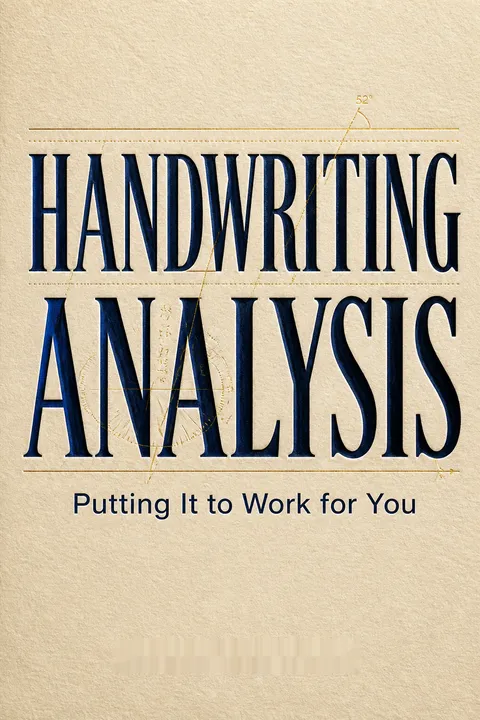
A trace of movement. McNichol defines graphology as the study of graphic expression, including handwriting, doodles, and drawings. She calls handwriting a kind of “brain print”: the brain directs the movement, so the page may reflect physical condition, habits, and emotional state. To illustrate the brain’s role, she describes people who lose the use of their hands and learn to write with their mouths or feet, eventually developing an individual style resembling their former handwriting.
A book built on a promise. McNichol recounts her unlikely path from a child ashamed of messy penmanship to a courtroom handwriting expert. Her book moves between personality interpretation and questioned-document work, promising readers clues about strangers from a few minutes of writing. Those are distinct claims: identifying who wrote something is not the same as inferring what kind of person they are.
The motor-control insight is plausible and useful: writing depends on the nervous system, and illness or fatigue can alter it. But a physical trace does not automatically provide a reliable personality profile. Handwriting also reflects schooling, language, writing tools, injury, and the situation in which a sample was produced. The book’s vivid “window into character” promise is best treated as an invitation to observe, not as proof that a page can reveal a stranger’s honesty, intelligence, or sanity.
Notice the metaphor behind a mark before trusting its supposed meaning
Movement becomes metaphor. McNichol’s method begins with familiar visual contrasts: upward versus downward, large versus small, open versus closed, and smooth versus jagged. A rising line can feel hopeful because everyday speech links “up” with positive states; large letters can suggest a wish to take up space. She also invokes bodily movement, reasoning that tense muscles produce sharper shapes while relaxed ones allow curves.
Five routes to a reading. The book combines physiological clues, common sense, shared visual associations, psychological interpretation, and comparisons of handwriting samples. Its opening quizzes ask readers to choose which writer seems moody, outgoing, or depressed before explaining the clues. The exercise shows that readers can recognize the intended metaphor. It does not, by itself, show that the metaphor accurately predicts the writer’s enduring personality.
The method’s strength is its accessibility. Readers do not need technical vocabulary to notice a line that droops or writing that fills the page. Such observations can prompt good questions about mood or context. The weakness is that an intuitively persuasive metaphor can feel like evidence even when it has not been tested against independent outcomes. Cultural conventions matter too: a symbol that feels natural in one writing system may not carry the same meaning in another.
Look for several patterns across samples, not one dramatic letter
The whole page matters. McNichol repeatedly warns that traits should be interpreted in combination. A graphologist might examine slant, baseline, size, spacing, pressure, margins, and letter connections, then ask whether several features point in a similar direction. The book calls handwriting traits “fixed” when they persist, such as aspects of a person’s identity, and “unfixed” when they can change with mood, health, or substances.
Time and conditions count. The author recommends collecting samples written over several days and in ordinary circumstances. A single page could reflect illness, exhaustion, a difficult moment, or an unusual writing surface rather than a person’s usual style. Her examples include slant changing with emotional expression and pressure varying with intensity. In this framework, a sample is a snapshot, not a complete biography.
This is the book’s most valuable methodological caution. Any behavioral interpretation improves when it considers context, repeated observations, and competing explanations. In research, this resembles triangulation: confidence rises when independent measures converge. Yet combining many loosely defined clues can also create a false sense of certainty, especially if the interpreter searches long enough for a confirming pattern. Several suggestive marks are not necessarily several independent pieces of evidence.
Treat a sudden change in writing as a reason to verify the story
A pause may matter. McNichol argues that sudden changes in spacing, slant, or speed can reveal a loss of spontaneity while someone writes. In one case, a supermarket janitor’s unusually wide gaps before the time he said he left work drew her attention. The gap suggested he might have paused over that detail. When questioned, he reportedly admitted that a manager had let him leave early, a fact that led investigators to examine the manager’s account.
A lead, not a verdict. The book presents such shifts as useful places to ask follow-up questions. The janitor’s writing did not establish that he stole money; it pointed to a discrepancy worth checking. Spacing can change for many reasons, including searching for a word, remembering a time, or simply writing unevenly. The practical lesson is to verify the detail through evidence independent of the handwriting.
The case is strongest when read as an example of hypothesis generation. A small irregularity directed attention toward a detail that investigators could check, and the investigation then moved beyond the page. That is a sound role for an ambiguous clue. The danger begins when a pause is treated as a lie detector: people hesitate for innocent reasons, and an interpreter who already suspects someone can read ordinary variation as confirmation.
Use handwriting to notice distress, never to diagnose its cause
A warning sign is not a diagnosis. McNichol argues that changes in handwriting can reflect physical or emotional strain. The book describes a ten-year-old, called Lisa, whose writing became especially irregular around references to a family friend she called “Uncle Phil.” The author interpreted the changes as anxiety and anger. In the account, Lisa’s mother sought professional help, and clinicians concluded that the man had molested her.
Context changes the meaning. The story illustrates how a sample might prompt a caregiver to investigate a concern. It cannot establish that a particular person caused harm. The book also discusses letter reversals as a clue to dyslexia and tremors as possible signs of physical illness. Those observations may warrant attention, but learning disorders, abuse, and medical conditions require assessment by qualified professionals using appropriate evidence.
The ethical distinction is essential: noticing a change can encourage timely support, while assigning its cause from handwriting risks false accusation or missed care. A child’s writing varies with development, instruction, stress, and motor skill. Safeguarding concerns should be handled through trained professionals and established procedures, not through a personality reading. The case has narrative force, but a compelling anecdote cannot establish that handwriting reliably detects abuse.
Separate document authentication from personality interpretation
Two different questions. The book discusses questioned-document examination, which compares writing to assess whether a particular person produced a signature or document. McNichol points to features such as connecting strokes and pressure patterns, and notes that copies may lose details useful for comparison. This is not the same task as deciding whether a writer is generous, unstable, or dishonest.
Samples must be comparable. In a disputed will case, McNichol says a signature attributed to an elderly woman looked too smooth given her age and reported illnesses, and she concluded it was forged. Her broader point is that age, illness, and medication can change handwriting, so examiners need appropriate samples and context. In real cases, authorship questions belong with qualified forensic document examiners and suitable original materials, not personality judgments.
The distinction protects both the evidence and the person being assessed. Document examination asks whether features of two writing samples are consistent with common authorship, a narrower question than inferring character. Even that work requires expertise, adequate originals, and careful comparison. A signature that looks unusual is not automatically forged; injury, illness, writing conditions, and natural variation can affect it. Personality claims should not be smuggled into an authorship assessment.
Keep graphology out of hiring, parole, and other high-stakes decisions
The author advocates broad use. McNichol proposes graphology for selecting employees, matching people to jobs, evaluating parole readiness, and identifying suspects. She tells stories of theft investigations in which handwriting analysis allegedly narrowed the field, including a dentist’s office where the employee she identified was later convicted of embezzlement. These cases show the book’s practical ambition and its appeal to employers and investigators.
Anecdotes cannot carry the burden. A successful-sounding case does not reveal how often the method misidentifies innocent people, how suspects were selected, or whether independent evidence produced the result. Handwriting should not determine someone’s livelihood, liberty, diagnosis, or reputation. At most, an observation could suggest a neutral question for an investigation that is independently justified and conducted fairly.
High-stakes decisions require methods with demonstrated accuracy, transparent error rates, and safeguards against bias. The book’s case narratives offer memorable successes, but they do not provide the comparison groups or blinded testing needed to establish predictive validity. Handwriting differences can also reflect disability, education, language background, or access to writing instruction. Using a subjective reading to hire, reject, or release someone risks turning an interpreter’s confidence into an unjustified authority.
Compare a signature with the surrounding writing to study public self-presentation
A signature has a special role. McNichol calls it the writer’s “public self-image,” meaning the way the person presents themselves to others. She compares the signature with the rest of a letter, which she treats as a more private expression. A larger signature, an illegible name, or a signature placed far from the text is interpreted as a clue about attention, communication, or social distance.
Audience matters. The book’s examples include people whose signatures differ sharply from their everyday writing, and it proposes that the contrast may indicate a change in public manner. But signatures also vary because people sign quickly, use different forms for different purposes, or develop a habitual shorthand. Comparing signature and text can generate questions about self-presentation; it cannot prove that someone is deceptive or insecure.
The comparison captures a real social distinction: people often adapt how they present themselves to an audience. A signature may be more practiced, abbreviated, or formal than ordinary writing. That makes it an interesting artifact of identity and habit. The leap from difference to deception is much less secure. A person can have a stylized signature simply because it is repeated, and social self-presentation is not inherently dishonest.
Read doodles as clues to the moment, not as a universal symbol dictionary
Drawing adds another channel. McNichol distinguishes deliberate doodles from marks made while attention is elsewhere. She suggests both can express concerns that a person may not state directly. The book assigns common themes to familiar images: vehicles can suggest wanting to go somewhere, flowers can suggest growth, and a house may invite questions about home life. It also uses a box-and-circle drawing exercise to discuss self-image.
The same image can mean different things. The author says interpretation depends on shape, placement, detail, and context, and describes drawings by children and adults alongside stories about their lives. Those stories make the chapter vivid, but they are not a dependable codebook. A doodled car may be a favorite object, a passing thought, or simply an easy shape to draw. Ask what it means to the artist before deciding.
Doodles can be useful conversation starters because they invite people to describe what they were thinking or feeling. Their openness is also their limitation. A symbol’s meaning depends on personal history, culture, and circumstance, so a fixed interpretation can project the analyst’s assumptions onto the artist. The safest use is exploratory: notice recurring images, ask about them, and let the person’s own account carry more weight than a symbolic formula.
Use handwriting practice for expression, but test claims of personality change
Practice can shape experience. McNichol proposes graphotherapy: deliberately changing a writing habit to influence the feeling associated with it. For example, someone who tends to stop writing lines early might practice extending them farther across the page. The author presents this as an inexpensive complement to self-improvement and argues that repeated physical movements can affect mood and behavior.
Keep the benefits grounded. The book also argues that handwriting supports communication, memory, fine motor practice, and personal expression. These are practical reasons to preserve the skill, even as keyboards become common. Its broader claims about changing personality through altered strokes rely mainly on the author’s account of cases and experiments, not on a detailed evaluation of outcomes. Treat graphotherapy as a personal exercise, not a proven treatment or substitute for care.
The idea that action can influence feeling has intuitive appeal, and writing can provide a structured way to reflect or set intentions. But changing the shape of letters is not, by itself, evidence that a lasting personality trait has changed. A useful test would measure a specific behavior before and after practice, while comparing other explanations such as expectation, attention, or counseling. Handwriting’s ordinary value does not depend on graphotherapy being effective.
Analysis
McNichol’s book is a persuasive teaching performance as much as a reference guide. Quizzes invite readers to make quick judgments, then explanations attach those judgments to visible features. Real-life cases provide suspense and give the methods a sense of consequence. This structure succeeds at making handwriting feel observable rather than mysterious. Its central weakness is that intuitive recognition is treated as proof of predictive power. If readers associate downward movement with sadness, correctly guessing which sample looks sad demonstrates that the metaphor is legible. It does not demonstrate that a writer with a downward baseline is reliably depressed.
A modern evaluation would distinguish three claims: handwriting can change with motor or physical state; handwriting can identify its author; and handwriting can reveal stable personality or predict behavior. Evidence for one claim cannot automatically support the others. The book often moves between them, particularly when it shifts from signature comparison to claims about honesty, illness, criminality, or suitability for employment. Its anecdotes are not accompanied by the information needed to assess false positives, missed cases, selection effects, or independent replication. Dramatic successes are especially vulnerable to confirmation bias because readers hear the cases that appear to work, not a full record of every prediction.
The book’s own practical cautions, including gathering multiple samples and considering illness or writing conditions, point toward a more defensible use: treat unusual writing as a prompt to ask questions, then check answers through independent evidence. That approach preserves the human interest of observing how people write without allowing visual metaphors to become verdicts. Forensic authorship comparison should also remain separate from personality analysis. The former examines features of documents under controlled conditions; the latter makes broader psychological claims. The most durable value here is not a diagnostic shortcut, but a reminder that marks on a page are produced by a person in a particular body, context, and moment.
Review Summary
Handwriting Analysis by Andrea McNichol receives mostly positive reviews, with readers praising its comprehensive approach and practical applications. Many find it fascinating and educational, noting how it changes their perception of handwriting. Some readers use it for genealogy or self-understanding. The book is praised for its easy-to-follow format and real-life examples. However, a few reviewers criticize it for being outdated, particularly regarding social issues and references. Overall, readers find the book insightful and recommend it for those interested in psychology and handwriting analysis.
People Also Read




Glossary
Graphology
Study of graphic expressionMcNichol uses graphology to mean the study of graphic movement, including handwriting, doodles, drawings, and other marks. Her book focuses mainly on interpreting handwriting as evidence about a writer’s physical, mental, or emotional state. This personality interpretation should be distinguished from forensic document examination, which compares writing to assess authorship.
brain prints
Brain-directed writing tracesThe book’s metaphor for handwriting and other graphic movements. McNichol argues that the brain directs the hand, so the distinctive movement recorded on paper reflects the writer rather than merely the hand or writing tool. The term expresses her claim that handwriting can reveal information about a person, but does not itself establish that personality can be accurately inferred.
universal concepts
Visual contrasts used as cluesA method in McNichol’s graphology that assigns psychological meaning to familiar visual contrasts, such as high and low, large and small, open and closed, or smooth and angular. For example, she links an upward baseline with positive energy and a downward one with negative mood. The approach relies on shared metaphorical associations and may vary across cultures and writing systems.
baseline
Direction of a lineThe imaginary line along which handwriting runs across a page. McNichol classifies baselines as level, rising, falling, or irregular, and interprets their direction as a clue to mood, energy, and persistence. She distinguishes a generally rising line from one that rises and then drops near its end, which she reads as a sign of giving up.
slant
Direction letters leanThe direction upper-zone letters appear to lean: toward the left, upright, toward the right, or inconsistently in multiple directions. McNichol interprets slant as a clue to how readily a writer expresses emotion. She advises examining several letters and finding an average rather than judging from one letter, since slant can vary within a sample.
zones
Upper, middle, lower writing areasMcNichol divides handwriting into upper, middle, and lower zones, based on the parts of letters that rise above, remain on, or descend below the central writing area. She connects these zones to thought, everyday life, and physical or instinctive concerns, respectively. Relative size and shape are interpreted as signs of emphasis, but these readings are the book’s framework, not established diagnoses.
graphotherapy
Changing writing to influence behaviorA technique proposed by McNichol in which a person repeatedly practices a chosen handwriting change to encourage a related psychological change. For instance, the person might practice writing farther toward the right side of the page to address a tendency to stop short of goals. The book presents it as inexpensive self-improvement, while the evidence described is not sufficient to establish it as treatment.
questioned-document examination
Comparison of disputed writingThe examination of handwriting or signatures when authorship is disputed. The book discusses comparing an questioned sample with known writing and considering features such as pressure, connections, and letter formation. This forensic task is distinct from using handwriting to infer personality, and sound conclusions depend on suitable samples, original documents when available, and qualified examination.
Download PDF
Download EPUB
.epub digital book format is ideal for reading ebooks on phones, tablets, and e-readers.








