

Plot Summary
A Captain's Daughter Arrives
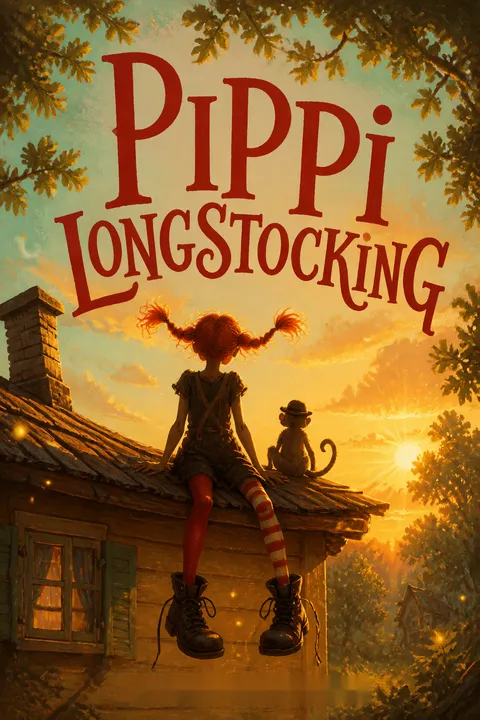
Pippi reaches the furnished Villekulla Cottage after leaving her father’s ship, carrying a suitcase of gold and her pet monkey, Mr Nelson. Her sea captain father vanished in a storm, but she imagines he survived and became ruler of an island kingdom. She buys a horse and keeps him on the porch, then meets neighboring siblings Tommy and Annika, who have been wishing for a playmate.
Pippi invites them in, flips pancakes with reckless confidence, shows them her travel treasures, and gives each a keepsake. Her claim that she lives alone does not frighten her; she treats the house as a place where she makes the rules. For Tommy and Annika, uneventful days end at the gate.
The cottage is both shelter and declaration: Pippi has no adult organizing her life, so she makes a home from the objects and habits she has carried across the sea. Her confidence does not erase the absences in her history. Instead, she gives them imaginative shape, picturing her father alive and her mother watching over her. Tommy and Annika enter this private world through ordinary neighborly curiosity, but the gifts and shared breakfast make the encounter reciprocal. Pippi offers them more than entertainment. She makes room for them in a household where welcome is something she chooses and gives.
Turnupstuffers and Bullies
While baking gingerbread on the kitchen floor, Pippi calls herself a turnupstuffer, someone who looks for useful things others overlook. Tommy and Annika join her search, collecting a rusty tin and an empty reel. Their wandering stops when they find Bengt and four other boys attacking Willie. Pippi lifts the bullies onto branches, a gatepost, and a toy cart, giving Willie time to escape their blows.
Back at Villekulla, she sends Tommy and Annika to search the old trees. Tommy finds a notebook and silver pen in a hollow; Annika discovers a coral necklace. Their unexpected finds persuade them that Pippi’s odd occupation is worth practicing, while her intervention makes clear that play does not mean standing aside when someone is hurt.
Pippi’s games carry a practical moral code. Her definition of searching makes attention itself an adventure, but the encounter with Willie tests what her strength is for. She does not punish the boys with lasting harm; she rearranges their positions until their advantage disappears. The children’s discoveries then give the game a small reward, though the book leaves the objects’ origins uncertain. That uncertainty suits Pippi’s world, where curiosity matters more than a tidy explanation. Tommy and Annika are not merely entertained by her; they begin to borrow her willingness to act before convention tells them what is possible.
The Home Authorities Cannot Place
Concerned townspeople decide that a child living alone should be sent to a children’s home, and two policemen arrive to take Pippi there. She refuses because the institution would not allow her horse or Mr Nelson, then turns the officers’ attempt into a game of tag. Pippi climbs from the porch to the roof, escapes across the tiles, and reaches a tree while the policemen struggle to follow.
After she removes their ladder, they ask her to return it, then try to seize her again once they are down. Pippi carries them out to the road and offers them gingerbread. The officers report that she is not suited to their plan, and the town leaves her at Villekulla.
The dispute is not simply between a naughty child and sensible adults. The town assumes that care must take the form of institutional supervision, while Pippi measures a home by whether it can hold her animal companions and her freedom. Her physical escape exposes the gap between the officers’ authority and their actual ability to understand or manage her. Yet she does not reject human contact: she offers the policemen food after defeating their coercion. The episode makes her independence vivid without presenting it as isolation. She remains in the neighborhood because the community’s intervention fails, and because friendship has already begun to root her there.
A Schoolday on Pippi's Terms
Watching Tommy and Annika receive school holidays while she gets none, Pippi decides to attend class. She arrives late on her horse and expects to enjoy the same breaks as the other children. Arithmetic questions irritate her because she sees them as pointless tests, and reading lessons invite her into sprawling tales of sea travel and danger.
When the class draws, she uses the floor to make a picture too large for the paper. The teacher tries to correct her behavior, and Pippi realizes she has not understood what school expects. She leaves, gives the teacher a gold chain, and rides away. Her brief visit satisfies her curiosity, but she chooses not to trade her freedom for lessons she cannot yet value.
Pippi’s school visit is driven by fairness rather than a desire for academic advancement: she wants the holidays that Tommy and Annika enjoy. Once inside, however, the conflict becomes one of competing definitions of knowledge. The teacher asks for answers within a shared structure; Pippi supplies stories, questions, and physical imagination that overflow it. Her mistakes are not a simple refusal to learn, since she is alert to the teacher’s kindness and distressed when she understands that she has behaved badly. The gold chain complicates the encounter: Pippi can give generously, but generosity cannot substitute for knowing the social rules she has missed.
The Hollow Oak Hideout
Sitting by the gate with Tommy and Annika, Pippi entertains a girl searching for her father with an elaborate story about a family in China. The girl doubts it, and Pippi admits she has been inventing much of what she said. Soon afterward, Pippi suggests climbing an old oak. She serves tea and buns among its branches, then finds a hollow running down through the trunk.
When Tommy and Annika worry that she is trapped, Pippi climbs out, fetches a ladder, and helps them descend into the tree. The dim space becomes a concealed meeting place where they can watch the orchard through a crack. Annika’s initial fear gives way to excitement as the children claim the hideout for future visits.
Pippi’s storytelling is less a bid to deceive than a way to test how confidently people accept an entertaining account. She can admit to invention without surrendering her delight in it, and the scene lets the children distinguish imagination from fact without treating either as a threat. The oak’s hidden interior gives their play a physical counterpart: a familiar tree contains a private room that appears only when someone climbs high enough to find it. Annika’s hesitation matters here. Pippi does not simply drag her into the adventure; the ladder and Tommy’s reassurance make the unknown manageable, allowing courage to grow through shared trust.
A Picnic Meets a Bull
When school closes for cleaning, Pippi scrubs her kitchen by skating across a flooded floor with brushes tied to her feet. She then packs a lavish picnic and leads Tommy and Annika into the countryside. After a failed attempt to fly from a ledge leaves her safely on the ground, the children realize Mr Nelson has wandered off.
They search separately, and Tommy encounters an angry bull that tosses him into the air. Pippi pulls the bull away, breaks off its horns, and rides it until it gives up, while Annika tends Tommy’s bruised arm. The children find Mr Nelson perched in a pine tree, unhappy at being alone. They return home together, soaked and shaken, but still singing about the excursion.
The picnic shifts the children’s games from imagined danger to real physical risk. Pippi’s impulsiveness, including her attempt to fly, can be funny because her strength and resilience usually protect her; Tommy’s encounter with the bull shows that the same countryside is not equally safe for everyone. Pippi’s rescue is comic in its manner, but its consequence is serious: she acts quickly, and Annika helps care for Tommy afterward. The episode also gives Mr Nelson vulnerability. The confident little monkey is frightened when separated from the group, and his return restores the party’s family-like shape before they head back.
Pippi Takes the Circus Ring
Tommy and Annika invite Pippi to the circus, and she uses a gold coin to buy them seats near the ring. The spectacle confuses her at first, but she quickly joins it: she climbs onto Miss Carmencita’s horse and then appears on the tightrope beside Miss Elvira. The ringmaster tries to have her removed, yet the crowd wants to watch her perform.
When he offers a reward to anyone who can defeat Mighty Adolf, Pippi enters the ring. She withstands his attacks, knocks him down repeatedly, and finally carries him around before ending the contest. The audience cheers, but Pippi treats the prize money as unimportant. She returns to her seat and falls asleep during the rest of the show.
The circus turns Pippi’s everyday abilities into public spectacle, but she does not approach the ring as a performer seeking approval. She joins because she assumes the entertainment belongs to everyone who paid to see it. The ringmaster’s efforts to control her reveal the commercial boundary she disrupts: he has hired acts and arranged a program, while Pippi moves through it without recognizing the distinction between audience and attraction. Her defeat of Mighty Adolf reverses the announced hierarchy of strength, yet her indifference to the money prevents the victory from becoming a conventional career or ambition. The applause belongs to the crowd; Pippi remains herself.
Gold Draws Two Thieves
Two wandering thieves, Thunder Karlson and Bloom, notice Pippi counting gold and wait outside until night. They enter the unlocked cottage expecting to steal from a sleeping child, only to find Pippi awake beneath her covers with her feet at the pillow. When they reach for her suitcase, Pippi takes it back, lifts Thunder Karlson onto a cupboard, and ties both men up.
Their fear softens her response: she frees them so they can help her practice the polka, with Bloom playing music on a comb. After dancing, Pippi feeds the hungry pair and listens as they prepare to leave. She gives each thief a gold piece, deciding that their visit and their dancing have earned a reward rather than revenge.
The thieves arrive with a familiar story about vulnerability: a child alone with money should be easy prey. Pippi overturns it physically, but the episode’s sharper surprise is her choice after the danger has passed. She neither excuses their intention nor treats them as irredeemable; she converts captives into dance partners and hungry strangers into dinner guests. Her generosity is not naïve, because she protects the suitcase first and only then releases them. Money, which gives her independence, becomes a tool for unexpected hospitality. Pippi’s response challenges the assumption that justice must end in punishment, while still making clear that she can defend herself.
Martha's Stories Break Tea
Tommy and Annika’s mother invites Pippi to tea, and Pippi admits she is nervous about behaving properly. She arrives in elaborate makeup and bows through a sequence of commands before joining the adults. At the table, she piles up cakes, eats the decorated cream cake, and scatters sugar on the floor.
When the ladies complain about their maids, Pippi tries to join in by telling increasingly absurd stories about her grandmother’s maid, Martha. Her attempts to match the adults only deepen their disapproval. Mrs Settergreen sends Pippi upstairs and says she cannot visit again. Pippi leaves in tears, apologizes, then follows the departing guests to add one last detail about Martha’s shortcomings.
This episode gives Pippi a goal she rarely has: she wants to fit in and avoid embarrassing her friends. Her nerves produce a theatrical entrance, but the deeper failure comes when she mistakes the adults’ complaints for an invitation to compete in complaint. Her stories expose the cruelty and absurdity hidden inside the ladies’ judgments, though Pippi does not understand that she is challenging the social performance they expect. The rejection wounds her precisely because she has tried. Tommy and Annika’s presence matters as a bridge to adult society, but their mother’s authority sets a boundary that friendship cannot erase. Pippi’s apology shows self-awareness without magically teaching her the manners she lacks.
Fire Above the Square
Riding through town on a cold evening, Pippi arrives as flames spread through the Skyscraper. Two young brothers are stranded in the attic, and the fire brigade’s ladder cannot reach them. Pippi asks for a rope, ties it to Mr Nelson, and sends him up a nearby tree so the rope can pass over a high branch.
She climbs it with a plank, lays the plank across the gap to the attic window, and brings both boys onto the tree side. Using the rope, she lowers each child to his waiting mother. Only after they are safe does Pippi return across the plank and descend. The crowd cheers her, and the fire brigade chief leads the praise.
The rescue gathers earlier elements into a single act of practical competence. Pippi’s strength matters, but it is not enough on its own: she needs a rope, a tree, a plank, and Mr Nelson’s ability to climb. Her courage works through improvisation, turning the town’s overlooked materials into a route between the burning building and safety. The two boys are very young and cannot be expected to solve their predicament, so Pippi’s intervention answers a clear need rather than creating an adventure for its own sake. The crowd’s admiration marks a rare moment when public authority recognizes what Pippi can do instead of trying to contain her.
A Birthday Without Rules
Pippi writes Tommy and Annika an invitation to her birthday party, struggling through the spelling because her schooling has been brief. They bring her a musical box, and she delights in it before giving them gifts of her own.
The three children eat cakes in the kitchen, then play a game that sends them scrambling across furniture without touching the floor. Pippi leads them to the dark attic, where an owl startles them before she finds her father’s old seaman’s chest.
Inside are clothes, books, a telescope, pistols, a sword, and more gold. After firing the pistols into the ceiling, Pippi lets Tommy and Annika gather their presents and head home with their father. She watches them go, dressed in the seaman’s nightshirt and holding the sword.
The birthday gives the book a small emotional landing rather than a final solution. Pippi and her friends exchange gifts, making their bond visible through chosen objects: the musical box she receives and the keepsakes she gives. The attic chest reconnects her present life to her father’s seafaring past, but it does not close the question of his return. Instead, the discovered objects prompt a new imagining of who Pippi might become. Her friends leave with their father, while Pippi remains in the house that holds both her independence and her memories. The ending keeps companionship and solitude together, allowing her future to stay open.
Analysis
Pippi Longstocking is built as a sequence of self-contained episodes rather than a single escalating mystery. Each chapter places Pippi inside a different social arrangement: neighborhood play, school, a tea party, a circus, or a public emergency. The pattern lets the book test one question repeatedly: what happens when the child who is expected to obey has enough strength, money, and imagination to act independently? Pippi’s freedom can look disruptive, and sometimes it is. Her school visit falters, her manners fail at tea, and her impulses occasionally lead her into needless danger. The book does not pretend that independence automatically produces wisdom.
Instead, it distinguishes between conventions and care. Pippi refuses rules that seem arbitrary, but she responds decisively when someone is being hurt or trapped. Her power matters because she uses it to alter an unfair situation, not because the story treats strength as virtue by itself. Even her generosity is more complicated than simple benevolence: she can give freely because she has resources, and she remains alert enough to defend them when threatened.
Tommy and Annika give the episodic structure an emotional center. They begin with orderly routines and a wish for something to happen. Pippi brings them into unfamiliar spaces, but their caution and companionship also make her adventures shared rather than solitary. The book’s underlying movement is therefore from loneliness toward chosen company, not from childhood into conventional adulthood. Pippi remains outside ordinary systems at the end, while her friendships make that independence less isolated. The final birthday gathering leaves her past present in the seaman’s chest and her future open to invention, preserving both the ache of absence and the exhilaration of possibility.
Review Summary
Pippi Longstocking receives mixed reviews from readers. Many love the character's rebellious and imaginative nature, finding her adventures entertaining and nostalgic. Some appreciate the book's underlying themes of independence and children's rights. However, others find Pippi's behavior problematic, viewing her as a poor role model for children. Adult readers often struggle with the episodic plot and lack of character development. The book's translation and cultural sensitivity in modern editions are also points of debate. Overall, Pippi remains a beloved but controversial figure in children's literature.
People Also Read




Characters
Pippi Longstocking
Rule-breaking sea childPippi is a nine-year-old with carrot-colored braids, mismatched stockings, a pet monkey, a horse, and a strength far beyond her size. Having traveled with her sea captain father, she is at ease with unfamiliar places and uncomfortable with rules she sees as arbitrary. She invents stories, admits when she has made them up, and often treats daily tasks as occasions for play. Her independence is not cold self-sufficiency: she welcomes Tommy and Annika, shares what she owns, and steps in when someone is being mistreated. Pippi’s world is shaped by both resourcefulness and longing, especially her imaginative belief that her absent father may return.
Tommy
Curious neighborhood friendTommy is Annika’s brother and one of Pippi’s closest playmates. He begins as a well-behaved boy whose days with his sister have become predictable, then discovers that Pippi’s company turns ordinary objects and places into adventures. He is more ready than Annika to test new ideas, though he still feels fear when real danger appears. Tommy often asks the practical questions that reveal how far Pippi’s logic departs from ordinary expectations. His growing willingness to follow her reflects not a rejection of his family life, but a widening sense of what play and friendship can include.
Annika
Cautious loyal friendAnnika is Tommy’s sister, careful, neatly dressed, and more easily unsettled by darkness, heights, or unexpected danger. Pippi’s boldness initially surprises her, but Annika is drawn into the adventures because she trusts both Pippi and Tommy. She is not merely a timid foil: she weighs risks, worries about other people, and helps when her friends are hurt or frightened. Her friendship with Pippi lets her try unfamiliar things without requiring her to become as reckless as Pippi. Annika’s gradual participation gives the group its balance, joining caution to curiosity.
Captain Ephraim Longstocking
Pippi's absent sea captainPippi’s father is a sea captain whose journeys shaped her early life and gave her a wealth of stories and keepsakes. In Pippi’s imagination, he is still alive and may one day come back for her. His influence remains present through her comfort with travel, her practical knowledge of ships and knots, and the objects she associates with their shared past. He is important less as an active presence than as the person around whom Pippi’s hope and memories gather.
Pippi's mother
Imagined maternal presencePippi’s mother is a quiet presence in her daughter’s private understanding of family. Pippi imagines her as a protective figure who can look down from heaven, a belief that lets Pippi picture herself as watched over even while living without an adult in the cottage. The mother does not take part in the children’s adventures, but Pippi’s idea of her helps explain how she carries loneliness without describing herself as abandoned.
Mr Nelson
Small trusted companionMr Nelson is Pippi’s little monkey, a gift from her father who travels on her shoulder and lives with her at Villekulla. He is dressed in human clothes and included in household routines as a companion rather than a pet to be kept apart. His small size and occasional independence give the children another source of surprise, while his presence makes Pippi’s home feel shared even before Tommy and Annika arrive.
Pippi's horse
Patient porch horsePippi’s horse lives on the cottage porch because she has no stable and likes having him nearby. She can lift him when she needs to move him, and she treats him as a companion in ordinary routines as well as adventures. Tommy and Annika’s early astonishment at his unusual home helps establish how little Pippi cares about conventional arrangements.
Tommy and Annika's mother
Neighborly party hostTommy and Annika’s mother is a caring parent who keeps a watchful eye on her children and welcomes Pippi into the family’s social world. Her invitation to tea gives Pippi a chance to meet adults on their terms, though their expectations prove difficult for Pippi to read. She represents ordinary household care, structured around good manners and routines that contrast with Pippi’s self-directed life.
Tommy and Annika's father
Steady family fatherTommy and Annika’s father belongs to the orderly, affectionate household next door. He appears as a dependable adult presence, including when he comes to collect the children after Pippi’s birthday party. His family life provides a quiet contrast with Pippi’s solitude without making him an antagonist or a source of conflict.
Pippi's teacher
Patient classroom guidePippi’s teacher is kind and tries to welcome the new girl rather than embarrass her. She explains classroom expectations and adjusts her lesson when Pippi resists the usual questions. Her patience reveals that adult authority can be humane, even when it cannot make school a natural fit for Pippi. She tries to balance care for an unusual child with responsibility for a classroom.
Bengt
Local bullyBengt leads a group of boys who target Willie. He relies on numbers and intimidation to dominate other children, and Pippi’s sudden intervention exposes how little courage his authority contains.
Willie
Bullied neighborhood boyWillie is the boy Bengt and his companions attack. His vulnerability makes the group’s unfairness plain, and his presence gives Pippi an immediate reason to intervene.
Thunder Karlson and Bloom
Two wandering thievesThunder Karlson and Bloom are two shabby tramps who roam the countryside looking for something to steal. They are hungry and opportunistic, but also easily drawn into Pippi’s unexpected hospitality. Their contrasting reactions to her confidence give the episode its comic tension.
The circus ringmaster
Showman's frustrated bossThe ringmaster controls the circus program and expects its performers to follow his arrangements. Pippi’s spontaneous participation disrupts his authority and threatens the distinction between trained act and curious audience member. His frustration makes the circus a brief contest over who gets to decide what counts as a performance.
Miss Carmencita
Mounted circus performerMiss Carmencita is a circus performer who rides a horse as part of the show. Her polished act depends on practiced control, making Pippi’s sudden appearance an unwelcome interruption.
Miss Elvira
Tightrope performerMiss Elvira performs on the tightrope with a parasol and graceful tricks. Her careful skill represents the circus’s rehearsed spectacle, which Pippi enters without training or invitation.
Mighty Adolf
Proud circus strongmanMighty Adolf is advertised as the world’s strongest man and performs feats of strength for the circus audience. His pride rests on being unbeaten, and the challenge he accepts makes him a measure of how extraordinary Pippi’s strength is.
Fridolf
Patient sailor tutorFridolf is a sailor from Captain Ephraim’s ship who sometimes tries to teach Pippi to write. His lessons are brief because Pippi’s curiosity often pulls her toward other things, but he gives her an early connection between learning and life at sea.
Plot Devices
Villekulla Cottage
A home without guardiansThe cottage gives Pippi a stable base while preserving her freedom from adult supervision. Its porch, orchard, kitchen, and attic repeatedly become places for meetings, games, meals, and discoveries. Because it sits between town and countryside, the house also connects Pippi’s private world to the community that keeps trying to interpret her. Its untidiness and unusual inhabitants express how Pippi makes domestic life according to her own needs rather than inherited rules.
The gold suitcase
Freedom with a priceThe gold Pippi carries from her father’s ship gives her the means to choose what she buys and how she helps others. Its presence makes her independence concrete: she is not waiting for an adult to provide for her. At the same time, visible wealth attracts people who mistake a child living alone for an easy target. The suitcase therefore links Pippi’s security to a recurring question of what she will do with the resources she controls.
Pippi's strength
Power outside adult controlPippi’s extraordinary physical strength repeatedly changes situations that would otherwise be governed by age, size, or official authority. It lets her protect other children and move through places adults assume she cannot manage. The strength is also a source of comedy because Pippi treats feats that astonish others as ordinary solutions. The book gives this power a moral direction through her choices: what matters is not simply that she can overcome resistance, but when she decides to use her advantage.
Travel tales and fibs
Imagination as self-defensePippi’s stories about distant places grow from a childhood shaped by travel and from a talent for invention. They let her entertain friends, unsettle adults, and answer questions on her own terms. She sometimes acknowledges that a tale is made up, which keeps the stories from functioning as a hidden mystery about the world. Instead, they reveal how Pippi treats truth, play, and social expectation as things to negotiate openly rather than obey automatically.
Improvised play
Rules turned into playAcross the episodes, Pippi transforms ordinary settings and obligations into games. A school visit becomes a test of what lessons are for, a tree becomes a hiding place, and a formal gathering becomes an occasion for her own kind of performance. These games are not all harmless, and the story lets real danger interrupt them. Their recurring function is to expose how much of everyday life depends on conventions that children may accept without examining, while giving Tommy and Annika permission to imagine alternatives.
FAQ
Synopsis & Basic Details
What is Pippi Longstocking about?
- Independent girl's adventures: The story centers on Pippi Longstocking, a nine-year-old girl who lives alone in a Swedish town, possessing extraordinary strength and a suitcase full of gold, leading to a series of whimsical and unconventional adventures.
- Challenging societal norms: Pippi's unique lifestyle and disregard for rules challenge the conventional upbringing of her neighbors, Tommy and Annika, and the expectations of the adults in her town.
- Celebration of imagination: The narrative emphasizes Pippi's boundless imagination and her ability to transform ordinary situations into extraordinary experiences, highlighting the power of a child's perspective.
Why should I read Pippi Longstocking?
- Empowering female protagonist: Pippi is a strong, independent, and resourceful female character who defies traditional gender roles, making her an inspiring figure for readers of all ages.
- Joyful and imaginative storytelling: The book is filled with humor, whimsy, and fantastical elements, offering a delightful escape into a world where anything is possible, appealing to both children and adults.
- Critique of conformity: The story subtly critiques societal norms and the rigidity of adult rules, encouraging readers to question authority and embrace individuality, making it a thought-provoking read.
What is the background of Pippi Longstocking?
- Post-war Sweden context: Written in 1945, the book reflects a post-war era where traditional values were being questioned, and there was a growing desire for freedom and individuality, which Pippi embodies.
- Children's literature revolution: Astrid Lindgren's work was part of a movement that challenged the didactic and moralistic tone of earlier children's literature, focusing instead on the child's perspective and imagination.
- Author's personal influence: Lindgren's own independent spirit and her desire to create a character that defied expectations are reflected in Pippi, making the story a personal expression of her values.
What are the most memorable quotes in Pippi Longstocking?
- "I'm a turnupstuffer.": This quote defines Pippi's unique approach to life, highlighting her ability to find joy and value in unexpected places, and her belief that the world is full of undiscovered treasures.
- "Why am I walking backwards? This is a free country, isn't it?": This quote encapsulates Pippi's defiance of societal norms and her belief in personal freedom, showcasing her refusal to conform to arbitrary rules.
- "I can do anything I please.": This quote embodies Pippi's self-confidence and her belief in her own abilities, highlighting her independence and her refusal to be limited by others' expectations.
What writing style, narrative choices, and literary techniques does Astrid Lindgren use?
- Child-like perspective: Lindgren employs a narrative style that reflects a child's way of thinking, using simple language, exaggerated scenarios, and a focus on the immediate and tangible, making the story relatable to young readers.
- Humor and absurdity: The book is filled with humorous situations, absurd logic, and playful language, creating a lighthearted and entertaining tone that appeals to both children and adults.
- Episodic structure: The story is structured as a series of loosely connected episodes, allowing for a variety of adventures and showcasing Pippi's diverse talents and interactions with the world, making it easy to read in segments.
Hidden Details & Subtle Connections
What are some minor details that add significant meaning?
- Pippi's mismatched stockings: The detail of Pippi wearing one brown and one black stocking symbolizes her rejection of conformity and her embrace of individuality, highlighting her unique and unconventional nature.
- The horse on the porch: The horse living on Pippi's porch, rather than in a stable, represents her disregard for traditional norms and her ability to create her own rules, emphasizing her independent spirit.
- The suitcase of gold: The suitcase full of gold pieces, a seemingly fantastical element, symbolizes Pippi's financial independence and her freedom from the constraints of societal expectations, allowing her to live life on her own terms.
What are some subtle foreshadowing and callbacks?
- Pippi's "tag" game: Pippi's playful use of "tag" with the policemen foreshadows her ability to outwit authority figures and her tendency to turn serious situations into games, highlighting her unconventional approach to conflict.
- The "pluttification" reference: Pippi's repeated mispronunciation of "multiplication" as "pluttification" serves as a humorous callback to her school experience, emphasizing her rejection of formal education and her unique way of learning.
- The recurring mention of sea travel: Pippi's frequent references to her travels with her father foreshadow her eventual desire to return to the sea, highlighting her longing for adventure and her connection to her father's legacy.
What are some unexpected character connections?
- Pippi and the thieves: The connection between Pippi and the thieves, who she initially overpowers but then invites to dance and share a meal, reveals her capacity for empathy and her ability to see beyond societal labels, highlighting her unconventional morality.
- Pippi and the school teacher: Despite their initial clash, Pippi and the school teacher develop a mutual respect, demonstrating that even those who represent traditional authority can appreciate Pippi's unique perspective and genuine nature.
- Pippi and the circus performers: Pippi's ability to seamlessly join the circus performers and outshine them highlights her natural talent and her ability to connect with people from different walks of life, showcasing her adaptability and charisma.
Who are the most significant supporting characters?
- Tommy and Annika: As Pippi's closest friends, Tommy and Annika represent the bridge between Pippi's unconventional world and the more traditional society, highlighting the impact of Pippi's influence on their lives and their growing acceptance of her unique perspective.
- Mr. Nelson: Pippi's pet monkey, Mr. Nelson, serves as a constant companion and a symbol of her connection to her father's seafaring past, adding a touch of whimsy and loyalty to her adventures.
- Captain Ephraim Longstocking: Though absent, Pippi's father, Captain Longstocking, is a significant supporting character whose adventurous spirit and tales of the sea inspire Pippi's own sense of independence and her belief in the extraordinary.
Psychological, Emotional, & Relational Analysis
What are some unspoken motivations of the characters?
- Pippi's need for connection: Despite her independent nature, Pippi's actions often reveal a deep-seated need for connection and friendship, as seen in her eagerness to include Tommy and Annika in her adventures and her desire to be accepted by others.
- Tommy's desire for excitement: Tommy's fascination with Pippi stems from his unspoken desire for excitement and adventure beyond his structured upbringing, highlighting his longing for a life less ordinary.
- Annika's need for security: Annika's initial hesitance towards Pippi's unconventional ways reveals her unspoken need for security and stability, which is gradually challenged and expanded by her friendship with Pippi.
What psychological complexities do the characters exhibit?
- Pippi's emotional vulnerability: Despite her outward confidence, Pippi occasionally reveals moments of emotional vulnerability, such as her sadness at not being able to behave "properly" at the tea party, highlighting her internal struggle with societal expectations.
- Tommy's internal conflict: Tommy's internal conflict between his desire for adventure and his ingrained sense of obedience is evident in his cautious approach to Pippi's escapades, showcasing his struggle to reconcile his traditional upbringing with his growing desire for freedom.
- Annika's evolving perspective: Annika's psychological complexity is seen in her evolving perspective, as she gradually moves from initial caution to admiration for Pippi's bravery and creativity, highlighting her capacity for growth and change.
What are the major emotional turning points?
- Pippi's decision to leave school: Pippi's decision to leave school marks a major emotional turning point, as she realizes that formal education is not for her and chooses to embrace her own unique path, highlighting her commitment to self-discovery.
- The fire rescue: The fire rescue is a major emotional turning point, as Pippi's bravery and quick thinking earn her the admiration of the townspeople, solidifying her status as a local hero and demonstrating the positive impact of her unconventional ways.
- Pippi's sadness at the tea party: Pippi's sadness at being told she cannot behave properly at the tea party reveals her emotional vulnerability and her desire to be accepted, highlighting her internal struggle with societal expectations.
How do relationship dynamics evolve?
- Pippi and Tommy and Annika's friendship: The relationship between Pippi and Tommy and Annika evolves from initial curiosity to deep friendship, as they learn to appreciate each other's unique qualities and support each other's growth, highlighting the power of acceptance and understanding.
- Pippi and the adults: Pippi's relationship with the adults in the town evolves from initial skepticism and attempts to control her to grudging acceptance and admiration, demonstrating the impact of her unconventional ways on their perspectives.
- Pippi and her father: Though absent, Pippi's relationship with her father is a constant source of inspiration and motivation, shaping her sense of adventure and her belief in the extraordinary, highlighting the enduring power of familial bonds.
Interpretation & Debate
Which parts of the story remain ambiguous or open-ended?
- The fate of Pippi's father: The story leaves the fate of Pippi's father, Captain Longstocking, ambiguous, allowing readers to imagine his adventures as a cannibal king and leaving open the possibility of his return, highlighting the power of hope and imagination.
- Pippi's future: The ending of the book leaves Pippi's future open-ended, with her expressing a desire to become a pirate, suggesting that her adventures are far from over and that she will continue to defy expectations, highlighting her boundless potential.
- The nature of Pippi's strength: The source of Pippi's extraordinary strength is never fully explained, leaving it open to interpretation and adding a touch of the fantastical to her character, highlighting the power of imagination and the suspension of disbelief.
What are some debatable, controversial scenes or moments in Pippi Longstocking?
- Pippi's treatment of authority figures: Pippi's playful but often disrespectful treatment of authority figures, such as the policemen and the school teacher, can be seen as both empowering and problematic, sparking debate about the balance between challenging authority and respecting social norms.
- Pippi's disregard for social conventions: Pippi's disregard for social conventions, such as her behavior at the tea party, can be interpreted as both liberating and disruptive, raising questions about the value of tradition and the importance of social graces.
- Pippi's use of physical strength: Pippi's use of her physical strength to overpower bullies and even adults can be seen as both empowering and potentially problematic, sparking debate about the appropriate use of force and the role of physical strength in conflict resolution.
Pippi Longstocking Ending Explained: How It Ends & What It Means
- Pippi's pirate declaration: The ending sees Pippi declaring her intention to become a pirate, which is not a traditional ending for a children's book, emphasizing her continued defiance of societal expectations and her commitment to a life of adventure.
- Open-ended future: The open-ended nature of the ending suggests that Pippi's adventures are far from over, leaving readers to imagine her future exploits and highlighting the boundless potential of her character.
- Celebration of individuality: The ending reinforces the book's central theme of celebrating individuality and imagination, encouraging readers to embrace their own unique qualities and to pursue their dreams, no matter how unconventional they may seem.
Pippi Långstrump Series
Download PDF
Download EPUB
.epub digital book format is ideal for reading ebooks on phones, tablets, and e-readers.








