

Plot Summary
The Window at Witching Hour
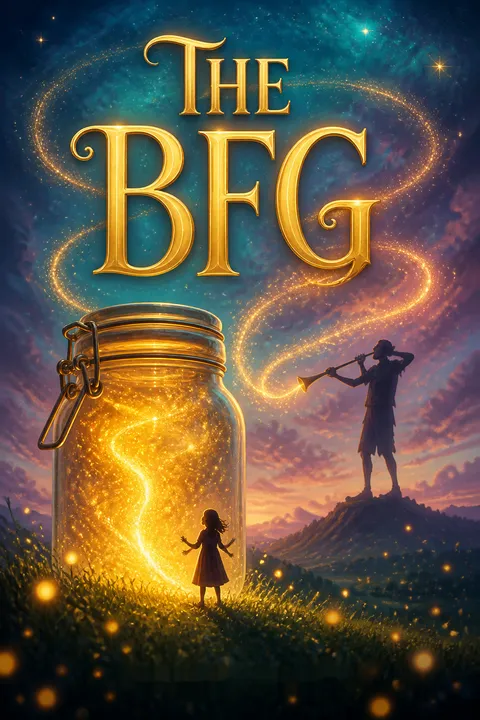
Sophie, an orphan in a village home, is awake after the other girls have fallen asleep when she spots a towering black figure outside. The giant pauses at the Goochey house, pours something from a jar into a long trumpet, and blows it through the window where two children sleep. He notices Sophie watching.
Before she can call for help, his hand lifts her, wrapped in her blanket, from her bed and carries her across fields, rivers, and an unknown landscape. His impossible speed turns the village into a shrinking patch of moonlight behind her. Sophie believes she is being taken for food, and has no way to know that the jar and trumpet conceal a purpose very different from the one she fears.
The abduction begins with a child making a choice: Sophie breaks the orphanage rules because curiosity outweighs fear. That choice brings her face to face with an adult-sized power she cannot resist, but the opening also plants a contradiction. The giant is not merely hunting; he performs a careful, almost ceremonial act at children’s windows. The jar and trumpet make the danger legible before its meaning is known. Sophie’s vulnerability is real, yet her attention to detail becomes the first form of agency she can carry into the unknown.
The Gentle Giant's Cave
The giant hides Sophie in a cave behind a stone the size of a house, then sets her on a table and announces that, unlike the other giants, he does not eat people. He calls himself the Big Friendly Giant, or BFG, but admits he took her because a human witness might expose him to the world. Outside, he shows Sophie the nine giants who hunt people every night, each with a favored country or taste.
Sophie understands that a return home could reveal the secret, while staying outside the cave could put her in the hunters’ reach. When she explains that she is an orphan, the BFG’s huge tears splash onto the floor. His kidnapping remains wrong, but his grief complicates the fear Sophie first felt.
The BFG’s kindness does not erase the coercion of his first act. He has decided Sophie’s future for her, then asks her to trust the moral distinction between himself and the other giants. Her orphanhood gives that distinction emotional weight: she has little safe home to return to, but that does not make captivity harmless. The giant’s tears show a capacity for empathy that he cannot yet translate into responsible action. Sophie, meanwhile, begins to assess him rather than simply fear him, a practical shift that lets a powerless child negotiate with a being who can lift her in one hand.
Dreams in Glass Jars
Sophie asks what the BFG had been doing in the village, and he finally explains that he blows good dreams into sleeping children’s rooms. His enormous ears can hear sounds humans miss, including the faint signals of passing dreams; he catches them with a net and stores them in bottles. The secret makes his strange nighttime visits less sinister, though Sophie is still stranded far from home.
She tells him that the orphanage’s cruel keeper, Mrs Clonkers, punished girls by locking them in a rat-filled cellar without food or water. The BFG’s sorrow is immediate. He feeds himself and Sophie only snozzcumbers, a repulsive vegetable, because he refuses to steal food or eat people. His principles are genuine, but they leave both of them hungry.
The dream collection gives the BFG a vocation rather than merely a magical ability: he uses extraordinary senses to bring children comfort while the other giants exploit darkness to harm them. Sophie’s account of the cellar links her past neglect to the present danger without making her helplessness disappear. She questions the BFG, corrects his words, and recognizes the limits of his good intentions. His refusal to steal is ethically consistent, but the awful vegetable makes the cost of that ethic tangible. Here, compassion is not an abstract virtue; it must survive hunger, loneliness, and an imperfect relationship.
A Hideout in Snozzcumber
The Bloodbottler, one of the man-eating giants, barges into the cave after hearing the BFG talking and suspects he has hidden a human child. Sophie cannot escape the high table, so she crawls into the hollow end of the partly eaten snozzcumber. The BFG draws the intruder’s attention to the vegetable and persuades him to taste it.
When the Bloodbottler bites down, Sophie is trapped inside his mouth; its foul taste makes him spit everything out. She lands against the BFG’s hanging cloak instead of the stone wall. The Bloodbottler leaves after smashing the vegetable over the BFG, and Sophie is safe. The BFG’s anger at the other giants hardens into a wish to stop them, and Sophie offers to help find a way.
Sophie survives through observation and nerve, using the very food she despises as concealment. The episode refuses to make the BFG’s decency sufficient protection: the Bloodbottler is stronger, has entered the cave, and nearly eats her despite the BFG’s intentions. The rescue depends on both characters adapting under pressure. Sophie improvises a hiding place; the BFG turns his own humiliation into a distraction. Their shared danger changes the relationship from captor and captive toward collaborators, though the imbalance of power remains. The comic disgust of the giant’s meal sharpens rather than cancels the bodily terror of being inside a predator’s mouth.
Thrown Across Giant Country
After Sophie discovers frobscottle, a sweet drink whose bubbles travel downward and produce the giants’ celebrated whizzpoppers, the BFG carries her in his pocket toward Dream Country. On the way, the other giants intercept him. Their leader, the Fleshlumpeater, has the group toss the smaller BFG from hand to hand until they tire of the game and send him running under a hail of rocks.
Sophie sees that the BFG’s gentleness has not made him safe among his own kind. They reach the mist country, where he sweeps a net through the air and catches two dreams: one golden and pleasant, the other a violent nightmare. He seals both in jars, refusing to release the nightmare where it might torment a child.
The giants’ game makes hierarchy physical: they turn the BFG into an object, while Sophie is carried inside his pocket and shares his danger without being able to intervene. His smallness is not just comic; it explains why years of moral disapproval have not stopped the nightly hunts. Dream Country offers a different kind of power, one based on listening and care rather than force. The BFG’s treatment of the nightmare also reveals responsibility in practice. Catching it is not enough; he must keep it from reaching a vulnerable sleeper.
A Nightmare Turns Back
The BFG decides to use the nightmare on the sleeping Fleshlumpeater. The giant dreams of a legendary human giant-killer, thrashes in terror, and strikes two sleeping companions; their retaliation wakes the rest, setting off a brawl across Giant Country. Later, Sophie studies the BFG’s jars and learns that he taught himself to read from a book he borrowed long ago.
Their quiet exploration ends when the nine giants announce that they are going to England to eat children from schools. Sophie cannot accept the BFG’s belief that nothing can be done. She proposes giving the Queen a dream that names the giants, predicts the raid, and promises a real girl and giant will appear to confirm it. The BFG agrees to try.
The nightmare turns the giants’ appetite for cruelty against them, but the BFG’s method is not simple revenge: the terror also exposes the group’s shared vulnerability and disrupts their routine. Sophie’s discovery of his borrowed book parallels her own education in this unfamiliar world; both characters learn by close attention rather than institutional permission. The announced raid forces their moral debate into a deadline. The BFG has accepted helplessness as the price of surviving among larger giants, while Sophie treats that resignation as a choice. Her plan uses his dream craft to make disbelief itself part of the strategy.
A Dream for the Queen
The BFG gathers dreams about the Queen, giants, children, and Sophie, then blends them into one frightening vision of the coming attack. The dream tells the Queen that the nine giants will enter England and that Sophie and the BFG can identify their hiding place. Because a warning alone might be dismissed as fantasy, Sophie insists that the Queen must wake to find her sitting in the bedroom window.
The BFG carries her through the night to London, slips into the Palace garden, and finds the Queen’s room by listening to the breathing beyond its windows. Sophie sits behind the curtains while he blows the dream toward the bed. He leaves her there to wait, with the Queen still asleep and the truth dependent on whether the dream reaches her.
Sophie’s plan is a carefully staged test of evidence. She understands that an extraordinary claim cannot persuade a ruler merely because it is true, so she arranges for one part of the dream to become physically verifiable. The strategy also reverses the opening image: instead of a giant secretly reaching into a child’s bedroom, a child waits at the edge of royal authority to prevent other children from being taken. The BFG’s skill gets them to the window, but Sophie accepts the exposed, frightening task of remaining there. Their cooperation now depends on trust in a plan neither can fully control.
The Queen Sees Sophie
At dawn, the Queen wakes distressed by the dream and finds Sophie on her windowsill, just as the dream predicted. A newspaper reports that children have vanished from Roedean and Eton, with bones found beneath dormitory windows.
The Queen summons the BFG, then feeds him and Sophie while the BFG recalls where the giants hunted on previous nights. Telephone calls to Sweden and Baghdad confirm that people disappeared in the places he names.
The Queen now has more than a child’s alarming story: she has a matching dream, a living giant, recent British disappearances, and foreign rulers reporting earlier losses. She summons the heads of the Army and Air Force and orders them to help capture the giants alive, rejecting their proposals to kill them.
The Queen’s belief is not secured by the dream alone. Its force comes from converging evidence: Sophie’s presence, the newspaper, the BFG’s knowledge, and reports from other countries. The sequence gives credibility a social dimension, showing how an unheard child becomes persuasive when institutions verify what she has seen. The Queen’s insistence on capture rather than execution also answers the BFG’s criticism that humans make rules for themselves. Her authority is exercised through restraint, even under pressure, though the military leaders initially imagine violence as the obvious solution.
The Army Follows the BFG
The BFG leads nine helicopters beyond the last pages of the military atlas to his hidden country, where the giants sleep before their nightly hunts. Soldiers creep forward with ropes and chains and bind eight giants, but the Fleshlumpeater wakes and grabs one man. Sophie uses the Queen’s sapphire brooch to stab his ankle.
The BFG persuades the frightened giant that a poisonous snake has bitten him, then ties his hands to his ankle while he clutches the supposed wound. The soldier escapes, and the remaining giants are secured. The army loads the BFG’s dream bottles for transport, then lifts the bound giants beneath helicopters and carries them toward England. Sophie’s quick action makes the capture possible.
This is the point where Sophie’s smallest possession becomes consequential force. The brooch is jewelry chosen to dress an orphan for breakfast at court, yet its pin gives her a way to act when the Fleshlumpeater threatens a soldier. The BFG’s deception completes what her courage begins: he turns the giant’s fear into the means of restraint. The scene makes cooperation necessary across differences in size and authority. Soldiers provide equipment, the BFG provides knowledge, and Sophie supplies improvisation. No single participant can manage the danger alone, a practical counterpoint to the giants’ habit of treating others as food or toys.
Snozzcumbers for Supper
England prepares a deep pit for the nine captured giants, and the BFG descends to untie them, safe from being eaten because giants do not eat their own kind. He and the Queen condemn them to a diet of snozzcumbers, while the BFG supplies plants so the crop will continue. Sophie receives a cottage near the BFG’s specially built home, where he can keep his dream collection and visit children to bring them good dreams.
The world sends gifts, including the elephant the BFG had once longed for, and Sophie begins teaching him to speak and write. He writes the story of their adventure, which the Queen has printed under another name. The book identifies itself as the tale the reader has just finished.
The ending answers the opening’s central problem by giving Sophie a secure home and giving the BFG a public place from which to do the work he was already doing in secret. The giants’ punishment mirrors the BFG’s old diet, but now snozzcumbers are imposed as containment rather than chosen restraint. Sophie’s lessons repay the BFG’s care while addressing the humiliation he feels about his speech and education. The final authorship turn makes their story an object passed outward, much like a dream: private experience becomes something that can reach children the characters will never meet.
Analysis
The BFG is built around a reversal of scale and authority. The giants are physically immense, yet their appetite makes them morally small; Sophie is physically small and socially unprotected, yet she repeatedly interprets situations more accurately than the adults and giants around her. Her power is not magical. It comes from attention, inference, and a willingness to act before certainty is complete. The BFG’s size makes him capable of crossing continents and hearing what no human can hear, but his isolation and fear have kept that capacity politically useless. Sophie helps him convert private decency into public action.
Dreams are both the story’s central magic and its model of persuasion. The BFG can catch, classify, and combine them, but Sophie understands that a dream alone will not convince the Queen after waking. She builds a test into the warning, so imagination produces evidence rather than replacing it. The Queen’s decision follows the same logic: she compares the dream with the newspaper and with reports from Sweden and Baghdad. The story therefore treats belief neither as gullibility nor as a failure of reason. It becomes reasonable when separate clues converge and when institutions are willing to listen to a child.
The book also puts competing moral systems beside one another. The giants justify eating humans through appetite; humans, as the BFG points out, kill their own kind while condemning other predators. The Queen’s refusal to answer violence with execution offers a practical alternative to simple revenge, though the giants’ confinement and forced diet remain a punitive solution. Sophie and the BFG instead embody a less grand form of ethical action: they prevent the next attack, protect strangers, and teach one another. Their final home and shared book turn rescue into lasting work. The BFG’s dreams continue to reach children, while Sophie’s instruction helps him claim literacy and authorship. Their friendship does not erase the unequal power that began with an abduction; it changes what each can do with that power.
Review Summary
The BFG receives mixed reviews, with many praising its imaginative story, memorable characters, and Dahl's creative language. Readers appreciate the friendship between Sophie and the giant, as well as the humorous elements. However, some criticize the giant's difficult-to-understand speech and potential racial insensitivity. Adults often enjoy revisiting the book, finding nostalgic value and hidden depth. While some consider it a classic, others feel it's not Dahl's strongest work. Overall, it remains a beloved children's book that sparks imagination and laughter.
People Also Read


Characters
Sophie
Curious orphan strategistSophie is an orphan who lives in a village children’s home and has learned to observe carefully because adults do not always protect the children in their care. Her curiosity leads her to watch the BFG, and her quick reasoning helps her understand his dream work and devise a way to warn the Queen. She is frightened, but fear does not prevent her from asking questions or acting when someone is in danger. Her relationship with the BFG grows from wary dependence into affection and partnership. Sophie’s intelligence is practical: she connects details, tests assumptions, and turns small opportunities into action.
The BFG
Dream-blowing outsiderThe BFG is a giant who refuses to eat people and spends his nights collecting dreams for children. His enormous ears let him hear sounds beyond human range, while his physical smallness makes him vulnerable among the other giants. He is compassionate, imaginative, and proud of his dream work, yet his limited schooling leaves him uncertain about language and about how humans will treat him. Sophie becomes his confidante and collaborator. His wish to help children coexists with fear of exposure, creating a character whose gentleness is genuine but whose courage must be learned.
The Queen of England
Practical royal allyThe Queen is accustomed to ceremony, but she can respond decisively when evidence demands it. She listens to Sophie, tests the BFG’s account against reports from other countries, and directs her military leaders toward capturing the giants rather than killing them. Her authority is not portrayed as mere pageantry: she can mobilize people and resources, but must first decide what kind of action is justified. Her relationship with Sophie is respectful, and her curiosity about the BFG makes room for an unfamiliar visitor inside a tightly ordered institution.
The Fleshlumpeater
Largest man-eating giantThe Fleshlumpeater is the largest of the nine human-eating giants and a dominant presence among them. He treats people as food and the BFG as an easy target for rough games, using size and confidence to control the group. His appetite and swagger contrast with the BFG’s restraint. The giant’s fear of a legendary human giant-killer also shows how easily a bully can be governed by the stories he believes.
The Bloodbottler
Cave-searching predatorThe Bloodbottler is a suspicious, aggressive giant who enters the BFG’s cave after hearing him speak. He is eager to find a human snack and enjoys intimidating the smaller BFG. His appetite makes him dangerous, but his greed also makes him susceptible to distraction. He embodies the casual brutality Sophie must survive whenever the other giants come close.
Mary
The Queen's maidMary is the Queen’s experienced maid, responsible for the morning routine and breakfast tray. She reacts with alarm to the impossible events in the royal bedroom, providing a grounded human response to Sophie’s arrival. Her loyalty to the Queen is clear, though she has no training for dealing with a child on a windowsill or a giant in the garden.
Mr Tibbs
Resourceful palace butlerMr Tibbs is the Palace butler, skilled at turning an impossible request into workable arrangements. When the BFG needs furniture and utensils large enough for him, Mr Tibbs improvises with Palace furnishings and kitchen equipment. He represents the practical machinery behind royal hospitality, meeting the extraordinary with efficiency rather than needing to understand it first.
Head of the Army
Impatient military plannerThe Head of the Army is a senior officer accustomed to conventional threats and direct force. He initially struggles to accept the BFG’s unfamiliar geography and methods, and he favors weapons when the giants’ scale seems to make ordinary tactics useless. His role exposes the gap between military confidence and the specialized knowledge needed for this mission.
Head of the Air Force
Skeptical air commanderThe Head of the Air Force helps organize the helicopter operation but is unsettled when the BFG leads the force beyond the known atlas. He values maps, plans, and reliable coordinates, all of which fail to contain Giant Country. His presence gives the expedition a cautious institutional counterweight to the BFG’s confidence.
The young pilot
Adventurous helicopter pilotThe young pilot accompanies the senior officers and flies one of the helicopters into unmapped territory. Unlike his commanders, he meets the strange journey with curiosity and a taste for adventure.
Mrs Clonkers
Cruel orphanage keeperMrs Clonkers runs the village orphanage where Sophie lives. Her severe punishments, including locking girls in a dark cellar without food or water, leave Sophie wary of adult authority.
The other seven giants
Man-eating giant packBonecruncher, Manhugger, Childchewer, Meatdripper, Gizzardgulper, Maidmasher, and Butcher Boy make up the rest of the hunting group. Each has a preferred way of finding human prey, from beaches and parks to city streets. Together they create a system of nightly predation, while their different habits give the BFG useful knowledge about their movements.
The King of Sweden
Foreign witnessThe King of Sweden speaks with the Queen after people vanish from his country. His report helps connect the BFG’s account to events beyond England.
The Sultan of Baghdad
Foreign witnessThe Sultan of Baghdad reports that members of his family disappeared from their beds. His account gives the Queen another independent point of comparison for the BFG’s knowledge.
Plot Devices
The dream-catching jars
Store and shape dreamsThe BFG catches dreams with a long net and seals them in glass jars, where he can identify and preserve them. Good dreams wait quietly; nightmares struggle against their confinement. The collection gives the BFG a way to bring comfort to children, and the different dreams can be combined to create a new one. Its practical use turns an invisible, fleeting experience into something that can be carried, selected, and delivered.
The Queen's mixed dream
Make disbelief testableSophie asks the BFG to combine dreams about the Queen, giants, child abductions, and a girl appearing at a bedroom window. The nightmare warns the Queen of danger, while Sophie’s real presence gives her a way to test part of what she has dreamed. The device makes persuasion depend not only on an extraordinary claim but on evidence the Queen can verify for herself.
Snozzcumbers
Food, cover, and punishmentSnozzcumbers are the only crop growing in Giant Country, and the BFG eats them because he refuses to prey on humans or steal food. Their foul taste becomes unexpectedly useful when Sophie hides inside one to escape the Bloodbottler. Later, the BFG’s supply of plants gives the human-eating giants a permanent food source that cannot harm people. The vegetable links his personal ethics to the punishment devised for the predators.
Frobscottle
Comic bond and reliefThe BFG’s sweet green drink has bubbles that move downward rather than upward, producing the giants’ loud, celebratory whizzpoppers. When Sophie tries it, their shared laughter briefly releases the tension of captivity and danger. The drink also gives Sophie a small experience of the BFG’s culture on its own terms, rather than through the frightening assumptions she brought from the human world.
The sapphire brooch
A small weapon in crisisThe Queen pins a sapphire brooch to Sophie’s borrowed dress at the Palace. When the Fleshlumpeater grabs a soldier during the capture operation, Sophie uses the brooch’s sharp pin to stab his ankle. The ornament’s transformation into a weapon makes Sophie’s earlier welcome at court materially useful, allowing her to interrupt the giant’s attack long enough for the BFG to restrain him.
FAQ
Synopsis & Basic Details
What is The BFG about?
- Orphan meets gentle giant: The story follows Sophie, a young orphan girl who is snatched from her bed during the "witching hour" by a giant.
- Discovery of a secret world: She is taken to Giant Country, where she discovers that her captor, the Big Friendly Giant (BFG), is a kind soul who blows good dreams into children's bedrooms, unlike the other nine monstrous, man-eating giants.
- A plan to save humanity: Learning that the other giants plan to eat children in England, Sophie and the BFG devise a daring plan to enlist the help of the Queen of England to stop the terrifying giants once and for all.
Why should I read The BFG?
- Celebrates friendship and courage: The book beautifully portrays the unlikely and deep bond between a small, brave girl and a lonely, kind giant, highlighting how friendship can overcome fear and difference.
- Imaginative language and world-building: Roald Dahl's unique use of language, particularly the BFG's "gobblefunk," creates a whimsical and memorable reading experience, building a world both fantastical and grounded in relatable emotions.
- Explores complex themes simply: Despite being a children's book, it touches on themes of justice, prejudice, the nature of good and evil, and the power of dreams, offering layers of meaning for readers of all ages.
What is the background of The BFG?
- Dedicated to a lost child: The book is dedicated "For Olivia, 20 April 1955 – 17 November 1962," referencing Roald Dahl's daughter who died from measles encephalitis at the age of seven, adding a poignant, personal layer to the story's themes of childhood vulnerability and protection.
- Published in 1982: The BFG was first published in 1982, building on a character Dahl had introduced in his 1975 book Danny, the Champion of the World, where the BFG was mentioned briefly as a giant who blew dreams.
- Reflects Dahl's fascination with dreams and giants: The story combines Dahl's recurring interest in the power of imagination and dreams (seen in his dream-catching activities) with the classic folklore trope of giants, subverting the typical monstrous image with the character of the BFG.
What are the most memorable quotes in The BFG?
- "We is in Giant Country now! Giants is everywhere around! Out there us has the famous Bonecrunching Giant!": This quote, spoken by the BFG early on, establishes the dangerous world Sophie has entered and immediately contrasts the BFG with his terrifying counterparts, setting the stakes for the story.
- "Words... is oh such a twitch-tickling problem to me all my life... I is speaking the most terrible wigglish.": The BFG's self-deprecating but charming explanation of his unique language, "gobblefunk," encapsulates his character's struggle with communication and his endearing humility.
- "Human beans is the only animals that is killing their own kind.": This profound observation from the BFG highlights a central, darker theme of the book, questioning human morality and suggesting that even monstrous giants are less inherently violent towards their own species than humans are.
What writing style, narrative choices, and literary techniques does Roald Dahl use?
- Inventive Language (Gobblefunk): Dahl creates a unique dialect for the BFG, filled with malapropisms and neologisms like "scrumdiddlyumptious," "whizzpoppers," and "trogglehumper," which provides humor, character depth, and a distinct voice.
- Hyperbole and Exaggeration: The descriptions of the giants' size, appetites, and the BFG's abilities (like hearing ants talk or plants scream) are greatly exaggerated, creating a sense of wonder and emphasizing the fantastical nature of the story.
- Dark Humor and Understated Horror: Dahl balances the whimsical elements with genuinely frightening concepts (giants eating children) and dark humor (the specific "flavors" of humans, the giants' brutal simplicity), creating a tone that is both entertaining and slightly unsettling.
Hidden Details & Subtle Connections
What are some minor details that add significant meaning?
- The Queen's Sapphire Brooch: The small detail of the Queen pinning a sapphire brooch on Sophie before the mission becomes crucial when Sophie uses its pin to injure the Fleshlumpeater, demonstrating how seemingly insignificant gifts or items can become vital tools in unexpected circumstances.
- The BFG's Reading Material: The BFG teaches himself to read using Charles Dickens' Nicholas Nickleby, a story about an orphan's struggles and eventual triumph, subtly mirroring Sophie's own journey from orphanage to finding a protector and helping others.
- The Gardener's Faint: When the BFG appears at the Palace, a gardener faints upon seeing him. This brief moment serves as a realistic counterpoint to the Queen's composure, highlighting the sheer, unbelievable shock the BFG's existence would cause to an ordinary person.
What are some subtle foreshadowing and callbacks?
- The Witching Hour Description: The initial description of the witching hour as when "all the dark things came out from hiding" foreshadows Sophie's encounter not just with the BFG, but with the reality of the other, truly dark giants who hunt during this time.
- The BFG's Wish for an Elephant: Early in the story, the BFG wistfully expresses a desire for an elephant to ride while picking fruit. This seemingly throwaway line is paid off at the end when the Ruler of India gifts him a magnificent elephant as a reward, fulfilling his dream.
- Giants' Fear of Jack: The Fleshlumpeater's nightmare about "Jack" and his "spikesticking beanstalk" is a direct callback to the classic fairy tale Jack and the Beanstalk, subtly establishing a pre-existing, perhaps mythological, fear of human giant-killers among the giants.
What are some unexpected character connections?
- Sophie and the Queen's Shared Experience: The connection between Sophie and the Queen is solidified not just by Sophie's presence, but by the fact that the Queen's nightmare about giants eating children aligns with real-world disappearances reported in the newspaper, making Sophie's story uniquely credible to her.
- The BFG's Connection to Human Literature: The BFG's self-education through Dickens reveals a deep, unexpected connection to human culture and storytelling, showing his capacity for learning and empathy despite his isolation and lack of formal schooling.
- The Giants' Simple, Human-like Fears: Despite their monstrous nature, the giants exhibit surprisingly human-like fears (like the Fleshlumpeater's terror of "Jack" or his concern about soldiers' hats sticking in his throat), making them slightly less purely evil and more akin to brutal, simple-minded bullies.
Who are the most significant supporting characters?
- The Queen of England: Far from a passive figurehead, the Queen is the pivotal character who bridges the gap between the fantastical threat and the real world's ability to combat it. Her open-mindedness and decisive action are essential to the plot's resolution.
- Mr. Tibbs, the Butler: While seemingly a minor character, Mr. Tibbs represents the ingenuity and adaptability of human systems when faced with the extraordinary. His elaborate, comical arrangements for the BFG's breakfast highlight the logistical challenges and humor of integrating the giant into the human world.
- The Fleshlumpeater: As the largest and most fearsome of the man-eating giants, the Fleshlumpeater serves as the primary antagonist and the embodiment of the threat Sophie and the BFG must overcome. His capture is the climax of the giant capture plan.
Psychological, Emotional, & Relational Analysis
What are some unspoken motivations of the characters?
- The BFG's Desire for Acceptance: Beyond simply not wanting to eat humans, the BFG's deep loneliness and his pride in his dream-blowing suggest an unspoken longing for acceptance and validation, which he finds in his friendship with Sophie and later, the Queen.
- Sophie's Need for a Protector/Family: Sophie's willingness to stay with the BFG, despite the initial terror and danger, stems from her life as an orphan. Her motivation is not just to stop the giants, but also to find a sense of belonging and safety, which the BFG provides.
- The Other Giants' Simple Hunger: The man-eating giants' motivation is presented as purely driven by appetite and habit ("Every giant is having his own favourite hunting ground"), highlighting their lack of complex thought or malice beyond basic predatory instinct, contrasting sharply with human cruelty.
What psychological complexities do the characters exhibit?
- The BFG's Sensitivity and Isolation: The BFG is deeply sensitive, capable of hearing the "screaming" of plants and crying enormous tears over Sophie's orphanage life. This acute sensitivity, coupled with his physical difference and moral stance, leads to profound isolation from his own kind.
- Sophie's Resilience and Adaptability: Despite being kidnapped and facing terrifying giants, Sophie quickly adapts to her extraordinary circumstances. Her ability to maintain composure, think strategically (like the dream plan), and even find humor reflects remarkable psychological resilience for a child.
- The Giants' Pack Mentality and Bullying: The nine man-eating giants exhibit a simple, brutal pack mentality, bullying the smaller BFG and finding amusement in cruelty ("playing ball" with him). Their behavior reflects a primitive, group-enforced dominance hierarchy rather than individual psychological depth.
What are the major emotional turning points?
- Sophie's Realization of the BFG's Kindness: The moment the BFG declares "I is THE BIG FRIENDLY GIANT!" is a major turning point, shifting Sophie's emotion from pure terror to cautious hope and opening the door for their friendship to develop.
- The BFG's Distress Over the Trogglehumper: Catching the "trogglehumper" dream deeply upsets the BFG, revealing the emotional weight of his work and his genuine care for the children he protects, solidifying his benevolent nature for Sophie.
- The Queen's Belief and Compassion: The Queen's decision to believe Sophie and the BFG, triggered by the dream and the newspaper report, is a crucial emotional turning point for the plot, demonstrating empathy and a willingness to act on extraordinary information.
How do relationship dynamics evolve?
- Captor to Protector/Friend: The relationship between Sophie and the BFG rapidly evolves from one of captor and terrified captive to a deep, trusting friendship based on mutual respect and affection ("huggybee," Sophie kissing his thumb).
- Orphan to Valued Partner: Sophie's role transforms from a helpless orphan to the BFG's indispensable partner in the plan to save children. Her intelligence and courage are valued and essential to their success, giving her agency she lacked in the orphanage.
- Skepticism to Alliance: The dynamic between the human world (represented by the Queen and military) and the giants (represented by the BFG and Sophie) shifts from disbelief and potential conflict (the BFG's fear of zoos) to a necessary alliance against a common enemy.
Interpretation & Debate
Which parts of the story remain ambiguous or open-ended?
- The Origin of Giants and Snozzcumbers: The BFG states that giants "simply appears, the same way as the sun and the stars," and snozzcumbers are the only thing that grows in Giant Country. The ultimate origin of these elements and their unique properties remains unexplained, adding to the world's mystery.
- The Nature of Dream Country: Dream Country is described as a misty, colorless place where dreams "float around in the air," but its location and how it exists separately from the human world are left ambiguous, emphasizing the magical, intangible quality of dreams.
- The BFG's Age and Past: While the BFG says he is "very very old and crumply. Perhaps as old as the earth," his exact age and the full history of his solitary existence among the other giants are not detailed, leaving much of his personal past open to reader interpretation.
What are some debatable, controversial scenes or moments in The BFG?
- The Morality of Eating Humans: The book presents the man-eating giants' actions as horrific but also includes the BFG's argument that humans kill each other more than giants kill giants or other species, prompting a debate about which species is truly more "beastly" or morally corrupt.
- The Giants' Punishment: The resolution involves permanently imprisoning the giants in a deep pit and feeding them only snozzcumbers. While presented as a just outcome, the ethics of this perpetual confinement and forced diet could be debated, especially considering their actions are framed as instinctual hunger.
- The Use of the Queen's Brooch: Sophie's act of stabbing the Fleshlumpeater with the Queen's brooch pin, while necessary for the plot, is a surprisingly violent act for the protagonist of a children's book, potentially sparking discussion about justified violence.
The BFG Ending Explained: How It Ends & What It Means
- Giants Captured and Imprisoned: The story concludes with the nine man-eating giants being tricked, captured by the British military (led by the BFG and Sophie), and permanently imprisoned in a deep pit in England, where they are forced to eat only snozzcumbers. This signifies the triumph of cleverness and cooperation over brute force and cruelty.
- Sophie and the BFG Find a Home: Sophie and the BFG are celebrated as heroes. The Queen provides them with homes in Windsor Great Park, allowing them to live safely and together. This represents Sophie finding a loving family and the BFG finding acceptance and purpose outside of his lonely existence.
- The BFG Becomes a Writer: The BFG learns to read and write properly with Sophie's help and eventually writes the very book the reader has just finished. This meta-fictional twist emphasizes the power of storytelling, education, and the idea that even the most unlikely individuals have stories worth telling, cementing their legacy.
About the Author
Other books by Roald Dahl
Download PDF
Download EPUB
.epub digital book format is ideal for reading ebooks on phones, tablets, and e-readers.








