

Plot Summary
The Fire at Briny Beach
On a gray morning at Briny Beach, Violet Baudelaire, fourteen and forever turning over inventions in her mind, skips stones while Klaus studies tide pools and baby Sunny bites whatever she can reach. Their parents’ friend Mr. Poe arrives from the city and tells them a fire has killed their parents and destroyed their mansion.
The news takes their home, their possessions, and the library where Klaus had hoped to read every book. As executor, Mr. Poe explains that Violet’s inheritance must remain protected until she is old enough to claim it. With no home and no nearby relative chosen by their parents, the siblings leave the beach holding hands and enter a future arranged by a banker rather than by family.
The beach makes the loss painfully ordinary: the siblings are absorbed in their own small interests when an adult arrives to redraw their lives. Each child’s response is distinct. Klaus thinks of the books he will never finish, Violet loses access to the space where her inventiveness flourished, and Sunny’s habitual biting dulls. The fortune offers security in theory, but its legal inaccessibility means it cannot help them when they need it most. Mr. Poe becomes the first example of a recurring imbalance: adults possess the authority to decide what happens to the children, while the children must live with the consequences.
An Eye Above the Door
After several bleak days in Mr. Poe’s crowded home, the Baudelaire children learn that they are being sent to Count Olaf, a distant relative who lives nearby and works as an actor. Their first welcome comes from Justice Strauss, the judge next door, whose neat house makes Olaf’s sagging, filthy home look worse by comparison.
Olaf greets the children in a stained suit and leads them past an eye carved into his front door. He gives the three siblings one cramped bedroom, a single bed, and a pile of rocks instead of toys or books. Their clothes go into a discarded appliance box. Olaf is often absent, but leaves them difficult chores, marking his instructions with the same eye that appears throughout the house and on his ankle.
The children’s transfer is presented as a search for convenient placement, not for emotional safety. The contrast between Justice Strauss’s cared-for home and Olaf’s neglected one lets them recognize danger before they can name it. The repeated eye turns that unease into a concrete experience of surveillance: Olaf seems present even when he is away. Their cramped sleeping arrangements also make the siblings’ dependence literal. They have each other, but little privacy, comfort, or control over their days. The new household does not simply fail to replace their former home; it converts their abilities and labor into resources an adult can use.
Dinner for Olaf’s Troupe
One morning Olaf orders the children to prepare dinner for his ten-person theater troupe. Justice Strauss lends them a cookbook from her private library, where Klaus finds a pasta recipe; the siblings buy ingredients, cook together, and briefly feel less alone.
Their hope collapses when Olaf returns expecting roast beef. He frightens Sunny by lifting her, then lets her go when his actors enter. One performer threatens Violet, and the troupe eats the meal without concern for the children.
When Klaus protests that they have only one bed, Olaf points to the inheritance they cannot access and strikes him across the face. His companions laugh. Violet comforts Klaus, and Sunny retrieves his glasses, small acts of care in a house where the adults have made cruelty part of the evening’s entertainment.
Cooking gives the siblings a brief, practical form of agency: they choose a recipe, divide the work, and remember their parents while the sauce simmers. That shared competence matters because Olaf’s household otherwise reduces them to unpaid labor. His reaction to the meal shows that obedience is not enough; the rules can change whenever he wants them to. The slap turns Klaus’s complaint into a visible injury, while the troupe’s laughter makes abuse feel socially protected. In contrast, Sunny returning his glasses and Violet staying beside him show how the siblings create a small system of recognition and care that Olaf cannot fully commandeer.
The Bank Refuses Them
Violet and Klaus decide to seek help from Mr. Poe, but must walk across the city to find his bank because Olaf has not left them a map. Mr. Poe listens between telephone calls, then dismisses their complaints as an adjustment to a new home; the legal phrase in loco parentis, he says, gives Olaf wide authority. The children visit Justice Strauss afterward and borrow books, their only available refuge.
The next morning Olaf serves them raspberries and pretends to regret his behavior. He then announces a play in which Klaus and Sunny will appear as wedding guests and Violet will play his bride, with Justice Strauss as the judge. When Violet objects, Olaf invokes his authority as guardian and makes clear that her participation is compulsory.
The bank scene reveals that procedure can be a shelter for adults as readily as a safeguard for children. Mr. Poe does not need to be malicious to abandon the siblings; his reliance on a legal category lets him treat their concrete injuries as an ordinary transition. Justice Strauss offers warmth and books, but she has not yet understood the danger in the neighboring house. Olaf’s raspberries are a calculated use of familiar comfort: he briefly imitates care, then converts the children’s legal dependence into coercion. Violet’s refusal to trust the performance instinctively is significant. She has learned that a pleasant gesture does not erase the pattern of what came before.
Klaus Finds the Clause
Violet and Klaus search Justice Strauss’s law books for a way to stop Olaf’s play. Justice Strauss, excited by her first chance to perform, does not suspect the scheme. When Olaf’s hook-handed assistant discovers Klaus studying inheritance law, he threatens him and bars the children from the library.
Klaus secretly carries away a book on marriage law and reads through the night. He learns that a wedding before a judge, followed by Violet’s spoken consent and her signature, could make the ceremony legally binding; a husband could then control his wife’s property.
At dawn, Klaus confronts Olaf with the plan and believes he has exposed it. Olaf gives no sign of panic. Klaus returns to wake his sisters, only to find Sunny missing from her makeshift bed.
Klaus’s knowledge becomes a survival tool, but the episode also tests his faith that reading can make a problem solvable. The legal text gives him a precise explanation of Olaf’s strategy, yet information alone does not protect the children. His confrontation mistakes the discovery of a plan for the defeat of one. Olaf’s calm response is therefore more frightening than anger: he has already prepared a move the book cannot prevent. Justice Strauss’s stage excitement and Mr. Poe’s earlier procedural indifference show how institutions can be manipulated by people who understand their rules better than the people meant to uphold them. Klaus’s courage is real, but so is the cost of acting without power.
Sunny in the Tower
Olaf leads Violet and Klaus outside and points to Sunny, bound in a cage high in the tower window. He offers to release her after the performance if Violet agrees to marry him, making Sunny’s safety the price of her obedience.
Violet accepts because the alternative is watching her baby sister fall. That night, she builds a grappling hook from a broken curtain rod, the wire from an eye painting, and strips of unwanted clothes tied into a rope. She climbs the tower alone, but the hook catches on the hook-handed assistant’s metal prosthesis.
He hauls Violet inside and drops her rescue device. The assistant later brings Klaus up as well. By morning, all three siblings are imprisoned in the tower room, with Sunny still trapped and the performance approaching.
Olaf turns Violet’s protective responsibility into leverage. Her agreement is not consent in any meaningful sense; it is an attempt to keep Sunny alive under a threat designed to eliminate every safe choice. Violet’s improvised device shows that her inventiveness is not a decorative talent but a response to material scarcity. Yet the failed rescue prevents a simplistic equation between ingenuity and victory. Her plan works technically, but Olaf’s guards alter the conditions around it. The siblings’ capture makes the danger collective: Violet’s attempt to save Sunny also brings Klaus into confinement. Their loyalty remains their strength, but Olaf has learned how to use that loyalty against them.
The Wedding Turns
Olaf brings the captive siblings to the theater for the final act. Backstage, Justice Strauss treats the ceremony as a real legal wedding, while the children fail to convince her to change the script. Mr. Poe arrives, but Olaf’s presence prevents Klaus from warning him.
Onstage, Violet says the required words and signs the official document with her left hand. Olaf announces that the marriage gives him control of the Baudelaire fortune, but Violet points out that the law requires her own hand, meaning her right hand.
Justice Strauss agrees that the signature invalidates the marriage. Sunny is brought back safely, and the adults turn against Olaf. Before he can be arrested, a troupe member cuts the lights; Olaf and his accomplices escape in the confusion.
The climax depends on a distinction too small for the audience to notice and large enough to defeat Olaf’s plan. Violet cannot openly refuse without risking Sunny, so she finds a narrow space inside the required act and uses a detail Olaf failed to control. This is not a triumph of force but of close attention, the same habit that drives her inventions. Justice Strauss’s role shifts from unwitting participant to legal interpreter, though only after the damage has nearly been done. The theater’s darkness then reverses the apparent victory: the crowd can identify Olaf’s wrongdoing but cannot keep hold of him. The law corrects the marriage, yet does not restore lasting safety.
Justice Strauss Says Goodbye
After the escape, Justice Strauss offers the Baudelaire children a home, and the siblings begin to imagine a life with her library and garden. Mr. Poe stops them: their parents’ will requires them to live with a relative, and Justice Strauss does not qualify. He takes them to his own house for the night and says he will consult the bank about their next placement.
Justice Strauss accepts the decision, though she is devastated, and hugs each child before they leave. Violet, Klaus, and Sunny watch her recede through the car’s back window. Ahead lies an unknown home; behind them is the one adult who listened, helped, and treated them as people. Their immediate danger has passed, but their future remains in other hands.
The ending withholds the conventional reward that the theater scene seemed to promise. Justice Strauss has earned the children’s trust through books, attention, and practical kindness, yet none of those qualities can override the legal rule governing their placement. Mr. Poe again treats procedure as decisive, even when its human cost is plainly visible. The siblings’ departure therefore repeats the structure of the opening: adults decide where they belong, and the children must travel there. But the repetition is not emotionally identical. They now know that kindness exists beyond their family and that their own intelligence can expose a scheme. These resources cannot guarantee security, but they change what helplessness means.
Analysis
The novel makes the Baudelaire children’s danger depend less on a lack of intelligence than on their lack of recognized authority. Violet can invent, Klaus can research, and Sunny can communicate her needs in the ways available to her, yet adults control the home, the money, and the legal decisions. Mr. Poe’s failures are especially important because they are procedural rather than spectacular. He believes a guardian’s formal status excuses him from examining what that guardian does. The book thus distinguishes institutional correctness from actual protection.
Olaf’s theater plot turns performance into a practical instrument of coercion. The wedding is staged so that a real legal act can hide inside something the audience believes is make-believe. This makes the theater more than a setting: it is a model of how appearances can train people to overlook what is happening in front of them. Justice Strauss’s excitement, the audience’s limited awareness, and Mr. Poe’s inability to intervene all help the deception work. Violet counters it not through a dramatic refusal but through exact attention to a small legal requirement. Her left-handed signature is a modest action with enormous consequences, suited to a story in which survival depends on noticing details that powerful people dismiss.
The siblings’ talents are also forms of character. Klaus trusts books because they organize a frightening world; Violet trusts making because it turns thought into something usable. Both approaches help, but neither is sufficient on its own. Klaus’s knowledge cannot prevent Sunny’s capture, and Violet’s grappling hook cannot overcome Olaf’s guard. Their abilities matter most when joined to mutual care: they investigate for one another, risk themselves for one another, and keep returning to the task of protecting the youngest sibling.
The ending refuses to make rescue equivalent to safety. Olaf escapes, and the children lose the chance to remain with Justice Strauss, the adult who has treated them most generously. Their immediate crisis ends without a secure home, preserving the novel’s central tension: courage and competence can change the outcome of a moment, but cannot by themselves undo a world in which children’s welfare is decided by adults and rules.
Review Summary
The Bad Beginning receives generally positive reviews, with readers praising its dark humor, unique writing style, and engaging characters. Many appreciate the book's subversive take on children's literature and its vocabulary-building approach. Some readers find it nostalgic, while others criticize its depressing tone. The story of the orphaned Baudelaire children and their struggle against the villainous Count Olaf resonates with many, though some feel the plot is simplistic. Overall, readers find it an entertaining start to the series, despite its intentionally unfortunate events.
People Also Read





Characters
Violet Baudelaire
Inventor and eldest siblingViolet, fourteen, is the eldest Baudelaire child and a resourceful inventor who thinks through problems in gears, pulleys, and improvised mechanisms. She ties her hair back when she needs to concentrate, a small ritual that reflects how deliberately she manages attention. Her parents have entrusted her with looking after Klaus and Sunny, and that responsibility shapes how she weighs danger: she often accepts risk for herself before allowing it to fall on her siblings. Violet is capable and observant, but she is still a young person forced to make decisions without dependable adult protection. Her central tension is between the confidence her skills inspire and the loneliness of having to use those skills in place of help.
Klaus Baudelaire
Reader and careful brotherKlaus, a little over twelve, is the middle Baudelaire child, an avid reader with an unusually strong memory for what he studies. His parents’ extensive library has taught him to approach confusion by gathering facts, comparing details, and searching for rules. He is protective of Violet and Sunny, though his reliance on books can make him believe that the right information will always produce a safe answer. Klaus is also emotionally direct: he names the cruelty around him and shows anger when adults ignore it. His glasses, books, and careful observations are not simply signs of intellect; they are the tools he uses to preserve a sense of order when the adults around him make arbitrary decisions.
Sunny Baudelaire
Biting infant sisterSunny is the youngest Baudelaire, a tiny infant whose sharp teeth and habit of biting make her preferences unmistakable despite her limited speech. Her siblings interpret her sounds and gestures with affection, and she responds to people through physical contact, especially biting. Sunny is dependent on Violet and Klaus for nearly everything, but she is not merely a passive presence: she notices, reaches, and acts in the small ways available to her. Her vulnerability intensifies the choices her siblings face, while her lively appetites keep her personality distinct from the tragedy surrounding the family. Sunny’s place in the trio makes care a daily, practical responsibility rather than an abstract promise.
Count Olaf
Predatory theatrical guardianCount Olaf is a tall, shabby actor whose theatrical ambitions coexist with a talent for intimidation and manipulation. His glittering eyes, single eyebrow, and eye insignia make his appearance feel deliberately watchful, while his home and treatment of the children reveal how little he values their comfort. Olaf uses the authority adults have over children as a weapon, shifting from feigned warmth to open threats when it suits him. He is not merely impulsive or careless: he plans, recruits accomplices, and pays close attention to what the law permits. His vanity as a performer helps him disguise exploitation as spectacle, making the children’s forced participation in his household and theater part of his control.
Mr. Poe
Distracted estate executorMr. Poe is the Baudelaire parents’ friend and the banker assigned to manage the children’s inheritance and placement. He is courteous and appears concerned, but work repeatedly distracts him from listening closely to the children. His trust in official rules makes him reluctant to question a guardian’s conduct, even when the siblings describe specific mistreatment. Mr. Poe represents a failure of care through bureaucratic passivity rather than deliberate cruelty: he believes that following the proper process is enough.
Justice Strauss
Neighbor and High Court judgeJustice Strauss is Count Olaf’s neighbor and a High Court judge whose tidy home and welcoming library offer the Baudelaire children a rare place to feel at ease. She enjoys gardening and has long wanted to perform onstage, which makes her receptive to Olaf’s theatrical invitation. Her kindness is genuine, but her excitement and trust can leave her slow to recognize how others are using her. She brings both warmth and legal knowledge into the children’s lives.
Mrs. Poe
Temporary household hostMrs. Poe is Mr. Poe’s wife and the hostess of the household where the Baudelaires stay after their parents’ deaths. She buys them uncomfortable clothes and places them in a crowded room with her sons. Her response to the children is practical and detached, offering shelter without the attentive care they need.
Edgar and Albert Poe
Unkind temporary housematesEdgar and Albert are the loud, inconsiderate sons of Mr. and Mrs. Poe. They resent sharing their room with the Baudelaire children and complain about Sunny’s biting. Their behavior makes the Poe home feel less like refuge and more like another place where the siblings are merely being accommodated.
The hook-handed man
Hook-handed theater enforcerOne of Count Olaf’s troupe members, the hook-handed man uses metal prostheses in place of hands and acts as a guard and threatener. He speaks to Klaus with calculated menace and helps enforce Olaf’s control over the children. His role reveals how the troupe’s loyalty to Olaf turns the theater company into an extension of his household power.
Count Olaf’s theater troupe
Unsettling theatrical accomplicesOlaf’s troupe includes a bald performer with a long nose, two white-faced women, an enormous member whose gender the children cannot readily identify, a wart-faced man, and others. Some assist with costumes, threats, and stage effects; not all appear to know the full purpose of the performance. Their presence gives Olaf both practical help and an audience that often treats his cruelty as entertainment.
The Baudelaire parents
Loving family foundationViolet, Klaus, and Sunny’s parents are remembered through the children’s habits, possessions, and shared family memories. They encouraged Violet’s inventiveness, filled their home with books for Klaus, and taught the siblings to look after one another. Their warmth becomes the standard against which the children measure the adults now making decisions about their lives.
Plot Devices
The Baudelaire inheritance
A fortune beyond their reachThe children’s inheritance is managed by the bank and cannot be used until Violet comes of age. This restriction explains why the siblings cannot simply leave Olaf, replace their lost possessions, or pay for a safer home. It also gives Olaf a concrete incentive to keep the children under his control. The fortune is therefore both a possible source of future security and a present source of danger: its legal protection does not protect the children from the adult who wants access to it.
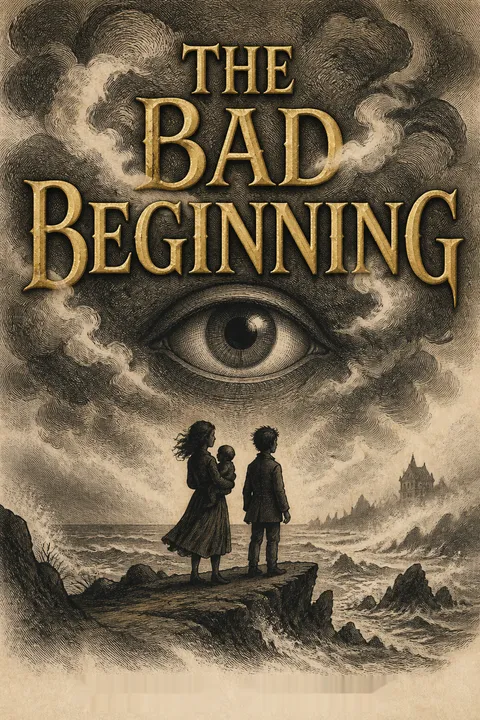
The eye insignia
Olaf’s mark of surveillanceThe eye appears carved on Olaf’s door, painted on objects in the house, and tattooed on his ankle. Its recurrence gives the children a visual clue that connects Olaf’s public appearance to the atmosphere of his home. It also makes his control feel continuous: even when he is absent, the mark remains on walls and belongings. The emblem is a motif as well as a warning, turning a simple repeated image into a reminder that the children are being watched and managed.
Marriage law
A ceremony with legal forceKlaus’s research reveals that a marriage requires a judge, the bride’s consent, and a signature in her own hand. Olaf exploits those rules by disguising a legally binding ceremony as the final act of a play. Violet cannot safely refuse while Sunny is held in the tower, so she uses the requirement concerning the signature to resist within the performance itself. The law first gives Olaf a route toward the fortune, then provides Violet with the precise technical distinction that can invalidate his claim.
Violet’s improvised tools
Ingenuity under constraintViolet’s inventiveness recurs as a means of responding to problems the adults have left unsolved. The story first establishes her mechanical imagination and her habit of concentrating by tying back her hair. Later, without proper equipment, she repurposes a curtain rod, picture wire, and strips of clothing to build a grappling hook. Her inventions do not guarantee success, but they make action possible when the children have no purchased tools, money, or reliable adult assistance.
FAQ
Synopsis & Basic Details
What is The Bad Beginning about?
- Orphaned siblings face peril: The Bad Beginning tells the story of the Baudelaire children—Violet, Klaus, and Sunny—who become orphans after their parents die in a fire and are placed under the care of the villainous Count Olaf.
- Count Olaf's sinister plot: Count Olaf, their distant relative, is not interested in their well-being but in their vast fortune, which he schemes to obtain through a deceptive marriage plot.
- Children's resilience and struggle: The children must use their intelligence and resourcefulness to navigate the dangers and injustices they face, while also dealing with the grief of losing their parents and home.
Why should I read The Bad Beginning?
- Unique narrative voice: Lemony Snicket's distinctive, darkly humorous, and meta-narrative style offers a refreshing and engaging reading experience, constantly reminding the reader of the story's tragic nature.
- Intriguing characters: The Baudelaire children are intelligent and resourceful, while Count Olaf is a memorable villain, making for a compelling dynamic between good and evil.
- Exploration of themes: The book delves into themes of loss, injustice, and the importance of family, making it a thought-provoking read beyond its surface plot.
What is the background of The Bad Beginning?
- No specific historical setting: The story is set in a vaguely modern, yet timeless, urban environment, with elements of both old-world charm and contemporary life, creating a slightly surreal atmosphere.
- Focus on social commentary: The book critiques the ineffectiveness of adults and the legal system, highlighting how they often fail to protect children, reflecting a broader social commentary.
- Gothic and theatrical influences: The story incorporates elements of gothic literature, such as a dilapidated mansion and a sinister villain, alongside theatrical elements, like the play within the story, creating a unique blend of genres.
What are the most memorable quotes in The Bad Beginning?
- "If you are interested in stories with happy endings, you would be better off reading some other book.": This opening line immediately establishes the tone of the series, warning readers of the misfortunes to come and setting the stage for a non-traditional narrative.
- "Although he said he was the executor, Violet felt like Mr. Poe was the executioner.": This quote highlights Violet's astute perception of Mr. Poe's role in their lives, revealing the subtle ways in which adults can fail children, despite their intentions.
- "Your initial opinion on just about anything may change over time.": This quote, while seemingly simple, underscores the unreliable nature of first impressions, a theme that is central to the story and the children's experiences with Count Olaf.
What writing style, narrative choices, and literary techniques does Lemony Snicket use?
- Meta-narrative and direct address: Snicket frequently breaks the fourth wall, directly addressing the reader, offering commentary, and warning them about the story's unpleasantness, creating a unique and engaging reading experience.
- Dark humor and irony: The narrative is filled with dark humor and irony, often juxtaposing tragic events with humorous observations, creating a distinctive tone that is both entertaining and unsettling.
- Extensive use of vocabulary and definitions: Snicket often interrupts the narrative to define words, not only enriching the reader's vocabulary but also adding to the book's unique style and highlighting the importance of language.
Hidden Details & Subtle Connections
What are some minor details that add significant meaning?
- The eye motif: The recurring image of an eye, found on Count Olaf's door, his tattoo, and throughout his house, symbolizes his constant surveillance and the lack of privacy the children experience, foreshadowing his manipulative nature.
- Justice Strauss's name: Her title, "Justice," is ironic given the injustices the children face, highlighting the failure of the legal system to protect them, and her first name is never revealed, emphasizing her role as a symbol of justice rather than an individual.
- The children's possessions: The destruction of the children's belongings in the fire, such as Violet's microscope and Klaus's pen, symbolizes the loss of their past lives and the disruption of their identities, emphasizing the depth of their loss.
What are some subtle foreshadowing and callbacks?
- Mr. Poe's cough: Mr. Poe's constant coughing fits, often interrupting important conversations, foreshadow his ineffectiveness and inability to help the children, highlighting his role as a well-meaning but ultimately useless adult.
- The mention of Al Funcoot: The name of the playwright, Al Funcoot, is a subtle nod to the absurdity of the play and the ridiculousness of Count Olaf's scheme, foreshadowing the farcical nature of the wedding plot.
- The children's skills: The children's individual skills, such as Violet's inventing, Klaus's reading, and Sunny's biting, are subtly foreshadowed early on and become crucial to their survival and attempts to thwart Count Olaf's plans.
What are some unexpected character connections?
- Justice Strauss and Count Olaf: The fact that Justice Strauss is Count Olaf's neighbor, yet completely unaware of his true nature, highlights the theme of deception and the ability of evil to hide in plain sight, creating a sense of unease.
- Mr. Poe and Count Olaf: Mr. Poe's unwitting role in facilitating Count Olaf's guardianship, despite his supposed responsibility to protect the children, reveals the systemic failures that allow Count Olaf to exploit the legal system.
- The hook-handed man and the library: The hook-handed man's presence in Justice Strauss's library, and his threat to Klaus, reveals the extent of Count Olaf's reach and the danger the children are in, even in seemingly safe spaces.
Who are the most significant supporting characters?
- Justice Strauss: She provides a temporary haven and a source of knowledge for the children, representing the potential for kindness and support in a world filled with cruelty, and her library becomes a symbol of hope and escape.
- Mr. Poe: Despite his ineffectiveness, he represents the flawed adult world and the legal system that fails to protect the children, highlighting the theme of adult incompetence and the children's vulnerability.
- The hook-handed man: As a menacing henchman, he embodies the constant threat of violence and the lengths to which Count Olaf will go to achieve his goals, serving as a physical manifestation of the danger the children face.
Psychological, Emotional, & Relational Analysis
What are some unspoken motivations of the characters?
- Count Olaf's insecurity: Beneath his greed, Count Olaf's actions are driven by a deep-seated insecurity and a need for power, which he attempts to fulfill by controlling the Baudelaire fortune and manipulating those around him.
- Mr. Poe's fear of responsibility: Mr. Poe's reluctance to intervene is motivated by a fear of taking responsibility and a desire to avoid conflict, highlighting his inability to act as a true guardian for the children.
- Justice Strauss's desire for purpose: Justice Strauss's eagerness to participate in the play stems from a desire for purpose and recognition, revealing her own vulnerabilities and her susceptibility to Count Olaf's manipulation.
What psychological complexities do the characters exhibit?
- Violet's burden of responsibility: Violet carries the weight of her siblings' safety, often suppressing her own emotions to focus on problem-solving, revealing her complex mix of strength and vulnerability.
- Klaus's intellectual frustration: Klaus's reliance on books and knowledge is both a strength and a source of frustration, as he struggles to reconcile his intellectual understanding with the harsh realities of their situation.
- Sunny's emotional resilience: Despite her infancy, Sunny exhibits a remarkable resilience and a strong will, using her biting as a form of communication and resistance, revealing her emotional depth beyond her age.
What are the major emotional turning points?
- The news of their parents' death: The children's initial shock and grief at the news of their parents' death is a major emotional turning point, setting the stage for their subsequent struggles and highlighting the depth of their loss.
- The discovery of Count Olaf's plan: The revelation of Count Olaf's marriage plot is a turning point, shifting the children's focus from grief to survival and forcing them to confront the immediate danger they face.
- Violet's decision to marry Count Olaf: Violet's decision to sacrifice herself to save Sunny is a major emotional turning point, highlighting her selflessness and the lengths she will go to protect her siblings.
How do relationship dynamics evolve?
- Sibling bond strengthens: The children's shared experiences of loss and adversity strengthen their bond, as they rely on each other for support and comfort, highlighting the importance of family in the face of hardship.
- Distrust of adults grows: The children's experiences with Mr. Poe and other adults lead to a growing distrust of authority figures, as they realize they must rely on their own abilities to survive.
- Justice Strauss as a temporary ally: The children's relationship with Justice Strauss offers a glimpse of kindness and support, but her inability to protect them ultimately highlights the limitations of adult intervention and the children's isolation.
Interpretation & Debate
Which parts of the story remain ambiguous or open-ended?
- The nature of the fire: The exact cause of the fire that killed the Baudelaire parents is never revealed, leaving the reader to wonder if it was truly an accident or something more sinister, adding to the overall mystery.
- Count Olaf's motivations: While his greed is apparent, the deeper reasons behind Count Olaf's obsession with the Baudelaire fortune and his cruelty remain somewhat ambiguous, leaving room for interpretation about his character.
- The future of the Baudelaires: The ending leaves the children's future uncertain, as they are once again without a guardian and facing an unknown fate, emphasizing the ongoing nature of their misfortunes and the lack of a true resolution.
What are some debatable, controversial scenes or moments in The Bad Beginning?
- Mr. Poe's inaction: Mr. Poe's repeated dismissal of the children's concerns and his failure to protect them is a controversial aspect of the story, raising questions about the responsibility of adults and the effectiveness of the legal system.
- Justice Strauss's naivete: Justice Strauss's blind faith in Count Olaf and her inability to see his true nature is a controversial element, highlighting the dangers of naivete and the ease with which evil can manipulate good intentions.
- Violet's forced marriage: The forced marriage plot is a controversial element, raising questions about the exploitation of children and the lengths to which villains will go to achieve their goals, making it a disturbing and thought-provoking aspect of the story.
The Bad Beginning Ending Explained: How It Ends & What It Means
- Count Olaf's escape: Count Olaf's escape at the end of the book signifies that evil is not easily defeated and that the children's troubles are far from over, setting the stage for future conflicts and highlighting the ongoing nature of their misfortunes.
- Loss of Justice Strauss: The children's forced separation from Justice Strauss underscores the theme of injustice and the limitations of the legal system, as they are once again placed in an uncertain situation despite her kindness and support.
- Cycle of misfortune: The ending reinforces the cyclical nature of the children's misfortunes, as they are once again left without a home or a reliable guardian, emphasizing the tragic tone of the series and the ongoing challenges they face.
A Series of Unfortunate Events Series

About the Author
Other books by Lemony Snicket
Download PDF
Download EPUB
.epub digital book format is ideal for reading ebooks on phones, tablets, and e-readers.








