

Plot Summary
The Eye at Paltryville
Violet, fourteen, Klaus, twelve, and baby Sunny Baudelaire are being sent to a new guardian after their parents' deaths and Count Olaf's repeated attempts to seize their inheritance. Banker Mr. Poe delivers them to Paltryville, then boards the returning train rather than stay overnight.
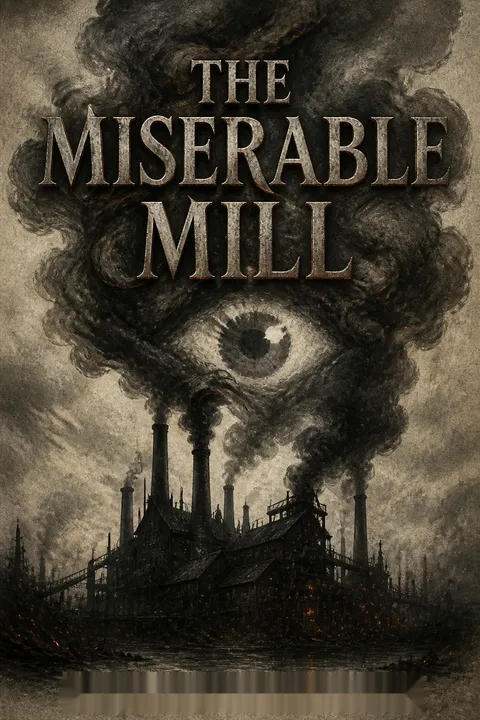
The town offers shuttered shops, a gum-lettered gate, and stacks of newspapers instead of trees. At the far end stands a windowless building painted like an enormous eye, the same image as Olaf's ankle tattoo.
The siblings recognize the resemblance but cannot prove it means anything. With nowhere else to go, they enter the Lucky Smells Lumbermill to find their new caretaker. The train vanishes into the forest, leaving them with suspicion, a small bag, and no adult they trust to protect them.
The journey begins with a practical failure of guardianship: Poe transports the children but will not remain long enough to see them safely settled. The eye-shaped building gives their fear a visible object before they know whether it is evidence or coincidence. That uncertainty matters. The Baudelaires are not simply frightened children; they have learned to read surroundings because adults repeatedly dismiss what they notice. Their arrival therefore establishes the book's central tension between observation and official reassurance. They must decide whether to trust their own pattern recognition, even when the only responsible adult present has already left.
A Bargain Behind the Gates
An envelope orders the Baudelaires to live in the dormitory and report for mill work, although Poe had promised only a guardian. Phil, a weary but hopeful worker, shows them the windowless bunks and explains that the owner rarely appears while the new foreman, Flacutono, terrorizes the crew.
The owner soon arrives with his face hidden in cigar smoke and offers protection from Olaf in exchange for years of labor until Violet comes of age. His partner Charles objects, gives the hungry children a peach, and shows them an empty library containing only three donated books.
One, Dr. Orwell's medical text, bears the same eye emblem as the building outside. The bargain leaves the Baudelaires trapped inside the gates, ostensibly protected from the danger they already suspect is nearby.
Sir makes safety conditional on the children surrendering their time and labor, turning a guardian's duty into a business exchange. His face obscured by smoke matches his refusal to be personally accountable: he names himself the boss and expects that title to settle every objection. Charles offers food and a library, but neither gesture changes the terms imposed by Sir. The eye on Orwell's book extends the earlier warning into the mill itself. Even the apparent refuge contains a clue to danger, while the children must depend on adults whose kindness and authority do not translate into protection.
Gum Instead of Lunch
At dawn Flacutono wakes the dormitory by banging pots and sends even the baby to strip bark from logs. The children work hungry, deafened by machinery, and receive chewing gum for lunch; workers are paid in useless coupons, so they cannot buy food. As the mill shifts from debarking to sawing and bundling, the siblings grow too exhausted to invent, read, or play, while Olaf remains unseen.
Their unease persists because the eye-shaped clinic and the eye on Orwell's book echo his tattoo. During a break, Charles brings them a little beef jerky, but Flacutono trips Klaus as work resumes. Klaus's glasses shatter, and Charles leads him to Dr. Orwell's office for replacements, despite Violet's warning about the eye-shaped building.
The mill's exploitation is made measurable through what the workers cannot obtain: real wages, a proper meal, or enough rest to think clearly. Coupons imitate payment while preventing independence, and gum turns hunger into another instrument of control. The work also suppresses the children's defining abilities. Violet has no time to invent, Klaus's reading gives way to repetitive labor, and Sunny's biting becomes a substitute for food. Charles's small kindness cannot alter the system. When Flacutono breaks Klaus's glasses and Charles takes him to Orwell, the machinery of the mill has pushed the children toward the very place their instincts distrust.
Klaus Comes Back Empty
Hours pass before Klaus returns through the gate wearing new glasses, unable to recall the appointment or even where he is. He follows Violet's directions like a stranger, calls her sir, and sleeps without understanding his surroundings.
Next morning, he again forgets where he is and obeys Flacutono without question. The foreman puts him at the stamping press, where Klaus mishandles the controls; the heavy stone crushes the string machine and breaks Phil's leg. At the word inordinate, Klaus suddenly recovers his memory and explains the term, showing that his usual intelligence has returned.
Flacutono immediately trips him again, smashing the replacement glasses, then insists the three children return to Orwell. The sisters decide they must accompany Klaus rather than leave him alone there.
Klaus's changed behavior turns a routine medical visit into a threat to his agency. He is physically present but cannot recognize his sisters, remember the clinic, or judge the orders he follows. The press accident gives this invisible violation a concrete cost: Phil is injured, and Klaus is blamed for damage he could not knowingly prevent. His recovery through an ordinary act of defining a word reveals that his learning remains within reach, even when his judgment has been commandeered. Violet's choice to accompany him marks a shift from accepting adult assurances to taking direct responsibility for investigating what is happening.
The Receptionist's Bright Eyes
On the way to the eye clinic, Klaus remembers only being taken there and losing the rest of the day, then identifies hypnosis as the likely cause. He has read about it but skipped the sections on breaking its hold. At the office, Dr. Orwell separates Violet and Sunny from him by sending them to the waiting room.
The receptionist Shirley wears a wig and makeup, but her bright eyes reveal Count Olaf. Orwell returns Klaus in his dazed state, while Olaf plans to become the children's adoptive mother and take their fortune with Sir's help. Back at the mill, a memo confirms Sir may hand them to Shirley if they cause another accident. Violet realizes the adults' neglect has made the threat seem official.
Olaf's disguise succeeds because it exploits the gap between what the children recognize and what adults are willing to verify. Violet sees the familiar eyes, while Orwell's professional manner and Sir's confidence in a nameplate make the false identity seem socially acceptable. Klaus's partial memory gives the sisters a framework, but not yet a remedy: he knows the category of harm without the means to stop it. Sir's memo converts Olaf's threat into paperwork, making institutional authority serve the deception. The scene shows how appearances become dangerous when adults treat their own assumptions as stronger evidence than the children's repeated warnings.
Violet Reads for a Way Out
Violet and Sunny take their warning to Sir, but the owner dismisses hypnosis as an excuse and refuses to call Mr. Poe. He says Shirley is a respectable prospective guardian and threatens to send the children away if the mill suffers again; Charles offers only a promise of raisins.
The sisters retreat to the library, where Violet tackles Orwell's forbidding book by copying Klaus's habit of using its contents page to find the relevant chapter.
Reading around unfamiliar terms, she learns that a hypnotized person obeys a repeated command word and can be released by another word. Before she can identify both, a saw starts before dawn. The girls find Charles bound to a log, Flacutono directing Klaus toward the blade, and understand the plot has become immediate.
Violet's research is an act of adaptation rather than sudden mastery. She cannot read Orwell's dense prose as easily as Klaus could, so she borrows his method of locating relevant material and guesses at unfamiliar words. That imperfect approach still yields knowledge with immediate practical value. Sir's refusal to intervene leaves no institutional route to safety, while Charles's offer of raisins exposes the limits of decency without courage or power. The saw interrupts study with a demand for action. The book's knowledge is no longer abstract; Violet must use it to interrupt a command before Klaus turns the machinery against Charles.
Lucky, Then Inordinate
Violet recognizes Flacutono's repeated use of lucky as the command controlling Klaus and shouts it, redirecting him away from the saw. She recalls that inordinate was the word that once restored his mind and repeats it until he wakes.
While Sunny bites Orwell's hand and faces the doctor's sword cane, Klaus chews gum, fixes it to a debarker, and casts the tool like a fishing line. The sticky strand catches Charles's bindings; Klaus pulls the log sideways, and the saw passes harmlessly through empty space.
Orwell kicks Sunny down and raises her blade, but Sir enters. Startled, Orwell steps backward into the still-running saw and is killed. The children have stopped the forced accident, though the machinery and the adults' refusal to understand its danger remain.
The rescue depends on each child using a different kind of intelligence under pressure. Violet listens for the command that governs Klaus, then retrieves the difficult word that once broke its hold. Klaus turns a memory of fishing into a practical invention from gum and a debarker. Sunny uses her teeth to resist an armed adult. Their methods are not interchangeable, and success comes from their coordination rather than from any one child's mastery. Orwell's death is an accident caused by the machinery she set in motion, not a victory the children control. They save Charles, but the scene refuses to make danger orderly or deserved.
The Tattoo Names Olaf
After the danger passes, Sir and Mr. Poe still doubt the children's account. In the library, Shirley and Flacutono pretend to have been hypnotized, and Sir accepts their performance. Poe asks Shirley to show her ankle; the eye tattoo identifies her as Count Olaf.
Flacutono removes his wig and mask, revealing one of Olaf's long-nosed accomplices. Poe tries to arrest them, but Olaf smashes a library window with Orwell's book and escapes with his partner. Sir then expels the Baudelaires for disrupting his mill, despite Charles and Phil speaking up for them.
As the children prepare to leave, they acknowledge that Violet's reading, Klaus's improvised device, and Sunny's courage kept them alive. Phil's optimism finally feels earned: Olaf failed to take them this time.
The tattoo settles the question the adults have repeatedly evaded: the children's pattern recognition was accurate, but their testimony alone was not enough. Poe finally acts when he receives visible proof, yet even that recognition arrives too late to prevent Olaf's escape. Sir protects his business from inconvenience rather than protecting the children from a proven threat, and Charles's sympathy again cannot overcome his submission. The Baudelaires leave without security or justice. Their sense of luck is therefore not a promise that the next danger will be smaller; it is an acknowledgment that their separate skills and loyalty to one another preserved their lives in this encounter.
Analysis
The novel makes its central danger both physical and interpretive. The Baudelaires are sent to a mill where their labor is controlled, their food restricted, and their warnings ignored. Olaf and his allies exploit the same conditions adults have created: Sir values convenience over scrutiny, Poe trusts appearances, and Charles's sympathy lacks the force to alter policy. The eye motif sharpens this problem. The children see the clues, but evidence becomes effective only when an adult finally accepts what they have observed.
The mill's machines give the story's exploitation a concrete shape. They are too large for the children to control, yet the siblings survive by understanding how objects work and combining their distinct abilities. Violet adapts her reading, Klaus applies a remembered physical process, and Sunny uses her teeth against an armed opponent. Their rescue is not a triumph of strength over weakness. It is an example of shared intelligence: each child's partial skill becomes useful because the others make room for it.
The ending refuses an easy restoration. Olaf escapes, Sir dismisses the children, and no institution has proved dependable. Still, the siblings leave with a sharper sense of their own capacities and of what luck can mean. Here luck is not protection bestowed by a benevolent world. It is the narrow opening created when people notice, remember, improvise, and act for one another. The book's bleakness and its hope are inseparable: the children face repeated failures of adult care, but they are not alone inside those failures.
Review Summary
The Miserable Mill, the fourth book in A Series of Unfortunate Events, receives mixed reviews. While some readers appreciate its darker tone and character development, others find it repetitive and unrealistic. The story follows the Baudelaire orphans working in a lumber mill under a cruel guardian. Many readers note this as their least favorite in the series, citing the outlandish plot and limited appearances of Count Olaf. However, fans still enjoy Snicket's clever wordplay and humor, making it an entertaining read despite its flaws.
People Also Read



Characters
Violet Baudelaire
Inventive eldest sisterViolet is the eldest Baudelaire child, an inventor who ties up her hair when she needs to concentrate. She feels responsible for protecting Klaus and Sunny, a duty made heavier by their parents' death and the adults who repeatedly leave them to manage danger alone. Her practical imagination is strongest when a problem can be taken apart and rebuilt, but she is also capable of learning from methods that are not her own. Violet's confidence does not make her fearless; she worries, doubts, and sometimes has to act before certainty arrives. Her bond with her siblings gives her inventiveness its purpose: she wants to make things that keep them safe, not simply demonstrate what she can do.
Klaus Baudelaire
Bookish middle brotherKlaus is the middle Baudelaire child, a voracious reader whose memory supplies facts, definitions, and useful connections. He often approaches unfamiliar danger by searching for what books have already taught him, though his curiosity can lead him to skim past material he assumes will not matter. His reliance on glasses makes his reading possible, while his loyalty makes him attentive to the needs of Violet and Sunny. Klaus is neither merely a repository of information nor a passive younger sibling: he can turn remembered details into action when the situation demands it. His combination of intellectual confidence and practical uncertainty complements Violet's inventive approach.
Sunny Baudelaire
Teeth-first baby sisterSunny is the youngest Baudelaire, an infant who speaks in sounds her siblings interpret and has unusually sharp teeth. She explores the world by biting, but that comic habit also gives her a fierce, physical resource when older people underestimate her. Sunny depends on Violet and Klaus for care, yet she is not simply carried along by their decisions. She notices danger, contributes ideas in her own way, and acts with startling resolve. Her place in the family draws out the protective instincts of the older children, while her courage reminds them that being the smallest person in a room does not mean being powerless.
Count Olaf
The fortune-hunting pursuerCount Olaf is the Baudelaires' relentless pursuer, driven by the desire to control their inheritance. He relies on disguises, intimidation, and accomplices to get close to the children, counting on adults to accept convenient explanations rather than investigate. His theatricality makes him difficult to identify, but it also reveals a weakness: he assumes that a convincing performance can replace genuine care or credibility. To the siblings, Olaf represents a danger that travels with them from one household to the next. His pursuit forces them to become observant and resourceful long before they should have to manage adult threats.
Sir
Smoke-veiled mill ownerSir owns the Lucky Smells Lumbermill and keeps his face hidden behind cigar smoke. He is impatient with disagreement and treats his title as proof that his decisions should not be questioned. His arrangement with the Baudelaires frames protection as a transaction, requiring children to work in exchange for a promise he cannot reliably keep. Sir is not presented as a careful guardian; he is preoccupied with business, order, and avoiding inconvenience. His partnership with Charles shows how a person may appear generous in private while allowing an unequal system to continue.
Charles
Kind but yielding partnerCharles is Sir's business partner at the mill, a gentle man who dislikes the treatment of the Baudelaires and tries to soften it with food, a library, and sympathy. He believes children should be treated as family, but his reluctance to challenge Sir limits what he can change. Charles's kindness is genuine, and so is his fear of angering the person with greater authority. That tension makes him a humane presence in a harsh workplace, while also showing the difference between recognizing an injustice and being willing to confront the power sustaining it.
Phil
Optimistic mill workerPhil is a tired Lucky Smells employee who looks for a hopeful interpretation even when the dormitory has no windows and lunch is only gum. His optimism helps him remain generous toward the Baudelaires, but it can also make him underestimate their warnings and distress. Phil accepts difficult circumstances without turning cruel, offering the children a welcome and a steady presence among the workers. He embodies a kind of resilience that is useful but incomplete: hope can help someone endure, yet it cannot by itself correct an exploitative workplace or protect children from a disguised threat.
Dr. Georgina Orwell
Paltryville eye doctorDr. Georgina Orwell is the town's eye doctor, a polished professional whose clinic is housed in a building shaped like an enormous eye. She speaks with the composed confidence of someone accustomed to being trusted and uses her medical authority to guide how patients behave. Her presence links the mill's damaged glasses to the wider question of who controls what the Baudelaires can see and understand. Orwell's formal manner contrasts sharply with the unsettling setting of her office, making her a figure whose courtesy does not automatically make her safe.
Foreman Flacutono
Masked mill supervisorForeman Flacutono supervises the mill workers with a surgical mask, an ill-fitting wig, and a habit of banging metal pots to issue orders. He is contemptuous toward the children and uses humiliation and intimidation to keep the crew moving. His authority over daily work makes him an immediate obstacle, especially in a workplace where the owner rarely appears.
Mr. Poe
Overburdened family bankerMr. Poe is the banker responsible for managing the Baudelaires' affairs and finding them homes after their parents' deaths. He means to carry out his duties, but he repeatedly trusts other adults' assurances and overlooks the children's warnings. His coughing and busy schedule recur as signs of how little practical help he offers when danger becomes immediate. Poe is not malicious; his failure comes from treating procedure and appearances as substitutes for careful attention.
Plot Devices
The Eye Emblem
A warning hiding in plain sightAn eye shape appears on the clinic building, on the cover of Dr. Orwell's book, and as the tattoo the Baudelaires associate with Count Olaf. At first the image is only a suspicious resemblance, so the children have to decide whether their fear is making them see patterns or whether the clues belong together. Its repetition links the town's landscape, medical knowledge, and the villain's identity. Later, the tattoo provides the physical evidence Mr. Poe needs to recognize Olaf. The emblem therefore works both as foreshadowing and as a test of whose observations adults are prepared to believe.
Hypnotic Command Words
Language that controls and freesDr. Orwell's hypnosis makes Klaus obey a repeated command, leaving him unable to remember what he has done. The control is not explained to the Baudelaires all at once. Klaus's changed behavior first gives the sisters a reason to suspect hypnosis, and Violet later pieces together the mechanism by reading Orwell's book. The command word gives Flacutono and Orwell a way to direct Klaus, while the release word lets Violet restore his judgment. Their different purposes turn ordinary vocabulary into an instrument of coercion and resistance, making the siblings' attention to language essential to their survival.
The Mill Machinery
Workplace danger becomes a weaponThe lumbermill's machines first impose exhausting, repetitive labor: pinchers move trees, saws cut them, string binds the boards, and a stamping press marks the finished bundles. Their scale makes the children appear powerless and gives Flacutono control over their daily routines. The machines also turn the mill's neglect into physical danger when Klaus is placed at the press and later commanded near a running saw. Their operation provides the crisis's immediate stakes, but their components also become materials for rescue when Klaus adapts a debarker and gum to move Charles away from the blade.
Coupons for Wages
Payment without independenceLucky Smells pays workers in coupons for discounts and purchases rather than in money. The coupons appear to reward labor, but they cannot provide the workers with the cash needed to buy food or choose what they actually need. The device makes exploitation tangible: the employees work all day, receive gum for lunch, and remain unable to improve their circumstances. It also reinforces the mill's isolation, because the workers cannot simply use their wages to shop elsewhere or leave. The Baudelaires quickly see that the system is designed to keep people dependent while pretending that they have been compensated.
Books and Definitions
Knowledge becomes practical actionKlaus's habit of reading closely gives the siblings facts and vocabulary, while Violet's attempt to use Orwell's difficult book shows that knowledge can be approached through method even when a reader lacks expertise. The contents page helps her find the section on hypnosis, and Klaus's remembered definition of inordinate later provides a clue to how he regained his senses. At the climax, the siblings use words not as decoration but as tools with consequences. This device connects the children's intellectual habits to their physical survival and emphasizes that reading is most powerful when information is selected, interpreted, and applied under pressure.
FAQ
Synopsis & Basic Details
What is The Miserable Mill about?
- Orphans in a lumbermill: The Baudelaire orphans are sent to live and work at the Lucky Smells Lumbermill in the dreary town of Paltryville, where they face harsh conditions and a mysterious owner.
- Olaf's lurking presence: The children suspect Count Olaf is nearby, especially with the presence of an eye-shaped building and a book with an eye on the cover, but they struggle to find concrete evidence.
- Hypnosis and danger: Klaus is hypnotized, leading to dangerous situations, and the children must use their wits to survive and uncover the truth behind the mill's sinister operations.
Why should I read The Miserable Mill?
- Intricate plot twists: The story is filled with unexpected turns, including the reveal of Count Olaf in disguise and the use of hypnosis, keeping readers engaged and guessing.
- Exploration of resilience: The Baudelaires demonstrate remarkable resilience in the face of adversity, inspiring readers with their determination to survive and protect each other.
- Unique narrative style: Lemony Snicket's distinctive voice and use of literary devices create a compelling and darkly humorous reading experience, offering a unique perspective on the children's plight.
What is the background of The Miserable Mill?
- Gloomy setting: The story is set in the isolated and depressing town of Paltryville, dominated by the Lucky Smells Lumbermill, creating a bleak and oppressive atmosphere.
- Industrial backdrop: The lumbermill setting highlights the harsh realities of labor and exploitation, with the children forced to work in dangerous conditions for little reward.
- Psychological manipulation: The use of hypnosis and mind control adds a layer of psychological horror, reflecting themes of manipulation and the loss of autonomy.
What are the most memorable quotes in The Miserable Mill?
- "You catch more flies with honey than with vinegar.": This quote, used by Dr. Orwell, highlights the deceptive nature of politeness and how it can be used to manipulate others, foreshadowing her true intentions.
- "Appearance matters a great deal, because you can often tell a lot about people by looking at how they present themselves.": This quote emphasizes the importance of observation and how appearances can be deceiving, a key theme in the series.
- "The deal is this: I will try to make sure that Count Olaf and his associates never go anywhere near you, and you will work in my lumbermill until you come of age and get all that money.": This quote reveals the unfair bargain offered to the Baudelaires, highlighting the exploitation and injustice they face.
What writing style, narrative choices, and literary techniques does Lemony Snicket use?
- Metafictional narration: Snicket frequently breaks the fourth wall, addressing the reader directly and commenting on the nature of storytelling, creating a unique and engaging narrative voice.
- Dark humor and irony: The story is filled with dark humor and irony, often juxtaposing the children's miserable circumstances with Snicket's sardonic observations, adding a layer of complexity to the narrative.
- Extensive use of definitions: Snicket often defines words within the text, sometimes in a humorous or tangential way, which both educates the reader and adds to the book's distinctive style.
Hidden Details & Subtle Connections
What are some minor details that add significant meaning?
- Chewed gum letters: The "Lucky Smells Lumbermill" sign made of chewed gum foreshadows the disgusting and unpleasant nature of the mill and its owner, Sir, highlighting the lack of care and hygiene.
- Window drawings: The drawn windows in the dormitory emphasize the pathetic and depressing conditions, symbolizing the lack of hope and the artificiality of their environment.
- Coupon payment: The employees being paid in coupons instead of money reveals the exploitative nature of the lumbermill, highlighting the unfair power dynamics and the lack of real value placed on their labor.
What are some subtle foreshadowing and callbacks?
- Eye-shaped building: The repeated presence of the eye-shaped building foreshadows Dr. Orwell's connection to Count Olaf and the sinister events that unfold, creating a sense of unease.
- Klaus's definitions: Klaus's ability to define words, especially "inordinate," foreshadows his eventual unhypnotized state and his role in saving Charles, highlighting the power of knowledge.
- "Lucky" as a trigger: The repeated use of the word "lucky" by Foreman Flacutono and others foreshadows its significance as the command word for Klaus's hypnosis, adding a layer of dramatic irony.
What are some unexpected character connections?
- Sir and Count Olaf: The connection between Sir and Count Olaf, though Sir is oblivious, reveals how easily the children are manipulated by adults, highlighting the theme of betrayal.
- Dr. Orwell and Count Olaf: The alliance between Dr. Orwell and Count Olaf showcases the extent of Olaf's network and his ability to manipulate others, emphasizing the danger he poses.
- Foreman Flacutono and Olaf's assistant: The reveal of Foreman Flacutono as the bald man with the long nose connects the seemingly separate characters, highlighting the pervasive nature of Olaf's influence.
Who are the most significant supporting characters?
- Phil: Phil's unwavering optimism, despite the harsh conditions, provides a stark contrast to the misery of the mill, highlighting the power of hope and resilience.
- Charles: Charles's kindness and attempts to help the children, despite his powerlessness, emphasize the importance of empathy and compassion in a cruel world.
- Dr. Orwell: Dr. Orwell's role as a hypnotist and ally of Count Olaf underscores the theme of manipulation and the dangers of unchecked power, making her a significant antagonist.
Psychological, Emotional, & Relational Analysis
What are some unspoken motivations of the characters?
- Sir's desire for control: Sir's motivation is not just about money but also about maintaining control and authority, as seen in his refusal to listen to the children and his insistence on being "The Boss."
- Charles's need for approval: Charles's actions are driven by a need for approval from Sir, which prevents him from taking a stand against the injustices at the mill, highlighting his internal conflict.
- Olaf's obsession with the fortune: Count Olaf's relentless pursuit of the Baudelaire fortune is driven by a deep-seated greed and a desire for power, which overshadows any other motivation.
What psychological complexities do the characters exhibit?
- Klaus's vulnerability: Klaus's susceptibility to hypnosis reveals his vulnerability and the fragility of his mental state, highlighting the psychological impact of trauma and manipulation.
- Violet's burden of responsibility: Violet's constant worry for her siblings and her determination to protect them showcase the psychological burden she carries as the eldest, emphasizing her internal strength.
- Phil's denial: Phil's extreme optimism and denial of the harsh realities of the mill reveal a coping mechanism, highlighting the psychological impact of living in a miserable environment.
What are the major emotional turning points?
- Klaus's first hypnosis: Klaus's return from Dr. Orwell's office in a dazed state marks a major emotional turning point, as his sisters realize the extent of the danger and their helplessness.
- Charles's near death: The scene where Charles is tied to the log and nearly sawed in half is a major emotional turning point, highlighting the extreme danger and the children's desperation.
- Violet's discovery of "inordinate": Violet's realization that "inordinate" is the word to break Klaus's hypnosis is a moment of hope and relief, showcasing the power of knowledge and determination.
How do relationship dynamics evolve?
- Baudelaire siblings' bond: The siblings' bond deepens as they face constant danger, relying on each other for support and protection, highlighting the strength of their familial love.
- Charles and the Baudelaires: Charles's relationship with the Baudelaires evolves from a polite acquaintance to a bond of shared suffering and mutual respect, emphasizing the importance of kindness.
- Sir and Charles's partnership: The power dynamic between Sir and Charles is revealed as exploitative, with Sir using Charles for his own benefit, highlighting the theme of unequal relationships.
Interpretation & Debate
Which parts of the story remain ambiguous or open-ended?
- Sir's true nature: Sir's motivations and his level of awareness regarding Count Olaf's presence remain ambiguous, leaving the reader to question his true intentions and whether he is simply oblivious or complicit.
- The effectiveness of "lucky": The exact nature of the word "lucky" as a trigger for hypnosis is not fully explained, leaving the reader to wonder about the specific mechanisms of mind control.
- The future of the Baudelaires: The ending leaves the Baudelaires' future uncertain, with them being sent to boarding school, creating a sense of unease and anticipation for the next installment.
What are some debatable, controversial scenes or moments in The Miserable Mill?
- Dr. Orwell's death: The graphic and sudden death of Dr. Orwell by the saw is a controversial moment, raising questions about the appropriateness of such violence in a children's book.
- Sir's lack of accountability: Sir's refusal to take responsibility for the events at the mill and his decision to send the children away is a controversial moment, highlighting the failures of authority figures.
- The use of hypnosis: The portrayal of hypnosis as a tool for manipulation and control raises ethical questions about the power of suggestion and the vulnerability of individuals.
The Miserable Mill Ending Explained: How It Ends & What It Means
- Olaf's escape: Count Olaf's escape through the library window, despite being cornered, reinforces his cunning and the cyclical nature of his pursuit of the Baudelaires, highlighting the ongoing threat.
- Boarding school fate: The Baudelaires being sent to boarding school signifies a new chapter of misery and uncertainty, emphasizing the lack of stability and safety in their lives.
- "Lucky" as a final word: The final emphasis on the word "lucky" is ironic, as the children's lives are far from fortunate, highlighting the dark humor and the ongoing struggle against misfortune.
A Series of Unfortunate Events Series

About the Author
Other books by Lemony Snicket
Download PDF
Download EPUB
.epub digital book format is ideal for reading ebooks on phones, tablets, and e-readers.








