


Plot Summary
Sixty-Six Floors Up
After their parents die, the Baudelaire siblings are placed by banker Mr. Poe with Jerome and Esmé Squalor, wealthy residents of 667 Dark Avenue. Poe leaves them at the shadowed building to catch his helicopter, despite their fear that Count Olaf may find them and their worry that their friends Duncan and Isadora Quagmire remain kidnapped.
With elevators declared unfashionable, Violet, Klaus, and baby Sunny climb sixty-six flights to the penthouse. Jerome greets them warmly and recalls knowing their mother; Esmé welcomes them chiefly because orphans are fashionable.
The apartment is enormous, but dim, and its residents follow shifting rules about what is in or out. The children reach a lavish home already unsure whether its comforts will make them safe.
The exhausting climb makes the siblings' new placement feel less like rescue than another trial imposed by adults. Jerome offers personal warmth, but Esmé treats the children as evidence of her taste. Their safety is therefore conditional from the beginning, tied to adult convenience and fashion rather than care. The elevator's removal also establishes the book's central tension between appearances and function: a building designed to move people upward has made ascent needlessly punishing.
Orphans Become Fashion
Jerome takes the Baudelaires around their hometown, letting them revisit familiar places, but the penthouse offers little to suit them. Violet gets a workbench without tools, Klaus finds a library filled with dull books about past fashions, and Sunny's toys are too soft for her sharp teeth.
Jerome tries to help, while Esmé is usually absent or absorbed in trends. When the children ask for help finding the Quagmires, Esmé dismisses their concern and focuses on her In Auction, where the proceeds will go to her.
Jerome suggests supporting a poor family instead, but backs down when Esmé refuses. She gives the siblings oversized pinstripe suits rather than the useful gifts Jerome had planned. Their gratitude cannot hide how little either guardian understands what they actually need.
The penthouse's abundance disguises a form of neglect: the children have rooms, objects, and money around them, but little that supports their identities or urgent concerns. Esmé's gifts turn care into display, while Jerome recognizes the children's interests yet lacks the resolve to defend them. The siblings' discomfort is not simple ingratitude. They are learning to distinguish material provision from attention, a distinction that will become crucial when adults claim to be protecting them.
Gunther Behind the Doors
The children recognize Esmé's new auctioneer, Gunther, as Count Olaf beneath his pinstripes, monocle, and high boots. They identify the disguise by remembering the tattoo hidden under his boot and the eyebrow concealed by his monocle, but Esmé insists that he is a genuine guest.
Jerome offers no useful challenge, preferring a harmless banister ride to investigating the danger. After dinner, Esmé claims Gunther has left the apartment, although the doorman says he has not left the building.
The next day the Baudelaires search the vast penthouse, then listen at all sixty-six apartment doors on their way downstairs. Klaus notices that the penthouse has two elevator entrances while the other floors have one, and realizes that the supposedly disabled elevator may conceal Olaf's hiding place.
The children possess evidence, but their guardians treat confidence and social standing as stronger proof than observation. Jerome's aversion to conflict turns kindness into passivity, while Esmé's investment in being fashionable makes her eager to believe the auctioneer's performance. Klaus's solution comes from comparing the building's physical details, not accepting an adult's explanation. The siblings' growing independence is practical: when protection fails, they turn suspicion into method.
Friends Below the Penthouse
Klaus opens the second elevator entrance and finds an empty shaft disguised as an elevator. The siblings lower themselves through it on extension cords, curtain pulls, and Jerome's ties, joined with Violet's knot. At the bottom, they discover Duncan and Isadora locked in a cage.
The Quagmires have recorded Olaf's boasts in their notebooks: he intends to hide them inside an auction lot, smuggle them away, and hold them until he can claim their sapphire fortune.
Violet returns upstairs to prepare a rescue, heating fireplace tongs in an oven as improvised welding tools. But when the Baudelaires descend again, the cage is empty. Klaus searches the auction catalog and finds Lot 50 labeled V.F.D., the clue he believes will identify the Quagmires' hiding place.
The Quagmires' notebooks preserve agency under captivity: Duncan continues reporting, and Isadora continues writing, refusing to let imprisonment erase their roles. The Baudelaires answer with their own distinct skills, but urgency does not guarantee success. Violet's carefully improvised rescue arrives too late, leaving Klaus to use research instead. Their shared effort is built on trust in one another's abilities, even as the catalog's mysterious initials invite a dangerous certainty.
The Guardian's Trap
Esmé calmly listens as the Baudelaires explain Olaf's disguise, the hidden shaft, and the catalog's V.F.D. entry. She pretends to agree to stop the auction scheme, then leads the children to the false elevator and shoves them into the shaft. A net Olaf has stretched across it catches their fall, leaving the siblings suspended between the penthouse and the empty cage.
From above, Esmé admits that she has been working with Olaf and wants the Baudelaire fortune, adding that she resents Beatrice for taking something from her. Violet and Klaus cannot climb the smooth walls or use the net without risking a fall. Sunny discovers that her teeth can grip the soft shaft walls and begins climbing toward the penthouse.
Esmé's betrayal converts the book's earlier uncertainty into a clear rupture: the guardian who seemed merely shallow has chosen profit over the children's lives. Her grievance about Beatrice hints at a private history, but offers no justification for her cruelty. The net embodies the trap's moral structure, saving the children from immediate death while keeping them captive. Sunny's small body becomes an advantage, and her courage emerges not as a sudden gift but as a form of practical care.
The Passage to Ashes
Sunny reaches the top by gripping the shaft with her teeth, retrieves the makeshift rope, and returns to her siblings. Klaus rejects a climb back through the lobby because the doorman has been ordered to keep them inside. Instead, the three descend to the bottom of the shaft and follow a narrow passage they believe Olaf used to move the Quagmires.
When its apparent dead end yields no door, Violet sweeps ash from the ceiling and finds a locked trapdoor. She uses the bent fireplace tongs as crowbars, and the siblings emerge into daylight on the burned remains of their parents' mansion. A mailman mistakes them for ghosts. They orient themselves and hurry toward Veblen Hall, where the auction is underway.
The siblings escape by refusing the obvious route: returning to the lobby would put them back under the doorman's control. Their choice to go deeper into the building turns a place of confinement into a passage toward the outside. Violet's tongs fail as welding tools but become useful as levers, showing how ingenuity depends on adapting a tool to circumstance. Emerging from their own home's ashes links their present danger to the loss that began their story.
Doilies and Red Herrings
At Veblen Hall, the Baudelaires find Olaf auctioning lots while Esmé collects the money. Jerome and Mr. Poe are present, but neither accepts the children's warning. The children bid on Lot 50, marked V.F.D.; Sunny's thousand-unit bid defeats the other bidders, and they tear open the box to find fancy doilies, not the Quagmires.
Olaf slips on the scattered napkins, exposing the eye tattoo that proves his identity. He and Esmé flee with the hook-handed doorman, who carries the real captives inside the red fish statue from Lot 48.
The Baudelaires cannot stop the truck. Jerome offers another home but will not help pursue Olaf, so the siblings choose to keep searching together, relying on Violet's inventions, Klaus's research, and Sunny's teeth.
The auction's two decoys expose how easily the children can be manipulated through partial clues: V.F.D. points to the wrong lot, while the red fish conceals their friends. Olaf's identity becomes undeniable only through a physical detail, yet proof arrives too late to secure justice. Jerome's affection cannot overcome his fear, leaving the siblings with grief but also a firmer sense of their own alliance. Their closing resolve is not triumph; it is a decision to remain responsible for one another when adults withdraw.
Analysis
The novel makes false appearances its central mechanism, then tests whether the children can distinguish performance from evidence. A disabled elevator is actually a passage; a fashionable auctioneer is Olaf; a guardian's calm agreement conceals betrayal; and the apparent clue V.F.D. leads to doilies rather than the captives. These reversals are more than puzzles. They expose the children's dependence on adults who control homes, money, and official explanations, while showing that observation and cooperation can partially compensate for that imbalance.
The adults fail in different ways. Poe mistakes appointment and authority for care. Jerome recognizes the children's distress but retreats from conflict. Esmé turns guardianship into a transaction, and Olaf turns acting into a weapon. The siblings, by contrast, make care active: they climb into danger for the Quagmires, share the consequences of failed plans, and combine invention, research, and physical courage. Their rescue attempt does not succeed, and the ending grants them no easy justice. Olaf escapes with Duncan and Isadora, while the Baudelaires lose another home. What they retain is not optimism that circumstances will improve, but a more dependable form of trust: they know they can rely on one another, even when adults cannot be relied upon.
Review Summary
The Ersatz Elevator receives mixed reviews, with many praising its humor, mystery, and character development. Readers appreciate the introduction of new elements and the expansion of the overarching plot. Some find the repetitive formula tiresome, while others enjoy the familiar structure. The book's themes of wealth, fashion, and societal trends are highlighted as clever satire. Many reviewers express enthusiasm for continuing the series, despite some frustrations with predictable outcomes and character decisions.
People Also Read





Characters
Violet Baudelaire
The inventive eldestAt fourteen, Violet is the eldest Baudelaire and the sibling most likely to challenge an adult's explanation. She invents by studying whatever materials are available, tying her hair back when she needs to concentrate. Her instinct is to turn fear into a practical task, whether that means devising a way through a lock or adapting an unsuitable tool. She feels responsible for Klaus and Sunny, but her leadership is collaborative: she listens to their observations and trusts their skills. Violet's resourcefulness is not a guarantee of success; her plans can fail because circumstances shift faster than she can prepare.
Klaus Baudelaire
The searching readerKlaus, the middle Baudelaire, is a devoted reader whose knowledge becomes useful when he connects clues that others overlook. He studies details carefully and turns uncertainty into questions, as when he compares the elevator doors across the building. His intelligence does not make him fearless; he openly feels dread, especially when his sisters are at risk. Klaus balances Violet's invention with research and interpretation, while Sunny often notices the small physical fact that redirects their thinking. He values evidence, though the mysterious auction catalog shows how easily hope can shape what he thinks the evidence means.
Sunny Baudelaire
The sharp-toothed babySunny is the youngest Baudelaire, a baby whose unusually sharp teeth make her an unexpectedly capable problem-solver. Much of her speech is difficult for others to understand, but her siblings know her well enough to interpret her intentions. She observes objects adults dismiss, including the elevator buttons, and acts decisively when the family needs her. Sunny is small and vulnerable, yet her courage is neither comic nor effortless: it grows from fierce attachment to Violet and Klaus. Her biting is a practical skill, a source of humor, and a reminder that usefulness does not belong only to the oldest or strongest.
Duncan Quagmire
The captive reporterDuncan is one of the Quagmire triplets and a friend of the Baudelaires. A reporter by temperament, he keeps notes even when imprisoned, preserving details that might help his friends understand his captor's plans. His habit reflects both curiosity and discipline: recording events gives him a task when he has little control over them. He shares a bond with his sister Isadora and with the Baudelaire siblings, who regard the Quagmires as fellow orphans facing a related danger.
Isadora Quagmire
The notebook poetIsadora is Duncan's sister and one of the Quagmire triplets. She writes poetry in her notebook, using the form to make sense of frightening events and to preserve what she learns. Her imagination works alongside Duncan's reporting, giving the siblings different ways to hold onto their identities while in danger. Isadora is close to the Baudelaires and trusts them, though captivity has left her frightened and exhausted.
Jerome Squalor
The gentle avoiderJerome is Esmé's wealthy husband and the Baudelaires' more considerate guardian. He remembers their mother as a friend and tries to make the children comfortable, offering warmth and gestures of welcome. Yet he dislikes disagreement so deeply that he often yields when a firm decision is needed. Jerome's kindness is genuine, but it does not reliably become protection. His conflict avoidance reveals how good intentions can fail children when maintaining peace matters more to an adult than confronting danger.
Esmé Squalor
The fashion-minded guardianEsmé is a wealthy financial advisor who organizes her life around the changing boundary between what is fashionable and unfashionable. She is observant about status, presentation, and social advantage, but pays little attention to the Baudelaires' distinct interests. Her confidence and polish make her persuasive, while her self-absorption narrows her concern for other people. Esmé measures generosity by its public effect and treats attention as a scarce resource. Beneath her devotion to trends lies a personal history she does not readily explain.
Count Olaf
The fortune-hunting actorCount Olaf is a criminal who pursues the Baudelaire fortune through disguises and elaborate schemes. His acting lets him exploit the assumptions of adults who trust costumes, social manners, or official titles more than children's testimony. Olaf is patient enough to build a plan around an auction and ruthless enough to use other people's homes as cover. His theatricality is not harmless performance: each invented identity helps him evade responsibility while turning children into objects to be controlled.
Mr. Poe
The coughing bankerMr. Poe is the banker assigned to manage the Baudelaire orphans' guardianships. He believes his official role and scattered information are sufficient to protect them, despite repeatedly failing to recognize danger. His cough and handkerchief recur as signs of his uneasy presence, while his confidence often exceeds his attention. Poe is not malicious, but his habit of trusting adult explanations over the children's evidence makes him an unreliable advocate.
Plot Devices
The ersatz elevator
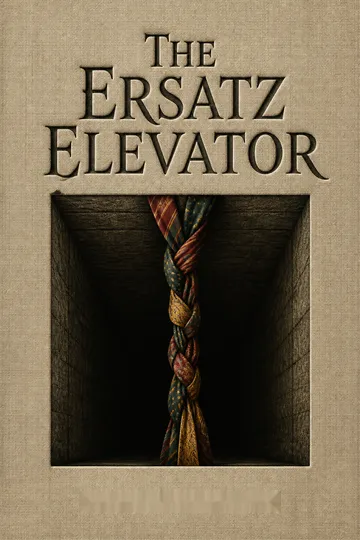
A doorway hiding a passageOne of the penthouse's elevator entrances is a false front for an empty shaft, which Olaf uses to hide and transport captives unseen. Klaus discovers the discrepancy by comparing the two elevator entrances on the top floor with the single entrances below. The shaft first seems to confirm the children's suspicions, then becomes a route to the cage, a trap, and finally an escape path through an underground corridor.
In and out
Fashion as social camouflageEsmé and her circle constantly change which objects, habits, and people are considered fashionable. This system explains the darkened building, disabled elevators, the children's unwanted pinstripe suits, and the auction's commercial logic. Its deeper plot function is to make appearances seem more trustworthy than evidence: Olaf's fashionable disguise helps him pass as an auctioneer, while the adults dismiss the children's accurate suspicions.
The auction catalog
A clue that misleadsThe catalog lists the auction lots and gives Klaus a way to investigate Olaf's plan. Its V.F.D. entry seems to identify the Quagmires' hiding place, so the siblings take a dangerous risk to bid on it. The box contains doilies instead. Olaf has planted a false clue, while the actual captives are hidden inside the red fish statue. The device distinguishes research from certainty: a clue can be real and still point in the wrong direction.
The siblings' specialties
Three skills, one rescueViolet invents, Klaus researches, and Sunny uses her teeth to bite or grip objects. The plot repeatedly gives each child a problem suited to a different strength, from making a rope and adapting tongs to identifying the hidden shaft and climbing its walls. Their abilities are not interchangeable, and none guarantees success alone. The device makes their cooperation concrete: survival depends on recognizing what each sibling can do and trusting that contribution.
FAQ
Synopsis & Basic Details
What is The Ersatz Elevator about?
- Orphans face new challenges: The Baudelaire orphans are placed with the trend-obsessed Squalors, where they encounter Count Olaf in disguise as an auctioneer.
- Hidden schemes and mysteries: The children uncover a secret passageway and a plot to smuggle their friends, the Quagmire triplets, out of the city.
- A race against time: The Baudelaires must navigate a world of deception and danger to expose Olaf and rescue their friends before it's too late.
Why should I read The Ersatz Elevator?
- Intricate plot and suspense: The story is filled with twists, turns, and hidden clues that keep readers engaged and guessing.
- Exploration of themes: It delves into themes of deception, resilience, and the importance of family in the face of adversity.
- Unique narrative style: Lemony Snicket's distinctive voice and use of literary devices create a captivating and thought-provoking reading experience.
What is the background of The Ersatz Elevator?
- Urban setting: The story takes place in a city with distinct districts, including a fancy area (Dark Avenue) and a fish district, highlighting social and economic contrasts.
- Cultural commentary: The "in" and "out" trends satirize consumerism and the superficiality of high society, reflecting a critique of cultural fads.
- Post-fire world: The Baudelaires' lives are still shaped by the fire that killed their parents, creating a backdrop of loss and vulnerability.
What are the most memorable quotes in The Ersatz Elevator?
- "Anxious' and 'nervous' mean the same thing.": Mr. Poe's repeated misinterpretation of the children's feelings highlights his incompetence and inability to understand their true concerns.
- "Around here, people decide whether something is in, which means it's stylish and appealing, or out, which means it's not.": The doorman's explanation of the Squalors' world reveals the arbitrary and shallow nature of their values.
- "It's all uphill from here.": This ironic phrase, used by the doorman and later by the narrator, underscores the Baudelaires' constant struggles and the unlikelihood of things improving.
What writing style, narrative choices, and literary techniques does Lemony Snicket use?
- Metafictional elements: Snicket directly addresses the reader, breaking the fourth wall and commenting on the nature of storytelling, creating a unique and engaging narrative.
- Ironic tone and dark humor: The story is filled with dark humor and irony, often highlighting the absurdity of the situations the Baudelaires face.
- Extensive use of foreshadowing: Snicket uses subtle hints and clues to foreshadow future events, creating suspense and encouraging readers to pay close attention to details.
Hidden Details & Subtle Connections
What are some minor details that add significant meaning?
- The doorman's oversized coat: The doorman's coat, which hides his hands, foreshadows his true identity as the hook-handed man, a member of Olaf's troupe.
- The Squalors' pinstripe suits: The pinstripe suits, initially presented as a symbol of being "in," become a disguise for Olaf, highlighting the superficiality of trends.
- The aqueous martinis: The Squalors' preference for aqueous martinis, a non-alcoholic drink, symbolizes their superficiality and lack of genuine substance.
What are some subtle foreshadowing and callbacks?
- Jerome's story about Mount Fraught: Jerome's anecdote about hiking with the Baudelaires' mother foreshadows his own lack of courage and inability to protect the children.
- The mention of the Run-a-Thon: The Baudelaires' memory of their parents' tired feet foreshadows their own exhaustion from climbing the stairs, creating a parallel between past and present.
- The doorman's comment about coffee: The doorman's remark about drinking coffee to stay awake foreshadows his role as a constant observer and his connection to Olaf's scheme.
What are some unexpected character connections?
- Esmé and Olaf's alliance: Esmé's collaboration with Olaf, revealed later in the story, is unexpected given her initial disdain for him, highlighting her own villainous nature.
- The doorman and the hook-handed man: The doorman's true identity as the hook-handed man, a member of Olaf's troupe, is a surprising twist that reveals his duplicity.
- Jerome and the Baudelaire parents: Jerome's past friendship with the Baudelaire parents adds a layer of tragedy to his inability to protect their children.
Who are the most significant supporting characters?
- The doorman: The doorman's seemingly minor role as a gatekeeper is crucial, as he is revealed to be the hook-handed man, a key player in Olaf's schemes.
- Mr. Poe: Mr. Poe's incompetence and obliviousness, despite his good intentions, highlight the lack of reliable adults in the Baudelaires' lives.
- The Quagmire triplets: Though absent for much of the story, the Quagmires' kidnapping and the mystery surrounding V.F.D. drive the plot and motivate the Baudelaires' actions.
Psychological, Emotional, & Relational Analysis
What are some unspoken motivations of the characters?
- Esmé's desire for status: Esmé's obsession with being "in" stems from a deep-seated need for social validation and a desire to be seen as important.
- Jerome's fear of conflict: Jerome's passivity and unwillingness to argue are rooted in a fear of confrontation and a desire to avoid discomfort.
- Olaf's greed and obsession: Olaf's relentless pursuit of the Baudelaire fortune is driven by a deep-seated greed and an obsessive desire for power and control.
What psychological complexities do the characters exhibit?
- The Baudelaires' resilience: Despite facing constant adversity, the Baudelaires demonstrate remarkable resilience and a determination to protect each other.
- Esmé's narcissism: Esmé's self-centeredness and lack of empathy reveal a narcissistic personality, prioritizing her own desires over the well-being of others.
- Jerome's passivity: Jerome's inability to take action or stand up for what is right highlights a deep-seated passivity and a fear of conflict.
What are the major emotional turning points?
- The discovery of the secret passageway: The Baudelaires' descent into the elevator shaft marks a turning point, as they realize the extent of Olaf's treachery and the danger they face.
- The betrayal by Esmé: Esmé's revelation of her alliance with Olaf and her attempt to kill the children is a major emotional blow, highlighting the depth of her cruelty.
- The failure at the auction: The Baudelaires' failure to rescue the Quagmires at the auction and their subsequent escape with Olaf is a devastating setback, leaving them feeling hopeless.
How do relationship dynamics evolve?
- The Baudelaires' bond: The siblings' relationship strengthens as they face constant adversity, relying on each other for support and protection.
- The Squalors' dysfunctional marriage: The Squalors' relationship is characterized by Esmé's dominance and Jerome's passivity, highlighting a lack of genuine connection.
- The Baudelaires and Jerome's relationship: The Baudelaires' initial hope for a caring guardian is shattered by Jerome's inability to protect them, revealing the limitations of his kindness.
Interpretation & Debate
Which parts of the story remain ambiguous or open-ended?
- The meaning of V.F.D.: The true meaning of V.F.D. remains a mystery, leaving readers to speculate about its significance and connection to the larger conspiracy.
- The purpose of the secret hallway: The hallway's connection to the Baudelaire mansion and its significance in the larger plot remain unclear, adding to the story's mystery.
- The fate of the Quagmires: The Quagmires' ultimate fate and their whereabouts after being taken by Olaf are left unresolved, creating suspense and uncertainty.
What are some debatable, controversial scenes or moments in The Ersatz Elevator?
- Esmé's betrayal: Esmé's decision to push the Baudelaires down the elevator shaft is a controversial moment, highlighting her cruelty and lack of empathy.
- Jerome's passivity: Jerome's inability to protect the children and his decision to abandon them are debatable, raising questions about his responsibility as a guardian.
- The red herring at the auction: The use of doilies as a red herring is a controversial plot device, as it leads to the Baudelaires' failure and the Quagmires' capture.
The Ersatz Elevator Ending Explained: How It Ends & What It Means
- Olaf's escape: Olaf's escape with Esmé and the Quagmires leaves the Baudelaires in a state of despair, highlighting the villain's cunning and the children's powerlessness.
- Jerome's abandonment: Jerome's decision to leave the Baudelaires, despite his initial kindness, underscores the lack of reliable adults in their lives and the importance of self-reliance.
- The Baudelaires' resilience: Despite the setbacks, the Baudelaires' determination to continue their fight against Olaf and rescue their friends demonstrates their unwavering resilience and hope.
A Series of Unfortunate Events Series

About the Author
Other books by Lemony Snicket
Download PDF
Download EPUB
.epub digital book format is ideal for reading ebooks on phones, tablets, and e-readers.








