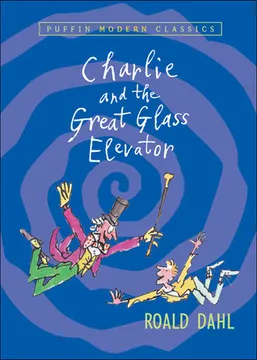


Plot Summary
A Button Too Late
Charlie and his family expect to leave the Great Glass Elevator at the Chocolate Factory, but Mr Wonka first sends it climbing high above Earth so it can gather enough speed to punch through the factory roof. As the continents shrink beneath them, Grandma Josephine grabs Wonka and pulls him away from the controls.
Charlie presses the green button when Wonka calls for it, but the timing has gone wrong. The Elevator tips sideways, everyone becomes weightless, and Wonka realizes they have entered orbit. He turns on the oxygen, while the grandparents struggle to stay in their bed. The journey home has become a spaceflight, and the family must now navigate an unfamiliar orbit with no easy way down.
The opening turns Wonka's confidence into a literal force of motion: he treats danger as a matter of timing, while Josephine reacts to danger by interrupting him. Charlie's obedience cannot undo the mistake, but it places him inside its consequences. The family's first crisis therefore establishes the story's central tension between invention and judgment. Wonka's plans can be brilliant, yet the people around him have to live with the risks when his certainty outruns their understanding.
The Hotel in Orbit
Nearby, Space Hotel U.S.A. circles Earth with its staff still approaching in a transport capsule. Astronauts Shuckworth, Shanks, and Showler spot the glass Elevator and report its floating passengers to Houston. The President, Lancelot Gilligrass, assumes the strangers may be hostile and alerts his advisers, while television broadcasts turn the sight into a worldwide spectacle.
Wonka, meanwhile, decides the family should board the hotel before the transport capsule arrives. Charlie and Grandpa Joe help operate the Elevator's separate booster controls, and Wonka guides it to the docking entrance. The family enters the luxurious hotel, still unaware that the people watching below have mistaken them for dangerous intruders carrying a bomb.
The hotel turns a private adventure into a public performance. From Earth, the family appears as a blurred image that invites authorities to project their fears onto it; inside the Elevator, they are simply trying to get somewhere safe and interesting. Gilligrass's rushed suspicion shows how easily limited evidence becomes political certainty. Charlie's role at the controls also marks a shift: he is no longer only Wonka's passenger but an active participant in keeping the group moving.
Five Eyes in the Lifts
In the hotel's lobby, Houston demands that the family identify themselves and threatens to freeze the building if they remain silent. Wonka answers with invented words and theatrically strange verse. The President concludes that the visitors must be beings from Mars and Venus, then invites them to the White House.
Wonka knows the invitation cannot be accepted without exposing their deception, so he gives another fantastical reply instead. Before he can continue, Grandma Josephine spots movement in the elevators. Their doors open one by one to reveal five slimy, egg-shaped creatures with red eyes. The visitors' mistaken identity has drawn attention, but the actual danger is already inside the hotel with them.
Wonka's performance protects the family by exploiting the same uncertainty that frightened them. He does not persuade the President with evidence; he gives Gilligrass a story grand enough to make sense of the unexplained image. Yet the joke collapses into real peril when Josephine notices the creatures. The scene's reversal is sharp: the officials invent a threat where none exists, while the family overlooks a genuine one until it stands in front of them.
The Knids Break Cover
Wonka recognizes the five creatures as Vermicious Knids, shape-changing predators capable of stretching their boneless bodies into almost any form. The family shoves the grandparents' bed back into the Elevator and escapes just before the Knids can reach them. One enormous Knid catches up in orbit and rams the glass, bruising its pointed end but failing to break through.
Wonka insists the Elevator can withstand the attack, although the Knid remains alongside them. The danger grows when the Elevator circles Earth again and the family sees the Knids pouring out of the hotel. The transport capsule has docked, and its passengers are now exposed to the creatures.
The Knids make the novel's comic exaggeration physically consequential. Their ability to change shape turns appearance into a weapon, while the supposedly absurd object, a bed carried into space, becomes part of the family's escape. Wonka's confidence is not entirely misplaced: the Elevator is strong enough to resist a direct strike. But its safety cannot protect the people in the capsule, forcing Charlie and Wonka to consider responsibility beyond their own survival.
A Capsule Under Siege
The Knids swarm around the transport capsule, striking it in organized waves and smashing its rockets and radio antenna. The astronauts can no longer steer back to Earth, and hotel workers who entered the building are being eaten. Charlie urges Wonka to help the trapped passengers.
Wonka lowers a steel cable from the Elevator, while Grandpa Joe works the winch and Charlie helps guide their approach. The cable catches the damaged capsule, and the Elevator begins towing it away from the Knids. The creatures then change tactics: one coils around the Elevator, while the others link themselves into a long chain and try to tow both spacecraft toward their home planet.
The rescue begins with Charlie's refusal to accept safety as an excuse for leaving strangers behind. His compassion gives Wonka a practical problem to solve, and Grandpa Joe supplies the steady work that the plan requires. The steel cable is more than a clever gadget: it binds the family's fate to the astronauts' and prevents the rescue from being merely symbolic. The Knids' coordinated counterattack then makes clear that courage has bought time, not victory.
Knids Become Shooting Stars
As the Knid chain closes in, Wonka recognizes that their best chance is to dive toward Earth. Charlie helps steer the Elevator into the atmosphere while Grandpa Joe holds the towline to the capsule. Friction heats the pursuing Knids until they glow and burn away, just as Wonka has explained happens to Knids entering Earth's air at speed.
The family releases the capsule once it can descend on its parachutes, then continues toward the factory. Wonka aims for the roof and drives the Elevator through it. The ride ends among broken beams and glass, but the passengers reach the Chocolate Room, where the Oompa-Loompas welcome them home.
The climax pays off the story's earlier explanation of why Knids become shooting stars: the atmosphere, not a weapon, defeats the swarm. Wonka's knowledge matters, but so does his willingness to risk a hard landing while towing people who cannot save themselves. Charlie contributes to the maneuver, and Grandpa Joe secures the cable. Their return is therefore a collective achievement, even though Wonka remains the one who designs the escape.
The Dangerous Cure
Once the family is back at the factory, Wonka asks Charlie's three elderly grandparents to try Wonka-Vite, a medicine that makes each pill-taker twenty years younger. He explains that it took many experiments to make the formula safe enough to use, though the early trials had disastrous results.
The grandparents, still unwilling to leave their bed, become eager when they see a rejuvenated Oompa-Loompa demonstrate the medicine's effect. Wonka offers twelve pills and warns them not to exceed the recommended amount. Instead, the three grandparents argue over the supply and take four pills apiece. Their choice turns a promised renewal into a new emergency.
The grandparents' bed has come to represent both comfort and refusal: they want the benefits of change without giving up the habits that keep them dependent. Wonka-Vite offers a literal shortcut around aging, but its clear dosage rule makes the danger ethical as much as scientific. The grandparents' quarrel over the pills shows how desire can eclipse instruction, while Wonka's impatience with their argument leaves him distant at precisely the moment his invention requires careful supervision.
A Grandmother Minus Two
The pills rapidly strip years from all three grandparents. Josephine becomes a baby, Grandpa George shrinks into a one-year-old, and Georgina grows smaller until she vanishes. Wonka explains that Georgina was seventy-eight and has lost eighty years, leaving her at minus two. She is not dead, he says, but has gone to Minusland, where she must wait before returning to ordinary existence.
Charlie sees how frightened his mother is and asks Wonka to bring Georgina back. Wonka agrees, explaining that he invented Vita-Wonk, a medicine made from ingredients gathered from exceptionally old living things, to restore the Oompa-Loompas who became Minuses during his experiments.
The consequences convert a comic dosage mistake into a family crisis. Arithmetic becomes a physical law that separates Georgina from her daughter, while the other grandparents' infancy burdens the adults with reversing roles. Charlie's response is notable: instead of dwelling on blame, he attends to his mother's grief and asks for action. Wonka's earlier failures, which he had treated as embarrassing experiments, now become the knowledge needed to attempt a rescue.
The Mayflower Calculation
Charlie and Wonka descend through the factory to Minusland, a silent, fogbound realm where invisible Gnoolies make the search dangerous. They find Georgina as a faint, drifting shadow, and Wonka sprays her with Vita-Wonk to bring her back. The dose is far too large: Georgina returns to the factory hundreds of years old.
To work out how much Wonka-Vite she needs, Charlie prompts her to recall the earliest event she remembers. Georgina remembers sailing on the Mayflower as a small child, allowing Charlie and Grandpa Joe to calculate her age. Wonka measures a corrected dose, and Georgina returns to seventy-eight, close to the age at which the family first knew her.
Charlie solves a problem that Wonka's technical ingenuity cannot: he understands that memory can provide a more reliable measure than Georgina's failing sense of time. The Mayflower turns her personal recollection into evidence, linking intimate family knowledge with historical scale. Wonka's first attempt also exposes the limits of rescue by improvisation. Bringing someone back is not enough; care requires precision about who that person is and what restoration should mean.
The Bed Finally Empties
With Georgina restored, Wonka and Charlie give measured drops of Vita-Wonk to baby Josephine and one-year-old George, returning them to their former ages. The three grandparents immediately insist on staying in bed. Then a letter arrives from President Gilligrass, inviting all eight space travelers to the White House and promising medals for saving the transport capsule.
Wonka points out that the bed cannot fit in the helicopter. The grandparents finally leap out, eager to attend, only to realize they have no clothes. Charlie suggests stopping at a shop on the way. The family heads for the waiting helicopter, leaving the factory together and accepting the journey beyond its gates.
The ending resolves the bed's meaning through action rather than persuasion. The grandparents resist Wonka's repeated appeals, but the prospect of public recognition and a trip to the White House makes leaving bed their own choice. Charlie again finds the practical bridge between desire and action, this time solving the clothing problem. The invitation also answers the opening's unfinished journey: the family reaches a new destination together, not as passive passengers but as people who have survived shared danger.
Analysis
The novel builds its comedy from a precise mismatch: Wonka treats the impossible as manageable, while his family experiences each invention through its immediate bodily risks. Space travel, alien predators, and age-changing medicines are played for absurdity, but their consequences are concrete. The transport capsule loses its rockets; a grandmother disappears from ordinary time; two elders become infants. The jokes do not erase danger. They make danger approachable enough for Charlie to act within it.
Charlie repeatedly supplies the ethical judgment that Wonka's brilliance lacks. He presses the controls, urges the rescue of strangers, notices his mother's grief, and uses Georgina's memory to solve a problem that calculation alone cannot answer. His inheritance is therefore more than possession of a factory. The story presents leadership as the ability to combine invention with attention to other people.
The elders' attachment to bed and the medicines' promise of renewed youth both express a wish to avoid the discomfort of change. Yet neither staying still nor reversing age provides a simple escape from time. The grandparents' appetite for pills brings upheaval, and Georgina's restoration requires memory, patience, and family knowledge. By the end, they leave the bed not because Wonka orders them to, but because they want to join the others. The book's final movement is from imposed motion to chosen participation.
Review Summary
Charlie and the Great Glass Elevator receives mixed reviews. Many find it disappointing compared to its predecessor, lacking the same magic and charm. The story is criticized for its disjointed plot, with the first half set in space and the second in the chocolate factory. Some readers enjoy the silliness and humor, particularly aimed at adults, while others find it contrived. The book's dated cultural references and potentially offensive content are noted. Despite its flaws, some still appreciate Dahl's imaginative writing and find it entertaining for children.
People Also Read


Characters
Charlie Bucket
The thoughtful young heirCharlie is a kind, observant boy who has been chosen to inherit Wonka's factory. He trusts Wonka's inventiveness but does not confuse confidence with infallibility. In space, he helps steer the Elevator and insists that the stranded astronauts deserve help. At the factory, he notices his mother's distress and finds a way to recover Georgina's age from her memories. Charlie's defining strength is practical empathy: he pays attention to what people need and turns concern into useful action.
Willy Wonka
The daring inventorWonka is a brilliant chocolate-maker whose inventions expand the factory into spaces most people would never imagine. He treats danger with flamboyant humor and trusts his own ability to improvise, sometimes more than circumstances warrant. He loves experimentation, yet his creations can carry consequences beyond his control. Charlie's steadiness gives Wonka a trusted partner, and Wonka recognizes the boy's judgment as essential to the factory's future. His ingenuity is genuine, but so is his need for others to help him see what his plans overlook.
Grandpa Joe
Charlie's loyal companionGrandpa Joe is Charlie's grandfather and closest family ally on the adventure. He shares Charlie's trust in Wonka, welcomes danger more readily than the other grandparents, and helps operate the Elevator during the rescue. His warmth makes him a source of courage for Charlie, while his willingness to act gives that courage practical force.
Grandma Georgina
The wary bed-bound elderGeorgina is Charlie's maternal grandmother, one of three elderly relatives who have spent years in bed. She is suspicious of Wonka and quick to object when his plans threaten her sense of safety. Her caution often sounds like stubbornness, but it reflects a strong desire to remain in control when events become bewildering.
Grandma Josephine
The outspoken skepticJosephine is Charlie's paternal grandmother and the most openly distrustful of Wonka's explanations. She challenges his authority and reacts sharply to danger, sometimes disrupting plans in ways that make matters worse. Her skepticism gives the family's fear a voice, even when her judgment is clouded by panic.
Grandpa George
The cantankerous elderGeorge is Charlie's maternal grandfather and Georgina's husband. Like the other elders, he is attached to the bed and resistant to Wonka's schemes. His impatience and bluntness add to the family's comic friction, while his close bond with Georgina makes her fate personal to him.
Mr Bucket
Charlie's cautious fatherMr Bucket is Charlie's father, a quiet man whose life before the factory was marked by modest work and worry. The space journey frightens him, but the wonders of Wonka's world also bring out a more hopeful, animated side. He wants security for his family and is learning to respond when possibility arrives in an unfamiliar form.
Mrs Bucket
Charlie's protective motherMrs Bucket is Charlie's mother, a loving and practical presence among the family's upheavals. She worries about the risks Wonka takes and becomes especially concerned when her parents are affected by the medicines. Her protectiveness is not mere timidity: she is attentive to the human cost that Wonka's experiments can obscure.
Lancelot R. Gilligrass
The anxious presidentGilligrass is the President of the United States, a public leader whose confidence is undercut by impulsive guesses and comic vanity. Faced with the unexplained visitors in orbit, he reaches for a dramatic explanation before he has the facts. He is easily influenced by his advisers, but his concern for the astronauts eventually makes him recognize that the strangers may have helped.
Miss Elvira Tibbs
The president's firm adviserMiss Tibbs, Gilligrass's vice-president and former nurse, is a commanding presence in the White House. She corrects the President, restrains his more reckless advisers, and urges diplomacy when he fears an alien threat. Her authority comes from long familiarity with Gilligrass and a willingness to speak plainly when others flatter him.
Shuckworth, Shanks, and Showler
The stranded astronautsThe three astronauts pilot the transport capsule carrying the Space Hotel staff. They report the mysterious Elevator to Earth and later face the Knids' attack on their damaged craft. Their observations connect the family's hidden adventure to the public crisis unfolding below.
The Oompa-Loompas
Wonka's factory helpersThe Oompa-Loompas work throughout Wonka's factory, assisting with inventions, testing, and daily operations. Their musical gatherings comment on the consequences of foolish choices, while their practical loyalty helps the family through crises. They are a community rather than a single character, but their labor makes Wonka's extraordinary projects possible.
Plot Devices
The Great Glass Elevator
A vessel for impossible travelWonka's transparent, rocket-powered Elevator can move in any direction and is controlled through buttons that fire boosters around its frame. Its glass walls make each danger visible to the passengers, from Earth shrinking below to Knids striking from outside. The Elevator provides shelter, but it cannot remove the consequences of Wonka's decisions. It also becomes a rescue craft when Charlie and Wonka use it to tow the damaged transport capsule.
Wonka-Vite and Vita-Wonk
Age changed by inventionWonka-Vite makes a person twenty years younger per pill, while Vita-Wonk rapidly makes a person older. Together, the medicines turn age into a measurable quantity, but their effects make dosage critical. The grandparents' misuse of Wonka-Vite creates the crisis involving Georgina and the two infants; Vita-Wonk then enables the rescue and restoration. Their paired effects also reveal the gap between a clever formula and the care needed to use it safely.
Minusland
A realm beyond ordinary timeMinusland is the strange destination of people whose age has been reduced past zero. Its fog obscures what is inside, and invisible Gnoolies make entry hazardous. Wonka must use Vita-Wonk to bring a Minus back, turning a numerical mistake into a physical rescue journey.
Vermicious Knids
Shape-changing space predatorsThe Knids are dangerous creatures that can stretch and reshape their powerful, boneless bodies. They attack the Space Hotel and its transport capsule, and their ability to link together lets them threaten the Elevator itself. Their vulnerability to Earth's atmosphere gives the family a possible route to escape.
About the Author
Other books by Roald Dahl
Download PDF
Download EPUB
.epub digital book format is ideal for reading ebooks on phones, tablets, and e-readers.








