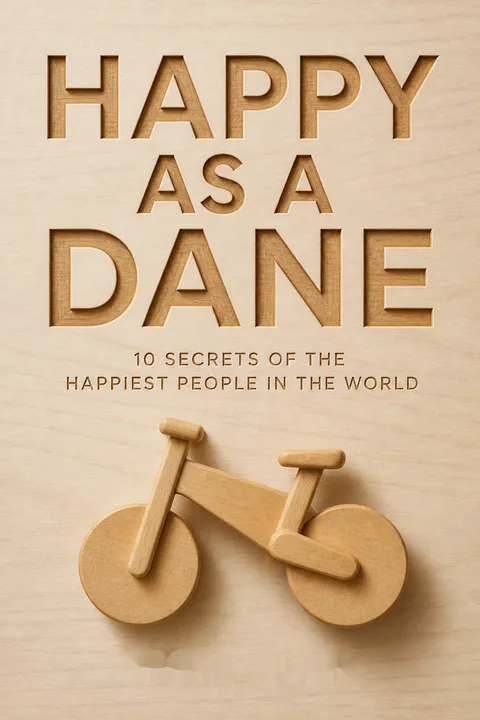


Key Takeaways
Build a foundation for well-being, not a fantasy of permanent happiness.
Happiness has a base. Rydahl opens with a Danish paradox: her homeland regularly tops international happiness rankings, yet it has real hardship, including depression and alcohol misuse. She left Denmark at eighteen to make a life in France, carrying cultural habits she had once taken for granted. When news of her father’s medical crisis abruptly ended a peaceful holiday, she was reminded that happiness cannot mean feeling good every moment. It is better understood as a foundation that helps someone enjoy good times and endure bad ones.
Society can help build it. The book’s ten contributors include trust, education, independence, opportunity, realistic expectations, solidarity, work-life balance, a less status-driven relationship with money, modesty, and gender equality. None guarantees personal happiness; together, they can make it easier to find a place in society and live by one’s values.
The distinction between a pleasant mood and durable well-being is useful because it prevents ordinary grief from being mistaken for personal failure. It also clarifies the book’s central tension: institutions shape the conditions for a good life, but they cannot supply a private sense of purpose. This resembles the distinction between external resources and psychological adaptation. Rankings can describe average self-reports, not the full range of lives inside a country, so national happiness is best treated as a clue about social conditions, not a verdict on every citizen.
Make trust reciprocal, and ordinary life needs fewer guards.
Trust saves effort. In the surveys Rydahl cites, 78 percent of Danes said they trusted other people, compared with an average of 25 percent or less across the countries studied. She recalls roadside produce stands where customers selected food and left payment in an unattended box. A lost-wallet experiment cited in the book found that every wallet dropped in Aalborg was returned with its money, while just over half were returned across all test cities.
Institutions matter too. Trust in public institutions helps make shared services workable: people are more willing to contribute when they believe others will follow the rules and the money will be used fairly. The book also links trust to lower costs for monitoring and compliance, and describes Danish institutions as relatively trusted and corruption as relatively low.
Trust is not simply optimism about strangers. It is a practical expectation that others will generally honor shared rules, which can reduce the need for surveillance and defensive behavior. That makes trust a form of civic infrastructure, not just a personal virtue. The account is strongest when it connects trust to institutions and reciprocity. It is less persuasive if read as proof that trust alone causes happiness: prosperity, effective public services, and fair enforcement can create trust as much as trust helps sustain them.
Educate children to find a place, not just beat the class.
Learning should develop agency. Rydahl describes Danish teaching as encouraging students to form opinions, ask questions, and learn through participation rather than rely only on memorized authority. Education is free, and students in higher education receive public grants, reducing the role of family income in access. Two Danish options illustrate the broader aim: an efterskole is a residential school for teenagers that emphasizes personal development and group life; a højskole is an adult folk school centered on learning, creativity, and community rather than formal exams.
Inclusion has tradeoffs. The book reports that students from efterskoler were more likely to begin and complete further study. But a school system focused on the majority can underserve gifted students. One school administrator estimated that about 5 percent were insufficiently challenged, raising a real question about how to value broad inclusion without neglecting exceptional needs.
Education here is treated as preparation for participation in society, not merely as a sorting mechanism for scarce prestige. That expands the definition of achievement: belonging, curiosity, and the confidence to choose a path count alongside test results. The tension around gifted students is important. A system can reject elitism yet still differentiate instruction, since meeting varied needs does not require ranking children’s worth. The account also suggests that access alone is insufficient: students need guidance and environments where they can discover what they are capable of doing.
Give young people income and room to choose before they inherit your plans.
Autonomy starts early. Rydahl recounts taking small jobs as a child and teenager, partly to pay for her own activities. The book says nearly 70 percent of Danish teenagers aged thirteen to seventeen had jobs, and that young people commonly left home around eighteen. Those figures describe the period covered by the book, not a timeless rule. Public student grants, available regardless of parents’ income, also make it easier to study without depending entirely on family money.
Freedom needs support. The point is not that every young person should leave home or work early. It is that practical independence can let people make choices without asking parents to finance each step. Rydahl also notes a hard edge: freedom can feel daunting, and statistics about suicide cannot be reduced to a simple story about autonomy.
Material independence can change family relationships by turning permission into advice. The distinction matters: a young adult may still value parental guidance while gaining the ability to make a decision that parents would not fund. But autonomy is not the same as being left alone. Income, housing, education, and emotional support affect whether choice feels empowering or overwhelming. The book’s careful uncertainty about suicide is warranted; population-level rates have many causes and cannot establish that freedom itself creates danger.
Measure opportunity by freedom to choose, not only by who gets rich.
Mobility means options. The book challenges the idea that the United States uniquely owns the promise of social mobility. It cites OECD research placing Denmark among countries where a person’s prospects are less tightly tied to their parents’ position. Public education and student grants help widen access, while redistribution narrows economic gaps. Rydahl’s Danish lawyer interview illustrates the promise: a partner from a working-class background said he completed law studies without debt and could pursue a career that suited him.
Equal rules are not equal outcomes. Rydahl also remembers a close friend whose family faced serious difficulties. They had access to the same schooling, but her friend left high school. A system can open doors without removing emotional strain, unequal support, or other obstacles. In this account, mobility means being able to live differently from one’s parents, not simply climbing into a wealthier class.
This broader definition of mobility captures a form of freedom that income rankings miss: the ability to refuse an inherited script. It also avoids treating every life choice as a climb toward more money or status. The friend’s experience supplies an essential corrective, since formal access does not erase differences in health, family stability, or confidence. Equal opportunity is therefore better understood as removing avoidable barriers and providing support, rather than promising that identical inputs will produce identical outcomes.
Keep the dream, lower the forecast, and make room for surprise.
Aim high without demanding perfection. Rydahl calls this balance realistic idealism: having a meaningful aspiration while accepting that progress will be difficult and outcomes uncertain. She connects Danish modesty about expectations to the country’s history of lost territory and limited national grandeur. In 1992, Denmark’s football team entered the European Championship only after another team was disqualified, then won the tournament. The unexpected victory became a vivid example of how a low forecast can make a good surprise feel extraordinary.
Realism is not surrender. Rydahl’s own dream of living in Paris collided with lonely, difficult beginnings, but she did not abandon the aim. The useful distinction is between valuing a destination and expecting the journey to be easy. The book cites research associating lower expectations with higher reported satisfaction, while acknowledging that such patterns do not prove that lowering expectations causes happiness.
Expectation management is powerful because disappointment often comes from the gap between reality and a rigid forecast, not from reality alone. Yet low expectations can become a polite name for discouragement if they shrink what people believe they can attempt. The more useful model is flexible ambition: keep the goal, revise the route, and judge progress against constraints that are actually present. The 1992 win makes the emotional point memorable, but one sporting upset cannot establish a national psychology.
Fund shared security when everyone can see both contribution and return.
Solidarity depends on fairness. The book reports that seven in ten Danes surveyed were satisfied with the balance between taxes paid and public services received. Denmark’s tax revenue was cited at about 51 percent of GDP, a figure from the period discussed. Rydahl argues that people accept high contributions when they trust that taxes support services such as education, health care, and transport, and when they believe others contribute too.
Support comes with obligations. The Danish approach she describes combines unemployment benefits with expectations that job seekers look for work and accept suitable opportunities. Flexicurity is this combination of income protection, active employment policies, and relatively flexible hiring and dismissal. The author’s account of public anger at perceived benefit abuse shows that generosity is not unconditional: people support help, but resent the sense that someone is exploiting the common pool.
The key design issue is not simply the amount of redistribution, but whether people perceive procedures as fair and reciprocal. That echoes a broader principle in collective-action problems: cooperation is more durable when contributions are visible and rule-breaking is addressed consistently. Still, public support can depend on who is seen as deserving, and perceptions of abuse may be distorted by vivid anecdotes. A well-functioning safety net needs accountability without allowing suspicion to turn into a presumption that recipients are dishonest.
Protect ordinary hours for family, friends, and unhurried shared rituals.
Time is part of prosperity. In the OECD figures cited by Rydahl, Danes spent about 69 percent of their day on personal activities, and only 2 percent of employees worked longer than normal hours. Flexible schedules, paid leave, and short commutes help make it possible for parents to collect children and spend evenings together. The book describes hygge, a Danish term for warm, informal togetherness, often involving food, friends, candles, and a comfortable home. It is deliberately ordinary rather than luxurious.
Leisure is not automatically healthy. Rydahl remembers a teenage party that ended with her needing medical attention after drinking too much. The book reports high rates of alcohol use among Danish teenagers. A culture that protects free time can make room for connection, but the activities filling that time still matter.
Work-life balance is more than an individual scheduling trick. It depends on what employers consider normal, how far people travel, and whether care work is treated as legitimate. Hygge gives the social value of leisure a concrete shape: shared time need not be expensive or impressive to feel meaningful. The alcohol examples keep the picture from becoming sentimental. Free time is a resource, not a guaranteed benefit; social norms can make it nourishing, or can normalize risky behavior.
After basic security, comparison often costs more happiness than money buys.
Enough changes the question. A fisherman in a parable catches enough food, then spends time with his family and friends. A visiting businessman urges him to build a company and get rich, only to describe a retirement that resembles the fisherman’s life now. Rydahl uses the story to question the assumption that income is the best route to a good life. She cites evidence that money matters most when basic needs are unmet, and less reliably predicts well-being once those needs are covered.
Status keeps moving. Relative income means judging one’s earnings against other people’s rather than by what they can actually provide. The book also discusses a study in which lottery winners’ initial rise in happiness faded over time. Rydahl’s brother pursued a meaningful food business despite uncertain financial rewards, illustrating that purpose can matter more than maximizing earnings.
The fisherman story exposes a common planning error: treating a desired experience as a reward postponed until after an indefinite expansion of work. Relative comparison adds a social mechanism, since satisfaction can fall even while material conditions improve. These ideas do not make money trivial. Income can buy safety, options, and freedom from exhausting constraints. The more defensible lesson is to ask what additional money is for, and whether its opportunity cost is the very time or relationship it is meant to improve.
Practice humility without teaching talented people to hide.
Modesty shapes group life. The Law of Jante is a cultural code popularized by Danish-Norwegian writer Aksel Sandemose, discouraging people from acting as though they are superior to others. Rydahl connects it to the Danish preference for fair play over swagger. At the restaurant Noma, chef René Redzepi brought his staff into the public story of success, including a dishwasher who could not attend an awards ceremony. A study cited in the book found that humility was associated with greater willingness to help others.
Restraint has a cost. The same norm can make talented people reluctant to stand out or claim credit. Danish modesty is not proof that ambition is bad; it is a warning about how ambition is expressed. The challenge is to value shared achievement without making visibility or excellence feel socially suspect.
Humility is most useful when it reduces entitlement and increases attention to other people’s contributions. It becomes less useful when a group uses it to punish distinction or silence criticism. The Noma example shows a constructive form: success is acknowledged, but ownership is shared. That differs from pretending achievement does not exist. Healthy institutions need both cooperation and recognition, especially for people whose work might otherwise remain invisible.
Make roles negotiable, so equality frees men and women alike.
Equality begins at home. Rydahl remembers her mother assigning household chores equally to her and her brother, without treating tasks as gendered. The book describes Danish parental leave as shared between parents and reports that men spent much more time on domestic work than men in some comparison countries. Such arrangements challenge the assumption that caregiving belongs naturally to women and paid work to men.
Choice needs cultural backing. Rydahl also describes relatively open conversation about feelings and sexuality, and a social expectation that women can pursue work and relationships without fixed roles. The point is not that Denmark has eliminated discrimination or unequal outcomes. It is that equality can expand men’s freedom to care and women’s freedom to work, rather than being framed as a transfer of advantage from one group to another.
Gender equality is often discussed as access to education and employment, but daily divisions of care determine whether those options are usable. Shared domestic work can widen both partners’ choices and reduce the hidden labor that limits careers. Formal leave policies matter, yet norms about who actually takes leave can determine their effect. The author’s account is persuasive as a cultural contrast, though national averages can conceal inequalities by class, family structure, and workplace.
Analysis
Rydahl’s central claim is institutional and personal at once: a society cannot make its citizens happy, but it can make it easier for them to construct lives that fit. Denmark appears in this account not as a perfect model to copy, but as a case where trust, public services, personal autonomy, and modest expectations reinforce one another. The book’s most useful move is to connect apparently private feelings to public arrangements. A parent leaving work early, a student choosing a non-elite path, and a citizen paying taxes are not isolated lifestyle choices. Each depends partly on norms and systems that make the choice feasible and socially legitimate.
This argument resonates with self-determination theory, which distinguishes autonomy, competence, and relatedness as important ingredients of motivation and well-being. The Danish examples map neatly onto those needs: independence supports autonomy, education and meaningful work support competence, and solidarity and hygge support relatedness. The connection also helps explain why no single pillar can do all the work. Autonomy without security can feel like abandonment; security without autonomy can become paternalism; community without room for difference can become conformity.
The evidence is suggestive rather than definitive. Cross-country happiness rankings are self-reports shaped by culture, question wording, and momentary conditions. A country’s policies and citizens’ satisfaction also influence each other, making causal claims difficult. High trust may support generous public services, while reliable services may give people reasons to trust. In addition, national averages can obscure people excluded from the dominant picture, including those who struggle with poverty, illness, or discrimination. Rydahl’s own caveats, such as alcohol misuse and under-challenged gifted students, matter because they reveal the costs hidden by an attractive national narrative.
The transferable lesson is therefore not to import Denmark’s tax rate or imitate its customs wholesale. It is to ask which social conditions help people exercise agency without bearing every risk alone. Trustworthy institutions, meaningful education, time for relationships, and fair expectations form a plausible architecture for well-being. The architecture is not happiness itself; it is a structure that gives more people a credible chance to build it.
Review Summary
Happy as a Dane explores Danish happiness through ten principles, including trust, education, work-life balance, and modesty. Reviews are mixed, with some praising its insights and others finding it contradictory or oversimplified. Readers appreciate the cultural analysis but criticize the writing style and lack of depth. Many find the Danish approach intriguing, though some question its applicability elsewhere. The book's short length and statistical focus receive criticism, while its thought-provoking nature and easy readability are commended.
People Also Read



Glossary
foundation of well-being
durable basis for copingRydahl’s term for the underlying personal and social resources that influence how someone handles both joy and difficulty. It is not a constant happy mood. The foundation develops through choices, self-knowledge, relationships, and one’s environment, and provides a base from which a person can recover or keep functioning during changing circumstances.
hygge
warm, informal togethernessA Danish cultural idea describing a comfortable, intimate atmosphere, often created through simple time with family or friends, food and drink, candlelight, or relaxed conversation. In Rydahl’s account, hygge is accessible rather than lavish. It represents the value placed on ordinary shared experiences and time away from work.
Law of Jante
code discouraging superiorityA set of ten social rules popularized by Danish-Norwegian writer Aksel Sandemose. Its general message is that people should not consider themselves better or more important than others. Rydahl presents it as an influence on Danish modesty and group solidarity, while noting that it can also discourage people from showing talent or standing out.
flexicurity
flexible work, protected transitionsThe Danish labor-market approach described in the book, combining relatively flexible hiring and dismissal with unemployment support and policies intended to help people find work. It aims to protect workers during transitions without making employers' staffing decisions unusually difficult. Benefits come with expectations that recipients actively seek suitable work.
realistic idealism
ambition with grounded expectationsRydahl’s phrase for holding meaningful aspirations while accepting that progress can be difficult, slow, and uncertain. It rejects both blind optimism and the idea that realism requires abandoning dreams. The emphasis is on valuing the purpose of a goal while adjusting expectations about the route and its obstacles.
efterskole
residential school for teenagersA Danish school option, usually for students aged fourteen to eighteen, where teenagers live and study together for a period after compulsory schooling. Rydahl describes efterskoler as emphasizing personal development, creative or vocational interests, sports, and group life, alongside education. They can offer students a different setting in which to build confidence and explore their strengths.
højskole
non-exam folk schoolA Danish folk school associated with the educational ideas of N. F. S. Grundtvig. It offers courses for adults and young people, centered on curiosity, creativity, discussion, and learning to live in community rather than on competition or formal diplomas. Courses can range from brief sessions to extended residential study.
relative income
income compared with othersThe idea, discussed through economist Richard Layard, that people often judge their financial position in relation to what others earn rather than by their absolute resources alone. A person can earn more and still feel worse off if those around them earn more. The concept helps explain why status competition can persist even as material living standards rise.
set-point theory
genetic influence on well-beingA theory discussed in the book proposing that people have a relatively stable baseline level of happiness influenced substantially by genetics. Rydahl notes that studies estimate the genetic contribution differently, with some claims much higher than others. She presents the debate to distinguish inherited tendencies from the influence of personal choices and external conditions.
FAQ
What's "Happy as a Dane" about?
- Exploration of Danish Happiness: "Happy as a Dane" by Malene Rydahl explores why Denmark is consistently ranked as one of the happiest countries in the world.
- Ten Key Secrets: The book outlines ten secrets or principles that contribute to the happiness of the Danish people, such as trust, education, and work-life balance.
- Personal and Societal Insights: Rydahl combines personal anecdotes with societal analysis to provide a comprehensive view of Danish culture and its impact on happiness.
- Universal Application: While focused on Denmark, the book offers insights that can be applied to improve happiness in other cultures and societies.
Why should I read "Happy as a Dane"?
- Understanding Happiness: The book provides a unique perspective on happiness, offering insights into how societal structures can influence personal well-being.
- Cultural Insights: It offers a deep dive into Danish culture, which is often cited as a model for happiness and social welfare.
- Practical Advice: Readers can find practical advice and inspiration to apply Danish principles of happiness in their own lives.
- Broader Perspective: It encourages readers to think about the role of government, community, and personal choices in achieving happiness.
What are the key takeaways of "Happy as a Dane"?
- Trust is Fundamental: Trust in people and institutions is a cornerstone of Danish happiness, fostering a sense of security and community.
- Work-Life Balance: Danes prioritize a balance between work and personal life, valuing time with family and leisure activities.
- Modesty and Realism: A modest and realistic approach to life helps Danes manage expectations and find contentment in everyday experiences.
- Social Equality: The Danish model emphasizes equality and social welfare, ensuring that everyone has access to opportunities and support.
How does Malene Rydahl define happiness in "Happy as a Dane"?
- Feeling Good: Happiness is defined as feeling good, enjoying life, and wanting to maintain that feeling.
- Collective vs. Personal Happiness: The book distinguishes between collective happiness, as measured by surveys, and personal happiness, which is subjective and individual.
- Role of Environment: Rydahl emphasizes the importance of a supportive environment in fostering happiness, both at the societal and personal levels.
- Realistic Expectations: Happiness involves having realistic expectations and finding joy in the journey rather than just the destination.
What are the ten secrets of happiness according to "Happy as a Dane"?
- Trust: High levels of trust in others and institutions.
- Education: A system that develops individual potential and personality.
- Freedom and Independence: The ability to choose one's own path in life.
- Equal Opportunity: Ensuring everyone can become who they want to be.
- Realistic Expectations: Having realistic dreams and goals.
- Solidarity and Respect: A strong sense of community and mutual respect.
- Work-Life Balance: Prioritizing personal time and family.
- Relationship to Money: Contentment with what one has.
- Modesty: Valuing humility over superiority.
- Gender Equality: Freedom to choose roles without stereotypes.
How does "Happy as a Dane" address the concept of trust?
- High Trust Levels: Denmark has the highest level of trust in the world, with 78% of Danes trusting those around them.
- Trust in Institutions: Danes also have high confidence in their institutions, which contributes to societal stability and happiness.
- Economic Impact: Trust reduces the need for expensive monitoring and compliance mechanisms, lowering business costs.
- Social Cohesion: Trust fosters a sense of community and cooperation, essential for a functioning welfare state.
What role does education play in Danish happiness according to "Happy as a Dane"?
- Personal Development Focus: Danish education emphasizes developing individual personality and skills rather than creating an elite.
- Free Education: Education is free and accessible to all, with state grants supporting students financially.
- Encouraging Independence: Schools encourage students to think independently and form their own opinions.
- Lifelong Learning: The concept of lifelong learning is integral, promoting continuous personal and professional growth.
How does "Happy as a Dane" explain the Danish work-life balance?
- Prioritizing Personal Time: Danes value personal time and family, often leaving work by 5 p.m. to spend time with loved ones.
- Flexible Work Hours: Many Danish companies offer flexible working hours to accommodate family and personal needs.
- Cultural Norms: The culture supports a balance between work and leisure, contributing to overall happiness.
- Government Support: Policies like paid vacation and parental leave further support work-life balance.
What is the Danish approach to money as described in "Happy as a Dane"?
- Contentment Over Wealth: Danes generally prioritize happiness and contentment over accumulating wealth.
- Welfare State Security: The welfare state ensures basic needs are met, reducing the pressure to earn more.
- Relative Income Theory: Happiness is more about relative income compared to others rather than absolute wealth.
- Focus on Meaningful Work: Danes often choose jobs that provide personal fulfillment over those that offer higher salaries.
How does "Happy as a Dane" address gender equality?
- Equal Opportunities: Denmark offers equal opportunities for men and women in education, work, and family life.
- Shared Responsibilities: Household and childcare responsibilities are often shared equally between genders.
- Cultural Norms: Gender equality is deeply ingrained in Danish culture, allowing individuals to choose roles without stereotypes.
- Political Representation: Women are well-represented in politics and business, reflecting societal commitment to equality.
What are some of the best quotes from "Happy as a Dane" and what do they mean?
- "Trust is one of those things that can change everything in life, because it brings peace of mind." This highlights the foundational role of trust in Danish happiness.
- "Happiness is never permanent." This quote emphasizes the transient nature of happiness and the importance of building a solid foundation of well-being.
- "The key is to return to what I call your own foundation of well-being." Rydahl suggests that a strong personal foundation helps navigate life's ups and downs.
- "The happiest people often demonstrate a degree of humility toward life." This underscores the value of modesty and humility in achieving happiness.
How can the principles in "Happy as a Dane" be applied to other cultures?
- Adaptation to Local Contexts: While the principles are rooted in Danish culture, they can be adapted to fit different societal contexts.
- Focus on Trust and Community: Building trust and a sense of community can enhance happiness in any culture.
- Emphasize Work-Life Balance: Encouraging a balance between work and personal life can improve well-being universally.
- Promote Equality and Opportunity: Ensuring equal opportunities and reducing societal pressures can foster happiness across cultures.
Download PDF
Download EPUB
.epub digital book format is ideal for reading ebooks on phones, tablets, and e-readers.








