

Plot Summary
The Graveyard Behind Home
Nearly forty, Nikki Lovejoy-Berry1 arrives in Zirconia, North Carolina, with a faltering real-estate career, a strained relationship with her daughter,7 and little knowledge of her grandmother,3 Rita Lovejoy.3 Rita3 has summoned her with a promise to explain the family’s silences and a request for help.
Their first conversations are awkward: Rita3 asks after Nikki’s mother,4 Lorelle,4 while refusing to explain their estrangement. She feeds Nikki1 beans and cornbread, then leads her through the land to a family burial ground marked by uninscribed stones.
Rita3 says her ancestors lie there and asks Nikki1 to bury her there someday. The graves make the family’s missing history physical, and Nikki1 begins to suspect that her visit concerns more than a reconciliation.
Cross Anchor Falls Silent
In 1870s South Carolina, Luella Bobo2 lives with her father,11 a formerly enslaved minister who leads their church. She meets William Montgomery,5 a tall, persuasive man whose brother6 Robert6 is also newly arrived in the congregation. After federal action briefly suppresses the Ku Klux Klan, white violence returns.
Luella’s father11 is publicly whipped for his political influence, then a newspaper falsely accuses the church community of plotting murder and cannibalism. A white landowner warns them that worse danger is coming.
William5 proposes moving north to work for a widow near the North Carolina line. Luella2 and her father11 join roughly fifty people who leave behind homes, crops, and possessions, then cross the mountains on foot. The Widow Davis19 lets them settle in former slave cabins in exchange for labor.
A Kingdom Takes Shape
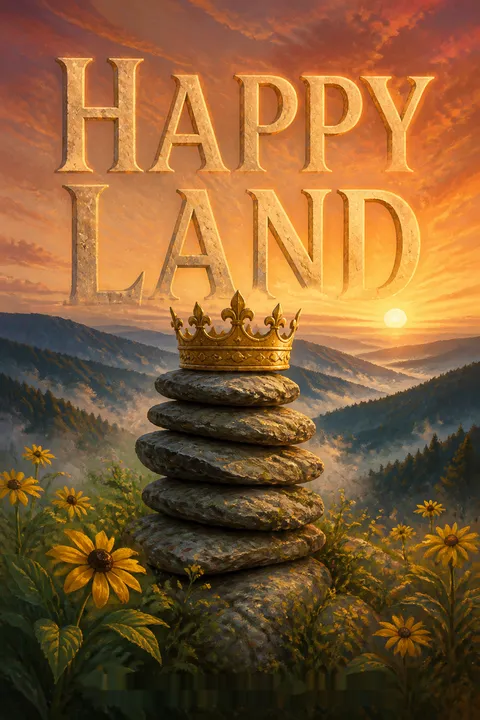
The newcomers repair the Oakland Inn, build cabins, and arrange their settlement around a central oak. William5 persuades them to establish their own council and treasury, then names the community Happy Land. The people acclaim him king and Luella2 queen, and the two marry beneath the tree.
Luella2 soon discovers that the crown brings isolation as well as honor: William5 strikes her when she resists wearing it, then later supports her effort to teach the children.
She finds a schoolteacher and slates, but William5 refuses to spend scarce funds on a schoolhouse while the community is saving to buy land. Hoping to earn the money himself, he secretly takes dangerous mining work. An accident leaves him blind, and ashamed of his injury, he stays away rather than return to Luella.2
The Women Claim Seats
With William5 gone, Robert6 becomes king, while Luella2 remains the person many residents turn to. She organizes women to make and sell Happy Land Liniment, first using comfrey and later adding mountain ginseng and sassafras.
Their earnings strengthen the communal treasury, and Luella2 presses Robert6 to give women two seats on the council. The new seats let women raise practical needs, from better seed to rest after childbirth. Robert6 supports their work and offers Luella2 a gentler partnership than she had with his brother.5
After William5 has been absent for months, Luella2 accepts Robert’s6 proposal without a public marriage ceremony. Her decision brings love and a new family, but William’s5 disappearance remains unresolved, and Robert6 has not told her the full reason his brother5 went to the mines.
Cancer Changes the Visit
As Nikki1 helps Rita3 in her flower garden, she learns that Rita3 sells flowers for a living and sees how deeply the land anchors her. She also notices Rita’s3 opioid prescription, then accompanies her to the emergency room when Rita3 becomes ill.
There, Rita3 reveals that she has cancer and has been given only months, though she refuses chemotherapy. Nikki1 understands why her grandmother3 called her, but Rita3 still directs her toward flower-market duties rather than discussing the illness.
Maddie Mae,9 Rita’s3 neighbor and closest friend, finally tells Nikki1 that the Thomas family plans to evict Rita.3 At the hospital, Rita3 explains that a distant relative’s share in the family property was sold through heirs-property proceedings. The Thomas brothers16 now claim the land, and Rita3 has a court date approaching.
Two Hundred Five Acres
Happy Land grows to more than a hundred residents, and the women’s liniment, food, flowers, and sewing help fund the community. Robert6 takes work with a white shoemaker, but on the road home he is beaten by men who demand regular payments for protection.
The kingdom’s leaders recognize the threat as a familiar form of racial extortion. Robert6 argues that owning property may give the community a stronger claim to safety, so the council authorizes him and Luella2 to approach Widow Davis.19 Their treasury has saved two hundred dollars.
Davis19 agrees to sell them 205 acres across the state line, with the deeds divided between Luella2 and Robert.6 A woman’s name on a land deed becomes a public achievement. Their purchase turns the kingdom from a settlement dependent on a white landowner into a community with property of its own.
The Palace Still Stands
Nikki1 searches library archives and slave schedules, finding evidence that Luella2 and the Montgomery brothers5 came from South Carolina, not Mississippi as one local pamphlet claims.
Maddie Mae9 shows her a box of Lorelle’s4 and Nikki’s1 school records, sports mementos, and college acceptance papers that Rita3 saved, proof of a love Nikki1 had mistaken for indifference. After leaving hospital, Nikki1 visits Al Thomas,16 whose family owns the land, and he takes her to the old palace, fields, and schoolhouse chimney. The ruins make Luella’s2 community tangible.
Al16 admits that his family inherited the property years earlier but will not stop the eviction because his brother wants to sell. Nikki1 returns to Rita’s3 house to find a fresh trespassing notice. Her planned short visit has become a fight against immediate removal.
Two Husbands, One Home
Years after leaving, William5 comes back to Luella’s2 home, partly blind and weakened by his mining injury. He explains that he had gone to earn money for the schoolhouse she wanted, then stayed away out of shame. Luella2 lets him live with her, Robert,6 and their children, Sunny13 and Wade.12
The crowded household strains the brothers’5 loyalty and Luella’s2 divided sense of duty. When she becomes pregnant again, Robert6 learns the news from William,5 and suspicion sharpens the conflict. Luella2 loses the baby.
Soon afterward, her father11 dies, and grief clarifies how much she depends on Robert.6 She asks William5 to leave and tries to recommit herself to Robert,6 but he says the years of uncertainty have wounded him too deeply. He departs, leaving Luella2 to lead the shrinking kingdom.
A Wedding, Then Arrest
As the kingdom’s population dwindles, Luella2 prepares a flower-filled church wedding for Sunny13 and Vernon, who plan to live away from the settlement. Robert6 appears at the ceremony with Ursula,17 his sister,17 whom slavery separated from the family as a child.
Luella2 had mistaken her for Robert’s6 new wife. Robert6 explains that he spent years searching for his sold-away siblings; the reunion softens Luella’s2 anger, and she tells him she would not need long to welcome him back.
Before he can return, a sheriff takes fifteen-year-old Wade,12 falsely linking him to a farmer killed when cattle escaped. Robert6 comes back to help, while Luella2 fears the law will kill or imprison her son.12 She and Robert6 hire the lawyer who handled their land purchase,20 offering the kingdom deed as security for Wade’s12 defense.
The Deed Becomes Ransom
The lawyer20 accepts the deed to all 205 acres as collateral, promising to defend Wade12 and return the land if the family repays him. At trial, Wade’s12 friend refuses to testify, and the jury convicts him despite his denial and William’s5 testimony about his character.
Wade12 receives two years of forced labor and serves eighteen months. The lawyer20 then demands far more than the original agreement, so the kingdom’s residents cannot reclaim all their land. They leave their homes, dividing food and carrying away small reminders of the settlement.
Luella2 and Robert6 work and save while living near Sunny13 and Vernon. Once Wade12 returns, Luella2 insists they negotiate for the inhabited heart of the kingdom rather than lose every acre. They regain their homes and a smaller portion of the property, returning by Christmas.
Four Generations Gather
Back in Washington, Nikki1 tells Lorelle4 that Rita3 has cancer and faces eviction. Lorelle4 initially admits how much she hated growing up in North Carolina, then explains the deeper rift: after Nikki’s father15 died, Rita3 asked for help paying property taxes, and Lorelle4 stalled, hoping her mother3 would abandon the land and move to Washington.
The delay let the county notify the Thomas brothers16 that they owned the property. Nikki1 returns with Lorelle4 and Shawnie7 for Rita’s3 hearing. The judge gives Rita3 seventy-five days to leave, despite R.J.’s14 argument about her family’s history.
Then R.J.14 identifies a possible claim under North Carolina’s adverse-possession law, since Rita3 has openly occupied and improved the land for decades. She obtains a temporary stay while the new claim is heard.
Four Acres Remain
While the new motion is pending, Nikki1 stays with Rita3 and helps her keep working in the garden. She starts imagining a future for herself there, including a flower nursery called Kingdom Nursery.
R.J.14 argues that Rita’s3 continuous, visible care of the property meets the legal standard for adverse possession. The judge grants Rita3 title to four acres containing her house, garden, family cemetery, and road frontage, not the whole ancestral holding but enough to keep a home place.
Rita3 asks Nikki1 whether she is happy with that outcome, shifting the question from legal victory to the life Nikki1 might build. Lorelle4 and Rita3 begin to speak honestly, and Nikki1 takes up the family history rather than treating it as a story belonging only to the past.
Epilogue
Rita3 lives until Christmas, then dies quietly in her sleep. In spring, Nikki1 welcomes eighty-five descendants to the land and tells them how their ancestors made the Kingdom of the Happy Land. Shawnie,7 moved by the story of her great-great-grandmother Lily, plans to study teaching at Bennett College. Nikki1 and Lorelle4 place names beside the cemetery stones and walk the property together.
Lorelle4 reveals that she named Nikki1 Veronica after the flowers Rita3 loved, a quiet sign of affection she never explained. Nikki1 has learned to tend the garden and now imagines a future rooted in the land. The descendants own only four acres, but they gather there as stewards of the family’s surviving home place.
The ending makes inheritance active rather than merely biological. Nikki does not simply learn the family story; she tells it to descendants, marks graves, and begins to care for the land. Veronica’s name completes a chain of affection that was present but unreadable to her: Lorelle used a flower to signal love to Rita, while Rita preserved the evidence of Nikki’s life. The four acres are a genuine limit, not a total reversal of dispossession, yet they provide a place where memory can be practiced and passed on. Shawnie’s interest in teaching turns that transmission toward the future, making the family’s recovery less a return to an untouched past than a new act of stewardship.
Analysis
The novel treats land as more than property, but it never lets symbolic meaning erase material stakes. In Happy Land, communal ownership gives formerly enslaved people room to govern labor, educate children, and imagine themselves as a political community. Yet the kingdom remains exposed to wage extraction, racial terror, legal coercion, and the unequal power of people who control courts and deeds. Luella’s2 leadership is therefore neither a fantasy of sovereignty nor a simple triumph. It is practical work under conditions designed to make independence precarious.
The parallel story of Nikki1 tests what happens when inherited knowledge has been withheld or dismissed. Her first instinct is to translate Rita’s3 claims into familiar real-estate terms, while Lorelle’s4 silence reflects a different survival strategy: leaving the mountain behind and refusing a story that once felt constraining. Neither response is merely ignorance or betrayal. The conflict shows how families can mistake distance for freedom and persistence for stubbornness when love has been expressed through demands rather than explanation. Nikki’s1 research changes that pattern because she learns to combine documents with testimony, skepticism with attention.
The women’s relationships also revise the meaning of inheritance. Luella2 claims authority by listening to other women and creating economic work; Rita3 preserves the family’s memory through gardening and collected papers; Lorelle4 communicates affection indirectly; Nikki1 turns what she learns into a public account and a possible livelihood. Their agency is not identical, and reconciliation does not erase the harm done by silence. The final four acres matter precisely because they are not the whole kingdom. The novel refuses a consoling restoration of everything lost. Instead, it asks what can still be protected, named, and passed on, and suggests that legacy survives when descendants make a shared practice out of remembering.
Review Summary
Happy Land is a dual-timeline historical fiction novel inspired by the real-life Kingdom of Happy Land in North Carolina. Readers praise Perkins-Valdez's captivating storytelling, complex characters, and exploration of themes like generational wealth, land ownership, and family legacy. The book alternates between Queen Luella's story in the 1880s and her descendant Nikki's journey in the present day. While some found the pacing slow and wished for more depth in certain areas, most reviewers were moved by the powerful narrative and its illumination of lesser-known African American history.
People Also Read










Characters
Nikki Lovejoy-Berry
The reluctant heirNikki, whose given name is Veronica, is a Washington real-estate agent and Lorelle’s4 only daughter. She is nearly forty, divorced, worried about her finances, and unsure how to guide her own daughter7. She has inherited her family’s habits of keeping difficult feelings contained, but her curiosity about Rita’s3 invitation draws her into records, land law, and a history she was never taught. Nikki tends to trust what can be documented, yet she is also capable of changing her mind when evidence becomes personal: the old house, the family papers, and Rita’s3 garden make ancestry more than an abstract claim. Her central drive is to be useful to the people she loves, even as she begins to ask what future she wants for herself.
Luella Montgomery
The mountain queenLuella is a formerly enslaved woman from South Carolina whose father11 raised her in a church community. She is observant, practical, and wary of empty authority, yet she can recognize a possibility before others do. Her work teaching children and organizing women gives her influence beyond the ceremonial status of queen. Luella measures leadership by whether people are fed, educated, and heard, not by the clothing or deference attached to a title. She is also emotionally complex: loyalty, desire, grief, and duty do not line up neatly in her life. Her connection to land is rooted in daily labor and collective survival, making her a crucial ancestor in Nikki’s1 search for a usable family history.
Rita Lovejoy
The stubborn matriarchRita is Nikki’s grandmother1 and Lorelle’s mother4, a lifelong resident of her family’s mountain land. She is a voracious reader, a skilled gardener, a vegetarian, and a flower seller who prefers practical work to sentimental performance. Her sharp manner can make closeness difficult, especially when she feels that others dismiss the history she has carried. Rita’s certainty about the land is bound to more than ownership: she sees it as the proof that generations of her family built a home and community after slavery. Beneath her independence is a deep need for family connection, though she often expresses that need through tasks, instructions, and inherited stories rather than open requests for comfort.
Lorelle Lovejoy Berry
The daughter who leftLorelle is Rita’s3 only child and Nikki’s mother1. She leaves North Carolina as a young woman, builds a career in federal accounting, and raises Nikki1 with her husband in Washington. Lorelle values order, self-reliance, and a life beyond the mountain where she grew up. Her long silence about Rita3 and the kingdom protects her from a history she experienced as confining, but it also leaves Nikki1 without a sense of the family she came from. Lorelle is not indifferent to her mother3; she struggles to approach old conflict without reopening it. Her tension with Rita3 reflects two competing forms of love, one that asks a child to remain connected to home and one that lets a child leave.
William Montgomery
The kingdom's first kingWilliam is Robert’s6 older brother and one of the men who leads the South Carolina group toward the mountains. His confidence and command of language help frightened families imagine a self-governing community. He is ambitious, proud of his intelligence, and capable of tenderness, but his authority can harden into control. William wants the kingdom to embody a remembered African sovereignty, even though the people must invent many of its customs for themselves. His relationship with Luella2 mixes genuine respect, harm, and a shared investment in the community. The contrast between his public role and private vulnerability reveals how difficult it is to build a new order without carrying old patterns of power into it.
Robert Montgomery
The patient builderRobert is William’s5 younger brother, a thoughtful worker whose humor and patience differ from William’s5 forceful leadership. He helps build the kingdom, values its material security, and supports Luella’s2 practical ideas. Robert’s devotion to his family and his wish for a peaceful, productive community shape his choices, though he can become guarded when he fears losing the people closest to him. He carries the trauma of a family fractured by enslavement, especially the sale of children, and his search for relatives reflects a need to restore connections that were deliberately broken. Robert’s tenderness is real, but his desire for certainty can conflict with Luella’s2 complicated obligations.
Shawnie
Nikki's searching daughterShawnie is Nikki’s1 only daughter, a recent high-school graduate working part time at a bakery. Her uncertain plans have become a source of tension between her and Nikki1, who wants her to choose a direction. Shawnie is also curious about the family’s silences, though she has grown up accepting them as ordinary. Her presence links Nikki’s1 attempt to understand the past with a younger generation that may inherit a different set of choices.
Bryan
The librarian and allyBryan is a Henderson County librarian who knows Rita3 through the library and treats her with affection. He helps Nikki1 find local histories and genealogy resources, then connects her with legal assistance when Rita’s3 housing is threatened. Bryan is attentive without being intrusive, and his steady presence gives Nikki1 a model of community care that is not based on blood ties. His affection for books and local history makes him an important guide to the records Nikki1 cannot interpret alone.
Maddie Mae
Rita's lifelong friendMaddie Mae is Rita’s3 neighbor and close friend, a forthright woman who collects Black dolls and welcomes people into her crowded, hospitable home. She knows the Lovejoy family and has watched the estrangement from nearby, though she does not pretend to know every detail. Maddie Mae pushes Nikki1 to stay engaged when she sees her preparing to leave. Her bluntness is tempered by warmth, food, and practical help, making her a chosen-family presence in the story.
Jola Casey
Luella's steadfast friendJola has been Luella’s2 closest friend since childhood and travels with her family from South Carolina to Happy Land. She offers Luella2 frank counsel and reliable companionship, while keeping her own independence and showing little interest in marriage. Jola supports the women’s work and helps Luella2 gather them into a meeting. Her long friendship gives Luella2 a relationship not defined by a husband, a crown, or the demands of the community.
Luella's father
The preacher and guideLuella’s father is a minister whose church serves as a center for worship, political discussion, and mutual support. He protects his daughter2 and treats her as a person capable of judgment, asking for her view before the community leaves South Carolina. His spiritual authority comes from memory, discipline, and care rather than command. He teaches Luella2 that survival requires both faith and practical decisions, shaping the leader she becomes.
Wade Montgomery
Luella's sonWade is Luella2 and Robert’s6 son, raised in Happy Land alongside his sister13 Sunny13 and under the care of William5 as well as his parents2. As a boy, he is curious, protective of others, and conscious of the dangers facing Black youth beyond the mountain. His experiences reflect the limits of the kingdom’s refuge: a community can shelter its children, but it cannot fully shield them from the law and racial violence outside.
Sunny Montgomery
Luella's spirited daughterSunny, born Cordelia and nicknamed for her love of the outdoors, is Luella2 and Robert’s6 daughter. Tall, lively, and independent, she follows her brother12 into learning and practical work, and she grows into a young woman with her own hopes for marriage and home. Her choices test Luella’s2 wish to keep the younger generation in the kingdom. Sunny’s ease with both affection and self-direction embodies the freedom her parents2 wanted their children to possess.
R.J. Parker
The family’s legal advocateR.J. is an estate-planning lawyer whose family history connects her to the kingdom through the Casey line. She is confident, colorful, and candid about the limits of the law, but she does not reduce the family’s claim to a technical problem. Her willingness to assist reflects both professional commitment and personal connection. R.J. helps Nikki1 understand how property rules can shape a family’s choices across generations.
Darius
Nikki's former husbandDarius is Nikki’s1 ex-husband and Shawnie’s father7. He remains a friend and co-parent, and his practical advice helps Nikki1 think through ways to preserve a piece of the family property. He is experienced in real estate and more comfortable than Nikki1 with business decisions, but he also recognizes how often she has organized her life around other people’s needs. Their relationship has shifted from marriage to a durable, respectful partnership.
Al Thomas
The reluctant landownerAl is one of the Thomas brothers16 who claim ownership of the Lovejoy land. He is polite to Nikki1 and familiar with Rita3, but he does not share her family’s attachment to the property. His position is complicated by his brother’s desire to sell and by the history he inherited without initially understanding it. Al becomes Nikki’s1 first direct contact with the family holding legal title.
Ursula Montgomery
The lost Montgomery sisterUrsula is William5 and Robert’s6 sister, separated from her family as a child under slavery. She is a warm presence when she meets Luella2 and the kingdom community. Her return represents one family’s effort to find relatives scattered by forced sale and to restore bonds that slavery was designed to sever.
Stephen
Maddie's helpful grandsonStephen is Maddie Mae’s9 teenage grandson. He helps set up the flower-market stall and assists Nikki1 as she learns the work. His practical support makes the community’s care visible in small, ordinary acts.
Widow Davis
The landowning benefactorWidow Davis owns the inn and surrounding property where the South Carolina refugees first settle. Grieving and financially strained, she depends on their labor, while they depend on her permission to live on the land. Her dealings with Luella2 and Robert6 show the fragile opening through which the community begins to build a more independent future.
Mr. Weaver
The lawyer with leverageMr. Weaver is the local lawyer who handles the kingdom’s land paperwork and later becomes involved in Wade’s12 defense. He understands the power of deeds and the limits of the family’s resources. His role places him at the intersection of legal protection and economic vulnerability, where the kingdom’s land becomes both an asset and a source of risk.
Plot Devices
The interwoven timelines
Past reshapes the presentThe novel alternates between Nikki’s1 present-day visit and Luella’s2 nineteenth-century life. Each strand changes how the other is understood: Nikki’s1 search for the origin of Rita’s3 attachment to the land gains emotional weight through Luella’s2 work to establish the kingdom, while Luella’s2 decisions acquire new meaning as Nikki1 confronts the same questions of inheritance, family responsibility, and belonging. The structure withholds parts of each story until the other has made them newly legible. It turns family history from background information into a lived argument across generations.
Oral family history
Memory fills archival gapsRita3 transmits stories about Luella2 that cannot all be recovered from public records. Nikki1 compares that inherited account with census schedules, a local-history pamphlet, deeds, and physical remains. The differences do not simply sort truth from falsehood; they show how official archives often leave Black people unnamed or misrepresented. Oral history supplies relationships and motives that documents omit, while Nikki’s1 research tests and enriches what the women have passed down. The family story survives through repeated telling, but each generation must decide how to carry it forward.
The family land
Home becomes evidenceThe mountain property links the two timelines through houses, fields, flowers, a schoolhouse ruin, and a cemetery. For Luella’s2 community, ownership means the power to organize work and build a refuge. For Rita3, living on the land is a continuation of that inheritance, even after legal title passes elsewhere. Nikki’s1 real-estate knowledge initially makes her think in deeds and market value, but the physical place complicates that understanding. The land functions as both material wealth and a record of the people who shaped it.
Heirs property and adverse possession
Law threatens, then protectsThe novel presents two legal routes through which family land can change hands. Heirs-property rules allow an individual share to be sold, creating an opening for outsiders to force a sale of the whole property. Later, Nikki1 and R.J.14 consider adverse possession, which can recognize a person’s long, open, and continuous occupation of land. These mechanisms make legal knowledge consequential without suggesting that law is neutral or easily accessible. This device reveals how the same system that enables dispossession can, under specific conditions, offer a narrow means of defense.
Flowers and the garden
Care takes root in workFlowers connect generations of women through planting, selling, arranging, and teaching. Luella2 sells blossoms to help prepare for Sunny’s13 wedding, Rita3 builds her livelihood from a garden, and Nikki1 learns to tend and market what grows there. The garden gives the women a practical way to support themselves, but it also makes knowledge transmissible: how to cut stems, judge a bloom, and care for soil. Flowers become a language of affection and memory, including the meaning hidden in Nikki’s1 given name.
Download PDF
Download EPUB
.epub digital book format is ideal for reading ebooks on phones, tablets, and e-readers.








