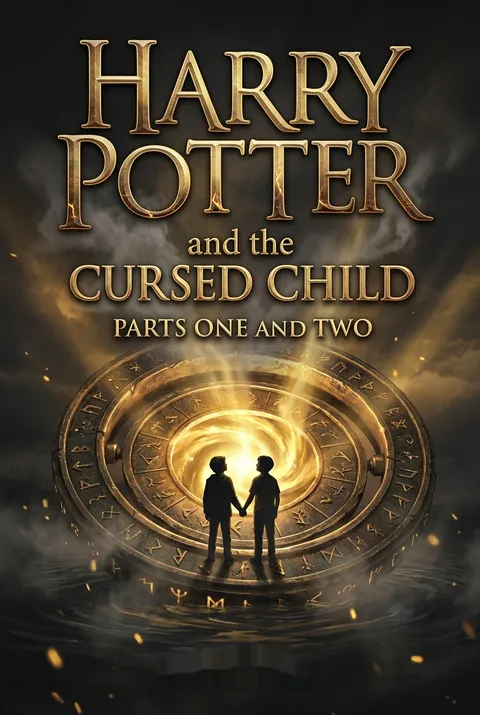


Plot Summary
The Slytherin Potter
At King's Cross, Harry's younger son1 Albus1 worries that Hogwarts will sort him into Slytherin, and the Sorting Hat does. On the train, Albus1 chooses to sit with Scorpius Malfoy,2 whose family name brings suspicion and a cruel rumor that he is Voldemort's child.
Rose Granger-Weasley9 leaves rather than be associated with him, but Albus1 stays. The boys become each other's refuge as classmates mock Albus1 for failing at magic and Scorpius2 for his supposed parentage.
Their friendship deepens through the next school years, even as Albus1 grows bitter about living beneath Harry's3 fame. When Scorpius's mother,15 Astoria,15 dies, Albus1 promises to attend her funeral, standing by his friend when both boys feel more defined by their names than by their choices.
The opening makes belonging a practical problem rather than an abstract theme: Albus is sorted into a house his father once feared, while Scorpius inherits a public accusation he cannot disprove. Albus's choice to remain in the compartment is his first small act of independence, though it also narrows his social world around one friend. Their bond is not built on shared confidence but on mutual recognition of being misread. That intimacy sustains them, yet leaves Albus especially vulnerable when he later feels Scorpius is the only person who understands him.
The Unforgivable Argument
Before Albus1 leaves for another school year, Harry3 gives him the blanket he was wrapped in as a baby, hoping to share a piece of his own past. Albus1 rejects the gift, and their argument ends with Harry3 saying he sometimes wishes Albus1 were not his son. That night, Albus1 overhears Amos Diggory10 pleading for a way to bring back Cedric,11 his son,11 whom Voldemort killed during the Triwizard Tournament.
Harry3 denies that the Ministry has a Time-Turner, though he has one. Albus1 meets Delphi,4 the caregiver who accompanies Amos,4 and recognizes her loneliness. After learning from Rose9 that the Ministry seized a device from Theodore Nott, Albus1 decides to help Amos,10 believing that saving Cedric11 can correct one of Harry's3 failures.
Albus turns grief into a mission because the mission offers what family conversation has not: a clear wrong, a target, and the possibility of repair. Harry's insult is especially damaging because it confirms Albus's fear that his father sees him as a disappointing version of someone else. Amos's plea then gives Albus a moral language for rebellion, allowing him to call defiance an act of justice. The blanket matters as a failed gesture of intimacy here, but its presence also plants a physical link between Harry's childhood and the crisis still to come.
The Stolen Time-Turner
Albus1 persuades Scorpius2 to leave the Hogwarts Express, and they reach St. Oswald's with Delphi's4 help. Amos10 initially dismisses them, but Delphi4 convinces him that the boys may be his only chance. Using Polyjuice Potion to disguise themselves as Harry,3 Ron,8 and Hermione,7 they enter the Ministry and search Hermione's7 office.
A magically armed bookcase attacks them until Scorpius2 solves its clues and finds the hidden Time-Turner. They travel to the first Triwizard task in 1994, where Albus1 disarms Cedric11 as he faces a dragon. The device pulls the boys back to the present, leaving Albus1 injured and Harry3 furious. Harry3 finds them, then orders Albus1 to stay away from Scorpius,2 mistaking their friendship for a danger he can control.
The theft converts a private family wound into public risk. The boys borrow adult identities to enter the Ministry, but their disguises cannot supply adult judgment: they mistake technical access to time for authority over its consequences. The enchanted library makes that limitation literal, forcing Scorpius's intelligence to save them where Albus's certainty cannot. Their first intervention also exposes Harry's central error. Faced with fear for his son, he treats separation as protection, repeating the very pattern of emotional distance that helped drive Albus toward danger.
Rose Vanishes From History
The altered present reveals the cost of Albus's1 spell: Rose9 was never born, Hermione7 teaches at Hogwarts, and Ron8 is married to Padma Patil. Scorpius2 traces the change to the Yule Ball. Because Cedric's11 disarming disrupted the tournament, Hermione7 never attended with Viktor Krum, Ron8 never became jealous, and he and Hermione7 never became a couple.
Harry's3 ban keeps Albus1 and Scorpius2 apart, while Scorpius2 understands that the smallest historical change has reshaped lives. They reconcile in the library, then decide to try again by humiliating Cedric11 during the lake task, hoping to keep him from winning. With Moaning Myrtle's18 help, they enter the lake through the girls' bathroom plumbing and travel back to 1995.
The changed timeline gives causality an intimate scale: a spell aimed at one death alters not only public history but the private chain of attraction that led to Rose's birth. Scorpius understands that history is relational, made from small encounters whose importance is invisible in advance. Albus, by contrast, initially sees repair as a matter of trying harder. Their argument forces him to recognize that his need to prove himself to Harry has turned Scorpius into an instrument. The reconciliation is meaningful because Albus listens to the harm he caused before asking his friend to risk more.
Voldemort Day Returns
Under the lake, Albus1 and Scorpius2 enlarge Cedric,11 sending him ballooning out of the task in front of the watching crowd. Their prank humiliates him, and the Time-Turner throws Scorpius2 into a changed present where Albus1 is missing.
Voldemort won the Battle of Hogwarts in this history, and the school celebrates him under Dolores Umbridge's17 rule. Scorpius2 discovers that Cedric's11 humiliation drove him toward the Death Eaters, and that Cedric11 killed Neville Longbottom, preventing Neville from destroying Nagini.
With Voldemort's snake alive, the battle turned against Harry's3 side. Scorpius2 has to conceal his shock while questioning the world around him, then seeks out Severus Snape,13 the one person who may understand how the original history can be restored.
The prank exposes the violence hidden inside Albus's idea of justice. He means to prevent Cedric's death, yet chooses humiliation because it seems like a controllable tool; instead, it becomes the injury that changes Cedric's character and shifts the war's outcome. The alternate world also tests Scorpius with a version of himself who is powerful, feared, and cruel. His horror is not simply at a dictatorship but at discovering that social approval can reward the very traits he rejects. The timeline makes moral consequences visible by giving private choices public architecture.
Snape's Last Resistance
Scorpius2 pretends to cooperate with Umbridge17 while he searches for the cause of Voldemort's victory. He finds Snape,13 then reaches Hermione7 and Ron,8 who lead a diminished resistance. They confirm that Cedric11 killed Neville and that this allowed Voldemort to win.
Scorpius2 explains the original world and persuades them to use the Time-Turner to stop Albus's1 first spell. Hermione7 blocks Albus1 from disarming Cedric,11 but the group returns to the wrong place and dementors corner them.
Hermione7 and Ron8 stay behind to hold the attackers while Snape13 escorts Scorpius2 toward the lake. Snape13 drives the dementors back with a Patronus shaped like a doe, then remains behind as Scorpius2 escapes. Albus1 reappears, and the boys return to their restored history.
Scorpius's courage takes the form of testimony: he asks people in a brutal world to trust a history they cannot verify, and earns that trust by speaking precisely about their relationships and sacrifices. The resistant Hermione, Ron, and Snape are not restored to easy heroism; they are people whose loyalty has survived under pressure. Their decision to protect Scorpius costs them dearly, giving his return a moral weight that a clever solution alone could not provide. The doe Patronus also joins Snape's private grief to his public resistance, showing how memory can become an action rather than merely a wound.
The Boys Come Back
Back in the original history, Harry,3 Ginny,5 Draco,6 and McGonagall12 find the boys at the lake. McGonagall12 reprimands them for stealing the Time-Turner and risking the lives of Rose,9 Hugo, and countless others. Albus1 and Scorpius2 keep quiet about still having the device. In Slytherin, Harry3 admits that he misread Scorpius2 as a threat, while Albus1 recognizes that his house did not cause their problems.
Scorpius2 secretly keeps the Time-Turner, and the friends decide it must be destroyed. They invite Delphi4 to join them, believing she wants to prevent another disaster. When Scorpius2 notices the Augurey tattoo on her neck and recognizes the symbol from the dark world, he realizes she has been concealing her purpose.
The return does not erase the boys' mistakes; McGonagall names their consequences, while Harry and Albus begin to see the fear beneath each other's behavior. Their restored friendship is more reciprocal than before because Albus now acknowledges that Scorpius's life carries burdens of its own. Yet secrecy remains the boys' reflex: they hide the Time-Turner even after learning what it can do. The Augurey tattoo interrupts their fragile relief, reminding them that intimacy without discernment can be exploited. Their trust in Delphi is emotionally understandable, but it repeats the haste that began the crisis.
The Augurey's Mask Falls
Delphi4 overpowers both boys, binds them, and reveals that she wants Voldemort restored. She has used their effort to save Cedric11 to steer history toward the outcome she desires. When Craig Bowker16 follows them and tries to get help, Delphi4 kills him, showing the boys that her plans are no longer a game of altered outcomes.
She takes Albus1 and Scorpius2 to the Triwizard maze in 1995, intending to force them to humiliate Cedric11 again and fulfill a prophecy linking the spared boy, altered time, and Harry's son.1 The boys resist despite having no wands and being threatened with Scorpius's2 death. Cedric11 hears their struggle, frees them, and gives them a chance to escape Delphi's4 control.
Delphi's betrayal weaponizes the boys' hope: she does not invent their desire to save Cedric, but bends it toward her own political and familial longing. Killing Craig marks a shift from manipulating history to treating individual lives as disposable. The prophecy gives her violence a story in which she can cast herself as destiny's agent, yet Albus and Scorpius resist by choosing loyalty over survival. Cedric's intervention complicates their attempt to control his fate. He is no longer simply the object of their rescue plan; he acts for himself, disrupting the role they assigned him.
A Message in the Blanket
When Delphi4 destroys the Time-Turner, Albus1 and Scorpius2 are stranded in the past. They identify their year as 1981, the night Voldemort attacked the infant Harry,3 and realize Delphi4 intends to alter that defining event. Albus1 remembers that his baby blanket is still in his bedroom and that Ron's8 spilled love potion damaged it.
He and Scorpius2 write a message in invisible Demiguise tincture, which the potion's pearl dust will reveal when the blanket is handled. In the present, Harry3 finds the burned words and understands their location and date. Meanwhile, Harry's3 allies uncover Delphi's4 prophecy and learn she claims Voldemort as her father. Draco6 reveals a second, more powerful Time-Turner, and the adults travel to rescue the boys.
The blanket changes meaning across the story. First it is Harry's awkward gift, then the casualty of Albus's anger, and finally a communication channel made possible by the residue of that same failed exchange. The message depends on remembered domestic details rather than superior magical force: Harry must know where the blanket is, and Albus must trust that his father will look. In parallel, the adults move from blame to cooperation, with Draco surrendering a secret device he could have used to revisit his own loss. Care becomes effective when it attends to particular people and objects.
Godric's Hollow Trap
The adults reach 1981 with Albus1 and Scorpius2 and hide in St. Jerome's Church. They infer that Delphi4 is waiting not merely to kill baby Harry3 but to meet the father she has never known. Harry3 transforms himself into Voldemort to draw her inside. Delphi4 recognizes the deception, seals the doors, and overpowers Harry;3 Albus1 crawls through a floor grate and draws her attention, allowing his father3 to defend him.
Harry3 opens the doors, and Ginny,5 Ron,8 Hermione,7 Draco,6 and Scorpius2 help subdue Delphi.4 Though Albus1 wants her punished for Craig's16 murder, Harry3 refuses to kill her. They then witness Voldemort kill James and Lily, an agony Harry3 cannot prevent. Hagrid arrives afterward to carry the orphaned baby away.
The climax refuses the fantasy that repairing a family wound means reversing every loss. Harry must watch his parents die again, this time with his son beside him, and the experience turns inherited trauma into shared witness. Delphi's desire to meet Voldemort is met with the brutal truth that proximity cannot create the love she wants. Harry's refusal to kill her is not forgiveness or softness; it is a boundary between justice and imitation. Albus's emergence through the grate makes him a participant in the rescue, while his father's protection finally answers the fear that he is unwanted.
Cedric's Quiet Grave
Back in their own time, Albus1 and Scorpius2 return to Hogwarts under severe detention. Scorpius,2 newly willing to risk embarrassment, asks Rose9 out, and she responds with a less guarded friendliness. Albus1 chooses to meet Harry3 for a walk instead of joining Scorpius2 at Quidditch.
On a hill, Harry3 admits that fatherhood frightens him because he has no father of his own to imitate. He tells Albus1 he was wrong to measure him against James and names the qualities he sees in him. They visit Cedric's11 grave, where Harry3 continues to acknowledge the life his friend lost. Albus1 stands beside him, and the two leave with a more honest understanding of their bond.
The resolution is deliberately modest after the scale of time travel: one walk, one grave, and a father willing to admit fear. Harry stops treating love as something his son should infer from heroic deeds and describes Albus as an individual with traits he values. Albus, in turn, can hear that difference without needing to become a copy of James or Harry. Scorpius's tentative approach to Rose suggests that confidence can begin with risking a small rejection. The story closes not by erasing grief but by giving it a place beside ongoing affection.
Analysis
The play's central mechanism is temporal, but its deeper subject is the desire to repair relationships by rewriting events. Albus1 wants to save Cedric11 partly because the request gives him a role that his family and school life have denied him. Harry3 wants to protect Albus1 from pain, yet his controlling response confirms the boy's fear that he is not understood. Each tries to solve an emotional problem through action at a distance: a rescue, a rule, a secret, or a magical device. The resulting timelines make that strategy visible. Changing Cedric's11 humiliation changes his character; changing one dance alters Rose's9 existence; trying to undo a death opens the way to political catastrophe.
The story also treats reputation as a force that shapes behavior. Albus1 is judged against Harry,3 Scorpius2 against a rumor about Voldemort, and Draco6 against the family history he is trying to escape. These judgments do not merely hurt; they limit what each character believes possible. Scorpius's2 compassion and Albus's1 willingness to act become strengths only when they are joined to listening and restraint. Their friendship provides each boy with an alternative witness, someone who can see beyond the story imposed by a surname.
Finally, the ending rejects the idea that love means preventing all suffering. Harry3 cannot save his parents in 1981, and he cannot give Delphi4 the father she wanted. He can, however, remain beside Albus,1 acknowledge his own fear, and refuse to become an executioner. The graveyard visit leaves Cedric's11 death intact while allowing Harry3 and his son1 to share its meaning. The play's resolution is therefore not mastery over time but a more honest use of the present: care offered specifically, limits accepted, and grief carried together.
Review Summary
Harry Potter and the Cursed Child received mixed reviews from fans. While some appreciated the nostalgic return to the wizarding world and enjoyed the new characters, many criticized the plot as convoluted and inconsistent with the original series. Readers found the characterization of Harry and other familiar characters to be out of character. The time travel element and the revelation of Voldemort's daughter were particularly controversial. Despite these criticisms, some fans still found enjoyment in revisiting Hogwarts and experiencing new magical adventures.
People Also Read



Characters
Albus Potter
The burdened second sonHarry3 and Ginny's5 younger son, Albus grows up under the pressure of a famous surname and the expectation that he should resemble his older brother. His Slytherin sorting sharpens his sense of being the wrong kind of Potter, while his struggles at school leave him socially dependent on Scorpius2. He wants to be recognized as himself, but often pursues that recognition through defiance and dramatic gestures. His compassion is real, especially toward people treated as expendable, yet his urgency can turn care into control. Albus's central psychological tension is the difference between wanting to be seen and demanding proof that he matters.
Scorpius Malfoy
The gentle Malfoy heirDraco6 and Astoria's15 son, Scorpius is intelligent, curious, socially awkward, and generous with the few people who treat him as an individual. His classmates attach a monstrous rumor to his family history, so he learns to expect scrutiny even when he has done nothing wrong. He finds in Albus1 a friend willing to sit beside him without demanding a defense. Scorpius's knowledge of magical history and his careful reasoning often counterbalance Albus's1 impulsiveness, but he can also mistake caution for proof that he is destined to fail. His wit and loyalty conceal how deeply he longs for ordinary acceptance.
Harry Potter
The famous, faltering fatherNow a senior Ministry official, Harry is a husband to Ginny5 and father to James, Albus1, and Lily. He can act decisively in danger, but fame and old trauma make him less sure-footed at home. Harry wants to protect Albus1 and offer him the love he himself lacked, yet he often reaches for rules, reassurance, or gifts instead of listening to what his son1 is saying. His public identity as a rescuer complicates the private task of being a parent, because he assumes experience should make him competent. Beneath his authority lies a man still learning how fear shapes his choices.
Delphi
The helpful strangerDelphi presents herself as Amos Diggory's niece4 and caregiver, a capable young witch who understands grief and knows how to make isolated people feel noticed. She approaches Albus1 without the deference or suspicion that usually follows his name, which helps him feel understood. Her confidence and practical help make her seem like a natural ally to the boys' plan. Delphi is especially attentive to the needs of people who feel excluded from family or history, and that apparent empathy gives her influence. Her role in the story depends on the difference between being invited into someone's trust and being worthy of it.
Ginny Potter
The clear-eyed mediatorHarry's wife5 and the mother of their three children, Ginny understands both the private cost of living under public attention and the pain of being shut out. She notices when Harry's3 protective instincts are turning into control and tries to help him see Albus1 as a separate person rather than a problem to solve. Her directness does not diminish her tenderness; she can challenge Harry3 while still standing beside him. Ginny's own experience of vulnerability gives her a sharp sense of what children need from adults: not only safety, but unmistakable, personal affection.
Draco Malfoy
A father remaking himselfDraco is Scorpius's father6 and a former adversary of Harry3. He remains proud and controlled, but his devotion to his son2 has made him more capable of recognizing what his own upbringing cost him. The rumors surrounding Scorpius2 make Draco protective, sometimes to the point of defensiveness; he fears that public suspicion will repeat the isolation he knows well. His relationship with Harry3 is strained by history, yet both men share the difficulty of loving sons whose needs they do not immediately understand. Draco's guardedness hides a strong wish to be a better father than the one he had.
Hermione Granger
The meticulous MinisterHermione is Ron's wife7, Rose9 and Hugo's mother, and Minister for Magic. Her instinct is to investigate, organize evidence, and act before danger becomes catastrophe. Those strengths make her an effective leader, though her faith in procedure cannot prevent every mistake, including the Ministry's retention of a dangerous Time-Turner. She is protective of her family without surrendering her public responsibilities, and she expects others to take risks seriously. Hermione's intelligence is practical and relational: she can connect a small clue to a broad consequence, but must also accept that good intentions do not cancel the harm caused by poor judgment.
Ron Weasley
The loyal comic heartRon is Hermione's husband8, Harry's3 lifelong friend, and a warm presence in the Potter children's lives. His humor often eases tense rooms, while his loyalty makes him willing to stand beside people even when he is frightened or out of his depth. Ron can seem less serious than Hermione7, but his emotional intelligence appears in his ability to notice who feels alone and to keep showing up. As a father and friend, he offers affection without ceremony. His comic habits are not merely a diversion; they are one way he keeps fear from taking over the people around him.
Rose Granger-Weasley
The ambitious cousinRose is Hermione7 and Ron's daughter9 and Albus's cousin9. Bright, competitive, and eager to succeed at Hogwarts, she initially approaches friendship as something to choose strategically. Her confidence can make her quick to judge Scorpius2 by his family name and Albus1 by his choices. Rose's presence links the boys' private friendship to the wider family network, reminding them that their actions affect people who are not part of their plans. She is neither simply a rival nor a sidekick; she has her own ambitions and social judgments.
Amos Diggory
A grieving fatherAmos is Cedric Diggory's elderly father10, living at St. Oswald's and still consumed by the loss of his son11. He has spent years pursuing recognition for Cedric11 and cannot accept that remembrance is all the world can offer him. His grief gives him a powerful, understandable motive, but it also leaves him vulnerable to anyone who promises a way to reverse the past. Amos's insistence that Cedric11 mattered challenges the tendency to treat a casualty as an incidental cost of someone else's survival.
Cedric Diggory
The stolen championCedric is a Hufflepuff champion in the Triwizard Tournament and the beloved son Amos10 cannot stop mourning. He is remembered as gifted, fair-minded, and brave, but the boys' efforts to alter his fate treat him at first as a piece in a larger strategy. His story therefore raises a difficult question about rescue: whether helping someone means honoring their agency, or deciding on their behalf what their life should become. Cedric's place in the plot gives the past a human face beyond its famous survivors.
Professor McGonagall
The stern school guardianHogwarts's headmistress, McGonagall takes the safety of her students and the integrity of the school seriously. She is capable of warmth, but she does not soften the consequences of reckless choices simply because the children involved come from famous families. Harry's3 attempt to make her monitor Albus1 tests their long-standing trust, and her insistence on professional judgment protects the school from becoming an extension of Ministry authority. McGonagall offers a model of care that includes boundaries, accountability, and respect for young people's capacity to learn.
Severus Snape
The guarded resistance fighterSnape is a Hogwarts professor whose reserve makes him difficult to approach and whose loyalties are rarely obvious to those around him. He prizes discipline and distrusts students who treat danger as adventure. Yet his knowledge of the past and capacity for sacrifice make him important to anyone trying to understand how the war was won. Snape's emotional life is concealed behind severity, but his choices are shaped by enduring attachments and a private moral code. He challenges Scorpius2 to prove that his appeal is more than a clever story.
Albus Dumbledore
The painted adviserDumbledore appears through his portrait, a preserved likeness that can advise Harry3 but cannot replace the living man he was. Their conversations expose the limits of inherited wisdom: a portrait may offer insight, yet it cannot undo the distance created by past choices. Dumbledore's affection for Harry3 is sincere, but his secrecy once left Harry3 feeling abandoned. As a figure of memory, he embodies both the comfort and insufficiency of advice from the dead.
Astoria Malfoy
Scorpius's gentle motherAstoria is Draco's wife15 and Scorpius's mother15. Though she is not present for most of the action, her influence is visible in Scorpius's2 kindness and in Draco's6 memories of a softer life. Her family circumstances contribute to the intense attention surrounding Scorpius's2 upbringing, while her tenderness helps explain why he resists becoming the person others expect him to be.
Craig Bowker Jr.
The overlooked classmateCraig is a Hogwarts student who often appears at the edge of other people's attention. His attempts to approach Albus1 and Scorpius2 show how easily a quiet classmate can be reduced to a background figure. Craig's ordinary school life brings the danger of the boys' choices close to home, making their adventure consequential for someone beyond their families.
Dolores Umbridge
The authoritarian headmistressUmbridge represents institutional power stripped of compassion. In the altered history, she governs Hogwarts through obedience, ideological slogans, and the punishment of students she deems undesirable. Her polished manner disguises a capacity for cruelty, making her a reminder that tyranny can present itself as orderly administration. She is less interested in teaching students than in sorting them into the categories her regime approves.
Moaning Myrtle
The bathroom guideMyrtle is the ghost who haunts Hogwarts's girls' bathroom. She is talkative, sensitive to how others describe her, and unexpectedly willing to help the boys reach the lake through the plumbing. Her fondness for secrets and her memories of the school make her an eccentric but useful guide. Myrtle's presence turns a neglected corner of Hogwarts into a route between the present and the past.
Bane
The guarded centaur seerBane is a centaur who reads the stars and protects the boundaries of the Forbidden Forest. He distrusts human claims of friendship when those claims ignore centaur sovereignty. His warning about a dark presence near Albus1 is difficult to interpret, partly because he speaks from a worldview Harry3 does not fully understand. Bane's reserve makes his help valuable but not infallible.
The Trolley Witch
The train's fierce keeperThe Trolley Witch has served the Hogwarts Express for generations, and she takes its passengers and their journey seriously. The boys discover that her cheerful snack service conceals formidable magic and an unwavering commitment to keeping the train on schedule. She turns an apparent escape route into a test of how little the students understand about the world they are trying to outwit.
Plot Devices
The Ministry Time-Turner
A fragile lever on historyThe Ministry's prototype Time-Turner lets Albus1, Scorpius2, and later others revisit brief moments in the past. Its narrow operating window and violent pullback make every trip dangerous, while the boys' repeated use shows that changing a single action can alter families, school life, and the outcome of a war. The device gives grief a tempting form of agency: if the past can be reached, then perhaps a death can be undone. Its central limitation is not merely technical. The travelers cannot predict the full web of consequences their interventions will disturb.
Harry's baby blanket
A message carried by memoryThe blanket connects Harry's3 infancy to Albus's1 present. Harry3 gives it to his son1 as an intimate family heirloom, but Albus1 rejects the gesture during their argument. After a love potion spills across it, the residue creates the condition for an invisible message written in Demiguise tincture to appear. The object eventually carries Albus's1 location and date to Harry3 across time. Its function depends on the story's emotional history: the message works because a failed attempt at closeness left the blanket in a place Harry3 could find.
The Invisibility Cloak
A shelter for forbidden closenessThe cloak helps Albus1 and Scorpius2 evade bullies and adult supervision, particularly when Harry3 and McGonagall12 try to keep them apart. It gives the boys a temporary space in which they can speak honestly and decide what to do next. The cloak does not solve their conflicts or make their plans wise, but it protects their friendship from being managed by adults. Its use therefore carries two meanings: concealment can enable irresponsible secrecy, yet it can also preserve a bond that controlling authority threatens to break.
The Augurey symbol
A warning hidden in plain sightThe dark bird associated with foretelling death appears as a tattoo on Delphi4 and as an emblem tied to the altered world's political movement. Scorpius2 recognizes it from the oppressive history he has witnessed, which turns a decorative mark into evidence that Delphi's4 story does not add up. The symbol joins personal identity to political intention: Delphi4 wears it as a claim that she can shape what comes next. Its ominous meaning is not fate itself, but the way people use predictions to justify the future they want.
FAQ
Basic Details
What is Harry Potter and the Cursed Child: Parts One and Two about?
- Struggles with Legacy: The story follows Albus Potter, Harry's son, as he grapples with the weight of his father's fame and his own identity, leading to a strained relationship with Harry.
- Time-Turning Mishaps: Albus and his friend Scorpius Malfoy use a Time-Turner to try and correct past wrongs, but their actions create dangerous alternate realities.
- Dark Prophecy Emerges: A new threat arises in the form of Delphi Diggory, Voldemort's daughter, who seeks to alter the past and bring about her father's return, forcing Albus and Scorpius to confront her.
Why should I read Harry Potter and the Cursed Child: Parts One and Two?
- Expands the Wizarding World: The play offers a new perspective on familiar characters and introduces compelling new ones, exploring themes of family, friendship, and legacy.
- Intricate Plot Twists: The narrative is filled with unexpected turns, time travel paradoxes, and emotional depth, keeping readers engaged and invested in the characters' journeys.
- Explores Complex Relationships: The story delves into the complexities of parent-child relationships, particularly between Harry and Albus, and the power of friendship between Albus and Scorpius.
What is the background of Harry Potter and the Cursed Child: Parts One and Two?
- Post-Voldemort Era: The play is set nineteen years after the events of Harry Potter and the Deathly Hallows, in a world where Voldemort is defeated, but the scars of the past still linger.
- Exploration of Trauma: The story explores the psychological impact of trauma on characters like Harry, who still struggles with the loss of his parents and the burden of his fame.
- Themes of Legacy: The play examines the weight of legacy and how it affects the next generation, particularly Albus, who feels the pressure of living up to his father's heroic status.
What are the most memorable quotes in Harry Potter and the Cursed Child: Parts One and Two?
- "Sometimes, I think I can see my dad thinking: How did I produce this?": This quote from Scorpius highlights his insecurity and the pressure he feels due to his parentage, resonating with Albus's own struggles.
- "The truth is a beautiful and terrible thing, and should therefore be treated with great caution.": This quote, attributed to Dumbledore, underscores the play's themes of truth, consequences, and the dangers of manipulating time.
- "We're the only ones volunteering to help. They're prepared to bravely put themselves at risk to return your son to your side.": Delphi uses this to convince Amos to trust Albus and Scorpius, highlighting the boys' courage and willingness to help others.
What writing style, narrative choices, and literary techniques does J.K. Rowling use?
- Play Format: The story is presented as a play script, using dialogue and stage directions to drive the narrative, creating a unique reading experience compared to the novels.
- Time Manipulation: The use of the Time-Turner allows for non-linear storytelling, creating alternate realities and exploring the consequences of changing the past.
- Emotional Depth: The play delves into the characters' inner conflicts and emotional struggles, using dialogue and character interactions to reveal their vulnerabilities and motivations.
Hidden Details & Subtle Connections
What are some minor details that add significant meaning?
- The Love Potion: Ron's joke love potion, initially a source of humor, becomes a crucial plot device when it spills on Harry's blanket, allowing Albus to send a message through time.
- The Augurey Tattoo: Delphi's Augurey tattoo, initially presented as a personal symbol, reveals her true identity and her connection to Voldemort's ideology.
- The Trolley Witch: The seemingly innocuous Trolley Witch on the Hogwarts Express is revealed to be a powerful magical being, highlighting the hidden depths of the wizarding world.
What are some subtle foreshadowing and callbacks?
- Albus's Slytherin Sorting: Albus's sorting into Slytherin foreshadows his internal conflict and his struggle to reconcile his identity with his father's legacy.
- The "Kill the Spare" Line: The recurring phrase "Kill the spare," initially referring to Cedric, foreshadows the tragic consequences of altering the past and the importance of every life.
- The Dementors' Presence: The increasing presence of dementors in the alternate reality foreshadows the return of Voldemort and the darkness that threatens to engulf the wizarding world.
What are some unexpected character connections?
- Snape's Loyalty: In the alternate reality, Snape's continued loyalty to Dumbledore and his willingness to help Scorpius highlights the complexity of his character and his hidden heroism.
- Draco's Redemption: Draco's transformation from a prejudiced antagonist to a protective father and ally to Harry showcases the power of personal growth and the importance of family.
- Delphi's Parentage: The revelation of Delphi as Voldemort's daughter, a secret kept hidden from the wizarding world, adds a new layer of complexity to the story and challenges the established narrative.
Who are the most significant supporting characters?
- Moaning Myrtle: Her knowledge of the pipes and her willingness to help Albus and Scorpius, despite her usual melancholy, is crucial for their time-traveling plans.
- Craig Bowker Jr.: His eagerness to please and his tragic death highlight the dangers of the alternate reality and the consequences of Delphi's actions.
- Bane: The centaur's warning about the "black cloud" around Albus foreshadows the danger he faces and adds a layer of mystery to the plot.
Psychological, Emotional, & Relational Analysis
What are some unspoken motivations of the characters?
- Harry's Fear of Failure: Harry's overprotectiveness of Albus stems from his fear of failing as a father and his inability to reconcile his past trauma with his present responsibilities.
- Albus's Need for Validation: Albus's reckless actions are driven by his need to prove himself and escape the shadow of his father's fame, seeking validation through his own achievements.
- Scorpius's Desire for Acceptance: Scorpius's loyalty to Albus and his willingness to risk everything stem from his desire for acceptance and his struggle to overcome the stigma of his family name.
What psychological complexities do the characters exhibit?
- Harry's PTSD: Harry's nightmares and his inability to connect with Albus reveal the lasting psychological impact of his past trauma and his struggle to cope with his fears.
- Albus's Identity Crisis: Albus's internal conflict and his struggle to define himself outside of his father's legacy highlight the challenges of adolescence and the search for self-identity.
- Delphi's Obsession: Delphi's obsession with her father and her desire to fulfill the prophecy reveal her deep-seated psychological wounds and her distorted sense of purpose.
What are the major emotional turning points?
- Harry and Albus's Argument: The argument between Harry and Albus, where they both express their deepest resentments, marks a low point in their relationship but also sets the stage for their eventual reconciliation.
- Scorpius's Isolation: Scorpius's experience in the alternate reality, where he is celebrated but alone, highlights the importance of his friendship with Albus and the emotional toll of their actions.
- The Dementor Attack: The dementor attack in the alternate reality, where Hermione and Ron are kissed, underscores the stakes of their mission and the emotional cost of their choices.
How do relationship dynamics evolve?
- Harry and Albus's Reconciliation: Harry and Albus's relationship evolves from one of misunderstanding and resentment to one of mutual respect and love, as they learn to communicate and accept each other's flaws.
- Albus and Scorpius's Bond: Albus and Scorpius's friendship deepens through their shared experiences, becoming a source of strength and support as they navigate dangerous situations.
- Ron and Hermione's Love: Ron and Hermione's relationship is explored in different timelines, highlighting the enduring nature of their love and their commitment to each other.
Interpretation & Debate
Which parts of the story remain ambiguous or open-ended?
- The Nature of Prophecy: The play leaves open the question of whether prophecies are fixed or can be changed, prompting debate about free will versus destiny.
- The Extent of Voldemort's Influence: The play raises questions about the nature of Voldemort's power and whether his influence can truly be eradicated, even after his death.
- The Long-Term Effects of Time Travel: The play leaves open the question of the long-term consequences of time travel and whether the characters' actions will have unforeseen repercussions.
What are some debatable, controversial scenes or moments in Harry Potter and the Cursed Child: Parts One and Two?
- The Portrayal of Hermione: Some readers have debated the portrayal of Hermione in the alternate reality, where she is depicted as a harsh and unforgiving professor, questioning the consistency of her character.
- The Use of Time Travel: The use of time travel as a plot device has been criticized for its potential to create plot holes and inconsistencies, raising questions about the rules of the wizarding world.
- The Character of Delphi: Delphi's character has been debated for her motivations and her connection to Voldemort, with some readers questioning the plausibility of her existence and her actions.
Harry Potter and the Cursed Child: Parts One and Two Ending Explained: How It Ends & What It Means
- The Time-Turner's Destruction: The destruction of the Time-Turner symbolizes the characters' acceptance of the present and their commitment to living with the consequences of their choices.
- The Power of Love and Sacrifice: The ending emphasizes the enduring power of love and sacrifice, as Harry and Albus reconcile and learn to appreciate their familial bonds.
- Hope for the Future: Despite the challenges they face, the ending offers a sense of hope for the future, as the characters embrace their roles in shaping their own destinies and protecting the wizarding world.
Harry Potter Series
About the Author
Other books by J.K. Rowling



Download PDF
Download EPUB
.epub digital book format is ideal for reading ebooks on phones, tablets, and e-readers.








