

Key Takeaways
A comma can turn Grandma’s dinner question into a cannibalism accusation
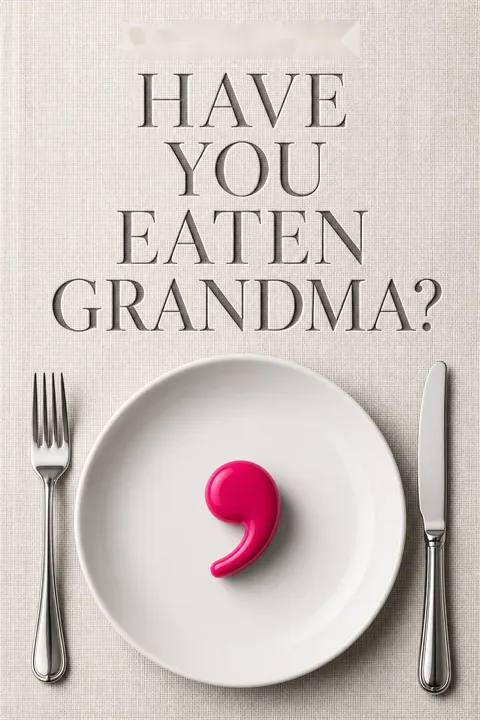
Punctuation carries meaning. The title’s question without a comma asks whether Grandma has been eaten. Add a comma before her name, and it asks whether she has eaten dinner. The mark changes who is doing what, not merely how the sentence sounds. Brandreth opens with this comic ambiguity to show why punctuation matters in ordinary communication, not just formal writing.
Context can rescue clarity. A sea captain once sent British authorities a message about a suspected murderer escaping by ship. The telegram had almost no punctuation, yet its clues were clear enough to help authorities identify the suspects. That success depended on context. In less forgiving situations, missing or misplaced marks can leave readers guessing, or make a harmless message sound alarming.
Writing lacks much of the information carried by speech, including tone, timing, and gesture. Punctuation provides some of that structure, helping readers infer how words and clauses fit together. The title’s joke works because the reader sees how quickly a small mark can change an interpretation. Yet punctuation is not a perfect transcript of spoken pauses. A comma inserted wherever a speaker breathes can make a sentence harder to parse. The stronger principle is to use marks to guide meaning, not to imitate every pause.
Match punctuation to how your clauses relate, not where you breathe
Marks have different jobs. A comma can separate items in a list or clauses within a sentence. In a list, a final comma before and, often called the serial comma, can prevent readers from grouping the items incorrectly. The book’s example of a documentary description makes a guest sound like an 800-year-old demigod without that clarifying mark.
Choose the size of the pause. A semicolon can connect two complete, closely related thoughts. A colon points forward, introducing a list, explanation, or consequence. A full stop ends the thought. These are useful patterns, not a mechanical formula for every sentence. If a comma makes a sentence ambiguous, rewrite it or choose a stronger mark rather than hoping the reader will guess correctly.
Punctuation is a compact system for managing a reader’s attention. Lists, explanations, and related claims create different expectations, and marks can signal those relationships before the reader reaches the next phrase. This resembles information design: a heading, indentation, or visual boundary helps people see how parts belong together. The serial comma is especially useful when list items are long or internally complex. Still, no single comma policy suits every publication. Consistency and clarity matter more than declaring one house style universally correct.
Use apostrophes for ownership or missing letters, never ordinary plurals
Apostrophes do two jobs. They can show possession, as in a singular person’s book or a plural group’s room, and they can mark omitted letters in contractions. They do not normally make nouns plural. A shop sign advertising several tattoos needs no apostrophe; a room used by several teachers may need one after the plural s to show ownership.
Check the meaning first. Its means belonging to it, while it’s means it is or it has. Saying the expanded version aloud can expose the mistake. Possessive pronouns such as yours, hers, and theirs also take no apostrophe. Brandreth’s examples of misplaced apostrophes on shop signs and hospital names show how a tiny mark can make writing look careless or change its meaning.
The apostrophe is unusually efficient: one mark can signal either a grammatical relationship or missing sound. That efficiency explains why errors attract attention, but it can also encourage overcorrection. English has exceptions and competing conventions, especially around names ending in s and organizational branding. A practical approach is to learn the common patterns, check the intended meaning, and follow a consistent style when authorities differ. Public mistakes may reveal weak editing, but they do not reliably measure a writer’s intelligence or worth.
Treat spelling as a learned convention, then build personal memory aids
English spelling has a history. Shakespeare used several spellings of his own name, and English spelling was not standardized when he wrote. Samuel Johnson’s 1755 dictionary helped establish widely accepted forms. In the United States, Noah Webster promoted simpler spellings such as color and center. These histories help explain why English spelling can feel inconsistent: it preserves old forms, reflects changing pronunciation, and differs across regions.
Practice what trips you up. Vice President Dan Quayle became a public joke after adding an e to potato during a school spelling exercise. Brandreth recommends identifying personal trouble words, then breaking them into parts, saying them aloud, or inventing a mnemonic. The best memory aid is one that connects the spelling to something the learner can readily recall.
A spelling system is both a tool for reading and a social convention. Shared spellings make texts easier to circulate, while historical leftovers can make the system harder to learn. Webster’s reforms show that spelling can change, but reforms rarely succeed simply because they seem more logical. Quayle’s episode also illustrates how a visible mistake can become a proxy for judgments about competence. That judgment is often unfair, particularly for people with dyslexia or other learning differences. Memory aids improve access without pretending that every irregularity is a personal failure.
Write for your reader’s English, not an imagined linguistic referee
English has several legitimate forms. British and American spelling differ in familiar ways, including colour and color, centre and center, and travelled and traveled. Vocabulary differs too: a British lift is an American elevator. Brandreth recommends using the form expected by the audience, while keeping the variety chosen for a piece consistent.
Usage also changes over time. The author notes that split infinitives, once condemned by some teachers, are now widely accepted. He treats other disputed forms as matters of judgment rather than eternal law. Even the phrase the Queen’s English does not mean that good English requires a particular accent. Its purpose is clear and effective communication, not imitation of a social class or a monarch.
Audience awareness is a form of practical respect. Writers adjust vocabulary and spelling so readers can follow without needless friction, much as speakers shift register across settings. That does not mean every difference is interchangeable: local terminology, legal language, and institutional standards may matter. It also helps to distinguish a useful standard from the claim that one dialect is inherently superior. Standard forms can open doors in education and work, but linguistic variation is not evidence of inferior thought. The task is to communicate across differences without confusing convention with intelligence.
Learn the history behind English’s unruly plurals
Some plurals preserve old patterns. Ox becomes oxen, while goose becomes geese and mouse becomes mice. The book traces forms such as these to older Germanic roots. The vowel change in words such as foot and feet is called umlaut, a historical change in a word’s vowel that survives in some plurals.
Other words followed different routes. English has adopted words from Latin, Greek, French, and Italian, so some nouns keep older plural endings while others take an English s. Both formulas and formulae are accepted, while octopuses is the standard plural recommended in the book, not the sometimes-used octopi. Many nouns simply add s, but there are enough exceptions that a dictionary remains useful.
Irregular plurals are less arbitrary when viewed as fossils of English’s layered history. A single modern language contains inherited forms and words borrowed under different conditions, so a uniform rule cannot explain every ending. This is a useful lesson in historical linguistics: present-day variation often records earlier contact and change. Etymology can make a form memorable, but it should not be mistaken for a complete spelling strategy. For less familiar words, current usage and the audience’s expectations are more practical guides than reconstructing every root.
Check confusing words by meaning, not sound alone
Similar sounds conceal different jobs. Homophones sound alike but have different meanings; heterographs are homophones that are also spelled differently. Their, there, and they’re sound alike, but only they’re expands to they are. Likewise, affect and effect often cause confusion because their roles and meanings vary with context.
Use a meaning test. Ask what the sentence is trying to say, then substitute a definition or expand a contraction. To separate imply from infer, remember that a speaker implies something while a listener infers it. To distinguish fewer from less, ask whether the noun describes countable items or an amount. These checks are more reliable than choosing the spelling that merely looks familiar.
Sound-based spelling errors expose a basic feature of English: pronunciation and written form do not map neatly onto one another. A spellchecker can catch unfamiliar spellings, but it may accept the wrong word when that word is correctly spelled in another context. Semantic checking asks a different question: does this form fit the intended meaning? That habit transfers beyond grammar into careful reading and argument. Some distinctions that Brandreth presents as firm are contested or fading in everyday use, so formal writers should also consult the standards of their audience.
Choose humane words without letting politeness hide reality
Words have consequences. Brandreth advises avoiding language that demeans people on the basis of race, sex, sexuality, or gender, and recommends care when a term might cause offense. He also welcomes some shifts in usage, such as replacing a gender-specific job label with flight attendant when the job is done by people of different genders.
Politeness can also obscure facts. A euphemism is a milder or less direct expression used in place of a harsher one. It can spare someone embarrassment, but it can also disguise what is happening. The book contrasts gentle language around death with phrases used to disguise torture or job losses. Before choosing a euphemism, ask whether it protects a person’s dignity or makes the truth harder to see.
This distinction is important because civility and candor are not opposites. Language can reduce unnecessary injury while still naming events accurately. In public institutions, euphemisms often shift attention away from who acted and who was harmed, so their effects deserve scrutiny. At the same time, standards of offense vary by community and context. No checklist can anticipate every response. Listening to the people described, and being willing to revise a choice, is more useful than either treating every new term as mandatory or dismissing every request for change.
Cut verbal clutter before it buries the actual point
Remove repetition that adds nothing. Return back and PIN number repeat information already present in the first word or acronym. Brandreth calls this kind of needless repetition tautology. He also objects to habitual fillers such as like and well, and to inflated workplace language that makes simple actions sound grander than they are.
Edit toward clarity. George Orwell’s writing advice, as presented in the book, favors short words when they work, cutting unnecessary words, and preferring active constructions when they are clearer. But concision is not a rule to apply blindly. Repetition can create emphasis, and an informal filler can express hesitation or personality. The test is whether a phrase helps the reader understand the point or merely delays it.
Concise writing reduces the effort required to locate an argument, especially when readers are scanning screens or working under time pressure. Removing duplicated meaning is a good first edit because it rarely sacrifices substance. The caution is that economy can become a false ideal: short prose may omit context, flatten voice, or make a complicated issue seem simple. A useful edit does not just shorten. It improves the ratio of relevant information to reader effort, while preserving the distinctions and evidence the claim needs.
Grow vocabulary by hunting words and using them immediately
Collect words actively. Brandreth recommends reading widely, listening across generations and professions, keeping a word notebook, exploring dictionaries, solving puzzles, and playing Scrabble. A new word is easier to remember when it is used soon after discovery, rather than left as a definition on a page.
Make communication a practice. The author recalls playing Scrabble with school founder J. H. Badley, who was nearly one hundred and still a formidable opponent. The game helped kindle Brandreth’s own enthusiasm for words and eventually led him to establish a national championship. He summarizes good communication through five A’s: be accurate, ambitious, adventurous, accepting of change, and aware of how words will be received.
Vocabulary grows through encounters and retrieval, not just exposure. Looking up a word, trying it in a sentence, and returning to it later creates several chances to remember its meaning and use. Games make that practice social and low-stakes, while reading supplies examples of how words behave in context. A large vocabulary is not automatically a better one: rare words can exclude or obscure. The useful goal is range, with the judgment to choose a familiar word when that serves the reader better.
Analysis
Have You Eaten Grandma? is a comic guide to English usage, organized as a tour through punctuation, spelling, grammar, vocabulary, and social language. Its most durable argument is that correctness matters when it changes meaning or affects a reader’s confidence, but that rules are tools rather than sacred objects. The title makes this argument miniature: a comma can distinguish a meal from an accusation.
The book’s humor is not decoration. Misleading signs, confusing lists, and spelling blunders give abstract rules a human consequence, making punctuation easier to remember. Brandreth also uses anecdotes to complicate the usual story of linguistic decline. English has never been perfectly stable: Shakespeare’s spelling varied, dictionaries helped standardize usage, and American spelling reform created familiar differences. His willingness to accept some changes, while resisting others, makes the book less rigid than its title might suggest. Its central tension is between clarity and social judgment. The author argues that strong English can help people succeed in school, work, and healthcare. That is plausible as a description of how institutions reward standard forms, but it risks treating those rewards as proof that some speakers are naturally more capable. A sociolinguistic view separates command of a prestigious register from intelligence. Readers can learn conventions that improve access while recognizing that accents and dialects are structured forms of language, not defects.
The practical method is therefore selective rather than purist: learn common conventions, notice where usage varies, and choose the form that best serves the reader. Punctuation should clarify relationships, spelling should be checked where it is uncertain, and euphemism should not conceal harm. The book is most persuasive when it asks writers to attend to consequences. It is less persuasive when individual preferences are presented as universal rules. That limitation is also part of the lesson: good usage requires not only knowing conventions, but judging when they matter.
Review Summary
Have You Eaten Grandma? is a witty and informative guide to English grammar, punctuation, and usage. Readers appreciate Brandreth's humorous approach to a typically dry subject, making the book both educational and entertaining. Many find it useful as a reference tool and praise its coverage of modern language trends. While some sections may drag or contain crude language, most reviewers recommend it for language enthusiasts and those looking to improve their English skills. The book's comparisons between British and American English are particularly noted as interesting.
People Also Read
Glossary
Serial comma
Clarifies list boundariesA comma placed before the final and or or in a list of three or more items. The book also calls it the Oxford comma. It is not required in every style, but it can make a list easier to interpret when the final items might otherwise seem connected or when the list contains complex phrases.
Restrictive relative clause
Identifies which oneA relative clause that supplies information needed to identify the person or thing being discussed. In the book’s examples, removing the clause changes the sentence’s meaning, because it no longer specifies which people or objects are meant. Such clauses are generally written without surrounding commas.
Homophones
Words with matching soundsWords that sound the same but have different meanings. They may be spelled the same or differently. The book uses pairs such as hear and here to show why sound alone cannot reliably determine spelling or meaning.
Heterographs
Same sound, different spellingWords that sound alike but are spelled differently and have different meanings. Examples include their, there, and they’re. The term identifies a particularly troublesome kind of homophone, because the speaker’s pronunciation does not reveal which written form is correct.
Umlaut
Historical vowel changeA linguistic process in which a vowel changes under the influence of another sound in an earlier form of a word. Brandreth uses the term to explain inherited English plurals such as foot and feet, goose and geese, and mouse and mice. It is distinct from the two-dot mark also called an umlaut.
Portmanteau word
Blend of two wordsA word formed by combining parts of two words and drawing meaning from both. The book gives brunch, formed from breakfast and lunch, and Brexit, formed from Britain and exit. The term comes from a kind of traveling case that opens into two compartments.
Initialism
Initial letters spoken separatelyAn abbreviation formed from the initial letters of a phrase and pronounced as the names of those letters. BBC and BLT are examples in the book. Initialisms differ from acronyms, which are also formed from initial letters but are spoken as words when pronunciation permits.
Acronym
Initial letters pronounced as a wordAn abbreviation formed from the initial letters of a phrase and pronounced as a word. Brandreth gives radar, from radio detection and ranging, and AWOL, from absent without leave, as examples. Some abbreviations are instead pronounced letter by letter and are classified as initialisms.
Five A’s
Communication checklistBrandreth’s five-part guide to communicating well: be accurate, ambitious, adventurous, accepting, and aware. The advice combines correctness with curiosity and flexibility. It encourages writers to choose precise words, expand their vocabulary, take creative risks, accept that usage changes, and consider how readers will understand or receive their language.
Download PDF
Download EPUB
.epub digital book format is ideal for reading ebooks on phones, tablets, and e-readers.








