Key Takeaways
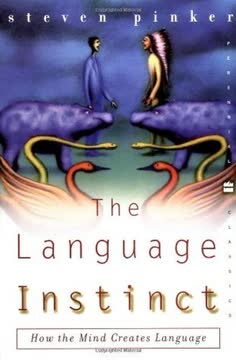
1. Language is an innate instinct, not a learned cultural artifact.
It conveys the idea that people know how to talk in more or less the sense that spiders know how to spin webs.
Innate ability. Language is not a cultural invention like writing or baking, but a complex, specialized skill embedded in our biological makeup. It develops spontaneously in children without conscious effort or formal instruction, much like spiders instinctively spin webs. This ability is qualitatively similar across all healthy individuals, distinct from general intelligence.
Universal presence. Complex language is found in every human society, regardless of technological advancement. There are Stone Age societies, but no Stone Age languages; all human languages are equally sophisticated. This universality suggests language is a product of a special human instinct, rather than a variable cultural invention.
Chomsky's insight. Noam Chomsky highlighted that nearly every sentence uttered is novel, meaning the brain must contain a "mental grammar" to generate unlimited sentences from finite words. Children acquire these complex grammars rapidly and consistently, implying an innate "Universal Grammar" that guides their learning.
2. Thought operates independently of spoken language in "Mentalese."
The idea that thought is the same thing as language is an example of what can be called a conventional absurdity: a statement that goes against all common sense but that everyone believes because they dimly recall having heard it somewhere and because it is so pregnant with implications.
Thought vs. words. We often feel that what we "meant to say" differs from what we actually said, indicating a pre-verbal thought. New words are coined, and translation between languages is possible, suggesting an underlying "language of thought" or "mentalese" that is distinct from any spoken language.
Whorfian hypothesis debunked. The Sapir-Whorf hypothesis, claiming language determines thought, is largely unsupported. Examples like Eskimo words for snow (a hoax) or Hopi concepts of time (misinterpreted) do not prove that language fundamentally shapes our perception of reality. Color perception, for instance, is constrained by human physiology, not linguistic categories.
Evidence for mentalese. Studies show thinking without language:
- Aphasics: Individuals like Mr. Ford can be intelligent despite severe grammatical impairment.
- Languageless adults: Ildefonso, a deaf Mexican immigrant, demonstrated full grasp of number and abstract reasoning before learning sign language.
- Babies: Five-month-olds perform mental arithmetic, tracking object quantities.
- Monkeys: Vervet monkeys understand kinship relations within their groups.
- Creative thinkers: Scientists like Einstein and artists often report thinking in visual images, not words.
Mentalese is likely richer than spoken languages in some ways (e.g., disambiguating word meanings) and simpler in others (e.g., lacking conversation-specific words).
3. Human language is a discrete combinatorial system.
It may not be a coincidence that the two systems in the universe that most impress us with their open-ended complex design—life and mind—are based on discrete combinatorial systems.
Two fundamental tricks. Language relies on two principles:
- Arbitrariness of the sign: Sounds are conventionally paired with meanings (e.g., "dog" doesn't resemble a dog).
- Infinite use of finite media: A finite set of discrete elements (words) combine to create an unlimited number of larger structures (sentences) with distinct properties.
Grammar as a code. This combinatorial system, called "generative grammar," translates word order into combinations of thoughts. Unlike blending systems (e.g., paint mixing), where properties average out, discrete systems allow for an infinite range of distinct combinations, much like DNA's genetic code.
Vastness and autonomy. The combinatorial nature leads to language's immense scope; an ordinary person can produce 10^20 unique sentences up to twenty words long. Grammar is also autonomous from cognition, meaning sentences can be grammatically correct but nonsensical (e.g., "Colorless green ideas sleep furiously") or ungrammatical but interpretable (e.g., "Drum vapor worker cigarette flick boom").
4. Children spontaneously reinvent complex grammar, defying simple imitation.
The crux of the argument is that complex language is universal because children actually reinvent it, generation after generation—not because they are taught, not because they are generally smart, not because it is useful to them, but because they just can’t help it.
Beyond Motherese. The idea that parents explicitly teach language through "Motherese" (simplified, repetitive speech) is a myth. In many cultures, parents don't speak to pre-linguistic children, yet children still learn language. This suggests an innate drive to acquire language, rather than reliance on specific teaching methods.
Structure-dependent rules. Children demonstrate knowledge of complex grammatical rules they couldn't have learned from input alone. For example, in forming questions, children correctly identify the auxiliary verb associated with the subject phrase, even when a simpler linear scan would lead to an ungrammatical sentence (e.g., "Is the boy who is unhappy watching Mickey Mouse?" not "Is the boy who unhappy is watching Mickey Mouse?").
Creolization and "Simons." When children are exposed to rudimentary "pidgin" languages (like Hawaiian Pidgin or early Nicaraguan Sign Language), they spontaneously inject grammatical complexity, creating full "creole" languages. Similarly, deaf children exposed to imperfect sign language from their parents (like "Simon") develop more grammatically complete versions than their models, demonstrating an innate drive to regularize and enrich language.
5. Specific brain regions and genes underpin language abilities.
"Ability to Learn Grammar Laid to Gene by Researcher."
Left hemisphere dominance. Language is primarily controlled by the left cerebral hemisphere. Evidence includes:
- Aphasia: Damage to specific left-hemisphere areas (Broca's and Wernicke's) causes distinct language impairments.
- Perceptual biases: Words are recognized more accurately when presented to the right visual field or right ear.
- Brain imaging: Techniques like PET scans show left-hemisphere "hot spots" during language processing.
- Sign language: Deaf signers with left-hemisphere damage exhibit sign aphasia, showing language, not just speech, is lateralized.
Grammar genes. Specific Language Impairment (SLI), a disorder affecting grammar while sparing general intelligence, runs in families, suggesting a genetic basis. The FOXP2 gene, for instance, has been linked to such deficits, affecting neural circuitry for linguistic computation. This indicates that genes contribute to building specialized brain structures for language.
Modular organization. While no single "grammar gene" or "language organ" has been precisely mapped, the brain's language circuitry is highly specialized. Damage can lead to remarkably specific deficits, such as pure word deafness or anomia (difficulty naming specific categories of nouns), suggesting a modular organization of language functions within the left perisylvian region.
6. Language comprehension is a rapid, intricate parsing process.
Understanding a sentence is one of these hard easy problems.
Real-time parsing. Human language comprehension is incredibly fast, occurring in "real time" with only a syllable or two lag. This involves "parsing" sentences—unconsciously grouping words into phrases and identifying grammatical roles (subject, verb, object) to extract meaning.
Memory and decision-making. Parsing faces two challenges:
- Memory load: Holding incomplete phrases in short-term memory. Sentences with multiple "center-embeddings" (e.g., "The rapidity that the motion that the wing has has is remarkable") overwhelm human memory, leading to unintelligibility, even if grammatically valid.
- Ambiguity: Words and phrases often have multiple possible interpretations (e.g., "Time flies like an arrow" has five grammatical readings). The human parser typically uses a "depth-first" strategy, gambling on the most likely interpretation and backtracking if it hits a dead end.
Contextual cues. The parser uses various cues to navigate ambiguity:
- Verb demands: Verbs dictate which roles must be filled (e.g., "devour" needs an object, "dine" does not).
- Word probabilities: Statistical likelihood of words appearing together.
- Structural preferences: Favoring "late closure" (packing new words into the current phrase) and "minimal attachment" (using fewer branches in the parse tree).
These strategies allow efficient, though not always perfect, comprehension.
7. Linguistic diversity masks universal grammatical principles.
According to Chomsky, a visiting Martian scientist would surely conclude that aside from their mutually unintelligible vocabularies, Earthlings speak a single language.
Surface variation, deep unity. Despite thousands of mutually unintelligible languages, linguists have identified hundreds of universal patterns. These include:
- Word order tendencies: Subjects usually precede objects (SVO or SOV).
- Implicational universals: If a language has feature X, it will also have feature Y (e.g., SVO languages tend to have prepositions; SOV languages tend to have postpositions).
- Morphological ordering: Derivational suffixes are always closer to the stem than inflectional suffixes.
Beyond historical descent. These universals are not merely inherited from a single proto-language, nor are they solely due to general cognitive constraints. They reflect a "Universal Grammar" hardwired into the human brain, which guides language acquisition and structure across all languages.
Parameters of variation. Languages vary within a limited set of "parameters," like switches in a universal blueprint. For example, a language can be "head-first" (English: "eat sushi") or "head-last" (Japanese: "sushi eat"). These parameter settings account for much of the superficial diversity, while the underlying principles remain constant.
8. The language instinct evolved through Darwinian natural selection.
The language instinct, like the eye, is an example of what Darwin called "that perfection of structure and co-adaptation which justly excites our admiration," and as such it bears the unmistakable stamp of nature’s designer, natural selection.
Complex design requires selection. Language is an "organ of extreme perfection and complication," comprising intricate syntax, morphology, lexicon, vocal tract, and neural circuits. Such adaptive complexity, useful for survival and reproduction, is best explained by natural selection, the only known process capable of building such low-probability arrangements of matter.
Evolutionary bush, not ladder. Human language's uniqueness doesn't contradict Darwinism. Evolution is a bushy tree, not a ladder. Humans and chimpanzees share a common ancestor, but language could have evolved gradually in the human lineage after the split, with intermediate forms now extinct. The "Big Bang" argument (language appearing all at once) is unnecessary.
Fitness advantages. Even small advantages in communication could drive language evolution. Precise grammar aids in:
- Survival: Conveying warnings (e.g., "Beware of the short beast whose front hoof Bob cracked...").
- Cooperation: Coordinating efforts for hunting or defense, and forming alliances through information exchange and commitments.
- Social dynamics: Persuasion, negotiation, and even gossip, which play crucial roles in reproductive success.
The "rococo complexity" of grammar, including recursion, allows for arbitrarily precise communication, offering significant fitness benefits.
9. Prescriptive grammar rules are often illogical and arbitrary.
Most of the prescriptive rules of the language mavens make no sense on any level.
Descriptive vs. prescriptive. Linguists study "descriptive rules" (how people actually talk), while "language mavens" (copy-editors, teachers) enforce "prescriptive rules" (how one "ought" to talk). Prescriptive rules are often arbitrary, based on historical fads or attempts to force English into a Latin mold.
Common myths debunked:
- Split infinitives: "To boldly go" is grammatically sound in English, unlike Latin where infinitives are single words.
- Ending sentences with prepositions: A rule irrelevant to English's case-poor structure.
- Double negatives: "I can't get no satisfaction" is logical in many languages and was common in Old English; "any" in "I can't get any satisfaction" serves a similar agreement function.
- "I could care less": This is often sarcastic, with distinct intonation, implying the opposite of its literal meaning.
- "Everyone returned to their seats": "Their" acts as a logical variable, not a plural pronoun, correctly referring to an unspecified individual.
- Nouns as verbs: English has a long history of converting nouns to verbs (e.g., "to head a committee"). Speakers unconsciously distinguish these from original verbs (e.g., "flied out" vs. "flew out").
Shibboleths and social status. Prescriptive rules often function as "shibboleths," distinguishing educated elites from others. Their psychological unnaturalness makes them difficult to learn, thus serving as markers of social class rather than logical clarity.
10. The mind is a collection of specialized, evolved modules.
Language is the most accessible part of the mind. People want to know about language because they hope this knowledge will lead to insight about human nature.
Beyond the blank slate. The "Standard Social Science Model" (SSSM) posits the mind as a general-purpose learning device, shaped arbitrarily by culture. However, the language instinct, with its innate Universal Grammar and specialized learning mechanisms, challenges this view. Learning itself requires innate mechanisms and "similarity spaces" to generalize correctly.
Integrated Causal Model. Evolutionary psychology proposes the mind is composed of many "adaptive computational modules," each designed by natural selection to solve specific problems faced by our ancestors. These modules include:
- Intuitive mechanics: Understanding object motion and forces.
- Intuitive biology: Classifying plants and animals, understanding growth and death.
- Number sense: Basic arithmetic abilities.
- Social cognition: Predicting others' behavior, forming alliances, understanding justice.
Human universals. Behind cultural diversity lies a "Universal People" with shared abstract patterns in behavior, emotions, and cognitive abilities. These universals are not arbitrary but reflect the fixed, richly structured human nature shaped by evolution.
Implications for equality. Recognizing innate mental structure does not imply "biological determinism" or justify inequality. All normal people share the same basic mental design, and individual differences are minor quantitative variations. The goal is to understand how the brain works, not to justify social hierarchies.
Last updated:
Review Summary
The Language Instinct by Steven Pinker argues that humans possess an innate capacity for language acquisition, building on Chomsky's Universal Grammar theory. Reviews are mixed: supporters praise Pinker's accessible writing and compelling evidence about how children naturally develop grammar, turn pidgins into creoles, and acquire language during critical periods. Critics challenge his dismissal of linguistic relativism, question his treatment of non-English languages (particularly Chinese), and accuse him of oversimplifying complex debates while presenting controversial theories as settled fact. Most agree the book offers fascinating insights into linguistics despite occasional technical density.
Language and Human Nature Tetralogy Series


Similar Books