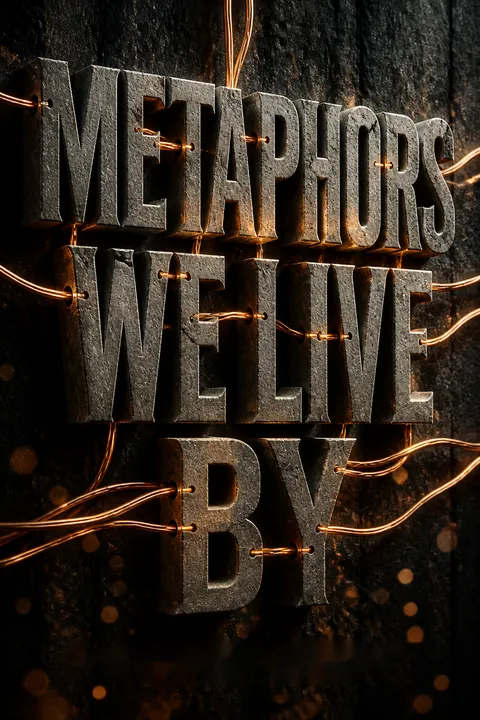


Key Takeaways
Treat everyday metaphors as operating instructions, not decorative language.
Metaphor guides action. Lakoff and Johnson argue that metaphor is not confined to poetry. It shapes ordinary thought and behavior. English speakers describe disagreements as battles: claims are defended, objections are attacked, and participants try to win. Those expressions reflect a way of understanding argument that can make confrontation feel natural. Imagine instead treating discussion as a coordinated performance, where success means mutual understanding. The activity would take a different shape because its underlying metaphor had changed.
Language reveals thought. Patterns of ordinary speech offer evidence about the concepts people use, often without noticing them. The book's central claim is that metaphor helps organize not only what people say, but what they perceive, infer, and do.
The argument is powerful because it makes familiar speech newly visible: a metaphor can operate like an unnoticed rulebook. This also connects to research on framing, where changing the description of a choice can shift which consequences people attend to. Still, language alone cannot establish that every conventional phrase controls behavior in a strong causal sense. The more defensible point is subtler: habitual metaphors make some interpretations and actions readily available, while leaving alternatives less obvious.
Trace a metaphor's logic to see what it makes easy to infer.
Metaphors form systems. The idea that time is money appears in familiar expressions about spending, saving, wasting, or investing time. These phrases are not isolated decorations. Together they frame time as limited, measurable, and useful for achieving goals. In an industrial economy, where work is often measured by duration and paid by the hour, that framework fits everyday institutions especially well.
Follow the implications. If time is treated as a resource, it can be budgeted, exhausted, and allocated. The book connects this view to related ideas: resources are valuable, and money is a resource. Those links help explain why expressions about time and money overlap. They also show how a metaphor supplies a network of inferences, not just a colorful way to name one thing.
This method resembles tracing assumptions in a scientific model: once a premise is identified, its consequences become easier to test. The time-as-resource frame can support planning and coordination, but it can also make unmeasured activities seem wasteful. Rest, care, and unhurried attention may have value that resists accounting. The metaphor is therefore useful without being complete. A practical audit asks not only whether its inferences are consistent, but whether they serve the situation at hand.
Ask what a metaphor highlights, and what it quietly removes.
Every frame has blind spots. Describing an argument as combat emphasizes opposition, defense, and victory. It can obscure the cooperative work of clarifying a problem together. The book applies the same scrutiny to the conduit metaphor for communication: it treats words as containers carrying fixed meanings from one person to another. That picture works when speakers share context, but it fails when meaning depends on circumstance.
A guest can understand which breakfast place is intended by a nickname that makes no sense outside the room. The same phrase about finding new energy sources can also carry different implications for an oil executive and an environmental advocate. Meaning depends partly on speakers, listeners, and context, not just on words considered alone.
Highlighting and hiding offers a useful discipline for reading headlines, policy language, and personal disputes. It shifts attention from whether a metaphor is simply accurate to what it makes salient and what it leaves in the background. Communication research likewise treats shared context as essential to interpretation. The caution is that a metaphor's blind spots do not automatically make it deceptive. A frame can simplify responsibly, provided its omissions remain open to examination.
Read metaphors through bodies, cultures, and the work they organize.
Experience gives metaphors footing. Many familiar expressions use spatial orientation: people describe good moods as elevated, quantities as rising, and serious illness as a decline. These patterns draw on bodily experience, such as posture and the visible increase of a pile. Yet culture also shapes which metaphors become prominent. Some communities orient the future ahead; others place it behind.
Abstract things become handleable. Ontological metaphors let people treat experiences as objects or substances. Calling inflation a force, for instance, makes it possible to discuss its amount or effects. Metonymy is different: one related thing stands for another, as when a newspaper's name refers to its reporter. Both practices organize thought, but metaphor explains one domain through another, while metonymy points within a connected domain.
The embodied account avoids two extremes: treating concepts as detached symbols, or treating culture as unconstrained invention. Human bodies provide recurring experiences, while social practices shape their interpretation. This combination helps explain why some metaphors recur broadly yet differ across communities. A useful nuance is that bodily correlations do not dictate one inevitable meaning. The same physical experience can support competing interpretations, and cultural coherence helps determine which one becomes conventional.
Use several partial metaphors instead of demanding one perfect picture.
Metaphors map selectively. A theory may be described as a building because it has foundations and support, but the metaphor does not require it to have hallways or plumbing. Only some features transfer. That partial fit is a strength: it lets people reason with a familiar structure without claiming that the two things are identical.
Coherence beats perfect consistency. Arguments can also be understood as journeys, where reasoning progresses toward a conclusion, or as containers, where claims and evidence make up content. These pictures do not form one literal image, yet they can complement each other because each illuminates a different aspect. The book calls a structured whole of experience an experiential gestalt. Such organization helps people recognize an activity and understand how its parts relate.
This plural approach resembles the use of multiple models in science: each can explain a different feature without serving as a complete portrait. It also gives a practical test for mixed metaphors. The question is not whether every image fits seamlessly, but whether the selected inferences work together. The limitation is that people can mistake coherence for proof. Several metaphors may reinforce one another because they share cultural assumptions, not because those assumptions capture every relevant fact.
Define concepts by lived use, not only by abstract checklists.
Categories have prototypes. People do not always sort experience by fixed rules that every member must satisfy. A typical chair may have a seat, a back, and legs, while a beanbag or a barber's chair differs in important ways. People still recognize them as chairs because each resembles the familiar example in relevant respects. The book describes this flexible organization through prototypes and family resemblances.
Purpose changes the category. Whether an object counts as a chair can depend on the occasion: an informal discussion may allow seats unsuitable for a formal dinner. The authors also treat causation as a category with a prototypical case: one agent intentionally manipulates something and produces a visible change. Less direct cases still count when they resemble that pattern sufficiently. Concepts are shaped by how people interact with things.
Prototype-based categories fit the messy work of everyday judgment better than rigid definitions do. They also explain why disagreement can persist even when people know the same facts: they may apply different purposes or prototypes. The challenge is that flexible categories can invite motivated boundary shifts. In legal, scientific, or political settings, decision-makers should make their classification purpose explicit, so contextual flexibility does not become a disguise for arbitrary judgment.
Notice how sentence form can strengthen or soften meaning.
Form carries more than grammar. The book argues that people often imagine language spatially, as words arranged in sequence and at varying distances. That makes spatial metaphors available to connect sentence form with meaning. Repetition can suggest greater quantity or intensity: saying an action happened repeatedly conveys more of it than mentioning it once.
Closeness can signal force. The authors describe a pattern in which a form placed nearer to what it affects can imply a stronger effect. A tightly attached negative prefix may suggest a more definite opposite than a separate negating word. These fine distinctions help explain why paraphrases rarely match perfectly. Changing word order, wording, or grammatical structure may shift emphasis even when the broad topic remains the same.
This insight matters for editing and rhetoric because meaning is not simply a package of propositions independent of delivery. It also aligns with the broader linguistic idea that syntax guides attention and interpretation. The book's examples are suggestive, though individual form-to-meaning patterns require careful testing across contexts and languages. The valuable habit is to ask what a sentence's shape invites the listener to notice, rather than assuming that different phrasings are interchangeable.
A new metaphor can change the problem, not merely describe it.
Fresh frames create options. The book contrasts treating problems as puzzles, which suggests a correct solution that ends the matter, with imagining them as substances that can dissolve and later reappear. In the second frame, progress means managing which difficulties become prominent, rather than expecting permanent disappearance. The metaphor changes what counts as success and what actions seem sensible.
The authors offer another alternative for love: see it as a jointly made artwork. This emphasizes cooperation, patience, and shared responsibility, rather than the lack of control suggested by some familiar love metaphors. New frames select certain experiences, connect them into a pattern, and can guide future behavior. Their influence becomes practical when people begin acting according to the picture they adopt.
A new metaphor can expand a person's sense of agency by changing the available goals. This resembles reframing in psychotherapy, where redescribing an experience can make new responses imaginable. But every replacement frame has its own omissions. Treating love as collaborative creation, for example, may understate unequal power or circumstances outside a couple's control. Reframing is most useful when it increases options, not when one appealing metaphor is promoted as the whole truth.
Treat truth as constrained by experience, not as absolute or arbitrary.
Understanding mediates truth. The authors reject the idea that statements can be assessed from a wholly neutral standpoint, independent of human categories and purposes. They also reject the opposite claim that meaning is merely private invention. Their experientialist account says a statement counts as true when an understanding of it fits an understanding of the situation closely enough for the purpose involved.
A seat that qualifies as a chair for an informal gathering may not suit a formal dinner. The objects have not changed; the relevant category and purpose have. At the same time, the physical world constrains what can reasonably be said. Experience, shared practice, and successful interaction anchor judgment, even though they do not deliver a single view from nowhere.
This position offers a middle path between naïve objectivism and unrestricted relativism. It recognizes that facts matter while explaining why descriptions depend on human purposes and categories. Its hardest task is adjudicating conflicts between communities with different frameworks. The book points toward negotiation and broader standards of fairness, but those standards cannot be assumed to be culturally neutral. The framework is strongest when it pairs interpretive humility with public evidence and explicit reasoning.
Challenge powerful metaphors before they turn into policy or habit.
Frames authorize action. When President Carter presented an energy shortage as a war, the language suggested an enemy, urgent targets, sacrifices, and centralized strategy. Another account, the soft energy path proposed by Amory Lovins, emphasized different features of energy systems and led toward different priorities. The framing was not a neutral label: it helped define which responses seemed reasonable.
The same scrutiny applies to the metaphor of labor as a resource. It makes labor measurable and comparable to materials, but can hide whether work is meaningful or degrading. In conversation, a practical response is to notice the frame, ask what it leaves out, and find language that allows people with different assumptions to negotiate what they mean.
Metaphor analysis becomes most consequential when a frame distributes costs and authority. Political communication research similarly asks who benefits when one description becomes common sense. The chapter's examples show how a metaphor can narrow debate before evidence is weighed. Still, exposing a frame does not settle policy: competing metaphors also simplify. A responsible analysis compares their predictions, identifies affected groups, and keeps consequences visible rather than treating rhetorical fluency as proof.
Analysis
The book's lasting achievement is to relocate metaphor from the margins of rhetoric to the machinery of ordinary understanding. Its strongest demonstration is cumulative: systematic language patterns, such as describing quantity through vertical movement, suggest that speakers inherit connected ways of reasoning, not merely isolated figures of speech. The examples become philosophically consequential because metaphors organize inference, and inference guides action. A disagreement framed as combat, for instance, makes victory more salient than shared clarification.
The authors' account also avoids a simple cultural determinism. Bodily experience constrains possible mappings, while institutions and local values influence which mappings become dominant. This gives the theory explanatory reach across language, politics, and everyday life. Its distinction between coherence and consistency is especially useful: several metaphors can jointly make a concept intelligible without combining into one seamless picture.
The argument nevertheless carries an evidentiary challenge. Recurrent expressions strongly indicate conventional patterns, but linguistic regularity by itself does not establish how deeply each metaphor shapes thought or behavior. The 2003 afterword acknowledges a broader body of supporting work, including psychological, developmental, gestural, and cross-linguistic research. That convergence strengthens the central thesis, while leaving room to test specific mappings rather than treating every proposed example as equally established.
The book's critique of absolute, context-free truth is most persuasive when read as a theory of human access to truth, not as a denial of external reality. The authors explicitly recognize that the world constrains understanding. Their more ambitious claim is that human categories and purposes mediate that understanding. The practical consequence is neither skepticism nor a search for metaphor-free thought. It is disciplined awareness: identify the frame, inspect its entailments, and compare it with alternatives before mistaking one useful perspective for the whole situation.
Review Summary
Metaphors We Live By explores how metaphors shape our understanding of the world. Readers find the book insightful, revealing how everyday language and thought are built on metaphorical concepts. Many appreciate its clarity and accessibility, though some find later chapters repetitive or overly philosophical. The book's ideas about metaphor's role in cognition and culture are seen as groundbreaking, influencing fields beyond linguistics. While some readers struggle with the dense academic style, most find the core concepts enlightening and applicable to various disciplines.
People Also Read



Glossary
Conceptual metaphor
One domain understood through anotherA conceptual metaphor is a systematic way of understanding one kind of experience in terms of another. It is not merely a phrase or literary device. A metaphor such as understanding ideas through food supplies connected expressions and inferences, allowing people to describe ideas as something that can be taken in, considered, or rejected.
Experiential gestalt
A structured whole of experienceAn experiential gestalt is a coherent organization of experience whose dimensions can include participants, parts, stages, sequence, causes, and purposes. It helps people recognize what kind of activity is occurring and how its elements fit together. A conversation, for example, has speakers, turns, an order of speaking, and often a shared topic.
Orientational metaphors
Concepts organized by spatial directionOrientational metaphors organize concepts through spatial relationships such as up and down, inside and outside, or front and back. Their grounding often involves bodily experience, but cultural practices influence which orientations become conventional. Linking positive moods with upward direction is one example; it belongs to a broader system of related expressions.
Ontological metaphors
Experiences treated as entitiesOntological metaphors let people understand abstract experiences as objects, substances, or containers. This makes it possible to refer to, quantify, categorize, or discuss them as if they had boundaries. Treating inflation as a substance, for example, permits talk about its amount and effects without making inflation a physical material.
Conduit metaphor
Communication as sending ideasThe conduit metaphor models communication as a sender placing ideas into words, which carry them to a listener who retrieves them. It captures some exchanges in which context is shared, but can mislead when speakers rely on background knowledge, social position, or circumstances to make meaning. Words do not always contain a fixed interpretation on their own.
Metonymy
One related thing stands for anotherMetonymy uses one element of a connected domain to refer to another element in that domain. A newspaper's name may stand for its reporter, or a producer's name may stand for a work of art. Unlike metaphor, metonymy does not primarily explain one domain through a different domain, though it can focus attention on a particular aspect of what it refers to.
Interactional properties
Properties shaped by human useInteractional properties are features understood through how people perceive, handle, use, or assign purposes to things. A chair is not categorized only by its physical construction; its suitability for sitting and its use in a particular setting matter too. The term contrasts with the idea that concepts depend solely on properties inherent in objects themselves.
Experientialist theory of truth
Truth grounded in situated understandingThe experientialist theory of truth holds that a statement is understood as true when its meaning fits an understanding of a situation well enough for a given purpose. Understanding depends on human categories, experience, and cultural practices, while the external world still constrains what can be said. The theory rejects both absolute, context-free truth and wholly unconstrained subjectivity.
Primary metaphor
A mapping grounded in recurring experienceA primary metaphor is a basic cross-domain connection that develops when two kinds of experience repeatedly occur together. The afterword describes affection linked with warmth as an example: early experiences of being held warmly can connect emotional closeness with physical temperature. Such connections can underlie more elaborate, culturally shaped metaphors.
FAQ
What's Metaphors We Live By about?
- Exploration of Metaphor's Role: The book examines how metaphors shape our understanding of the world, arguing they are fundamental to our thought processes.
- Conceptual Framework: It presents the idea that our conceptual system is largely metaphorical, influencing our perceptions and interactions.
- Cultural Implications: Authors George Lakoff and Mark Johnson discuss how different cultures have varying metaphorical frameworks that shape their realities.
Why should I read Metaphors We Live By?
- Understanding Language and Thought: The book provides insights into the connection between language and thought, revealing how metaphors influence communication and reasoning.
- Cultural Awareness: It encourages reflection on personal metaphorical frameworks and their impact on cultural perceptions and interactions.
- Interdisciplinary Relevance: The concepts are applicable across fields like linguistics, philosophy, psychology, and cultural studies, making it valuable for a broad audience.
What are the key takeaways of Metaphors We Live By?
- Metaphors Shape Reality: Metaphors are pervasive in everyday life, influencing thought and action, and shaping our experiences.
- Systematicity of Metaphors: Metaphorical concepts are systematic, following patterns that influence our understanding of life.
- Cultural Coherence: Metaphors contribute to cultural coherence, reflecting values and beliefs in the metaphors we use.
How do Lakoff and Johnson define metaphor in Metaphors We Live By?
- Metaphor as Conceptual Framework: Metaphor is defined as understanding one kind of thing in terms of another, shaping our conceptual system.
- Not Just Language: Metaphor is not merely linguistic but deeply embedded in thought processes and actions.
- Cognitive Function: Metaphors help make sense of complex experiences by relating them to familiar concepts, facilitating understanding.
What are some examples of metaphors discussed in Metaphors We Live By?
- ARGUMENT IS WAR: This metaphor shows how we conceptualize arguments as battles, using phrases like "attack a position."
- TIME IS MONEY: Reflects how we perceive time as a valuable resource, leading to expressions like "You're wasting my time."
- LOVE IS A JOURNEY: Frames love as a path with stages, emphasizing progress and direction in relationships.
How do metaphors influence our daily lives according to Metaphors We Live By?
- Guiding Behavior: Metaphors shape actions and decisions by framing our understanding of situations, like viewing a job as a "battle."
- Creating Expectations: They set expectations for interactions and experiences, such as seeing relationships as "partnerships."
- Emotional Responses: Metaphors evoke specific emotional responses, influencing attitudes towards challenges.
What is the significance of the metaphor ARGUMENT IS WAR in Metaphors We Live By?
- Conflict Framing: This metaphor illustrates perceiving arguments as battles, influencing behavior in discussions.
- Language Reflection: Examples like "He shot down my argument" show how language reflects this metaphorical understanding.
- Cultural Implications: Suggests a competitive cultural approach to discourse, affecting engagement in discussions and conflict resolution.
How do the authors explain the concept of ontological metaphors in Metaphors We Live By?
- Understanding Experiences as Entities: Ontological metaphors conceptualize experiences, emotions, and ideas as entities, aiding discussion and reasoning.
- Examples Provided: Metaphors like "TIME IS A RESOURCE" help structure understanding of abstract concepts.
- Practical Application: Framing experiences as entities allows for reference, quantification, and categorization, making complex ideas manageable.
How do the authors differentiate between metaphor and metonymy in Metaphors We Live By?
- Conceptual Differences: Metaphor involves understanding one concept in terms of another, while metonymy uses one entity to refer to another related entity.
- Functionality: Metaphors enhance understanding, whereas metonymy serves a referential function, allowing one entity to stand for another.
- Examples in Language: The authors provide examples illustrating how both operate in language and thought, contributing to conceptual frameworks.
What challenges to metaphorical coherence are discussed in Metaphors We Live By?
- Inconsistencies in Metaphors: Different metaphors can lead to conflicting interpretations, creating confusion.
- Cultural Misunderstandings: Metaphors vary across cultures, leading to potential misunderstandings in communication.
- Personal Variability: Individuals may have unique interpretations based on experiences, necessitating flexible communication approaches.
How does Metaphors We Live By relate to cultural change?
- Introduction of New Metaphors: Cultural change often arises from new metaphorical concepts reshaping societal understanding.
- Loss of Old Metaphors: As new metaphors gain prominence, older ones may fade, altering conceptualization of experiences.
- Impact on Reality: Metaphors create new realities, affecting perceptions and interactions, highlighting language's transformative power.
What are the best quotes from Metaphors We Live By and what do they mean?
- "The way we think is fundamentally metaphorical.": Highlights the central thesis that thought processes are rooted in metaphorical concepts.
- "Metaphors can create realities.": Emphasizes metaphor's power to shape perceptions and experiences, influencing beliefs and actions.
- "To live by the CHEMICAL metaphor would mean that your problems have a different kind of reality for you.": Illustrates how adopting specific metaphors changes approaches to life's challenges, encouraging dynamic problem-solving.
About the Author
Download PDF
Download EPUB
.epub digital book format is ideal for reading ebooks on phones, tablets, and e-readers.








