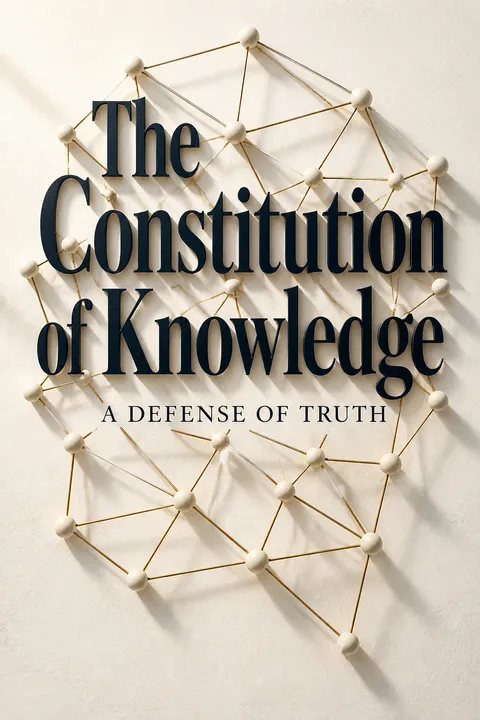


Key Takeaways
Truth is not private property; it must survive organized challenge
Knowledge begins with doubt. In Plato’s dialogue Theaetetus, Socrates tests several definitions of knowledge, including perception and true belief, and finds each inadequate. The lasting lesson is not a perfect definition, but a practice: keep asking, checking, and talking with others. Rauch calls the shared rules, institutions, and habits that make this possible the Constitution of Knowledge. It is society’s system for turning disagreement into reliable public claims, not a claim that any individual or institution possesses final truth.
Corrections are part of the work. Journalists, scientists, courts, and public agencies contribute by exposing claims to scrutiny and correcting errors. A correction can signal that a process is working, not that the whole enterprise is fraudulent. Knowledge, on this account, is provisional and collective.
The book’s central shift is from asking who knows the truth to asking how a community can test claims. That makes objectivity a procedural achievement rather than a personality trait. It also explains why trust should attach to visible practices, such as correction and review, rather than to a leader’s confidence. The harder question is whether institutions consistently let outsiders challenge them. A process that invites scrutiny in principle but blocks it in practice cannot earn durable trust.
Treat certainty as a warning when identity is on the line
Reason has social motives. The book draws on research suggesting that human reasoning evolved partly to persuade others and defend group standing, not simply to discover facts. Confirmation bias makes people seek evidence that supports existing beliefs; identity-protective cognition makes changing a group-defining belief feel socially costly. Intelligence can sharpen the arguments for a preferred conclusion without making that conclusion more accurate.
Groups can bend perception. In Solomon Asch’s line-judgment experiments, roughly three-quarters of participants went along with a group’s obviously wrong answer at least once. Research on politically charged numerical problems likewise found that stronger math skills did not prevent partisan bias. The practical warning is precise: when a claim matters to belonging or status, confidence is not proof that reasoning is working well.
This account is useful because it treats bias as a predictable human vulnerability, not a defect exclusive to political opponents. It also cautions against assuming that more facts alone will persuade someone whose social identity is at stake. A fruitful response is to lower the interpersonal cost of reconsidering a belief, while preserving standards for evidence. Still, group belonging is not merely a trap. Trusted communities can also transmit expertise and correct individual mistakes when they reward honest disagreement.
Build institutions that make mistakes correctable without making dissent fatal
Networks outperform isolated geniuses. The Constitution of Knowledge depends on institutions that connect people, preserve findings, set standards, and make criticism consequential. The book illustrates this with early geology: rival explanations of the earth became less like religious factions as researchers gathered specimens, shared observations, and built professional societies. Evidence helped turn a lasting conflict into a cumulative field of study.
Discovery needs a community. Alexander Fleming noticed that mold inhibited bacteria, but initially judged the finding medically useless. Other researchers later found his published work and developed penicillin into a treatment. The important achievement was not the accident alone, but a network able to notice, test, and extend it. Institutions do not guarantee truth, but they give discoveries a path to scrutiny and correction.
The historical examples challenge the lone-genius story without diminishing individual creativity. A discovery becomes knowledge when others can inspect and build on it. Institutions also preserve memory, so each generation need not begin from scratch. Their authority, however, depends on openness: a professional network can become a closed club or protect its own mistakes. The useful test is whether its procedures make challenges possible and corrections safer than concealment.
No person gets the final word or a private truth-pass
Two rules organize inquiry. The fallibilist rule means no one gets the final say: claims remain open to possible correction. The empirical rule means no one has personal authority: a check should, in principle, be repeatable by someone else, regardless of who made the claim. Together, they distinguish public inquiry from rule by charisma, rank, or group identity.
Expertise still matters. A specialist can earn provisional deference through training and a track record, but credentials do not exempt a claim from challenge. Personal experience can offer important evidence or context; it cannot, by itself, settle a public factual dispute. The standards apply to everyone, while the methods of checking vary by field. The aim is not to erase differences, but to make competing perspectives answerable to a shared reality.
These rules guard against two opposite shortcuts: declaring a claim true because a powerful person says so, and dismissing a claim because of who said it. They create a demanding standard of reciprocal scrutiny. Yet treating people as interchangeable checkers is an ideal, not a description of equal access to time, expertise, or influence. Lived experience can reveal neglected questions and evidence. It becomes problematic only when it is used to end inquiry rather than inform it.
Keep ideas free to enter, but make accepted claims earn credibility
The knowledge pipeline has two stages. At its wide entrance, the reality-based community needs freedom to propose and criticize ideas. At its narrow end, claims face increasingly demanding checks, such as editing, peer review, replication, and citation. The book describes this as a social funnel: many proposals enter, but only a small number gain standing as established knowledge.
Speech alone is not enough. Open expression supplies ideas and criticism, but it does not automatically produce reliable conclusions. The community also needs standards, expertise, and limited resources for deciding what merits attention. Most claims receive little or no scrutiny, not because every neglected idea has been disproved, but because inquiry cannot investigate everything. Freedom protects the opportunity to contribute; credibility comes from surviving accountable review.
The funnel reconciles free expression with standards of expertise: open debate need not mean that every claim deserves equal weight. This distinction is essential when low-quality claims compete for scarce attention. It also makes gatekeeping a responsibility, not a neutral act. Institutions must explain their standards and leave room for appeal, or the process can look like an insider’s shield. The model works best when entry is open and evaluation is rigorous, transparent, and revisable.
Make digital systems slow, check, and contextualize before they amplify
Information is not yet knowledge. Digital platforms made publishing fast and cheap, while advertising models rewarded attention and engagement more reliably than accuracy. Personalized feeds can show different people different versions of public events, making comparison harder. The result is an information system that can amplify content before anyone checks it.
Design can change the incentives. Wikipedia offers a contrasting model: contributors work on shared pages, cite sources, track edits, and correct one another under community rules. Its success depends on social organization, not merely software. Rauch argues that other platforms need not become encyclopedias, but can introduce friction, warnings, context, and accountability. Such measures are difficult and can be misused, yet treating every platform as a neutral pipe ignores how its design shapes what spreads.
The chapter’s strongest insight is that media architecture is never neutral simply because it is technical. A system built to maximize clicks will select for what captures attention, whether or not it improves understanding. Wikipedia shows how shared reference points and visible correction can support cooperation at scale. But truth-oriented moderation concentrates power in platform companies. Better design therefore requires both safeguards against misinformation and scrutiny of who sets the rules.
Disinformation wins by exhausting trust, not merely by changing minds
Confusion can be the objective. Troll campaigns often spread multiple, even contradictory, accounts of an event. Their purpose may be less to convince everyone of one story than to make reliable sources seem indistinguishable from unreliable ones. The book calls this pattern a firehose of falsehood: high-volume, rapid, repetitive messaging that overwhelms people’s ability to assess claims. In one study discussed by Rauch, false news took about one-sixth the time of true news to reach 1,500 people on Twitter.
The audience can extend the campaign. When citizens, politicians, or news outlets repeat a claim while trying to debunk it, they may amplify it. The broader damage is cynicism and helplessness: people stop knowing where to turn for evidence, even if they never accept a particular falsehood.
This framework explains why fact-checking every individual claim may be insufficient. A campaign can succeed by damaging the shared standards that make checking possible. That shifts attention toward the health of the information environment: credible institutions, clear sourcing, and careful reporting all matter. Yet the book also warns against exaggerating disinformation’s reach. Many people do not encounter fake content, and exposure does not guarantee belief. Precision about its effects is part of resisting it.
Defend dissent by separating rigorous criticism from punitive shaming
Criticism tests claims; coercion punishes people. Rauch distinguishes ordinary disagreement from canceling, which he describes as an effort to isolate, intimidate, or damage someone’s social or professional standing. A campaign against philosopher Rebecca Tuvel demanded that a journal retract her article, even though some critics acknowledged they had not read it. The case illustrates how a public denunciation can displace engagement with the argument itself.
The distinction takes judgment. Criticism, boycotts, and calls for consequences are not automatically coercive conformity. The warning signs are tactics such as pressuring employers, threatening people who offer support, blocking publication, or distorting a target’s words. The book argues that such campaigns chill inquiry, particularly when people cannot predict which comment will provoke punishment.
The distinction is valuable because free inquiry requires both the right to criticize and protection from intimidation. It also prevents every objection from being labeled censorship. The difficult cases concern proportion, context, and power: public criticism can expose genuine misconduct, while demands for punishment can suppress legitimate debate. Institutions need fair procedures that consider evidence and allow response, rather than letting either a viral mob or a powerful individual decide the outcome.
Restore viewpoint diversity by organizing, not waiting for someone braver
Silence can manufacture consensus. The spiral of silence describes a process in which people who think their views are unpopular become quieter, making one position appear more dominant and increasing pressure on others to conform. Rauch argues that viewpoint diversity helps a community detect assumptions its members share and therefore struggle to notice. A demographically varied group can still be intellectually uniform.
Small groups can set the climate. On campuses, students and faculty often reported fear of social or professional penalties, while surveys found broad support for hearing more perspectives. Organizations such as FIRE and Heterodox Academy helped turn isolated concern into collective action. At Purdue, student leaders pressed for stronger free-speech policies and orientation instruction. The practical lesson is that a silent majority cannot counter an organized minority without organizing itself.
The argument connects pluralism to error detection: disagreement is not merely a courtesy to dissenters, but a resource for finding blind spots. Collective support also reduces the personal risk of speaking up. However, viewpoint diversity should not become a crude quota or a substitute for evaluating evidence. Institutions need to widen participation while keeping standards consistent. The point is not to balance every claim with its opposite, but to prevent one perspective from escaping scrutiny.
Keep facts clean, stay civil, and keep your voice audible
Integrity is a daily practice. The book’s closing advice is to speak when pressured into silence, but not to answer every provocation with outrage. Trolls can gain attention from angry reactions; sometimes ignoring them denies them the audience they seek. Humor can also puncture a performance without escalating it. The choice depends on whether a response helps inquiry or simply spreads the provocation.
Do not trade accuracy for a good cause. Rauch draws on gay-rights advocacy and activist Frank Kameny’s persistence to show how speaking openly can challenge a false social consensus. But the defense of a cause is weakened when its advocates bend facts. A person can stand firm and remain correctable: check the evidence, acknowledge mistakes, and keep arguments directed at claims rather than people.
The combination of voice and restraint is more demanding than either silence or perpetual confrontation. Speaking can break a false impression of consensus, while refusing to repeat every provocation can deny attention to actors who depend on it. The advice should not romanticize the costs of dissent: people with less security may reasonably choose caution. Institutional backing and mutual support make personal courage more sustainable, and accuracy keeps advocacy from adopting the very methods it opposes.
Analysis
The book’s most important contribution is to treat truth as a social achievement. Its account explains why individual intelligence, good intentions, and open expression are insufficient: people reason through identities, imitate groups, and inhabit information systems that reward some behaviors over others. The Constitution of Knowledge is therefore not simply a defense of free speech. It is a defense of the infrastructure that makes speech answerable to evidence, including professions, institutions, standards, and habits of correction.
The constitutional analogy is productive because it emphasizes checks, distributed authority, and the need for civic virtues. It also clarifies that stability can arise through structured disagreement rather than unanimity. The historical examples, from geology to medicine, make the claim tangible: knowledge accumulates when communities preserve work, compare findings, and let claims fail without destroying the people who proposed them.
The argument is most vulnerable where its boundary between legitimate expertise and illegitimate authority is difficult to draw. Institutions can correct error, but they can also reproduce exclusion, narrow agendas, and mistake professional consensus for objectivity. The book recognizes some of this, especially through its emphasis on viewpoint diversity, yet its confidence in liberal-scientific institutions can understate how unequal access shapes whose questions are asked and whose evidence is heard. Likewise, the line between criticism and coercive punishment cannot be settled by labels alone. It requires fair procedures and attention to context, power, and proportionality.
These tensions do not defeat the thesis; they sharpen it. A reality-based community earns authority only by applying its own rules to itself. Its legitimacy rests on making challenge possible, protecting dissent, correcting visible failures, and explaining why some claims carry more evidentiary weight than others. The book’s practical warning is that both organized falsehood and enforced conformity can disable those conditions. The remedy is neither unfiltered speech nor unquestioned expertise, but accountable institutions capable of turning conflict into shared, revisable knowledge.
Review Summary
The Constitution of Knowledge receives mostly positive reviews for its defense of truth and knowledge in an era of misinformation. Readers appreciate Rauch's balanced critique of both left and right-wing threats to truth-seeking institutions. Many find the book timely and insightful, praising its historical context and practical advice. Some criticize Rauch's reliance on establishment institutions and his use of the term "liberal science." Overall, reviewers recommend the book as an important contribution to understanding and combating the current epistemic crisis.
People Also Read








Glossary
Constitution of Knowledge
Rules for shared truth-seekingThe social rules, norms, institutions, and professional practices that govern how public claims are tested and accepted as knowledge. It is analogous to a political constitution because it distributes authority, limits coercion, and channels disagreement into structured processes. Its central commitments include fallibility, public checking, accountability, and correction.
reality-based community
Network of accountable inquirersThe broad community of people and institutions that use shared standards to investigate claims about reality. It includes fields such as science, journalism, law, and public research. Its members may disagree sharply, but they accept criticism, seek evidence that others can inspect, and hold one another accountable to common rules.
liberal science
Decentralized, error-seeking inquiryRauch’s broad term for organized inquiry that seeks knowledge through open, impersonal criticism rather than personal or centralized authority. It includes more than laboratory science, extending to disciplines and professions that test claims through evidence, argument, and public review. Its defining feature is a social process that permits claims to be challenged and revised.
fallibilist rule
No claim is finalOne of the Constitution of Knowledge’s core rules. It requires participants to accept that any claim, including their own, may be mistaken. A claim can count as knowledge only while it remains open to possible correction and withstands efforts to challenge it. The rule rejects any person’s or group’s right to end inquiry by decree.
empirical rule
No personal authorityA core rule requiring that claims be checked through methods that do not depend on the identity of the person checking them. In principle, another qualified person should be able to use the method and assess the result. Expertise may earn provisional respect, but neither status nor group membership grants a claim immunity from scrutiny.
marketplace of persuasion
Claims tested through argumentRauch’s alternative to imagining ideas as self-competing products in a marketplace. Knowledge emerges through ongoing efforts to persuade others using evidence, reasoning, and criticism. Participants may support, challenge, refine, or replace claims, but they cannot legitimately settle factual disputes through coercion, status, or silencing.
epistemic valence
A system’s tilt toward truthThe direction in which an information system’s incentives and design tend to push claims. A positive epistemic valence helps filter error and circulate well-supported information. A negative valence rewards misleading or inflammatory content, or speeds its spread without regard to accuracy. The term highlights that technology can shape the quality of public knowledge.
firehose of falsehood
High-volume, confusing propagandaA disinformation strategy that floods the public with rapid, repetitive, and sometimes contradictory claims. Rather than relying on one convincing narrative, it overwhelms people’s ability to determine what is credible and where to find reliable information. Its intended effect can be confusion, distrust, and disengagement as much as belief in any particular falsehood.
spiral of silence
Fear-driven public conformityA process in which people who believe their opinions are unpopular become less willing to express them. Their silence makes the dominant view appear even more widespread, which further discourages dissent. The apparent consensus can grow without a genuine majority changing its mind, weakening the diversity of views available for public discussion.
identity-protective cognition
Reasoning that shields group identityA pattern in which people interpret evidence in ways that protect their standing within an important group. When a belief becomes tied to identity, revising it can threaten social support and belonging. People may then accept favorable evidence readily and discount conflicting evidence, even when they have strong analytical skills.
FAQ
What's The Constitution of Knowledge: A Defense of Truth about?
- Exploration of Truth's Defense: The book examines the crisis of truth in society, focusing on disinformation and digital media challenges. Jonathan Rauch argues for a "Constitution of Knowledge" as a framework for collective knowledge production and validation.
- Reality-Based Community: Rauch introduces the concept of a "reality-based community" that relies on shared norms and rules for knowledge production, emphasizing the collective nature of understanding and truth.
- Historical Context: The book references historical philosophical discussions, such as Plato's Theaetetus, and explores how the Enlightenment and liberalism have shaped our understanding of knowledge.
Why should I read The Constitution of Knowledge?
- Timely and Relevant: In an era of rampant misinformation, the book provides a crucial analysis of defending truth and knowledge, addressing issues like cancel culture and digital disinformation.
- Insightful Framework: Rauch offers a compelling framework for understanding knowledge production, helping readers navigate the complexities of information in the digital age.
- Engaging Writing Style: The book is accessible and engaging, making complex philosophical ideas understandable for a general audience through a blend of history, philosophy, and current events.
What are the key takeaways of The Constitution of Knowledge?
- Shared Facts Importance: A functioning democracy relies on a shared understanding of facts, without which societal discourse becomes fragmented and unproductive.
- Fallibilism and Empiricism: Rauch advocates for no final say (fallibilism) and no personal authority (empiricism), encouraging open inquiry and critical debate.
- Role of Institutions: Institutions like universities and media organizations are crucial for maintaining the Constitution of Knowledge by validating knowledge and ensuring accountability.
What are the best quotes from The Constitution of Knowledge and what do they mean?
- Collective Knowledge: “Knowledge is not just something I have; more fundamentally, it is something we have.” This highlights the collective nature of knowledge production through collaboration and dialogue.
- Continuous Dialogue: “The most important words of the dialogue are those five words at the end. Let us meet here again.” This suggests that learning is an ongoing process, emphasizing continuous dialogue in the pursuit of knowledge.
- Ambition Counteracts Ambition: “Ambition must be made to counteract ambition.” This illustrates the idea that competing interests can lead to a balanced system, applicable in both politics and knowledge pursuit.
What is the "Constitution of Knowledge" as defined in the book?
- Framework for Knowledge Production: It outlines the rules and norms for how societies produce and validate knowledge, emphasizing a shared commitment to truth.
- Social Mechanism: Functions as a mechanism that channels disagreement into productive dialogue, ensuring knowledge results from collective inquiry.
- Protection Against Tyranny: Protects against authoritarianism by requiring knowledge claims to be open to scrutiny and debate, preventing any single perspective from dominating.
How does The Constitution of Knowledge address disinformation?
- Disinformation Crisis Diagnosis: Rauch analyzes how digital media exacerbates disinformation, creating an epistemic crisis where truth is obscured.
- Call for Solutions: Advocates for truth-friendly digital environments that prioritize accuracy and accountability, urging platforms to take responsibility for their information.
- Empowerment of Reality-Based Community: Reinforcing the Constitution of Knowledge principles, Rauch believes society can effectively combat disinformation through collective action and institutional support.
What role do institutions play in the Constitution of Knowledge?
- Guardians of Knowledge: Institutions like universities and media organizations maintain the integrity of the Constitution of Knowledge by validating knowledge and ensuring accountability.
- Facilitators of Inquiry: They establish norms and standards for research, journalism, and public discourse, promoting rigorous standards of evidence and argumentation.
- Counteracting Misinformation: Institutions provide reliable information and correct errors, serving as trusted sources for accurate knowledge.
How does The Constitution of Knowledge relate to the concept of fallibilism?
- Fallibilism Defined: Fallibilism is the principle that all knowledge is provisional and subject to revision, underpinning the Constitution of Knowledge.
- Encouragement of Inquiry: Embracing fallibilism fosters a culture of inquiry and critical thinking, encouraging individuals to question beliefs and engage with opposing viewpoints.
- Guarding Against Dogmatism: Recognizing knowledge's fallibility prevents dogmatism and promotes an open-minded approach to understanding complex issues.
What is the relationship between cancel culture and the Constitution of Knowledge?
- Cancel Culture Defined: Portrayed as coercive conformity that silences dissenting voices, posing a threat to open discourse and intellectual diversity.
- Impact on Academia: Leads to self-censorship in academic institutions, undermining their mission to foster critical inquiry and debate.
- Defense of Free Expression: Defending free expression is essential for protecting minority rights and promoting social progress, upholding the Constitution of Knowledge.
How does the book suggest we counteract the effects of cancel culture?
- Organize for Free Speech: Encourages mobilizing in defense of free speech and intellectual diversity, forming coalitions and supporting advocacy organizations.
- Promote Institutional Integrity: Calls for policies that protect free expression and prevent ideological discrimination in universities and other institutions.
- Encourage Open Dialogue: Advocates for environments where diverse opinions can be expressed and debated without fear of retribution, fostering respect and understanding.
What role do social media platforms play in the Constitution of Knowledge?
- Amplification of Voices: Social media can amplify diverse voices and facilitate idea exchange but also risks spreading disinformation and fostering echo chambers.
- Responsibility for Content: Emphasizes that social media companies must take responsibility for shared information, implementing measures to combat disinformation.
- Technological Innovations: Calls for developing technologies that prioritize truth, such as algorithms favoring fact-checked information and reducing false claims' visibility.
How can individuals contribute to the Constitution of Knowledge?
- Engage in Critical Discourse: Actively participate in discussions challenging beliefs, fostering a culture of inquiry and upholding the Constitution of Knowledge principles.
- Support Reliable Institutions: Advocate for journalistic integrity, scientific rigor, and educational standards prioritizing truth and accountability.
- Promote Open-Mindedness: Encourage open-mindedness and consider alternative viewpoints, bridging divides and fostering inclusive discourse.
About the Author
Other books by Jonathan Rauch


Download PDF
Download EPUB
.epub digital book format is ideal for reading ebooks on phones, tablets, and e-readers.








