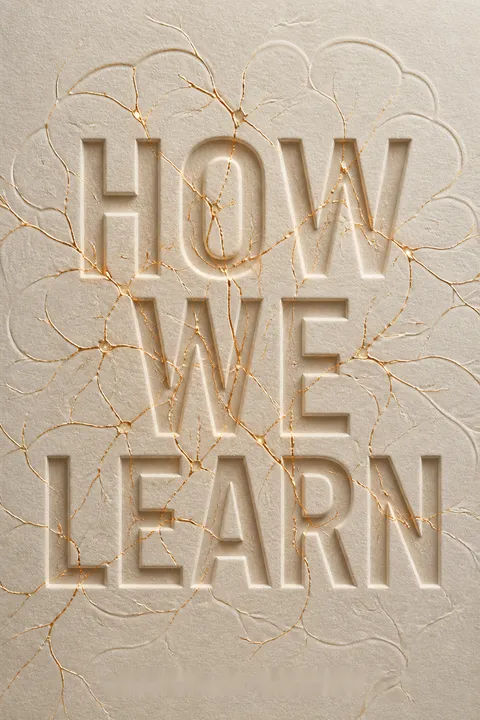


Key Takeaways
Treat learning as model-building, not as collecting disconnected facts
Learning builds models. Dehaene describes learning as constructing an internal model that predicts how the world works, then adjusting it when reality disagrees. Felipe, a blind and almost completely paralyzed child who wrote stories and spoke three languages, shows why learning cannot be reduced to copying sensory input. The brain uses its existing structure to infer beyond what it directly experiences. A Bayesian account describes this process as weighing possible explanations and revising their plausibility as evidence arrives.
Experience refines structure. A child learns the local details of language, objects, and people, but does so with inherited expectations that narrow the possibilities. Learning is therefore neither a blank slate being filled nor a fixed program unfolding untouched. It is an ongoing exchange between prior organization and new evidence.
The model-building view connects learning to scientific reasoning: observations matter because they help distinguish between competing explanations, not because each one must be memorized in isolation. It also makes room for Felipe's case without treating resilience as magic. His capacities show that cognition is not a simple mirror of sensory access. A useful caution is that Bayesian language describes a computational account, not proof that learners consciously calculate probabilities. The model is powerful precisely because it can explain intelligent adjustment without requiring the learner to articulate every inference.
Teach the structured baby, not the imaginary blank slate
Infants bring expectations. Babies arrive with early intuitions about objects, quantity, probability, faces, and other people. In experiments, infants stare longer when an object seems to pass through a solid wall or when a hidden set of objects appears to add up incorrectly. They can also infer that a rare-colored ball is less likely to emerge from a container dominated by another color. These responses suggest that babies form expectations before they can explain them in words.
Knowledge is a starting kit. The book calls these early capacities core knowledge: evolved intuitions that give later learning a framework. They are not complete adult concepts. Babies still have to learn, for example, exactly what supports an object. Their initial assumptions guide exploration, and experience sharpens them into more accurate models.
The central correction is not that babies are miniature adults, but that their behavior can conceal sophisticated expectations. Looking-time experiments offer a way to study minds before speech, yet surprise is an indirect measure: a longer gaze can indicate violated expectation, but does not reveal a full, adult-like theory. The distinction matters in education. Children need concepts connected to prior intuitions, while instruction must also expose where those intuitions are incomplete. Respecting early competence should encourage ambitious teaching, not romanticize unsupported discovery.
Intervene early, but do not confuse plasticity with limitless repair
Plasticity has windows. The brain changes through experience, but its capacity to reorganize varies by region and age. Dehaene calls a period of heightened learnability a sensitive period. Early sound perception narrows toward the languages a baby hears, while higher-level abilities remain more adaptable for longer. These windows are not identical, and learning does not become impossible when one closes.
Timing changes outcomes. In the Bucharest Early Intervention Project, children placed in foster homes before twenty months showed substantial gains in attention, vocabulary, and social skills. Those placed later remained much more impaired. Yet early care did not erase every effect of deprivation. The book also describes Israeli infants whose short-term lack of vitamin B1 was followed by lasting language difficulties, illustrating that brain development depends on physical as well as social conditions.
Sensitive periods make timing an ethical issue: delayed support can cost opportunities that later effort cannot fully restore. At the same time, treating a developmental window as a deadline risks discouraging help for older learners. Dehaene's distinction between sensitive and absolutely closed periods supports a more practical stance: act quickly, but keep investing afterward. The Bucharest findings also resist one-factor explanations. Caregiving, nutrition, health, and material resources interact, so early education cannot substitute for meeting a child's broader needs.
Build new skills by repurposing circuits the brain already has
Culture finds a neural niche. The neuronal recycling hypothesis proposes that new cultural skills adapt brain circuits that evolved for related abilities, rather than writing on an unrestricted neural blank slate. Reading, for instance, recruits visual regions to recognize letter strings and connect them to spoken language. In children learning to read, this specialization develops in a particular area of the left visual cortex and competes with the growth of neighboring visual abilities.
Old foundations support new abstractions. Mathematics builds on early systems for approximate quantity and spatial relationships. Brain scans show that blind mathematicians use many of the same number-related regions as sighted mathematicians, while also recruiting visual cortex for mathematical thought. Learning can redirect a circuit's work, but the brain's existing organization constrains which transformations are easiest.
Recycling offers a useful middle ground between rigid biological destiny and unlimited malleability. It explains how culture can create abilities with no direct evolutionary history, while still recognizing that learning has material constraints. The metaphor also highlights trade-offs: new expertise can compete with other uses of limited neural territory. Such competition need not mean that a skill simply destroys its predecessor. In the reading example, face processing shifts toward the right hemisphere as letters develop on the left. Educational change is adaptation within a system, not a cost-free download.
Direct attention to the feature learners must actually understand
Attention selects what matters. The brain receives more information than it can deeply process, so attention amplifies some signals and suppresses others. In the famous invisible-gorilla experiment, viewers counting basketball passes often miss a person in a gorilla costume crossing the scene, despite looking directly at it. Attention is not simply a brighter spotlight; it also leaves much of the scene in shadow.
The target matters. In a study teaching adults an unfamiliar script, people asked to notice its component letters later read 79 percent of new words. Those focused on whole-word shapes learned the training examples but could not generalize to unfamiliar words. The book distinguishes alerting, orienting, and executive attention: becoming ready to attend, selecting what to attend to, and controlling how to process it.
Attention is both a gateway and a bottleneck. The gorilla study challenges the common assumption that important information automatically enters awareness, while the script experiment shows that instructional focus can determine whether knowledge generalizes. This has implications beyond classrooms: a learner can be diligent yet attend to the wrong feature. The practical question is not merely whether attention is present, but whether it is directed toward the structure that transfers to new cases. Because selection suppresses competing signals, adding more visual material can sometimes make teaching less effective.
Make learning active and curious, but never abandon useful guidance
Engagement is mental work. In a classic experiment, one kitten actively explored an environment while another received the same visual input passively through a linked carousel. The active kitten developed normal visual abilities; the passive one did not. For learners, active engagement means generating ideas, making predictions, and working through meaning. It does not mean keeping the body in motion.
Guide the exploration. Dehaene's four pillars of learning are attention, active engagement, error feedback, and consolidation. Curiosity helps learners pursue questions at a manageable level of difficulty, but leaving students to discover everything unaided often fails. Research reviewed in the book found that active methods outperform passive lectures, while unguided discovery can leave learners without the underlying rules. Effective teaching pairs participation with examples, sequence, and explicit instruction.
The distinction between active thinking and unguided discovery resolves a common educational false choice. Students need agency, but agency is not the same as being abandoned to reinvent knowledge that took generations to develop. The best structure gives learners a problem worth solving, enough prior instruction to make progress, and room to test their understanding. Curiosity also depends on calibration: work that feels trivial becomes dull, while work that remains incomprehensible becomes discouraging. Good guidance keeps the learner near the boundary where effort can produce insight.
Turn mistakes into precise feedback, not evidence of incapacity
Surprise updates models. The brain learns when an outcome differs from what it expected. In Rescorla and Wagner's account, this difference is a prediction error, a signal that helps revise the model. Alexander Grothendieck, later a celebrated mathematician, once used compass drawings to conclude that pi equaled three. He remembered the episode not as humiliation, but as discovering that his reasoning was wrong.
Correction is not punishment. Useful feedback identifies what failed and how to improve. A grade by itself often gives little information about a student's reasoning, and a delayed or shaming response can make errors feel like proof of low ability. The book argues for clear goals, rapid correction, and a classroom climate in which a wrong answer is material for learning rather than a reason to withdraw.
A productive error is not simply a failure with a cheerful label. It becomes useful when the learner can identify the mistaken assumption and test a better one. That makes feedback quality more important than praise or punishment alone. The Grothendieck anecdote captures the intellectual value of being wrong without suggesting that every mistake is automatically instructive. Some errors require explanation, and repeated failure without a route to improvement can damage confidence. The strongest response preserves the learner's willingness to try while making the correction concrete.
Replace rereading marathons with self-tests spaced across time
Retrieval strengthens memory. Retrieval practice means trying to bring information to mind before checking the answer. Experiments described in the book found that students who alternated study with tests remembered more than students who spent the same time studying only. Testing helps reveal what is secure and what still needs work, so later study can target the weak spots.
Spacing resists forgetting. Distributing practice across days is more effective for lasting memory than packing it into one session. Dehaene reports that spaced review can multiply later recall, and notes a useful guide: the interval between reviews can grow with the length of time the knowledge needs to last. Flashcards work well when learners attempt an answer first, check it, and revisit missed items sooner than mastered ones.
Retrieval feels harder than rereading because it removes the comfort of seeing the answer in front of the learner. That difficulty is informative: it tests whether knowledge can be accessed, not merely recognized. Spacing adds a second benefit by letting some forgetting occur before the next attempt, which makes recall an active reconstruction. These methods are especially valuable because confidence can be misleading when material is freshly reviewed. Still, a test improves learning most when it is low-stakes and followed by accurate correction, rather than used only to rank students.
Practice until basics run automatically, then protect sleep
Practice compiles skills. A beginner reader works through letters one at a time, using substantial attention. After years of practice, reading becomes faster and more automatic, freeing conscious attention for meaning. Similar changes occur in arithmetic, music, and movement: repeated operations become efficient routines that no longer occupy the brain's limited executive resources.
Sleep continues the work. During sleep, the brain reactivates patterns from the day and helps stabilize, reorganize, and generalize what was learned. Studies described in the book found improvements in perceptual and motor performance after sleep, and infants generalized newly learned word meanings better after a nap. Sleep does not reliably teach an entirely unfamiliar subject by itself. It strengthens and reorganizes material first encountered while awake.
Automaticity is not mindless learning. It is the conversion of foundational steps into reliable tools, making more complex thought possible. A reader who still labors over every letter has less capacity left for interpreting an argument. Sleep adds a temporal dimension to this process: instruction and practice need an interval in which the brain can consolidate them. The claim should not be inflated into a promise that sleep solves every learning problem. Its value is clearest when paired with deliberate daytime learning, regular practice, and adequate rest.
Teach through shared attention, while keeping social trust critically examined
Learning follows intention. Shared attention is the ability to coordinate attention with another person, often by following their gaze or pointing. In experiments, children learned a new word when a person looked toward an object while naming it, but not when the same word came from a loudspeaker. A human tutor's communicative signals help children infer which information matters and may be worth generalizing.
Culture carries knowledge forward. Human teaching lets discoveries move beyond an individual's experience and accumulate across generations. Yet social trust can also spread false beliefs. Babies may imitate an adult's odd action when it appears intentional, and adults too can be swayed by group consensus. Good teaching therefore combines clear communication and trust with opportunities to question claims and test explanations.
Social learning is a remarkable efficiency: a student can inherit knowledge without personally repeating every experiment that produced it. But transmission and truth are separate achievements. The same trust that makes instruction efficient can make communities vulnerable to confident error. A strong educational relationship should therefore do more than command attention. It should make the reasoning behind claims visible and show when evidence supports revising them. The goal is neither suspicion of every teacher nor passive deference, but a learner who can receive expertise and still ask how it is warranted.
Judge machine learning by generalization, not spectacular narrow victories
Winning a task is not general intelligence. The book contrasts machines that excel at defined problems with human learners who can transfer a principle to a new situation. A system that masters the board game Go may still be unable to apply its skill to a slightly different board. Many machine-learning systems also need far more examples than people: Dehaene cites an Atari-learning system that needed about nine hundred hours to reach a level a person attained in roughly two.
Human learning recombines. A child who hears a new verb can infer how it fits into grammar, not just memorize one sound. People also share explicit knowledge through language and reuse it across tasks. These capacities, along with learning from sparse evidence, are presented as major advantages of the human brain over the machines discussed in the book.
The comparison is strongest when it asks what a learner can do beyond the training set. A narrow machine victory demonstrates real engineering achievement, but it does not settle questions about abstraction, flexibility, or transferable understanding. Conversely, human learning should not be romanticized as effortless or universally efficient; people also rely on substantial prior structure and can misgeneralize. The book's assessment of artificial intelligence is historically situated in its 2018 research context. Its enduring contribution is the choice of benchmark: measure how flexibly knowledge travels, not only how well a system performs on its home task.
Analysis
The book's central achievement is to join three levels of explanation that are often separated: evolution supplies a structured starting architecture, individual experience tunes it, and teaching deliberately shapes experience. This makes learning neither passive absorption nor unlimited self-reinvention. The brain searches a constrained landscape of possible models, using attention, curiosity, error signals, and consolidation to select and stabilize useful interpretations. Dehaene's account is most compelling when a mechanism meets a concrete case: a baby inferring a hidden object's persistence, a blind mathematician using familiar mathematical circuits, or a reader turning painstaking letter decoding into fluent recognition.
The educational consequences are unusually practical. Attention should be directed at the structure to be learned; students should actively retrieve and test ideas; teachers should correct errors without making them socially costly; practice should recur across time; and sleep should be treated as part of learning rather than its opposite. Importantly, active learning is not equated with unguided discovery. The learner needs agency and a knowledgeable guide, a combination that challenges simplistic debates between direct instruction and student-centered teaching.
The argument also needs careful interpretation. A baby's longer gaze is evidence about expectation, not a transcript of a fully articulated belief. Bayesian models explain how evidence could update expectations, but do not by themselves establish the exact neural computation. Likewise, the neuronal recycling hypothesis is an organizing account of how culture works within biological constraints, not a claim that every skill has a single fixed cortical address. These distinctions matter because neuroscience can become a persuasive metaphor before it becomes a complete causal explanation.
The book's deepest lesson is therefore methodological as much as pedagogical: educational practices should be tested against measurable learning, not defended by appealing intuition. Its synthesis encourages ambition for learners while insisting on constraints, support, and evidence. The result is a view of education as a cooperative technology, built on evolved capacities and improved through deliberate experimentation.
Review Summary
How We Learn explores the neuroscience of learning, comparing human and machine learning processes. Dehaene presents four pillars of learning: attention, active engagement, error feedback, and consolidation. The book debunks learning myths and offers evidence-based strategies for effective education. Readers appreciate its insights into brain function, child development, and practical applications for teaching and learning. While some found parts challenging, most reviewers praised the book's clarity and relevance for educators, parents, and lifelong learners. Many consider it a must-read for understanding how the brain acquires knowledge.
People Also Read







Glossary
Bayesian brain
Updates beliefs from evidenceA model of brain learning in which the brain maintains expectations about possible causes of what it senses, then revises their plausibility as new evidence arrives. In this account, prior expectations and personal experience work together. The model explains how even uncertain observations can help refine an internal representation.
core knowledge
Early evolved intuitionsBasic expectations present early in human development, including intuitions about objects, quantity, space, and other people. These starting capacities guide later learning but are not complete adult knowledge. Infants refine them through experience, testing their expectations against events in the world.
sensitive period
Window of heightened learnabilityA phase of development when a brain circuit is especially open to modification through experience. Sensitive periods differ across brain systems and do not necessarily make later learning impossible. They do mean that some skills, such as aspects of speech perception, are acquired more readily when relevant experience arrives early.
neuronal recycling hypothesis
Culture repurposes brain circuitsThe proposal that culturally acquired abilities, including reading and formal mathematics, develop by adapting existing brain circuits to new functions. Learning does not begin with unrestricted neural material. New skills use circuits whose inherited properties make them suitable, while remaining constrained by the brain's prior organization.
Four pillars of learning
Four mechanisms that support learningDehaene's framework identifies attention, active engagement, error feedback, and consolidation as mechanisms that improve learning. Attention selects information, engagement prompts learners to generate and test ideas, feedback corrects inaccurate expectations, and consolidation stabilizes and automates what has been acquired. Weakness in any pillar can undermine the others.
shared attention
Coordinated focus with anotherThe ability to align attention with another person's focus, often by following gaze or a pointing gesture. In language learning, shared attention helps a child infer what a speaker means by a new word. It also supports teaching by signaling which objects or events a communicator considers relevant.
prediction error
Mismatch between expectation and outcomeA signal generated when an observed event differs from what the brain expected. In learning models, the mismatch indicates that an internal representation needs adjustment. The size and direction of the discrepancy can guide correction. Learning can occur even when the learner guessed correctly, if feedback reduces uncertainty.
retrieval practice
Recall before checking answersA learning technique in which a person attempts to retrieve information from memory before looking at the answer. The act of recalling reveals what is accessible and strengthens retention. When paired with correction and repeated across time, retrieval can be more effective for long-term learning than rereading alone.
Goldilocks effect
Preference for manageable complexityThe tendency for learners, including infants, to attend most to material that is neither too familiar nor too confusing. Moderately challenging material offers a promising opportunity to learn. This idea helps explain why curiosity can fade when a task becomes either predictable or seemingly impossible.
global neural workspace
Shared conscious information spaceA temporary mental workspace in which information can become consciously available and be passed among specialized brain systems. It supports deliberate reasoning, working memory, and the ordered execution of complex tasks. Because this workspace has limited capacity, simultaneous effortful tasks compete for access and can slow one another.
language of thought
System for combining abstract symbolsA proposed internal representational system that lets the mind combine symbols according to rules, forming new thoughts from existing concepts. The proposal helps explain how learners can infer abstract principles, reuse a learned rule in a new setting, and represent ideas such as infinity rather than merely memorizing particular examples.
FAQ
What's How We Learn about?
- Exploration of Learning Mechanisms: The book examines how the human brain processes information and adapts over time, contrasting human learning with machine learning.
- Neuroscience and Education: Stanislas Dehaene integrates neuroscience findings with educational practices to improve teaching methods.
- Four Pillars of Learning: It identifies attention, active engagement, error feedback, and consolidation as essential mechanisms for enhancing learning.
Why should I read How We Learn?
- Understanding Learning Processes: Gain insights into how learning occurs in the brain, which can improve personal and educational outcomes.
- Practical Applications: Offers advice for educators and parents on fostering effective learning environments.
- Scientific Basis: The book is grounded in recent scientific research, providing credible and enlightening content.
What are the key takeaways of How We Learn?
- Active Learning: Learning requires active engagement and curiosity, essential for forming strong neural connections.
- Attention's Role: Attention is crucial for amplifying relevant information and filtering distractions, enhancing educational practices.
- Neuroplasticity: The brain's ability to reorganize itself based on experiences is central to acquiring new skills and knowledge.
What are the best quotes from How We Learn and what do they mean?
- “If we don’t know how we learn, how on earth do we know how to teach?”: Highlights the importance of understanding learning processes to improve teaching methods.
- “Learning is the triumph of our species.”: Reflects the unique human capacity to learn and adapt, emphasizing its evolutionary significance.
- “Neurons that fire together, wire together.”: Describes synaptic plasticity, where simultaneous neuron activation strengthens connections, crucial for learning and memory.
What are the four pillars of learning mentioned in How We Learn?
- Attention: Focuses on relevant information while filtering distractions, essential for effective learning.
- Active Engagement: Involves active participation, fostering curiosity and deeper understanding.
- Error Feedback: Crucial for refining knowledge and correcting misconceptions through real-world experiences.
- Consolidation: Stabilizes and integrates new information into long-term memory, with sleep playing a vital role.
How does How We Learn explain the difference between human learning and machine learning?
- Contextual Learning: Human learning involves understanding abstract concepts, unlike machines that rely on surface-level data.
- Neuroplasticity vs. Fixed Algorithms: The human brain adapts and reorganizes based on experiences, while machines follow fixed algorithms.
- Probabilistic Reasoning: Humans make inferences and predictions with limited data, whereas machines need vast amounts of data.
What role does attention play in learning according to How We Learn?
- Amplification of Information: Acts as a spotlight, enhancing relevant information processing and memory retention.
- Selective Filtering: Filters out irrelevant stimuli, focusing on pertinent information.
- Impact on Neural Activity: Increases neuron firing rates, strengthening synaptic connections for lasting memories.
How does How We Learn address the concept of neuroplasticity?
- Foundation of Learning: Neuroplasticity allows the brain to reorganize itself in response to learning experiences.
- Synaptic Changes: Learning involves strengthening or weakening synaptic connections based on activity.
- Limits of Plasticity: While powerful, neuroplasticity diminishes with age, making early learning intervention critical.
What is the significance of error feedback in the learning process as described in How We Learn?
- Correction of Misconceptions: Allows learners to identify and correct mistakes, refining understanding.
- Motivation to Improve: Feedback on errors motivates persistence and skill improvement.
- Strengthening Neural Connections: Adjusts synaptic connections to align with correct information, crucial for retention.
How does How We Learn suggest we can optimize learning environments?
- Create Engaging Experiences: Foster curiosity and active engagement to enhance learning.
- Utilize Feedback Mechanisms: Incorporate constructive error feedback to help learners adjust understanding.
- Encourage Attention Management: Focus on strategies to manage attention effectively, reducing distractions.
How does How We Learn address the importance of sleep?
- Memory Consolidation: Sleep plays a crucial role in consolidating memories formed during the day.
- Optimal Learning: Adequate sleep enhances learning efficiency and retention.
- Sleep and Development: Essential for cognitive development, especially in children.
What educational strategies does How We Learn recommend?
- Structured Learning Environments: Advocates for curricula that guide students through progressively challenging material.
- Encouraging Curiosity: Foster curiosity to enhance engagement and exploration.
- Feedback Mechanisms: Implement effective feedback to help students learn from mistakes, promoting growth.
About the Author
Other books by Stanislas Dehaene
Download PDF
Download EPUB
.epub digital book format is ideal for reading ebooks on phones, tablets, and e-readers.








