

Key Takeaways
Keep criticism and peaceful reform at the center of an open society
Openness is a practice. Popper calls a society open when people can question inherited rules, make individual choices, and change institutions without violence. Its opposite treats customs as fixed, almost like laws of nature, and assigns each person a settled place. Ancient Athens began a difficult transition between these forms: Pericles defended citizens' ability to judge public policy, even when only a few could devise it. The transition brought freedom, but also uncertainty and social strain.
The strain is real. In an open society, people must accept responsibility rather than rely on tribal authority to decide for them. Popper sees that burden as part of becoming more humane and rational, not as evidence that openness has failed.
What's distinctive is that openness is not simply a preference for individualism. It is a way to distribute error correction: citizens can challenge decisions, expose failures, and revise rules. That resembles the logic of scientific peer criticism, where no single investigator is trusted to be infallible. Yet openness can also feel isolating, especially when old communities weaken. The answer is not to romanticize the closed society, but to build institutions and associations that offer belonging without making dissent a betrayal.
Treat historical laws as forecasts to test, not destinies to obey
History is not an oracle. Popper calls historicism the belief that discoverable laws of historical development can reveal humanity's long-term destiny. The idea appears in different clothes: a chosen people inheriting the earth, a superior race destined to rule, or a class guaranteed to create a classless society. Their predictions are difficult to disprove because almost any event can be absorbed into a story whose promised outcome lies far away.
Prediction has limits. Social science can make conditional forecasts about particular situations, such as the likely effects of a policy. It cannot reliably announce the inevitable shape of centuries to come. Future knowledge, especially new discoveries, changes what people can do, so the future is not simply hidden inside the past.
The key distinction is between a conditional forecast and a prophecy. A forecast says what may happen if stated conditions hold; a prophecy claims to know the grand direction of history. Complex systems research reinforces the caution: feedback and adaptation can make long-range outcomes highly sensitive to new information. Still, not every broad trend claim is empty. Demographic or economic patterns can be informative when bounded, probabilistic, and open to revision. The danger begins when a trend is treated as fate, relieving people of responsibility.
When change feels frightening, beware promises to restore perfect social unity
Plato diagnoses the shock. Watching Athens change through war, democracy, and political conflict, Plato imagined societies as decaying copies of a perfect original. He offered a striking account of how ruling-class disunity and economic rivalry can destabilize a state. His preferred remedy, however, was to halt change by rebuilding an idealized, Sparta-like order: rigid ranks, a unified ruling caste, controlled education, and limits on private wealth among rulers.
Diagnosis is not cure. This design does not abolish class conflict; it suppresses the lower classes and insulates rulers from challenge. Plato's vision turns social peace into stillness, as if a society could be healed by stopping it from changing.
What's compelling is the psychological insight that rapid change can make hierarchy feel like shelter. People may genuinely want stability, not domination, and that distinction matters when evaluating political movements. But nostalgia can disguise a transfer of risk: the rulers gain security by making everyone else less free. Contemporary institutional design faces the same tension. Stability is valuable, yet systems that cannot adapt often preserve order for insiders by shifting costs onto people with less power.
Judge justice by how people are treated, not how stable the state looks
Plato changes the question. In the Republic, justice means that each class performs its assigned role and does not cross into another's. A city is therefore called just when its hierarchy is stable and its parts work together. This differs sharply from justice as impartial treatment of individuals, equal protection under law, and safeguards against privilege. The word stays familiar while its political meaning shifts.
Wisdom does not settle it. Plato gives the rulers, especially philosopher-kings, authority because they supposedly see the ideal order. Yet they may use censorship and politically useful deception to preserve that order. Popper's warning is that elevated language about wisdom, goodness, or harmony can conceal who bears the costs of a policy.
The useful test is to ask who can contest a system's definition of justice. A stable arrangement may coordinate social life, but stability alone does not show that burdens and benefits are fairly shared. Modern public administration often distinguishes performance from legitimacy for similar reasons: an efficient institution can still violate rights. Popper's reading of Plato is polemical and disputed, but the underlying diagnostic remains strong. Political ideals need scrutiny not only for what they promise, but for whose voices they exclude.
Design institutions to remove bad rulers before citizens must overthrow them
Replace the leadership puzzle. Asking who should rule invites answers such as the wisest, the best, or the people, but none guarantees wise government. Popper instead asks how political institutions can limit damage when rulers are incompetent or self-serving. He defines democracy by a practical safeguard: citizens must be able to dismiss a government peacefully, through elections and other durable procedures.
Majorities need limits. A majority can vote to weaken the very institutions that let it replace rulers. Democracy is therefore more than majority rule. It depends on protections for opposition, lawful transfers of power, and public criticism. These arrangements do not guarantee good policy, but they make peaceful correction possible.
This shifts democratic theory from selecting ideal rulers to controlling power, a move that resembles the logic of constitutional design and corporate oversight. Good procedures cannot manufacture virtue, but they can reduce the damage caused by its absence. The limitation is that formal removal mechanisms can be hollowed out while remaining on paper. Elections work only when opposition can organize, information can circulate, and the rules are enforced impartially. Institutional design requires vigilant citizens, not faith in procedure alone.
Repair specific harms before a grand blueprint turns society into a construction site
Change by testable steps. Popper contrasts piecemeal social engineering, which targets specific harms and checks the results, with Utopian social engineering, which tries to redesign society as a whole around a perfect ideal. A law to limit child labor or insure workers against unemployment can be adjusted if its effects disappoint. A total reconstruction is harder to assess, and dissent may be dismissed as an obstacle to the promised future.
Experience beats blueprints. Mechanical engineers test models and improve them before committing to a full design. Popper argues that social reform should likewise permit mistakes to be corrected without making society pay the full cost of a failed plan. He points to Lenin's temporary retreat from wartime economic controls as an example of large-scale policy being reversed after breakdown.
The framework anticipates experimental governance: treat policy as a revisable hypothesis, monitor effects, and preserve routes for correction. Its strength is ethical as well as technical, since it discourages sacrificing present people for an uncertain future. But gradualism can also become an alibi for leaving entrenched injustice untouched. The useful distinction is not small change versus large change in every case; it is whether reform remains accountable, learnable, and open to correction, especially when the stakes are high.
Separate facts from values, then own the choices evidence cannot make
Facts do not command. Critical dualism is Popper's view that statements describing what happens differ from norms that tell people what ought to happen. A natural law describes a regularity; a legal rule prescribes conduct and can be changed or broken. The fact that a society accepts a rule does not prove that the rule is good. Nor can biology, tradition, or history settle whether slavery should be abolished.
Choice remains ours. Conventions are human-made, but that does not make every convention equally defensible. People can compare rules by their consequences and by standards they choose to uphold. Since no authority can remove the need for that choice, responsibility for tolerated institutions belongs to citizens as well as their rulers.
This resembles the familiar distinction between describing the world and evaluating it, but Popper emphasizes its political consequence: facts can constrain available means without dictating ends. Evidence can show that a policy harms people; it cannot, by itself, decide how much injustice a society should tolerate. That is not an invitation to arbitrary taste. Public reasoning can compare values, consequences, and consistency. It simply cannot outsource moral responsibility to nature, history, or an expert's claim to neutrality.
Explain social outcomes through situations and institutions, not hidden masterminds
Intentions are not outcomes. Popper argues that social science should examine the logic of a situation: how incentives, rules, and constraints shape what people do. A person buying a house may only want a home, yet adding demand can raise prices for everyone. The result is real, but it was not necessarily anyone's plan.
Conspiracies exist, but rarely explain everything. Popper rejects the conspiracy theory of society, the claim that major social troubles are usually designed by a hidden group with a single purpose. Conspiracies do occur, but their plans often collide with institutions and unintended consequences. Explaining those mechanisms is more useful than inventing a master plot.
This approach connects naturally to systems thinking: outcomes emerge from interactions among agents, incentives, and rules, not only from declared intentions. It also guards against scapegoating, a common response when complex events feel threatening. The caution is that structural explanations should not erase deliberate wrongdoing. Specific conspiracies can be documented and prosecuted. The better question is whether a claim explains the full pattern, including failures and side effects, or merely assigns blame after the outcome is already known.
Reject histories that turn victory into proof of moral right
Hegel makes success sacred. Popper argues that Hegel recasts history as the unfolding of a rational national spirit, with the state as its highest expression. In this picture, the victorious state appears to embody reason, and war becomes a proving ground for nations. Hegel's defense of the Prussian state gave historicism a political use: present power could be presented as the necessary outcome of history.
History cannot acquit power. Later authoritarian movements adapted these ideas by substituting race or class for national spirit. Their doctrines differed, but each treated historical victory as evidence of legitimacy. Popper's objection is not that history has no patterns; it is that success cannot serve as a moral verdict.
The danger is a form of survivorship bias: the winners write the account, then their victory is cited as proof that they deserved to win. Historical explanation and moral judgment need separate standards. Hegel's role in this lineage is contested, and his work cannot be reduced to a single political use. Yet Popper identifies a durable rhetorical move: turn contingent power into necessity, then treat criticism as resistance to reason itself.
Keep Marx's economic critique, but reject his prophecy of inevitable socialism
Marx sees real harms. He analyzed how industrial competition drives investment in machinery, concentrates wealth, and can leave workers exposed to poverty and unemployment. His account of class power and economic institutions remains influential. But his historical argument goes further, predicting a sequence: capitalist accumulation deepens misery, workers unite and overthrow the ruling class, then a classless society follows.
The steps do not compel the ending. Popper argues that reform, trade unions, new social groups, and state intervention can alter the course Marx treated as inevitable. The growth of welfare protections and democratic regulation replaced unrestrained capitalism without producing Marx's predicted withering away of state power. Marx's moral urgency survives better than his claim to scientific prophecy.
A strong reading preserves Marx's empirical question, who benefits from an economic system, while refusing the claim that one class structure dictates the future. Economic analysis can reveal constraints and power relations, but it cannot establish that a revolution will produce egalitarian institutions. Political science adds a further issue: movements that capture the state need mechanisms to control their own leaders. Without them, liberation rhetoric can coexist with new hierarchies.
Build criticism into science and politics instead of trusting final answers
Knowledge advances by exposure. Popper's fallibilism holds that theories can be tested and rejected, but never finally proved by repeated success. Einstein's relativity made surprising predictions that survived a demanding test in 1919; this supported the theory without making it certain. By contrast, a theory that explains both acceptance and rejection as confirmation protects itself from genuine criticism.
Openness is institutional. Scientific objectivity depends not on individual researchers being unbiased, but on a community that permits testing, disagreement, and correction. Democracy needs a similar structure: citizens must be able to criticize policy and replace decision-makers. Neither institution guarantees truth or wisdom. Both make it harder for error to become untouchable authority.
The striking connection is that fallibilism is not passive skepticism. It treats criticism as a productive institution, a way to discover error without pretending that any person can stand outside it. This also links scientific pluralism to democratic accountability. Yet criticism alone is insufficient: it needs shared standards of evidence, access to information, and protection from retaliation. Popper's model is most persuasive when openness means organized scrutiny, not simply a marketplace in which every claim receives equal weight.
Analysis
Popper's book is a political argument built around a dispute about knowledge. Its narrative runs from the instability of ancient Greek society, through Plato's attempt to restore a fixed hierarchy, to modern philosophies that turn history into a source of political authority. Hegel and Marx are not treated as identical: Marx's concern for exploited workers and his analysis of economic institutions earn genuine respect, even as his forecasts are rejected. The central claim is that societies become safer not when they discover the perfect ruler or the final law of history, but when they create ways to detect and correct mistakes without violence.
The book's strongest contribution is its shift from political outcomes to political procedures. A government need not be wise for a democracy to be valuable; it must be removable, criticizable, and constrained. Likewise, social policy should be judged by observable effects and revised when it harms people. This joins epistemology to institutional design: fallible knowledge calls for institutions that keep correction possible.
Its most debatable move is the forceful reading of Plato and Hegel as architects of authoritarian thought. Popper often treats ambiguity as evidence of political strategy, and later scholarship disputes aspects of his historical reconstruction. The warning survives that dispute, but the indictment should not replace close reading. A second tension lies in gradual reform: incremental measures can reduce suffering, yet entrenched power may make them inadequate or delay necessary structural change. Popper's method offers no automatic answer to that dilemma. It offers a discipline instead: specify the harm, identify who bears it, test a remedy, preserve criticism, and refuse to treat either revolutionary promises or existing arrangements as immune from revision. The book's lasting challenge is to combine moral urgency with intellectual restraint.
Review Summary
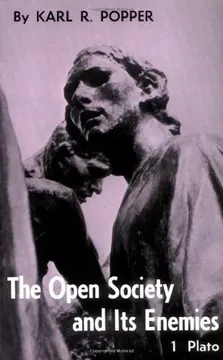
The Open Society and Its Enemies is a philosophical defense of liberal democracy against totalitarianism. Popper critiques Plato, Hegel, and Marx, arguing their ideas lead to closed societies. He advocates for an open society based on critical thinking, individual freedom, and gradual social reform. The book is praised for its intellectual rigor and relevance, though some find it difficult to read. Critics argue Popper misinterprets certain philosophers, while supporters see it as a crucial work on democracy and social progress.
People Also Read



Glossary
Open Society
Society open to criticismA society in which traditions and institutions can be questioned, individuals can make choices, and political arrangements can be changed without violence. It relies on public criticism and peaceful reform rather than an unquestionable authority. The term describes an institutional and moral orientation, not a perfect society or a guarantee of wise decisions.
Closed Society
Society ruled by fixed taboosA society in which customs and social roles are treated as sacred, natural, or beyond criticism. Its members are bound by inherited duties and a strong sense of group belonging, while personal choice has little room. Popper uses the term for a social type, not as a label for every traditional community.
Historicism
Prophecy from supposed historical lawsThe belief that history follows discoverable laws or stages that permit large-scale predictions about society's future. Historicist theories may assign destiny to a chosen people, race, class, or national spirit. Popper argues that social science can make conditional predictions, but cannot scientifically foretell the overall course of human history.
Piecemeal social engineering
Reform through limited, testable stepsA method of social change that identifies specific harms, designs limited reforms, and checks their actual effects. Because measures can be adjusted or reversed, failures need not endanger an entire society. The approach does not forbid ambitious goals; it rejects the claim that society can be safely rebuilt all at once from a comprehensive blueprint.
Utopian social engineering
Rebuilding society from one blueprintA method that begins with a comprehensive ideal society and seeks to reconstruct existing institutions to match it. Popper argues that the scale and uncertainty of the project make criticism difficult and encourage concentrated authority. Because the ideal may change during implementation, large sacrifices can be demanded without reliable evidence that the plan is working.
Critical dualism
Distinguishing facts from human-made normsThe view that descriptive statements about facts and normative rules about what people ought to do are different kinds of things. Norms can be adopted, criticized, and changed; they cannot be logically derived from facts alone. Calling them human-made does not mean they are arbitrary, but it does mean people remain responsible for them.
Methodological essentialism
Defining things by hidden essencesThe approach that treats the task of knowledge as discovering the true nature or essence of things, then expressing that nature in a definition. Popper contrasts it with inquiry into how things behave under specific conditions. He argues that disputes over supposed essences often substitute verbal debate for testable questions.
Methodological nominalism
Study behavior and testable regularitiesThe approach that asks how an object or institution behaves in particular circumstances and whether its behavior follows regular patterns. Definitions serve mainly as convenient labels, not as discoveries of hidden realities. In social science, this directs attention toward consequences and functioning rather than claims about what a society or institution essentially is.
Logic of the situation
Explain action through circumstancesA method of explaining behavior by examining the goals, information, rules, and constraints facing people in a particular situation. It does not assume that individuals are perfectly rational; instead, it asks whether their actions make sense relative to the situation they perceive. The method helps explain unintended outcomes without reducing society to individual psychology.
Conspiracy theory of society
Social events as hidden plotsThe view that major social outcomes, especially unwanted ones, are deliberately planned by powerful individuals or groups. Popper does not deny that conspiracies occur. He argues that many outcomes arise from interactions, institutions, and unintended consequences, and that conspiracies often fail to produce what their participants intended.
Paradox of freedom
Unrestricted freedom can destroy freedomThe problem that unlimited freedom can allow the powerful to bully or dominate the weak, eliminating the freedom of those without comparable power. Popper uses the idea to justify legal safeguards that restrict harmful actions. The challenge is to limit coercion without giving rulers unchecked authority to decide what citizens may do.
FAQ
1. What is The Open Society and Its Enemies by Karl Popper about?
- Critical analysis of totalitarianism: The book examines the philosophical roots and dangers of totalitarian ideologies, focusing on how thinkers like Plato, Hegel, and Marx contributed to anti-democratic thought.
- Philosophy of history and science: Popper critiques historicism—the belief in inevitable historical laws—and defends the open society’s capacity for learning, reform, and critical inquiry.
- Contrast of open and closed societies: The work distinguishes between open societies, which value freedom and rational criticism, and closed societies, which rely on tradition, authority, and dogma.
- Historical context: Written during World War II, the book reflects Popper’s response to the rise of fascism and communism, advocating for liberal democracy and rational social reform.
2. Why should I read The Open Society and Its Enemies by Karl Popper?
- Understanding totalitarian ideologies: The book provides a deep analysis of the intellectual origins of authoritarianism, helping readers recognize and resist such tendencies in politics.
- Insight into philosophy of science: Popper’s critique of historicism and his philosophy of science offer tools to critically assess claims of historical inevitability and scientific determinism.
- Relevance to modern politics: The defense of open society remains pertinent in debates about democracy, freedom of speech, and the role of experts and elites.
- Influence on liberal thought: Popper’s ideas have shaped modern liberalism, emphasizing openness, critical discussion, and the rejection of dogmatism in both politics and science.
3. What are the key takeaways from The Open Society and Its Enemies by Karl Popper?
- Defense of liberal democracy: The book argues for protecting open societies based on freedom, critical rationalism, and democratic governance.
- Critique of totalitarianism and historicism: Popper exposes the philosophical roots of totalitarian ideologies and the dangers of believing in inevitable historical laws.
- Fallibilism and critical method: Progress in science and society depends on the willingness to criticize and revise beliefs, rejecting dogmatism and determinism.
- Piecemeal social reform: Social change should be gradual, experimental, and reversible, avoiding utopian schemes that risk authoritarianism.
4. What is the difference between “open society” and “closed society” in The Open Society and Its Enemies?
- Open society defined: An open society is characterized by democratic governance, rule of law, individual rights, and the freedom to criticize and change institutions.
- Closed society defined: Closed societies are tribal, authoritarian, and based on tradition and myth, suppressing critical thought and individual freedom.
- Transition and strain: The move from closed to open society involves social strain, as traditional bonds dissolve and critical rationality emerges.
- Role of criticism: Open societies embrace fallibilism and critical discussion, while closed societies resist change and enforce conformity.
5. What is historicism according to Karl Popper in The Open Society and Its Enemies?
- Definition of historicism: Historicism is the belief that history is governed by discoverable laws or destinies, making social and political developments inevitable.
- Critique of historicism: Popper argues that historicism is a faulty method, confusing scientific prediction with historical prophecy and neglecting human agency.
- Forms and dangers: Historicism appears in various forms, such as Marxian economic determinism and fascist racialism, and supports fatalism and totalitarianism.
- Alternative approach: Popper advocates for a critical, scientific approach to social science, emphasizing unpredictability and the importance of human decisions.
6. How does Karl Popper critique Plato’s political philosophy in The Open Society and Its Enemies?
- Plato as originator of totalitarian thought: Popper sees Plato as advocating a rigid class society ruled by philosopher-kings, opposing freedom and critical inquiry.
- Theory of Forms and historicism: Plato’s belief in perfect, unchanging realities leads to a historicist view that justifies a static, hierarchical society.
- Political program: Plato’s ideal state is a caste society with strict divisions, communal property among rulers, and censorship to maintain order.
- Critique of justice: Popper argues that Plato’s concept of justice is about maintaining social order and privilege, not equality or individual rights.
7. What is the “Myth of the Metals” or “lordly lie” in Plato’s philosophy, as analyzed by Popper?
- Definition and purpose: The "Myth of the Metals" is a fabricated story claiming people are born with different metals in their souls, justifying social hierarchy.
- Political function: Popper interprets this as a deliberate propaganda tool used by rulers to maintain order and obedience.
- Racial and class implications: The myth supports a rigid caste system and racialism, reinforcing the idea of a master race or class.
- Critique: Popper sees this as evidence of Plato’s acceptance of manipulation and social control, opposing the transparency of open societies.
8. What is Popper’s critique of historicism’s role in political ideologies in The Open Society and Its Enemies?
- Historicism as foundation for ideologies: Historicism underlies ideologies like Marxism and fascism by claiming historical inevitability of certain outcomes.
- Misleading political consequences: It encourages passivity or violent attempts to hasten “inevitable” outcomes, often leading to totalitarian regimes.
- Methodological error: Popper argues historicism mistakes the social sciences for predictive sciences, ignoring the unpredictability of human actions.
- Moral and political danger: Historicism relieves individuals of responsibility, supports authoritarianism, and undermines the values of open societies.
9. How does Karl Popper distinguish between “piecemeal social engineering” and “utopian social engineering” in The Open Society and Its Enemies?
- Piecemeal social engineering: Advocates gradual, experimental reforms aimed at solving specific social problems, accepting fallibility and the need for adjustment.
- Utopian social engineering: Seeks to redesign society according to a comprehensive, ideal blueprint, often ignoring practical constraints and complexity.
- Popper’s preference: He supports piecemeal engineering as compatible with open societies, emphasizing caution and incremental change.
- Criticism of utopianism: Utopian engineering is linked to historicism and totalitarianism, as it often requires authoritarian enforcement.
10. How does Karl Popper analyze Hegel’s and Marx’s philosophies in The Open Society and Its Enemies?
- Hegel’s historicism and state worship: Popper critiques Hegel for transforming nationalism into a totalitarian ideology that worships the state and justifies war and obedience.
- Marx’s historicist prophecy: Marx is acknowledged for his moral impulse but criticized for his belief in inevitable historical laws and class struggle.
- Critique of determinism: Popper argues both Hegel and Marx neglect individual freedom and responsibility, promoting doctrines that justify authoritarianism.
- Impact on modern ideologies: Their philosophies provided intellectual foundations for later totalitarian movements and undermined liberal democracy.
11. What is Popper’s philosophy of science and its connection to The Open Society and Its Enemies?
- Falsificationism: Popper’s philosophy of science holds that theories can be falsified but never conclusively verified, emphasizing critical testing over dogmatic certainty.
- Theory-ladenness of observation: He argues all observation is influenced by preconceptions, rejecting the idea of pure, theory-free observation.
- Application to social sciences: Popper believes social sciences should adopt a critical, falsifiable approach, opposing historicism’s predictive claims.
- Political relevance: The open society’s method of critical discussion and fallibilism mirrors Popper’s scientific method, promoting openness and resistance to dogma.
12. What are the best quotes from The Open Society and Its Enemies by Karl Popper and what do they mean?
- “Great men may make great mistakes”: Popper warns against uncritical reverence for intellectual authorities, emphasizing the need for scrutiny of all thinkers.
- “The open society is not wholly comfortable; its opposite, what Popper and his admirers usually referred to as ‘tribal’ society, is much more so.” This highlights the tension between freedom and security, and the human temptation to accept conformity.
- “Science is a ‘trial and error’ learning process, and one of the virtues of an open society is its ability to learn from experience.” Popper connects the scientific method with political openness and adaptability.
- “The enemies of liberal democracy had taken advantage of its freedoms to undermine it in the twenties and thirties.” This reflects Popper’s concern that freedoms can be exploited by totalitarian movements, justifying limited tolerance of the intolerant.
The Open Society and its Enemies Series

About the Author
Download PDF
Download EPUB
.epub digital book format is ideal for reading ebooks on phones, tablets, and e-readers.








