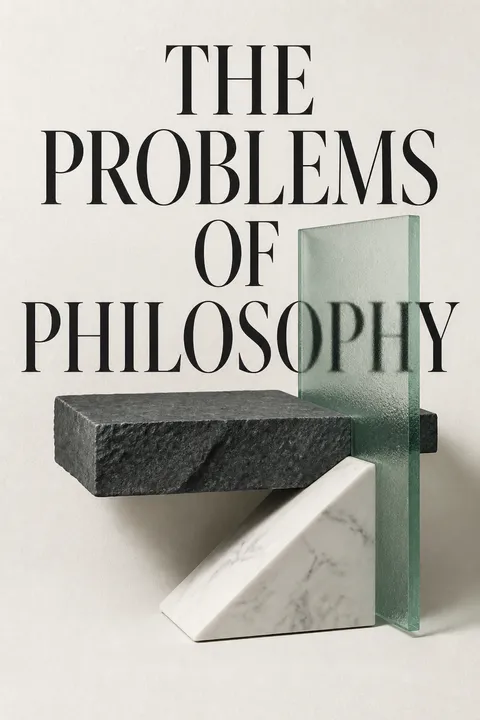


Key Takeaways
Treat the table you see as evidence, not the table itself
Appearance shifts with you. Russell begins with an ordinary table. Its color changes with the light and viewing angle; its shape looks different from different positions; and a microscope reveals a texture the naked eye misses. These immediate qualities, which he calls sense-data, are what a person directly sees, hears, or feels. They are not simply the table’s properties as it exists independently of anyone looking.
Perception is a starting point. The painter learns to notice how things actually appear, while everyday judgment silently corrects those appearances into stable objects. Russell’s point is not that the table is imaginary, but that seeing it is not the same as seeing reality exactly as it is. The familiar object becomes a philosophical question: what, if anything, lies behind its shifting appearances?
The table is a compact demonstration of how perception mixes signal with standpoint. Contemporary vision science likewise treats perception as an active process shaped by light, bodily position, and prior expectations, rather than a camera-like copy of the world. That connection makes Russell’s example useful beyond philosophy: disagreement about what someone saw need not imply dishonesty. Still, variation in appearance does not by itself show that the object’s underlying nature is unknowable. It shows that any account of that nature must explain why perspectives vary in orderly, predictable ways.
Believe in an external world as the simplest explanation, not a proof
Doubt has a limit. A person can be certain that a color appears or that pressure is felt while still questioning whether a table exists independently. Russell uses Descartes’ method of systematic doubt to separate immediate experience from assumptions about its cause. Even the claim “I think, therefore I am” needs care: a particular experience may be certain without proving the existence of a lasting, unchanging self.
The world earns belief. Russell cannot logically rule out the possibility that life is a dream. But an independent world explains why objects appear again when people return, why a cat seems to move while unobserved, and why experiences fit stable patterns. The external-world belief is therefore reasonable, not demonstrable. Its strength is that it organizes experience with fewer strange assumptions than a world made entirely of private impressions.
This is a useful model of rational belief under uncertainty: some claims cannot be proved from a position outside all assumptions, yet competing explanations need not be equally credible. In modern terms, explanatory simplicity is a virtue when it compresses many observations into one account. It is not a truth machine, however. A simpler story can still be wrong, and what counts as simple depends partly on background assumptions. Russell’s careful conclusion is stronger for admitting that limitation than a claim to have defeated every skeptical possibility.
Science maps matter’s relations without revealing its inner feel
Models describe structure. Physics explains light, heat, and sound through processes such as waves and motion. Russell stresses that a wave is not the color or sound someone experiences. Scientific theory describes physical causes of sensation, while the felt quality itself belongs to immediate experience. He also distinguishes private visual and tactile space from the public space used in science, whose structure connects different observers’ perspectives.
Relations travel farther. We can learn where the sun, Earth, and moon stand in relation to one another without directly experiencing physical space as it is in itself. Likewise, seeing the sun gives evidence about its earlier state, since its light takes about eight minutes to reach Earth. Science can establish powerful patterns and relations, Russell argues, while leaving the intrinsic nature of physical things beyond direct sensory access.
Russell’s distinction anticipates a durable debate in philosophy of science: whether mature science tells us what reality is made of, or chiefly how its parts relate and behave. The latter view fits the success of mathematical models that predict observations without picturing an object’s inner essence. Yet the distinction should not be mistaken for a defect in science. Explaining structure and causal relations is substantial knowledge, even if it does not reproduce the subjective character of experience. The useful question is not whether science reveals everything, but which kinds of questions its methods can answer.
Separate direct acquaintance from descriptions that let knowledge travel
Two kinds of knowing. Knowledge by acquaintance is immediate awareness, such as seeing a color, remembering an event, or noticing a feeling. Knowledge by description is knowing that something fits a description, even when the thing itself is not directly present. Russell’s example is a historical figure such as Bismarck: someone who never met him can know facts about him through descriptions and testimony without having direct acquaintance with the person.
Experience supplies the foothold. Descriptive knowledge ultimately depends on something directly encountered, such as printed words, a voice, or a remembered observation, together with truths that connect this evidence to what it describes. Russell argues that this distinction explains how people can know about distant places, historical figures, physical objects, and other minds without experiencing them firsthand. Knowledge extends beyond private experience, but it does not float free of it.
The distinction clarifies a central feature of modern knowledge: most people know far more through testimony, records, and institutions than through personal observation. A reader can know about a planet or a historical event without directly encountering either, provided there are reliable chains linking evidence to the claim. Russell’s account makes those chains philosophically visible. Its pressure point is trust: description only carries knowledge when sources and inference are dependable. Social knowledge is powerful precisely because it is shared, but that also makes its quality partly a matter of institutions and evidence practices.
Past regularity predicts tomorrow only if induction is trusted
Repetition is not proof. We expect the sun to rise because it has risen before, and we expect familiar-looking food to be safe because similar food has usually been nourishing. Russell asks what justifies moving from repeated past patterns to an unobserved case. The principle of induction says that repeated associations, without known exceptions, make another association more probable. It does not make it certain.
The argument circles back. Experience cannot prove induction without relying on it: saying that induction has worked in the past uses past success to predict continued success. Russell illustrates the risk with a chicken fed regularly by a person who eventually kills it. The lesson is not to abandon expectation, but to recognize that much ordinary and scientific reasoning rests on a principle that experience cannot independently certify.
Russell identifies a problem that remains live in statistics and machine learning: patterns in observed data support predictions only when the data-generating process remains sufficiently stable. Modern probability can express uncertainty more carefully, but it cannot guarantee that tomorrow will resemble yesterday. The chicken story captures the danger of mistaking a reliable local pattern for an exceptionless law. At the same time, practical inquiry does not require certainty. Predictions can be tested, updated, and compared against alternatives, even when the deepest justification for expecting continuity remains unresolved.
Treat mathematical certainty as knowledge of relations, not existence
Generality has objects. Russell calls qualities and relations shared across many particular things universals. Whiteness can apply to many white objects; “before” can relate many events. He argues that denying universals creates a problem: to explain why two things resemble one another, the explanation must invoke resemblance, itself a relation that can hold in many cases.
A priori does not mean magic. Russell says a priori knowledge concerns relations among universals, as in arithmetic and logic. Understanding that two and two make four does not require counting every pair in the world. But that truth alone does not establish that any particular people or objects exist. Experience identifies actual things; general principles help explain relations among them. This position rejects both the idea that mathematics is merely a summary of repeated observations and the claim that reason can conjure facts about what exists.
Russell’s account separates necessity from observation: mathematical truths can constrain any case without telling anyone which cases actually occur. That distinction still helps explain why mathematics can be both abstract and indispensable in empirical science. His realism about universals, however, is not the only available explanation. Structuralist approaches, for example, treat mathematical objects through their places in systems of relations rather than as a separate inventory of abstract entities. The enduring question is not whether mathematics reaches beyond particular examples, but what kind of reality its general structures possess.
Make truth answer to facts, not the confidence of belief
Belief can miss reality. Russell distinguishes a belief from the fact that would make it true. In his example, Othello believes that Desdemona loves Cassio. If she does, the belief corresponds to a fact; if she does not, the belief is false, however forcefully Othello holds it. Truth is therefore not a feeling of certainty or a feature a belief can give itself.
Agreement is not enough. Russell also questions the idea that truth simply means fitting coherently into a system of beliefs. More than one imagined history or scientific explanation might fit the evidence available so far. Coherence can help assess beliefs, but it cannot by itself guarantee that a belief matches reality. The distinction matters whenever persuasive conviction, elegant theory, or group agreement threatens to substitute for evidence about what actually happened.
The correspondence idea protects inquiry from a common mistake: treating consensus or confidence as if it made a claim true. It also explains why people can be sincere and wrong at the same time. In practice, however, facts are not always easy to access independently of the methods used to describe them. Historical records, instruments, and scientific measurements mediate the comparison. Russell’s account gives truth an external anchor, while leaving the difficult work of establishing what the relevant facts are to careful investigation.
Match confidence to evidence, and use coherence as a check
Certainty comes in degrees. Russell distinguishes immediate awareness from judgments made about it. A vivid, recent memory may be highly reliable, while a faint recollection becomes less secure; even simple sensory judgments can weaken as perception grows ambiguous. He calls truths supported by strong intuitive evidence self-evident, but emphasizes that many beliefs fall short of absolute certainty.
Knowledge has gradations. A true belief reached by a sound route can count as knowledge; a false one is error; a belief that is neither secure knowledge nor clear error is probable opinion. Coherence helps when several probable beliefs support one another, as when waking experience forms a more stable pattern than dreams. But a coherent system is not automatically true. For Russell, coherence strengthens a case only when there is already some trustworthy evidence within it.
This is a practical form of epistemic calibration: confidence should vary with the quality, freshness, and independence of evidence. Modern research on judgment likewise distinguishes a person’s felt certainty from the actual reliability of a conclusion. Russell’s emphasis on coherence also resembles the way scientific theories gain credibility by connecting multiple findings. The caution is essential: a tightly connected belief system can reinforce its own mistakes. Independent checks, contrary evidence, and clear separation between observation and interpretation help prevent coherence from becoming a polished form of confirmation bias.
Let logic open possibilities instead of dictating the universe
Metaphysics has boundaries. Russell challenges philosophers who claim to derive the whole universe from abstract principles. He criticizes a reading of Hegel in which every partial thing depends on a complete, harmonious whole: having relations to other things does not prove that all those relations are necessary to a thing’s existence. A person can be directly aware of a toothache without knowing every fact about its causes.
Possibility is not actuality. Mathematics showed that infinite collections need not be contradictory, and that different geometries can be logically possible. Logic therefore opens alternatives; observation helps determine which, if any, describes the actual world. Russell sees philosophy’s strongest role not as a special science of ultimate reality, but as criticism of assumptions, clarifying what evidence supports and what remains conjecture.
The distinction between logical possibility and empirical actuality is foundational to disciplined theorizing. A model can be internally consistent without describing the world, while evidence can rule out some models without selecting a final metaphysical picture. Russell’s caution is valuable wherever a beautiful system claims more than its premises warrant. Yet philosophy need not be reduced to policing science. It can also clarify the concepts, standards of explanation, and background assumptions that scientific work uses, even when it cannot settle a complete picture of reality.
Study philosophy to loosen dogma and enlarge your field of concern
Questions do real work. Russell does not promise that philosophy will deliver definitive answers to the universe’s largest questions. Its value lies partly in exposing how much ordinary certainty rests on unexamined assumptions, and in making unfamiliar possibilities thinkable. A table, a memory, or the expectation of tomorrow can become a reason to examine what counts as evidence and knowledge.
Attention can widen the self. Philosophical contemplation turns attention away from private advantage and toward the world beyond personal hopes and fears. Russell connects this impartiality with justice in action and a concern for people beyond one’s immediate circle. Philosophy may not solve practical problems by itself, but it can weaken the mental habit of treating one’s own interests and inherited beliefs as the measure of everything.
Russell offers an intellectual ethic, not merely a method of argument: examine the world without demanding that it confirm personal preference. That stance connects open inquiry with civic virtues such as fairness and willingness to hear unfamiliar perspectives. The aspiration has limits. Contemplation alone does not redistribute resources or correct institutions, and claims of impartiality can conceal a person’s own standpoint. Its practical value depends on pairing widened attention with accountable action and a readiness to revise one’s judgments.
Analysis
The book’s narrative begins by unsettling a table and ends by defending the value of unresolved questions. Its most important achievement is not a single theory of reality, but a disciplined sequence of distinctions: appearance versus object, awareness versus judgment, direct acquaintance versus description, necessary relations versus observed regularities, and truth versus confidence. These distinctions turn vague skepticism into specific problems that can be examined without pretending that doubt can be eliminated altogether.
Russell’s method is recognizably early analytic philosophy. He treats conceptual confusion as a source of false metaphysical certainty, then asks what kinds of evidence could support each claim. The result is a modest realism: an external world is a better explanation of experience than solipsism, but its existence is not demonstrated; science reveals patterns and relations, while the intrinsic character of matter remains obscure; induction is indispensable, yet cannot justify itself through experience alone. This combination of realism and epistemic restraint is the book’s intellectual center.
Some of Russell’s proposed solutions are less settled than his problems. His sense-data account assumes that immediate experience can be cleanly separated from the objects perceived, a distinction challenged by later philosophies of perception. His robust account of universals also opens a difficult question about how abstract entities relate to concrete events. These uncertainties do not erase the book’s value. They show that philosophical progress often consists in making disagreements precise enough to be productive.
The closing defense of philosophy follows from the method. If certainty is limited, inquiry still matters because it exposes hidden assumptions, expands the range of possible explanations, and counters the impulse to treat local habits as universal truths. Russell’s ideal of impartial contemplation is demanding and cannot replace empirical research or practical action. Its continuing force is as a corrective: intellectual humility need not mean passivity, and uncertainty need not collapse into cynicism.
Review Summary
The Problems of Philosophy receives mixed reviews, with many praising Russell's clear writing style and ability to explain complex concepts. Some find it an excellent introduction to philosophy, while others argue it may be too difficult for beginners. Readers appreciate Russell's exploration of epistemology and his arguments for the value of philosophy. Critics note that the book can be dense and occasionally repetitive. Overall, it is considered a classic primer on philosophical issues, though some suggest more accessible alternatives for newcomers to the field.
People Also Read






Glossary
Sense-data
Immediate sensory contentsSense-data are the colors, sounds, textures, smells, and other qualities a person is immediately aware of in sensation. Russell distinguishes these experiences from the physical objects people ordinarily take them to reveal. A table’s changing visible color, for example, is sense-data; the table as an independent object is inferred from such appearances.
Physical object
An inferred independent thingA physical object is something presumed to exist independently of any particular person’s perception. Russell uses the term for the reality thought to cause or underlie sense-data, such as the table that remains when nobody sees it. Physical objects are known through descriptions and inference, not through the same immediate acquaintance as colors or sounds.
Knowledge by acquaintance
Direct awareness of somethingKnowledge by acquaintance is immediate awareness of an object without relying on inference or a description. Russell’s examples include present sense-data, remembered experiences, and one’s own thoughts or feelings. It is knowledge of the thing itself as experienced, rather than knowledge of propositions about it.
Knowledge by description
Knowing through identifying factsKnowledge by description is knowing that an object is the unique thing fitting a description, without being directly acquainted with that object. A person can know facts about a historical figure through records and testimony, for instance, without having met that figure. Russell argues that this indirect knowledge ultimately depends on acquaintance with evidence and knowledge of relevant truths.
Inductive principle
Past patterns support probabilityThe inductive principle says that repeated association between events, with no observed exceptions, increases the probability that they will be associated in a new case. Russell argues that induction underlies expectations about the future and much scientific reasoning. It cannot be proved by experience without circularity, because any appeal to past success assumes that past patterns remain informative.
A priori knowledge
Knowledge not proved by experienceA priori knowledge is knowledge whose truth is not established by particular observations, although experience may prompt a person to recognize it. Russell’s examples include logical and mathematical principles. He argues that such knowledge concerns relations among universals and does not, by itself, establish that particular objects exist.
Universals
Repeatable qualities and relationsUniversals are qualities or relations that can apply to many particular things, such as whiteness, resemblance, or being before another event. Russell argues that universals are not identical to the mental acts by which people think about them. They are shared objects of thought, and logical or mathematical knowledge concerns relations among them.
Intuitive knowledge
Immediate knowledge of truthsIntuitive knowledge is knowledge of truths that does not depend on inference from other truths. Russell includes judgments about immediate perception, some logical principles, and simple mathematical relations. Intuitive judgments vary in reliability: some have exceptionally strong evidence, while others, such as uncertain memories, support only a tentative conclusion.
Self-evidence
A truth’s apparent certaintySelf-evidence is the degree to which a truth appears evident without requiring proof. Russell distinguishes especially strong cases, associated with direct acquaintance with a fact, from weaker judgments that provide only varying degrees of support. Because self-evidence can be incomplete, confidence in a belief should be proportionate to its evidential strength.
Probable opinion
Belief short of knowledgeProbable opinion is a belief that is neither securely established knowledge nor recognized error. Russell uses it for much of what people ordinarily call knowledge, since evidence often supports a conclusion without making it certain. Agreement with other well-supported beliefs can strengthen a probable opinion, but coherence alone cannot turn it into indubitable truth.
FAQ
What's "The Problems of Philosophy" by Bertrand Russell about?
- Exploration of Philosophy: The book delves into fundamental philosophical questions, focusing on the nature of reality, knowledge, and truth.
- Theory of Knowledge: Russell emphasizes the theory of knowledge over metaphysics, exploring how we know what we know.
- Philosophical Problems: It addresses classic philosophical problems such as the existence of matter, the nature of universals, and the limits of philosophical knowledge.
- Constructive Approach: Russell aims to provide positive and constructive insights into philosophical issues rather than merely critiquing existing theories.
Why should I read "The Problems of Philosophy" by Bertrand Russell?
- Foundational Understanding: It offers a foundational understanding of key philosophical concepts and problems, making it ideal for beginners.
- Critical Thinking: The book encourages critical thinking and the questioning of everyday assumptions about reality and knowledge.
- Influential Work: As a work by Bertrand Russell, a leading philosopher, it provides insights into his influential thoughts and contributions to philosophy.
- Broad Appeal: The book is accessible to both students of philosophy and general readers interested in exploring philosophical questions.
What are the key takeaways of "The Problems of Philosophy" by Bertrand Russell?
- Appearance vs. Reality: Russell explores the distinction between how things appear to us and their true nature.
- Knowledge by Acquaintance and Description: He differentiates between direct knowledge of things and knowledge through descriptions.
- Induction and General Principles: The book discusses the principle of induction and how we derive general principles from specific instances.
- Value of Philosophy: Russell argues for the intrinsic value of philosophy in expanding our understanding and freeing us from dogmatic beliefs.
What is the distinction between "Appearance and Reality" in Russell's philosophy?
- Perception vs. Reality: Russell examines how our perceptions may not accurately reflect the true nature of objects.
- Sense-Data: He introduces the concept of sense-data, which are the immediate objects of perception, distinct from the physical objects themselves.
- Philosophical Inquiry: The distinction is a starting point for philosophical inquiry, questioning the certainty of our knowledge about the world.
- Critical Examination: Russell encourages a critical examination of our assumptions about reality, leading to a deeper understanding of philosophical problems.
How does Bertrand Russell define "Knowledge by Acquaintance and Knowledge by Description"?
- Knowledge by Acquaintance: This is direct knowledge of things we are immediately aware of, such as sense-data and personal experiences.
- Knowledge by Description: This involves knowing things indirectly through descriptions, such as historical figures or distant objects.
- Foundation of Knowledge: Russell argues that all knowledge, both of things and truths, ultimately rests on acquaintance.
- Philosophical Implications: The distinction highlights the limitations and scope of human knowledge, influencing how we understand and describe the world.
What is the "Principle of Induction" according to Russell?
- Inductive Reasoning: The principle of induction involves deriving general principles from specific observations or experiences.
- Foundation of Science: It is fundamental to scientific inquiry, allowing us to predict future events based on past occurrences.
- Philosophical Challenge: Russell acknowledges the philosophical challenge of justifying induction, as it cannot be proven by experience alone.
- Probabilistic Nature: Inductive reasoning is probabilistic, meaning it provides likely conclusions rather than absolute certainty.
What are "Universals" in "The Problems of Philosophy"?
- Definition of Universals: Universals are entities that can be shared by multiple particulars, such as qualities or relations.
- Plato's Influence: Russell draws on Plato's theory of ideas, suggesting that universals exist independently of particular instances.
- Role in Knowledge: Universals are crucial for understanding general principles and making sense of the world beyond individual experiences.
- Philosophical Debate: The existence and nature of universals have been a central debate in philosophy, influencing metaphysical and epistemological theories.
How does Russell address "Truth and Falsehood" in the book?
- Correspondence Theory: Russell supports the correspondence theory of truth, where truth is a matter of beliefs corresponding to facts.
- Nature of Beliefs: He explores how beliefs can be true or false based on their relation to external reality.
- Philosophical Implications: The discussion highlights the complexity of determining truth and the potential for error in human beliefs.
- Objective Reality: Russell emphasizes the importance of an objective reality that beliefs must correspond to in order to be true.
What is "Intuitive Knowledge" according to Bertrand Russell?
- Immediate Knowledge: Intuitive knowledge is immediate and self-evident, not derived from inference or reasoning.
- Examples: It includes basic logical principles and certain truths of perception that are directly known.
- Foundation of Other Knowledge: Intuitive knowledge serves as the foundation for derivative knowledge, which is inferred from intuitive truths.
- Degrees of Certainty: Russell acknowledges that intuitive knowledge can vary in certainty, influencing the reliability of derived beliefs.
What are the "Limits of Philosophical Knowledge" as discussed by Russell?
- Critique of Metaphysics: Russell critiques the ambitious claims of metaphysics to provide knowledge of the universe as a whole.
- Empirical Limitations: He emphasizes the limitations of human knowledge, which is largely based on empirical observation and logical inference.
- Role of Philosophy: Philosophy's role is to critically examine the principles underlying science and common beliefs, rather than providing absolute answers.
- Skepticism and Inquiry: Russell advocates for a balanced skepticism that questions assumptions while acknowledging the limits of philosophical inquiry.
What is the "Value of Philosophy" according to Bertrand Russell?
- Intellectual Expansion: Philosophy expands our understanding of possibilities and frees us from dogmatic beliefs.
- Speculative Interest: It keeps alive the speculative interest in fundamental questions about the universe and our place in it.
- Enlargement of Self: Philosophical contemplation enlarges the self by connecting it with the broader universe, fostering a sense of wonder.
- Intrinsic Value: The value of philosophy lies in the pursuit of knowledge and the intellectual growth it fosters, rather than in providing definite answers.
What are the best quotes from "The Problems of Philosophy" and what do they mean?
- "Philosophy is to be studied, not for the sake of any definite answers to its questions, but rather for the sake of the questions themselves." This quote emphasizes the intrinsic value of philosophical inquiry in expanding our understanding and challenging assumptions.
- "The value of philosophy is, in fact, to be sought largely in its very uncertainty." Russell highlights how philosophy's lack of definite answers encourages open-mindedness and intellectual exploration.
- "The life of the instinctive man is shut up within the circle of his private interests." This quote contrasts the narrow focus of instinctive life with the broader perspective offered by philosophical contemplation.
- "Philosophic contemplation does not, in its widest survey, divide the universe into two hostile camps—friends and foes." Russell advocates for an impartial view of the universe, free from personal biases and self-interest.
About the Author






Download PDF
Download EPUB
.epub digital book format is ideal for reading ebooks on phones, tablets, and e-readers.








