

Key Takeaways
Treat history's grand forecasts as hypotheses, not instructions
Prophecy is not science. Popper calls historicism the belief that history follows discoverable laws that let thinkers predict society's broad future. He argues that social change depends on knowledge, choices, and institutions, all of which can shift in ways no forecast can fully capture. A forecast that capitalism must collapse, for example, is not made scientific by sounding inevitable. At most, social analysis can identify conditional tendencies: if certain conditions persist, certain outcomes become more likely.
Test the claim. Popper asks readers to separate specific, testable predictions from sweeping stories about humanity's destiny. A forecast that cannot say what evidence would prove it wrong can absorb almost any outcome as confirmation. The danger is practical as well as intellectual: people may wait for a promised transformation instead of addressing preventable harms now.
The distinction between conditional prediction and destiny is useful well beyond political philosophy. Climate scenarios, economic projections, and public health models become more reliable when their assumptions and uncertainty are explicit. Popper's standard also guards against hindsight, the tendency to treat whatever happened as what had to happen. Still, broad social patterns can be informative even when they are not laws. The sensible response is not to abandon forecasting, but to treat forecasts as revisable tools for action, not authorities that relieve people of responsibility.
Use definitions to clarify terms, not manufacture certainty
Names are not discoveries. Popper traces a style of thinking from Plato and Aristotle that treats knowledge as the discovery of a thing's fixed essence, often through a definition. Aristotle's approach implies that defining a term reveals what the thing truly is. Popper contrasts this with scientific definitions, which work more like labels: they shorten a description but do not establish facts about the world.
Make claims testable. Scientists need not settle the ultimate meaning of words such as life or gravity before investigating them. They can define a term for a particular purpose, state what they mean, and test the resulting claims. Precision comes from specifying measurements and acknowledging error, not from pretending that every term has a perfectly sharp boundary. Demanding definitions of every word merely pushes ambiguity into the words used to define it.
This is a strong warning against mistaking verbal neatness for explanatory progress. In contemporary research, an operational definition can make a concept measurable without claiming to capture its full essence. That distinction is especially important in public debate, where a speaker can define democracy or freedom in a way that quietly settles a political argument in advance. Popper's view does not make language unimportant. It makes clarity a practical discipline: state how a term is being used, then let evidence and argument carry the weight.
Do not let national destiny make the state sacred
History can sanctify power. Popper presents Hegel as turning the idea of historical development into a defense of the state and nation. In this account, a nation's spirit unfolds through history, while war and political success become signs of its destiny. Hegel's language elevates the state above individual conscience and treats the existing order as rational because it exists. Popper reads this as an apology for Prussian monarchy, not a neutral description of political life.
The influence spreads. Popper argues that later nationalists borrowed this way of thinking, replacing Hegel's collective spirit with race or blood. He also sees Hegelian ideas behind political movements on both the far right and far left, even when their favored collective differs. His account is deliberately combative, but its central warning is clear: claims about a nation's mission can turn contingent political power into an unquestionable moral authority.
The warning remains relevant whenever leaders describe a state, nation, or movement as the unique vehicle of history. That language can make ordinary constraints seem like betrayal and dissent seem illegitimate. Popper's genealogy is most persuasive as an account of a reusable political pattern, rather than proof that one philosopher alone caused later authoritarian movements. Political ideas travel through institutions, education, and crises, and their effects depend on those settings. Scrutinizing the pattern is more useful than treating intellectual history as a single chain of blame.
Keep Marx's solidarity, but test his economic laws
Moral urgency meets determinism. Marx's analysis begins with a serious humanitarian concern: workers can be formally free to contract while economic need leaves them little real choice. He exposed the brutal conditions of early industrial labor and argued that social arrangements, not simply individual greed, could produce exploitation. Popper credits Marx with bringing economic structures into social analysis and with challenging the assumption that society can be explained entirely through individual psychology.
The method overreaches. Marx then treats economic development as the force that determines the course of history. He expects capitalist accumulation to create ever-growing misery and make socialism inevitable. Popper argues that this certainty undermines Marx's practical concern: if history's laws decide the outcome, political judgment and deliberate reform seem secondary. Marx's critique of exploitation can remain powerful even when his predictions about an unavoidable future do not hold.
Separating a thinker’s moral insight from the machinery of his forecast is a valuable habit. It allows analysis of structural inequality without assuming that economic structures dictate every political outcome. Marx's attention to bargaining power and material dependence still helps explain why formally voluntary contracts can be substantively unequal. Yet Popper's contrast between determinism and agency can be too stark: institutions and individual choices interact, and structural constraints are real without being absolute. The useful question is not whether people are free or determined, but which constraints can be changed, by whom, and at what cost.
Explain social outcomes through institutions, not motives alone
Situations shape behavior. Popper supports Marx's challenge to psychologism, the view that social laws can ultimately be reduced to laws of individual psychology. An action cannot be explained by motive alone; its social setting matters. Rules, markets, and institutions shape which choices are available and what consequences follow, including consequences nobody intended.
Look for the mechanism. Popper notes that a practice such as avoiding close-kin marriage might be explained as an instinct, or as a norm that helps create the apparent instinct. He also cites observations that young children and chimpanzees not taught to fear snakes may not show the expected fear, cautioning that widespread behavior is not automatically innate. In economic life, an individual purchase can contribute to scarcity even when the buyer wants low prices. Such cases call for analysis of the situation, not just a list of motives.
This approach anticipates a central strength of institutional analysis: it explains how rules and incentives aggregate individual actions into outcomes that no participant planned. It also avoids the opposite mistake of treating institutions as actors with minds of their own. The balance matters. Psychological evidence can explain how people respond to incentives, while institutional analysis explains which incentives are present and who designed them. Popper's examples are suggestive rather than decisive, especially where he challenges claims about instinct. Their lasting lesson is methodological: do not infer a cause from a behavior's apparent universality alone.
Use class conflict to illuminate history, not flatten it
Structures reveal exploitation. Marx's account of class conflict directs attention to who controls productive resources and who depends on wages. He argued that legal equality could coexist with severe material inequality, and that the state might protect a social order favorable to those who own capital. Popper accepts the value of examining these power relations, particularly in the laissez-faire economy Marx studied.
The record is more complex. Marx described workers, including children, enduring extraordinary hours and dangerous conditions. Popper cites a report of a child who began factory work before age eight and worked fifteen-hour days, alongside a seamstress who reportedly labored more than twenty-six continuous hours before dying. These cases make the moral force of Marx's critique unmistakable. But class conflict does not explain every political dispute, and divisions within classes can matter as much as conflict between them.
Class is a powerful lens because it links private hardship to the distribution of bargaining power and political influence. It becomes a poor map when every disagreement is forced into a single conflict between exploiters and exploited. Coalitions shift, workers can have competing interests, and institutions can protect some groups while burdening others. Popper's own concession that class analysis has real explanatory value is important: the correction is not to discard class, but to treat it as one causal dimension among several and ask what evidence would distinguish its influence in a given case.
Do not infer a classless society from workers winning
A victory proves less than promised. Marx's forecast moves from capitalist accumulation to growing misery, from misery to a polarized class struggle, and from workers' victory to socialism. Popper argues that the final step does not follow. Even if one ruling class is defeated, the workers who united against it may divide over new interests and sources of power. Revolutionary leaders and administrators could become a new governing elite.
Possibilities are not prophecies. Popper does not claim that a new ruling class must emerge. His point is that several outcomes remain possible, so the arrival of socialism cannot be deduced from the defeat of the bourgeoisie. He also questions the Marxist certainty that reforms cannot improve workers' conditions. Once gradual improvements are possible, the predicted escalation toward an unavoidable violent revolution loses its essential premise.
This is a general lesson about political transitions: removing an incumbent does not automatically remove the structure that concentrates authority. The question after a revolution is not only who holds power, but how power is monitored, challenged, and transferred. Popper's argument is logically strong against inevitability, though it does not show that a new elite is inevitable either. The most useful approach is to compare institutional designs and their failure modes before victory, not to assume that a movement's stated ideals will govern its behavior once it controls the state.
Defend democracy by limiting rulers, not merely electing them
Elections are not enough. Popper rejects the idea that democracy simply means majority rule. A majority can act tyrannically; democratic institutions matter because they let people remove governments and pursue change without violence. The test is whether a political system protects peaceful opposition and makes rulers answerable, not whether its leaders claim to represent a class or the people.
Violence changes the rules. Popper criticizes Marxist rhetoric that leaves unclear whether revolution means winning democratic elections or entrenching one party after taking power. He considers force defensible against tyranny when its aim is to restore democratic institutions, but not as a route to permanent rule by a new group. His concern is practical: threats of revolutionary seizure can help anti-democratic opponents portray themselves as defenders of order and weaken the coalition needed to protect democracy.
The institutional focus shifts political debate from the identity of ideal rulers to the design of constraints on all rulers. This is a more durable question because good intentions do not eliminate incentives to retain power. The emphasis on opposition rights also clarifies why democratic legitimacy requires more than a winning vote. At the same time, institutions cannot defend themselves automatically; citizens and political parties must be willing to enforce constitutional limits, including when doing so frustrates their own side. That commitment is difficult precisely when leaders claim an urgent historical mandate.
Reform concrete harms without designing a perfect society
Improve what can be changed. Popper rejects the idea that society must wait for a total transformation before addressing exploitation or unemployment. He favors piecemeal social engineering: testing limited institutional reforms, observing their effects, and correcting failures. The alternative, a sweeping plan to remake society as a whole, risks concentrating power in officials who cannot foresee all the consequences.
Intervention needs safeguards. Popper argues that laissez-faire markets can leave economically weak people vulnerable to coercion, so the state may need to protect workers and provide social insurance. But state intervention also expands political power. It should therefore be paired with democratic oversight and kept proportionate to the problem. The aim is neither an untouched market nor unlimited planning, but practical protections that preserve people's ability to criticize and replace those who govern.
This approach resembles experimental problem-solving: make a bounded change, monitor outcomes, and preserve the capacity to reverse course. Its strength is epistemic as well as moral, because small interventions can reveal information that a grand design cannot supply in advance. Its limitation is that incrementalism can understate how entrenched interests block modest reforms, or how some problems require coordinated action at scale. The relevant contrast is not small action versus large action in every case. It is corrigible policy, with feedback and accountability, versus plans insulated from criticism.
Replace history's alleged script with accountable human choices
No single story contains humanity. Popper argues that what is commonly called world history is largely a selective account of states, wars, and powerful leaders. A complete history of every person's hopes, suffering, and work cannot be written; historians must select a point of view. The mistake is to treat one selection, especially the history of political power, as the destiny or meaning of all human life.
Choose the meaning in practice. Popper rejects the claim that history itself judges actions or reveals a guaranteed moral direction. People must decide which ends to pursue and accept responsibility for the consequences. His preferred stance joins reason with humane action: listen to criticism, protect the institutions that allow it, and reduce suffering without pretending that success proves righteousness. Early Christianity's defense of conscience against imperial demands illustrates one version of this moral resistance, while later authoritarian church power shows that no movement is immune to betraying its ideals.
The argument distinguishes meaning from prediction. A community can give its past significance by asking questions that matter now, without claiming that the past secretly aimed at the present. This is also a safeguard against winner's history, in which successful rulers appear justified simply because they prevailed. Popper's account rightly insists that interpretation involves choices, but historians remain answerable to evidence even when their questions differ. The combination is productive: no view from nowhere, but no permission to invent the past either.
Analysis
The volume's strongest contribution is its separation of three things often collapsed into one: explaining institutions, predicting historical outcomes, and deciding what ought to be done. Popper grants Marx considerable success at the first task. Marx's account of labor, ownership, and bargaining power made visible how apparently voluntary arrangements can sustain exploitation. The failure, in Popper's reading, comes when that explanatory framework becomes a law of destiny, promising that worsening misery must culminate in socialism.
That distinction remains useful in contemporary social science. Structural explanations can identify durable pressures without claiming that those pressures determine one political result. Historical patterns are conditional and path-dependent: small changes in organization, policy, or leadership can redirect them. Popper's preference for testable claims and revisable interventions is therefore not merely a defense of modesty. It is a theory of political learning, where institutions must permit error correction because neither experts nor movements can anticipate every consequence.
The book also has limits. Popper's attack on Hegel is often prosecutorial, attributing intellectual dishonesty and political service where a more careful account might distinguish philosophical argument, institutional context, and later appropriation. His portrayal of Marx can also understate the difficulty of reform when power is deeply entrenched. Incremental change may be safer than revolution, but it is not automatically available to people denied political voice.
The enduring synthesis is neither historical fatalism nor faith that good procedures solve every injustice. It is a disciplined commitment to expose power, test explanations, protect dissent, and keep remedies open to revision. Political freedom matters not because it guarantees wise decisions, but because it allows a society to identify and correct bad ones without treating any class, nation, or leader as history's final authority.
Review Summary
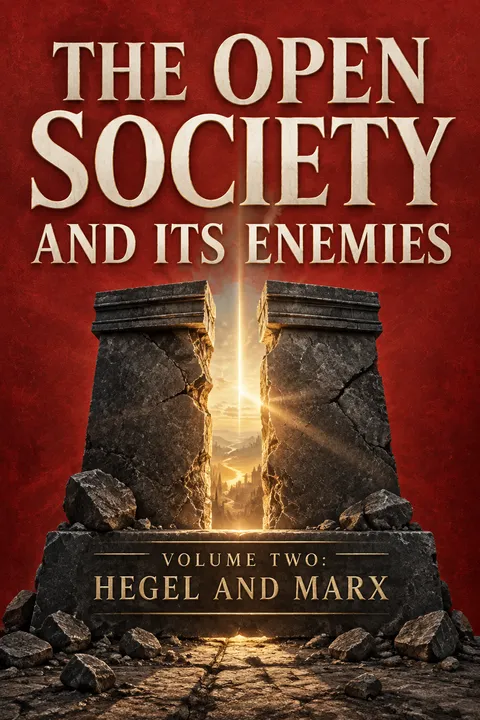
Reviewers of The Open Society and Its Enemies - Volume Two largely praise Popper's critique of historicism and his defense of rational, democratic society, while noting his treatment of Hegel as overly harsh and dismissive. His analysis of Marx is considered fairer and more nuanced, crediting Marx's humanitarian impulses while dismantling his prophetic determinism. Some readers find the volume less engaging than Volume One, and critics note Popper's optimism about liberal democracy appears increasingly naive in light of modern political developments.
People Also Read





Glossary
Historicism
Historical laws predict societyPopper's term for the view that history follows discoverable laws or fixed trends that allow prediction of society's broad future. He argues that such forecasts overreach because social outcomes depend on changing knowledge, choices, and institutions. Historicism is distinct from ordinary historical research, which studies past events without claiming to know history's inevitable direction.
Open society
Institutions protect peaceful criticismA society in which people can question authority, criticize public decisions, and change governments without violence. Its institutions make rulers answerable and permit reforms to be tested and revised. Popper contrasts it with a closed, tribal order that treats inherited authority or collective destiny as beyond challenge.
Piecemeal social engineering
Incremental, revisable reformPopper's approach to social improvement through limited, targeted reforms rather than a comprehensive plan to redesign society. Each intervention addresses a specific harm, then remains open to criticism and correction. The method reflects the limits of prediction: policymakers cannot know every consequence of large-scale change in advance.
Situational logic
Actions explained by circumstancesA method of explaining action by reconstructing the situation an individual faces, including available information, institutional rules, incentives, and constraints. It does not assume that people always behave rationally by some universal psychological standard. Instead, it asks whether an action makes sense in the specific situation being analyzed.
Historical materialism
History shaped by production relationsMarx's account of historical change in which the organization of material production and relations between social classes shape political, legal, and ideological life. Popper values its attention to economic conditions but rejects the stronger claim that economic development supplies laws capable of predicting a necessary historical future.
Surplus value
Value appropriated from laborIn Marx's theory, the worker sells labor power for wages while producing value beyond what is required to reproduce that labor power. The capitalist appropriates this surplus as the basis of profit. Popper argues that Marx's labor theory of value is not necessary to explain exploitation under conditions where workers have weak bargaining power and few alternatives.
Class consciousness
Awareness of shared class interestsMarx's term for workers' awareness of their position within the economic order and of interests they share with other workers. It is not merely knowledge of class membership; it also implies solidarity and confidence in collective action. Popper questions whether this unity would persist once a common class opponent had been defeated.
Sociology of knowledge
Knowledge shaped by social positionAn approach that explains how social and historical circumstances influence the assumptions through which people interpret the world. Popper objects when this becomes a claim that every argument is only an expression of class or social position. He instead locates scientific objectivity in public criticism and methods that allow claims to be tested by others.
Oracular philosophy
Impressive claims beyond criticismPopper's label for philosophy that relies on obscure, authoritative pronouncements rather than arguments that readers can examine and criticize. He associates it especially with systems that explain every outcome after the fact or protect themselves from counterevidence. Its danger is that rhetorical depth can be mistaken for knowledge.
The Open Society and its Enemies Series

About the Author

Download PDF
Download EPUB
.epub digital book format is ideal for reading ebooks on phones, tablets, and e-readers.








