

Key Takeaways
Judge a society by who can live well without working
Balzac makes the stakes concrete. In early nineteenth-century France, a young lawyer might earn a respectable living after years of study, yet still fall far short of a rentier’s comfort. In Père Goriot, Vautrin tells Rastignac that a million-franc fortune could generate about 50,000 francs a year, while a legal career offered no reliable path to comparable wealth. The choice is not simply between work and idleness: it is between earning a place in society and inheriting one.
Look beyond moral labels. Balzac’s example gives a practical test for any era: compare the living standards available through work with those available through inherited assets. That gap reveals whether merit or birth organizes social rank.
What's striking is how fiction supplies a social measurement before statistics do. Balzac turns income levels into decisions, humiliations, and family strategies, making distribution feel lived rather than abstract. This connects economic history to narrative sociology: novels can reveal what people believed money permitted, even when they cannot establish how common a particular experience was. The caution is important. A vivid character is not a representative sample. The book's historical data make the literary picture testable, rather than treating literature as proof.
When returns outrun growth, inherited wealth gains ground automatically
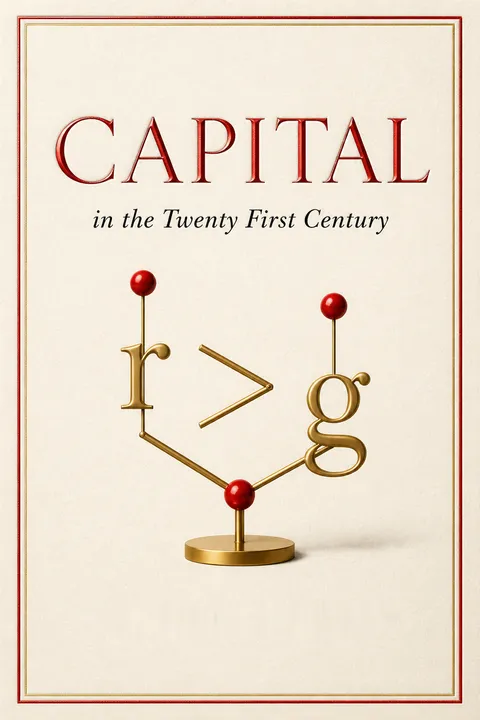
The central pressure is r > g. Here, r means the average annual return on capital, including rents, dividends, interest, and profits; g means the economy's growth rate. When r persistently exceeds g, wealth already accumulated grows faster than income from work and output. Owners need not spend all their capital income: reinvesting even a portion can make their fortunes pull ahead of the economy.
History supplies the warning. In nineteenth-century France and Britain, the return on capital was often around 4 to 5 percent while growth was near 1 percent. Inheritance therefore gained weight, helping create societies where family wealth could matter more than a lifetime of work. The relation is a powerful tendency, not a law that makes policy or history irrelevant.
The equation is memorable because it translates a technical relationship into a social question: who owns claims on future production? It also links economic growth to political legitimacy. If past wealth compounds faster than most people can earn, a society may formally reward merit while materially rewarding inheritance. Yet r and g are averages, and returns vary with risk, taxes, and portfolio size. The formula identifies pressure toward divergence; it does not, by itself, predict the exact distribution or prove that every fortune is undeserved.
Use savings and growth to estimate how much capital society accumulates
The long-run ratio has a simple guide. The capital/income ratio compares the value of a country's wealth with one year's national income. Piketty's second fundamental law of capitalism states that, over time, this ratio tends toward the savings rate divided by the growth rate: β = s/g. A country saving 12 percent of income while growing at 2 percent tends toward capital worth six years of income.
Low growth magnifies the past. With the same savings rate but growth of 1 percent, the ratio tends toward twelve years of income. The law describes a long-run destination, not a short-term forecast. Wars, asset-price swings, public policy, and natural resources can all interrupt or alter the path.
This is a useful bridge between household behavior and national structure. A modest annual saving rate can build an immense stock when growth is slow, much as a small flow fills a reservoir if the outlet is narrow. The model also clarifies why demographic trends matter: slower population growth lowers total growth and can raise the relative weight of accumulated wealth. Its limitation is equally useful to remember. The ratio does not reveal who owns the stock, and market valuations can move sharply without new saving.
Do not mistake wartime destruction for capitalism's natural equalizer
The twentieth-century reset was violent. In France and Britain, national capital stood around six to seven years of income before World War I, then fell to roughly two to three years by the 1950s. The decline reflected not only physical destruction but also bankruptcies, lost foreign assets, inflation, low saving, nationalization, rent controls, and other policy changes.
The distribution changed with it. In France, the top decile's share of national income fell from about 45 to 50 percent before World War I to roughly 30 to 35 percent after World War II. The fall was concentrated in high incomes from capital. These shocks were not a peaceful consequence of competition or technological progress, and the resulting lower inequality was not guaranteed to last.
The historical distinction between structural change and catastrophe matters for present policy. A society can become more equal because assets are destroyed, fortunes are taxed, or inflation erodes claims, but those mechanisms carry enormous human costs. This section challenges the comforting idea that markets naturally correct extreme concentrations. It also invites a more careful question: which deliberate institutions can reduce inequality without requiring crisis as the instrument? Historical explanation is not an endorsement of the events that produced the outcome.
Measure wage inequality and wealth inequality as separate problems
Different assets, different hierarchies. Across the societies Piketty studies, wealth is more concentrated than labor income. The top 10 percent typically receive about 25 to 35 percent of wages, while the bottom half receives roughly a quarter to a third. By contrast, the bottom half of the wealth distribution owns little or nothing, often less than 5 percent of total wealth.
A middle class changed the picture. Around 1900, the wealthiest 10 percent in France and Britain owned close to 90 percent of wealth. By 2010, a patrimonial middle class, the middle 40 percent of the wealth hierarchy, owned roughly a quarter to a third. This was a real transformation, even though wealth remained highly concentrated and the poorest half gained little.
Separating these distributions prevents a common analytical mistake: assuming that a fairer wage structure automatically means a fairer society. Wealth brings security, bargaining power, and the option not to work, so its concentration has consequences beyond annual income. The rise of a property-owning middle class is significant, but it should not be confused with broad ownership. The poorest half still has scant protection against shocks. A fuller account of opportunity therefore needs both labor-market data and balance-sheet data.
Test executive pay claims against bargaining power, not productivity alone
The United States is a distinctive case. Since the 1970s, the top decile's share of US income rose from roughly 30 to 35 percent to about 45 to 50 percent. The top 1 percent captured close to 60 percent of the total income growth between 1977 and 2007. Much of this increase came from soaring pay for senior executives, rather than from a broad rise across all skilled workers.
Productivity is hard to measure at the top. In a large corporation, no one can precisely calculate one executive's contribution to total output. Piketty argues that social norms, compensation committees, and executives' bargaining power help determine pay. The fact that top salaries rose much more in the United States and Britain than in continental Europe also suggests that institutions matter.
This argument connects inequality to the principal-agent problem: those who set compensation may also benefit from the decision, while outsiders cannot easily measure individual contribution. That makes governance and norms economically consequential, not merely cultural decoration. Still, bargaining power is difficult to quantify, and it should not become a catch-all explanation that dismisses real differences in skill or responsibility. The strongest interpretation is plural: technology shapes the range of possible rewards, while institutions and tax rules influence where within that range compensation settles.
Expand education, but pair it with institutions that shape wages
Skills matter, but they do not set every wage. A race between education and technology helps explain long-run pay differences: when demand for a skill grows faster than the supply of trained workers, its wage rises. Broader access to high-quality education can raise productivity and reduce skill-based inequality. Yet France's wage hierarchy remained fairly stable over the long run despite major educational expansion.
Rules can change the distribution quickly. France's 1968 Grenelle Accords raised the minimum wage by about 20 percent, and its purchasing power rose sharply through 1983. The US minimum wage followed a different path, falling in real terms after its 1969 peak. These cases show that wage schedules and labor-market institutions shape who receives growth, alongside schooling and technology.
Education is a powerful equalizer of capabilities, but it is not a self-executing equalizer of income. The same credentials can be rewarded differently under different wage-setting institutions, and access to elite training may remain socially patterned. This is a useful connection between human-capital theory and institutional economics: skills influence productivity, while bargaining rules determine how productivity gains are divided. The challenge is to improve educational access without treating it as a substitute for fair wage floors or for scrutiny of compensation at the top.
Track inheritances: they can return even when fortunes look modern
Inheritance did not disappear. In France, the annual flow of bequests and gifts was about 20 to 25 percent of national income in the nineteenth century, fell to roughly 4 to 5 percent in the 1950s, and climbed to about 15 percent by 2010. This flow measures wealth transferred each year, not the total stock of inherited assets.
The composition of wealth changed the timing. Longer lives delayed inheritances, but older people also held a larger share of wealth, while gifts to children grew more common. For people born in the 1910s, inheritance supplied less than 10 percent of lifetime resources; for cohorts born around the 1970s, it was again roughly one-quarter. Modern careers and financial products did not erase the family balance sheet.
The distinction between annual flows and accumulated stocks is crucial: a quiet year of inheritance does not mean inherited wealth has vanished. Demography can delay transfers while making them larger, and lifetime averages conceal sharp differences between recipients and nonrecipients. The comparison also complicates simple stories of meritocracy. Yet inheritance is not the only source of advantage: education, networks, and family support can transfer opportunity without appearing as a bequest. A complete account of mobility must follow both money and less visible forms of assistance.
Large fortunes can compound faster because size buys better investment access
Returns are not equal for everyone. Forbes rankings suggest that the largest fortunes grew much faster than average wealth from 1987 to 2013. University endowments offer clearer evidence: US endowments averaged an 8.2 percent real annual return from 1980 to 2010, while those under $100 million averaged 6.2 percent. Harvard, Yale, and Princeton averaged about 10.2 percent.
Scale changes the investment menu. Large portfolios can pay for specialized managers and access to alternative investments unavailable to ordinary savers. This can compound inequality beyond the basic gap between returns and growth. Endowments are not identical to family fortunes, and the exact return advantage is uncertain, but the data show why initial wealth can matter even when everyone faces the same headline market.
This is a concrete illustration of cumulative advantage: wealth can buy expertise, diversification, and access, which in turn generate more wealth. The mechanism resembles economies of scale in firms, but it has a distributive consequence because capital ownership is already concentrated. The comparison should be handled carefully: universities have different goals, tax treatment, and investment horizons from households. Even so, the evidence makes a strong case that average returns are not a neutral constant across the wealth hierarchy.
Treat public debt as a choice about who pays, and when
Debt redistributes across groups and generations. Britain carried public debt near twice annual national income after the Napoleonic wars and reduced it over roughly a century, largely through sustained budget surpluses and interest payments to bondholders. France and Germany later used high inflation to shrink public debt, shifting losses toward holders of nominal assets. Neither route was distributionally neutral.
Austerity is not the only option. Governments can reduce debt through taxes, inflation, spending cuts, or growth, and each choice affects different people. Piketty favors transparent debate over treating public debt as a household bill that simply must be repaid. The key question is who owns the debt, who pays taxes, and which public investments are sacrificed.
Public debt is a claim held by someone, not a weight that falls evenly on an abstract nation. This connects fiscal policy to balance-sheet analysis: the debtor and creditor may belong to different income groups, so repayment can redistribute wealth upward or downward. Inflation can reduce debt quickly, but it also obscures who bears the cost and may harm small savers. The chapter's strongest implication is procedural: debt policy needs public information about ownership, not just headline debt-to-GDP ratios.
Tax large fortunes transparently before wealth escapes democratic control
Progressive taxation is a governing tool. The book proposes an annual tax on capital, with rates rising by wealth level, backed by automatic sharing of bank information. The goal is not to abolish private property but to slow extreme accumulation, make wealth visible, and fund public needs. Even a European tax could be a step toward a global system; without coordination, tax havens and competition among states weaken national efforts.
The proposal faces real trade-offs. A capital tax must value assets fairly, protect ordinary savings, and avoid arbitrary treatment of different investments. Piketty also warns that the social state needs modernization, especially in education and pensions. A tax on wealth is not a magic fix, but it offers a more direct response to concentrated capital than relying on inflation or repeated crises.
The proposal is strongest as an institutional design principle: make large fortunes legible to democratic governments, then debate their taxation openly. That connects public finance to information infrastructure, not just rates and revenue. The difficult questions are implementation and legitimacy: valuation across borders, enforcement, and coordination among states are substantial obstacles. A regional start may be more feasible than a truly global tax. The alternative, however, is not neutral: opaque ownership leaves public choices vulnerable to private wealth and weakens trust in taxation.
Analysis
The book's deepest contribution is not a forecast that inequality must rise, but a framework for separating forces that are often blurred together. Growth, the return on capital, the distribution of wages, the distribution of wealth, and the institutions that tax or regulate them move on different clocks. Treating them as one story invites false conclusions: rising average income does not guarantee falling inequality, and a decline in the capital-income ratio does not prove that inherited wealth has lost social importance.
The equation r > g is powerful because it makes a political problem mathematically legible. When returns on accumulated assets exceed economic growth, past claims expand faster than the economy that supports them. But this is a pressure, not destiny. Wars, inflation, taxes, laws of inheritance, education systems, and wage-setting institutions alter the path. The evidence therefore supports neither market fatalism nor the belief that a single policy can engineer equality. It supports institutional analysis grounded in historical data.
The book is also strongest when it connects measurement to democratic legitimacy. Income tax records, estate records, and national accounts are not neutral windows; their coverage reflects what governments choose to see. When wealth can move across borders faster than public statistics, arguments about fairness are easily captured by anecdote, ideology, or the interests of those best able to hide assets. Better information is itself a form of political capacity.
A limitation is that long historical series are richest for France, Britain, and a few other advanced economies. The global claims are illuminating but necessarily less secure, especially where tax systems and household data are weak. The proposed capital tax is best read as a direction of travel, not a ready-made blueprint. Its enduring challenge is to reconcile democratic control with international mobility, while protecting productive investment and making concentrated ownership answerable to the societies that sustain it.
Review Summary
Capital in the Twenty-First Century receives mixed reviews, with many praising its comprehensive data analysis on wealth inequality and historical context. Critics argue it oversimplifies complex economic issues and proposes unrealistic solutions. Readers appreciate Piketty's clear writing style and use of literary references, but some find the book dense and repetitive. While some view it as groundbreaking, others see it as flawed in its assumptions and predictions. The book has sparked significant debate on economic inequality and potential policy responses.
People Also Read







Glossary
r > g
Returns outpace economic growthA shorthand for the condition in which the average return on capital, r, exceeds the economy's growth rate, g. When sustained, wealth accumulated in the past can grow faster than income and output, allowing inherited fortunes to gain relative importance. It describes a force toward divergence, not an unavoidable outcome, because taxes, shocks, and institutions can alter the result.
Capital/income ratio
Wealth compared with annual incomeThe value of a country's total capital stock divided by one year's national income. It is commonly expressed as years of income: a ratio of six means that national wealth equals six years of national income. The ratio measures the overall weight of accumulated wealth, but it does not reveal how that wealth is distributed among people.
First Fundamental Law of Capitalism
Links capital's share to its returnThe accounting identity α = r × β connects capital's share of national income, α, to the average rate of return on capital, r, and the capital/income ratio, β. For example, if capital equals six years of income and returns 5 percent annually, capital receives 30 percent of national income. The identity describes a relationship, not the causes of its variables.
Second Fundamental Law of Capitalism
Links wealth to saving and growthThe long-run relation β = s/g says that the capital/income ratio tends toward the net saving rate, s, divided by the growth rate, g. A high saving rate and low growth therefore imply a larger capital stock relative to income. It is an asymptotic relationship: it takes time to approach, and shocks or changing asset prices can interrupt it.
National income
Income accruing to a country's residentsThe total income available to residents of a country during a given year, regardless of where it was produced. It equals domestic output after capital depreciation, plus net income received from abroad. National income can differ from GDP when a country receives substantial profits, interest, or rents from foreign assets, or pays such income to foreign owners.
Inheritance flow
Annual transfers of accumulated wealthThe total value of bequests and gifts transferred during a year, usually expressed as a share of national income. It measures the yearly movement of wealth between generations, not the total stock of inherited wealth. Its size depends on the capital stock, mortality, and the relative wealth of people who die or make gifts.
Social state
Publicly financed social protectionsThe modern state that finances broad public services and replacement incomes, especially education, health care, pensions, and unemployment support. Its expansion in the twentieth century raised taxation to a much larger share of national income. The term emphasizes collective rights and public provision, while leaving open how services should be organized or funded.
World Top Incomes Database
Historical database of top incomesA collaborative research database compiling long-run income distribution estimates from tax records and national accounts across many countries. It extends earlier work by Simon Kuznets and enables comparisons of top income shares over time. Coverage and source quality vary by country, so the database is powerful for identifying patterns but does not eliminate gaps or measurement uncertainty.
FAQ
What's Capital in the Twenty-First Century about?
- Focus on Inequality: The book examines the dynamics of wealth and income inequality over the last three centuries, particularly in developed countries.
- Historical Analysis: Piketty provides a comprehensive historical analysis, highlighting how wealth distribution has evolved, especially in Europe and the United States.
- Key Concepts: It introduces critical concepts such as the capital/income ratio and the relationship between the rate of return on capital (r) and economic growth (g).
Why should I read Capital in the Twenty-First Century?
- Timely and Relevant: The book addresses contemporary issues of wealth inequality and economic disparity, making it highly relevant in today's socio-economic climate.
- Extensive Research: Piketty's work is based on fifteen years of research and extensive historical data, providing a well-rounded perspective on capital and income dynamics.
- Influential Ideas: It has sparked significant debate among economists, policymakers, and the public regarding the future of capitalism and inequality.
What are the key takeaways of Capital in the Twenty-First Century?
- Inequality is Persistent: Piketty argues that inequality is a fundamental characteristic of capitalism, especially when the return on capital outpaces economic growth.
- Historical Context Matters: The book emphasizes the importance of historical data in understanding current economic conditions and predicting future trends.
- Need for Regulation: Piketty advocates for policies that can help mitigate inequality, such as a global tax on wealth and reforms in taxation systems.
What are the best quotes from Capital in the Twenty-First Century and what do they mean?
- "Social distinctions can be based only on common utility.": This highlights that social hierarchies should be justified by their contribution to the common good.
- "When the rate of return on capital exceeds the rate of growth of output and income, capitalism automatically generates arbitrary and unsustainable inequalities.": Piketty warns that unchecked capitalism can lead to significant wealth disparities.
- "The history of the distribution of wealth has always been deeply political.": This emphasizes that economic systems and wealth distribution are influenced by political decisions and power dynamics.
How does Piketty define capital in Capital in the Twenty-First Century?
- Nonhuman Assets: Piketty defines capital as the total of nonhuman assets that can be owned and exchanged, excluding human capital.
- Types of Capital: This includes real estate, financial assets, machinery, and intellectual property, all contributing to wealth generation.
- Market Value: Capital is measured by its market value, which can fluctuate based on economic conditions and societal changes.
What is the capital/income ratio in Capital in the Twenty-First Century, and why is it important?
- Definition: The capital/income ratio (β) is the total stock of capital divided by the annual flow of income, indicating how much capital exists relative to income generated.
- Economic Implications: A higher capital/income ratio suggests a greater reliance on capital for income generation, which can lead to increased inequality.
- Historical Trends: Piketty shows that this ratio has fluctuated significantly over time, reflecting changes in economic conditions and policies.
What does Piketty mean by the "first fundamental law of capitalism"?
- Formula Explanation: The first fundamental law states that capital's share of income (α) is equal to the rate of return on capital (r) multiplied by the capital/income ratio (β): α = r × β.
- Accounting Identity: This relationship is a tautological accounting identity that holds true across all societies and periods.
- Implications for Inequality: Understanding this law helps analyze how changes in the rate of return and capital accumulation affect income distribution.
How does Capital in the Twenty-First Century address the issue of public debt?
- Historical Context: Piketty discusses how public debt levels rose significantly during the two world wars and how inflation helped reduce these debts postwar.
- Public vs. Private Wealth: He emphasizes that public wealth has historically been much lower than private wealth, with public debt often exceeding public assets.
- Policy Implications: The book suggests that managing public debt effectively is crucial for ensuring economic stability and addressing inequality.
How does Piketty's analysis of historical data inform his conclusions in Capital in the Twenty-First Century?
- Long-term Perspective: Piketty uses extensive historical data to illustrate trends in wealth and income distribution, showing that current inequalities have deep historical roots.
- Comparative Analysis: By comparing different countries and time periods, he highlights how various economic and political systems have influenced wealth distribution.
- Lessons for the Future: The historical context provides insights into potential future trends and the importance of policy interventions to address inequality.
What are the implications of Piketty's findings for modern capitalism?
- Need for Regulation: Piketty argues that without intervention, capitalism is likely to lead to increasing inequality, undermining democratic values and social cohesion.
- Global Tax on Capital: He proposes a progressive global tax on wealth as a potential solution to address the disparities created by capital accumulation.
- Rethinking Economic Policies: The book calls for a reevaluation of current economic policies and tax systems to ensure a more equitable distribution of wealth and income.
How does Piketty propose to combat inequality in Capital in the Twenty-First Century?
- Progressive Tax on Capital: Piketty advocates for a global tax on wealth to address growing disparities and ensure a fairer distribution of resources.
- International Cooperation: He emphasizes the need for countries to work together to implement such a tax effectively, as wealth is often held in offshore accounts.
- Reforming Democratic Institutions: Piketty argues that reforms in democratic institutions are necessary to regain control over capitalism and address structural causes of inequality.
How does Capital in the Twenty-First Century relate to current economic issues?
- Relevance to Modern Inequality: The book provides a framework for understanding current trends in wealth and income inequality, making it highly relevant to contemporary discussions.
- Policy Implications: Piketty's recommendations for progressive taxation and wealth redistribution resonate with current debates on economic policy and social justice.
- Global Perspective: The book's analysis extends beyond national borders, addressing the global nature of wealth inequality and the need for international solutions.
About the Author




Download PDF
Download EPUB
.epub digital book format is ideal for reading ebooks on phones, tablets, and e-readers.








