

Key Takeaways
Treat inequality as political design, not an economic law
Rules tell a story. Piketty’s central claim is that inequality is not simply produced by markets or technology. An inequality regime is the linked set of ideas and institutions that organizes and justifies differences in wealth, income, education, and power. Every society builds a story about why its arrangement serves the common good, from medieval claims that social groups perform complementary roles to modern faith in merit and entrepreneurship.
History exposes choices. Since 1980, income inequality has increased across most regions, but by very different amounts. In 2018, the top 10 percent received 34 percent of income in Europe and 48 percent in the United States. Such variation shows that societies facing similar technologies can choose different laws, taxes, and educational systems.
The argument connects political economy to the sociology of legitimacy: institutions endure not only through force, but because enough people see them as acceptable. That makes measurement politically consequential. A society cannot debate whether inequality is useful if its categories hide who owns what. The claim should not be stretched into saying material conditions do not matter. Resources and technology constrain choices, but they do not dictate one inevitable distribution.
Track borders and property together to see who belongs and who commands
Two questions shape inequality. Piketty argues that every regime answers who belongs to the political community and what people may own. These border and property rules determine who receives rights, who controls resources, and how inequality is reproduced. In premodern trifunctional society, clergy, nobility, and workers occupied different roles, while local rulers often controlled both land and the people working it.
The state changes the map. Modern ownership society separated private property from public authority. The French Revolution’s Great Demarcation transferred justice and security to a centralized state while declaring private ownership a universal right. Yet national borders still shape access to social rights, and property remains a source of political power. The historical sequence matters because today’s arrangements are not natural or permanent.
The paired lens is useful because policy debates often treat migration and redistribution as separate subjects. In practice, membership rules determine who can claim public services, while ownership rules determine who can influence the institutions that provide them. This resembles the distinction between legal citizenship and economic citizenship. The framework also raises a hard question: a wider political community can support wider solidarity, but its boundaries cannot simply be wished away.
Abolishing privilege did not redistribute property automatically
The Revolution drew a boundary. In 1789, French lawmakers sought to abolish feudal privileges and separate public powers from private ownership. But they often preserved existing claims once these could be recast as contracts. Peasants could be required to redeem old dues at prices they could not afford. The state gained control of justice and property records, while many former privileges survived as rents.
Concentration returned. The Revolution debated progressive taxes and inheritance reform, yet adopted a largely proportional tax system. The result was not a broadly shared ownership society. In France, the top 1 percent held about 45 percent of private property in 1800 to 1810 and nearly 55 percent by 1900 to 1910. In Paris, the top decile owned over 90 percent of wealth before World War I.
This episode illustrates a recurring institutional problem: abolishing an unjust rule is easier than deciding what should replace it. A legal system can remove titles and privileges while preserving their economic effects under new language. The lesson is not that revolutions are futile, but that formal equality needs a plan for the initial distribution of assets. Otherwise, old concentrations can reappear behind formally universal rights.
Abolition often compensated owners while leaving the enslaved without repair
Property law chose its beneficiaries. When Britain abolished slavery in 1833, the government paid slaveholders an indemnity worth about 5 percent of national income. Enslaved people received no compensation. France’s 1848 abolition also compensated owners, while former slaves faced labor controls designed to keep plantation work cheap. The American Civil War ended slavery without compensating owners, but it also failed to provide the promised land to freed people.
Haiti paid for freedom. In 1825, France demanded 150 million gold francs from Haiti to compensate former slaveholders. The debt exceeded three times Haiti’s annual income and was not fully repaid until the mid-twentieth century. These cases show how ownership claims survived moral and political upheaval, while the people whose labor created the wealth were denied comparable claims.
The cases expose a deep asymmetry in what governments recognize as a loss. Property owners had legible claims, legal advocates, and political influence; enslaved people had endured harm that the law had long refused to count. The comparison also connects reparations to debt policy: obligations imposed by force can be recorded as legitimate finance. A serious account of justice must ask whose losses institutions measure, not only whose assets they protect.
Expose colonial extraction behind the language of civilization
Budgets reveal priorities. Colonial governments often claimed to bring education and development, yet their taxes largely financed administration and order for the colonizers. In Morocco in 1925, schools reserved for Europeans received 79 percent of education spending while Europeans made up only 4 percent of the population. In French colonies, just two civil servants served every 1,000 residents, but each was paid roughly ten times average local income.
Coercion outlasted slavery. Forced labor and unequal legal systems continued after formal abolition. French colonial authorities maintained compulsory labor practices until 1946. In some colonies, education for native children remained minimal even as colonial budgets were balanced, because taxes paid by the colonized primarily supported the colonial apparatus. These arrangements shaped modern inequality within countries and between former colonies and their rulers.
The section links public finance to political legitimacy: a balanced budget says little about whether spending serves the taxed population. Similar questions arise today whenever governments describe investment as universal while allocating services unevenly. The colonial comparisons are powerful, though surviving records are uneven and categories were often created by the authorities themselves. Those records need contextual reading, not blind acceptance, but they still reveal whose interests counted.
Keep globalization’s poverty gains, but stop its growth pooling at the top
Global gains were uneven. The elephant curve tracks income growth for groups across the global distribution between 1980 and 2018. People in the second, third, and fourth deciles gained as Asian economies grew, while the global middle saw less progress and the richest gained most. The top 1 percent captured 27 percent of global income growth, compared with 12 percent for the bottom 50 percent.
The policy choice remains open. Piketty argues that globalization reduced inequality between some poorer and richer populations while increasing inequality between the global middle and the top. Both facts matter. The top 1 percent’s fortunes grew three to four times faster than the global economy from 1980 to 2018. The question is not whether to reject trade, but how to preserve poverty reduction while changing who captures the gains.
The distributional view is more informative than a single inequality score because it shows which groups gained and which were left behind. It also cautions against two easy stories: globalization did not help everyone equally, but neither did it simply enrich the already rich at the expense of every poor household. The unresolved challenge is institutional: trade can widen opportunity, yet without shared rules, mobile capital bargains from a stronger position than workers.
Tax extreme incomes and inheritances before wealth hardens into dynasties
Progressivity changed the trajectory. From 1932 to 1980, the average top marginal income tax rate was 81 percent in the United States and 89 percent in the United Kingdom. Such rates did not destroy capitalism. They helped limit the concentration of income and fortunes, alongside inheritance taxes, nationalizations, inflation, and wartime losses. In France, the middle 40 percent’s share of wealth rose from less than 15 percent before World War I to about 40 percent today.
The reversal mattered. Since the 1980s, top tax rates have fallen sharply, while income and wealth inequality have risen. Piketty argues that progressive taxes are not only a way to raise revenue; they also reduce the ability of large fortunes to reproduce themselves indefinitely. The historical evidence suggests that high growth and steeply progressive taxes can coexist.
This history challenges the claim that top tax rates necessarily suppress productive activity. One plausible mechanism is that high marginal rates weaken incentives to bargain for exceptionally large compensation without eliminating ordinary rewards for innovation. The evidence is not a controlled experiment: wars, reconstruction, and institutional change also mattered. Still, it undermines confident claims that low taxes on the very rich are a prerequisite for prosperity.
Give workers governing power, not merely a share of profits
Co-management shares decisions. In Germany, workers in large firms gained half the seats on supervisory boards in major sectors, and one-third in many other large firms. Sweden and neighboring countries adopted related systems. These arrangements give employees access to information and a voice in long-term strategy, unlike profit-sharing alone, which can leave decision-making power untouched.
The experiment remains unfinished. Co-management emerged from union struggles and political compromise, not from a natural consensus among owners. It has been associated with restrained executive pay and sustained productivity, but workers often lack a decisive vote when shareholders and employees disagree. Piketty argues that public ownership, worker power, and progressive taxation can complement one another rather than serve as mutually exclusive routes beyond shareholder control.
Co-management treats the firm as a community of long-term stakeholders rather than simply a bundle of assets owned by investors. That approach fits research on organizational commitment: workers who can influence decisions have more reason to invest knowledge and effort. But representation alone does not guarantee power. The crucial design questions concern voting rights, access to information, and whether worker voice applies to smaller firms as well as large corporations.
Fund broad education before meritocracy turns credentials into inherited privilege
Higher education changed the contest. The United States once led in universal primary and secondary schooling, helping it gain a productivity advantage over Europe. Later, mass university education created new inequalities. In 2014, about 30 percent of young adults from the poorest US families entered higher education, compared with roughly 90 percent from the richest families. France, despite low tuition, also directs substantially more public spending per student to elite tracks than to ordinary ones.
Equal access needs more than slogans. As education expanded, social-democratic parties often celebrated merit while leaving admissions, school quality, and financing highly unequal. The resulting gap between opportunity rhetoric and family background helped turn parties once supported by workers into parties of educated voters. Fairness requires transparent rules and adequate resources for disadvantaged students, not merely declaring that winners earned their place.
Education is both a public good and a sorting institution. When it expands without equalizing access, it can convert inherited advantage into credentials that appear personally earned. This dynamic helps explain why educational expansion alone does not dissolve class divisions. The challenge is not to make every course identical, but to prevent family wealth from controlling access to the most valuable pathways.
Rebuild coalitions around class before identity politics fills the vacuum
The old alignment broke. From 1950 to 1980, less educated, lower-income, and less wealthy voters often supported the same left parties. By 1990 to 2020, the left had become more attractive to highly educated voters, while wealthy voters increasingly backed market-oriented parties. In France in 2017, the electorate divided among four blocs with different views of redistribution and immigration.
Social nativism exploits the split. This term describes a politics that offers social protection to a favored native group while excluding immigrants or minorities. It can attract voters who feel abandoned by both pro-market elites and educated progressives. The result is not an inevitable return to class politics or a fixed cultural destiny; it is a contest over whether diverse disadvantaged groups can see a shared interest in fairer institutions.
The analysis usefully separates two dimensions that are often collapsed: economic redistribution and political membership. A coalition can be egalitarian within a favored group while remaining hostile to outsiders. That pattern is not unique to one country, and treating it as mere irrationality misses the policy failures it feeds on. Yet the class explanation should not erase genuine discrimination or religious conflict, which also shape political choices.
Learn from communism without treating markets as the only alternative
State ownership had limits. Soviet leaders abolished private ownership of major production, but never built a workable, decentralized account of who should decide what to produce. By 1953, more than 5 percent of Soviet adults were imprisoned, many for taking small amounts of state property. The failure was not proof that every form of equality was impossible; it showed the danger of concentrating economic power in an unaccountable state.
Postcommunism chose another extreme. Russia’s rapid privatization helped create oligarchs, while its flat 13 percent income tax abandoned progressivity. China took a different path: by the mid-2000s, public capital stabilized near 30 percent of total national capital, with the state still owning about 55 percent of firm capital. Neither model settles how to combine private initiative with democratic control and social equality.
The comparison rejects a false binary: total state ownership versus unrestricted private ownership. A decentralized system needs room for individual initiative, but it also needs limits on concentrated power and institutions capable of enforcing them. China’s mixed economy shows that ownership forms can coexist, though opacity and political centralization make it difficult to assess who benefits. The deeper test is whether citizens can contest the rules.
Pair wealth circulation with democratic institutions across borders
A participatory alternative. Piketty’s participatory socialism combines worker representation in firms with temporary private ownership, meaning large fortunes are taxed progressively and wealth circulates rather than passing intact through generations. One illustrative plan would use annual wealth and inheritance taxes to fund each 25-year-old with capital worth about 60 percent of average adult wealth. Progressive income taxes would finance health, education, pensions, and a basic income.
Democracy must match the economy. Because capital and climate risks cross borders, Piketty proposes social federalism: shared democratic institutions able to coordinate taxes, migration, and environmental policy. This is not a finished blueprint; it is a direction for public experimentation. The aim is to make economic integration answerable to citizens, rather than allowing market rules to outrun the institutions meant to govern them.
The proposal joins three problems often discussed separately: concentrated wealth, unequal power inside firms, and weak democratic control of globalization. Its strongest feature is that it specifies institutions rather than simply calling for capitalism’s abolition. Its hardest questions are administrative and political: valuing assets, preventing evasion, and winning consent across borders. These are not reasons to dismiss the program, but they are the work that would determine whether it is viable.
Analysis
The book’s most powerful move is to treat inequality as a regime rather than a number. The same distribution of income can rest on very different institutions: status hierarchy, racial domination, private ownership, or a social state. That historical framing makes policy choices visible and weakens claims that current arrangements are economically inevitable. It also explains why Piketty moves from medieval social orders to modern electoral behavior: ideas about property and membership shape both the economy and the coalition capable of changing it.
The argument is strongest when it links measurable shifts to institutional mechanisms. Progressive taxation, inheritance rules, education spending, and worker representation are concrete levers, not abstract appeals to fairness. The comparison between European social democracy and American inequality also makes a persuasive case that reduced concentration need not suppress growth. The evidence is less decisive when it assigns causal weight among war, mobilization, taxation, and institutional change. These forces interacted, and the historical record cannot isolate them as cleanly as policy debate often demands.
A further tension concerns state capacity. The book rightly rejects both sacred private property and total state ownership, but its proposed alternatives depend on governments that can measure wealth, enforce taxes, and earn trust. Those capacities are themselves unequal across countries and vulnerable to capture. A progressive tax written into law is not automatically progressive in practice; opacity and selective enforcement can recreate privilege under new rules.
The most useful contemporary implication is therefore procedural as well as distributive: make economic information public, make institutions contestable, and let citizens see who pays and who benefits. Without transparency, egalitarian programs lose credibility. Without credible redistribution, identity conflict becomes an easier political language than shared material interests. The book offers no painless escape from that dilemma, but it shows why history, rather than fatalism, is the proper place to begin.
Review Summary
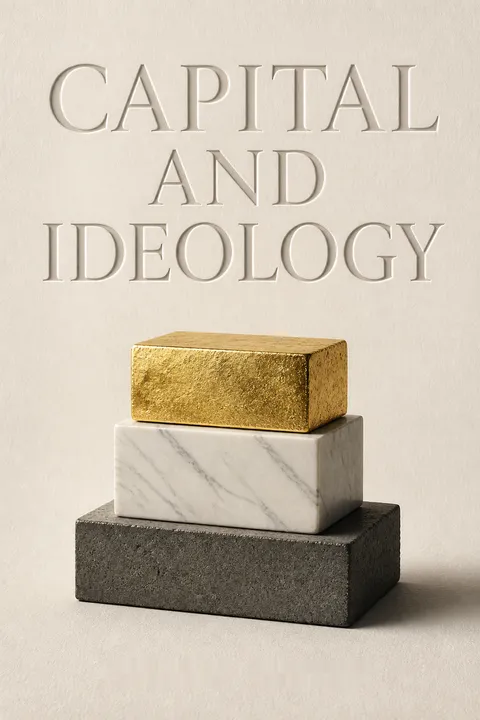
Capital and Ideology by Thomas Piketty examines inequality throughout history, analyzing how different societies have justified economic disparities through ideology. The 1,100-page work spans from medieval trifunctional societies to modern hyper-capitalism, using extensive data and historical analysis. Reviewers praise Piketty's ambitious scope and thorough research covering Europe, Asia, and the Americas, though some criticize the book's length and redundancy. The final chapters propose "participatory socialism" with progressive wealth taxes, co-management, and transnational cooperation. Most readers find it intellectually stimulating and thought-provoking, despite debates over its policy recommendations.
People Also Read








Glossary
Inequality regime
Institutions justifying inequalityA set of discourses and institutional arrangements that justify and structure economic, social, and political inequalities in a society. It includes more than income distribution: political rules, property rights, education, and taxation all help determine who holds resources and power, and how those arrangements are understood as legitimate.
Trifunctional society
Clergy, warriors, workersA premodern social order organized around three roles: a clerical or intellectual group that provides spiritual guidance, a warrior nobility that maintains security, and a laboring population that produces goods. The arrangement was often presented as serving the whole community, while in practice it joined property ownership to local political and judicial power.
Proprietarianism
Sacred defense of propertyA political ideology that treats private property as a universal right and a foundation of social stability. It arose as European societies moved away from inherited orders and local lordship. Its emancipatory promise was equal legal access to ownership; its central danger was treating existing property, however acquired or concentrated, as beyond peaceful challenge.
Great Demarcation
State power versus private propertyThe French Revolution’s attempt to separate public authority from private property. Justice, security, and legitimate force were assigned to the centralized state, while property rights were assigned to individuals and protected by law. The distinction transformed political institutions, but many former dues survived as rents and wealth remained concentrated.
Elephant curve
Global growth by income groupA chart tracking income growth for different percentiles of the global income distribution from 1980 to 2018. It shows substantial gains for some people in poorer countries and for the very richest, while much of the global middle saw less growth. The curve helps separate changes between global groups from changes within countries.
Co-management
Workers share board powerA system in which employees elect representatives to a firm's governing board, giving workers formal access to information and a role in strategic decisions alongside shareholders. Germany and several Nordic countries developed versions of co-management after World War II. The exact voting power varies, and worker representation does not always give employees the decisive vote.
Brahmin left
Educated voters' left coalitionPiketty’s term for the transformation of left-wing parties from coalitions supported most strongly by less educated workers into parties that attract highly educated voters. The phrase highlights education as a distinct dimension of social hierarchy. It does not mean that every educated voter is wealthy or that class and income cease to matter.
Social nativism
Welfare for favored nativesA political strategy that combines social or redistributive promises for a favored native population with exclusion or hostility toward immigrants and minorities. It can appeal to voters who feel abandoned by market-oriented elites while redirecting economic grievances toward identity and membership. The term describes a coalition, not an inevitable attitude among disadvantaged voters.
Temporary ownership
Property that must circulateThe idea that private ownership can remain legitimate while being limited over time by progressive taxes on wealth and inheritance. The revenue can be redistributed, including through a capital endowment for young adults. The aim is to prevent large fortunes from reproducing indefinitely and to broaden access to economic power without abolishing all private property.
Participatory socialism
Shared economic powerPiketty’s proposed alternative to both unrestricted capitalism and highly centralized state ownership. It combines worker participation in firm governance, progressive taxation of wealth and income, wider access to education, and mechanisms that circulate property. The term emphasizes democratic participation and institutional experimentation rather than a single fixed model.
Social federalism
Cross-border democratic solidarityA form of political cooperation in which democratic institutions coordinate social, fiscal, and environmental policy across national borders. It aims to make economic integration answerable to citizens rather than leaving countries to compete through lower taxes and weaker protections. Piketty presents it as a direction for reform, not an already established system.
About the Author



Download PDF
Download EPUB
.epub digital book format is ideal for reading ebooks on phones, tablets, and e-readers.








