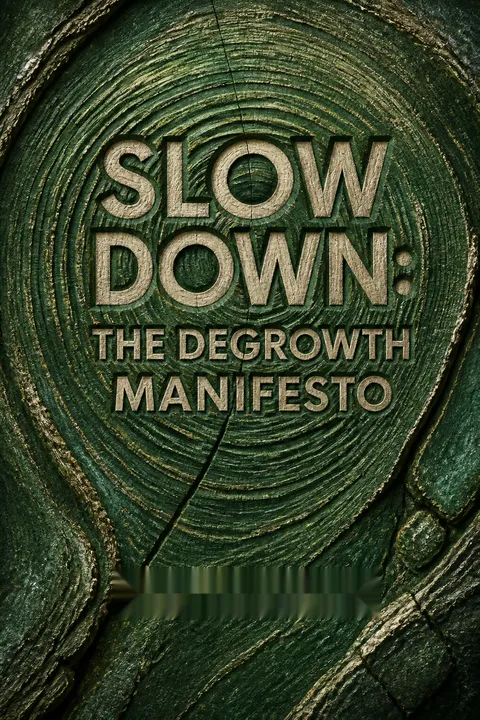


Key Takeaways
Treat climate action as a fight over who controls production
A business owner’s dilemma. After a lecture on climate change in Japan, a small-business owner asked Saitō what to do with his company, whose products contributed to environmental damage. Saitō’s answer was not to seek a greener brand or a better personal shopping habit. He suggested transferring the business to its employees, or ending its operations. The exchange captures the book’s central argument: climate change cannot be solved by individual virtue alone when the economic system rewards ever-expanding production and profit.
Change the system underneath. Saitō argues that capitalism’s growth imperative drives resource extraction, exploitation, and emissions. His proposed alternative, degrowth communism, is a democratic economy organized around meeting needs while reducing unnecessary production and material use. The goal is not simply a smaller economy, but a different logic for deciding what gets made, by whom, and for whose benefit.
The opening story makes a large political claim tangible: a company is not merely a bundle of products, it is also a structure of ownership and decision-making. That distinction points toward practical levers, including worker ownership, public procurement, and investment rules, rather than treating sustainability as a consumer preference. The challenge is that shifting ownership alone does not automatically make a business ecologically sound. Cooperatives can still face pressure to grow, compete, and cut costs. The deeper test is whether workers and communities gain power to set limits on production, not just a share of its proceeds.
Trace every green convenience to the people and places paying for it
Costs moved out of sight. The Imperial Mode of Living describes affluent consumption in the Global North that depends on resources and labor drawn from elsewhere, while much of the damage stays with producing communities. Fast fashion makes the arrangement visible: more than a thousand people died when Rana Plaza, a building housing garment factories in Bangladesh, collapsed in 2013. The cotton in such clothing can also involve farmers in India working in extreme heat and taking on debt for seeds and chemicals.
A global imbalance. The book cites an estimate that the richest 10 percent of the world’s population produce more than half of global carbon emissions, while the poorest half produce about a tenth and face disproportionate harm. Saitō calls the system that shifts social and environmental costs elsewhere an externalization society. Its comfort rests partly on making those costs easy to ignore.
This account usefully shifts attention from the apparent cleanliness of a place to the full geography of its consumption. A city can reduce visible pollution while importing goods whose production carries the emissions, waste, and labor abuses. That makes consumption-based accounting and supply-chain responsibility more revealing than territorial measures alone. The framework also guards against a simple blame story: consumers have limited control over infrastructure and corporate sourcing, even as affluent demand helps sustain them. Responsibility therefore needs to be matched with power, through labor protections, public rules, and alternatives to disposable supply chains.
Do not mistake cleaner technology for a smaller economy
Efficiency can rebound. Decoupling means separating economic growth from environmental damage. Relative decoupling reduces the harm per unit of output, while absolute decoupling requires total harm, such as carbon emissions, to fall even as the economy grows. Saitō argues that the second has not happened at the scale and speed climate action requires. Efficiency gains can also lower costs and encourage more use, a pattern known as the Jevons Paradox.
Green products have supply chains. Electric vehicles and renewable power can reduce fossil-fuel use, but batteries require minerals such as lithium and cobalt. The book describes water pressures from lithium extraction in South America and dangerous, exploitative cobalt mining in the Democratic Republic of Congo. Its point is not that clean technologies are useless, but that adding them while expanding total production can shift burdens rather than eliminate them.
The strongest version of this critique is not that technology cannot help, but that efficiency is not a policy for limiting total throughput. A lighter car or cleaner grid matters differently in an economy that keeps adding vehicles and energy demand. Rebound effects make that distinction important. Still, the argument should not flatten technologies into either salvation or distraction. Electrification, renewables, and efficiency can be indispensable when paired with public transport, material standards, and democratic decisions about scale. The analytical question is not whether technology is green in isolation, but what social rules govern its use and expansion.
Make degrowth mean shared security, not recession for workers
A floor and a ceiling. Kate Raworth’s doughnut model defines a just economy as one that meets a social foundation, including basics such as water, food, shelter, and education, without exceeding ecological boundaries. Saitō uses this to distinguish degrowth from indiscriminate contraction. The goal is to reduce excess resource use in wealthy societies while expanding access to essentials where people lack them. The book notes that providing electricity to roughly 1.3 billion people without it would, by one estimate it cites, add about 1 percent to global emissions.
Stagnation is not the answer. Japan’s long economic stagnation did not become a fair, sustainable society: inequality and insecure work persisted. Degrowth, in Saitō’s account, means changing what counts as prosperity, distributing resources more fairly, strengthening social provision, and freeing time, rather than shrinking output while workers bear the losses.
This distinction is essential because aggregate contraction has no automatic moral direction. Without protections, reduced output can mean layoffs, weaker services, and intensified competition for scarce income. A credible degrowth agenda therefore needs strong guarantees of housing, healthcare, energy, and income, alongside planned reductions in high-impact production. The doughnut model helps make that distributional question explicit: who falls below the social floor, and who is consuming beyond ecological limits? Its weakness is that a diagram cannot decide how to allocate contested resources. Those choices require accountable institutions and political participation.
Read Marx’s late work as an ecological break with growth worship
A changing Marx. Saitō contrasts the young Marx’s confidence in rising productive power with the later Marx’s study of soil exhaustion, forests, and communal societies. Marx used the idea of a metabolic rift to describe capitalism disrupting the cycles that connect human production with nature. In Saitō’s account, this research led Marx to see that more productivity under capitalism could deepen ecological damage rather than prepare society for freedom.
Communes offered another model. In an 1881 letter to Russian revolutionary Vera Zasulich, Marx argued that Russian agricultural communes might provide a route toward communism without first repeating Western Europe’s capitalist development. Saitō reads this turn as linking ecological sustainability with social equality: shared land and limits on accumulation could support both. He presents this as a new interpretation of Marx, not as a complete blueprint Marx left behind.
The interpretive move matters because it challenges the assumption that socialist politics must imitate industrial capitalism with different owners. It also makes ecological limits part of the analysis of work and property, rather than an environmental add-on. The link between communal control and sustainable use is plausible, but the historical evidence does not establish that all communal arrangements are equal or ecologically benign. Saitō’s reading is an argument about Marx’s intellectual development, not settled consensus. Its value lies in opening a question: which institutions can join equality, ecological knowledge, and collective control in modern societies?
Reclaim common resources instead of manufacturing scarcity around them
Enclosure changed access. Primitive accumulation names the process by which shared land was enclosed as private property, pushing people away from resources they had used to support themselves. Saitō argues that capitalism extends this process: resources once treated as common wealth become commodities available chiefly to those who can pay. He calls this the tragedy of the commodity, in contrast to the familiar claim that shared resources inevitably invite ruin.
Public wealth can shrink as money grows. The book uses the Lauderdale Paradox to describe how private riches may increase as commonly accessible wealth declines. Water bottled and sold for profit is one example. Another is the shift from freely available hydropower to coal, which could be transported and controlled by factory owners. The lesson is not that common resources need no rules. It is that access and stewardship can be organized collectively instead of through private profit.
The argument makes a sharp distinction between a resource’s usefulness and its market price. That helps explain why a rising GDP can coexist with declining access to housing, water, or clean surroundings. Research on common-pool resources, including the work of Elinor Ostrom mentioned in the book, also complicates the idea that shared ownership inevitably leads to overuse: communities can govern resources with clear rules and shared accountability. Yet common ownership is not a magic safeguard. It depends on who gets a voice, how conflicts are resolved, and whether powerful users can evade the rules.
Put democratic control inside workplaces, utilities, and city halls
Ownership shapes decisions. The commons are resources and institutions managed for shared use, rather than controlled exclusively by private owners or a centralized state. Saitō points to worker cooperatives, community-owned renewable power, and municipal services as ways to bring decisions closer to the people affected by them. In a cooperative, workers jointly own and manage an enterprise; in community energy projects, residents can help produce and govern local power.
Local action can connect. Detroit residents used urban farming and cooperative work to rebuild food access and neighborhood relationships after industrial decline. Barcelona’s municipal movement connected housing, energy, and climate concerns, while its solidarity economy employed about 53,000 people, according to the book. These examples suggest that shared management can create practical alternatives and organize political participation, although Saitō stresses that isolated cooperatives remain vulnerable to market competition.
The focus on governance is a useful correction to climate strategies that measure success only by technology installed or money spent. Who controls an energy system affects what it prioritizes, where costs land, and whether profits return to residents. Local institutions can also make abstract climate policy legible in daily life. Their limit is scale: grids, supply chains, and emissions cross municipal boundaries. Durable alternatives therefore need coordination among communities and public institutions, with safeguards against both corporate capture and bureaucratic command.
Spend less effort producing junk, and more time doing essential work
Change what work serves. Degrowth communism would prioritize use-value, meaning a good’s capacity to meet real needs, over profit and sales. Saitō argues that society could reduce work devoted to advertising, financial speculation, needless packaging, and rapid delivery, while directing more attention to food, housing, education, healthcare, and care. Shorter hours and more varied, creative work would help people regain control over their labor rather than simply produce more.
Care takes time. Care work depends on attention to individual needs, so treating it like an assembly line can damage the service itself. The book describes nurses, teachers, and childcare workers organizing for better conditions and better public services, not only higher wages. This makes labor a climate issue: decisions about what gets produced, and how work is organized, shape both emissions and people’s quality of life.
This proposal joins two debates often kept apart: reducing environmental throughput and improving the quality of work. It recognizes that productivity is not an unqualified good when its gains are used to expand output rather than shorten hours or improve care. A necessary caution is that celebrating care can reproduce the very exploitation the book criticizes if care workers remain poorly paid, disproportionately burdened, or expected to serve from devotion. Valuing essential work means material support, worker authority, and adequate staffing, not merely praise. Technology can assist care, but efficiency cannot substitute for human attention.
Build climate justice through movements that learn across borders
Start with those most affected. Climate justice recognizes that communities with the least responsibility for emissions often face the greatest harm. Saitō describes the South African Food Sovereignty Campaign, which supports farmers in developing cooperative, sustainable practices, and connects this work to the struggle against climate change. He argues that movements in wealthy countries should learn from such organizing rather than treating the Global South as a passive recipient of solutions.
Turn pressure into institutions. In Barcelona, a citizen-led movement helped produce a climate plan with more than 240 proposed actions, including transport changes and limits on high-emission activity. Saitō closes by pointing to research on nonviolent campaigns suggesting that committed participation by a small share of a population can matter greatly. The figure he invokes is 3.5 percent, offered as a reason to organize, not a guarantee of victory.
The transnational emphasis strengthens the book’s account of climate responsibility: solidarity is more than sympathy when it changes whose expertise guides policy and who bears the costs. Barcelona shows how movements can move from protest into municipal institutions without reducing politics to elections alone. The 3.5 percent figure is motivating, but it should not be treated as a universal threshold or a substitute for strategy. Participation matters alongside organization, durable coalitions, and institutional openings. Cross-border learning also has to be reciprocal, or international climate politics can repeat the hierarchy it claims to oppose.
Analysis
Saitō’s central contribution is to join three arguments that are often separated: climate change is driven by an economic system organized around accumulation; that system hides its costs by shifting them across borders and generations; and a democratic alternative must transform production, not only consumption or policy. The resulting proposal is stronger than a call for lifestyle restraint because it identifies ownership, work, and control over investment as political mechanisms. It also avoids treating economic contraction as inherently virtuous. A society can shrink in ways that deepen poverty, as the Japanese stagnation example suggests, or reduce excess production while securing essentials and widening access to free time.
The book’s most important intellectual risk is its confidence that Marx’s late writings support a distinct program of degrowth communism. The archival reinterpretation is stimulating, especially the connection Saitō draws between ecological study and communal traditions, but the evidence is interpretive and does not amount to a ready-made institutional design. Nor does the critique of green growth settle every empirical dispute about whether absolute decoupling can occur in particular sectors or under specific policies. Its more durable point is that efficiency and clean technology cannot substitute for decisions about total scale, material footprints, and distribution.
A practical tension remains between local democracy and the coordination required for global infrastructure, supply chains, and rapid emissions reductions. Worker cooperatives and municipal movements can demonstrate alternatives, but they cannot individually set the rules for international finance or industrial systems. The book’s answer is a political ecology built from movements, commons, and public power, while resisting both corporate control and authoritarian state planning. That is an ambitious balance, not an automatic outcome. The strongest reading is therefore less a settled blueprint than a demanding test for climate policy: does it reduce ecological pressure, redistribute power, protect essential needs, and let affected people shape the transition?
Review Summary
Slow Down receives mixed reviews, with praise for its accessible critique of capitalism and advocacy for degrowth communism. Readers appreciate Saito's analysis of Marx's ecological thinking and the book's relevance to current climate issues. However, some find the focus on Marx's unpublished works excessive and the proposed solutions lacking in detail. Critics argue that Saito oversimplifies complex economic concepts and fails to provide a clear strategy for implementation. Despite these criticisms, many readers find the book thought-provoking and valuable for understanding alternative approaches to addressing climate change.
People Also Read



Glossary
Imperial Mode of Living
Affluence built on distant costsA pattern of consumption, especially in wealthy Global North societies, that depends on extracting labor, energy, and materials from other regions. The benefits are concentrated among consumers and firms, while pollution, hazardous work, and resource depletion are disproportionately borne by producing communities. The term directs attention from individual purchases to the global relations that make affluent lifestyles possible.
Externalization society
A society that exports its costsA social arrangement that sustains prosperity by shifting environmental and social burdens onto other places or groups, making those costs less visible to beneficiaries. In Saitō’s account, externalization is not an accidental side effect but a recurring condition of affluent consumption and economic growth. Its limits become apparent when there is no longer a distant periphery able to absorb the damage.
Planetary boundaries
Limits for a stable Earth systemA framework developed by Johan Rockström and colleagues that identifies ecological processes with thresholds important to the stability of the Earth system. The framework covers areas such as climate change, biodiversity loss, land use, freshwater, and nutrient flows. Saitō uses it to argue that economic development must meet human needs without pushing ecological systems beyond dangerous limits.
Absolute decoupling
Growth with falling total impactsA reduction in total environmental harm, such as carbon emissions or material use, while economic output continues to increase. This differs from relative decoupling, where harm merely grows more slowly than output. Saitō argues that absolute decoupling at the global scale and speed required by climate targets is not a reliable foundation for continued growth.
Growth Trap
Efficiency gains overtaken by expansionThe difficulty of reducing total environmental pressure while an economy keeps growing. Expanding production and consumption increase demand for energy and materials, requiring efficiency improvements to outpace that expansion. Saitō argues that physical limits and rebound effects make the necessary gains implausible at the speed climate action demands.
Metabolic rift
A break in human-nature cyclesA concept Saitō draws from Marx to describe how capitalist production disrupts the cycles connecting human societies with nature. Soil nutrients, for example, can be extracted from rural land, consumed in cities, and discarded rather than returned. The idea treats ecological damage as a structural consequence of how production is organized, rather than as a separate environmental problem.
The commons
Shared wealth under collective managementResources, services, or productive assets that are managed for shared use rather than treated solely as private commodities or centralized state property. Examples in the book include water, energy, knowledge, social services, and workplaces. The commons require collective rules and democratic participation; they are not simply resources available without limits or governance.
Degrowth communism
Democratic prosperity beyond growthSaitō’s proposed post-capitalist society, drawing on his interpretation of Marx’s late writings. It would reduce unnecessary production and material throughput while organizing essential goods and work around human needs, equality, and ecological limits. Its defining features include shared management, democratic control of production, and less dependence on profit and continuous economic expansion.
The tragedy of the commodity
Useful goods made scarce for profitSaitō’s counterpoint to the claim that shared resources inevitably suffer from overuse. It describes how enclosing or commodifying common resources can restrict access, create artificial scarcity, and prioritize financial returns over their usefulness to people. Water converted from a shared necessity into a priced commodity is one of the book’s examples.
Locking technologies
Technologies that centralize controlA term Saitō draws from André Gorz for technologies that concentrate control, create dependence, or separate users from the ability to manage essential systems. Nuclear power and geoengineering are discussed as examples because they require centralized expertise and can limit democratic oversight. The contrast is with open technologies that support cooperation and decentralized management.
Private citizen-ization
Citizen control of shared servicesSaitō’s term for putting services or productive systems under collective citizen management rather than conventional private ownership or direct state control. Community-owned renewable energy is an example: residents help govern production, and returns can support the local community. The term emphasizes shared agency while preserving the possibility of decentralized organization.
Most Affected People and Areas (MAPA)
Communities bearing disproportionate climate harmA term used in climate justice movements for people and places that experience severe consequences of climate change despite contributing comparatively little to the emissions that cause it. Saitō uses it to emphasize unequal responsibility and vulnerability, and to argue that climate policy should include the voices of those most affected.
FAQ
What's Slow Down: The Degrowth Manifesto about?
- Call for Degrowth: The book advocates for a shift from capitalism to a degrowth model, emphasizing sustainability and ecological balance. It critiques the notion that technological advancements can solve environmental crises without addressing capitalist structures.
- Marxist Framework: Kōhei Saitō uses Marx's later writings to propose "degrowth communism," which aligns with ecological principles and prioritizes communal ownership over profit.
- Critique of Green Capitalism: The book critiques solutions like the Sustainable Development Goals and green technologies, arguing they distract from necessary systemic changes.
Why should I read Slow Down: The Degrowth Manifesto?
- Urgent Relevance: The book addresses the pressing issue of climate change and critiques the inadequacies of current economic systems, offering a timely perspective.
- Radical Ideas: Saitō presents bold ideas challenging conventional economic wisdom, encouraging readers to rethink progress and prosperity.
- Philosophical Insights: It combines philosophical discourse with practical activism, making it suitable for readers interested in both theory and application.
What are the key takeaways of Slow Down: The Degrowth Manifesto?
- Degrowth as a Solution: Degrowth is essential for sustainability and social justice, focusing on reducing consumption and prioritizing communal ownership.
- Critique of Capitalism: The book argues that capitalism inherently produces scarcity and environmental destruction, necessitating a shift to a degrowth model.
- Reclaiming the Commons: Saitō advocates for reclaiming communal resources and managing them democratically to achieve ecological balance.
What are the best quotes from Slow Down: The Degrowth Manifesto and what do they mean?
- “Capitalism is the ultimate cause of climate breakdown.”: This quote encapsulates Saitō's argument that capitalism inherently leads to environmental destruction, highlighting the need for systemic change.
- “Degrowth communism will save the world.”: Reflects Saitō's belief in communal ownership and degrowth as solutions to ecological and social crises, challenging readers to envision a different economic model.
- “SDGs are the opiate of the masses.”: Critiques the superficiality of the Sustainable Development Goals, suggesting they provide false comfort without addressing root causes.
How does Kōhei Saitō define degrowth in Slow Down: The Degrowth Manifesto?
- Reduction of Consumption: Degrowth involves a deliberate reduction in consumption and production to achieve ecological sustainability, prioritizing essential human needs.
- Social Ownership: Advocates for social ownership of resources to ensure equitable distribution and sustainable management, contrasting sharply with capitalist models.
- Cultural Shift: Requires a cultural shift in values, moving away from consumerism towards community and ecological health.
How does Slow Down: The Degrowth Manifesto relate to Marxist theory?
- Return to Marxism: Saitō argues for a revival of Marxist thought as a framework for understanding and addressing the climate crisis.
- Critique of Capitalism: Employs Marxist analysis to critique capitalism's role in environmental degradation and social inequality.
- Degrowth Communism: Proposes a new interpretation of Marx that incorporates degrowth principles, prioritizing communal ownership and ecological sustainability.
What critiques does Kōhei Saitō make about green technologies in Slow Down: The Degrowth Manifesto?
- Greenwashing Concerns: Argues that green technologies often serve as greenwashing, allowing capitalism to continue exploitative practices under the guise of sustainability.
- Ineffectiveness of Solutions: Critiques reliance on electric vehicles and renewable energy as panaceas, stating they don't address overconsumption and resource exploitation.
- Need for Structural Change: Emphasizes that without restructuring the economy towards degrowth, green technologies won't lead to meaningful environmental improvements.
What is the "Imperial Mode of Living" mentioned in Slow Down: The Degrowth Manifesto?
- Definition: Refers to the lifestyle of the Global North, characterized by high consumption levels relying on the exploitation of resources and labor from the Global South.
- Exploitation and Inequality: Highlights how this lifestyle is maintained at the expense of marginalized communities, both locally and globally.
- Call for Change: Serves as a critique of consumerism and a call for a shift towards more sustainable and equitable ways of living.
What are the proposed solutions for achieving degrowth in Slow Down: The Degrowth Manifesto?
- Democratization of Production: Advocates for democratizing production processes, allowing communities to have a say in what is produced and how.
- Shortening Work Hours: Suggests reducing work hours to improve quality of life and reduce environmental impact, allowing more engagement in community activities.
- Reclaiming the Commons: Proposes reclaiming communal resources, managed collectively to ensure equitable access and sustainability.
How does Slow Down: The Degrowth Manifesto address climate justice?
- Responsibility of the Global North: Emphasizes that the Global North bears significant responsibility for climate change due to historical emissions and resource exploitation.
- Solidarity Movements: Advocates for solidarity between movements in the Global North and South, emphasizing that climate justice must be a global effort.
- Inclusive Decision-Making: Argues for inclusive decision-making processes that incorporate voices of marginalized communities, essential for equitable solutions.
What role does technology play in Slow Down: The Degrowth Manifesto?
- Critique of Locking Technologies: Critiques technologies that reinforce capitalist structures and create dependency, labeling them as "locking technologies."
- Open Technologies: Advocates for developing open technologies that empower communities and promote sustainability, accessible and adaptable to local needs.
- Rethinking Innovation: Emphasizes that innovation should focus on enhancing human well-being and ecological health rather than maximizing profit.
How can individuals contribute to the ideas presented in Slow Down: The Degrowth Manifesto?
- Engaging in Local Movements: Participate in local movements promoting degrowth principles, such as community gardens and cooperatives.
- Advocating for Policy Change: Encourage policies supporting degrowth, like reducing working hours and protecting communal resources.
- Rethinking Consumption: Rethink consumption habits, focusing on sustainability and community well-being rather than material accumulation.
Download PDF
Download EPUB
.epub digital book format is ideal for reading ebooks on phones, tablets, and e-readers.








