

Key Takeaways
Inequality wounds in three ways: your wallet, your vote, your dignity
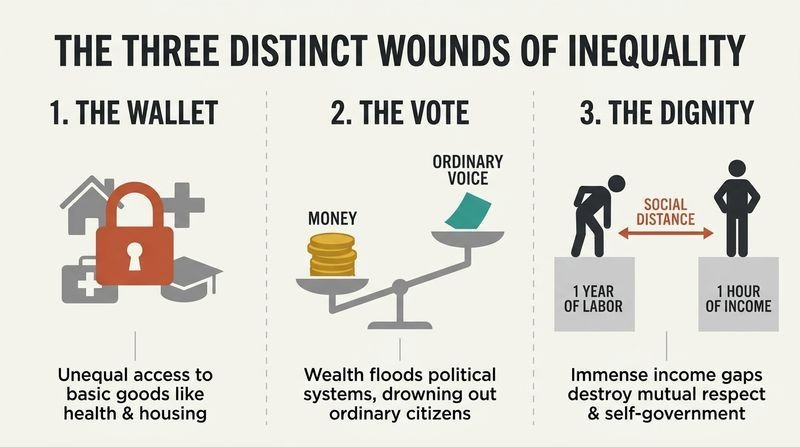
Money is only the first harm. In this recorded 2024 conversation at the Paris School of Economics, Piketty and Sandel dissect inequality into three distinct injuries. The first is economic: unequal access to basic goods like health, education, and housing. The second is political: money buys campaign influence, lobbying, and media, drowning out ordinary voices. The third, and most intriguing, is about dignity, status, and recognition.
Even a perfect fix leaves a wound. Sandel runs a thought experiment: suppose we publicly financed campaigns and built a generous welfare state, neutralizing the first two harms while leaving income gaps intact. Piketty insists a problem remains. If one hour of your income buys my entire year of labor, that monetary distance becomes social distance, poisoning human relations and the very fabric of self-government.
Separating inequality into three axes is analytically powerful because remedies differ. Redistribution treats the economic wound, campaign finance reform the political one, but recognition resists transfer payments entirely. This maps onto Axel Honneth's philosophy of recognition and Nancy Fraser's distinction between redistribution and recognition as separate justice claims. The dialogue's strength is refusing to collapse dignity into dollars. A worker earning a living wage can still feel invisible. What's underexplored is measurement: economists quantify income gaps precisely, but esteem gaps resist metrics, which may explain why policy neglects the third dimension despite the authors arguing it is politically the most explosive.
Equality is not gifted; it is seized through political battle

The long arc bends toward equality. Piketty, drawing on his historical research, insists that despite today's stark gaps, inequality was far worse a century and two centuries ago. Since the late eighteenth century, a movement toward equal rights has advanced through concrete struggles: abolition of aristocratic privilege, abolition of slavery, universal suffrage, social security, progressive taxation, and decolonization.
Nothing is frozen by culture. He offers Sweden as proof. Until World War I, only the wealthiest 20% of Swedish men could vote, with the rich casting up to 100 votes each. Dozens of municipalities had a single legal dictator holding a voting majority. Within decades, social democratic and union mobilization transformed Sweden into an egalitarian model. Levels of equality reflect political choices and struggle, not permanent civilizational traits.
This optimism counterbalances the pessimism of Piketty's own Capital in the Twenty-First Century, where capital's return outpacing growth drives concentration. The reconciliation is that equalizing forces are political, not automatic. The Swedish plutocratic voting example is genuinely startling and undercuts any claim that Nordic egalitarianism is cultural destiny. A useful challenge: the timeline is Eurocentric and treats progress as cumulative, yet the interwar rise of fascism and post-2008 oligarchic surges show reversals are real. Acemoglu and Robinson's work on institutions echoes the theme that distribution is contested rather than given, but warns that extractive elites often recapture reforms.
Pull essential goods out of the profit motive so money matters less

Decommodification means removing sectors from the market. Rather than only redistributing cash, Piketty champions decommodification: funding goods like education and health outside profit and shareholder logic, so they are freely accessible regardless of wealth. This already happened historically and quietly succeeded.
It is already a quarter of the economy. Education plus health make up nearly 25% of developed economies, larger than all manufacturing combined, and they operate largely outside the profit model. Piketty offers a striking hypothetical: if 99% of goods were decommodified, income gaps in the remaining 1% would become almost irrelevant, because there would be little left to buy. The US health system, run heavily on profit logic, spends almost 20% of GDP for worse outcomes than cheaper European public systems, illustrating the payoff of taking care out of the market.
Decommodification reframes the equality debate away from pure cash transfers toward the architecture of provision. It echoes Esping-Andersen's welfare-state typology, where decommodification measures how far citizens can maintain a livelihood independent of the market. The US health spending comparison is the empirical anchor: more money, worse life expectancy. A fair pushback is that public monopolies can ossify, ration through queues, and stifle innovation, and that the 99% thought experiment sidesteps how collective valuation decisions get made without price signals. Still, the core claim that some goods corrode when priced is defensible and widely supported by health-outcome data across the OECD.
Paying people to perform a good destroys why they cared about it
Markets can corrupt, not just exclude. Sandel presses a second reason to decommodify beyond fairness: putting things up for sale can degrade their meaning. Both authors agree markets can crowd out intrinsic motivation. When teachers are paid bonuses tied to student grades, scores rise briefly, but students retain nothing six months later because teachers coach to the exam rather than teach the real material.
Prestige does not require profit. Even elite, expensive institutions like Harvard operate as nonprofits, not shareholder companies, precisely because the profit motive would destroy what makes a place devoted to learning valuable. Trump University, a for-profit venture, was a disaster. The lesson: valuation is itself a political and moral act, not something to outsource to supply and demand. A more judgmental public discourse about what goods are worth is unavoidable.
This extends Sandel's argument from What Money Can't Buy and connects to behavioral economics. Deci and Ryan's self-determination theory and Gneezy and Rustichini's famous Israeli daycare study, where fining late parents increased lateness because the fine reframed a moral obligation as a purchasable service, both support the crowding-out thesis. The bold move here is normative: economists prefer to take preferences as given, but Sandel demands society deliberate over which valuations are worthier. Critics from the liberal-neutrality tradition warn this invites moralistic majorities to impose contested values. The authors accept that risk, betting that democratic deliberation beats pretending markets are value-free.
America taxed top incomes at 82% for fifty years and thrived
High taxes coincided with peak prosperity. Piketty dismantles the fear that steep progressive taxation wrecks economies. From 1930 to 1980, the US top income tax rate averaged 82%, sometimes reaching 90%. This did not destroy American capitalism. On the contrary, that era saw the highest US productivity in national income per labor hour, with the largest lead over other countries.
Education, not tax cuts, drove the lead. The real engine was schooling. In the 1950s, 90% of young Americans attended high school, versus 20 to 30% in Germany, France, and Japan, which only caught up in the 1980s. Steep top taxes also compressed the pay gap, built a social contract where the middle class accepted contributing because the rich paid more, and kept talented people in public regulation rather than losing them to private-sector pay 20 times higher.
This is Piketty's empirical trump card against supply-side orthodoxy, aligning with work by Saez and Zucman on optimal top rates and the historical decoupling of high marginal rates from growth. The productivity point matters: correlation is not causation, but the burden shifts to those claiming high taxes must harm output. The subtler insight is the social-contract mechanism. When the middle class suspects the wealthy dodge their share, solidarity unravels and everyone resists paying, a dynamic visible in contemporary tax morale research. A caveat: the postwar US also benefited from a war-shattered global competition landscape, so some productivity lead reflects unique historical circumstance rather than tax policy alone.
Meritocracy breeds hubris in winners and humiliation in losers
Even a fair meritocracy corrodes. Sandel identifies two flaws. First, we fail our own ideal: chances are not equal. At Ivy League schools, despite free tuition for families under roughly 85,000 dollars, there are more students from the top 1% than from the entire bottom half of the country. Second, and deeper, even a perfectly fair meritocracy would harm the common good.
Success breeds forgetting. When winners believe they earned everything, they inhale their own success, forget the luck and the collective labor that carried them, and conclude the struggling deserve their fate. Michael Young, who coined meritocracy in 1958, meant it as a warning, not an ideal. Mainstream parties told stagnating workers to get a degree because what you earn depends on what you learn, an implicit insult: if you are struggling, it is your own fault.
This is the core thesis of Sandel's The Tyranny of Merit, and its diagnostic power is in explaining populist backlash as a revolt against condescension, not just economics. Piketty adds a historical contrast: feudal hierarchies were brutal but assumed complementarity between nobles and peasants, never claiming the poor deserved poverty. Modern meritocracy uniquely moralizes outcomes, which research links to rising anxiety and deaths of despair documented by Case and Deaton. A sharp objection: abandoning merit rhetoric risks excusing genuine skill gaps and could demotivate effort. The authors distinguish valuing competence, which is fine, from the moralized belief that market rewards track moral desert, which is the target.
Credentialism is the last prejudice elites indulge without shame
Contempt for the non-degreed is respectable. Sandel argues that looking down on people without university degrees is the one bias educated elites express openly. A survey listing disfavored groups found the poorly educated ranked as the most disparaged in both Europe and the US. Unlike other prejudices we officially condemn, credentialism goes unexamined.
Policy encodes the disdain. Economist Isabel Sawhill found the US federal government spends about 162 billion dollars a year helping people attend university through grants, loans, and tax credits, versus only 1.1 billion on vocational and technical training. Meanwhile a hedge fund manager can earn 5,000 times a teacher or nurse. The remedy is to affirm the dignity of work, honoring the contributions of care workers, electricians, and plumbers rather than arming everyone for a scramble up a ladder whose rungs keep spreading apart.
The 162-to-1 spending ratio is a devastating illustration of how meritocratic values calcify into budget lines. This connects to the sociology of Michele Lamont on the moral boundaries workers draw, and to the political science finding that education has replaced income as a primary axis of partisan realignment across Western democracies. The dignity-of-work frame is deliberately cross-ideological, invitable by both left and right, which is its strength. A challenge worth noting: raising vocational funding and rhetoric is necessary but may not counteract labor markets that genuinely reward credentials, so recognition politics must pair with structural wage compression to avoid becoming mere consolation.
Admit qualified students by lottery to deflate the arms race
Chance, made visible, humbles everyone. Sandel proposes that elite universities set a qualification threshold, then admit by lottery among the many who clear it. Harvard and Stanford receive around 60,000 applicants and take fewer than 2,000, though perhaps 25,000 to 30,000 could thrive there. Randomizing the final cut would remind winners that luck carried them and spare losers the verdict of personal failure.
One tool, one job. Piketty pushes for something more redistributive, citing Daniel Markovits's plan to require at least half of students come from the bottom two-thirds of the income distribution, enforced by threatening tax-exempt status. Sandel agrees these are separate goals: the lottery targets meritocratic hubris and adolescent pressure, while income quotas or affirmative action target class composition. Both authors want legacy and donor admissions abolished, comparing paid access to the corrupt end of Imperial China's exam system.
The lottery-among-the-qualified idea is clever because it attacks the meaning of admission rather than only its distribution, addressing the psychological pathology of the credential race. Empirically, admissions officers already concede that beyond a threshold, distinctions are noise, which the lottery honestly encodes. Barbara Schneider and others document the mental-health toll of hyper-competitive schooling that the proposal aims to ease. The critical tension the dialogue surfaces itself: a lottery does little for class diversity, since the qualified pool is already skewed rich. Hence the need for Markovits-style quotas alongside. Skeptics worry lotteries could erode perceived legitimacy of institutions, though defenders counter that jury service already legitimizes random selection for weighty decisions.
Center-left parties abandoning workers built the runway for Trump
The winners' party lost the workers. Piketty and Sandel agree that right-wing nativism is a symptom of progressive failure. Parties that once championed the working class, the US Democrats, UK Labour, the French Socialists, became identified with credentialed professionals. Clinton, Blair, and Schroeder softened Reaganism's edges but never challenged its premise that markets define the public good, embracing NAFTA, the WTO, and financial deregulation.
The 2008 bailout was the hinge. Sandel points to Obama choosing to rescue Wall Street while leaving homeowners to fend for themselves, a move Obama admitted was unjust but deemed necessary. The resulting fury birthed both Occupy and Bernie Sanders on the left, and the Tea Party and Trump on the right. Counties with the worst manufacturing job losses from Chinese competition voted most for Trump, arguably his 2016 margin.
This convergence of a French economist and an American philosopher on the same diagnosis is notable. The trade-shock evidence draws on Autor, Dorn, and Hanson's China Shock research showing import competition reshaped voting toward populists, lending empirical spine to the argument. The authors disagree productively over the word populist: Sandel uses it for both Sanders and Le Pen given its nineteenth-century roots uniting farmers and workers against elites, while Piketty rejects it as centrist rhetoric that smears legitimate socialist and nationalist ideologies alike. The disagreement is more than semantic. It concerns whether anti-establishment energy is one phenomenon or two morally distinct responses to the same globalization wound.
Tax importers up to your own standards, not down to theirs
Trade rules can lift everyone. Piketty coins universalist sovereignism: a country can unilaterally charge imports the difference between its own tax or carbon standards and the exporter's lower ones. If France taxes corporate profit at 30% and a trading partner at 10%, France charges the 20% gap at the border. This differs from ordinary protectionism because the charge vanishes the moment the other country raises its standards. Ideally, part of the revenue flows to the global South.
Waiting for unanimity means doing nothing. The lesson is that governments must act alone to start the process rather than hiding behind the excuse of needing global consensus. When the left only ever says it awaits international agreement, it signals that the sole policy it can actually deliver is border control against migrants, handing the entire agenda to nationalists.
Universalist sovereignism is an ingenious reframing that flips the logic of trade wars: instead of protecting domestic firms, it exports higher standards. It resembles the EU's Carbon Border Adjustment Mechanism now being implemented, giving the idea real-world traction rather than pure theory. The design elegance is the built-in off-ramp, since the tariff dissolves when partners level up, distinguishing it from Trump-style protectionism. The obvious challenge is enforcement and retaliation: powerful exporters may counter-tariff, and developing nations could see it as green protectionism dressed in moral clothing, which is precisely why the revenue-sharing-to-the-South component is essential to its legitimacy rather than optional decoration.
Fight climate as a class war on billionaires, not a country war
Per capita history indicts the North. Piketty notes the US and Western Europe produced 60 to 70% of cumulative carbon emissions with under 20% of world population. The US ran above 15 tons per capita for decades while China looks likely to develop without exceeding 8 or 9. Blaming China's total emissions ignores its 1.4 billion people.
Nation-versus-nation blame is a dead end. If climate costs are framed as America pays, France pays, ordinary citizens rebel, saying rich Chinese should pay instead, and nationalists win. The fix is to reframe it as class conflict: a fixed slice of a global tax on billionaires and multinationals should flow directly to countries in the South by population and climate exposure, funding solar energy, schools, and hospitals. Tradable emission credits are merely an excuse for rich countries to avoid cutting their own output.
Recasting climate finance from a territorial to a class question is politically shrewd because it neutralizes the nationalist objection that ordinary Westerners are being made to subsidize foreign elites. It resonates with the World Inequality Lab finding that the top decile globally drives a disproportionate share of emissions, cutting across national borders. The per-capita versus total-emissions framing is the crux of every stalled climate negotiation, and the historical-responsibility argument has deep force in global-South diplomacy. The vulnerability is institutional: a global billionaire tax presupposes coordination that the same chapter admits is nearly impossible, which is why the unilateral-action pathway must carry the weight in the near term.
The danger is not owning a home; it is boundless accumulation
Property is bargaining power, not just cash. Closing with Rousseau's 1754 essay, which traces inequality to the first person who fenced land and said this is mine, the authors agree the deeper root is recognition. Rousseau saw esteem itself, the competition to be admired around the village tree, as the first step toward inequality. Wealth matters because it confers power over your own life.
A cushion changes everything. Someone with nothing, or only debt, must accept any wage and any condition to pay rent. Someone with even 100,000 to 300,000 dollars, trivial to a billionaire, can buy a home, start a small business, and be choosier about jobs. The problem Piketty targets is not modest ownership but the limitless concentration of property in few hands, which concentrates power and strips everyone else of leverage.
Grounding the whole discussion in Rousseau elegantly unites the book's three threads: property (economic), power (political), and esteem (dignity). The bargaining-power framing echoes the republican-liberty tradition of Philip Pettit, where freedom means non-domination, not merely non-interference, and the emerging economics of wealth as a buffer, seen in baby-bonds and universal-inheritance proposals. The insight that a small nest egg transforms a worker's negotiating position is empirically supported by studies of unemployment insurance and cash transfers improving job-match quality. The framing wisely disarms the objection that egalitarians envy all property. By targeting concentration rather than ownership, it keeps the middle class as ally rather than adversary.
Analysis
This slim volume is not a treatise but a transcribed 2024 dialogue between two of the era's most influential thinkers on inequality: Thomas Piketty, the economic historian of capital concentration, and Michael Sandel, the communitarian philosopher of merit and markets. Its form is its method. Rather than a single thesis, it stages a productive friction between an economist who wants concrete policy (progressive taxation to 90%, worker board seats, global billionaire levies) and a philosopher who insists that no redistribution scheme succeeds without first repairing the moral fabric of recognition and belonging. The reader watches two frameworks interlock. Piketty supplies the historical data and institutional blueprints; Sandel supplies the moral psychology of why people revolt. Their most illuminating move is decomposing equality into three irreducible dimensions: money, power, and dignity, then arguing the third is politically decisive yet chronically neglected. The book's originality lies less in new claims (both authors are summarizing their prior work, A Brief History of Equality, The Tyranny of Merit, Capital and Ideology) than in the synthesis their conversation forces: the economic left's redistribution and the cultural left's recognition are shown to be mutually dependent, not competing agendas. Their friendly disagreement over the word populist crystallizes a genuine fault line in the contemporary left about whether anti-elite energy is one thing or two. Weaknesses: the tone is often mutual admiration, with too few moments where either genuinely destabilizes the other. The policy proposals, especially universalist sovereignism and global wealth taxes, are asserted more than defended against serious enforcement and retaliation objections. And the Eurocentric optimism about equality's long arc sits uneasily beside the very oligarchic reversals the authors diagnose. Still, as a compact map of how economics, philosophy, and identity converge on the equality question, it is unusually lucid, and its insistence that dignity cannot be redistributed like income deserves to reshape how progressives campaign.
Review Summary
Glossary
Decommodification
Removing goods from profit logicTaking entire economic sectors, especially education and health, out of the market and shareholder-profit model so they are funded publicly and freely accessible regardless of wealth. Piketty argues this succeeded historically, now covers about 25% of developed economies, and could expand to a majority, making monetary inequality progressively less relevant because fewer essential goods carry a price.
Participatory socialism
Worker power plus decommodificationPiketty's proposed twenty-first-century economic system featuring at least 50% of corporate voting rights for workers' representatives even without capital shares, caps on any single shareholder's vote (around 10% in large firms), sharply progressive taxation, and expanded decommodified public services. He frames it as a change of the same magnitude that separated today's social democracy from the capitalism of a century ago.
Universalist sovereignism
Unilateral standards-based trade taxationPiketty's proposal that a nation unilaterally charge imports the gap between its own tax or carbon standards and the lower standards of the exporting country. Unlike ordinary protectionism, the charge disappears once the exporter raises its standards to match, so it pulls all countries toward higher social and environmental norms, with revenue ideally shared with the global South.
Tyranny of merit
Meritocracy corroding the common goodSandel's concept that meritocracy, even if fully fair, breeds hubris among winners who credit only themselves and humiliation among losers told their struggles are their own fault. Coined critically by Michael Young in 1958, the ideal drives social polarization, erodes solidarity, and fuels populist backlash against credentialed elites who look down on those without degrees.
Rhetoric of rising
Blaming losers via mobility gospelSandel's term for the mainstream political message that stagnating workers should get a university degree because earnings depend on education. It carries an implicit insult: those who fail to climb deserve their fate. This framing, embraced by center-left parties, alienated working-class voters and helped drive support toward nativist populists.
Social state
Broad welfare plus public servicesPiketty's preferred term over welfare state, encompassing not just social security but education, public infrastructure, health, and other public services. Its historical rise was funded by labor unions, social contributions, and steeply progressive taxation, growing from under 10% of national income before World War I to roughly 50% in European countries today.
Descriptive representation
Legislature mirroring population's compositionThe idea that an elected body should reflect the social, class, and educational makeup of the population it governs. The authors note working-class and non-degreed citizens hold only around 5 to 10% of parliamentary seats despite being a majority, and discuss lotteries, party quotas, and India's reserved constituencies for scheduled castes as remedies.
About the Author
Download PDF
Download EPUB
.epub digital book format is ideal for reading ebooks on phones, tablets, and e-readers.








