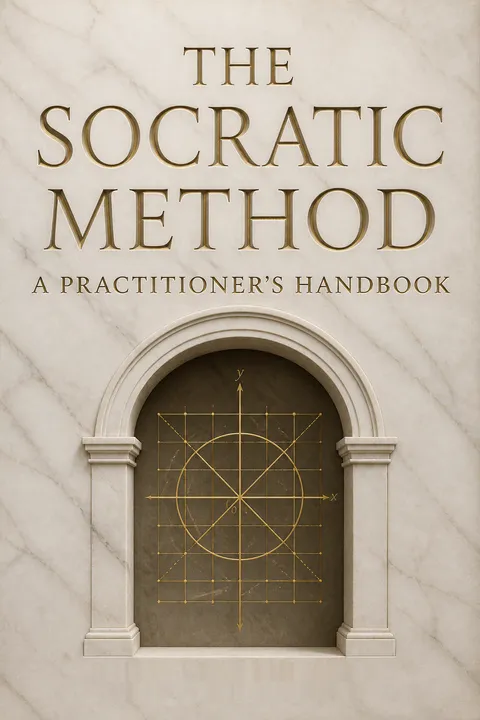


Key Takeaways
Treat Socratic questioning as a way to think, not a classroom trick
Method over doctrine. Farnsworth presents Socrates less as the source of a finished philosophy than as a model for examining claims. The surviving dialogues were written by Plato, and scholars cannot confidently separate the historical Socrates from Plato’s literary creation. The handbook therefore focuses on the reasoning displayed in the dialogues, especially the earlier ones, without pretending the authorship question is settled.
A public practice. John Stuart Mill valued this questioning as a way to expose confused assumptions, not merely as a teaching device. It needs no specialist vocabulary: begin with everyday beliefs, ask what they mean, and test whether they fit together. The aim is not to install a new doctrine, but to improve how people hold and examine their views.
The distinction between a method and a doctrine makes the book useful beyond classical philosophy. A doctrine asks readers to adopt conclusions; a method gives them procedures for challenging conclusions, including its own. That is close to the logic of scientific inquiry, where a claim earns trust by surviving attempts to disconfirm it. The historical uncertainty is also instructive: a practice can remain valuable even when its founder’s exact words and beliefs are unrecoverable. Still, a method is never entirely neutral. The questions chosen, and the assumptions allowed into discussion, shape what can be discovered.
Make your own mind cross-examine its confident claims
An inner interlocutor. Plato describes thinking as a silent exchange in which the mind questions and answers itself. Farnsworth calls the capacity for such questioning the Socratic function: an internal critic that tests assumptions before they harden into certainty. It can ask what a claim means, what supports it, and whether it conflicts with another belief.
Practice without an audience. In the dialogue Hippias Major, Socrates imagines a relentless questioner inside his own mind. The image suggests that his abrasiveness is more useful directed at private vanity than at unsuspecting conversation partners. External dialogue can help because another person may spot a blind spot, but self-examination is available daily. The task is to challenge one’s own favored explanations, not merely rehearse objections to people one already disagrees with.
This account anticipates a useful distinction in contemporary psychology: having a thought is not the same as treating it as fact. Creating a little distance from a judgment can make it easier to inspect rather than defend it. The internal critic, however, needs a humane job description. If questioning becomes self-attack, it can intensify shame without improving accuracy. The productive version is demanding about reasons but forgiving about fallibility. A good inner Socrates investigates the claim, not the person’s worth.
Use your beliefs to test your beliefs, not just your opponent's
The elenchus. This is Socrates’ characteristic form of examination: a partner states a claim, agrees to other propositions, and then discovers that the commitments conflict. In the Laches, a general first describes courage as persistence. Socrates gets him to agree that courage is admirable, while some persistence is foolish and harmful. The definition therefore needs revision, by the general’s own standards.
A test, not a verdict. The elenchus shows that at least one commitment needs changing; it does not automatically reveal which one is false. Farnsworth treats consistency as powerful evidence and a way to uncover mistaken confidence, not as a guarantee of truth. The same test should be applied to one’s own positions. Otherwise, questioning becomes a clever tool for winning against others rather than a discipline of inquiry.
Internal critique is persuasive because it begins with premises a person already accepts. It resembles debugging: the system’s own outputs reveal that something in its design does not work. But consistency is not sufficient for truth. A mistaken starting assumption can generate a beautifully coherent structure, and Socrates himself warns about this possibility. The strongest use of the elenchus therefore combines coherence checks with attention to evidence and to the basic assumptions from which the reasoning begins.
Move between broad principles and stubborn counterexamples
Two directions of thought. Farnsworth names the paired operations systole and diastole. Systole draws separate cases together under a common principle; diastole separates cases that a broad definition wrongly groups. When Laches defines courage through a soldier’s conduct, Socrates asks for an account that also covers courage in other settings. When Laches offers persistence as the principle, Socrates points to foolish persistence that should not count as courage.
Examples do the work. Socrates often uses ordinary comparisons to make abstract reasoning graspable. To clarify a general definition, he might compare it with a familiar skill or object. These analogies illuminate possible similarities, but they do not prove that the cases are alike. A partner can challenge the comparison. The useful habit is to alternate: widen the lens to find a principle, then narrow it with cases that expose its limits.
This back-and-forth resembles the way strong classifications are built in law, medicine, and scientific research. A category must explain why its cases belong together, yet remain precise enough not to absorb every superficially similar case. Counterexamples are especially valuable because they reveal hidden boundary rules. The danger is treating every exception as fatal. Some principles are useful approximations rather than perfect definitions. The Socratic question is not simply whether a rule has exceptions, but whether its holder understands and can justify them.
Treat intellectual dead ends as evidence of progress, not proof of failure
Aporia defined. Aporia is the impasse reached when proposed answers have failed and the person no longer knows what to say. In Plato’s Meno, a confident speaker finds himself unable to define virtue after Socratic questioning. The discomfort is real, but it can reveal a prior problem: he mistook fluency for understanding.
Ignorance in two layers. Farnsworth emphasizes double ignorance, the condition of not knowing while believing one knows. Recognizing the gap is an improvement because it makes inquiry possible. Yet confusion alone is not wisdom. A bad argument can also bewilder someone, and aporia is useful only if it prompts better examination rather than resignation. The Socratic response is to continue searching, with a more accurate sense of what remains unsettled.
Aporia resembles the productive frustration that appears when a learner discovers that a task is harder than expected. That moment can motivate deeper study because the person now has a clearer picture of the knowledge gap. It can also produce withdrawal, especially when the challenge feels humiliating or endless. The distinction matters in teaching: destabilizing a belief is not enough. Inquiry needs a next step, such as refining a definition, checking evidence, or identifying what would count as a better answer.
Make disagreement candid, charitable, and safe enough to continue
Rules that protect inquiry. Socratic dialogue depends on participants saying what they actually think, rather than giving agreeable answers. It also asks them to represent opposing views fairly, judge arguments rather than social status, and avoid treating contradiction as insult. Socrates considers the conversation partner’s agreement more important than a crowd’s applause: popularity cannot settle whether a claim is true.
Challenge as a service. Refutation can be received as help because it exposes a weakness before that weakness shapes decisions. The questioner has duties too: clarify the other person’s position, avoid needless offense, and accept correction. These habits are not merely manners. Without candor, charitable interpretation, and tolerance for challenge, a conversation shifts from examining a question to defending identities and reputations.
These norms resemble the conditions needed for a healthy research community: criticism is useful only when people can offer it without retaliation and receive it without collapsing into defensiveness. The book’s emphasis on civility is not a demand for softness; it is a way to keep difficult content discussable. Yet courtesy cannot by itself equalize a conversation. Differences in authority or social risk may make candor safer for some participants than others. A genuinely open inquiry must attend to who can speak, and what speaking may cost.
Ask why until the principle beneath the argument appears
Find the hidden premise. People often argue about a particular case while relying on a broader rule they have not stated. If someone objects to a court decision, for example, asking what punishment is for may reveal whether the underlying principle is retribution, deterrence, or something else. Once that premise is visible, the discussion can test it, compare it with the original claim, or ask what deeper reason supports it.
Put principles under pressure. Farnsworth offers practical routes: take a rule literally, test its extreme cases, reverse the political identities in an example, consider another person’s perspective, and ask what consequences the rule would produce. These questions are not automatic refutations. Their purpose is to reveal where a rule is too broad, too narrow, or dependent on an assumption its holder has not examined.
The method is especially valuable when people appear to disagree about facts but actually rely on different standards for judging them. Bringing those standards into view can turn a shouting match into a tractable dispute. The techniques also expose motivated reasoning: a principle may seem universal until its political beneficiaries change. However, hypothetical examples can distort as readily as clarify. They should reveal implications worth investigating, not substitute for evidence about how real policies work.
Measure a good life by judgment, not possessions or passing mood
Happiness as living well. Socrates’ eudaimonia means a flourishing or good life, not simply feeling cheerful. He treats virtue, wisdom, and knowledge as deeply connected to that end. Money, health, status, and power are not automatically good: their value depends on how they are used. A powerful ability can help a wise person and make a foolish person more dangerous.
Moral failure as misjudgment. Socrates argues that people do wrong because they misunderstand what is truly good, and that apparent failures of will may reveal incomplete understanding. This view turns ethical improvement into a problem of learning. It is also a demanding claim, not an established fact: habit, emotion, and addiction can resist what someone can state intellectually. The practical question is whether fuller attention to consequences and other people would change a choice.
The distinction between feeling good and living well remains useful because immediate satisfaction can diverge from long-term welfare and ethical integrity. Socrates’ account also directs attention to how people interpret their choices, rather than treating wrongdoing as inexplicable wickedness. Its weakness is the risk of intellectualizing conduct. People can recognize a reason and still fail to act on it, especially under stress or entrenched habit. Understanding matters, but it may need support from practice, relationships, and institutions.
Let Stoicism turn questioning into daily emotional practice
A Socratic inheritance. The Stoics, especially Epictetus, adapted questioning to ordinary problems. A student distressed by a family illness might be asked whether the feeling is natural, and then whether what is common is therefore right. The questions probe the belief behind the reaction instead of dismissing the emotion.
Interpret the impression. Stoic practice extends Socrates’ idea that ethical trouble often involves mistaken judgment. Events outside a person’s control, such as illness or public opinion, are not automatically good or evil; conduct and interpretation matter. This does not mean pain is imaginary. It means the first response to a painful event can be examined before it dictates action. Epictetus makes the Socratic style more directly practical, though more willing to guide students toward particular conclusions.
The Stoic development makes a compelling bridge between reasoning and emotional regulation. Naming the judgment embedded in an emotion can create room to respond rather than react automatically. Modern therapeutic approaches often use a related move by examining the interpretation attached to an event. The comparison has limits: grief, fear, and anger can carry information about real needs or injustice, not merely faulty beliefs. Examination should clarify an emotion’s message, not silence it in the name of control.
Use provisional probabilities to act without claiming certainty
Skepticism as continued inquiry. The ancient Academic Skeptics drew on Socrates’ habit of questioning, but pressed further toward epochē, or suspending judgment when arguments on opposing sides remain unresolved. This differs from aporia: aporia is the impasse after candidate answers fail, while epochē is withholding assent amid competing cases.
Act without pretending. The Skeptics did not have to abandon practical decisions. Carneades proposed acting on what appears more likely when no stronger contrary case emerges. The book presents this as a way to keep inquiry alive without confusing a working judgment with certainty. Its civic counterpart is a culture that welcomes challenge, resists crowd pressure, and teaches careful argument. Such habits matter especially where fast reactions and public approval reward confidence more than examination.
Fallible judgment is not indecision. It allows people to choose, revise, and explain their reasons without pretending that uncertainty has vanished. That stance fits many complex public problems, where evidence is incomplete and waiting also has consequences. The key is to distinguish degrees of confidence and remain open to correction. Skepticism becomes counterproductive if it treats every claim as equally doubtful. Some evidence is much stronger than other evidence, even when none delivers absolute certainty.
Analysis
Farnsworth’s strongest move is to make the Socratic method less a historical curiosity than a practical discipline for correcting confidence. Its sequence is memorable: surface a claim, uncover its assumptions, test its implications, and accept the discomfort of discovering a gap. The dialogue form matters because it shows reasoning as a process rather than presenting only polished conclusions. The book also draws a productive line from Socrates to Stoic practice and Academic Skepticism, showing how a shared habit of questioning can support different attitudes toward knowledge and action.
The method’s central tool, consistency, is powerful but limited. A contradiction establishes that something needs repair; it cannot determine by itself which belief should change. Coherent systems can rest on false premises, and people may rationalize apparent contradictions rather than revise deep commitments. The book acknowledges these risks, but its practical force depends on joining internal critique to sound evidence and careful attention to power. A conversation can be formally open while one participant bears greater reputational or material costs for speaking candidly.
The most compelling contemporary application is therefore not simply to question more, but to build settings where questioning remains possible. A good inquiry needs time, shared terms, freedom to dissent, and a willingness to distinguish confidence from proof. It also needs judgment about when dialogue is appropriate. Socratic questioning is poorly suited to every purpose or every relationship, and a skillful question can still be used to corner rather than understand. The method’s ethical test is whether the exchange improves mutual understanding and reasoning, not whether one speaker secures a concession. Its durable lesson is a combination that public argument often lacks: confidence that truth matters, paired with modesty about possessing it.
Review Summary
The Socratic Method is highly praised for its accessible exploration of Socratic philosophy and its practical application to modern discourse. Readers appreciate Farnsworth's clear writing style and insights into critical thinking. The book is seen as timely, offering tools to improve reasoning and communication in an era of polarization. Many reviewers found it thought-provoking and transformative, though some felt certain sections were redundant. Overall, it's recommended for those seeking to enhance their analytical skills and engage in more productive dialogues.
People Also Read



Glossary
elenchus
testing beliefs for conflictA form of Socratic examination in which a person states a claim, accepts further propositions, and discovers that these commitments conflict. The result shows that at least one belief needs revision, but does not by itself establish which belief is false. Socrates uses the process to expose unsupported confidence and test claims by the speaker’s own standards.
aporia
an impasse in inquiryA state reached when proposed answers to a question have been challenged and no satisfactory answer remains. Aporia can feel like confusion or speechlessness, but it is not automatically evidence that the question is impossible. In Socratic inquiry, recognizing the impasse can correct false confidence and motivate more careful investigation.
double ignorance
not knowing one does not knowThe condition of lacking knowledge while believing oneself knowledgeable. Socrates treats it as especially dangerous because the false confidence blocks learning and can lead people to act on mistaken assumptions. Recognizing ignorance does not supply the missing answer, but it removes the pretense that no inquiry is needed.
systole
drawing cases togetherFarnsworth’s term for the reasoning that finds a shared principle across cases that initially appear separate. Socrates uses this movement when he asks for a general account, such as a definition that explains several examples of courage. Systole is paired with diastole, which draws distinctions between cases that a broad account wrongly groups.
diastole
separating unlike casesFarnsworth’s term for reasoning that distinguishes cases or concepts initially treated as the same. A proposed definition is tested against examples it appears to cover but should exclude. The distinction can reveal that a principle is too broad or that an important difference has been overlooked. Together with systole, it describes a recurring rhythm in Socratic analysis.
Socratic function
inner capacity for questioningFarnsworth’s name for the mind’s capacity to examine its own beliefs through skeptical questioning. It acts like an internal interlocutor, challenging assumptions, exposing inconsistencies, and resisting vanity or partisan certainty. The concept adapts the dialogues’ question-and-answer structure to self-examination, while recognizing that a harsh inner critic can become counterproductive.
eudaimonia
flourishing or living wellAn ancient Greek conception of happiness that refers to the quality of a life, not merely a person’s passing mood. In Socratic ethics, eudaimonia is closely tied to virtue, wisdom, and sound judgment. Wealth, health, and status do not guarantee it, because their value depends partly on how they are used.
epochē
suspending judgmentThe Academic Skeptics’ practice of withholding assent when arguments for and against a claim remain unresolved. It differs from aporia, which describes an impasse after candidate answers fail. Epochē does not require abandoning inquiry or practical life; Skeptics could act on what seemed more likely while avoiding claims of certainty.
dialectic
truth-seeking by questionsIn the book’s broad account, dialectic is inquiry conducted through questions and answers. It is contrasted with eristic argument, which aims to defeat an opponent or win a dispute. Plato also uses the term in more developed philosophical senses, but its central relevance here is the disciplined exchange through which assumptions and arguments are tested.
Socratic goods
benefits of greater understandingFarnsworth’s label for benefits that may not seem attractive before they are experienced, such as clearer judgment and a more accurate awareness of ignorance. Like leaving Plato’s cave, gaining understanding can initially be uncomfortable and may bring no immediate worldly reward. Its value becomes more visible when compared with the limitations of remaining mistaken.
FAQ
What's The Socratic Method: A Practitioner's Handbook about?
- Comprehensive Overview: The book provides a detailed exploration of the Socratic method, focusing on its role as a style of thought rather than merely a teaching technique.
- Emphasis on Inquiry: It highlights the importance of asking questions and engaging in dialogue to foster deeper understanding and critical thinking.
- Practical Application: Farnsworth aims to make Socratic philosophy accessible for everyday use, encouraging readers to apply these principles in various aspects of life.
Why should I read The Socratic Method: A Practitioner's Handbook?
- Enhance Thinking Skills: The book offers tools to improve reasoning and analytical skills through the practice of questioning.
- Cultural Relevance: It addresses contemporary issues in discourse and encourages a return to thoughtful dialogue in a time of polarized opinions.
- Historical Insight: Readers gain insight into the origins of Stoicism and Skepticism, connecting them to Socratic thought and its relevance today.
What are the key takeaways of The Socratic Method: A Practitioner's Handbook?
- Socratic Method as Inquiry: The method is framed as a process of inquiry that prioritizes questions over answers, fostering a mindset of curiosity.
- Importance of Consistency: The book emphasizes the significance of internal consistency in beliefs, as inconsistency can indicate a lack of understanding.
- Ethical Engagement: It promotes engaging in dialogue with humility and openness, valuing truth over winning arguments.
What is the Socratic method, according to The Socratic Method: A Practitioner's Handbook?
- Style of Thought: The Socratic method is described as a style of thought that encourages critical questioning and self-examination.
- Question and Answer: It involves a dialogue format where questions lead to deeper insights and understanding, rather than simply providing answers.
- Elenchus Technique: The elenchus is a key technique within the method, where Socrates leads his interlocutors to discover contradictions in their beliefs.
How does the elenchus work in The Socratic Method: A Practitioner's Handbook?
- Refutation Process: The elenchus involves making a claim, agreeing to another proposition, and then revealing inconsistencies between the two.
- Ownership of Beliefs: Socrates ensures that his partners own their contradictions, which encourages self-reflection and deeper understanding.
- Example from Laches: Farnsworth illustrates this with the dialogue Laches, where Socrates helps Laches refine his definition of courage through a series of questions.
What is the significance of consistency in the Socratic method?
- Indicates Understanding: Consistency in beliefs is seen as a sign of understanding; inconsistency suggests confusion or ignorance.
- Moral Health: Socrates views internal consistency as essential for moral health, equating it with a well-tuned psyche.
- Self-Examination: The pursuit of consistency encourages self-examination and reflection, leading to personal growth and better decision-making.
What is the significance of aporia in Socratic dialogue?
- State of Confusion: Aporia refers to a state of perplexity or impasse reached during Socratic questioning, often revealing inconsistencies in beliefs.
- Catalyst for Inquiry: Experiencing aporia can motivate individuals to seek further understanding and knowledge, serving as a reminder of the complexity of philosophical questions.
- Encouragement of Humility: Aporia emphasizes the importance of intellectual humility, as it reveals the limits of one's knowledge.
How does The Socratic Method: A Practitioner's Handbook relate to modern discourse?
- Cultural Critique: The book critiques contemporary discourse, suggesting that the Socratic method can serve as a remedy for the decline in rational dialogue.
- Encourages Humility: It promotes humility in discussions, urging individuals to embrace uncertainty and the possibility of being wrong.
- Socratic Ethic: Farnsworth argues for a Socratic ethic that values inquiry and respectful engagement over partisan conflict.
How can I apply the Socratic method in everyday conversations?
- Ask Open-Ended Questions: Use questions that encourage elaboration and deeper thinking, rather than simple yes or no answers.
- Listen Actively: Pay close attention to what others say and respond thoughtfully, demonstrating respect for their views.
- Seek Common Ground: Start discussions by identifying shared beliefs or values, creating a collaborative atmosphere.
What role does self-skepticism play in the Socratic method?
- Critical Self-Examination: Self-skepticism involves questioning one's own beliefs and assumptions, crucial for personal growth.
- Encouraging Openness: By being skeptical of one's own views, a person remains open to new ideas and perspectives.
- Promoting Intellectual Humility: Self-skepticism fosters a sense of humility, reminding individuals that they may not have all the answers.
What are some practical applications of the Socratic method from the book?
- Everyday Conversations: Farnsworth encourages readers to apply the Socratic method in daily conversations to foster deeper understanding and connection.
- Self-Reflection: The method can be used for personal reflection, helping individuals clarify their beliefs and values.
- Educational Settings: The book suggests that educators can use the Socratic method to engage students in critical thinking and active learning.
What are the best quotes from The Socratic Method: A Practitioner's Handbook and what do they mean?
- "The Socratic method is a style of thought.": This emphasizes that the method is not just a teaching tool but a way of engaging with the world intellectually.
- "Socrates didn’t question people in order to teach us how to question people. He did it to teach us how to think.": This highlights the ultimate goal of the Socratic method—developing critical thinking skills rather than merely imparting knowledge.
- "The search for consistency thus makes the Socratic method useful in all sorts of situations.": This underscores the versatility of the method, applicable in various contexts beyond philosophy, including personal and professional life.
About the Author
Other books by Ward Farnsworth


Download PDF
Download EPUB
.epub digital book format is ideal for reading ebooks on phones, tablets, and e-readers.








