

Key Takeaways
Judge each ruling twice: for today's litigants and tomorrow's choices
The past is not enough. An ex post analysis asks who should bear a harm that has already happened. An ex ante analysis asks how a ruling will change choices in similar situations. In the book's bank robbery example, making a bank pay for a hostage's death might seem fair to the victim's family. But it could encourage banks to hand over money, making hostage-taking more attractive to criminals. The court's decision settles one dispute and signals a rule to others.
Look for changed behavior. Ask what each side, and people like them, might do differently after learning the result. A damages award for a house built over a boundary may resolve today's conflict sensibly, yet encourage future builders to build first and pay later. The best answer depends on both the case and the rule it creates.
This distinction resembles the difference between treating a system as a snapshot and studying how it responds to feedback. The ruling is not merely a verdict; it is a signal entering a world of people who adapt. That makes precedent powerful, but also makes predictions uncertain. People may not know the rule, may misunderstand it, or may care more about habit and social norms than legal incentives. The ex ante lens is most useful as a question to investigate, not as proof that a judge can reliably forecast behavior.
Measure a rule by total costs, including the margins it distorts
Efficiency means fewer wasted resources. The book uses Kaldor-Hicks efficiency: a choice is efficient when its total benefits exceed its costs, even if some people lose and are not compensated. That is not the same as fairness, and the author does not claim efficiency is law's only purpose. In an accident, the calculation includes both the harm and the cost of precautions. Brick walls and armed guards might keep every cow off a road, but inexpensive fencing plus occasional accidents may cost society less overall.
Compare increments, not totals. A taller cricket-ground fence might prevent some injuries, but the extra height is worthwhile only if its added protection exceeds its added cost. Also watch for second-best effects: reducing pollution in a river could shift production toward worse air pollution. Improving one part of a flawed system does not guarantee the whole system improves.
The useful contribution is the insistence on counting the costs that are easy to overlook, including prevention, delay, and side effects. This is close to systems analysis: optimizing one component can degrade the larger system. But cost comparisons do not settle what deserves protection. A society may rationally accept lower aggregate wealth to protect rights or distribute burdens fairly. Efficiency is strongest as a way to expose trade-offs and weakest when presented as a complete moral verdict.
Assign risk where prevention is cheapest, unless judging that costs more
Think like one owner. The single-owner thought experiment combines all affected interests under one decision maker. If a ballpark owner also owned the neighboring houses, would the cost of a fence be less than the expected cost of broken windows? The legal rule can encourage the separate owners to make the same comparison by making the ballpark pay for the damage it causes.
Find the cheapest avoider. The least cost avoider is the person who can prevent or reduce a harm at the lowest cost. A dynamite contractor may be better placed than neighbors to control blasting risks, which helps explain strict liability. Yet legal rules must also be affordable to apply. In a buffalo hunt, awarding the animal to whoever invested the most effort could reward hunters, but invite costly arguments about who chased longer or wounded it first. A simple possession rule may prevent more waste overall.
These tools turn an abstract question, who is responsible, into a practical one: who can change the outcome most cheaply, and what information would a court need to decide? The single-owner test also gives a rough moral intuition, since it asks whether someone would take the same risk if others' losses counted as their own. Its limits matter. People value things differently, and courts may not know which precautions were feasible. The simplest rule can be better than an ideal test that is expensive or impossible to administer.
Use bargaining to move rights, but do not assume parties will bargain
Rights can be starting points. The Coase theorem describes an ideal world where parties can bargain without cost. If a noisy bakery's location is worth more to a doctor than to the baker, the doctor could pay the baker to move, regardless of who initially wins in court. The legal rule affects who has leverage and who pays, but bargaining can move the right to the party who values it more.
Real bargaining has friction. Many neighbors may be unable to coordinate, or parties may refuse to deal because they distrust or dislike each other. In those cases, courts may need to choose a remedy. An injunction lets an owner block an intrusion unless they consent. Damages allow an intruder to proceed by paying for the harm. Damages can avoid holdouts, but a court may set the price wrong, especially when the owner's personal attachment is not captured by market value.
The theorem is most illuminating as a counter to reflexively blaming one side for a conflict. A factory and nearby homes can be incompatible uses, so the key question is which adjustment costs less. Yet the bargaining ideal depends on more than legal permission. Coordination, trust, money, and emotional attachments shape what people will actually negotiate. Treating every failure to bargain as a mere transaction cost risks overlooking genuine values, while assuming parties will freely resolve disputes can leave collective problems unsolved.
Tie rewards to agents' results without making them bear every bad outcome
Effort is hard to observe. In an agency relationship, a principal hires an agent whose work affects the principal, but cannot perfectly monitor the agent. A restaurant owner cannot easily tell whether slow business comes from inattentive service or unpopular food. A flat wage may give waiters little incentive to work hard; pay based entirely on tips leaves them exposed to bad luck. A guaranteed wage plus tips balances incentive with insurance.
Every incentive has side effects. A real estate agent's commission links pay to the sale, but may still leave the agent unwilling to spend extra effort for a slightly higher price. Stock options can connect corporate managers' rewards to company performance, while salaries soften risks outside their control. These arrangements create agency costs: monitoring expenses, the cost of reassuring a principal, and losses from shirking or misaligned incentives. Insurance deductibles likewise give the insured reason to take care, reducing moral hazard.
The chapter's central design problem appears throughout organizations: reward measurable results, but avoid making people absorb risks they cannot control. This is a familiar problem in management and public administration, where a metric can motivate effort while narrowing attention to what gets counted. Incentives are therefore not simply stronger or weaker. They redirect effort among tasks. A well-designed contract needs multiple signals and safeguards, while recognizing that monitoring itself consumes time and can damage trust.
Diagnose whether cooperation fails from temptation, fear, or free riding
Not every standoff is the same. In a prisoner's dilemma, each person has an incentive to defect even when both would be better off cooperating. Repeated dealings, trustworthy norms, contracts, or legal penalties can change that calculation. In a stag hunt, people prefer mutual cooperation but fear being the only one to cooperate. Deposit insurance can calm a bank run by assuring customers that waiting will not leave them with nothing. In chicken, each side wants the other to yield, but a collision is disastrous; a traffic yield sign assigns the roles.
Public goods invite free riders. Clean air and national defense benefit people who did not pay, so private providers may produce too little. Taxes, contracts, property rights, or social norms can help fund or create these benefits. Law can also make cooperation undesirable, as when antitrust rules prevent rival firms from fixing prices.
Game theory is valuable here because it distinguishes motives that can look identical from the outside. A holdout may be exploiting others, or may simply fear being stranded. The remedy differs: penalties can deter opportunism, while assurances can unlock a stag hunt. This is also why importing one game label too quickly misleads. Real settings often mix incentives, uncertainty, and unequal power. The framework clarifies the strategic structure, but the actual payoffs still need evidence.
Choose rules for clear notice, standards for context, and expect trade-offs
Rules and standards distribute discretion. A rule gives a relatively clear trigger, such as requiring police to give Miranda warnings before questioning a suspect. A standard asks for judgment across the circumstances, such as whether a confession was coerced. Rules improve notice and can limit arbitrary decisions, but may fit unusual cases badly. Standards can respond to context, yet cost more to apply and make outcomes harder to predict.
Law's starting points matter. A slippery slope occurs when one decision makes a later one easier, changes public attitudes, weakens distinctions, or empowers a group seeking further change. Acoustic separation means the public-facing rule of conduct differs from the rule courts apply, as when a simple public maxim hides exceptions. Baseline questions ask what counts as government action or private property in the first place. There is rarely a neutral starting position: existing legal rules already shape the choices being compared.
These ideas reveal that legal design is partly about managing information. Rules tell people what to expect; standards preserve room for judgment; exceptions and baselines determine who gets that room. A clear rule can prevent favoritism but also produce absurd results at its edges. A flexible standard can correct those results while inviting inconsistency and strategic argument. The key question is institutional: who writes the rule, who applies it, and who bears the cost when discretion goes wrong?
Separate genuine agreement from cascades, agendas, and hidden competitions
Crowds can manufacture confidence. In an information cascade, people infer that an earlier decision contains knowledge and copy it, even when the apparent consensus rests on little evidence. A crowd at a restaurant can attract more diners simply because it looks popular. Reputational cascades work differently: people conform to avoid social disapproval. Both can make a fragile opinion look settled.
Group choices depend on procedure. With three candidates, majority preferences can cycle: a group may prefer A to B, B to C, and C to A. The order of votes can therefore determine the winner. A related pattern appears when communities suppress competition inside their borders. Universities may select students through intense admissions contests, then resist excluding them once admitted. The competition has not disappeared; it has shifted to a less visible stage, with different winners and costs.
This section connects social psychology to institutional design. Consensus is not always accumulated evidence; it can be imitation, fear of exclusion, or the product of agenda control. In organizations, the same dynamic makes silence look like agreement and a procedural win look like a collective preference. Still, conformity can transmit useful information, and communities may suppress competition for humane reasons. The analytical task is to identify what the pattern rewards, and who bears its hidden costs.
Treat judgment as movable: ownership, outcomes, and framing alter perceived value
People do not value choices in isolation. In the endowment effect, people often demand more to give up an object than they would pay to acquire it. Students given coffee mugs valued them more highly than students asked to buy the same mugs. Loss aversion, anticipated regret, and wealth effects can all help explain the gap. Once a right is assigned, this can make bargaining less likely to move it.
Context changes judgment. Hindsight bias makes an outcome seem more predictable after it happens, which can make juries unfairly blame someone for failing to foresee an accident. Framing changes reactions to equivalent choices: people tend to prefer certainty when considering gains, but may gamble to avoid a sure loss. Anchoring lets an initial number influence later estimates, including damage awards. Self-serving bias can make litigants overrate their own case.
The practical lesson is not that people are irrational in every decision, but that evaluation depends on reference points and social context. Behavioral economics explains why formally equivalent options can feel different, while also warning that the effects vary with experience and stakes. Legal institutions can reduce some distortions by using objective measures or separating decision makers from interested parties. Yet a supposedly neutral baseline can itself favor whoever already holds the entitlement.
Update evidence against base rates, and never multiply dependent clues blindly
Start with the background odds. A base rate is the underlying frequency of an event before new evidence arrives. If one passenger in a hundred carries drugs and a dog has a 10 percent false alarm rate, a bark does not mean the passenger is 90 percent likely to be guilty. Among a hundred passengers, the dog finds the one carrier but may also falsely flag about ten innocent people. The positive signal is therefore correct only about one time in eleven.
Separate clues carefully. The product rule multiplies probabilities when several events must all occur, but only if those probabilities are independent. A prosecutor who says a rare feature match makes a suspect almost certainly guilty ignores the possibility that many innocent people share it. Legal proof also uses thresholds: civil claims usually turn on whether a claim is more likely than not, while criminal convictions require proof beyond a reasonable doubt. The threshold allocates the risk of error.
Frequency-based examples make probability more intuitive because they replace abstract percentages with counts of people. The deeper point is epistemic: evidence has meaning only relative to what was plausible before it appeared. But a numerical posterior is not automatically a sound verdict. Estimates can be unreliable, clues can be dependent, and legal judgments include choices about which errors society finds most costly. Quantification disciplines intuition; it does not remove judgment.
Market value prices a wrecked car, not the owner's whole loss
Markets offer usable measures. If someone destroys a used car, market value gives courts a relatively clear estimate of the loss. It is cheaper to verify than the owner's personal attachment, though it may undercompensate. When a store lost a customer's home movies, replacement film had almost no market value, while the memories mattered greatly to the owner. The court allowed a larger award, but still rejected unlimited sentimental valuation.
Some values resist pricing. Agencies estimate the value of reducing risks by examining what people pay for small safety improvements or what extra wages workers demand for dangerous jobs. Such calculations can guide regulation, but they do not turn human life into an ordinary commodity. Avoiding dollar estimates does not eliminate trade-offs; it can make them less visible and less consistent. Damages also affect future behavior, so a court must consider both the victim's loss and the incentives created by the award.
Valuation is not merely an accounting exercise. A market price is a practical proxy, shaped by wealth, available alternatives, and the rights people already possess. It can be more consistent than jury intuition, but consistency is not the same as completeness. Conversely, subjective awards may recognize real losses while inviting exaggeration and unpredictable results. The strongest analysis makes the measurement choice explicit, then asks what the chosen measure excludes and how those omissions affect both justice and future conduct.
Analysis
The book's organizing insight is that legal reasoning improves when legal doctrines are treated as tools for diagnosing recurring problems, rather than as isolated rules to memorize. A single dispute can be examined through incentives, cooperation, institutional design, psychology, and evidence. That range is the book's strength: the bank's hostage case, the bakery's noise, and the jury's evaluation of a witness become variations on questions about behavior, information, and cost. The economic perspective is especially effective when it forces hidden costs into view. A remedy may resolve a dispute yet change future conduct; a precise standard may be fairer in theory but expensive to administer; an apparent free market may fail because bargaining is difficult. These are useful corrections to reasoning that treats legal outcomes as costless or assumes that the parties before a court are the only people affected.
The framework also requires discipline. Efficiency is not justice by another name. A rule that increases total wealth can still distribute burdens unfairly, and preferences may reflect unequal starting positions or social pressure. Behavioral concepts complicate the economist's picture of stable, informed choice, but they do not supply a single alternative measure of welfare. The most responsible use of the toolkit is therefore comparative: identify plausible effects, state what evidence would support them, and distinguish empirical predictions from moral commitments.
The book's lasting value lies in its method. It teaches readers to ask what each rule encourages, what information decision makers actually have, which errors the system tolerates, and who pays for complexity. Those questions travel across legal fields. They also resist easy answers, which is precisely why they are worth asking.
Review Summary
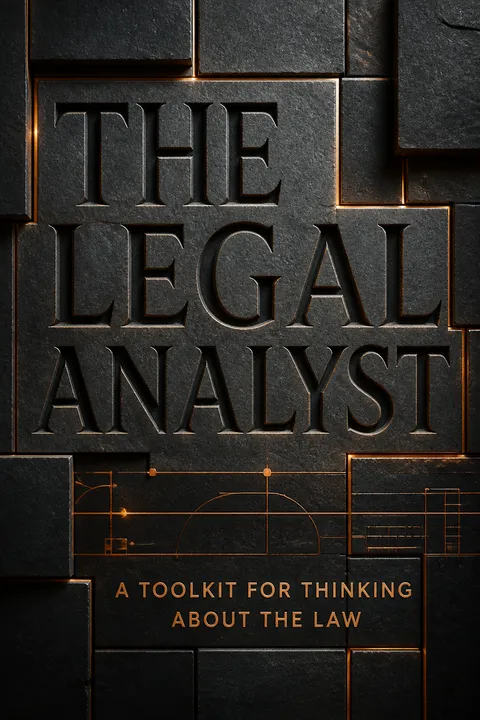
The Legal Analyst receives overwhelmingly positive reviews for its accessible approach to complex legal concepts. Readers praise its interdisciplinary perspective, incorporating economics, game theory, and psychology. Many find it valuable for law students and those interested in understanding legal reasoning. The book is lauded for its clear explanations, real-world examples, and thought-provoking content. Some reviewers note its relevance beyond law, applicable to policy-making and general analytical thinking. While a few mention occasional repetitiveness or density, most consider it an essential read for aspiring lawyers and curious minds alike.
People Also Read






Glossary
Ex ante and ex post
Future-facing and backward-looking analysisEx ante analysis asks how a legal rule will affect choices before similar events occur. Ex post analysis asks how to allocate the costs of an event that has already happened. A court usually does both: it resolves the current dispute while setting a signal that may shape later behavior.
Kaldor-Hicks
Benefits exceed total costsA decision is Kaldor-Hicks efficient when the people who benefit could compensate those who lose and still retain a net gain. Actual compensation is not required. The measure is useful for comparing total benefits and costs, but it does not establish that the outcome is fair or that the initial distribution of resources is justified.
Least cost avoider
Cheapest preventer of harmThe least cost avoider is the person or party able to prevent a harmful event, reduce its likelihood, or switch to a safer activity at the lowest cost. Assigning responsibility to that party can encourage efficient precautions. The analysis depends on information about each side's options and may be too costly to apply precisely in every case.
Coase theorem
Bargaining can reassign rightsIn the idealized setting of zero transaction costs, parties can bargain so that a right ends up with whoever values it most, regardless of its initial legal assignment. In practice, coordination problems, hostility, unequal resources, and other frictions can prevent bargaining. The theorem is a way to ask when law matters to resource use and when it mainly determines who pays.
Agency costs
Costs of aligning principal and agentAgency costs arise when one person, the agent, acts for another, the principal, but their interests do not perfectly align and the principal cannot fully observe the agent's effort. Costs include monitoring, attempts by the agent to reassure the principal, losses from shirking or self-dealing, and opportunities that fail because sufficient trust cannot be established.
Prisoner's dilemma
Individual incentives defeat mutual gainA prisoner's dilemma is a strategic situation in which each player has an incentive to defect regardless of what the other does, even though all players would be better off if they cooperated. Repeated dealings, enforceable agreements, social norms, or legal penalties can change the incentives and make cooperation sustainable.
Stag hunt
Cooperation requires assuranceA stag hunt is a coordination problem in which everyone prefers successful cooperation, but each person risks being left worse off if others do not join. Unlike a prisoner's dilemma, players do not necessarily want to exploit one another. The central obstacle is uncertainty about whether others will cooperate, so credible assurance can move the group to a better outcome.
Rules and standards
Specific triggers versus contextual judgmentA rule specifies a condition that triggers a legal consequence once the relevant facts are established. A standard asks a decision maker to evaluate circumstances, such as whether conduct was reasonable. Rules tend to provide clearer notice and lower application costs; standards can adapt to context but give decision makers more discretion and can make outcomes less predictable.
Information cascades
People copy earlier choicesAn information cascade occurs when people infer that earlier decisions reveal useful knowledge and follow those decisions rather than relying on their own limited information. A cascade can grow even when its early signals are weak, creating a strong appearance of consensus without a corresponding increase in truth. Related social cascades can arise from pressure to conform.
Endowment effect
Ownership raises perceived valueThe endowment effect is the tendency for people to value an item or right more once they possess it. In experiments, people given an ordinary mug often ask more to sell it than others would pay to acquire it. The effect can widen the gap between willingness to accept and willingness to pay, complicating bargaining and legal valuation.
Product rule
Multiply independent probabilitiesThe product rule calculates the probability that multiple events all occur by multiplying their individual probabilities, provided the events are independent. It can expose errors in legal arguments about several required elements or pieces of identification evidence. Applying it incorrectly, especially to dependent clues or unsupported estimates, can produce a misleading appearance of mathematical certainty.
Base rate
Background frequency before new evidenceA base rate is the underlying frequency of an event in the relevant population before a new piece of evidence is considered. A test result or witness description must be interpreted against that background. When the event is rare, even a seemingly accurate signal may generate many false positives and provide less evidence than intuition suggests.
FAQ
What is "The Legal Analyst: A Toolkit for Thinking about the Law" by Ward Farnsworth about?
- Toolkit for legal thinking: The book is a user-friendly guide that introduces a wide array of analytical tools for understanding and dissecting legal problems, making complex law school concepts accessible to a broad audience.
- Interdisciplinary approach: Farnsworth draws on economics, psychology, sociology, and jurisprudence to explain how legal actors think and make decisions.
- Focus on methods, not just rules: Rather than teaching legal rules, the book emphasizes frameworks and methods for analyzing legal issues, such as game theory, cognitive biases, and economic reasoning.
- Practical examples: The book is filled with real-world examples and thought experiments to illustrate how these tools apply to actual legal questions.
Why should I read "The Legal Analyst" by Ward Farnsworth?
- Understand legal reasoning: The book demystifies how lawyers, judges, and scholars approach legal problems, making it valuable for students, practitioners, and curious readers.
- Recognize cognitive biases: It reveals how psychological phenomena like framing effects, anchoring, and self-serving bias influence legal decisions and negotiations.
- Improve advocacy and analysis: By learning Farnsworth’s toolkit, readers can enhance their ability to analyze, argue, and resolve legal disputes more effectively.
- Bridge disciplines: The book’s interdisciplinary insights help readers see legal issues from new perspectives, deepening their understanding of law’s interaction with human behavior.
What are the key takeaways from "The Legal Analyst" by Ward Farnsworth?
- Analytical tools matter: Legal analysis benefits from frameworks like game theory, economic efficiency, and cognitive psychology, not just memorization of rules.
- Incentives shape law: Legal rules are often designed to influence behavior and minimize social costs, requiring an understanding of how people respond to incentives.
- Cognitive biases are pervasive: Decision-making in law is affected by biases such as hindsight, framing, and self-serving bias, which can distort judgments and outcomes.
- Rules vs. standards: The book explores the trade-offs between clear, rigid rules and flexible, context-dependent standards in legal decision-making.
What are the most notable quotes from "The Legal Analyst" by Ward Farnsworth and what do they mean?
- On legal certainty: “Courts usually don’t declare things true or false. That’s too difficult. Usually they just try to estimate likelihoods.” This highlights the probabilistic nature of legal decisions.
- On framing effects: “The look of moderation in a choice often is comforting, but it tends to be an artifact of the other options that are set around it.” This warns against being misled by contextually shaped choices.
- On self-serving bias: “People tend to be overly optimistic about a very long list of things... Overcoming this tendency is one of the most important jobs of a negotiator.” This underscores the challenge of managing optimism bias in legal disputes.
- On legal analysis: The book is filled with pithy observations that encourage readers to question assumptions and think more deeply about how law works.
How does Ward Farnsworth explain the use of game theory in "The Legal Analyst"?
- Game theory as a legal tool: The book uses concepts like the prisoner’s dilemma, stag hunt, and chicken to illustrate how legal rules address cooperation and conflict.
- Prisoner’s dilemma: Shows how individually rational choices can lead to collectively worse outcomes, explaining the need for legal intervention to enforce cooperation.
- Stag hunt and chicken: These games model situations where cooperation is risky or where mutual defection is disastrous, helping readers understand why law sometimes assigns roles or creates assurances.
- Legal applications: Game theory helps explain issues in contracts, torts, criminal law, and public goods, showing how law structures incentives.
What is the difference between rules and standards in legal decision-making according to "The Legal Analyst"?
- Rules: Clear, specific directives that are easy to apply and provide predictability, but can be rigid and sometimes unfair in individual cases.
- Standards: Flexible, context-dependent criteria that allow for tailored decisions but can create uncertainty and inconsistency.
- Trade-offs: Farnsworth explains that rules reduce discretion and administrative costs, while standards allow for fairness and adaptability.
- Practical implications: The choice between rules and standards affects everything from sentencing to contract enforcement and regulatory compliance.
How does "The Legal Analyst" by Ward Farnsworth address cognitive biases like framing effects, anchoring, and hindsight bias in legal contexts?
- Framing effects: The way choices are presented (as gains or losses) can dramatically alter decisions by plaintiffs, defendants, and juries.
- Anchoring: Initial numbers or suggestions, such as damage demands, can unduly influence judgments, even when they are arbitrary.
- Hindsight bias: After an event, people overestimate its foreseeability, leading to unfair judgments of negligence or liability.
- Mitigation strategies: The book discusses legal tools like bifurcated trials, jury instructions, and reliance on objective standards to reduce these biases.
What is the "single owner" concept in legal analysis as described by Ward Farnsworth?
- Unified interests thought experiment: The single owner model imagines all affected parties as one owner who seeks to minimize total costs and maximize efficiency.
- Internalizing externalities: Legal rules often aim to make parties act as if they were single owners, forcing them to bear the costs they impose on others.
- Applications in law: This concept helps explain doctrines in nuisance, property, and necessity, showing how courts simulate efficient outcomes.
- Efficiency focus: The single owner framework is central to understanding how law tries to reduce waste and allocate resources optimally.
How does "The Legal Analyst" by Ward Farnsworth explain efficiency and the least cost avoider principle in law?
- Efficiency as minimizing waste: Legal rules are often designed to keep the total costs of accidents, precautions, and legal processes as low as possible.
- Kaldor-Hicks efficiency: The book emphasizes decisions that maximize net benefits, even if some parties are worse off, as long as overall gains exceed losses.
- Least cost avoider: Liability is often assigned to the party best positioned to prevent harm at the lowest cost, encouraging efficient precautions.
- Complexities and limits: Determining the least cost avoider can be difficult, and legal doctrines like comparative negligence reflect attempts to balance incentives.
What is the Coase theorem and how does "The Legal Analyst" by Ward Farnsworth apply it to legal rules?
- Bargaining solves externalities: The Coase theorem posits that if transaction costs are zero, parties will negotiate to efficient outcomes regardless of legal rights assignments.
- Role of transaction costs: In reality, bargaining is costly, so legal rules should assign rights to the party who values them most and reduce transaction costs.
- Limitations: The theorem assumes easy bargaining and ignores factors like hostility or distrust, which often prevent efficient deals.
- Legal implications: Farnsworth uses the Coase theorem to explain property rights, liability rules, and the importance of reducing barriers to negotiation.
How does "The Legal Analyst" by Ward Farnsworth address public goods, free riding, and legal solutions?
- Definition of public goods: Public goods are non-excludable and non-rivalrous, meaning everyone can benefit without reducing others’ enjoyment.
- Free riding problem: Because people can benefit without paying, public goods are often under-provided without legal intervention.
- Legal solutions: The law addresses these issues through taxation, regulation, intellectual property rights, and fostering social norms that encourage cooperation.
- Game theory connection: Problems like free riding are often modeled as prisoner’s dilemmas, illustrating why legal rules are needed to promote collective action.
What is the endowment effect and how does "The Legal Analyst" by Ward Farnsworth explain its impact on legal rights and negotiations?
- Endowment effect defined: People value things more once they own them, leading to higher demands to give them up than they would pay to acquire them.
- Willingness to pay vs. accept: This psychological bias creates discrepancies in negotiations and affects how property rights are valued and transferred.
- Legal implications: The endowment effect influences bargaining, compensation, and the allocation of rights, making it important for law to consider which baseline to use.
- Efficiency concerns: The effect can lead to inefficiencies in voluntary exchanges and legal settlements, complicating the pursuit of optimal outcomes.
About the Author
Other books by Ward Farnsworth


Download PDF
Download EPUB
.epub digital book format is ideal for reading ebooks on phones, tablets, and e-readers.








