

Key Takeaways
English's most quotable lines are engineered, not accidental
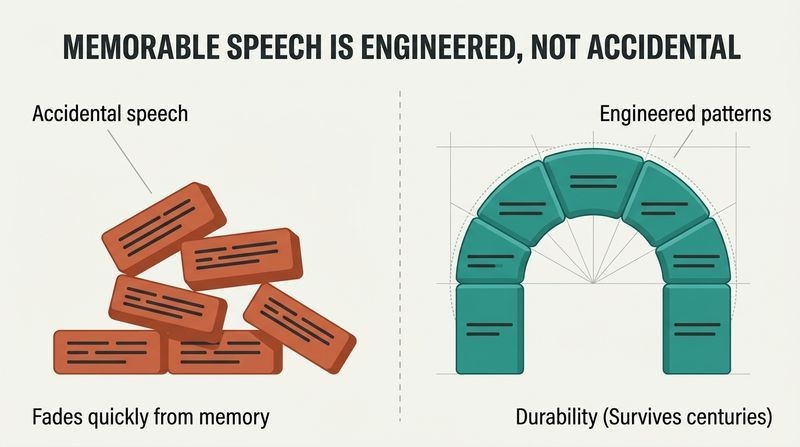
Memorable speech runs on hidden patterns. Farnsworth's premise is that we all arrange words in patterns absorbed unconsciously from the speech around us, but the patterns that make words stick were catalogued by the Greeks and Romans as rhetorical figures. A figure is simply a departure from plain statement: repeating a word, flipping word order, dropping an expected word, asking a question and answering it.
He treats roughly eighteen of the most useful figures, illustrating each with over a thousand examples from Shakespeare, the King James Bible, Lincoln, Burke, Dickens, and Churchill. Metaphor and simile are deliberately left out as too large. His test of quality is durability: these devices cluster in the utterances that outlive their authors, from Churchill's tribute to "so few" to Lincoln's "of the people."
What's striking is how cognitive science backs the claim. Studies of "processing fluency" show that rhythm, repetition, and rhyme make statements feel truer and more memorable, the so-called Keats heuristic and rhyme-as-reason effect. Oral cultures preserved epics precisely through such patterning. Farnsworth's insight predates the research: these are not decorations but mnemonic and persuasive machinery. One caveat worth flagging early is his corpus skews toward 1600 to 1950 literary and oratorical English, so the aesthetic he recovers is high style. The devices transfer to plain modern prose, but readers should adapt rather than imitate the Victorian density on display.
Repeat a word, and where you place it changes everything

Position is the hidden variable in repetition. The simplest figure is repeating a word for emphasis, like Othello's anguished cry of "reputation" three times. But placement transforms the effect. Repeating words at the start of successive clauses (anaphora) hammers and builds rhythm, as in "I have a dream." Repeating them at the end (epistrophe) lands more subtly, revealed only as each clause closes, as in Lincoln's "of the people, by the people, for the people."
Doing both at once is symploce, where only the middle changes, sharpening contrast: a press we should not censor becomes a censorship by the press. Repeating a word at a sentence's start and finish (epanalepsis) closes a loop. Each placement serves a different purpose: hammering, comprehensiveness, contrast, or circuitry.
The deeper principle is that English sentence positions carry unequal weight. The final stressed slot lands hardest, which is why epistrophe often outperforms anaphora for a quiet knockout. Linguists call this end-focus and end-weight: readers instinctively expect the most important information last. Farnsworth intuits what information structure theory formalizes. A useful extension is that repetition also manages attention decay. In long enumerations the repeated stem (Lincoln's "I combat it") reorients a listener who would otherwise lose the thread inside the elaboration. Repetition, then, is not just emphasis but navigation, a handrail through complex thought.
Chain each sentence's last word to the next one's first

Anadiplosis builds an unbreakable-seeming chain. The device repeats the word ending one clause at the start of the next, an ABBC pattern. Franklin's proverb walks the reader down it: for want of a nail the shoe is lost, for want of a shoe the horse, for want of a horse the rider. The repeated links make causation feel inevitable.
It suits three jobs especially:
1. Chains of cause and effect, where one thing visibly produces the next.
2. Chains of reasoning, where a is b and b is c, so a is c.
3. Ascension toward a climax, as impulse grows to wish, wish to desire, desire to longing.
The repeated word lets both feet rest on each stair before stepping up, so the audience feels the progress rather than merely hearing it asserted.
The persuasive danger and power here are identical. By making each link explicit, anadiplosis lends a syllogism emotional momentum that can outrun its logic. Scripture's chain from tribulation to patience to experience to hope is moving but not deductively valid. The form smuggles inevitability into what may be mere sequence, the classic post hoc trap. This is worth remembering as a reader as much as a writer: when an argument marches downhill this smoothly, check whether each handoff is real causation or just verbal adjacency. The device also mirrors how memory actually works, chaining associations, which is why such sequences are unusually easy to recall.
Reverse a phrase's order to make it sound irrefutable
Chiasmus flips word order into an ABBA loop. Kennedy's "ask not what your country can do for you, ask what you can do for your country" is the textbook case. The reversal does three things: it mirrors a genuine reversal of meaning, it creates a closed loop that seems to leave no room for dispute, and it produces the small pleasure of hearing the same words rearranged and still making sense.
It thrives on specific occasions: reversed control (we shape our buildings, then they shape us), reciprocity (and vice versa), matches and mismatches, and stark identities. Farnsworth warns it is the riskiest figure to fake. Force the substance to fit the pattern and it sounds slick and repellent, the hallmark of the teleprompter politician. A structural chiasmus that reverses grammar without repeating exact words reads subtler and safer.
Chiasmus exploits a real cognitive bias: symmetry reads as truth. Because the sentence balances perfectly, the mind extends that sense of balance to the claim itself. Chesterton weaponized this, producing lines that feel unanswerable precisely because they are airtight in form, though often debatable in content. That is the caution. The very feature that makes chiasmus persuasive, its closed loop, is also its rhetorical sleight of hand: it converts a clever inversion into apparent logical necessity. Neuroscience of aesthetic preference suggests humans are drawn to symmetry as a proxy for order and fitness, which may explain why the pattern feels so satisfying and so trustworthy.
Parallel structure makes claims feel equally weighty and true
Isocolon lines up phrases of similar length and matching grammar. Kennedy's "pay any price, bear any burden, meet any hardship, support any friend, oppose any foe" is a cascade of it. The parallel shape produces pleasing rhythm and, more importantly, makes the substance feel parallel too, so a list of claims reads as a unified, considered whole.
Its close cousin is antithesis, parallel phrasing that frames contrasting ideas, as in "married in haste, we repent at leisure." Farnsworth's cautionary tale is Brutus's funeral oration in Julius Caesar: so relentlessly balanced that it sounds overpolished and calculating, which primes the crowd to be swept away by Antony's looser, subtler speech. The lesson is that perfect symmetry can betray effort, and effort undercuts trust.
The Brutus-versus-Antony contrast is the book's sharpest practical warning and deserves emphasis. Rhetorical skill that announces itself defeats persuasion, because audiences discount speakers who seem to be performing. This anticipates modern findings on the "sleeper effect" and source credibility: overt artifice triggers resistance. Isocolon also does real cognitive work by chunking information into equal, digestible units, easing working memory, much as a well-formatted list outperforms a dense paragraph. The tension Farnsworth identifies is permanent: the same parallelism that aids comprehension can, overdone, read as manipulation. Mastery lies in letting variety disrupt the symmetry just enough to sound human.
Set up a pattern, then break it for release and impact
Abandonment is the meta-technique behind all the figures. Establish a repetition or parallel structure long enough to condition the ear's expectation, then drop it at the crucial moment. The relief itself becomes emphasis. Farnsworth compares it to inflating a balloon with short breaths and then letting go: the built-up energy discharges into the final, unpatterned phrase.
Churchill's "we shall fight" passage is the master example. The famous repeated clause comes and goes irregularly, the phrases lengthen and shorten, and the sequence finally abandons the pattern entirely at "we shall never surrender." That internal variety, not the repetition alone, gives the passage its improvised passion and force. The same principle animates the whole book: repetition and variety, suspense and relief, expectation created and then satisfied or frustrated.
This is arguably the book's single most transferable idea, and it maps cleanly onto how music and comedy work. A groove must be established before a syncopation can register; a joke's setup builds the expectation the punchline violates. The neuroscience of pleasure implicates prediction error: the brain rewards a pattern confirmed just enough and then surprised. Farnsworth is describing, in prose terms, the same dopaminergic economy. The practical takeaway for any writer is counterintuitive: perfect regularity is forgettable. Build the cage precisely so the escape has somewhere to escape from. Structure exists to be strategically betrayed.
Stretch and shrink your phrases to build rhythmic drama
Length variation, or oscillation, turns lists into music. Within a parallel series, deliberately varying how long each unit runs creates momentum. Lengthening the final phrase releases contained energy and unfurls toward climax. Shortening the phrases produces acceleration and a sharpening point. A classic pattern starts with parallel long clauses, compresses into a rush of short single words, then finishes with one long elaborate phrase, a grow-shrink-grow arc that Dickens and Melville used to great effect.
Burke did this deliberately, lengthening the parts of a sentence syllable by syllable so the finale arrives with maximum weight. The point is that rhythm is not decoration layered on meaning; the physical shape of the sentence, its expansions and contractions, is felt by the reader as tension and resolution mirroring the content.
Prosody research supports the instinct. Skilled readers and listeners track sentence rhythm subconsciously, and variation in unit length prevents the monotony that dulls attention. This is why a string of same-length sentences reads flat regardless of content, a lesson formalized in Gary Provost's famous demonstration of sentence-length variety. Farnsworth's contribution is showing that the effect scales down to phrases within a single sentence. One extension: the grow-shrink-grow arc resembles musical phrasing and even the shape of a well-told anecdote, setup, staccato beats, payoff. Writers who read their drafts aloud are really auditing this hidden rhythmic architecture.
Use conjunctions as a throttle to speed up or slow down
Adding or dropping "and" controls pace and weight. Polysyndeton, piling on extra conjunctions, can slow an utterance to a solemn march or, paradoxically, speed it into breathless excitability, depending on context. It gives each item its own moment (a tutor, and a counselor, and a physician) and echoes the biblical cadence of "and God said... and it was so." It also makes a list sound spontaneous, as if the speaker keeps thinking of more.
Asyndeton, omitting conjunctions, does the opposite and the similar. Leaving out the connectors accelerates the flow and suggests each word is a restatement or upgrade of the last, as though stronger words keep occurring to the speaker. Lincoln's "we cannot dedicate, we cannot consecrate, we cannot hallow" gains its gravity from the missing "and." Both devices work by treating every item alike.
The neat symmetry here is that opposite techniques produce overlapping effects, because both replace the ordinary comma-with-final-and rhythm that signals a list winding down. Removing that signal, whether by flooding or starving the sentence of conjunctions, keeps the series feeling open-ended and emphatic. This connects to punctuation as breath-notation: Caesar's "veni, vidi, vici" hits hard precisely because asyndeton refuses the pause a conjunction would insert. A modern application is in advertising and speechwriting, where clipped asyndeton conveys decisiveness and polysyndeton conveys abundance. The choice encodes attitude, not just rhythm, which is why the same list can feel urgent or overwhelming depending on the connectors.
Invert or omit words to add weight and delay your point
Anastrophe puts words in unexpected order. Moving an object to the front or an adjective after its noun ("reasoning weak, rotten, and sophistical") lends emphasis and heightened tone. It also enables the periodic sentence, one whose meaning stays incomplete until the final words, creating suspense the loose sentence lacks. Yoda is the modern mascot, but Dickens and Burke used it to make endings land.
Ellipsis leaves out expected words, trusting the reader to supply them. "Talent, Mr. Micawber has; capital, Mr. Micawber has not" omits nothing essential yet gains density and force. Often a later clause borrows a verb from an earlier one, binding the two together. Both devices share a logic: the audience participates, filling the gap or holding the suspense, and that participation makes the sentence stickier.
Both figures exploit reader involvement, which memory research links to the "generation effect": we retain information we help produce better than information handed to us complete. An elliptical sentence recruits the reader as co-author of its missing word. The periodic sentence, meanwhile, weaponizes the Zeigarnik effect, our tendency to fixate on unfinished tasks; the unresolved grammar keeps attention taut until the payoff. The tradeoff Farnsworth is honest about is cognitive load. English speakers, trained on loose sentences, tire of held-back meaning quickly, which is why German and Latin verb-final structures feel alien. Deploy suspense in short bursts, not paragraphs.
Say the forbidden thing by loudly refusing to say it
Indirection can be more powerful than assertion. Praeteritio names something while claiming to pass over it: "I will not mention his cowardice." The speaker gains credit for discretion while planting the very idea, and shifts the burden of proof by offering the charge only half-said. Mark Antony's "I come to bury Caesar, not to praise him" is the celebrated case, since he proceeds to praise him into a riot.
Aposiopesis breaks a sentence off mid-thought, letting silence or the listener's imagination finish it, as in a threat that trails into "or else..." Litotes affirms by denying the opposite, so "not unhappy" occupies a precise middle ground pure affirmation cannot. Orwell mocked the tic ("a not unblack dog"), but used well it enables understatement, discretion, and irony that direct statement would coarsen.
These figures reveal rhetoric's psychological subtlety: what is withheld or negated often lands harder than what is declared. Praeteritio is the ancestor of the modern non-denial denial and the "I'm just asking questions" gambit, which is why it reads as slippery when the discretion is obviously feigned. Litotes carries genuine semantic value that critics miss: two negatives do not perfectly cancel, so "not uncommon" truthfully marks a zone between rare and frequent. Politeness theory explains why understatement flourishes in cultures prizing indirection, notably British English, where saying less signals both tact and confidence. The reader's imagination, once invited in, tends to exaggerate.
Ask the questions yourself so you control the answers
Questions can persuade more than statements. A rhetorical question (erotema) implies its own answer and dares the listener to disagree, quietly shifting the burden of proof onto the audience. Hypophora goes further: the speaker poses a question and answers it, as in Churchill's "You ask, what is our aim? I can answer in one word: it is victory." This manufactures suspense, supplies a motive for what comes next, and lets the speaker pick which objections get aired.
Prolepsis anticipates an objection and rebuts it before the opponent can raise it, defusing counterarguments and projecting open-handedness. The catch is that the speaker chooses the questions, so they are rarely the toughest ones. Strung together, these devices create a sense of dialogue and momentum while keeping the speaker firmly in command of the exchange.
These are the persuasion techniques most alive in modern discourse, from courtroom summations to op-eds. Rhetorical questions work because of the self-persuasion effect: an answer the listener generates internally is more convincing than one imposed. Hypophora and prolepsis map onto "two-sided" messaging, which communication research finds more durable than one-sided appeals because pre-empting objections inoculates the audience against later counterarguments. The manipulation risk is real and worth naming: by controlling which objections surface, a speaker can perform fairness while dodging the strongest challenge, a rhetorical straw man in question form. A sharp listener's defense is to ask what question was conspicuously not answered.
Forced or overdone, any figure curdles into cliché
The devices only work when they seem unstudied. Farnsworth's governing warning is that figures collapse under three abuses. First, using them to dress up trivial content: a splendid pattern wrapped around a dull claim merely amplifies the dullness. Second, overdoing it, since too much ornament in any art repels more than too little. Third, sounding rehearsed, because a figure that announces itself as a freshly learned trick kills the spontaneity that gives it life.
Mastery comes from immersion, not imitation. Studying a few examples breeds clumsy copying; steeping in hundreds lets the shapes become instinct, so words assemble into patterns on their own when the occasion calls. And occasion is everything: some figures fit only certain feelings or genres, and some are useful once in a lifetime, so one simply wants to be ready.
This is the book's quiet philosophy and its most humane point. Technique divorced from substance and sincerity becomes the "tinny" quality Farnsworth hears in teleprompter oratory. The paradox he confronts, how to teach devices that succeed only when they seem spontaneous, resolves through the same mechanism as musical or athletic skill: deliberate practice until conscious rules submerge into automaticity, what psychologists call procedural fluency. The deeper claim is ethical. Rhetoric worthy of the name serves worthy sentiment; deployed on empty content it corrodes trust in language itself. In an age of algorithmic content and slogan politics, that warning about ornament without substance reads as unexpectedly urgent.
Analysis
Farnsworth's project is quietly radical: it treats style not as ineffable talent but as a catalog of learnable moves, while insisting those moves die the moment they look learned. This is the book's central tension and its intellectual signature. It sits in a lineage running from Quintilian and the Rhetorica ad Herennium through Renaissance manuals like Peacham's Garden of Eloquence, but it breaks with them methodologically. Where the ancients offered terse definitions and a few examples, Farnsworth bets everything on immersion, more than a thousand specimens curated for taste rather than taxonomy. He explicitly refuses the scholastic hair-splitting between schemes and tropes, figures of speech and figures of thought, treating such distinctions as pedantry that impedes use.
The deeper argument, mostly implicit, is that a handful of aesthetic primitives govern all the figures: repetition and variety, suspense and relief, concealment and surprise, expectation created then honored or betrayed. Read this way, the eighteen chapters are not eighteen tricks but eighteen applications of maybe four principles to the sentence. That reframing is the book's most useful gift, and it aligns strikingly with cognitive science Farnsworth never cites: fluency effects, prediction-error reward, end-focus, the generation effect. He arrives by connoisseurship where psychology arrives by experiment.
The limitations are honest ones. The corpus is overwhelmingly white, male, Anglo-American, and pre-1950, so the recovered tradition is a particular high style, not a universal one. The relentless Victorian density can mislead a modern writer toward purple excess, precisely what Farnsworth's own restraint chapter forbids. And his political asides, jabs at the "modest literacy" of contemporary politicians, betray a nostalgia that romanticizes an earlier oratory whose sincerity was hardly guaranteed. Still, the core claim endures: durable prose is patterned prose, the patterns are finite and teachable, and the difference between eloquence and manipulation is whether the pattern serves something worth saying.
Review Summary
Farnsworth's Classical English Rhetoric is highly praised for its comprehensive collection of rhetorical devices with numerous examples from classic literature and speeches. Readers appreciate its educational value, clear explanations, and wealth of quotations from renowned authors and orators. The book is considered an invaluable resource for writers, speakers, and language enthusiasts, offering insights into the art of persuasive communication. While some find it dense, most reviewers commend its usefulness as a reference guide and its potential to enhance one's writing and speaking skills.
People Also Read





FAQ
What's Farnsworth's Classical English Rhetoric about?
- Focus on Rhetorical Figures: The book delves into classical English rhetoric, emphasizing rhetorical figures that enhance writing and speaking.
- Historical Context: It explores how these figures were historically used by notable writers and speakers, highlighting their enduring relevance.
- Practical Application: Farnsworth aims to equip readers with the skills to apply these techniques in their own communication efforts.
Why should I read Farnsworth's Classical English Rhetoric?
- Enhance Communication Skills: The book is a valuable resource for improving rhetorical skills, beneficial for writers and public speakers.
- Accessible Learning: Farnsworth presents complex concepts in an engaging and understandable way, suitable for all learning levels.
- Rich Examples: It includes over a thousand illustrations from historical speeches and literature, providing practical examples of rhetorical figures.
What are the key takeaways of Farnsworth's Classical English Rhetoric?
- Understanding Rhetorical Figures: Readers will learn about various rhetorical figures like anaphora, chiasmus, and isocolon.
- Application in Writing: Mastering these figures can lead to more emphatic and effective communication.
- Historical Appreciation: The book fosters a deeper appreciation for rhetorical traditions in English literature and oratory.
What are some key rhetorical figures discussed in Farnsworth's Classical English Rhetoric?
- Anaphora: Repetition of a word or phrase at the beginning of successive clauses, creating rhythm and emphasis.
- Chiasmus: Reversal of structures in clauses to enhance contrast or relationship between ideas.
- Isocolon: Use of parallel structure in phrases or clauses to reinforce connections between ideas.
How does Farnsworth's Classical English Rhetoric define rhetoric?
- Broad Definition: Rhetoric is defined as "the use of language to persuade or otherwise affect an audience."
- Historical Roots: The book traces rhetoric's origins to ancient Greece and Rome, illustrating its evolution.
- Practical Importance: Understanding rhetoric is essential for effective communication in various contexts.
What methods does Farnsworth's Classical English Rhetoric suggest for studying rhetorical figures?
- Deliberate Practice: Readers are encouraged to practice using rhetorical figures in their writing and speaking.
- Immersion in Examples: The book advocates for studying historical examples to see effective use of these figures.
- Moderation and Restraint: Farnsworth advises using figures with moderation to avoid sounding forced.
How does Farnsworth's Classical English Rhetoric address the decline of rhetoric in modern times?
- Cultural Shift: The decline reflects broader cultural changes towards simpler communication forms.
- Importance of Recovery: Farnsworth argues for recovering classical techniques to enhance modern communication.
- Timeless Nature of Rhetoric: Despite challenges, rhetorical principles remain relevant and beneficial.
What is polysyndeton and how is it used in rhetoric according to Farnsworth?
- Definition of Polysyndeton: It involves the deliberate use of multiple conjunctions in close succession.
- Purpose and Effect: This device can slow down a statement's pace, emphasizing each item individually.
- Examples in Literature: Farnsworth provides examples showing how it conveys excitement or urgency.
How does Farnsworth illustrate the use of chiasmus in classical rhetoric?
- Definition of Chiasmus: A rhetorical figure where clauses are balanced by reversing their structures.
- Examples from Literature: Famous examples like JFK's speeches showcase its power in memorable speechmaking.
- Impact on Persuasion: Chiasmus enhances a statement's persuasive quality by making it engaging and memorable.
What role does hypophora play in effective communication as discussed in the book?
- Definition of Hypophora: A device where a speaker poses a question and immediately answers it.
- Creating Suspense: It creates suspense, resolved when the answer is provided, keeping the audience engaged.
- Encouraging Audience Involvement: Hypophora invites the audience to think about the question, fostering connection.
How does Farnsworth address the concept of metanoia in the book?
- Definition of Metanoia: A device of correcting oneself to refine or strengthen a statement.
- Purpose and Effect: It emphasizes the revised statement, making it more impactful.
- Examples in Use: Farnsworth provides examples where metanoia clarifies or enhances the message.
What is the significance of the historical context provided in Farnsworth's Classical English Rhetoric?
- Understanding Tradition: Historical context helps appreciate the evolution and significance of rhetorical techniques.
- Learning from Masters: Studying historical figures offers valuable lessons in persuasion and language power.
- Cultural Relevance: Farnsworth's exploration underscores rhetoric's ongoing relevance in contemporary contexts.
About the Author
Other books by Ward Farnsworth

Download PDF
Download EPUB
.epub digital book format is ideal for reading ebooks on phones, tablets, and e-readers.








