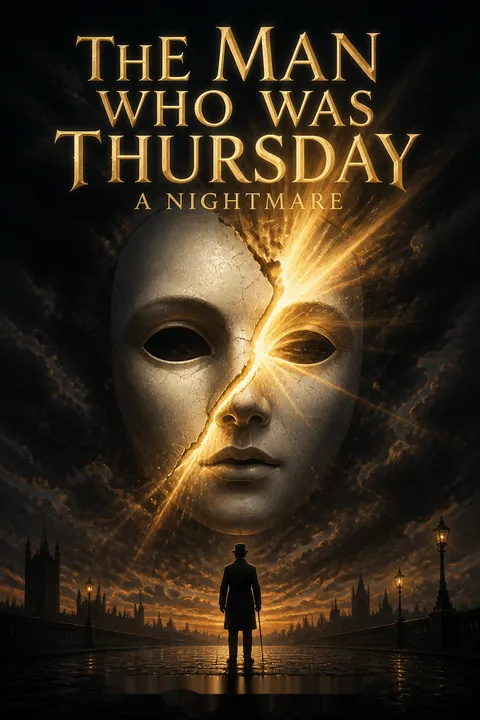


Plot Summary
Two Poets, One Fuse
In the bohemian London suburb of Saffron Park, the red-haired poet Lucian Gregory argues that art and anarchy both thrive on breaking rules. Gabriel Syme, a mild-looking poet who admires order, counters that a train reaching its appointed station is more astonishing than chaos. Gregory takes the disagreement personally.
His sister Rosamond, who worries that her brother’s radical talk may be more than performance, asks Syme to judge how serious he is. Later, Gregory waits outside in the dark and admits that he belongs to a secret anarchist group. Syme doubts him, so Gregory proposes a visit to the group’s headquarters. Syme agrees after promising not to tell the police what he learns, unaware that the promise will soon entangle them both.
The opening makes argument a form of intimacy and a test of character. Gregory’s anarchism is not just a platform; Syme’s challenge exposes the distance between his theatrical language and the possibility of real commitment. Syme, meanwhile, defends order in deliberately comic terms, treating ordinary reliability as a human achievement rather than a dull default. Rosamond’s concern grounds their abstractions in family feeling: she is less interested in winning the debate than in knowing whether Gregory is safe. The promise Syme makes turns curiosity into obligation, establishing the story’s recurring bind between moral conduct and practical danger.
The Secret Policeman
Gregory brings Syme to a shabby pub, where their table descends through the floor into an armed underground chamber. There Gregory explains that his group seeks to erase the distinction between right and wrong, not merely overthrow a government.
He expects to be elected Thursday, a seat on the European anarchist council. Syme asks Gregory to promise equal secrecy, then reveals that he is a detective in a special police unit built to stop intellectual conspiracies.
Their confidences cancel each other: neither can expose the other without breaking his word. When the other anarchists arrive, Gregory cannot identify Syme as a policeman without betraying his own promise. Syme must therefore enter the meeting alone, surrounded by men who believe he is one of them.
The underground chamber converts Gregory’s rhetoric into material danger: weapons, bombs, passwords, and guarded passages give the abstract argument a physical cost. Yet Syme and Gregory are not simple opposites. Each is bound by an oath made to someone he distrusts, and each uses the other’s honor as a kind of restraint. The scene’s irony depends on that restraint being real. Syme cannot fall back on institutional support, while Gregory cannot protect himself by exposing his guest. Their predicament establishes a moral logic in which conduct matters even when the people involved disagree about the foundations of morality.
Thursday Takes the Seat
The anarchist council meets to replace its dead Thursday, and Gregory expects the members to elect him. When Gregory gives a deliberately soothing account of the group, Syme sees that the room wants a more forceful candidate. He denounces Gregory’s moderation and presents himself as a man ready to act against society. The speech catches the council’s appetite for severity, and Syme is elected Thursday.
Gregory tries to stop the vote, but cannot explain his alarm without exposing Syme’s secret. Syme takes the council’s cloak, sword-stick, revolver, and proof of office, then leaves by river tug. He has gained access to the group’s highest circle, but the oath he made to Gregory still prevents him from summoning the police.
Syme wins by performing the very extremity he opposes. His success shows how easily political identity can be mistaken for conviction when an audience rewards style over evidence. Gregory’s silence is not consent: he recognizes the danger but is bound by his promise, so his knowledge becomes useless at precisely the moment it matters most. The election also reverses the usual relation between disguise and truth. Syme’s role as an anarchist is false, yet the courage required to inhabit it is genuine. The scene makes the novel’s central tension practical: moral sincerity must operate inside systems built to reward deception.
Breakfast Above Leicester Square
Syme’s fear of anarchism began after he witnessed the human cost of a bombing, and a policeman recruited him into a covert corps trained to detect political ideas before they became crimes. Now, as the newly appointed Thursday, he joins the council at a public balcony breakfast in Leicester Square.
Its members include the gaunt Secretary, the disheveled Gogol, the Marquis de St. Eustache, the frail Professor de Worms, and the spectacled Dr. Bull.
Their huge President, Sunday, watches Syme while the others discuss killing the Czar and the French president in Paris. Syme considers seeking help from a policeman below, but his promise to Gregory holds him back. Sunday then moves the conspirators to a private room and announces that a traitor is among them.
The council’s public breakfast makes concealment look like a performance of normality. The plot is discussed over food in full view of strangers, while Syme’s genuine danger comes not from secrecy alone but from Sunday’s unblinking attention. The ordinary policeman below offers a possible escape, yet Syme refuses it because he has made a promise to an adversary. That choice complicates his loyalty to law: he is not simply obeying an institution but honoring a personal commitment when it becomes costly. Sunday’s accusation shifts the scene from surveillance to judgment, exposing how little Syme can know about the people around him.
Gogol’s Card Betrays Him
Syme braces for Sunday to name him, but the President accuses Gogol instead. Gogol draws pistols before the others seize him; Sunday demands to see what he carries. Gogol produces a blue police card, removes his false beard, and leaves as a detective who had infiltrated the council. The relief is brief.
Sunday tells the remaining members to let Dr. Bull handle the Paris operation, then warns the Secretary that a spy might still be listening. Syme cannot tell whether Sunday suspects him. In the falling snow, he tries to escape the council’s orbit, but Professor de Worms keeps appearing behind him: outside a shop, in a restaurant, in a tea room, and even on a moving omnibus.
The first exposure reassures Syme and then immediately undermines his confidence: another detective was present, but that does not prove Sunday has failed to identify him. The blue card turns an abstract suspicion into a concrete token, yet even proof of identity provides no dependable safety. Syme’s flight through snow gives uncertainty a bodily form. De Worms seems physically incapable of keeping pace, so each reappearance makes ordinary explanations feel less persuasive. The sequence shows how paranoia feeds on gaps between what a person sees and what seems possible, while Sunday’s control of information keeps Syme from knowing whether he is hunted or merely afraid.
The Cripple Is Wilks
At a dockside tavern, de Worms asks Syme directly whether he is a detective. Syme denies it, and the old man reveals that he is one too, carrying a matching blue card. The apparent invalid is Wilks, an actor hired after his successful imitation of the real Professor de Worms attracted the police. Syme finally has an ally, though both men remain frightened of Sunday.
Wilks explains that Dr. Bull knows the Paris arrangements and takes Syme to a tower of flats where Bull lives. Before they confront him, Wilks teaches Syme a finger-tapping code for secret messages. At Bull’s door, the supposed Professor falls silent and communicates only by taps, forcing Syme to trust the hand signals rather than the convincing face.
Wilks’s disguise begins as a theatrical joke and becomes a working identity that he can no longer easily set aside. His revelation relieves Syme’s isolation, but the relief does not erase their fear of Sunday; solidarity gives them company, not certainty. The finger code sharpens this distinction. It lets the men share information in hostile company, while its awkwardness reminds them that trust must be constructed through small, verifiable acts. Wilks’s false body and true allegiance also prepare the reader for a world where appearances are neither reliable evidence nor meaningless decoration. A disguise can deceive, protect, and slowly reshape the person wearing it.
Bull Removes His Spectacles
Dr. Bull receives Syme and Wilks in his bare garret, smiling behind dark spectacles while Wilks struggles to make him disclose the Paris plan. Syme suspects that the glasses create the menace, asks Bull to remove them, and sees the cheerful face of a young clerk. Bull reveals that he is another detective, and that Sunday forced him to send the Marquis to France while keeping him under watch.
The three men compare blue cards and realize that several supposed anarchists are undercover officers. They cannot call in the police: Syme has promised Gregory, Wilks has his own oath, and Bull will not betray the miserable Secretary. They cross the Channel together, aiming to delay the Marquis until the Paris train is gone.
Bull’s spectacles make perception itself the problem: the same face reads as sinister or harmless depending on a small obstruction. Syme’s intuition solves the immediate puzzle, but it does not grant mastery over the larger one. The three detectives discover that shared allegiance cannot simplify their choices, because each has made a binding promise to someone on the opposing side. Their decision to act without police support turns conscience into a practical handicap, but also into the only stable ground they possess. The scene asks whether moral consistency remains meaningful when every available action appears to endanger someone.
The Marquis Has No Blood
Syme invents a pretext to challenge the Marquis de St. Eustache, then arranges the duel for a time that should make him miss the train to Paris. In a flowered meadow, the Marquis fights with startling skill as a locomotive approaches.
Syme’s sword repeatedly strikes him without leaving blood; at last, the Marquis removes his false nose, brows, and face. He is Inspector Ratcliffe, a detective who had been sent to France as the supposed bomb carrier.
Ratcliffe explains that Sunday arranged the council so the officers would watch one another while powerful interests escaped their notice. The six men had mistaken a network of police disguises for a council of genuine anarchists, leaving Sunday free to direct the game. The approaching crowd now threatens to close around them.
The duel turns a political chase into a test of what counts as evidence. Syme’s blade seems to prove that the Marquis is inhuman, but the explanation is an elaborate disguise, not a supernatural body. That does not make the danger unreal: Syme has risked death because both sides have mistaken appearance for allegiance. Ratcliffe’s account widens the deception from individual masks to an entire structure of surveillance, where every officer’s attention has been diverted toward another officer. The chapter’s irony is severe. The men have successfully infiltrated their enemy, yet their mutual suspicion has made that success useless.
Lancy Turns Against Them
Ratcliffe leads the group through the woods toward the coast, where a peasant gives them a cart and a priestly innkeeper provides horses. At Lancy, Colonel Ducroix persuades his wealthy friend Dr. Renard to lend a motor car.
The Secretary, apparently leading the pursuers, rides at them, but Syme starts the car and drags him from his saddle. Their escape fails when Renard’s other cars arrive full of masked men and the town turns against them. Trapped between an armed crowd and pursuing riders, the detectives crash onto the seafront and retreat along a breakwater.
Syme knocks Ducroix down when the Colonel appears to have joined the enemy, then the Secretary removes his mask and identifies himself as a police officer. He had believed the others were real anarchists.
The flight strips away the comfort of assigning trust by class, profession, or appearance. Renard’s wealth and civility do not prevent him from joining the hostile force; the innkeeper’s apparent kindness cannot guarantee safety either. Yet the townspeople are not revealed as committed anarchists. They attack because they have mistaken the detectives for the threat, while the Secretary makes the same error from the opposite direction. This symmetry matters: the group is endangered not by a single villainous crowd but by a chain of false identifications. Syme’s blow against Ducroix shows the human cost of acting before certainty is possible.
Sunday Escapes By Air
Back in London, the six reunited detectives return to Leicester Square to demand an explanation from Sunday. He identifies himself as the mysterious chief who recruited them, then vaults from the balcony and escapes in a cab. Syme follows, joined by the others in separate vehicles.
Sunday lashes the cab horse himself, transfers to a passing fire engine, and finally rides an elephant out of the zoo. At each stage he leaves baffling notes for his pursuers. The elephant reaches the Earl’s Court Exhibition, where Sunday vanishes into the crowd and escapes in a captive balloon.
The detectives abandon their cabs and follow on foot across the fields, watching the balloon drift toward the countryside. Their quarry is still ahead, but the chase has turned into a shared journey.
Sunday’s flight makes authority impossible to pin down. He moves through London’s transport and public amusements as if each institution were another costume, forcing the detectives to pursue him without knowing whether they are arresting, confronting, or being entertained by him. His notes do not provide useful clues; they deepen the sense that he controls the meaning of the chase as well as its pace. Yet the escape also changes the group. The men who had been isolated by secrecy now travel together, arguing about Sunday rather than suspecting one another. Their cohesion is real even though the purpose of the pursuit remains unresolved.
The Accuser Returns
The balloon descends near a country house, where servants escort the exhausted detectives to rooms, food, and costumes representing the days of creation. At a garden revel, they take their places in seven ceremonial chairs, and Sunday appears in the central seat.
He describes their long struggle as a trial of courage and calls himself the Sabbath and God’s peace. Gregory then arrives as the one true anarchist, accusing the seated men of never having suffered.
Syme answers that their ordeals have earned them the right to reject that charge, then asks whether Sunday has suffered too. Sunday’s immense face fills Syme’s vision, and he loses consciousness. He next finds himself walking near Saffron Park with Gregory. Dawn has come, and Rosamond is cutting lilac in the garden.
The final gathering recasts the disguises as costumes that reveal rather than conceal: each detective is assigned a day, and the frantic political plot opens into a creation story. Gregory’s accusation gives the finale its ethical pressure. He does not dispute that the men defend order; he challenges their right to judge revolt without knowing suffering. Syme’s answer depends not on victory but on having endured fear and isolation himself. Sunday’s unanswered question prevents the scene from becoming a simple explanation. The return to Saffron Park restores ordinary life without fully dissolving the dream, suggesting that consolation comes through renewed attention to the familiar, not through complete mastery of mystery.
Analysis
The novel builds its suspense by making moral and physical uncertainty reinforce each other. Syme enters the anarchist council believing that his task is to identify enemies; instead, each supposed enemy may be an ally, while Sunday’s purpose remains beyond the group’s grasp. The repeated reversals do not make truth irrelevant. They make conduct more important, because the characters must decide whether to keep promises, defend strangers, or risk acting on incomplete knowledge.
The book’s treatment of anarchy is deliberately concrete. Its argument is staged through a bomb plot, disguises, a duel, a chase, and a besieged breakwater, not left as abstract debate. Syme’s defense of order rests on ordinary lives and habits, while Gregory’s rebellion grows from a grievance about power that he experiences as invulnerable. Their final confrontation matters because Gregory accuses the defenders of law of judging suffering from a position of safety. Syme can answer only by recalling the fear and isolation that the adventure has forced on him.
Sunday concentrates the book’s contradictions. He appears at once threatening and playful, powerful and buoyant, a pursuer and a figure who seems to invite pursuit. The ending gives him religious language but withholds a tidy explanation of his nature. This keeps the resolution from reducing the preceding adventure to a solved puzzle. Instead, the detectives’ ordeal has changed how they interpret danger, loyalty, and ordinary life. The return to Saffron Park and Rosamond’s garden restores a familiar human scale after the city’s theatrical chaos. Dawn does not prove that every mystery has vanished; it makes the commonplace newly visible as something worth defending.
Review Summary
The Man Who Was Thursday receives mixed but largely positive reviews, with readers praising Chesterton's wit, philosophical depth, and surreal narrative style. Many compare it to Alice in Wonderland for adults, noting its dreamlike quality and Christian allegory. Reviewers appreciate the absurdist humor, brilliant prose, and unexpected plot twists involving undercover detectives infiltrating an anarchist council. Some find the ending confusing or heavy-handed with religious symbolism. The book's exploration of good versus evil, reality versus appearance, and its prescient themes about terrorism resonate with modern readers. While some struggle with its dated elements and philosophical density, most agree it's an entertaining, thought-provoking classic that influenced later surrealist and magical realist writers.
People Also Read





Characters
Gabriel Syme
The order-loving poetSyme is mild in manner and fierce in conviction, a poet whose delight in timetables and ordinary decency hides an appetite for danger. A childhood surrounded by fashionable rebellion taught him to distrust ideas that treat destruction as sophistication. He sees social order not as a dull constraint but as the fragile work of human beings choosing to keep promises and protect one another. His imagination can turn a routine journey into an adventure, but it can also make threats feel cosmic. Syme’s defining struggle is to act bravely without pretending he is fearless, and to preserve his moral obligations even when they make his task harder.
Lucian Gregory
The anarchist poetGregory is a red-haired poet and public advocate of anarchy, gifted at making radical ideas sound vivid and alluring. He wants to be taken seriously, especially by people who assume his talk is only theatrical provocation. His relationship with Syme begins as a contest of ideas but becomes an uneasy bond shaped by mutual promises. Gregory’s self-presentation is flamboyant, yet his conviction is not merely a pose; beneath the performance lies an intense resentment of the security and authority he believes others take for granted. His sister Rosamond’s concern suggests a more vulnerable life behind his public image.
Sunday
The colossal presidentSunday presides over the anarchist council with immense physical presence, easy humor, and an authority that unsettles even his closest followers. He favors bold schemes and public displays of normality, leaving others uncertain whether his apparent carelessness is strategy or something stranger. His attention can make a room feel exposed, yet he is also capable of playful, almost childlike behavior. The novel keeps his motives difficult to classify: he inspires fear without fitting neatly into the role of a conventional political villain. Sunday functions as a test of the other characters’ assumptions about power, goodness, danger, and the nature of the world.
Rosamond Gregory
Gregory’s watchful sisterRosamond shares her brother’s striking red hair but meets his radical performances with affection and skepticism. She worries that Gregory’s public provocations might conceal genuine danger, and her concern brings the story’s political argument back to the consequences for people who love him. Her brief encounter with Syme gives him an early glimpse of a more personal stake beneath the debate.
Professor de Worms
The uncanny elderProfessor de Worms appears to be a frail, nearly helpless council member whose age and infirmity make him seem vulnerable. His presence unsettles Syme because his movements do not always fit what his body appears capable of doing. He belongs to the council’s theatrical world of disturbing contrasts, where a person’s visible weakness may not tell the whole story.
Dr. Bull
The unreadable doctorDr. Bull is a brisk, robust physician whose dark spectacles give his otherwise ordinary face a sinister cast. He is practical, quick to act, and less attached to grand theories than several of the council members. His good humor persists under pressure, and his instinctive sympathy for ordinary people complicates the group’s grim assumptions about human nature.
Gogol
The tragic TuesdayGogol is introduced as a shaggy, tragic-looking member of the council who struggles to perform its expected air of respectable secrecy. His emotional directness makes him appear out of place among the other conspirators, and Sunday frequently mocks his lack of subtlety. Gogol’s discomfort with deception gives the council’s masquerade a visible crack.
Inspector Ratcliffe
The pessimistic inspectorRatcliffe is a guarded man whose pessimism often anticipates the dangers the others would rather dismiss. He brings a clear-eyed understanding of how power can extend through wealth, communications, and organized force. His restraint can seem bleak, but it is rooted in an effort to describe threats accurately rather than soothe his companions with easy optimism.
The Secretary
The tortured secretaryThe council’s Secretary is thin, intellectually intense, and marked by a crooked smile that makes his composure seem unstable. He treats the group’s rules with grave seriousness, even when its conduct becomes absurd. His austere manner suggests a man burdened by ideas as much as by duty, and his severity makes him one of the most unsettling figures around Sunday.
Colonel Ducroix
The gallant French colonelDucroix is an elderly French officer whose manners remain courteous even when events become implausible. He helps Syme’s party navigate the countryside and offers practical knowledge, social connections, and old-fashioned courage. His instinct is to act according to honor, even when he lacks a reliable account of who deserves his trust.
Dr. Renard
The wealthy physicianRenard is a prosperous doctor and friend of Colonel Ducroix, known for a richly furnished house and a collection of motor cars. His calm professional manner initially makes him seem a reliable ally to the fugitives.
Wilks
The actor in disguiseWilks is an actor whose talent for imitation draws him into dangerous police work. He approaches disguise as a craft, carefully studying how a body can communicate character. His humor and willingness to confide help Syme endure the loneliness of undercover life, though the role he performs continues to shape his manner.
Plot Devices
The weekday council
Masks within masksThe anarchist council assigns each member a weekday name, turning its hierarchy into a compact system of aliases. The titles let conspirators conceal personal identities, but they also make the characters seem like pieces in a larger design. As officers and supposed anarchists mistake one another for enemies, the weekday scheme carries the central irony of the plot: people can share a purpose while remaining unable to recognize it. The names also prepare the final creation-day imagery, when the detectives’ assigned days become part of the country-house ceremony.
Blue police cards
Identity made tangibleThe small blue cards identify members of the special police corps. Because the characters cannot safely call on ordinary police support, the cards become rare pieces of evidence that can verify an ally’s claim. Their discovery repeatedly changes the meaning of a scene: a supposed anarchist may prove to be an officer, while a familiar disguise may conceal a colleague. The cards offer certainty about membership, but not about motive, strategy, or Sunday’s larger purpose.
The secrecy oaths
Honor under pressureSyme promises Gregory that he will not report the anarchist cell, and Gregory promises not to expose Syme to the conspirators. Later, other detectives also find themselves constrained by promises made during undercover work. These vows prevent easy appeals to authority and force the characters to solve immediate dangers with limited help. The device makes honor more than an abstract virtue: keeping a promise can protect an enemy, expose the speaker to danger, and still feel morally necessary.
Disguised appearances
Faces that misleadFalse beards, spectacles, masks, and the Marquis’s removable features turn identity into a physical performance. The disguises are often comic, but they produce real consequences: Syme mistakes allies for threats, attackers mistake police for anarchists, and characters become trapped in roles they once chose to imitate. The device also shapes the book’s deeper uncertainty. Appearance can lie, yet it cannot simply be ignored, since the characters must act before they can know what lies beneath it.
About the Author
Other books by G.K. Chesterton

Download PDF
Download EPUB
.epub digital book format is ideal for reading ebooks on phones, tablets, and e-readers.








