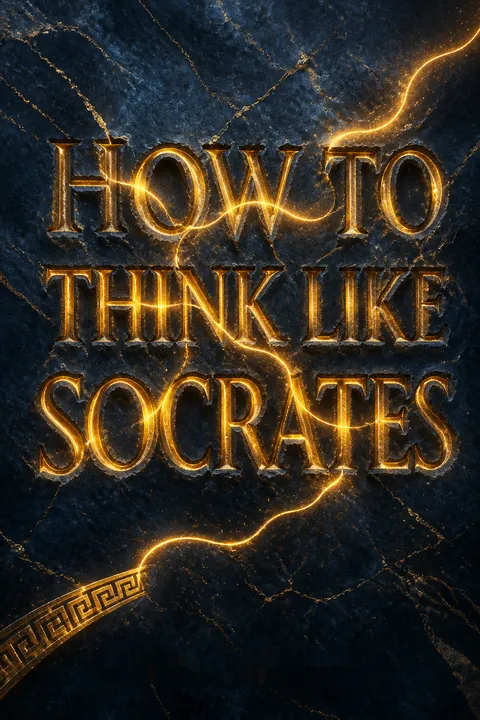


Key Takeaways
Use questions as a compass, not advice as a script
Wisdom takes practice. This book presents philosophy not as a store of answers but as a way to examine beliefs, values, and choices. Its Socrates questions people who claim expertise, testing whether their confidence rests on understanding or merely a polished opinion. Ancient Sophists sold training for public success; modern self-improvement figures can play a similar role when they offer appealing rules without teaching people how to judge when those rules apply.
The story has limits. The Socrates here is a dramatized character assembled from ancient sources, not a reliable transcript of the historical man. The author adapts dialogues and events to make their ideas accessible, while arguing that their questions can still be useful. Books and teachers can offer tools, but the reader must test them against reason and lived circumstances.
What's striking is the shift from consuming advice to building judgment. It resembles the difference between memorizing a route and learning to navigate: a rule can help in familiar terrain, but judgment matters when conditions change. This does not make expertise or guidance dispensable. Medical and technical knowledge often require trained specialists. The Socratic challenge is narrower and valuable: expertise in a subject does not automatically confer wisdom about what deserves priority, or what makes a life good.
Define flourishing before you optimize your life
Start with the destination. The Greek term eudaimonia means living well or flourishing, not simply feeling cheerful. Socrates asks people to identify what makes a life good before chasing wealth, status, health, or knowledge. These may help, but they are not automatically good in themselves. A fortune matters through its use; a reputation matters through what it enables someone to do.
Borrow the final perspective. Imagine looking back from the end of life and ask what deserved your time. The book invokes Ebenezer Scrooge, who changes after envisioning his own death, and Alfred Nobel, who reconsidered his legacy after seeing a harsh obituary published by mistake. Such stories make a practical point: time and attention reveal priorities more clearly than aspirations do.
This is a useful correction to goal-setting that treats achievement as self-justifying. Values-based approaches to mental health, also discussed in the book, distinguish immediate pleasure from a life that feels worthwhile. The same distinction can improve ordinary planning: a career milestone is not a complete account of flourishing unless its costs and purpose are examined. Still, an imagined final review can overemphasize dramatic acts and undercount quiet forms of care. A good life may be built from ordinary commitments, not a single grand achievement.
Admit what you don't know before advising anyone
The oracle creates a puzzle. According to the story Socrates tells at his trial, Delphi declared that no one was wiser than he was. He took this not as proof of personal brilliance but as a challenge. He questioned people with reputations for wisdom and found that some knew less than they claimed. His advantage was recognizing the limits of his knowledge, especially about goodness and justice.
Notice double ignorance. This is the condition of not knowing something while mistakenly believing that one does. Socrates saw it as more dangerous than acknowledged ignorance: a person who knows a gap exists can seek help, while a person who mistakes confidence for knowledge may act on false certainty. The point is not to doubt everything, but to inspect confidence where the stakes are high.
Intellectual humility is most useful when paired with a method for reducing uncertainty. In this story, Socrates does not treat ignorance as a badge of virtue; he investigates claims and asks for reasons. That distinction matters in a world where suspicion can masquerade as critical thinking. Evidence from experienced practitioners should not be discarded simply because experts can be wrong. The Socratic move is to ask what supports a claim, where its limits lie, and what would change the conclusion.
Treat moral rules as drafts that exceptions can revise
Test definitions with cases. In a dialogue with a young book collector, Socrates helps examine justice using two columns: examples of just and unjust actions. The student first lists lying and stealing as unjust. Socrates then asks whether deceiving an enemy in war is unjust, or whether a parent may hide medicine in a child's food. The examples expose how a rule that seemed simple depends on context.
Revise, then test again. The two-column technique turns a definition into a working hypothesis. Socrates keeps searching for counterexamples, rather than settling for a memorable maxim. The book connects this practice to research on rule-following: people can persist with an instruction even after it stops producing the promised outcome. Ethical flexibility is not permission to excuse anything. It is a demand to consider consequences, relationships, and purpose before applying a rule.
This approach resembles case-based reasoning in law and medicine, where principles guide decisions but particulars can alter their application. It helps explain why slogans often fail under pressure: they compress judgment into a sentence. Yet exceptions need standards too. Without attention to rights, power, and predictable consequences, flexibility can become convenient self-justification. Socratic questioning is strongest when it asks not only whether a rule has exceptions, but also what principled distinction makes one case different from another.
Measure future consequences against the pleasure right now
Emotion involves judgment. In a debate with Protagoras, Socrates argues that people often choose a smaller immediate pleasure at the cost of a greater future good. Fear and desire can mislead when the present consequence feels vivid and the distant one abstract. The book links this to temporal discounting, the tendency to give less weight to outcomes farther away in time.
Make the trade-off visible. A person avoiding a feared situation may feel relief now while strengthening the fear over time. A written comparison of costs and benefits can make the longer view harder to ignore. Socrates's imagined scale for weighing pleasure and pain becomes a practical decision tool: describe what each option offers, what it costs, and how those consequences spread across health, work, and relationships.
The strength of this model is that it treats self-control as partly a problem of attention: immediate rewards are easier to feel than delayed consequences. Writing, visualization, and repeated review can make distant outcomes more concrete. But cost-benefit tables cannot capture every moral or emotional value, and people do not always choose through calculation. Habit, addiction, stress, and circumstance can constrain choice. The exercise is best used to widen the decision, not to imply that anyone can reason their way out of every difficulty.
Practice the qualities you admire in the people you love
Love can educate desire. In the book's adapted conversation with Aspasia, attraction begins with physical beauty but can deepen into appreciation of character, then wisdom and virtue. The point is not that physical attraction is worthless; it is that love focused only on appearance has little reason to survive change. Caring about another person's character can encourage both people to grow.
Turn admiration inward. Socrates applies a related test to friendship: list the qualities valued in a good friend, then ask whether those qualities are being cultivated in oneself. Someone who wants honesty, generosity, and reliability from companions should try to offer them as well. This is a practical version of the Golden Rule, made more demanding by asking whether one's standards for others also apply to one's own conduct.
The insight makes relationships more than a source of comfort: they can become settings for moral learning. Admiration is especially useful when it identifies traits that can be practiced, rather than turning another person into an idealized object. At the same time, reciprocity should not be confused with keeping score. Relationships differ in capacity and need, and fairness does not always mean identical treatment. The deeper test is whether care is attentive to the other person's good, rather than merely performing the behavior one hopes to receive.
Borrow another person's perspective to see your blind spots
Use conversation as a mirror. Socrates learns about himself by examining how other people reason. The book describes a modern finding called Solomon's Paradox: people often show wiser judgment about someone else's problems than about their own. In one study cited here, participants considering a friend's dilemma scored higher on measures of humility, open-mindedness, and willingness to compromise than those considering their own.
Create some distance. One technique is illeism, or referring to oneself by name and in the third person. Instead of being absorbed in a thought, a person might describe what is happening as if observing someone else. The book reports studies linking this style of self-reflection with wiser reasoning and less anger in some social situations. The aim is not to escape responsibility, but to see one's reactions with more perspective.
Psychological distance can loosen the grip of defensiveness without requiring emotional numbness. A name-based self-description creates a small pause between a person and an immediate interpretation, much as an outside adviser may notice options that an involved person overlooks. This tool is not equally comfortable or useful for everyone, and a detached viewpoint can become avoidance if it replaces direct engagement. Its value lies in helping someone return to the problem with more curiosity and less automatic certainty.
Question the speaker who wants applause more than truth
Athens became a warning. After the statesman Pericles died during a plague, demagogues gained influence by stirring fear and anger in the Assembly. Cleon urged extreme punishment for a rebellious city; at Melos, Athens eventually massacred the men and enslaved women and children. Later, ambitious speeches helped drive the disastrous Sicilian expedition. In the book's account, the city repeatedly mistook persuasive confidence for sound judgment.
Separate persuasion from knowledge. Socrates challenges Gorgias, a famous teacher of rhetoric, to explain what rhetoric produces. The orator concedes that it can persuade an audience without giving it knowledge. The lesson applies to public debate and personal life: notice when a speaker attacks opponents, selects only convenient facts, or seeks approval instead of examining what is just or true.
The political narrative gives the book's psychological argument a civic scale. Fear and anger can narrow attention, while rhetorical skill can make a weak case feel compelling. Contemporary media systems can intensify this dynamic by rewarding material that provokes fast reactions. But eloquence is not inherently corrupt, and emotional language can communicate genuine harm that sterile argument obscures. The useful distinction is not emotion versus reason. It is whether persuasion remains answerable to evidence, consequences, and the people affected.
Choose integrity over survival when injustice is the price
Socrates faces the verdict. At his trial, he refuses to abandon philosophy to save his life. Years earlier, under the Thirty Tyrants, he had also refused an order to arrest Leon, an innocent man targeted for his wealth and political ties. In both episodes, he treats wrongdoing as a deeper danger to character than suffering punishment for refusing it.
Death tests the hierarchy. Socrates does not claim to know what follows death. He argues that fearing an unknown fate as certainly terrible is a form of false knowledge, while injustice is a known moral harm. His final hours, as portrayed through his friend Phaedo, return to conversation and self-examination. The narrative closes by insisting that philosophy matters only when it shapes conduct under pressure.
The stance gives moral courage a clear criterion: success is not simply remaining alive or retaining power, but avoiding actions that corrupt one's judgment and character. That is a demanding standard, particularly for people facing coercion or responsibility for others. Refusal can carry costs beyond the individual, and not every compromised choice is equivalent to injustice. The force of Socrates's example is not that consequences do not matter, but that survival alone cannot decide what a person ought to do.
Analysis
This book is both a practical introduction to Socratic reasoning and a dramatic reconstruction of a life whose historical details remain uncertain. Its central device is productive: the reader encounters ideas through disputes, political crises, and relationships rather than through a detached catalogue of doctrines. The author also makes the uncertainty explicit. The Socrates on these pages is a literary figure shaped from Plato, Xenophon, and later reports, so the narrative's psychological coherence should not be mistaken for documentary proof.
The strongest intellectual thread is the connection between questioning and agency. Socrates's method does more than expose contradictions. It asks people to define what they value, test the rules they follow, and notice how beliefs shape emotion and action. The bridge to cognitive therapy is persuasive where the book identifies shared practices, such as examining evidence, generating alternative interpretations, and weighing consequences. Its practical exercises give the philosophical material a route into daily life.
The political story expands the argument beyond private self-improvement. Athens's reversals show how confidence, fear, and popular approval can distort collective judgment. The contrast between Socratic inquiry and rhetorical performance remains timely, especially where public speakers can gain from certainty rather than correction. Yet the psychological lens has limits. Beliefs influence distress and conduct, but illness, violence, poverty, and institutional power are not merely errors of interpretation. Clear thinking can help people respond to conditions without making those conditions disappear.
The book's most useful promise is therefore modest but consequential: not guaranteed serenity, expertise in every subject, or a final formula for virtue, but greater capacity to recognize uncertainty and examine choices. Its challenge is less to imitate Socrates's answers than to practice the questions, especially when an answer would be comfortable, popular, or profitable.
Review Summary
"How to Think Like Socrates" blends ancient philosophy with modern psychology, offering insights into Socratic wisdom and its practical applications. Readers praise Robertson's engaging narrative style, historical context, and connections to cognitive behavioral therapy. The book is lauded for making complex ideas accessible, providing tools for critical thinking, and demonstrating the relevance of Socratic methods in contemporary life. While some found the historical details occasionally distracting, most reviewers appreciate the book's blend of biography, philosophy, and self-help, recommending it for both newcomers and those familiar with Socrates.
People Also Read





Glossary
Socratic problem
Uncertainty about the historical SocratesThe difficulty of distinguishing the historical Socrates from the literary character portrayed by Plato, Xenophon, Aristophanes, and later writers. Socrates left no writings of his own, and the surviving accounts differ in purpose and reliability. The book therefore treats its narrative as a dramatized interpretation, not a verified record of conversations or events.
Socratic method
Questioning beliefs through dialogueA practice of asking focused questions to test definitions, assumptions, and claims of knowledge. Rather than supplying a ready-made doctrine, the questioner examines a person's answers, looks for contradictions or counterexamples, and revises the claim where needed. The book presents this as a way to develop judgment and self-knowledge, not merely a technique for winning debates.
eudaimonia
A flourishing or good lifeAn ancient Greek term for living well or achieving human flourishing. The book distinguishes it from a passing feeling of happiness or pleasure: someone may feel good while living badly, or face discomfort while pursuing a worthwhile life. Socrates uses the question of eudaimonia to ask what ultimately makes a life valuable.
aporia
Confusion that follows examinationA state of perplexity or disorientation that can arise when questioning reveals that a person cannot support beliefs they previously treated as certain. In the book, this discomfort is not itself the goal. It can mark the beginning of more careful inquiry, because acknowledged uncertainty is preferable to confidence built on unexamined assumptions.
double ignorance
Not knowing that one does not knowA dangerous form of ignorance in which a person lacks knowledge but assumes they possess it. Socrates contrasts it with recognizing a gap in one's understanding. Someone who knows they lack medical expertise can seek a physician; someone falsely confident in that expertise may make harmful decisions for themselves and others.
Two-column technique
Testing claims with opposing casesA written exercise that places examples or evidence into two columns, then uses questions and counterexamples to test an initial judgment. In the book's example, a student sorts actions under justice and injustice, then considers cases such as deceiving an enemy or misleading a friend to protect them. The exercise helps reveal where a general rule needs revision.
cognitive distancing
Seeing thoughts as thoughtsThe ability to observe a thought or belief as a mental event rather than treating it as identical to reality. The book connects this idea to cognitive therapy: a person can notice a distressing interpretation, examine its evidence, and consider alternatives. This distance may make emotions less automatic and create room for a deliberate response.
illeism
Third-person self-talkA way of referring to oneself using one's name or third-person pronouns instead of speaking only in the first person. The book presents it as a form of psychological distance that can make personal problems easier to examine with perspective. It draws on research associating this kind of self-reflection with wiser reasoning and reduced negative emotion in some situations.
philotimia
Love of honor and gloryA strong desire for victory, status, honor, and public recognition. In the book, the trait helps explain Alcibiades's ambition, courage, and appetite for risk. It can energize achievement, but it can also make a person vulnerable to praise, political manipulation, and choices driven more by reputation than by justice or sound judgment.
Nous
Ordering intellect in AnaxagorasAnaxagoras's term for the intellect or organizing principle that sets the cosmos in motion and gives order to an initially mixed, chaotic state. The book distinguishes this abstract principle from the traditional Greek gods. Socrates is drawn to the possibility that rational order might explain what is best, but becomes dissatisfied when natural philosophy offers little guidance about ethical questions.
FAQ
1. What is How to Think Like Socrates by Donald J. Robertson about?
- Philosophy as a way of life: The book presents Socratic philosophy as a practical guide for living, not just abstract theory, emphasizing self-examination, wisdom, and justice.
- Historical and psychological context: Robertson intertwines Socrates’s life in turbulent Athens with modern psychological insights, showing how his methods remain relevant today.
- Socratic method and therapy: The book draws parallels between Socratic questioning and cognitive-behavioral therapy (CBT), illustrating how ancient philosophy can support mental health and resilience.
- Literary and dramatic approach: Socrates is depicted both as a historical figure and a literary character, making his teachings accessible and engaging for modern readers.
2. Why should I read How to Think Like Socrates by Donald J. Robertson?
- Timeless wisdom for modern life: The book offers practical tools for navigating fear, anger, injustice, and death anxiety, all of which are still relevant today.
- Critical thinking and self-awareness: Readers are encouraged to develop cognitive and emotional resilience through Socratic questioning and self-examination.
- Bridges philosophy and psychotherapy: Those interested in mental health will find valuable connections between ancient philosophy and modern CBT techniques.
- Engaging narrative and critique: Robertson dramatizes Socratic dialogues and critiques modern self-help culture, inviting readers to develop their own reasoned philosophy of life.
3. What are the key takeaways and themes from How to Think Like Socrates by Donald J. Robertson?
- Self-knowledge is foundational: The maxim “Know thyself” is central, emphasizing the importance of recognizing one’s ignorance and limitations for personal growth.
- Questioning assumptions and values: The book urges readers to critically examine their beliefs about virtue, justice, and the good life, rather than accepting popular opinions.
- Philosophy as daily practice: Socratic philosophy is presented as a way of life aimed at achieving eudaimonia (flourishing) through character improvement.
- Beware of intellectual conceit: Socratic questioning helps dismantle the false belief that one already knows important truths, opening the path to genuine understanding.
4. What is the “Socratic problem” as discussed in How to Think Like Socrates by Donald J. Robertson?
- Uncertainty about historical Socrates: The “Socratic problem” refers to the difficulty in distinguishing the real Socrates from the literary character in Plato’s and Xenophon’s dialogues.
- Dialogues as literary devices: These sources are semi-fictional and often contradictory, using Socrates as a character to explore philosophical ideas rather than record history.
- Philosophical value over accuracy: Robertson argues that the enduring value lies in the ideas and questions attributed to Socrates, not in strict historical accuracy.
- Creative adaptation: The book adapts and sometimes creates dialogues to capture Socrates’s style and make his philosophy relevant for modern readers.
5. How does Donald J. Robertson explain the Socratic method in How to Think Like Socrates?
- Method of questioning: The Socratic method involves asking probing questions to expose contradictions and challenge assumptions, fostering critical self-examination.
- Two-column exercise: Robertson highlights a technique from Xenophon’s Memorabilia, where Socrates uses a two-column diagram to clarify concepts, similar to CBT exercises.
- Cognitive flexibility: The method encourages openness to alternative perspectives and helps avoid rigid thinking, which is linked to psychological distress.
- Therapeutic aim: Socratic questioning serves as a remedy for intellectual conceit and confusion, aligning beliefs with reason and reality for improved well-being.
6. How does How to Think Like Socrates by Donald J. Robertson connect Socratic philosophy with modern cognitive-behavioral therapy (CBT)?
- Shared insight on emotions: Both Socratic philosophy and CBT recognize that people are disturbed not by events themselves but by their opinions about those events.
- Socratic questioning in therapy: CBT uses “Socratic questioning” to help clients examine and challenge irrational beliefs, a technique inspired by Socrates’s method.
- Values clarification: Socratic exercises in defining virtues and the good life resemble modern therapeutic practices that focus on clarifying personal values.
- Philosophy as therapy: Socrates’s approach is presented as a form of psychological therapy aimed at intellectual humility, self-knowledge, and emotional resilience.
7. What are the main philosophical concepts explained in How to Think Like Socrates by Donald J. Robertson?
- Cognitive distancing: The ability to observe one’s thoughts as separate from reality, allowing for greater objectivity and emotional regulation, is linked to Socratic epistemology and CBT.
- Justice and virtue: Socrates argues that doing wrong is worse than suffering wrong, and that true power lies in wisdom and justice, not in harming others.
- Socratic method and dialectic: The book emphasizes questioning assumptions to expose ignorance, contrasting this with rhetoric aimed at persuasion without truth.
- Eudaimonia: The concept of flourishing or living the best possible life, achieved through virtue and self-mastery, is central to Socratic ethics.
8. How does How to Think Like Socrates by Donald J. Robertson critique modern self-help culture?
- Overreliance on advice: The book argues that modern self-help often encourages passive consumption of advice rather than active reasoning and questioning.
- Superficial improvement: Many self-help seekers accumulate knowledge and techniques but fail to achieve lasting change because they do not critically examine their values or assumptions.
- Need for personal philosophy: Robertson stresses the importance of developing one’s own reasoned philosophy of life, guided by critical thinking.
- Socratic freedom: True self-improvement involves “Socratic freedom,” or cognitive flexibility, enabling adaptation and avoiding rigid adherence to ineffective strategies.
9. What role do rhetoric and demagoguery play in How to Think Like Socrates by Donald J. Robertson, and how are they critiqued?
- Rhetoric as persuasion, not truth: The book presents rhetoric, especially as taught by Sophists, as focused on winning debates and influencing crowds, often without concern for justice or truth.
- Danger of demagoguery: Figures like Cleon used rhetoric to manipulate fear and anger, undermining democracy and leading to destructive decisions in Athens.
- Socratic opposition to rhetoric: Socrates challenges Sophists by exposing contradictions and insisting that true oratory must be grounded in knowledge of justice and aimed at improving souls.
- Analogy to confectionery: Socrates likens rhetoric to confectionery, suggesting it panders to desires rather than promoting true well-being.
10. How does How to Think Like Socrates by Donald J. Robertson address the fear of death and dying?
- Philosophical preparation for death: Socrates teaches that true philosophers rehearse dying by detaching from bodily desires and focusing on the soul’s purification.
- Death as cognitive challenge: The book explains that fear of death arises from mistaken beliefs and opinions, not knowledge, and that cognitive distancing can help manage this fear.
- Socrates’s final moments: Through the dialogue with Phaedo, Socrates’s serene acceptance of death is recounted, emphasizing that a life devoted to wisdom diminishes death anxiety.
- Practical application: The approach encourages readers to question their beliefs about death, reducing emotional suffering and fostering acceptance.
11. What practical psychological techniques from How to Think Like Socrates by Donald J. Robertson can help manage anger and injustice?
- Two-column technique: Listing evidence for and against beliefs that provoke anger helps evaluate their validity and reduce emotional reactivity.
- Metacognition and rumination: Observing thoughts from a third-person perspective (illeism) can interrupt angry rumination and lessen its intensity.
- Cost-benefit analysis: Assessing the pros and cons of anger helps individuals understand its consequences and choose more constructive responses.
- Alignment with justice: These techniques align with Socratic emphasis on justice and moderation, promoting rational and ethical responses to perceived injustice.
12. What are the most memorable quotes from How to Think Like Socrates by Donald J. Robertson, and what do they mean?
- “The unexamined life is not worth living.” This dictum underscores the central theme that self-examination and philosophical inquiry are essential for a meaningful life.
- “Doing wrong is a greater evil than suffering wrong.” This Socratic paradox emphasizes that moral corruption harms the wrongdoer more than the victim, highlighting the importance of justice.
- “People are not upset by events but rather by their opinions about them.” This quote, linked to both Socratic thought and CBT, highlights the cognitive basis of emotional distress.
- “Rhetoric is to the mind as confectionery is to the body.” Socrates’s analogy critiques rhetoric as pandering to desires rather than promoting true well-being, warning against superficial persuasion.
About the Author
Other books by Donald J. Robertson

Download PDF
Download EPUB
.epub digital book format is ideal for reading ebooks on phones, tablets, and e-readers.








