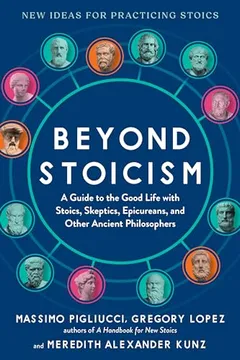


Key Takeaways
Build a life philosophy by testing goals, not inheriting one school
A map, not a creed. The book’s central claim is that no single ancient philosophy suits every person. A life philosophy begins by choosing a purpose, or telos, and asking what human nature suggests about pursuing it. The resulting flourishing life is called eudaimonia. The authors organize the options into three broad aims: feeling good through pleasure, becoming good through character, and thinking well through doubt.
Try before committing. The schools differ sharply, from Aristippus’s sensory enjoyment to the Cynics’ rejection of possessions. Even Stoicism began through its founder Zeno combining ideas from other traditions. The book therefore encourages readers to test practices, reflect on their effects, and build a deliberate personal approach rather than pledge allegiance to one doctrine.
The useful distinction is between borrowing a practice and accepting its entire worldview. A person can learn from Epicurean restraint without withdrawing from public life, for example, or use Stoic judgment without adopting Stoic theology. This resembles pluralist approaches in applied ethics, where different principles guide different kinds of decisions. The risk is eclecticism without coherence: a collection of attractive ideas can become an excuse to follow whichever rule feels convenient. A chosen purpose can help resolve that tension by giving borrowed practices a shared standard.
Enjoy the present without letting pleasure become your master
Pleasure, deliberately chosen. Aristippus and the Cyrenaics treated immediate bodily pleasure as life’s clearest good, valuing the taste of food or comfort now more than memories or plans for later. Aristippus openly enjoyed luxury and the company of Laïs, but insisted that enjoying pleasures did not mean being ruled by them. He criticized endless accumulation: owning more couches does not make it possible to lie on more than one at a time.
Carry judgment with you. After a shipwreck, Aristippus found signs of geometry in the sand and used them to locate people who could help him and his companions. The lesson was that good judgment remains useful when money and possessions disappear. Cyrenaic practice therefore means savoring available pleasures, reducing avoidable discomfort, and learning when enough is enough.
This view usefully distinguishes pleasure from consumption. Attention can make an ordinary sensory experience satisfying, while repeated acquisition often brings only a temporary lift. The modern language of hedonic adaptation captures a similar pattern: people adjust to new comforts and seek another upgrade. Still, immediate pleasure is a poor sole compass when choices impose costs on other people or on a future self. The Cyrenaic focus is most defensible as a corrective to needless self-denial, not as a complete account of responsibility.
Cut limitless desires before they turn pleasure into anxiety
Sort what you want. Epicurus distinguished natural, necessary desires, such as food and shelter, from natural but unnecessary wants, such as elaborate meals, and desires that are both unnecessary and unnatural, such as limitless fame or wealth. Basic needs are comparatively straightforward to satisfy. Status and riches have no obvious stopping point, so pursuing them can make a person anxious even while success accumulates.
Choose durable calm. Epicurus’s Garden offered simple food, friendship, and a life apart from political ambition. Its community welcomed women and former slaves, unusual for its time. Epicureans valued aponia, freedom from bodily distress, and ataraxia, peace of mind. Their fourfold remedy also challenged fear of gods and death, and emphasized that basic goods are attainable while pain can be endured. This was not indulgence, but a careful effort to reduce sources of distress.
Epicurus’s categories work like a diagnostic for whether a desire has a natural limit. Food can satisfy hunger; public approval often renews its own demand. The Garden also shows that tranquility is partly social: reliable friendship can be more nourishing than conspicuous success. Yet withdrawal from civic life has a cost. A peaceful private circle cannot by itself address harms beyond its boundaries. The Epicurean model is compelling as protection against status competition, but less complete as a guide to public responsibility.
Aim for virtue’s context-sensitive mean, not a bland midpoint
Excellence depends on context. Aristotle’s arete means excellence, and human excellence involves developing virtues rather than merely following rules. A virtue lies between excess and deficiency, but the right balance is not a mathematical midpoint. The amount of food appropriate for Milo, an athlete, would not suit an ordinary person. Likewise, courage is not reckless danger-seeking or habitual avoidance, but fitting action in the circumstances.
Train judgment and desire. Aristotle distinguishes a truly virtuous person, who acts well willingly, from someone who knows the right thing but struggles to do it, or acts well only through effort. Character develops through repeated, mindful practice. Good intentions matter too: volunteering to help others differs morally from volunteering only to improve a résumé. Aristotle also warns that virtue alone may not guarantee a flourishing life; health, upbringing, and fortune can matter.
Aristotle’s mean is closer to skilled judgment than moderation for its own sake. A good response changes with the person, stakes, and setting, much as professional expertise depends on reading a situation rather than applying a fixed script. His attention to desire also matters: durable character is not simply outward compliance. The harder question is how to judge the fitting response when people disagree about what counts as excess. Aristotle offers a model of practical reasoning, not an easy formula, and that makes discussion and feedback essential.
Spend effort on your judgments, not outcomes you cannot own
Separate agency from outcome. Epictetus, born enslaved and left with a lasting leg injury, taught that judgments, intentions, and chosen values are up to us in a way that health, reputation, property, and other people’s reactions are not. His term prohairesis refers to our capacity for considered choice. This is not a claim that people control every thought or can guarantee success. It asks where responsibility ultimately rests when outcomes depend on many factors.
Aim well, accept uncertainty. A skilled archer can choose equipment, practice, position, and aim, but cannot guarantee that wind or a moving target will not spoil the shot. The Stoic effort belongs in preparation and conduct, not in demanding a particular result. Epictetus illustrated the distinction by treating a stolen iron lamp as a loss of property, not a reason to surrender his character.
This framework can interrupt rumination by shifting attention from an uncontrollable result to the next available action. It also resembles the distinction in decision theory between the quality of a choice and the luck of its outcome. The distinction must be used carefully: external conditions are not trivial simply because they are not fully controllable. Illness, discrimination, and poverty can sharply constrain choices. The Stoic insight is strongest as a guide to agency within constraints, not as a reason to deny those constraints.
Break conventions when they injure freedom, not just to provoke
Expose the rule beneath the custom. Hipparchia chose Cynic philosophy over the sheltered domestic role expected of a wealthy young woman. At a gathering dominated by men, she defended her right to study and speak. Her life made a direct challenge to conventions that excluded women from public intellectual life. Cynics treated reason and nature, rather than custom alone, as guides to living well.
Practice three freedoms. Cynic freedom included independence from social restrictions, self-sufficiency through reducing needs, and frank speech directed especially at the powerful. Diogenes’s famous response to Alexander was to ask him to stop blocking the sunlight. These gestures were not meant to be mere stunts: they exposed the absurdity of status and convention. The authors advise testing small, safe acts of dissent, not copying the Cynics’ extreme rejection of ordinary life.
Cynicism offers a useful test: is a convention protecting people, or merely protecting a hierarchy? That question remains relevant wherever custom disguises unequal power as common sense. Hipparchia’s example also shows that dissent can be more than an argument; refusing an assigned role makes alternatives visible. But unconventional behavior is not automatically liberating. A rule can be arbitrary and still coordinate useful behavior, and public provocation can harm bystanders. Critique should target the source of power, not simply seek attention.
Make civic justice a practice, not a philosopher-king fantasy
Justice needs wise judgment. Plato linked a just society to just individuals and argued that political decisions require wisdom, not merely ambition or social rank. His dialogues test definitions of justice, including the claim that justice serves the powerful. Plato’s answer emphasizes cooperation: injustice breeds conflict, while fairness supports shared life. He imagined rule by trained, self-disciplined leaders, and later explored how good laws could restrain political power.
Learn, then act. Plato repeatedly tried to influence Syracuse’s ruler Dionysius, but the ruler enjoyed the prestige of philosophy without accepting the discipline or correction it required. The effort failed. The book turns that failure into practical advice: choose a concrete public concern, learn its details, identify allies or decision-makers, and take a specific, achievable action. Civic effort can build character even when the outcome remains uncertain.
Plato’s failed experiment is a warning against confusing access to power with the ability to change it. Advice has little force when a leader wants philosophical language as decoration rather than as a constraint. His emphasis on educated judgment remains valuable, but concentrated rule by supposedly wise people creates its own danger: who verifies their wisdom? Institutions, public scrutiny, and informed participation can distribute that burden. The practical lesson is to pair moral aspiration with knowledge of how decisions are actually made.
Ask what a virtue means before claiming you possess it
Refine ideas through questions. Socrates challenged confident claims by asking for definitions, then testing them for contradictions. In Plato’s dialogue with Euthyphro, proposed definitions of piety repeatedly fail under questioning. This process, called elenchus, does not always produce a final answer. It can end in aporia, a state of perplexity that reveals how much remains unresolved.
Treat confusion as progress. Socrates believed that recognizing ignorance is wiser than mistaking confidence for knowledge. His questioning was not only a debate tactic; it aimed to improve the reasoning and character of the people involved. Readers can apply the method to their own moral claims: define the value, identify what would count as an example, and look for counterexamples. A good conversation seeks clearer understanding, rather than a victory for a conclusion already chosen.
The method resembles modern practices of active learning: people often understand a claim more deeply when they have to explain and test it rather than repeat it. It can also expose moral slogans that conceal disagreement about meanings. However, questioning is not inherently virtuous. Used aggressively, it becomes a status game or a way to exhaust someone who lacks rhetorical training. Socratic inquiry works best when participants share a genuine interest in clarification and when the questioner is willing to have their own assumptions examined.
Match confidence to evidence, and keep rival explanations alive
Perspective shapes practical claims. Protagoras argued that human experience measures how things appear to people, and that laws and judgments differ across communities. His interest in orthoepeia, or accurate speech, asked whether a description fits a speaker’s purpose and perspective. This need not mean every moral claim is equally sound: Protagoras also viewed cooperation as necessary for communities to endure.
Use doubt in different ways. Carneades urged people to weigh impressions by how much evidence supports them, from a weak first appearance to a carefully investigated belief. Pyrrho instead emphasized suspending judgment when competing accounts seem equally persuasive, seeking tranquility rather than certainty. Both approaches resist overconfidence, but they are not identical. One permits provisional conclusions based on probability; the other urges restraint about claims that cannot be settled.
These skeptics offer a valuable antidote to certainty built from a single vivid example. Asking what else could explain the evidence is a practical defense against confirmation bias, while recognizing perspective can clarify why people use the same word differently. Yet perspective does not erase factual constraints, and uncertainty does not make every position equally credible. Carneades’s graded confidence is especially useful for decisions that cannot wait for certainty. Pyrrhonian restraint can calm disputes, but it risks becoming avoidance if action is indefinitely postponed.
Use ancient schools as tools, then assemble a life that fits
Explore the less familiar shores. Pythagoreans combined communal living, friendship, and spiritual beliefs about the soul; many practices depended on mystical ideas or rules whose rationale is now unclear. Megarian thinkers developed logical puzzles such as the Sorites, which asks when a pile of grains stops counting as a pile, exposing the vagueness in ordinary categories. Neoplatonists sought spiritual reality through contemplation, while Hypatia taught philosophy and mathematics across religious divisions before being murdered by a mob.
Keep what withstands examination. The authors treat these traditions as historically important, but harder to adopt wholesale because evidence about their practice is sparse or their metaphysics may not persuade modern readers. Their closing advice is to review which ideas helped, choose a goal, and make a practical plan. The result can be one guiding philosophy, several compatible practices, or a personal toolkit for different situations.
The book’s treatment of its more obscure traditions models intellectual honesty: admiration for an ancient figure does not require pretending that the evidence is complete. Hypatia’s story also complicates any easy division between philosophy and public life; her intellectual work took place amid real political and religious conflict. A personal toolkit can be adaptive, much as different disciplines offer methods for different problems. Its coherence depends on regular review: practices should be judged by whether they serve the life someone intends to build, not by their age or prestige.
Analysis
Beyond Stoicism is both a guided history of ancient practical philosophy and a set of structured experiments in living. Its governing idea is pluralism: the good life does not have to be reduced to one universal recipe. The book’s three broad destinations, pleasure, character, and doubt, make competing aims visible without pretending that they always agree. That structure is its chief strength. Readers encounter real trade-offs: immediate enjoyment against tranquility, personal virtue against political withdrawal, and decisive judgment against intellectual caution.
The biographies make those disagreements concrete. Aristippus and Epicurus both value pleasure, yet one prizes immediate bodily sensation while the other favors simple needs and freedom from disturbance. Aristotle’s context-sensitive virtue differs from the Stoic claim that virtue is sufficient for flourishing. Hipparchia’s public dissent shows how a way of life can challenge social hierarchy, while Plato’s failed effort to educate a ruler shows that good arguments cannot substitute for political willingness. The historical stories thus function as tests of ideas, not merely decoration.
The book is strongest when it asks readers to try a practice and inspect its effects. That experimental posture resembles reflective learning: a principle gains meaning when applied to an actual choice, then revised in light of what happened. Its limitation is that the five-day exercises can only offer an introduction to philosophies that ancient adherents treated as demanding, often lifelong commitments. A brief exercise may reveal friction or appeal, but it cannot establish that a whole worldview is sound.
The authors’ eclectic conclusion is promising but requires discipline. Combining traditions can respect differences in temperament and circumstance, yet some doctrines conflict at the level of reality, morality, or what counts as knowledge. A workable personal philosophy needs more than a shelf of appealing maxims. It needs priorities, an account of how to settle conflicts, and a willingness to revise its commitments. The book supplies a rich map and invites that further work rather than claiming to finish it.
Review Summary
Reviews of Beyond Stoicism are mixed, averaging 3.69/5. Many praise its accessible, practical introduction to thirteen Greco-Roman philosophies, with workbook-style exercises helping readers apply ancient wisdom to modern life. Newcomers to philosophy particularly appreciate its clarity and broad scope. Critics, however, find it too shallow, noting chapters lack depth and read like encyclopedia entries. Some feel the exercises bog down the pace. The consensus: an excellent starting point for philosophical beginners, but potentially unsatisfying for those seeking rigorous engagement with the material.
Glossary
telos
life’s guiding purposeA telos is an end, goal, or purpose. Ancient philosophers used the idea to ask what a human life is ultimately for, such as pleasure, virtue, or tranquility. In this book, clarifying one’s telos helps a reader evaluate which practices and philosophies are likely to support a life worth living.
eudaimonia
a flourishing lifeEudaimonia is the ancient Greek ideal often translated as happiness, though it means more than a pleasant feeling. It describes a life that is going well or is worth living, understood in relation to human nature and a chosen purpose. Different philosophical schools disagree about what produces it.
arete
excellence of characterArete means excellence or virtue. The term can describe what makes a person, animal, plant, or object function well. In ethical philosophy, it refers to human excellence: qualities and actions that express a person’s capacities well. Aristotle and the Stoics give it central roles in their accounts of the good life.
aponia
freedom from bodily distressAponia is the Epicurean condition of having no physical distress. It includes being free from basic bodily discomforts such as hunger and thirst. Epicurus treated it as one of the foundations of a pleasurable life, alongside ataraxia, or peace of mind.
ataraxia
tranquility of mindAtaraxia means freedom from mental disturbance or deep tranquility. Epicureans seek it by reducing fears and unnecessary desires. Pyrrhonian skeptics seek it through suspension of judgment when arguments appear equally persuasive. The term therefore names a shared goal reached by different philosophical methods.
kinetic and katastematic pleasures
active and settled pleasuresEpicurus distinguishes kinetic pleasures, which arise during an activity such as eating or greeting a friend, from katastematic pleasures, which consist in a settled condition of well-being. The latter include relief from hunger, pain, or fear. Epicureans value enduring calm because active pleasures pass and may be followed by renewed desire.
prohairesis
considered power of choiceProhairesis is Epictetus’s term for a person’s capacity to make considered choices, including judgments, intentions, and commitments. It is central to Stoic practice because it distinguishes what a person can answer for from outcomes that depend on the body, circumstances, or other people.
elenchus
testing claims by refutationElenchus is the Socratic practice of examining an argument by asking questions and showing where its claims lead to contradiction or fail to support a conclusion. Refuting an inadequate answer can improve understanding even when the discussion does not reach a final definition.
orthoepeia
accurate, fitting speechOrtho epeia, also written orthoepeia, is Protagoras’s specialized concern with using words correctly and understanding what speakers mean. The book presents it as attention to how a description fits a perspective and purpose. Clarifying terms can prevent people from arguing past one another.
pithanon
what appears persuasivePithanon is Carneades’s term for the persuasiveness or likelihood of an impression. Rather than claiming certainty, an Academic Skeptic assesses how strongly available evidence supports a belief. Further investigation and the absence of known counterevidence can increase confidence without making a claim infallible.
epoché
suspension of judgmentEpoché is the suspension of judgment when competing arguments seem comparably persuasive or the evidence does not warrant certainty. Pyrrhonian skeptics practice it to avoid becoming attached to unsupported claims and to pursue tranquility. It does not mean proving that truth is impossible or abandoning ordinary action.
Agrippa’s trilemma
three problems for justificationAgrippa’s trilemma identifies three ways an attempt to justify a belief may fail to reach a secure foundation: it may continue in an infinite regress, stop at an unsupported assumption, or rely on circular reasoning. Pyrrhonian skeptics use the challenge to question claims of certain knowledge.
tetrapharmakos
Epicurean four-part remedyThe tetrapharmakos, literally the fourfold remedy, is a compact Epicurean guide to reducing fear and distress. It advises against fearing gods or death, emphasizes that basic goods are attainable, and maintains that severe pain can be endured. It summarizes the therapeutic aims of Epicurean philosophy.
metempsychosis
transmigration of the soulMetempsychosis is the belief that a soul passes into another body after death. Pythagorean tradition used this idea to explain why a human soul might inhabit an animal. It shaped practices such as concern about killing animals, though the book notes that the evidence about Pythagoras’s own doctrines is limited.
About the Author
Other books by Massimo Pigliucci


Download PDF
Download EPUB
.epub digital book format is ideal for reading ebooks on phones, tablets, and e-readers.








