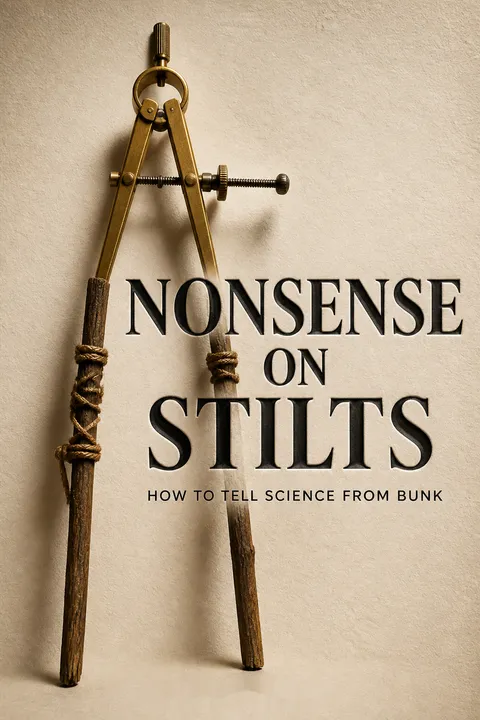


Key Takeaways
Judge science by testable evidence, not by its prestige or confidence.
No magic boundary. The demarcation problem is the challenge of distinguishing science from nonscience and pseudoscience. Pigliucci's practical answer combines three features: inquiry concerns natural processes, uses theories to organize observations, and tests claims against empirical evidence. Naturalism here is methodological, not proof that supernatural realities do not exist. It limits scientific explanations to causes that can be investigated.
A historical shift. From Greek natural philosophy through Bacon and Galileo, inquiry gradually separated from theological authority and made observation, argument, and natural causes central. Science earns authority from procedures and evidence, not a lab coat, confident speaker, or impressive equation. Ask what observation could bear on a claim, and whether a clear theory connects that observation to its conclusion.
What's striking is that the book rejects both easy cynicism and easy reverence. Science is not authoritative because scientists say so, but neither is every unsupported claim an equal alternative. The same distinction matters in medicine and law: a conclusion gains force when the process that produced it can be inspected and challenged. These criteria are guides, not a mechanical test. Some fields have sparse evidence or immature theories, so judgment should reflect how much testing is currently possible.
Match scientific confidence to the complexity and history of the question.
Different jobs, different tools. Physics can often isolate a few variables and make precise predictions. Ecology and psychology study systems with many interacting causes, so their explanations are usually less complete. Strong inference is a method of testing a short list of mutually exclusive hypotheses with experiments designed to rule alternatives out. It works especially well for simple questions, but cannot be a universal template for science.
Precision is not rank. A study by Larry Hedges found that research results in psychology could be about as consistent across studies as results in particle physics. George Howard's analysis added an important distinction: physicists often explain nearly all the measured variation, while complex social and organismal sciences commonly explain about 25 to 35 percent. Differences in complexity, not scientists' intelligence, help explain that gap.
The useful lesson is to ask what a field can reasonably explain, not whether it resembles physics. Complexity creates a ceiling on prediction, but a partial explanation can still be powerful when it identifies causes that matter. The distinction also guards against a common mistake: treating uncertainty as evidence of incompetence. A limitation should lower confidence in a specific conclusion, not discredit an entire discipline. Conversely, a field's reputation for precision should not exempt its findings from replication.
Ask what result could change a theory before trusting its explanation.
Risk a real test. Falsifiability is the possibility that some conceivable observation could show a claim to be wrong. Karl Popper used it to distinguish science from theories that can absorb every outcome. The idea is helpful, but a strict version is too simple: one unusual two-legged dog does not refute the general claim that dogs normally walk on four legs. Scientists may reasonably investigate an exception, measurement error, or limits on a theory before abandoning it.
Revision needs discipline. Adjusting a theory can be sensible when the change explains the discrepancy and generates further tests. It becomes rationalization when each inconvenient result is patched away without independent support. The practical question is not merely whether a theory has survived criticism, but whether it has made specific claims, faced demanding tests, and changed in response to evidence rather than in response to embarrassment.
This is a more realistic picture of scientific testing than the notion that one failed prediction instantly kills a theory. In medicine, for example, a surprising trial result may reflect an ineffective treatment, a flawed measure, or an unrepresentative sample. Follow-up work sorts those possibilities out. The danger is that flexibility can become immunity from evidence. A useful safeguard is to state in advance what would count as a serious failure, then require any proposed repair to earn its place with new evidence.
Treat borderline fields as provisional, not automatically fraudulent or established.
The border moves. Some research programs meet parts of science's standards while struggling to test their central claims. String theory, as discussed in the book, was mathematically developed but lacked empirically testable predictions that distinguished it from rivals. SETI makes systematic observations, but a long run of silence cannot easily rule out life elsewhere. Its Drake equation organizes estimates about stars, planets, life, intelligence, communication, and how long civilizations send signals, yet many inputs are unknown.
Plausibility is not proof. Evolutionary psychology applies evolutionary ideas to human behavior, but claims about ancient selection pressures can become untestable stories when behavior leaves no fossil record and close comparisons are scarce. That does not make the field inherently pseudoscientific. It means some claims are better supported than others, and a promising question can remain unresolved without being either established science or a fraud.
Borderline cases expose why labels are less useful than examining a research program's actual practices. A field may develop new instruments or methods that make once-untestable claims answerable; it may also keep producing speculation without stronger evidence. The distinction resembles the difference between a research agenda and a settled result. Patience is appropriate, but so is restraint about public claims. Potential value, mathematical elegance, and scientific vocabulary do not substitute for empirical contact.
Use surviving traces to test history, even when experiments are impossible.
Past events leave evidence. The asymmetry of overdetermination describes how many traces can remain after an event, while predicting its occurrence beforehand may be difficult because many causes must align. Historical sciences use those traces much as detectives reconstruct a crime. Astronomers supported the Big Bang with background radiation at about three degrees above absolute zero, a signal its rival steady-state model did not predict in the same way.
Converging clues count. In the case of the dinosaurs' extinction, researchers found a worldwide layer rich in iridium, an element rare on Earth but common in some meteorites. They later identified a large crater near Mexico's Yucatan Peninsula, with geological evidence consistent with the impact. No scientist could rerun that event in a laboratory. The strength comes from independent observations that converge on a testable account of the past.
Historical explanation is often mistaken for storytelling because it cannot rely on controlled repetition. Forensics illustrates the opposite: a fingerprint, a timeline, and a chemical trace can jointly constrain an account even when the event cannot be recreated. The method is not automatically decisive, since traces can be incomplete or ambiguous. Its strength comes from comparing rival explanations and asking which best accounts for the evidence with the fewest unsupported assumptions.
Treat pseudoscience as a public risk, not harmless eccentricity.
Belief has consequences. The book recounts women accused of witchcraft and murdered in East Africa, with accusations rising amid droughts or floods. It also describes AIDS denialism in Gambia, Ethiopia, and South Africa, where leaders or religious practitioners promoted untested remedies and discouraged established treatment. Such cases make clear why pseudoscience is not simply a private preference: people can lose money, make dangerous medical choices, or be harmed by other people's beliefs.
Check the claim, not the appeal. Astrology offers a less lethal but revealing example. Studies reviewed by Geoffrey Dean and Ivan Kelly found that astrologers' predictions and personality matches did not perform reliably; in a double-blind test, prominent astrologers matched birth charts at chance levels. Cold reading and selective memory can make weak predictions feel personal. Emotional need may explain why a claim attracts believers, but it cannot establish that the claim is true.
The connection between belief and harm is especially important in health decisions, where an appealing alternative may delay effective care. Yet identifying harm does not itself prove that a particular claim is false; evidence still has to do that work. The strongest public response pairs careful testing with attention to trust, access, and local history. Where institutions have failed people, simply repeating expert conclusions may not persuade. Credible communication must address both the evidence and the reasons suspicion took hold.
Check who funds a scientific story before accepting its framing.
Controversy can be manufactured. Pigliucci contrasts the 2007 climate assessment, which said human emissions were very likely warming the planet, with public arguments that portrayed the science as evenly divided. He criticizes Bjorn Lomborg's book for emphasizing economic costs and uncertainty while treating climate models selectively. Al Gore's presentation was less technical and occasionally overstated implications, but the book argues that its central account better reflected scientific agreement.
Follow the incentives. The author describes think tanks that promote policy positions through reports, media appearances, and expert commentary. Some are funded by interests affected by the science they discuss. Funding alone does not refute an argument, but undisclosed interests and selective presentation should prompt closer scrutiny. Equal airtime is not the same as fair treatment: a media outlet should explain the strength of evidence, not merely place opposing claims side by side.
The central media problem is not that every journalist is biased, but that attention often rewards conflict, certainty, and simple opposing camps. Those incentives can turn a technical range of uncertainty into the impression that experts know nothing. Funding information is a useful warning signal, not a verdict. A stronger check is to compare the claim with the methods, evidence, and relevant expert assessments, while asking whether the same standards are being applied to both sides.
A supernatural designer cannot replace a testable biological mechanism.
The Dover dispute. In 2005, a Pennsylvania school board required teachers to present intelligent design as an alternative to evolution. The judge found that the policy was religiously motivated and ruled that intelligent design was not science. Methodological naturalism means that science seeks natural causes that can be investigated; it does not declare that no supernatural being exists.
A gap is not a rival theory. Intelligent design's claim of irreducible complexity says that some biological systems could not function if parts were removed, so they could not have evolved gradually. But that argument creates a false choice between evolution and design. Scientists described intermediate structures, including proteins used in bacterial systems related to the flagellum. Design proponents did not specify a designer or provide testable predictions, so the proposal could not compete with an evidence-based evolutionary explanation.
The case shows how scientific and legal questions can overlap without becoming identical. The court considered both the policy's religious purpose and the scientific status of the ideas being taught. Methodological naturalism is often mistaken for a claim about God's existence; it is better understood as a boundary on what scientific investigation can test. That boundary keeps science useful, though it leaves metaphysical questions to other forms of inquiry rather than settling them.
Science earns trust through correction, not claims of perfection.
Error is real. The Piltdown fossils, presented in 1912 as an ancient human ancestor, fooled many scientists for decades. Chemical tests eventually showed that the remains combined a human skull with an orangutan jaw, altered to appear old. The hoax demonstrates how expectations and national pride can distort judgment. It also shows correction at work: researchers, not creationists, exposed the fraud as new evidence accumulated.
Correction is no absolution. Eugenics offers a darker lesson. A movement that borrowed from genetics and statistics promoted coercive policies, including forced sterilization. More than 60,000 people were sterilized under US state laws. Scientific language did not make those policies sound or ethical. The record supports a double conclusion: science can be socially biased and badly misused, yet organized criticism and new evidence can expose errors. Neither fact excuses the harm already done.
Self-correction is a genuine strength, but it is not a moral safety net. A false claim can shape policy long before it is corrected, and people harmed in the meantime cannot be restored by a later retraction. The lesson for institutions is to pair openness to revision with accountability, transparency, and ethical review. Scientific reliability is therefore both an intellectual achievement and a civic responsibility, not an automatic property of laboratories.
Trust expertise by its evidence, field fit, peers, and track record.
Expertise is specific. A doctorate or public reputation does not make someone an authority on every subject. Pigliucci draws on philosopher Alvin Goldman's account of how a nonexpert can evaluate competing specialists. Consider the quality of their arguments, whether relevant experts agree, whether their training fits the question, what interests may bias them, and how well their past claims have held up.
Compare the actual records. In the evolution debate, biologist Kenneth Miller and biochemist Michael Behe both hold legitimate credentials, but their expertise and arguments differ in relevance. The book notes that most biologists accept evolution, that Miller's account engages the relevant evidence, and that Behe's claims about biological complexity have been answered with research he did not adequately address. Credentials matter, but only in context; a Nobel Prize in one field does not confer expertise in another.
This approach turns deference into an informed, defeasible judgment. It resembles hiring: a title may open the door, but relevant experience, demonstrated performance, and independent references provide better evidence of competence. Expert consensus is also informative without being infallible. The challenge is to distinguish a genuine minority view from a manufactured appearance of dissent. That requires checking whether disagreement concerns data, methods, or merely broad statements that sound critical but avoid the disputed evidence.
Update confidence gradually; certainty and cynicism both distort evidence.
Beliefs should move. Bayesianism describes a way to update confidence in a hypothesis by combining prior expectations with new evidence. A family may be more likely to have gone fishing in sunny weather than in rain, but learning that they did go fishing should adjust the odds rather than establish certainty. Scientific conclusions work similarly: evidence can raise or lower confidence without turning a provisional claim into an absolute truth.
Perspective is not relativism. Scientific instruments and theories give humans a limited perspective on a world that exists independently of them. Measurements are shaped by tools and assumptions, but the world can constrain the result. This avoids two extremes: imagining science provides a view from nowhere, and claiming that knowledge is only a social convention. A rational reader should ask how strong the evidence is, what alternatives remain, and how much the new evidence should change the conclusion.
Calibrated belief is useful well beyond science. Courts weigh evidence rather than demanding impossible certainty, and everyday decisions often rely on changing probabilities as new information arrives. The Bayesian image also exposes dogmatism: if no conceivable evidence can alter a belief, the belief is insulated from inquiry. Still, numerical probabilities can create a false sense of precision when the underlying estimates are weak. Calibration depends on honest uncertainty, not just putting a number beside it.
Analysis
The book's strongest contribution is not a single definition of science, but a way to move among standards without confusing them. Testability matters, yet the relevant test differs between a controlled particle experiment and a reconstruction of an ancient impact. Predictive precision matters, but it is not a fair measure of a field studying many interacting causes. The result is a practical pluralism: scientific disciplines vary in method and reach, while remaining answerable to evidence about a world that does not simply bend to preference.
That pluralism makes the book's public argument sharper. It rejects the false balance that treats every claim as an equal side, while also refusing the scientist's fantasy of a view from nowhere. Expertise deserves provisional trust because specialist knowledge is real, but credentials, funding, and consensus all require context. In this account, skepticism means calibrated scrutiny, not reflexive disbelief.
One tension remains. The book's polemical examples make harms and conflicts vivid, but they can encourage readers to sort people into reliable scientists and irrational outsiders too quickly. The same standards must apply to the skeptic's favored explanations: disclose uncertainty, distinguish evidence from inference, and revise when the record changes. A reliable demarcation practice should assess specific claims and research behavior, not merely attach labels to disciplines or speakers.
The civic implication is demanding but useful. Citizens cannot personally master every technical field, yet they can ask whether a claim risks failure, whether evidence is independently convergent, whether a proposed repair is testable, and whether an apparent controversy reflects substantive expert disagreement. These questions do not guarantee truth. They make it harder to confuse confidence with knowledge, and harder for unsupported claims to borrow science's authority without accepting its discipline.
Review Summary
Nonsense on Stilts explores the demarcation between science and pseudoscience, offering insights into the philosophy of science. Reviews praise Pigliucci's thorough examination of scientific methodology and his critique of pseudoscientific claims. Some readers found the book dense and philosophical, while others appreciated its nuanced approach. Critics note that the book sometimes strays from its central theme and that Pigliucci's personal biases occasionally show through. Overall, readers found the book informative and thought-provoking, despite some disagreements with specific arguments or examples.
People Also Read







Glossary
Demarcation problem
Science versus pseudoscienceThe problem of determining what separates science from nonscience and pseudoscience. No single rule settles every case. Empirical testability, coherent theory, and investigation of natural processes help identify science, but disciplines differ in methods and some fields occupy a changing borderland.
Falsifiability
Capacity to be disprovedA property of a claim or theory that makes it possible, at least in principle, for some observation or experiment to count against it. Karl Popper treated falsifiability as a key distinction between science and pseudoscience. The book argues that it is useful but insufficient as a complete rule, because scientists do not discard theories automatically after one anomaly.
Strong inference
Ruling out rival hypothesesA method for addressing a question by proposing alternative explanations, designing tests that distinguish among them, eliminating explanations that fail, and repeating the process. It is especially effective when the alternatives are limited and mutually exclusive. It is less suited to complex systems where many causes interact and results are probabilistic.
Asymmetry of overdetermination
Past traces, future uncertaintyThe difference between reconstructing a past event and predicting a future one. Past events can leave many surviving traces, and a few may help identify what happened. Predicting the event beforehand is harder because many conditions and causes must align. Historical sciences use this difference to test accounts without laboratory experiments.
Methodological naturalism
Testing natural causesThe working rule that scientific explanations rely on natural causes that can be investigated empirically. It does not require scientists to deny that supernatural realities exist. Rather, it recognizes that supernatural explanations cannot be tested through the methods of science, so they cannot do the explanatory work of scientific theories.
Irreducible complexity
Claim of indispensable partsAn argument associated with intelligent design that some biological systems could not evolve gradually because removing a part would prevent the system from functioning. The book argues that the claim wrongly assumes current function is the only possible function and overlooks intermediate structures, repurposed components, and evidence for evolutionary pathways.
NOMA
Separate domains for science and religionStephen Jay Gould's term for nonoverlapping magisteria, the proposal that science addresses facts about the natural world while religion addresses values and meaning. Pigliucci presents it as an attempted accommodation, but argues that it fails when religions make factual claims about origins or when science studies religious belief as a human phenomenon.
Perspectivism
Knowledge from limited viewpointsThe view that science provides a human perspective on a world that exists independently of human observers. Instruments, concepts, and theories shape what can be measured and understood, but evidence from the world constrains those interpretations. This position rejects both absolute, view-from-nowhere objectivity and the claim that scientific knowledge is merely arbitrary convention.
Bayesianism
Confidence updated with evidenceA framework for understanding how beliefs should change as evidence accumulates. A person's prior expectations and the likelihood of new evidence are combined to produce an updated level of confidence. In science, this illustrates why conclusions can become more or less credible without becoming absolutely certain, and why beliefs immune to all evidence are not genuinely being updated.
FAQ
What is Nonsense on Stilts: How to Tell Science from Bunk by Massimo Pigliucci about?
- Science vs. pseudoscience focus: The book investigates how to distinguish genuine science from pseudoscience, exploring the "demarcation problem" and why this distinction matters.
- Interdisciplinary analysis: Pigliucci draws on philosophy, history, sociology, and psychology to examine how science operates, why pseudoscience persists, and how both influence society.
- Critical thinking tools: Readers are equipped with practical methods to evaluate claims, question authority, and demand evidence in public discourse.
- Societal and cultural context: The book addresses the roles of media, public intellectuals, and cultural attitudes in shaping science communication and public understanding.
Why should I read Nonsense on Stilts by Massimo Pigliucci?
- Clarifies science-pseudoscience boundary: The book provides accessible tools and frameworks to help readers critically evaluate scientific and pseudoscientific claims.
- Empowers informed citizenship: Understanding the difference between science and bunk is presented as a moral and practical necessity, influencing public health, policy, and personal decision-making.
- Addresses real-world controversies: Pigliucci uses case studies like climate change and evolution to show the real consequences of scientific illiteracy and misinformation.
- Balances skepticism and trust: The book encourages a healthy skepticism—questioning all claims, including those from authorities—while recognizing the value and limits of scientific expertise.
What are the key takeaways from Nonsense on Stilts by Massimo Pigliucci?
- Science is provisional and self-correcting: Scientific knowledge is always tentative, subject to revision, and advances through error correction and critical scrutiny.
- No single scientific method: Science employs diverse methods—observation, experimentation, theory-building—tailored to the complexity of different fields.
- Social and human dimensions: Science is a human endeavor, shaped by biases, ideologies, and social context, but its collective processes help correct individual errors.
- Critical thinking is essential: The book stresses the importance of skepticism, evidence-based reasoning, and the ability to evaluate expertise in navigating scientific controversies.
How does Nonsense on Stilts by Massimo Pigliucci define and address the "demarcation problem"?
- Demarcation problem explained: The book explores the challenge of distinguishing science from nonscience and pseudoscience, a problem famously addressed by philosopher Karl Popper.
- Falsifiability and its limits: While Popper’s criterion of falsifiability is discussed, Pigliucci shows it is too rigid for all scientific disciplines, as good theories often adapt to new data.
- Nuanced criteria needed: The book advocates for more flexible, context-sensitive criteria that account for the diversity of scientific practices across fields.
- Practical implications: Understanding the demarcation problem is crucial for public policy, education, and protecting society from harmful pseudoscientific claims.
What is the difference between "hard" and "soft" sciences according to Nonsense on Stilts?
- Hard vs. soft science debate: The book discusses how fields like physics ("hard" sciences) progress rapidly, while areas like psychology ("soft" sciences) face slower progress due to complexity.
- Complexity, not rigor: Pigliucci argues that differences in progress are due to subject complexity, funding, and social factors, not a lack of scientific rigor or method.
- Empirical findings: Studies show that while soft sciences may have lower explanatory power, their replicability can match that of hard sciences.
- Misconceptions addressed: The book refutes the notion that soft sciences are less scientific, emphasizing methodological adaptations to complex phenomena.
How does Massimo Pigliucci describe the scientific method and "strong inference" in Nonsense on Stilts?
- Strong inference defined: The method involves formulating multiple hypotheses, designing experiments to falsify them, and iteratively narrowing down explanations.
- Applicability varies by field: Strong inference works best in hard sciences with clear, testable hypotheses but is less suited to fields with complex, probabilistic phenomena.
- Soft sciences adapt methods: Pigliucci explains that methodological differences in soft sciences arise from their subject matter, not from a lack of scientific rigor.
- No universal method: The book emphasizes that science uses a variety of methods, tailored to the questions and complexity of each field.
How does Nonsense on Stilts by Massimo Pigliucci explain the role of historical sciences and causality?
- Science beyond experiments: The book clarifies that not all science requires experiments; historical sciences like astronomy and paleontology rely on systematic observation and evidence.
- Causal asymmetry concept: Philosopher Carol Cleland’s idea is discussed, showing how past events leave multiple traces, making reconstruction possible, while prediction is harder.
- Different strengths: Historical sciences excel at explaining past phenomena, while experimental sciences are better at prediction under controlled conditions.
- Legitimacy of historical sciences: Pigliucci defends the scientific status of these fields, countering claims that they are less scientific due to their methods.
What are examples of "almost science" or borderline scientific fields in Nonsense on Stilts?
- Physics and philosophy overlap: The book examines string theory and quantum mechanics interpretations, noting their mathematical elegance but lack of empirical testability.
- SETI as a borderline case: The Search for Extraterrestrial Intelligence is discussed as systematic but challenged by issues of falsifiability and theoretical grounding.
- Evolutionary psychology critique: Pigliucci critiques evolutionary psychology for relying on untestable historical scenarios, placing it near the border of science and pseudoscience.
- Importance of empirical grounding: These examples illustrate the need for testability and evidence in distinguishing science from "almost science."
How does Massimo Pigliucci define and exemplify pseudoscience in Nonsense on Stilts?
- Characteristics of pseudoscience: Pseudoscience is marked by unfalsifiable claims, resistance to revision, reliance on myths, and storytelling over empirical evidence.
- Examples provided: The book discusses AIDS denialism, astrology, parapsychology, and UFO beliefs as clear cases of pseudoscience.
- Consequences of pseudoscience: Pigliucci highlights the real-world harm caused by pseudoscientific beliefs, including financial loss, poor decisions, and even death.
- Critical thinking as defense: The book stresses the importance of scientific literacy and skepticism in protecting against pseudoscientific claims.
What does Nonsense on Stilts by Massimo Pigliucci say about the role and decline of public intellectuals and the rise of think tanks?
- Public intellectuals’ challenges: The book analyzes how public intellectuals, often academics, face career risks and criticism for engaging in public discourse.
- Quality vs. quantity: While the number of public intellectuals has increased, their quality has declined due to entertainment and ideological pressures.
- Rise of think tanks: Think tanks have shifted from independent research to advocacy, often promoting ideological agendas and influencing public opinion on science.
- Impact on science communication: The decline of public intellectuals and the rise of think tanks complicate the public’s ability to discern credible scientific information.
How does Nonsense on Stilts by Massimo Pigliucci address major science controversies like climate change and evolution?
- Climate change debate: The book contrasts scientific consensus on anthropogenic global warming with the politicized, polarized public debate fueled by media and think tanks.
- Evolution vs. intelligent design: Pigliucci explains why evolution is a well-supported scientific theory, while intelligent design is a religious, untestable position.
- Legal and educational battles: The Dover trial is highlighted as a landmark case affirming that intelligent design is not science and cannot be taught in public schools.
- Role of ideology and misinformation: The book shows how cultural, religious, and political factors distort scientific debates and public understanding.
What is Massimo Pigliucci’s advice on evaluating expertise and scientific claims in Nonsense on Stilts?
- Defining expertise: An expert is someone with more true beliefs and substantial knowledge in a domain than nonexperts.
- Five criteria for judging experts: Evaluate the quality of arguments, consensus among experts, independent evidence of expertise, potential biases, and track record.
- Experts are fallible: While experts can make mistakes, they remain the best guides for non-specialists when chosen carefully.
- Beware of false experts: Credentials alone are not enough; consider possible ideological or financial biases when assessing expertise.
What are the best quotes from Nonsense on Stilts by Massimo Pigliucci and what do they mean?
- Huxley on morality and evidence: "The foundation of morality is to ... give up pretending to believe that for which there is no evidence..." stresses the ethical duty to base beliefs on evidence.
- Sherlock Holmes’ method: "You know my methods. Apply them." encourages readers to use critical, evidence-based reasoning.
- Carl Sagan on skepticism: "But the fact that some geniuses were laughed at does not imply that all who are laughed at are geniuses." warns against equating ridicule with truth.
- Adam Smith on science: "Science is the great antidote to the poison of enthusiasm and superstition." highlights science’s role in combating irrational beliefs.
- George Carlin on authority: "I have as much authority as the Pope, I just don’t have as many people who believe it." humorously reminds us that authority depends on acceptance, not just position.
About the Author
Other books by Massimo Pigliucci



Download PDF
Download EPUB
.epub digital book format is ideal for reading ebooks on phones, tablets, and e-readers.








