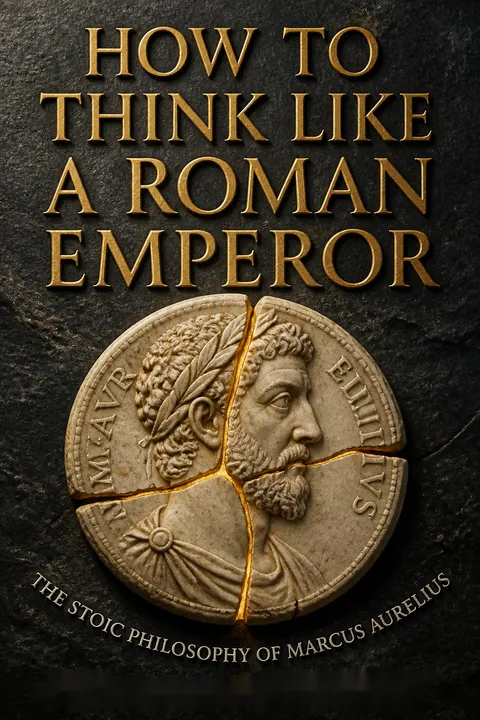


Key Takeaways
Treat philosophy as daily training, not a collection of impressive ideas.
A personal search. Robertson begins with the death of his father, a humble man whose example suggested that character mattered more than wealth. Grief left the author, then a troubled teenager, searching for a way to live. Years later, psychotherapy and the Stoics offered a practical answer: examine the judgments behind distress and train a wiser response.
Marcus as a case study. The book follows an emperor who faced plague, war, illness, and repeated bereavement while using philosophy to guide his conduct. Stoicism here is not a pose of toughness or emotional numbness. It is a way of practicing reason, virtue, and care for others in ordinary decisions and extreme conditions.
The book’s strongest organizing choice is to treat philosophy as a practice rather than a museum of arguments. That puts it in conversation with clinical therapy, where insight matters most when it changes what someone does under pressure. It also restores an ethical dimension that symptom-focused accounts can miss: feeling calmer is not the only aim; acting justly matters too. The historical portrait makes the ideal tangible, although Marcus’s exceptional status can make his resources seem more available than they are to ordinary readers.
Separate the event from the verdict your mind adds to it.
First reaction, then judgment. Stoics distinguish involuntary impressions from assent. An impression is the immediate thought or bodily response to an event; assent is the further judgment that the event is terrible, humiliating, or unbearable. A Stoic caught in a storm might feel fear, but need not accept every catastrophic conclusion that fear suggests. The aim is not to suppress the first reaction, but to question the story built on it.
Describe before you condemn. Marcus practiced plain, factual language rather than dramatic labels. Losing a job can be described as losing a job, not automatically as a ruined life. This resembles cognitive distancing, a therapy skill for noticing thoughts as interpretations rather than facts. Once the facts are clearer, a person can assess risk, make a coping plan, and respond more deliberately.
This distinction is a useful bridge between ancient ethics and modern cognitive therapy. A thought can feel compelling without being a reliable report, and naming that gap creates room for choice. Still, interpretation is not the whole of distress: pain, discrimination, poverty, and danger can impose real constraints. Clearer language should sharpen practical judgment, not persuade someone that an objectively harmful situation is harmless. The method is most powerful when it supports both emotional steadiness and an accurate appraisal of what needs to change.
Borrow a mentor’s eyes, then review your own conduct each day.
Learn by example. Marcus studied people whose character he respected, especially his adoptive father Antoninus and his Stoic mentor Junius Rusticus. Antoninus modeled calm leadership; Rusticus offered philosophical guidance and correction. The point is not to treat admired people as flawless, but to study specific qualities and imagine how those qualities might shape a difficult choice.
Make reflection routine. The book describes a daily cycle: prepare in the morning for likely challenges, pay attention to thoughts and actions during the day, then review the evening. Ask what went well, where judgment slipped, and what could be handled differently. Comparing what a person desires with what that person admires can reveal a gap between stated values and daily habits. Small, repeated corrections turn ideals into practice.
Role models make abstract virtues observable. In social learning, people acquire behavior partly by watching others, while reflective practice helps convert experience into better judgment. The morning and evening review adds structure without requiring elaborate rituals. There is a useful safeguard in the book’s emphasis on choosing trustworthy examples: imitation can also transmit prejudice, rigidity, or bad judgment. A mentor’s value lies not in unquestioned authority, but in helping a learner see blind spots while preserving independent reasoning.
Choose the hard path that builds character over pleasure that drains it.
Two roads for Hercules. In an ancient moral story, the young Hercules must choose between an easy life of luxury and a demanding life of virtue. Stoics used the story to argue that lasting fulfillment comes from living well, not from maximizing pleasant sensations. Marcus’s brother Lucius makes the contrast concrete: lavish parties, drinking, and entertainment brought him distraction, but pulled him from public responsibility and self-command.
Audit the habit. The book recommends weighing short-term reward against longer-term cost, noticing the situations and thoughts that trigger a craving, and choosing a healthier substitute. Marcus also looked for joy in virtuous action, good qualities in others, and gratitude for what he already had. Pleasure is not inherently bad; the danger is letting it displace meaningful activity or become a demand.
The contrast between pleasure and fulfillment helps expose a common mistake: immediate reward can masquerade as a good life while narrowing attention to the next hit of comfort. Behavioral approaches to habit change similarly ask what a behavior accomplishes in the moment and what it costs over time. Yet hardship is not automatically noble, and pleasure is not automatically shallow. The Stoic test is whether a choice serves sound values and responsibilities, rather than whether it feels difficult or comfortable.
Pain hurts, but the belief that it is unbearable can deepen suffering.
Do not add a second injury. Marcus learned from the Stoic teacher Epictetus, who was said to have remained composed when his master broke his leg. The example is not a demand to deny injury. It illustrates the distinction between a bodily sensation and the further distress created by panic, rumination, or the belief that one cannot endure it. Epicurus offered a related perspective: severe pain tends to be brief, while persistent pain is, in some measure, being endured.
Accept and respond. Stoic acceptance means allowing a sensation to be present without fighting it mentally, while still taking sensible steps such as seeking medical care. The book suggests describing pain precisely, locating it in the body, and remembering that sensations change. Ordinary, safe discomfort can also be practice in responding calmly, but serious or chronic pain deserves appropriate professional support.
Acceptance-based therapies make a similar distinction between pain and the additional struggle against pain. That can free attention for treatment, relationships, and activity instead of constant monitoring. The distinction must be handled carefully: chronic pain can be both severe and persistent, and a person’s suffering is not evidence of a faulty attitude. The most defensible Stoic reading is not that pain is unreal, but that judgment and attention influence some parts of suffering while medical, social, and material conditions remain real.
Act fully, but reserve your peace for outcomes you cannot command.
Aim without demanding. The Stoic reserve clause means pursuing an outcome while recognizing that success depends on more than personal effort. The book uses an archer: the archer can train, choose a target, and release the arrow skillfully, but cannot control every condition that determines where it lands. Marcus applied this stance to public duty. He could work for the common good without making his serenity depend on winning every political or military contest.
Prepare for what may happen. Stoics also rehearsed adversity in imagination, picturing setbacks and practicing a reasoned response. This premeditation can reduce the shock of uncertainty and reveal useful coping steps. A study described in the book found that students who postponed worries to a set time for four weeks cut the time spent worrying by nearly half. Imagined exposure should be cautious, especially for trauma or severe anxiety.
This approach separates commitment from control, a distinction useful wherever outcomes depend on teams, institutions, or chance. It resembles process goals in performance psychology: attention stays on preparation and execution rather than an uncontrollable score. The practice can also reduce avoidant worry by making feared possibilities thinkable. Its limit is important: accepting uncertainty should not become an excuse to abandon advocacy or planning. A person can remain emotionally flexible while still taking every reasonable step to improve the odds.
Prepare for adversity before it arrives, then meet it without panic.
Rehearse the feared scene. Marcus used Stoic reflection while facing invasions, disease, and political upheaval. The book describes premeditation of adversity as deliberately imagining possible setbacks, then considering how to respond with courage and judgment. This can make a threat less mysterious and help someone discover a practical plan. In modern exposure therapy, repeated, supported contact with a fear can also reduce anxiety over time.
Stay with the present. When worry spirals into repeated what-if questions, the book recommends noticing the spiral and setting it aside for a planned worry period. A person can then return attention to immediate tasks and revisit the concern when calmer. Marcus’s inner citadel is the capacity to recover composure through reason, wherever he happens to be. It is not a physical retreat from danger, but a practiced way to meet it.
The value of rehearsal is that it turns an amorphous threat into a sequence that can be examined, endured, and sometimes solved. Exposure research supports gradual, sustained contact with many ordinary fears, while worry postponement can interrupt repetitive mental loops. These practices are not interchangeable with treatment for trauma or disabling anxiety, and intense self-directed imagery can overwhelm some people. Properly bounded, rehearsal is preparation, not pessimism: it helps distinguish what requires action from what is only a forecast.
Answer wrongdoing with justice, not anger that damages your own judgment.
Mercy under pressure. When general Avidius Cassius rebelled and claimed the throne, Marcus prepared to march against him but publicly emphasized clemency. He treated the rebellion as a danger requiring action, not as permission for revenge. After Cassius was killed by his own men, Marcus resisted collective punishment and urged leniency toward the rebels’ families, soldiers, and supporters.
Understand without excusing. Stoic anger practices include considering that people may act from mistaken beliefs, remembering one’s own faults, and questioning assumptions about another person’s motives. The aim is to replace revenge with a response guided by justice and kindness. That can mean correcting someone, setting a boundary, or stopping harm. It does not require tolerating abuse or pretending that wrongdoing has no consequences.
The Cassius episode shows a valuable distinction between restraint and passivity. Anger often narrows attention to blame, whereas a justice-oriented response asks what will protect people and repair the situation. Modern conflict resolution likewise benefits from separating a person’s motives, which may be uncertain, from the observable effects of their actions. The Stoic assumption that wrongdoing stems from ignorance can foster mercy, but it should not erase accountability. Compassion and consequences can coexist.
Practice mortality to love what is present without demanding it last.
Loss is part of life. Marcus lost his father young, buried his wife and several children, and faced death during a plague. Stoic reflection did not make grief impossible; it aimed to prevent grief from turning into endless protest against what cannot be changed. The book portrays Marcus contemplating how emperors, cities, and whole generations disappear, placing private loss within the wider movement of time.
Widen the view. The view from above is an exercise in imagining one’s life from a vast spatial or historical perspective. It can make status, insult, and temporary setbacks seem less consuming. Contemplating mortality also encourages gratitude for people and experiences that are present now, without pretending they can be kept forever. The intended result is not indifference to love, but a more lucid and less possessive form of attachment.
Mortality reflection can clarify priorities by exposing how much energy goes to status and grievance. It also connects grief to a broader human condition, which can make loss feel less isolating. Perspective, however, is not a cure for bereavement, and cosmic scale can be misused to belittle intimate suffering. The strongest version holds both truths at once: a single life is brief in the history of the universe, and its relationships remain profoundly important to those who live it.
Analysis
The book’s distinctive contribution is its joining of biography, ancient ethics, and cognitive therapy. Marcus is not presented merely as an author of memorable maxims. He is a ruler whose responsibilities make the Stoic question concrete: how can a person act vigorously in a world they cannot fully control? The answer combines two commitments that are often separated. One is inward discipline, questioning judgments and refusing to let fear, anger, or craving dictate conduct. The other is outward responsibility, especially justice, social cooperation, and public service. The reserve clause captures this combination: pursue a worthy result while locating moral success in the quality of the effort, not in guaranteed victory.
The connection to cognitive behavioral therapy is illuminating because both approaches examine how appraisals shape emotion. The book also usefully distinguishes involuntary reactions from chosen elaborations, avoiding the caricature of Stoicism as emotional suppression. Yet the overlap should not be mistaken for identity. Stoicism rests on a broader account of nature, virtue, and human purpose, while contemporary therapy usually aims at defined clinical problems and does not require a single moral cosmology. Nor can reframing dissolve external causes of distress. Illness, grief, injustice, and material insecurity may require care, resources, or collective action alongside inner discipline.
The narrative gives the philosophy human stakes: Marcus’s losses, illness, strained family relations, and confrontation with Cassius show practice under pressure. Historical reconstruction also has limits. The author draws on uneven ancient evidence and explicitly imagines some dialogue and scene details, so dramatic passages should be read as interpretive storytelling rather than transcripts. That caveat does not weaken the book’s central method. It clarifies what the narrative is for: not to prove that Marcus was flawless, but to make a demanding ideal visible. Its most useful standard is practical and social: does a response preserve clear judgment, serve other people fairly, and remain adaptable when the outcome changes?
Review Summary
How to Think Like a Roman Emperor receives high praise for its accessible blend of Stoic philosophy, Marcus Aurelius's biography, and modern psychology. Readers appreciate Robertson's ability to make ancient wisdom relevant to contemporary life, drawing parallels between Stoicism and cognitive behavioral therapy. The book is lauded for its practical advice on managing emotions, developing resilience, and cultivating virtue. Many find it both educational and inspirational, offering valuable insights into Stoic principles and their application in daily life. Some reviewers note its effectiveness as an introduction to Stoicism and Marcus Aurelius.
People Also Read







Glossary
Stoic therapy of the passions
Training to transform harmful emotionsA Stoic practice of examining the judgments that fuel destructive emotions such as anger, fear, and excessive craving. It aims not to suppress all feeling, but to weaken harmful passions and cultivate healthier responses grounded in reason, courage, moderation, and justice.
ruling faculty
The mind’s judging capacityThe Stoic name for the human capacity to assess impressions, make judgments, and guide action. The ruling faculty is not every thought or feeling that arises automatically. It is the part of the mind that can examine an impression and decide whether to accept the judgment it suggests.
preferred indifferent
An advantage, not the highest goodA Stoic category for external conditions such as health, wealth, and reputation. These can reasonably be preferred to sickness, poverty, or disrepute because they offer useful opportunities, but they do not determine whether a person lives virtuously. Their value depends on how they are used.
cognitive distancing
Seeing thoughts as interpretationsA therapeutic skill of recognizing that thoughts and beliefs are interpretations of events, rather than the events themselves. In Stoic practice, distancing creates room to question a judgment before acting on it. A person might notice a catastrophic thought without treating it as a fact or command.
objective representation
A factual, unembellished impressionA Stoic practice of describing an event or sensation as accurately and plainly as possible, before adding evaluative language. For example, the practitioner distinguishes an observable event from the claim that it is disastrous. The practice aims to keep judgment grounded in what is known.
Dichotomy of Control
Separate agency from circumstanceA distinction associated with Epictetus between what is directly up to a person, especially judgments and intentions, and what is not fully under personal control, including other people’s actions and external outcomes. It is used to focus effort on responsible choices without demanding command over events.
reserve clause
Act without demanding successA Stoic way of pursuing a goal while acknowledging that success depends on circumstances beyond one’s control. The practitioner commits to the best available action but mentally allows for interruption or failure. The aim is wholehearted effort without making peace of mind depend on the result.
premeditation of adversity
Rehearse possible setbacksA Stoic exercise of calmly imagining misfortunes or obstacles before they occur. The practitioner considers how to respond with reason and virtue, which can reduce surprise and support practical preparation. It is not an instruction to dwell endlessly on worst-case scenarios or to confront traumatic memories without support.
inner citadel
A practiced inner refugeA metaphor for the capacity to regain composure through one’s faculty of reason, even when external circumstances are harsh. Marcus uses the idea to reject dependence on a particular place or retreat for peace. The refuge is a disciplined way of judging and responding, not escape from responsibilities.
view from above
See life at cosmic scaleA Stoic visualization in which a person imagines viewing human activity from a great height or across vast stretches of time. The exercise places personal status, conflict, and loss within a broader perspective. Its purpose is to loosen disproportionate attachment, not to declare individual lives meaningless.
proto-passions
Automatic first emotional reactionsThe Stoic term for initial, involuntary responses such as flinching, blushing, or feeling a sudden surge of fear. These reactions can occur before deliberate judgment and are not treated as moral failures. The practitioner focuses on whether to assent to the beliefs that might intensify them.
FAQ
What's How to Think Like a Roman Emperor about?
- Exploration of Stoicism: The book delves into the life and philosophy of Marcus Aurelius, focusing on how his Stoic beliefs influenced his leadership and character.
- Personal Journey: Donald J. Robertson intertwines his own experiences with Stoicism, demonstrating its relevance to modern life.
- Practical Philosophy: It emphasizes Stoicism as a practical philosophy, offering techniques and exercises for emotional resilience and moral integrity.
Why should I read How to Think Like a Roman Emperor?
- Timeless Wisdom: Gain insights from Marcus Aurelius's reflections, which address contemporary challenges like anxiety and stress.
- Self-Improvement Tools: The book provides practical exercises and methods from Stoic philosophy for personal development.
- Engaging Narrative: Robertson combines historical anecdotes with personal stories, making philosophical concepts accessible and engaging.
What are the key takeaways of How to Think Like a Roman Emperor?
- Emotional Resilience: Learn to manage emotions through Stoic practices for greater emotional stability.
- Virtue as the Highest Good: True fulfillment comes from living virtuously, not from external pleasures or material wealth.
- Perspective on Mortality: Contemplating mortality fosters a deeper appreciation for life and reduces the fear of death.
What are the best quotes from How to Think Like a Roman Emperor and what do they mean?
- "Waste no more time arguing about what a good man should be; just be one.": Encourages action over debate, emphasizing embodying virtue.
- "It’s not things that upset us but our judgments about things.": Highlights the Stoic belief that emotions are shaped by perceptions, not events.
- "Know Thyself.": Calls for self-awareness, underscoring the importance of understanding one's thoughts and motivations.
What is Stoicism, as described in How to Think Like a Roman Emperor?
- Philosophy of Life: Stoicism is a way of life emphasizing rationality, virtue, and emotional resilience.
- Core Virtues: Advocates for wisdom, justice, courage, and moderation to guide ethical behavior.
- Indifference to External Events: Teaches that external circumstances are indifferent; what matters is responding with virtue and reason.
How does Marcus Aurelius exemplify Stoic principles in his life?
- Personal Reflections: Through The Meditations, Marcus reflects on his struggles and Stoic practices to maintain composure and virtue.
- Facing Adversity: Despite challenges like wars and personal losses, he remained committed to Stoic ideals, demonstrating resilience.
- Role Model: Marcus serves as a model for applying Stoicism in leadership, guiding ethical governance and personal conduct.
How does How to Think Like a Roman Emperor connect Stoicism with modern psychotherapy?
- Cognitive-Behavioral Therapy (CBT): The book draws parallels between Stoic techniques and modern CBT practices, addressing emotional distress through rational thinking.
- Therapeutic Exercises: Many Stoic exercises are early forms of psychological techniques used in contemporary therapy.
- Emotional Resilience: Both Stoicism and modern therapy emphasize developing resilience and coping strategies for life's challenges.
What specific methods or exercises does How to Think Like a Roman Emperor recommend for practicing Stoicism?
- Morning and Evening Meditations: Reflect on values and actions daily to cultivate self-awareness.
- Cognitive Distancing: Practice separating emotional responses from external events for a rational perspective.
- Values Clarification: Identify and write down personal values to align daily actions with what is truly important.
How does How to Think Like a Roman Emperor address the concept of fear?
- Premeditation of Adversity: Visualizing potential fears and challenges prepares individuals to face them calmly.
- Cognitive Distancing: Recognize that fear often stems from judgments about potential outcomes.
- Acceptance of Uncertainty: Encourages acceptance of uncertainty, alleviating the burden of fear.
What strategies does Marcus Aurelius use to cope with anger in How to Think Like a Roman Emperor?
- Self-Monitoring: Be aware of early signs of anger, such as physical tension or negative thoughts.
- Cognitive Distancing: Understand that anger arises from judgments about others' actions, not the actions themselves.
- Empathy and Understanding: View others as flawed humans acting out of ignorance, fostering compassion.
What is the significance of the "reserve clause" in How to Think Like a Roman Emperor?
- Acceptance of Uncertainty: Acknowledge that outcomes are not entirely under control, reducing anxiety.
- Focus on Virtue: Prioritize virtuous actions over specific outcomes, emphasizing intention.
- Emotional Detachment: Maintain composure regardless of outcomes, fostering resilience.
How does How to Think Like a Roman Emperor address the theme of death?
- Contemplation of Mortality: Reflect on mortality to live more fully and reduce fear of death.
- Acceptance of Change: Emphasizes that death is a natural part of life and should be accepted.
- Perspective Shift: View death as a return to Nature, alleviating fear and encouraging a balanced view of life and death.
About the Author
Other books by Donald J. Robertson

Download PDF
Download EPUB
.epub digital book format is ideal for reading ebooks on phones, tablets, and e-readers.








