

Key Takeaways
Treat philosophy as emotional training, not a command to stop feeling
Feeling was not failure. As a young man, Marcus wept openly when a beloved tutor died. His adoptive father, Antoninus, stopped attendants from restraining him: grief was human, not a breach of philosophy. Decades later, Marcus was still moved by news of plague deaths and an earthquake. His aim was not to become numb, but to keep pain from taking over his judgment.
Name the real target. Stoic apatheia means freedom from unhealthy, irrational passions, not the modern sense of apathy. Marcus trained himself to examine emotion and respond with reason. Grief could remain; panic, rage, or distorted judgment did not have to rule.
What's striking is the difference between regulating emotion and suppressing it. Contemporary psychology likewise distinguishes reappraising a feeling from pretending it is absent: naming grief can make it easier to respond deliberately, while forced composure can deepen distress. Marcus's example also resists a familiar caricature of Stoicism as emotional coldness. Still, the ideal of rational command has limits. Grief is not merely a cognitive error, and its intensity can reflect the value of a relationship. The more humane reading is not to judge the feeling, but to judge what action the feeling is pushing toward.
Aim to live rationally and justly, whatever fortune puts in your path
Nature meant human beings to reason together. For the Stoics, living in agreement with Nature meant developing the capacities that make human life go well: reason, moral judgment, and cooperation with others. It did not mean retreating from public life or treating hardship as harmless. Marcus understood external events as less important than the choices made in response to them.
Virtue supplied the standard. Stoic ethics gathered wisdom, justice, courage, and moderation into a single picture of good character. Marcus understood these not as badges of perfection, but as disciplines to practice in decisions and relationships. A ruler's title, health, or victory could not make him good; how he used power and faced loss mattered more.
This framework shifts attention from outcomes a person cannot guarantee to judgments and actions that remain answerable to them. It resembles the distinction in virtue ethics between success and character: a good decision may fail, while a fortunate result may be achieved unjustly. The word Nature can mislead modern readers into hearing a command to accept whatever happens. Marcus's account is more demanding. It asks for reasoned participation in a social world, not passive surrender. The hard question is how to tell acceptance of limits from acquiescence in preventable harm.
Build character from honest examples before abstract doctrines
Marcus's first philosophy teachers were at home. His mother, Domitia Lucilla, encouraged Greek learning and close examination of motives. In his recollections, he praised her for kindness, simplicity, and a concern with avoiding wrongdoing even in thought. She also fostered an intellectual household, despite the expectations placed on elite Roman women.
A humble tutor mattered, too. Marcus remembered his childhood attendant, whose name he never recorded, for lessons in hard work, tolerating hardship, and being content with basic needs. The tutor warned him away from factional loyalties at gladiatorial contests and chariot races, and from gossip. In Marcus's account, these everyday models came before formal philosophical instruction and gave it a moral foundation.
The emphasis on example connects philosophy to social learning: values become credible when children see them practiced in ordinary situations, not only praised in speeches. The anonymous tutor's prominence is especially revealing. Marcus's formative influences crossed class lines, even though Roman society depended on hierarchy and enslaved labor. There is also a source limitation: the Meditations' list of admired people is a selective act of self-portraiture, not a neutral record of everyone who shaped him. Its silences matter as much as its praise.
Let philosophy expose your flaws before it flatters your intelligence
Rusticus made philosophy personal. Marcus credited his Stoic teacher Junius Rusticus with showing him that he needed moral therapy, or therapeia, rather than simply more theory. Rusticus introduced him to the Discourses of Epictetus, whose teaching treated philosophy as rigorous examination of daily conduct. The work could sting because it named vanity, anger, and the gap between professed ideals and actual behavior.
Marcus felt that gap. In his mid-twenties, reading the Stoic Aristo, he wrote to his rhetoric tutor Fronto in distress about failing to live up to his principles. He also grew suspicious of rhetorical exercises that trained speakers to argue either side for effect. Philosophy was becoming less a way to impress an audience and more a practice for changing himself.
This model makes self-knowledge less like collecting insights and more like receiving useful, sometimes uncomfortable feedback. It aligns with approaches to behavior change that ask people to notice the difference between stated values and repeated actions. Yet criticism alone does not produce growth. A teacher who identifies flaws without preserving trust can trigger defensiveness or shame. Rusticus's importance, as presented here, lies in the combination of frank challenge and a continuing relationship. The lesson is to seek feedback that is specific enough to act on and humane enough to hear.
Judge power by whether it protects people, not whether it magnifies the ruler
Marcus saw two models up close. In Hadrian's final years, fear of plots led to informers, surveillance, and political purges. Marcus's relatives were among those caught in the emperor's suspicions. The young heir learned how quickly imperial authority could become personal intimidation, and he dreaded being corrupted by the role.
Antoninus offered a different example. After becoming emperor, he ended the use of informers and military spies, dressed simply, consulted the Senate, and intervened to spare people condemned by Hadrian. Marcus studied him as a working model of restraint. His long apprenticeship under Antoninus suggested that imperial power could be exercised as service, not merely displayed as status.
The contrast shows that leadership character affects more than private virtue. Surveillance and fear damage the trust that makes honest advice and competent administration possible; consultation can give institutions room to correct a ruler. This connects Marcus's moral education to modern ideas of accountable government. Still, a decent leader is not a substitute for durable safeguards. Antoninus's restraint depended heavily on his own dispositions, and Marcus's examples show how fragile political norms can be when they rely on one person's character. Good intentions need procedures that survive bad rulers.
Treat disasters as calls to act, not excuses to surrender judgment
Marcus faced several emergencies at once. Soon after his accession, the Tiber flooded Rome, destroying homes and contributing to famine and disease. A Parthian invasion then threatened the East, while plague spread through crowded cities and military camps. In response to the flood, Marcus ordered stored grain distributed to people in need. He also prepared a major military counteroffensive rather than treating danger as a reason to abandon responsibility.
Stoic discipline did not mean doing nothing. Marcus tried to distinguish events he could not command from actions he still owed the public. He could not control disease, weather, or an enemy king's decisions; he could organize relief, choose commanders, and make policy. The point was to preserve judgment under pressure, not to pretend the crisis was small.
This is a useful corrective to shallow versions of resilience that ask people simply to change their attitude. In a pandemic or natural disaster, material conditions matter, and competent relief can save lives. Marcus's distinction between control and responsibility avoids making acceptance an excuse for neglect. Its limitation is that leaders may describe structural failures as unavoidable fate. A sound test is whether the person accepting what cannot be changed is still working seriously on what can be changed, especially for those with less power.
Treat enemies as human kin, without mistaking trust for wisdom
Stoic kinship crossed political borders. Marcus reminded himself that people who opposed him shared humanity's capacity for reason, even while his armies fought Germanic and Sarmatian tribes. He negotiated with defeated groups, accepted surrenders, and arranged for many captives to be settled or recruited rather than simply sold into slavery. He also rejected pride in capturing people as though they were animals to be hunted.
The ideal had legal consequences, but clear limits. Marcus's writings suggest unease with slavery, and surviving legal references credit him with decisions that improved some enslaved people's prospects for freedom. He did not abolish slavery, which remained embedded in Roman society. The tension matters: Stoic concern for human dignity influenced policy, but could not by itself undo the system in which the emperor lived and ruled.
The move from shared reason to moral concern offers a powerful challenge to tribal thinking: an opponent's status as an enemy does not erase their humanity. It also suggests that ethical progress may begin with practical protections before an entire institution can be dismantled. But the limits are substantial. Marcus led wars of imperial expansion and governed a slave society, so his humane policies cannot be mistaken for equality. The case is strongest when read as evidence of moral pressure within an unjust order, not as proof that the order had become just.
When betrayal invites revenge, choose restraint that prevents another war
A trusted general became a rival emperor. In 175, Avidius Cassius was proclaimed ruler by troops in the East, and several provinces joined his rebellion. Marcus marched to confront him. Cassius was killed by his own officers before the emperor arrived, and soldiers brought Marcus his severed head. Marcus refused to look at it and ordered proper burial.
He also resisted a purge. Marcus pardoned most people involved in the revolt and protected Cassius's family, despite pressure to punish the conspirators. One official was banished, so the response was not consequence-free. The decision followed a Stoic principle: anger at betrayal should not dictate policy. It also reflected the political reality that retaliatory executions could deepen divisions and invite another civil war.
Clemency here is more than personal magnanimity. In a state where power changed hands through armies, restraint could reduce the incentive for future rivals to fight to the death. That resembles restorative approaches to conflict, which prioritize ending cycles of retaliation. Yet mercy is not automatically justice. Survivors of a rebellion may bear costs while its planners escape punishment, and leniency can appear to reward disloyalty. Marcus's choice is compelling because it considered the empire's stability, but the case also raises a lasting question: how can reconciliation protect the vulnerable without erasing accountability?
Use private notes to rehearse how you want to act under pressure
The Meditations was a working notebook. Marcus wrote these private reflections during the plague and northern wars, probably between 169 and 175. They were not a polished manual for readers. He repeatedly reminded himself to act justly, resist anger, and remember that possessions, status, and life itself were temporary. The repetition is part of the point: an idea must be recalled often if it is to guide action when fear or grief narrows attention.
Mortality was a practice, not an abstraction. Marcus's reflections on death drew on Stoic philosophy and Greek religious symbolism. In 176, he joined the Eleusinian Mysteries in Athens, rites associated with Demeter and the cycles of life and death. His private writing could steady his conduct, but it could not guarantee a good political outcome: his son Commodus inherited the throne and proved a very different ruler.
The notebook offers a model of reflective practice that does not depend on pretending to have solved life's problems. Writing can slow an impulsive reaction, make values visible, and create a record against which conduct can be checked. Its recurring reminders also expose how fragile conviction is under stress. The contrast with Commodus sharpens the limits: a parent's discipline cannot simply be transferred to an heir, and an ethical life cannot control history. The value of self-examination lies in improving the next choice, not securing a perfect legacy.
Analysis
Robertson's biography is strongest when it treats the Meditations not as a freestanding collection of wisdom but as evidence of a person practicing under pressure. Marcus's philosophy emerges through a sequence of relationships: Lucilla and an anonymous childhood tutor supply early habits of honesty; Rusticus turns philosophy into moral correction; Antoninus demonstrates a less coercive style of rule. The political narrative then tests those lessons against plague, war, betrayal, and bereavement. This structure makes the emperor legible without reducing his life to a string of aphorisms. The book also makes an important interpretive choice: Stoicism is presented as compatible with grief, affection, and public duty, rather than as emotional anesthesia. That reading fits the reported episodes of Marcus's tears and the importance he assigns to natural affection. It also explains why the philosophy mattered to him as a ruler. His task was not to withdraw from events, but to keep his judgments from being captured by fear, vanity, or rage while acting within an unstable political system.
The evidence is uneven. The private letters and the Meditations offer unusual access to Marcus's voice, but the historical account also relies on later narratives, especially the notoriously unreliable Augustan History. Robertson generally signals uncertainty around disputed motives and speeches, yet vivid reconstructed scenes can make conjecture feel more certain than it is. Readers should distinguish documented events from plausible interpretation.
A deeper tension remains unresolved by any portrait of Marcus as a humane Stoic: he exercised imperial power through armies, inherited a society built on slavery, and could mitigate rather than abolish its injustices. That tension does not erase the significance of his restraint. It clarifies the scale of the achievement and its limits. The book's most durable insight is that moral seriousness does not make a person sovereign over circumstances; it makes conduct within those circumstances more answerable to reason and justice.
Review Summary
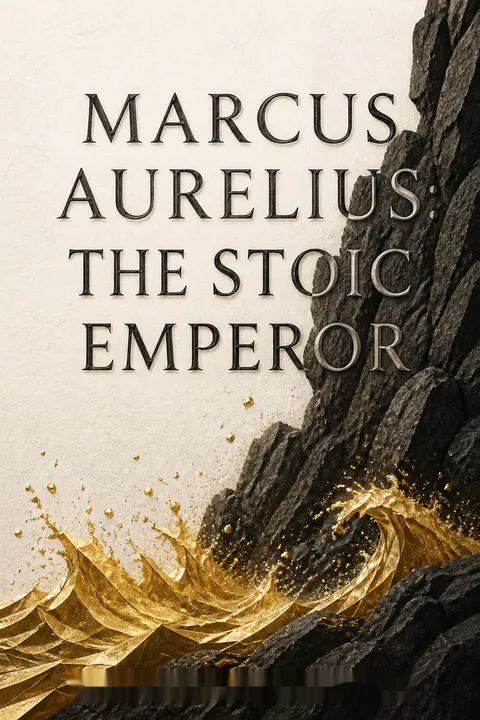
Marcus Aurelius: The Stoic Emperor is praised as an engaging, well-researched biography that offers valuable historical context for understanding the Roman emperor's life and philosophy. Readers appreciate Robertson's accessible writing style, his focus on Marcus Aurelius' character development, and the book's exploration of Stoic principles. Many consider it an excellent companion to "Meditations" and a fresh perspective on the philosopher-emperor. While some reviewers felt it didn't add much new information, most found it informative and enjoyable, highlighting Marcus Aurelius' human qualities and struggles.
People Also Read









Glossary
living in agreement with Nature
Stoic ethical aimThe Stoic goal of living according to human nature understood as rational and social. It involves using reason, acting justly toward others, and developing wisdom, courage, and moderation. It does not mean avoiding civic responsibilities or treating every event as good. External conditions may be outside one's control, but one's judgments and actions remain subject to ethical scrutiny.
apatheia
Freedom from unhealthy passionsA Stoic state of freedom from irrational or destructive passions, such as uncontrolled anger or fear. It does not mean having no feelings. Marcus's grief and affection could remain, while philosophical practice aimed to prevent emotion from overwhelming judgment and action. The term differs from modern apathy, which usually suggests indifference or lack of concern.
philostorgia
Natural human affectionA Greek term used for the affection associated with family bonds, especially the love between parents and children. In the Stoic context described here, this kind of care could extend beyond one's household because rational people were understood as sharing a moral kinship. Marcus valued this warmth alongside freedom from irrational passions, not as a weakness opposed to reason.
parrhesia
Frank, courageous speechA philosophical ideal of speaking plainly and candidly, including to people with greater power. Marcus learned to value straightforwardness and to tolerate receiving frank criticism from teachers and friends. The practice is not simply bluntness: its purpose is honest moral guidance rather than performance, flattery, or the pursuit of advantage.
therapeia
Philosophy as moral therapyThe idea, credited in the book to Marcus's teacher Rusticus, that philosophy should treat problems of character rather than remain abstract instruction. It involves examining habits such as vanity and anger, confronting the distance between ideals and conduct, and practicing a better response. The term draws on an ancient medical analogy in which philosophical teaching cares for the soul.
horror imperii
Fear of becoming emperorA Latin expression for dread of imperial rule. Marcus reportedly felt anxiety rather than excitement when Hadrian's adoption arrangements placed him in the succession. His fear reflected concern that palace life and political power would corrupt his character, a worry shaped by his observations of Hadrian's final, increasingly violent years.
About the Author
Other books by Donald J. Robertson

Download PDF
Download EPUB
.epub digital book format is ideal for reading ebooks on phones, tablets, and e-readers.








