

Key Takeaways
Build science from bold guesses, then try hard to prove them wrong.
Induction cannot finish the job. Observing many white swans does not logically establish that every swan is white. A single black swan could overturn the universal claim, while no finite number of white ones can secure it for all places and times. Popper takes this asymmetry, sharpened by Hume’s problem of induction, as the starting point for a different picture of science: theories are proposed as conjectures, not extracted from a pile of observations.
Invention is not a deduction. How a scientist first imagines a theory may involve intuition, accident, or creative insight. Logic enters once the idea is stated clearly enough to test. The rational discipline lies less in finding a guess than in exposing it to serious criticism.
What's striking is the shift from asking how evidence builds certainty to asking how criticism can reveal error. That shift resembles error-correcting methods in engineering: a system becomes more reliable not because every component is trusted, but because failures can be detected and corrected. It also makes intellectual courage practical. A theory that risks being wrong can teach more than a vague claim that accommodates every outcome. The limitation is that scientists do not always begin with explicit, sharply stated hypotheses. Much research is exploratory, but exploratory work still becomes testable when its claims and consequences are made precise.
Call a claim scientific only when possible evidence could rule it out.
Demarcation is not meaning. Popper calls the problem of distinguishing empirical science from metaphysical systems the problem of demarcation. His proposed boundary is falsifiability: a scientific theory must rule out some observable possibility. “It will rain tomorrow” risks failure; “it will rain or not rain” does not. This is a rule for classifying scientific claims, not a verdict that unfalsifiable claims are meaningless or worthless.
Risk carries information. A theory that excludes more possible outcomes says more about the world and gives investigators more ways to test it. Popper therefore resists the idea that metaphysics must be dismissed as nonsense. Speculative ideas, including atomism, can guide scientific inquiry before they have been shaped into testable theories.
The distinction helps separate two questions often run together: whether a sentence can be understood, and whether it can be tested as an empirical claim. That separation leaves room for philosophical or speculative ideas to inspire research without pretending they already have scientific standing. It is also a useful corrective to the temptation to treat scientific status as a badge of truth. Falsifiability is a boundary condition, not a guarantee of quality. A testable theory may be weak, and a non-testable idea may still help researchers imagine new questions.
Derive risky predictions, then let failed results challenge the theory.
Testing proceeds by deduction. A scientist combines a theory with initial conditions to derive a prediction. For instance, a claim about a thread’s strength and the load placed on it predicts whether the thread will break. The prediction is then compared with experiments or practical applications. If an accepted test result contradicts a prediction, deductive logic allows the theory, or some part of the system needed to derive that prediction, to be rejected.
A pass is temporary. Popper distinguishes four checks: whether the theory is internally consistent, whether its logical form makes it testable, whether it advances on competing theories, and whether its derived predictions survive empirical tests. A theory that passes has not been proved true. It has, for now, avoided a reason to discard it.
This framework makes the logic of testing visible: a theory earns a hearing by producing consequences that can be checked, and a failure matters because the consequences were entailed by the assumptions. That is stronger than merely collecting examples that fit. Yet a failed prediction rarely identifies its culprit automatically. Instruments, initial conditions, and background assumptions may also be responsible. Popper acknowledges that a whole system can be implicated, but his method depends on investigators agreeing which components to revise. The value is a disciplined standard for criticism, not a mechanical verdict machine.
Treat observations as revisable public decisions, not unquestionable foundations.
Experience does not certify sentences. A vivid perception or strong feeling of certainty cannot, by itself, justify a scientific statement. What matters is whether other investigators can test the claim. Popper calls a singular testable statement a basic statement: it describes an observable event in a particular place and time and can serve as evidence against a theory.
The foundation stays provisional. Investigators may accept a basic statement when tests produce agreement, but they can reopen it if doubts arise. There is no final layer of observation statements immune to further checking. Popper compares science to a building supported by piles driven into a swamp: inquiry stops when the supports seem adequate for the present, not because it has reached unquestionable bedrock. Experiences can motivate acceptance, but the statement is assessed through further statements and tests.
The public, revisable character of observation is a powerful account of objectivity. It does not require observers to be free of perspective; it requires their claims to be available for criticism by others. This connects scientific objectivity to practices such as replication, shared measurement standards, and open reporting. The account also reveals a real vulnerability: agreement can be mistaken, especially when observers share methods or assumptions. Inter-subjective testing reduces dependence on private conviction, but it does not make a community infallible. Its strength lies in keeping conclusions challengeable.
When evidence hurts, revise boldly rather than shield theories with excuses.
Rescue tactics can empty a theory. A researcher can protect almost any claim by blaming an instrument, rejecting an awkward observation, or adding an auxiliary assumption. Popper calls such moves conventionalist stratagems when they remove a theory’s exposure to testing. Scientific method therefore needs rules about how evidence is accepted and how a threatened theory may be revised.
A revision should add risk. An auxiliary hypothesis is worthwhile when it creates new testable consequences rather than merely explaining away a failure. Popper points to the Pauli exclusion principle as an example that strengthened the testability of quantum theory. He contrasts this with adjustments that only restore agreement with known results. The aim is not to defend a theory at all costs, but to replace it with a more testable system when criticism succeeds.
This is a theory of intellectual accountability, not a ban on changing models. Research routinely improves instruments and corrects mistaken measurements; the key question is whether a repair opens fresh ways to discover that the revised account is wrong. That criterion resembles the distinction between a predictive model and a post hoc fit in statistics. Still, the line can be difficult to draw. A hypothesis introduced after a surprise may later yield a successful prediction, while an apparently bold prediction may depend on hidden assumptions. Judging revisions requires historical and technical context.
Prefer theories that forbid more, because they face harder tests.
More content means more risk. Popper uses empirical content for the range of possible observations a theory excludes. A theory that allows nearly any outcome is difficult to refute and says little. A precise, universal theory rules out more possibilities, so it is easier to test and more informative if it survives.
Simplicity has an epistemic role. Popper does not mean that the prettiest equation or easiest explanation is always best. He links scientific simplicity to testability: a theory with fewer freely adjustable parameters often makes clearer, more vulnerable predictions. Kepler’s initial idea that planetary paths were circles was relatively easy to test. Its failure was useful because it gave him a definite constraint to abandon, rather than a flexible curve that could be fitted to every observation.
This account gives simplicity a more demanding meaning than elegance. A compact theory matters when its structure constrains what can happen, not simply when it is pleasant to write down. The connection to statistical model selection is intuitive: extra adjustable parameters can make a model fit existing data while weakening its exposure to new data. Yet Popper's ranking is not universal. Two theories may make different predictions and be incomparable in testability, or address different problems altogether. Simplicity is therefore a guide to comparison, not a single score that settles every contest.
Separate the probability of events from the credibility of a theory.
A frequency is not a truth score. Popper favors an objective interpretation of numerical probability: it describes the relative frequency of an outcome within a specified sequence, such as how often a die shows five across repeated throws. That differs from saying a theory itself is probably true. A theory’s probability cannot be read off from how often its predictions have succeeded.
Frequency estimates remain conjectures. Even a mortality forecast based on past records assumes that relevant frequencies will remain stable. That assumption reaches beyond the observations and is not logically derived from them. Probability calculations can organize predictions about event sequences, but they do not solve induction by converting a successful theory into a more probable one.
The distinction guards against a familiar equivocation: a highly probable event under a model is not the same thing as a highly probable model. Bayesian methods make this separation explicit by distinguishing likelihoods from posterior probabilities, though they add assumptions about prior probabilities and how evidence is represented. Popper's objection usefully asks what a probability measure is actually measuring. It should not be treated as a universal solvent for uncertainty. At the same time, modern statistical reasoning often uses probabilistic evidence to compare models without claiming deductive proof, a practice that needs more nuance than Popper's broad rejection of probability for theories.
Use large-sample regularity as a testable pattern, not a promise.
Randomness can still yield stability. Popper examines how irregular sequences can display stable frequencies over long runs. In his technical account, n-freedom means that a sequence’s frequencies are insensitive to selections based on patterns among up to n preceding outcomes. Bernoulli’s theorem shows how, under suitable randomness assumptions, the proportion in sufficiently long segments tends to stay near an estimated frequency, even while short segments can fluctuate sharply.
Rare is not impossible. A finite run that looks surprising does not logically refute a probability estimate, since even a very unusual run can occur. Popper therefore emphasizes reproducible, systematic deviations as scientifically significant, rather than treating every isolated anomaly as decisive. His original frequency-based treatment was revised in later additions, and he eventually preferred a propensity interpretation of probability.
The large-sample pattern is a reminder that order and disorder can coexist at different scales: local irregularity does not prevent aggregate stability. This is central to statistical physics and to everyday sampling, where a large group can behave predictably even when individual outcomes cannot. The methodological caution is equally important: “unlikely” is not synonymous with “impossible,” and thresholds for rejecting a probability model require explicit procedures. Popper’s evolving account also illustrates his own fallibilism. His treatment of probability is not a finished doctrine but a sequence of revisions under criticism.
Record which tests a theory survives, not a made-up truth percentage.
Corroboration records a history. Popper’s degree of corroboration summarizes how severely a theory has been tested and how it has performed up to a stated point. It is not a truth value and does not mean the theory has become probably true. A claim that has survived one set of tests may fare differently when new evidence arrives.
Progress is comparative. Scientists choose among competing theories by asking which remains testable, explanatory, and unrefuted after demanding checks. A broader theory may replace an older one while recovering its successful results as an approximation. Popper calls this trend quasi-inductive: science can move toward theories of greater universality without using inductive inference to prove them. The result is rational preference, but never a final certificate of truth.
Corroboration offers a useful alternative to false precision: it makes the record of testing central instead of disguising judgment as a probability score. It also encourages a historical view of rationality, since an assessment depends on the tests available at a particular time. Its weakness is that the summary can be difficult to quantify and compare, especially across fields with different standards of evidence. That is not a reason to collapse it into probability. It is a reason to report which tests were attempted, how demanding they were, and what competing explanations remain.
Do not confuse quantum equations with one interpretation of reality.
Formal results do not dictate a single story. Popper argues that quantum equations interpreted statistically can describe distributions of outcomes without establishing that measurement itself imposes an absolute limit on attainable precision. He reads uncertainty relations as constraints on statistical scatter, not automatically as claims that particles lack definite positions or momenta. The difference is between what the mathematics predicts and what a philosophical interpretation says exists.
The proposed experiment had limits. Popper’s chapter criticizes Heisenberg’s interpretation and proposes an imaginary experiment intended to challenge it. In the book’s later appendices, he acknowledges that this proposed experiment rests on a mistake and withdraws it. The broader methodological lesson remains: an interpretation should be tested against the formalism and actual experimental possibilities, not smuggled in as if the equations alone had settled the metaphysics.
The separation between formalism and interpretation remains valuable wherever equations support more than one account of what is real. But quantum uncertainty is not simply a dispute about the imprecision of laboratory instruments; modern treatments distinguish measurement disturbance from the statistical spreads associated with incompatible observables. Popper’s caution about importing metaphysics into mathematics is strongest when applied symmetrically, including to his own preferred interpretation. His retraction of the proposed decisive experiment is especially instructive: a critic of dogmatism must expose critical arguments to the same standards as the theories they challenge.
Analysis
The book’s most durable achievement is not a checklist for spotting bad science. It is a change in what counts as rational confidence. Knowledge grows without becoming certain: a theory earns provisional preference by making informative claims, surviving serious attempts at refutation, and outperforming available rivals. This links three ideas that are often separated: the logical asymmetry between verification and falsification, the methodological obligation to resist immunizing theories, and the historical development of increasingly powerful explanations.
The argument also makes objectivity a social achievement. Observations are not pristine foundations, but public statements that investigators can challenge, repeat, or replace. That view anticipates a practical understanding of scientific objectivity as organized criticism rather than the absence of perspective. It also exposes a tension: decisions about which observations to accept, which auxiliary assumptions to retain, and what counts as a severe test are not dictated by logic alone. Popper treats methodological rules as conventions chosen for the purpose of preserving criticism. Their rationality therefore depends partly on shared aims and disciplined practice.
The sharpest limitation is that theories are rarely tested in isolation. A failed prediction may implicate the central theory, an instrument, or an assumption about conditions. Popper recognizes this underdetermination, but his rules cannot provide an automatic algorithm for choosing which component to revise. Scientific communities resolve such disputes through background knowledge, comparative success, and judgment. Probabilistic methods also complicate the contrast between testing and confirmation: Bayesian model comparison can update relative support without making a theory certain, although its conclusions depend on priors and model choices.
These qualifications do not erase Popper’s central insight. They clarify its best use. Falsifiability is not a complete sociology of science or a one-line verdict on every discipline. It is a demanding norm: state claims clearly, derive consequences, disclose the assumptions needed to reach them, and make it possible for evidence to count against the preferred view. The book is strongest when read as a defense of that norm and of scientific learning through error, not as a claim that one logical formula can capture every working scientific judgment.
Review Summary
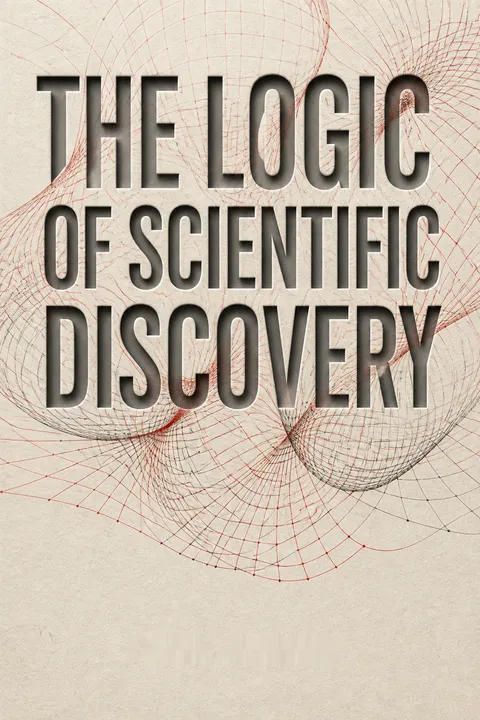
The Logic of Scientific Discovery presents Popper's influential ideas on falsification and demarcation in science. Readers praise its revolutionary approach to scientific methodology, emphasizing testability over verification. Many find the book challenging due to its technical content, especially in probability and quantum theory sections. Some criticize Popper's dismissal of induction and narrow view of science. Despite its difficulty, the work is considered fundamental to the philosophy of science and continues to spark debate on the nature of scientific inquiry.
People Also Read







Glossary
Falsifiability
Capacity to be refutedA theory is falsifiable when it rules out at least one possible empirical outcome. An observation that conflicts with the theory can count against it, provided the observation itself is accepted through appropriate testing. Popper uses falsifiability to distinguish empirical science from claims that make no testable restrictions, not to separate meaningful from meaningless statements.
Problem of demarcation
Boundary between science and non-scienceThe problem of demarcation asks how to distinguish empirical scientific systems from logic, mathematics, and metaphysical systems. Popper proposes that scientific theories must be falsifiable: they must exclude some possible observations. This criterion classifies how a claim relates to empirical testing. It does not establish that the claim is true or that non-scientific ideas lack value.
Basic statement
A testable singular claimA basic statement reports an observable event in a specific region of space and time. It can serve as a premise in an empirical test, including an attempted falsification of a theory. Basic statements are not guaranteed by private perception or treated as final foundations. Investigators accept them provisionally through procedures that allow inter-subjective checking and further criticism.
Degree of corroboration
Record of tests survivedA degree of corroboration summarizes how severely a theory has been tested and how it has performed up to a specified time, relative to accepted test statements. It is not a probability that the theory is true, nor a permanent property of the theory. New tests can change the appraisal, including by overturning a positive assessment.
Empirical content
What a theory rules outThe empirical content of a theory is the class of possible basic statements with which it is inconsistent. A theory that excludes more possibilities has greater empirical content and is more exposed to testing. In Popper’s account, this makes informative theories riskier: if they survive severe tests, they provide stronger grounds for preferring them over claims compatible with almost any outcome.
n-freedom
Insensitivity to recent patternsIn Popper’s frequency analysis, a sequence is n-free when the relative frequencies of its outcomes are insensitive to selections based on the properties of preceding groups of up to n elements. The concept describes freedom from specified after-effects, not the absence of every imaginable pattern. Popper uses it to formalize aspects of randomness and analyze why large samples can show stable frequencies.
Logical probability
Probability from logical formLogical probability concerns how much a statement’s content goes beyond what is given by another statement, rather than how often an event occurs. Popper treats it as distinct from frequency probability and from corroboration. In his account, a less testable claim is logically more probable, while a claim that says more about the world is more vulnerable to falsification.
Conventionalist stratagem
A theory-protecting adjustmentA conventionalist stratagem is a change that shields a theory from an apparent failure without increasing its testability. Examples include adding an auxiliary assumption solely to explain away a conflicting result, rejecting an inconvenient observation without adequate grounds, or altering definitions to preserve agreement. Popper’s methodological rules oppose such moves while allowing revisions that create new, independently testable consequences.
FAQ
What's The Logic of Scientific Discovery about?
- Philosophical Exploration: The book delves into the philosophy of science, focusing on the nature of scientific theories and the process of scientific discovery.
- Critique of Induction: Popper critiques traditional inductive reasoning, arguing it doesn't provide a solid foundation for scientific knowledge.
- Falsifiability Emphasis: The book emphasizes falsifiability as a criterion for distinguishing scientific statements from non-scientific ones.
Why should I read The Logic of Scientific Discovery?
- Influential Work: It's considered a foundational text in the philosophy of science, influencing many thinkers and scientists.
- Understanding Falsifiability: The book helps readers understand the concept of falsifiability, crucial for evaluating scientific claims.
- Critical Thinking Development: It encourages skepticism and critical thinking towards scientific claims, promoting questioning and testing over blind acceptance.
What are the key takeaways of The Logic of Scientific Discovery?
- Falsifiability is Key: A theory must be falsifiable to be considered scientific, meaning it can be tested and potentially disproven.
- Induction is Insufficient: Popper argues that induction cannot provide a reliable basis for scientific knowledge.
- Corroboration vs. Verification: The book distinguishes between corroboration and verification, emphasizing the former as a measure of a theory's scientific status.
What is the principle of falsifiability in The Logic of Scientific Discovery?
- Definition of Falsifiability: It refers to the ability of a theory to be tested and potentially disproven by empirical evidence.
- Importance in Science: This principle distinguishes scientific theories from metaphysical or pseudoscientific claims.
- Examples of Falsifiability: Popper provides examples like Einstein's theory of relativity, which can be tested through experiments.
How does Popper critique induction in The Logic of Scientific Discovery?
- Induction's Limitations: Popper argues that induction relies on the assumption that future observations will resemble past ones, which is flawed.
- Problem of Induction: He identifies it as a fundamental issue, suggesting it leads to circular reasoning.
- Alternative Approach: Popper advocates for a deductive approach where theories are tested through falsification.
What is the concept of corroboration in The Logic of Scientific Discovery?
- Definition of Corroboration: It refers to the degree to which a theory has withstood rigorous testing and has not been falsified.
- Measurement of Corroboration: The severity of tests a theory has passed measures its corroboration.
- Corroboration vs. Probability: Popper emphasizes that corroboration should not be confused with probability.
How does Popper define scientific theories in The Logic of Scientific Discovery?
- Criteria for Scientific Theories: Popper defines them based on their falsifiability and testability.
- Contrast with Non-Scientific Theories: Scientific theories must make predictions that can be empirically tested and potentially disproven.
- Role of Hypotheses: Hypotheses should be structured to allow for clear testing and potential falsification.
What role do basic statements play in Popper's philosophy?
- Foundation for Testing: Basic statements are singular existential statements that serve as the empirical basis for testing theories.
- Logical Form: They must be logically independent of universal statements, crucial for their role in testing.
- Observable Events: Basic statements must describe observable events, ensuring they can be tested inter-subjectively.
What is the significance of the deductive method in The Logic of Scientific Discovery?
- Testing Hypotheses: Popper advocates for a deductive method of testing, where hypotheses are formulated and then tested through logical deduction.
- Critical Examination: The deductive approach emphasizes critically examining hypotheses rather than simply trying to confirm them.
- Scientific Progress: Science progresses through the elimination of false theories, leading to a more robust understanding of the natural world.
How does Popper address the concept of scientific objectivity?
- Inter-Subjective Testing: Scientific statements must be testable by anyone, not just the original observer, to maintain objectivity.
- Separation from Subjective Experience: Objective scientific statements are distinguished from subjective experiences.
- Role of Theories: Theories guide observations and experiments, reinforcing science as a collective endeavor aimed at uncovering objective truths.
What is the relationship between simplicity and testability in Popper's philosophy?
- Simplicity as a Measure: Simplicity equates to the degree of testability of a theory, with simpler theories being more easily tested and falsified.
- Preference for Simplicity: Simpler theories make clear predictions and can be rigorously tested, aligning with scientific goals.
- Complexity and Falsifiability: More complex theories may have lower degrees of testability, making them less desirable.
What are the best quotes from The Logic of Scientific Discovery and what do they mean?
- "Hypotheses are nets: only he who casts will catch.": Emphasizes the importance of formulating hypotheses in scientific inquiry.
- "The principle of induction cannot be justified.": Critiques inductive reasoning, arguing it leads to logical inconsistencies.
- "A theory is scientific only if it is falsifiable.": Asserts that the ability to be tested and potentially disproven distinguishes scientific theories from non-scientific claims.
About the Author


Download PDF
Download EPUB
.epub digital book format is ideal for reading ebooks on phones, tablets, and e-readers.








