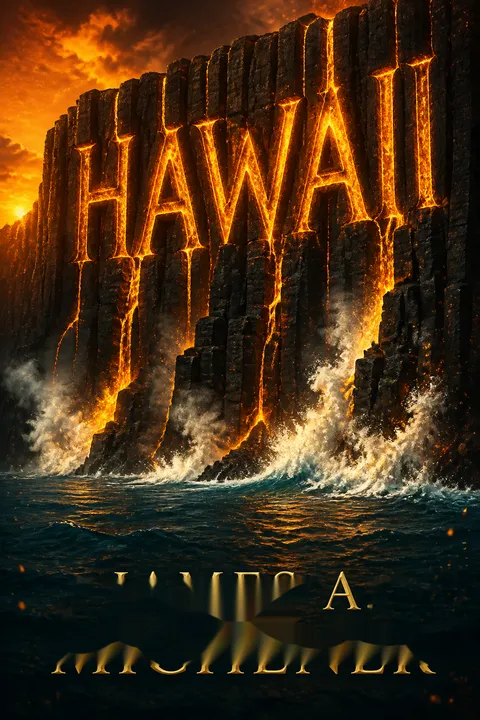


Plot Summary
Land Before Witnesses
Before people arrive, the Pacific builds the Hawaiian chain through volcanic eruptions, sinking land, coral growth, and the slow work of wind and rain. Plants and animals reach the islands only by accident, carried on storms, driftwood, or birds. Many species evolve nowhere else, yet the islands offer little food and unreliable water to any future settlers.
The land that looks like paradise is therefore a difficult promise: its beauty conceals scarcity, and its fertility depends on finding water and bringing useful crops. Across millions of years, older islands erode as younger ones rise. The newest islands wait beneath the trade winds, empty and inviting, but survival will depend on what people carry there.
The novel begins on a scale that makes human history seem brief, but it also establishes a practical condition for every later conflict: Hawaii is not an effortless paradise. Its exceptional ecology is the result of isolation, while its agricultural promise depends on water and imported life. This opening complicates later claims of discovery or possession. The islands existed, changed, and supported unique forms of life long before any human group arrived. Every migration that follows is both an act of courage and an intervention in a world that was never empty of value.
Teroro Chooses Exile
On Bora Bora, the High Priest of the new god Oro demands human sacrifices, using the convocation to strengthen his authority. King Tamatoa fears losing his throne, while his younger brother Teroro sees the deaths of skilled warriors as both cruelty and a threat to the island. Teroro's wife, Marama, warns that the priest may target him, but the brothers cannot stop the killings.
After the convocation, Tamatoa decides the family must leave Bora Bora rather than submit or start a hopeless war. The islanders load their double canoe with relatives, animals, food, plants, and ancestral gods. When Teroro throws Oro's statue into the sea, the canoe's company rejects the terror that drove them out, then follows the stars toward an unknown land.
The migration begins not as triumphant exploration but as a choice made under political and religious coercion. Teroro's courage is real, yet it is sharpened by anger and his inability to accept submission. Tamatoa supplies the harder judgment: survival requires leaving, even when exile feels like disgrace. Their conflict reveals how spiritual authority can become a tool of political control, while the canoe carries more than people. It carries food systems, gods, rank, and memory, making migration the transfer of an entire social order.
Pere Claims the Shore
After a punishing voyage guided by stars, storms, and the old navigator Tupuna, Tamatoa's people reach the great volcanic island they call Havaiki. They establish a temple and plant the crops and animals they brought, but Teroro stops the king from burying slaves beneath its pillars and persuades him to use fish instead.
The settlers have nevertheless arrived without Pere, the volcano goddess, and the forgotten omission soon becomes dangerous. Earthquakes and lava destroy their first settlement, forcing the survivors to flee to better land.
They carry away their seeds, gods, and what remains of their community. From this second beginning come the customs and strict social rules that shape Hawaiian life, including the divisions later missionaries will challenge.
The settlers' first failure makes the island an active presence rather than a passive setting. Teroro's refusal to sacrifice slaves marks a moral break with inherited practice, but the community still interprets natural catastrophe through the religious system it brought with it. Their second settlement therefore combines adaptation with continuity: they alter their location, preserve their crops, and create rules that make an uncertain society legible. The episode also plants a lasting conflict between local religious knowledge and imported explanations of nature.
A Sermon Sends Them
In New England, Yale students Abner Hale and John Whipple hear Keoki Kanakoa, a Hawaiian convert, describe the violence and religious practices of his homeland. John immediately offers himself as a missionary doctor. Abner, a severe young minister shaped by his austere family, follows after deciding that he too must go.
The mission board requires its male missionaries to travel with wives, so Reverend Eliphalet Thorn arranges Abner's introduction to Jerusha Bromley, a warm, lively woman from a comfortable New Hampshire household.
They marry after a brief courtship and sail with the other missionaries aboard the cramped brig Thetis. Their voyage around Cape Horn tests them with storms, sickness, and confinement, while Abner's rigid piety begins to govern even the smallest parts of their life together.
Keoki's appeal turns distant suffering into a personal summons, but the missionaries carry sharply different temperaments into the work. John is curious and responsive; Abner seeks certainty through duty and doctrine. Jerusha's warmth offers a counterweight to his severity, though their marriage begins within the mission board's practical machinery rather than ordinary courtship. The voyage then makes their beliefs bodily: cramped quarters, illness, fear, and dependence expose the cost of Abner's conviction that discipline can solve every problem.
Lahaina Takes Its Measure
The missionaries arrive in Lahaina, where Alii Nui Malama welcomes them and asks Jerusha to teach her to read and write. Abner insists that literacy without Christianity is insufficient, while Malama initially wants the practical power she associates with writing. He then teaches her a faith centered on sin, predestination, and salvation, and she begins to accept its demands.
Through Malama, Abner gains an audience among the rulers and proposes laws against killing infants, selling alcohol to Hawaiians, and letting sailors roam freely at night. When sailors resist, they burn the church and fire a cannon at the mission house. Malama enforces the new laws despite the danger, and the town's inhabitants gradually restore order.
Malama is not a passive convert. She evaluates what the missionaries offer against the harms she sees in Lahaina, and her interest in writing begins with political agency, not submission. Abner's insistence on exclusive religious truth makes their exchange unequal, even as his advice produces concrete protections for the town. The riots expose the limits of preaching without coercive power: sailors can destroy the church and threaten the mission. Malama's authority, rather than Abner's theology alone, makes reform enforceable.
The Church Splinters
As Abner builds schools, translates scripture, and tries to shape Lahaina's government, he repeatedly refuses to ordain Keoki, even though Keoki has studied in America and leads local Christians. Keoki eventually marries his sister Noelani according to Hawaiian tradition, and Abner publicly denounces the union.
When measles reaches the islands, thousands fall ill and many Hawaiians die; Abner's wife Jerusha and other missionaries work through the epidemic, while John Whipple tends the sick.
Years later, Noelani bears twins, and the community's response to a sickly child deepens the divide between Hawaiian custom and missionary authority. Jerusha dies after exhausting herself in service. Abner remains in Lahaina, increasingly isolated, while his children are sent away to America.
The conflict is no longer simply Christianity versus older religion. It concerns who has the right to lead, marry, interpret custom, and define a child's worth. Abner's refusal to ordain Keoki reveals that his belief in spiritual equality stops at institutional authority. The epidemic makes the missionaries' limitations visible: their labor matters, but it cannot reverse the demographic catastrophe. Jerusha's care earns affection without granting her husband's doctrine universal legitimacy, and Abner's isolation grows from the distance between his moral certainty and Hawaiian experience.
Hakka Leave the Village
The narrative turns back to China, where drought forces farmer Char and his family to leave their mountain village in search of food. A rich man's offer to buy Char's daughter, Siu Lan, nearly breaks the family, but General Ching proposes robbing the buyer instead.
The group kills the men who would have taken Siu Lan and escapes with food. When they return, Tartars have stolen the village's seed grain and ordered its people to leave. General Ching leads the survivors south toward a rumored fertile valley, while Char insists on bringing his elderly mother despite the danger.
After a long journey, the Hakka settle in the highlands above a Punti village. Their shared hardships harden into close family obligations and enduring separation from their neighbors.
The Hakka story gives migration a different pressure from Teroro's: hunger, invasion, and the threat of family separation drive the movement. Char's decision to protect his mother resists General Ching's military logic, insisting that survival without obligations would hollow out the community. The resulting Hakka identity is built through memory, work, and an insistence on family continuity. Its contrast with the Punti is not mere cultural color; it becomes a durable social boundary that later shapes marriage, labor, and political life in Hawaii.
The Kees Cross Oceans
As the whaling trade expands, Captain Retire Janders and Dr. John Whipple turn Lahaina into a supply port, buying food, rope, and other goods from local producers. Whaling wealth and sugar demand draw Chinese workers to Hawaii, including men from the Hakka and Punti communities whose histories and customs remain distinct.
The Kees carry a strong memory of their village, family names, and obligations to relatives left in China. On arrival, they face plantation work, crowded living quarters, and contracts that offer little money, while Hawaiian society is already being reshaped by foreign ships and trade. The new laborers are not simply a workforce: they bring a family system, commercial skill, and a long view of belonging that will alter the islands.
Migration is presented as an economic transaction that cannot contain the people it moves. The planters want laborers who will work and eventually return, but the Kees arrive with networks, loyalties, and ambitions that exceed the contract. Their ancestral village remains active in their decisions through remittances, names, and marriage expectations. The contrast between Hakka and Punti also complicates any easy category of Chinese identity. Hawaii receives workers, but it also receives competing social systems that will take root.
A Family Builds Its Foothold
In Honolulu, the Kee family turns work into a growing commercial foothold. The family elder, Hong Kong Kee, learns to manage land and trade, while his relative Africa becomes a lawyer and the brothers build businesses through the family hui, pooling earnings and lending among themselves.
Their mother, known in Hawaii as the Pake Kokua, sells vegetables and pineapples, then insists that her sons receive education and support relatives in China. Her ambition clashes with her husband, who expects the family eventually to return.
She also faces the loss of her youngest son, raised by a Hawaiian family after she gave him up to protect him from leprosy. By keeping savings, land, and education within the family, she creates a durable base in the islands.
The Kee family converts vulnerability into an alternative institution. The hui pools resources and distributes risk, while remittances preserve a link to China and schooling prepares the next generation for roles beyond plantation labor. The mother is central because she treats land and education as intergenerational tools, not private luxuries. Her decision to release one child into another household also shows how kinship in Hawaii can be chosen and shared. The Kees' rise challenges the planters' assumption that imported workers will remain temporary and politically inconsequential.
The Fort Faces New Power
The missionary families and sugar merchants consolidate power through land, shipping, and plantation management. Dr. Whipple's business partnership with Captain Janders grows into a major commercial network, while Rafer Hoxworth builds his own shipping empire and later brings Noelani into his household.
Their descendants inherit competing loyalties to Hawaii, America, and the wealth built from sugar. Chinese and Japanese workers, meanwhile, organize families, buy property, and seek education.
The Fort expects them to remain laborers, but the Kees' businesses and the Japanese students' achievements make that expectation untenable. By the time political leaders begin debating Hawaii's future, the old ruling circle faces an organized population that will no longer accept decisions made without it.
The Fort's power rests on an alliance between commercial infrastructure and a paternal story of stewardship. Its members can sincerely believe they protect Hawaii while excluding most residents from ownership and government. The Chinese and Japanese challenge that arrangement not through one identical movement, but through distinct routes: the Kees build family capital; Japanese workers pursue education and collective bargaining. The chapter's central instability is that the institutions claiming to civilize Hawaii also depend on keeping its people subordinate.
The War Tests Belonging
When war reaches Hawaii, Japanese ancestry becomes a source of danger as well as identity. The island's Japanese Americans face suspicion despite their deep roots, and young men such as the Sakagawa brothers seek to prove their loyalty through military service. In Europe, Goro leads men of the Japanese American 442nd through a desperate rescue of a trapped Texas unit near the Rapido River.
The cost is severe, and his brother Minoru dies in the effort. Their courage wins recognition, but it does not erase the discrimination their family faces at home. After the war, Goro returns to Hawaii with new authority and begins organizing workers, while his brother Shigeo uses education and political skill to challenge the old order.
The war turns the question of belonging into a life-or-death test imposed by others. The Japanese Americans prove their loyalty in combat, yet their service cannot retroactively make the prejudice against them disappear. Goro's battlefield leadership gives moral force to his later labor organizing, while Shigeo's political path converts the same experience into institutional action. Their trajectories expose a contradiction at the heart of national identity: the state can demand sacrifice from people it still treats as suspect.
A Strike Breaks the Silence
After the war, the laborers who once endured the plantations' demands begin pressing for better wages and the right to organize. Goro becomes a leader in the movement, while his brother Shigeo, trained as a lawyer, works to win Japanese Americans a voice in public life. The Fort fights to preserve its control, framing union activity as a threat to Hawaii's stability.
As strikes and political campaigns intensify, the family businesses and racial alliances that once seemed fixed begin to shift. The Kees' pooled wealth, Whipple's commercial network, and Hoxworth power all become part of a new contest over who will govern the islands and whose interests the law will protect.
The strike is a test of whether economic dependence can be mistaken for consent. The Fort's leaders regard order as proof of good governance, but workers experience that order as low wages and constrained movement. Goro's organizing makes collective action possible; Shigeo's legal work gives it a route into formal politics. Their challenge does not erase old ethnic divisions, but it forces them into new coalitions. The conflict recasts Hawaii's central question from who owns the plantations to who has the authority to define a fair society.
The Next Generation Arrives
By the mid-century, the families that once stood on opposite sides of Hawaii's transformation are entangled through business, marriage, and politics. The Kees have converted plantation wages into shops, land, and education; the Hales have carried missionary influence into public life; and the Hoxworths still command shipping and sugar.
Yet their younger members do not inherit a single worldview. Whip Hoxworth embraces business and adventure, while Micah Hale's son imagines American expansion as inevitable.
Japanese American leaders argue for a larger share of political power, and Chinese families build institutions of their own. The old hierarchy survives, but no longer uncontested, as the children of laborers enter the same arenas once reserved for plantation dynasties.
This stage of the saga makes inheritance unstable. The children inherit names, property, and unresolved arguments, but they do not simply reproduce their parents' positions. The Kees' investment in education gives them leverage; the Hales' religious authority is challenged by their own descendants; and the Hoxworths' commercial dominance meets a younger generation shaped by cross-cultural life. The novel treats family as a mechanism for transmitting power, but also as the place where inherited loyalties can be revised.
Hawaii Claims Its Future
As labor organizing and political campaigning intensify, the old ruling families can no longer assume that wealth will guarantee control. Japanese American candidates seek office, Chinese families support education and enterprise, and Hawaiians continue to insist on their own history and claims to the land.
In the 1954 election, the rise of Japanese American political leadership signals that the islands' public life has changed beyond recognition from the era when plantation owners chose who could govern.
The novel ends its supplied narrative not with a settled answer, but with Hawaii entering a new balance of power: business, ancestry, race, and democratic participation now collide in the same arena, and the next generation must decide what kind of home they will build.
The ending is a transfer of possibility rather than a clean resolution. The old order is not simply defeated, and the newer political forces do not erase inherited inequalities. Instead, people once treated as labor, dependents, or outsiders acquire the means to contest public decisions. The 1954 election matters because it makes representation visible: the descendants of migrants and workers can now act within the institutions that once excluded them. Hawaii's future remains unsettled, but it is no longer the private possession of a few families.
Analysis
Hawaii is organized less as one protagonist's journey than as a sequence of arrivals, each bringing a new system of survival and a new claim on the islands. Polynesian navigators transport food, gods, and social rank; missionaries bring literacy and an exclusive theology; merchants convert land and labor into capital; Chinese and Japanese families turn migration into durable community. The novel's central conflict is therefore not a simple contest between tradition and modernity. Every group carries both constructive knowledge and coercive power. Abner Hale's education and lawmaking protect some people while his refusal to ordain Keoki reproduces racial hierarchy. The Fort builds ports, trade, and plantations while excluding workers from decisions. The Kees answer exclusion through family pooling, schooling, and land, while Japanese Americans force their claim to citizenship through service and political organizing. The repeated images of water, ships, and names connect these histories: water sustains and destroys, ships carry whole cultures, and names preserve loyalties across distance. By ending with political power becoming more contested, the narrative suggests that Hawaii's future cannot be secured by any single founding story. Its people must decide whether belonging means inheriting authority or sharing it.
Review Summary
Hawaii receives widespread praise for its epic scope and meticulous historical research, with many readers awarding it five stars. Reviewers consistently highlight Michener's masterful storytelling across the island's geological formation, Polynesian settlement, missionary influence, and waves of Chinese and Japanese immigration. Common criticisms include slow opening chapters, occasional historical inaccuracies, and uneven pacing in later sections. Several readers note the book profoundly deepened their appreciation for visiting Hawaii. The overall Goodreads rating of 4.22 reflects a largely enthusiastic readership, though some found its 1,000+ pages daunting.
Characters
Teroro
Exiled navigatorThe younger brother of King Tamatoa, Teroro is an impetuous warrior and gifted navigator who distrusts the new cult of Oro and its demand for human sacrifices. He is loyal to his brother and to his wife Marama, but anger often outruns his judgment. His ability to read stars and act under pressure helps carry his people toward Hawaii. Teroro embodies a difficult form of leadership: brave enough to defy sacred authority, yet still shaped by the customs he hopes to leave behind.
Marama
Navigator's wise wifeTeroro's wife, Marama is a careful observer who sees political danger before her husband does. She understands the High Priest's ambitions and warns Teroro that he may be targeted, then accepts the costs of his eventual voyage. Her intelligence is practical rather than ceremonial: she reads motives, anticipates consequences, and offers counsel that men around her often mistake for mere caution.
King Tamatoa
Bora Bora's rulerTamatoa is a capable ruler whose authority depends on religious tradition and the fragile balance among neighboring islands. He fears the growing power of Oro's priesthood, but he is also responsible for the survival of his people. His decision to leave Bora Bora rather than force a hopeless confrontation shows a ruler who can accept retreat when it protects the community.
Abner Hale
Rigid missionaryA New England minister formed by severe Calvinism, Abner arrives in Hawaii convinced that disciplined belief can remake society. His marriage to Jerusha and his work among the rulers reveal both his capacity for devotion and his difficulty accepting values he cannot control. He translates scripture, builds schools, and argues for laws protecting vulnerable people, yet his conviction can harden into judgment. Abner's story turns on the distance between sincere moral purpose and the humility required to understand another culture.
Jerusha Hale
Mission teacherJerusha comes from a warm, sociable New England family and brings to Lahaina a practical compassion unlike Abner's stern certainty. She teaches Malama and local girls to read, sew, and care for children, while building genuine relationships across cultural lines. Jerusha's strength lies in attention to everyday needs: she notices when a child is hungry, when a woman is exhausted, and when Abner's convictions are hurting rather than helping. She becomes a moral counterweight to her husband without ceasing to share his faith.
John Whipple
Mission doctor and traderAbner's Yale roommate, John Whipple begins as a doctor bound for missionary service, but his curiosity and practical judgment lead him beyond the mission's rules. He studies Hawaiian medicine, navigation, and business, and eventually works with Captain Janders to supply whalers and plantations. John is less certain than Abner that one institution can monopolize truth. His skepticism does not make him indifferent; it makes him attentive to consequences, especially when doctrine and human need collide.
Malama
Alii Nui of MauiMalama is a powerful Hawaiian leader, the mother of Keoki and Noelani, and a keen judge of political realities. She seeks literacy and practical knowledge, but she does not surrender her own gods or customs easily. Her working relationship with Jerusha and Abner grows through argument, lessons, and efforts to regulate sailors, protect girls, and curb abuse. Malama's authority is rooted in both ancestry and public responsibility, and she insists that any new order prove its value to ordinary Hawaiians.
Keoki Kanakoa
Hawaiian scholarKeoki is the son of Malama and a gifted student who travels to New England to study Christianity before returning to Hawaii. He is capable, eloquent, and deeply attached to his people, yet he finds himself caught between missionary institutions and Hawaiian religious tradition. His wish to lead his own church exposes the limits of the missionaries' promise to prepare Hawaiians for self-government. Keoki's intelligence makes him both a bridge between cultures and a figure through whom their conflicts become personal.
Noelani
Hawaiian noblewomanNoelani, daughter of Malama and sister of Keoki, is an admired alii whose beauty and lineage carry political weight. She learns from the missionaries but remains attentive to Hawaiian inheritance and the future of her people. Her choices are shaped by a tension between Christianity, traditional authority, and the survival of the ruling line. Noelani is not merely a symbol of cultural change; she is a leader expected to make decisions on behalf of a community under mounting pressure.
Rafer Hoxworth
Whaling captainA forceful New England sea captain, Rafer Hoxworth turns whaling, shipping, and trade into a family empire. He is charming when it serves him and brutally decisive when challenged. His early attachment to Jerusha Hale leaves a lasting antagonism with Abner, while his later connection to Noelani binds him to Hawaii's ruling families. Hoxworth's instinct is to control the conditions around him, whether at sea, in business, or in the households he enters.
Char
Hakka farmerChar is a poor farmer in famine-stricken China whose family is threatened by hunger, invasion, and the sale of his daughter. He is stubbornly loyal to his mother and willing to take dangerous risks to protect his household. His choices help define the Hakka family's migration south and its lasting emphasis on kinship, endurance, and self-reliance.
General Ching
Hakka migration leaderA former soldier turned village leader, General Ching organizes the Hakka family's flight from famine and Tartar conquest. He is bold, persuasive, and capable of turning a scattered group into a disciplined community. His military instincts save lives, but they also clash with Char's refusal to abandon family members who cannot keep pace. Ching represents leadership forged by crisis rather than inherited authority.
Char Nyuk Tsin
Hakka matriarchKnown in Hawaii as the Pake Kokua, Char Nyuk Tsin is a Hakka woman who survives displacement and builds a life through work, discipline, and shrewd choices. She sells food, acquires land, and insists that her sons be educated, while maintaining obligations to relatives in China. Her strength is practical and quiet: she can recognize a chance, keep a family afloat, and endure a loss without surrendering her purpose. She becomes a central force in the Kee family's rise.
Kee Mun Ki
Gambler turned cookA clever Punti man, Mun Ki arrives in Hawaii with a gambler's confidence and an instinct for opportunity. He earns a living through cooking, card games, and work for the Whipple household, while his marriage to the Hakka woman Nyuk Tsin creates a complicated family with ties to both communities. His charm and opportunism help him adapt, but he does not always grasp the consequences of the choices made around him.
Hong Kong Kee
Family business strategistA resourceful member of the Kee family, Hong Kong builds influence through land, commerce, and an ability to read how power works in Hawaii. He understands that education and pooled family resources can move Chinese descendants beyond plantation labor. His outlook is pragmatic, sometimes at odds with older loyalties, but he remains attentive to the family's long-term security and to the shifting political balance around it.
Whip Hoxworth
Restless plantation heirThe grandson of Rafer Hoxworth, Whip inherits commercial power but resists the narrow life expected of him. He is drawn to the sea, women, new crops, and bold ventures, and he repeatedly challenges the boundaries set by his family. His energy makes him an innovator and a danger to settled arrangements. Whip represents the younger generation's appetite for expansion, even when it comes at personal and political cost.
Micah Hale
Missionary heir and politicianAbner and Jerusha's son, Micah grows up in Hawaii, studies at Yale, and returns with confidence in American political ideals. He is bright, ambitious, and convinced that Hawaii's future lies in closer union with the United States. His relationship to the islands is more complicated than his rhetoric suggests: he belongs to a missionary family, yet his choices affect a society whose people do not all share his vision.
Goro Sakagawa
Japanese American veteranThe eldest surviving Sakagawa son, Goro is shaped by the discipline of his Japanese family and the demands of American life. He serves with extraordinary courage in Europe, then returns to Hawaii and becomes an organizer for plantation workers. His loyalty is not simple obedience to either nation or family; he seeks a way for Japanese Americans to claim belonging while changing the economic conditions that constrain them.
Shigeo Sakagawa
Lawyer and reformerShigeo is the youngest Sakagawa son, a decorated veteran who studies law at Harvard and enters Hawaiian politics. His fluency across cultures makes him an effective advocate, but his success depends on negotiating with both the old business families and the communities they once excluded. He inherits his father's discipline and his family's hunger for education, then applies them to public life.
Whipple Hale
Missionary family heirA descendant of the missionary Hales, Whipple is energetic, restless, and drawn to business, travel, and women. His choices place him at odds with the austere expectations of his family, while his connection to the Hoxworths brings him into the center of Hawaii's commercial world. He is one of the younger figures through whom the novel shows inherited power changing shape.
Uliassutai Karakoram Blake
Unorthodox schoolmasterA flamboyant English educator with unusual experience across cultures, Blake teaches Chinese and Hawaiian children while rejecting the narrow expectations of plantation society. His sharp intelligence and irreverent manner make him an important advocate for education beyond the elite schools. He recognizes talent in students whom others would overlook and encourages them to imagine careers beyond the limits imposed by race and class.
Captain Tamatoa
Polynesian kingTamatoa rules Bora Bora during a period of religious change and political pressure. He values the island and its independence, but understands that continued resistance will destroy his people. His decision to leave rather than fight a stronger coalition marks him as a ruler who places survival above pride.
Abraham Hewlett
Missionary turned planterA vulnerable missionary, Abraham is left alone with a young son after his wife's death. He forms a relationship with a Hawaiian woman he has taught, then refuses to let the mission board dictate the rest of his life. His later work growing food and sugar for the whalers shows how survival can require leaving institutions that no longer protect the people they claim to serve.
Plot Devices
The double canoe
Carries a people northThe voyagers' double canoe, Wait-for-the-West-Wind, is both vessel and portable society. Its cargo includes people, food plants, animals, tools, and ancestral gods, so every practical choice aboard determines what can survive after landfall. Navigation depends on stars, birds, waves, and inherited chants. The canoe also lets the story compare migration across eras: Polynesian navigators cross the Pacific under their own knowledge, while later arrivals travel on commercial ships governed by foreign powers.
Kapu and tabu
Regulates power and conductKapu and tabu systems establish who may touch a king, eat particular foods, enter sacred places, or approach another person's status. They protect social order but also enable sacrifice and rigid hierarchy. Missionaries attack these rules as superstition, while Hawaiians see them as inherited structures for managing danger and authority. The term's shifting meaning becomes a measure of cultural conflict: neither side fully understands how much law, religion, and everyday survival are entangled.
The translated Bible
Makes faith a public forceAbner Hale's translation work turns religious teaching into a durable tool of education and governance. It gives the missionaries access to Hawaiian readers, yet it also exposes the limits of their claim to cultural authority. Keoki can study Christianity without accepting that only white ministers may interpret it, while Malama uses literacy for purposes that do not always match Abner's. The Bible therefore functions not only as a sacred text but as a contested technology of language, law, and political influence.
Land and water
Turns scarcity into powerAcross the novel, control of water and arable land determines who can settle, farm, and accumulate wealth. The original islands hide underground reservoirs beneath rock, while later plantation districts depend on irrigation and captured rainfall. Sugar and pineapple fortunes rise when water can be moved to dry land, and family power follows ownership and control of that infrastructure. Land is never simply scenery: it is a resource, a memory of home, and the basis for political leverage.
Genealogy and names
Keeps ancestry in motionHawaiian chants and Chinese family records preserve identity across distance and upheaval. The Hakka genealogies connect generations to villages left behind, while naming poems assign children a place within a living family line. These systems contrast with the missionaries' written records and with American habits of individual identity. The Kees' names become especially consequential as their descendants move between Chinese, Hawaiian, and American worlds, carrying obligations that no single border or language can erase.
About the Author
Other books by James A. Michener


Download PDF
Download EPUB
.epub digital book format is ideal for reading ebooks on phones, tablets, and e-readers.








