

Key Takeaways
Buy a proven company, then become the CEO who improves it
A third career path. Entrepreneurship through acquisition means buying an established small business and taking over as its CEO. Unlike a startup founder, the buyer inherits customers, employees, and a working business model. The authors estimate that roughly 200,000 U.S. businesses in their target range exist, many serving unglamorous niches with steady revenue and profits. Most buyers they studied had never been CEOs or owned a business before.
Tony Bautista’s example. At 28, Bautista bought Fail Safe, a fire-hose testing service, after a ten-month search. He learned payroll and other operational details on the job. His motivation was direct responsibility: serving customers, employing people, and building a company. The path can offer autonomy and financial upside, but the search and ownership both demand sustained effort.
The appeal is not simply ownership. It is the chance to inherit a functioning organization and use management skill where decisions have immediate consequences. That makes this path a practical counterpoint to the cultural fixation on inventing something new. It also changes the entrepreneur’s first task: instead of proving that customers want a product, the buyer must prove that the business can survive a change in leadership. The opportunity is real, but the book’s examples come from a particular pool of successful buyers. Their outcomes should inspire investigation, not be mistaken for a guarantee.
Choose the responsibility, not the fantasy of being your own boss
Freedom has a price. An owner can choose priorities, shape the workplace, and decide how to spend the day. But independence means deciding what matters without a manager setting the agenda. The owner answers to employees, customers, lenders, investors, suppliers, and regulators, and carries the emotional consequences when the business struggles. Greg Ambrosia, a former military officer who bought a high-rise window-washing company, found the constant responsibility more stressful than his earlier work in combat.
Know what disappears. A full-time search usually means giving up a regular salary and benefits. Small firms also lack the colleagues, brand prestige, and specialist departments that larger organizations provide. The authors advise judging the ordinary work, not just imagining the financial reward: Can the buyer tolerate ambiguity, learn unfamiliar operations, and keep going through setbacks?
This is a useful distinction between autonomy and ease. Organizational research often treats autonomy as a resource that can increase motivation, but autonomy also transfers planning and emotional labor to the individual. In a small firm, freedom from bureaucracy can become exposure to every unresolved problem. The right test is therefore not whether independence sounds attractive, but whether the person can create structure for themselves and find social support outside the company. A buyer’s family and health constraints matter because ownership’s flexibility is meaningful only when the business can actually accommodate them.
Favor recurring customers and slow growth over a glamorous turnaround
Stability beats spectacle. The authors define an enduringly profitable business as one with an established model that repeatedly earns profits, especially because customers return. Rapid growth can consume cash, strain management, attract competitors, and raise the purchase price. A troubled company may look cheap, but fixing its business model adds uncertainty to an already demanding acquisition.
Look for a manageable scale. The authors favor companies with roughly $750,000 to $2 million in annual pretax profits, steady cash flow, and moderate growth. A slow-growing market can give a new owner time to learn customers and improve operations without betting the company on expansion. The business should also fit the buyer’s abilities and preferred location. The aim is not a sleepy job: it is a sound company that can function through employees and systems, rather than depending entirely on the seller.
The preference for modest growth is a form of risk control, not a claim that growth is inherently bad. Fast expansion increases working-capital needs and creates more opportunities for execution errors, especially when management is new to the business. This resembles the distinction in operations research between a system’s throughput and its resilience: maximizing output can leave little room to absorb shocks. Still, slow growth does not guarantee safety. A stable business can be disrupted by regulation, new technology, or a changing customer base, so durability must be tested rather than inferred from a calm history.
Seek companies customers trust and cannot easily replace
Retention has a cause. Recurring customers are strongest when the company gives them a reason to stay beyond habit. The authors point to four sources of customer loyalty: a strong reputation, few practical competitors, low importance to the customer’s total budget, and integration into the customer’s operations. A caterer may keep using a dependable party-rental company because a failed delivery could ruin an event. An oilfield pipe service may face little local competition because transporting heavy pipe long distances is costly.
Check whether it is a business. A company is more than a job when customers value the firm’s service, not only the owner’s personal contribution. If the seller alone holds essential relationships or performs every critical task, the business may weaken when that person leaves. The buyer should understand why customers return and whether employees can continue delivering the service.
These examples show that customer loyalty is not a vague asset. It rests on switching costs, trust, and the consequences of failure. Those mechanisms are familiar in economics, but the practical insight is to ask what customers risk by changing providers, not merely whether they say they are satisfied. At the same time, apparent loyalty can conceal dependence on a few decision-makers or one large account. Customer interviews and retention records help distinguish a durable relationship from a temporary pattern that disappears when the owner exits.
Search full time, keep prospects flowing, and reject weak deals quickly
Treat the search as a job. Finding and buying a company commonly takes six months to two years of full-time work. The market is fragmented, and sellers often do not advertise openly. Buyers can source through brokers, contact owners directly, or combine the two. Brokers offer organized listings and some evidence that a seller intends to sell. Direct outreach may uncover less-contested opportunities, but requires contacting thousands of owners and often produces very few promising responses.
Keep the funnel moving. Searchers may review hundreds of prospects to find one suitable acquisition. The authors advise maintaining outreach even when a deal looks promising, because negotiations often fail. Apply quick filters for profitability, size, location, management fit, and lifestyle, then investigate only the survivors. A search fund raises money for search costs and may help finance the eventual purchase; a self-funded search can give the buyer more negotiating flexibility but places more personal resources at risk.
A disciplined pipeline protects buyers from a common decision trap: treating one attractive prospect as the only chance available. In decision science, a wider set of options can reduce premature commitment and improve comparison, provided the search does not become endless. The book’s funnel approach addresses both risks by separating quick rejection from deeper investigation. Its insistence on a full-time search also reflects seller behavior: responsiveness and availability help sustain trust. Yet the cost of that commitment is substantial, so search duration and personal runway deserve explicit planning.
Test the seller’s reason for selling before investing months in a deal
Intent is a separate filter. A broker listing or a seller’s early enthusiasm does not prove the owner will close. Retirement, poor health, divorce, or conflict between partners can create a compelling reason to sell. Without such pressure, an owner may change course after discovering the tax consequences, the likely sale price, or the need to help with a transition.
Clarify expectations early. Small-business owners often overestimate their company’s value or misunderstand a debt-free, cash-free sale, in which the seller keeps the company’s cash and pays off its debt. Buyers should also explain that a normal amount of working capital stays with the business. Check that all owners are willing to sell and that the seller can accept the likely price and remain involved during the handover. A seller who claims only a new owner can take the business “to the next level” deserves careful scrutiny.
This is a subtle form of counterparty due diligence. A transaction depends not only on whether the buyer can finance it, but on whether the seller’s incentives remain aligned as new information arrives. The seller’s changing mind may be rational learning, not bad faith, which is why expectations should be surfaced early rather than treated as a late-stage surprise. A compelling reason to exit reduces one uncertainty but does not prove the business is sound. The buyer must separately assess the seller’s motives, the company’s condition, and whether both sides understand the transaction.
Verify the cash, customers, and claims before trusting the seller’s story
Test the operating evidence. Confirmatory due diligence begins after a signed letter of intent. The buyer checks whether financial and operational claims match company records, speaks with customers and key employees, and hires experienced accountants and lawyers. A proof of cash compares reported results with bank deposits and payments. A quality-of-earnings analysis examines whether historical revenue and profit are likely to recur, including customer patterns, unusual expenses, and seller add-backs.
Use fast warning signals. EBITDA means earnings before interest, taxes, depreciation, and amortization, a common measure of operating earnings. The book suggests initial EBITDA margins of at least 20% for manufacturing and service companies, or 15% for wholesalers and distributors; customer churn of 25% or less; and careful review of customer concentration. A drop of 30% or more in EBITDA during the last major recession is presented as a serious warning. If the evidence changes the deal materially, renegotiate or walk away.
Due diligence is strongest when it tests a small number of decision-critical assumptions rather than collecting documents for their own sake. The book’s focus on cash reconciliation is especially practical because accounting records can appear consistent while timing errors distort earnings. The thresholds are useful screens, not universal laws: margins differ across industries, and a recession may affect sectors unevenly. That makes comparison with relevant peers and an explanation of business-specific risks essential. The buyer should treat a clean report as evidence, not certainty, because past performance cannot eliminate future shocks.
Base your offer on sustainable cash flow, not the seller’s best year
Start with a market range. The authors report that enduringly profitable traditional small businesses often sell for three to five times adjusted EBITDA. The multiple should reflect growth, predictability, reinvestment needs, size, and corporate structure. Adjust EBITDA for personal expenses, one-time costs, and any expense that will still be required under new ownership. Do not count the seller’s entire salary as an add-back if someone must be paid to run the company.
Model what can go wrong. Build projections from historical results, then test different assumptions for sales, costs, capital spending, debt payments, and a future sale. In the Zeswitz Music example, a model based on the apparent asking price produced an investor return below the book’s approximate 25% target. A lower purchase price or lower instrument spending improved the modeled result. The model’s job is not to predict perfectly; it is to expose which assumptions make the deal work.
Valuation is presented here as a disciplined negotiation between evidence and uncertainty. Scenario analysis makes hidden dependencies visible: a deal may look attractive only if unusually low expenses continue or capital investment falls. This is more informative than arguing over a single “correct” multiple. The 3-5 range and 25% return target are context-specific benchmarks, not promises or laws of finance. In particular, forecasts can create false precision. A prudent buyer should examine downside cash flows and debt capacity, not just whether an optimistic exit scenario produces an appealing return.
Match debt and investor terms to the company’s real ability to pay
Layer the financing. Acquisitions commonly combine senior debt, seller financing, and investor equity. Senior lenders are paid first and may claim company assets if payments fail. Seller debt defers part of the purchase price and can keep the seller invested in a successful transition. Equity absorbs more risk and has no fixed repayment schedule. In the United States, an eligible Small Business Administration loan can finance up to 80% of acquisition cost, subject to a $5 million maximum, with a typical ten-year term.
Protect operating flexibility. Investors in these deals often seek returns near 25% annually, reflecting risk and limited liquidity. Buyers should present conservative projections, seek enough equity commitments to cover the need, and avoid debt covenants that leave no room for a downturn. An earn-out can bridge disagreement: the seller receives additional payment only if the company later meets agreed performance targets.
The capital structure distributes risk as much as it supplies money. Debt can amplify returns when cash flows are steady, but fixed payments make a temporary downturn more dangerous. This is why the quality of earnings and the flexibility of loan terms matter together. An earn-out can align buyer and seller when they disagree about future growth, although it can also create disputes over how performance is measured. Investor return targets are useful negotiating reference points, but the buyer should not force a deal to fit them by relying on aggressive assumptions.
Set the essential terms before exclusivity turns negotiation into a countdown
Make the handshake concrete. A letter of intent, or LOI, records the core proposed terms before the parties invest heavily in final diligence and legal work. It generally covers price, asset or stock purchase, seller financing, working capital, timing, exclusivity, and the seller’s transition role. Most terms are not binding, but exclusivity and confidentiality usually are. The LOI should clarify how working capital will be calculated, even if the final dollar amount is settled later.
Keep checking the deal. A final purchase agreement spells out representations, warranties, liabilities, employee arrangements, and remedies such as escrow or setoff. Confirmatory findings may justify a price change, revised protections, or a decision to walk away. The seller commonly helps with the transition for several months. A buyer should not sign an LOI on terms they are unwilling to complete, and should retain legal and accounting advisers familiar with small-company acquisitions.
The LOI works as a coordination device: it narrows the parties’ expectations while leaving room for facts uncovered during diligence. That balance matters because exhaustive early negotiation can overwhelm a first-time seller, while vague terms can invite conflict when the purchase agreement arrives. The working-capital formula is a good example of defining the rule before the exact number is known. Exclusivity also creates pressure, so the buyer needs a realistic timetable and enough financing preparation to use that period well.
After closing, secure cash and authority before changing how the company works
Stabilize the handover. The closing itself may be anticlimactic, but the first weeks put the buyer in charge of a business they are still learning. Introduce yourself to employees, explain who now makes which decisions, and clarify the former owner’s transition role. Reassure staff without making promises or announcing large changes before understanding the operation.
Watch cash closely. The authors recommend approving payments, reviewing receivables weekly, and maintaining a rolling 90-day cash forecast. This matters because the company may now carry acquisition debt even if the previous owner ran it with little or no debt. Meet customers to learn what they value: the buyers of Castronics, a pipe-threading company, found that customer conversations generated ideas for new services. Make small decisions as needed, but delay major changes until experience replaces assumptions.
A leadership transition is a social process as much as a financial one. Employees need clarity about authority, while customers need evidence that service will remain reliable. Early listening helps the new owner learn the informal routines that rarely appear in formal records. The advice to delay large changes is not a call for passivity; it is a way to reduce avoidable disruption while knowledge accumulates. Cash forecasting provides a parallel discipline: it turns vague anxiety about liquidity into a practical view of upcoming obligations and choices.
Analysis
The book reframes entrepreneurship as a search-and-selection problem. Instead of beginning with an invention, the buyer finds an existing company whose customers already pay for something valuable, then takes responsibility for preserving and improving that system. Its strongest contribution is the insistence that acquisition success depends on several distinct uncertainties: whether the business earns durable profits, whether the owner will actually sell, whether the financial records are reliable, and whether the buyer can finance the transition without exhausting cash.
That structure is more than a checklist. It is a sequence for buying information cheaply before paying for information expensively. Teasers and early calls screen prospects; preliminary diligence tests the business model; confirmatory diligence verifies records and obligations. The logic resembles staged investment under uncertainty: commit more time and money only as the probability of a good outcome rises. Maintaining a pipeline also limits the psychological tendency to overvalue a single prospect after months of effort.
The book’s “dull business” preference is persuasive as a risk-management strategy, especially for a first-time operator using substantial debt. Recurring revenue, modest reinvestment, and customer loyalty can make repayment more predictable. Yet durability is not a static property. A strong reputation may depend on a departing owner, a supplier may change terms, and a slow industry may still face technological or regulatory disruption. The buyer must understand why retention exists and what could weaken it.
The financial examples are best read as illustrations, not expected outcomes. Multiples, return targets, search costs, and loan availability vary with market conditions, geography, industry, buyer experience, and financing structure. Leverage increases the buyer’s upside only by concentrating downside as well. Likewise, an acquisition can offer autonomy while creating obligations to employees, lenders, investors, and customers that are more immediate than those of many corporate roles.
The final test is therefore behavioral as well as financial: Does the buyer want the actual work of searching, negotiating, learning, and operating? A sound acquisition cannot remove uncertainty, but a disciplined process can reveal which uncertainties are tolerable before they become expensive.
Review Summary
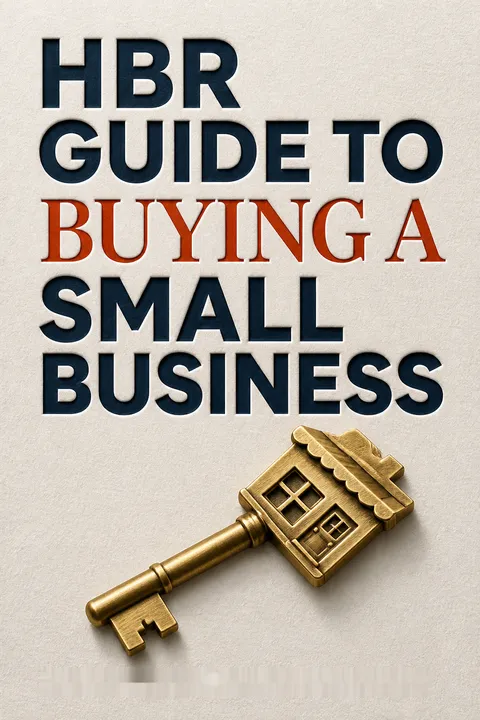
HBR Guide to Buying a Small Business receives high praise for its practical, detailed advice on acquiring small businesses. Readers appreciate its step-by-step approach, covering everything from sourcing to due diligence. The book's focus on "enduringly profitable" businesses with loyal customers is highlighted as valuable insight. Many reviewers find it an essential resource for first-time buyers, offering clear guidelines and real-world examples. Some note it could be more detailed in certain areas, but overall, it's considered a must-read for anyone considering small business acquisition.
People Also Read










Glossary
Entrepreneurship through acquisition
Buy and lead an existing companyA career path in which a buyer searches for an established small business, acquires it, and becomes its chief executive. Unlike starting a company from scratch, the buyer takes over an operating business with existing customers, employees, and a tested business model, then works to sustain or improve its performance.
Enduringly profitable
Profit supported by returning customersA description of a company with an established business model that produces profits consistently over time. The book emphasizes recurring customers as the foundation: reputation, limited competition, low switching incentives, or integration with customers can help preserve revenue and margins. Historical profits alone do not establish that a business is enduringly profitable.
EBITDA
A measure of operating earningsEarnings before interest, taxes, depreciation, and amortization. Buyers and sellers commonly use EBITDA to compare operating performance and express a small company’s purchase price as a multiple of earnings. It is not the same as cash available to owners, since taxes, debt payments, capital expenditures, and working-capital needs can reduce cash flow.
Search fund
Investor-backed business searchA financing arrangement in which investors provide money for a buyer’s search expenses and often receive an early opportunity to invest in the eventual acquisition. The funds can cover operating costs and a modest salary during a search that may last up to two years. If no business is acquired, investors can lose their search investment.
Churn rate
Share of customers who leaveThe percentage of customers who buy in one period but do not buy in the next. A low churn rate indicates that customers tend to return, supporting more predictable revenue. The book suggests screening for businesses with churn of 25% or less, while stressing that buyers should understand customer patterns and concentration as well.
Proof of cash
Check records against bank activityA preliminary verification that reported business results are consistent with actual bank deposits and payments. The buyer compares cash entering and leaving company accounts with reported sales, expenses, and owner distributions. The calculation is approximate because receivables, payables, and inventory change, but large discrepancies require explanation.
Quality-of-earnings analysis
Assess whether earnings can recurAn examination of a company’s historical revenue and expenses to judge whether its reported earnings are accurate and likely to continue. It can break revenue down by customer and product, review unusual expenses and seller add-backs, and test whether major costs or customer relationships may change. An accountant typically leads the formal review.
Letter of intent (LOI)
Written outline of proposed deal termsA document setting out the main terms of a proposed acquisition, including price, financing, working capital, timing, and transition arrangements. Most commercial terms are nonbinding, while confidentiality and exclusivity provisions are generally binding. An LOI records a shared understanding before the parties invest heavily in final due diligence and legal documents.
Working capital peg
Target operating funds at closingThe agreed amount of net working capital that should remain in the business at closing. Working capital commonly includes accounts receivable and inventory, less accounts payable, with the exact calculation defined in the transaction documents. The purchase price can be adjusted if the company delivers materially more or less than the agreed target.
Seller debt
Purchase price financed by sellerA portion of the purchase price that the seller lends to the buyer and receives over time, usually with interest. The note is generally subordinate to senior bank debt, meaning the senior lender is paid first if the company defaults. Seller financing can reduce the buyer’s upfront funding need and keep the seller economically involved in the company’s transition.
FAQ
What's "HBR Guide to Buying a Small Business" about?
- Overview: The book is a comprehensive guide on how to successfully purchase and manage a small business. It is part of the Harvard Business Review Guides series.
- Authors: Written by Richard S. Ruback and Royce Yudkoff, both professors at Harvard Business School, the book draws on their extensive experience in teaching and researching entrepreneurship through acquisition.
- Target Audience: It is aimed at managers considering a career change, newly minted MBAs, or anyone interested in becoming a business owner through acquisition.
- Content Structure: The book is divided into five parts, covering everything from preparing for a search to completing the acquisition and transitioning into ownership.
Why should I read "HBR Guide to Buying a Small Business"?
- Practical Guidance: The book offers step-by-step instructions on how to find, evaluate, and purchase a small business, making it a practical resource for aspiring entrepreneurs.
- Expert Insights: It provides insights from Harvard Business School courses, making complex concepts accessible to a broader audience.
- Financial Opportunities: The book highlights the financial benefits of buying a small business, such as potential high returns on investment.
- Risk Management: It offers strategies for mitigating risks associated with buying and running a small business.
What are the key takeaways of "HBR Guide to Buying a Small Business"?
- Entrepreneurship Through Acquisition: The book emphasizes buying an existing business as a viable path to entrepreneurship, offering both financial rewards and career flexibility.
- Enduring Profitability: Focus on acquiring businesses with recurring customers and stable cash flows to ensure long-term success.
- Due Diligence: Conduct thorough due diligence to confirm the business's financial health and the seller's commitment to sell.
- Financing Options: Explore various financing options, including bank loans, seller financing, and equity from investors.
What are the best quotes from "HBR Guide to Buying a Small Business" and what do they mean?
- "Think Big, Buy Small": This quote encapsulates the book's philosophy of achieving significant career and financial goals by acquiring a small, enduringly profitable business.
- "The Opportunity: Entrepreneurship Through Acquisition": This highlights the book's central theme that buying a business is a practical and rewarding path to entrepreneurship.
- "Managing the Risks of Ownership": This quote underscores the importance of understanding and mitigating the risks involved in owning a small business.
- "Reaping the Rewards: The Financial Opportunity": It emphasizes the potential financial benefits of buying a small business, such as high returns on investment.
How do I determine if entrepreneurship through acquisition is right for me according to the book?
- Self-Assessment: The book suggests evaluating your values, goals, and skills to determine if this path aligns with your personal and professional aspirations.
- Independence and Rewards: Consider if you value professional independence and direct rewards for your efforts, as these are key aspects of owning a business.
- Emotional Resilience: Assess your ability to handle the emotional ups and downs that come with entrepreneurship.
- Learning and Adaptability: Be prepared for continuous learning and adapting to new challenges in managing a business.
What is the acquisition process outlined in "HBR Guide to Buying a Small Business"?
- Four Phases: The process is divided into four phases: preparing for your search, finding the right business to buy, making an offer, and completing the acquisition.
- Preparation: This involves understanding the costs, raising funds, and identifying the characteristics you want in a business.
- Finding and Filtering: Source prospects through brokers or direct outreach and apply filters to identify viable acquisition targets.
- Due Diligence and Negotiation: Conduct thorough due diligence, negotiate terms, and finalize the purchase agreement.
How does the book suggest financing the acquisition of a small business?
- Debt and Equity: The book recommends using a combination of debt (bank loans, seller financing) and equity from investors to finance the purchase.
- Senior Loans: These are typically used to cover a significant portion of the purchase price and are secured against the business's assets.
- Seller Financing: This involves the seller providing a loan to the buyer, which is repaid over time, aligning the seller's interests with the business's success.
- Equity Investors: High-net-worth individuals can provide equity, expecting a return on investment, usually around 25% annually.
What are the characteristics of an enduringly profitable business according to the book?
- Recurring Customers: Businesses with a stable customer base that makes repeat purchases are considered enduringly profitable.
- Strong Reputation: A good reputation can keep customers loyal and deter competitors.
- Low Competition: Businesses with few competitors or high barriers to entry are more likely to maintain profitability.
- Stable Cash Flows: Consistent cash flows indicate financial health and reduce the risk of business failure.
How does "HBR Guide to Buying a Small Business" recommend conducting due diligence?
- Preliminary Due Diligence: Focus on understanding the business model, financials, and potential deal-breakers.
- Confirmatory Due Diligence: Validate initial findings with detailed financial analysis, legal checks, and customer and employee interviews.
- Professional Advisors: Engage accountants and lawyers to assist with financial and legal due diligence.
- Iterative Process: Continuously update your understanding of the business as new information becomes available.
What are the potential risks and rewards of owning a small business as outlined in the book?
- Risks: These include financial loss, management challenges, and market competition. The book emphasizes the importance of risk mitigation strategies.
- Rewards: Potential rewards include financial independence, high returns on investment, and personal fulfillment from running a successful business.
- Risk Management: The book advises buying businesses with stable cash flows and recurring customers to minimize risks.
- Long-Term Success: Focus on businesses with enduring profitability to ensure long-term success and financial stability.
How does the book suggest managing the transition after acquiring a business?
- Employee Communication: Clearly communicate your role and plans to employees to ensure a smooth transition.
- Cash Management: Implement a cash flow management system to avoid financial pitfalls.
- Customer Engagement: Meet with key customers to understand their needs and build relationships.
- Gradual Changes: Avoid making major changes immediately; take time to learn about the business before implementing new strategies.
What are the common mistakes to avoid when buying a small business according to the book?
- Overpaying: Avoid overpaying by conducting thorough due diligence and negotiating a fair price.
- Ignoring Red Flags: Pay attention to any red flags during due diligence, such as inconsistent financials or uncommitted sellers.
- Underestimating Costs: Be aware of all costs involved, including acquisition costs, working capital needs, and potential liabilities.
- Lack of Preparation: Ensure you are well-prepared for the acquisition process, from financing to transition management.
Download PDF
Download EPUB
.epub digital book format is ideal for reading ebooks on phones, tablets, and e-readers.








