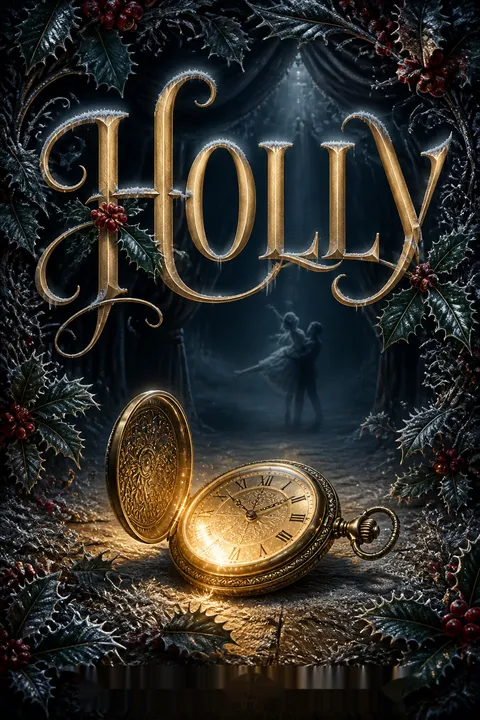


Plot Summary
Holly Against the Unlucky
Four months after Aris returns to Wisteria Gardens, his wife Blythe covers their new home with holly, determined to make their first Christmas together in decades flawless. The family gathering includes her cousin Signa, Signa’s husband Sylas, and Blythe’s father, Elijah.
Aris, a maker of enchanted tapestries and clothes, worries that he has no gift worthy of Blythe, while Signa wraps toys for children at the hospital. When the library books crash from their shelves, Signa sees a soot-marked young woman in an old-fashioned costume.
More spirits appear around her, searching for someone called Jules. Aris and Blythe cannot see them, but Signa recognizes a haunting. Their hoped-for quiet holiday has acquired a mystery before the decorations are even finished.
Blythe’s insistence on a perfect holiday is rooted in more than seasonal enthusiasm: she and Aris have lost decades together, so ordinary domestic pleasures carry the pressure of recovered time. Aris’s gift anxiety echoes that pressure from another angle. He wants to prove that he can give back what his return has restored, even though Blythe values his presence above spectacle. The spirits disrupt a family celebration built around control and careful preparation. Their first appearance also sets up a useful imbalance: Signa alone can perceive the problem, making her expertise necessary while leaving those closest to her dependent on trust.
The Fire Beneath the Game
Signa finds that the library spirits wear costumes from a long-ago theatrical production, but none can explain why they are there. Sylas is away on a secret errand, leaving her to manage them with Aris, who cannot see what she sees. During a Christmas game involving raisins and brandy, the red-haired spirit panics when Aris reaches into the flames.
A bottle shatters, the fire flares, and Signa smothers it with sand while Blythe heals Aris’s burned hand. The spirit’s terror gives Signa a crucial lead: fire shaped these ghosts’ deaths. Once the room quiets, she asks the woman’s name. The spirit remembers that she is Odette, and Signa now has both a person and a cause to investigate.
The harmless party game becomes a traumatic reenactment because the spirits experience fire not as festive spectacle but as the danger that ended their lives. Signa’s power is not simply seeing the dead; it requires her to interpret their involuntary reactions without assuming that she already understands them. Aris’s injury briefly makes Blythe’s healing gift visible in the living world, while Odette’s distress reveals the limits of protection by holly or magic. The scene turns the haunting from an atmospheric inconvenience into a specific ethical task: the family must learn what happened, then address the fear that keeps these spirits repeating it.
Odette's Name in Stone
Unable to learn the spirits’ history inside Wisteria, Signa searches Brude’s cemetery and finds Odette Van der Meer’s name on a memorial to a theater troupe lost on Christmas Eve. An elderly visitor, Jules, brings flowers to the same memorial. He admits that he danced with Odette and planned to ask her to marry him.
On the night of their final rehearsal, nerves sent him outside to smoke; he hurried home after emptying his pipe, but sparks from the ashes ignited the theater. By the time he returned, everyone inside had died. Signa tells him that Odette is searching for him, but Jules believes she is cruelly inventing a ghost story. He leaves her with the knowledge of his guilt and no consent to help.
Jules’s confession reframes the haunting as a story of survivor guilt rather than a puzzle with a villain to expose. He has spent a lifetime treating one careless act as proof that he is responsible for every death, a familiar human attempt to make catastrophe feel controllable. Signa’s supernatural knowledge does not automatically persuade him; indeed, the intimacy of her information makes it sound like an attack. Her failed approach matters because it establishes that helping the dead requires negotiation with the living, whose grief can be as resistant as a spirit’s loop. The memorial supplies facts, but trust remains the missing instrument.
A Stage Without Music
Signa suspects the troupe cannot move on until it completes its interrupted performance, so she returns to the library and tries to gather the dancers. The ballet mistress calls them to their places, but the rehearsal stalls when the spirits demand music. Signa’s attempt at the piano draws a hostile musician, and Aris takes over, playing a Christmas melody that calms him.
Elijah then sings while Blythe and Aris join the caroling party in Brude, leaving Signa room to coax the musicians toward the library. Aris supplies instruments and an enchanted rehearsal space. The spirits settle into their old roles, but the empty place beside Odette remains. Music can restore the company’s purpose; it cannot replace Jules.
The failed rehearsal reveals that a ghost’s unfinished business is not always a single hidden fact. These dancers are bound to a practice, a score, and the company that once gave their work meaning. Signa’s clumsy piano playing initially intensifies the musicians’ anger, but Aris’s artistry and Elijah’s voice transform the room into a shared performance space. Their different abilities become practical forms of care. Still, Odette’s absent partner makes the limits of spectacle plain. The family can recreate the conditions around the spirits, but no magical staging can substitute for the human relationship at the center of her unfinished story.
The Cat in the Alley
While Signa handles the haunting, Sylas searches far from Wisteria for a soul Blythe has sensed but cannot locate. He carries Aris’s old wedding coat and garments belonging to Blythe through a village, spreading their familiar scent until a black cat follows the trail. The feral animal attacks the floating souls around Sylas, then allows him to catch it.
Blythe recognizes the creature when Sylas finds her during caroling in Brude: it carries the soul of Beasty, Aris’s lost fox, now returned in a cat’s life. She asks Sylas to keep the animal at Foxglove overnight, out of Aris’s sight. Meanwhile, Aris and Elijah sing for townspeople, and Blythe enjoys seeing her husband relax into the holiday rather than obsess over a perfect present.
Sylas’s search gives Blythe’s gift a different emotional weight from Aris’s planned present. It is not an object that can demonstrate taste or skill, but an attempt to repair a loss that Aris never had the chance to mourn properly. The scent trail makes memory almost bodily: a familiar garment draws a soul through the world when deliberate searching has failed. Blythe’s secrecy is affectionate but also anticipates the story’s recurring mistake, the belief that love justifies withholding difficult information. Her joy at Aris caroling offers a counterpoint to that impulse. He is happiest when he participates in the imperfect celebration already unfolding around him.
The Lie Breaks Open
When Blythe returns to Wisteria, she hears the uproar in the library and realizes Aris has been hiding the spirits from her. He tries to stop her from entering, but Blythe breaks free of his golden threads with her own thorned, living magic. Inside, she finds Signa freezing, Sylas armed with a scythe, and Gundry enlarged into a shadow-fanged hound.
Her anger turns to hurt when she learns Aris concealed the danger because he wanted to protect her Christmas. Signa explains the theater fire and the stalled ballet. Elijah then identifies what the plan lacks: a real audience. Blythe accepts the danger and helps devise a public performance, refusing to let her family solve the haunting by keeping her out of it.
The conflict is not that Aris lacks faith in Blythe’s strength; it is that he confuses protection with deciding for her. His concealment turns a loving intention into an intimate breach, especially for a couple rebuilding a life after long separation. Blythe’s response is both physical and relational: she breaks his restraint with her powers, then asks why he did not trust her participation. Elijah’s practical suggestion helps redirect the family from blame toward a workable plan. The episode makes cooperation more than a convenient plot solution. It is the condition Blythe needs in order to experience this restored family as truly shared.
Sylas's Christmas Mystery
Signa confronts Sylas about the spirits and learns that he knew Wisteria stood on the old theater site. He chose not to warn Aris because he believed Signa, restless and hungry for meaningful work, would find the clues and help the dead. He even ensured Jules would be drawn to the cemetery, turning the haunting into a mystery meant as a gift.
Signa sees the care beneath the deception, but tells Sylas that future mysteries must be faced together. Then she and Sylas visit Jules. When he dismisses her again, Sylas uses wind and shadows to make the supernatural undeniable. Signa explains that Odette needs him, and Jules agrees to return to the theater and dance with her once more.
Sylas’s intervention is a psychologically astute but ethically compromised act. He recognizes that Signa’s competence does not erase her need for challenge, then mistakes insight into her desires for permission to engineer her circumstances. Signa’s laughter signals affection and relief, not approval without reservation; she explicitly changes the terms for any future collaboration. The scene therefore gives their romance a mature conflict, where being known is valuable but cannot replace consent. Jules’s renewed agreement also depends on a shift in method. Signa first offered information and was rejected; with Sylas’s demonstration, she can make the cost of staying away visible enough for Jules to choose engagement.
A Stage Made of Wisteria
On Christmas Eve, Blythe turns the library into a theater while Aris creates costumes for the spirits, working so deeply that he loses track of time. They build the stage together, each making the old rehearsal space beautiful enough to receive its performers and audience.
Before the show, Aris gives Blythe his own tapestry, the woven record of his life, marked with a red thread for every day he has loved her. He promises its pattern will keep growing, but Blythe values the gift because it makes his commitment tangible without pretending their lost years did not hurt.
Outside the stage, Elijah gathers townspeople. Signa prepares Jules to face Odette, while Sylas stands ready to guide the spirits onward if the performance finally releases them.
The tapestry turns Fate’s abstract power into an intimate object, but its emotional force comes from its incompleteness. Aris does not offer a finished account of their love; the red thread will continue as they live. That makes the gift a promise of time rather than an attempt to compensate for every year they lost. The shared theater construction likewise corrects the earlier concealment. Blythe contributes Life’s transforming power, Aris contributes creation, Signa supplies knowledge, and Elijah brings the audience. Their magic becomes meaningful through coordination, not through one person’s private attempt to manufacture perfection.
Odette Takes Her Bow
The audience fills Wisteria’s transformed library, believing it has come to a festive show. Jules enters in costume, and Odette recognizes him with a clarity she has lacked while trapped in her loop. He learns that she does not blame him and had once intended to accept his proposal. They take their places and dance together as the troupe performs around them.
The living spectators see a magical production, while Signa witnesses a final farewell. Odette kisses Jules, then fades, and the other spirits begin to disappear as well. Sylas steps onto the stage and guides them across. The music ends, the audience applauds, and Jules, alive but grieving, takes his final bow with the company’s long absence finally answered.
The performance resolves the haunting through recognition rather than exoneration. Jules is not told that his carelessness had no consequences; instead, Odette’s forgiveness allows him to stop confusing remorse with permanent punishment. The audience’s partial perception is important: they can respond to the beauty of the show without seeing the spirits’ full passage, while Signa bears witness to both realities. Odette’s departure and Jules’s survival are deliberately unequal endings, but each receives what the other can offer. The troupe completes its communal act, and the applause gives the farewell a public form after decades of silence.
Beasty Comes Home
On Christmas morning, Sylas returns the black cat to Aris, who recognizes Beasty’s soul and breaks down as he gathers the animal into his arms. Blythe admits she sensed the familiar presence and asked Sylas to find it, giving Aris a reunion he had never expected.
The family then exchanges presents. Aris gives Sylas a bell-trimmed cowl and a treasured chalice, offering the brothers a chance to share a drink again. Elijah receives a key that lets him reach Wisteria from anywhere, while Signa gets a journal that links her writing to Blythe’s.
Their gifts acknowledge particular needs rather than wealth: belonging, communication, and renewed bonds. With Beasty near and the family gathered, Blythe finally has the imperfect, loving Christmas she wanted.
The Christmas exchange resolves the novella’s parallel anxieties about what a gift can do. Beasty’s return cannot undo Aris’s earlier loss, but it lets him grieve openly and receive comfort from the family he once left behind. His gifts to Sylas and Elijah also make affection concrete where he usually relies on awkwardness or magic. The linked journals answer Signa’s practical separation from her cousin, while the key turns Wisteria into a durable home for Elijah. These objects matter because each is tailored to a relationship. Blythe’s desired perfection arrives not as a flawless holiday, but as a family willing to offer one another access, memory, and care.
Epilogue
After Christmas dinner, Signa stays by the fire while the others sleep or tend to their own tasks. Aris quietly gives her an old stopwatch, explaining that it may help her discover what happened to her parents, though he cannot promise it is safe to use.
Signa pockets it without telling Sylas, choosing to keep the question for another day. The gift opens a mystery beyond the holiday story, but she lets the remaining hour of Christmas belong to the family gathered around her.
The stopwatch complicates the comfort of the ending without undoing it. Signa’s curiosity has always been both vocation and appetite, and the object offers answers about her parents at the precise moment she has found a more secure sense of belonging. Her decision to hide it temporarily is not a rejection of knowledge; it is an act of timing. For once, she allows intimacy and rest to take precedence over investigation. Aris’s warning also transfers a measure of agency to Signa: he gives her an option, not an instruction, leaving the next mystery to begin only when she chooses to open it.
Analysis
Holly uses a Christmas mystery to test a family’s idea of care. Blythe prepares an immaculate holiday because she and Aris have already lost too much time; Aris hides the haunting because he wants to protect the celebration; Sylas engineers a mystery because he believes Signa needs work that matters. Each act begins in love, yet each substitutes private judgment for another person’s participation. The spirits’ story supplies the counterexample. Their release depends on Jules returning, Odette recognizing him, and the company being allowed to perform before witnesses. No one can complete the ballet on another person’s behalf.
The novella’s supernatural roles also function as distinct forms of labor. Signa interprets and mediates, Aris makes environments and objects, Blythe heals and animates, and Sylas escorts souls onward. Elijah contributes something less magical but equally necessary: attention to what a gathering needs. Their abilities do not make them self-sufficient. The story repeatedly makes magic effective only when it becomes collaborative, whether in building a theater or creating a route for a spirit to move on.
The central emotional repair is not the elimination of grief but its conversion into a shared act. Jules cannot undo the fire, and Aris cannot recover the years he missed with Blythe. The ballet and Beasty’s return offer recognition rather than reversal. That distinction keeps the sentiment grounded: love does not erase the past, but it can make the past less solitary. The epilogue preserves this balance. Signa receives a possible path to answers about her parents, yet chooses to leave the stopwatch unopened for the moment. The book ends with mystery still alive, but no longer mistaken for the only source of purpose.
Review Summary
Holly is a holiday novella set in the Belladonna universe, featuring beloved characters like Blythe, Aris, and Signa. Readers praise its cozy atmosphere, gothic elements, and mystery plot. Many appreciate the return to the world and characters, though some feel it doesn't add much to the overall story. The novella includes illustrations that are highly regarded. While most reviewers enjoyed the festive tale, a few found it unnecessary or less engaging than the main series. Overall, fans of the Belladonna series seem delighted by this Christmas-themed addition.
Characters
Blythe Dryden
Life's determined hostessBlythe is Aris’s wife, Signa’s cousin, and Elijah’s daughter. As the reincarnation of Life, she can make plants grow and heal injuries, though her powers do not spare her ordinary frustrations such as allergies. She meets loss by insisting on action, whether decorating Wisteria with protective holly or organizing games and family celebrations. Her warmth comes with a sharp tongue and a formidable competitive streak, and she is quick to challenge anyone who mistakes her affection for passivity. What she wants most is not luxury but time with the people she loves. Her central tension is learning that care cannot be made perfect by controlling every circumstance or by letting others decide what risks she may take.
Aris Dryden
Fate with a maker's handsAris is Blythe’s husband and a master maker whose magic lets him weave tapestries, alter rooms, and create clothing. His craft reflects the larger power associated with Fate, but it also gives him a way to pursue memories and connections he cannot otherwise recover. After a long separation from Blythe, he is newly returned to their shared life and eager to make their time together count. He expresses love through elaborate creations and practical acts of protection, yet his desire to prevent pain can become a habit of withholding choices from others. Beneath his pride and teasing manner is a man learning that affection is not measured by spectacle. He is happiest when his artistry serves the family rather than replaces honest closeness.
Signa Farrow
A bridge to the deadSigna is Blythe’s cousin and Sylas’s wife. She sees and communicates with spirits, helping the dead and the bereaved understand one another, though she has no simple divine title for what she is. Curious, observant, and often more comfortable with the dead than with the living, she is drawn to mysteries because they give her a concrete way to serve. Her work requires patience: seeing a spirit does not mean she can command it, and knowing the truth does not guarantee that the living will believe her. Signa balances compassion with a taste for intellectual challenge, and her directness can expose how easily others make decisions on her behalf. She values both purposeful work and the intimacy she has built with her family.
Sylas
Death and devoted husbandSylas, also known as Death, is Signa’s husband and Aris’s brother. His lethal touch requires him to wear gloves, while his shadows let him travel, conceal himself, and guide souls onward. He is dryly playful, fond of needling Aris, and deeply attached to Signa, even when his responsibilities keep him away from home. His work makes him intimate with mortality but not immune to loneliness or poor judgment. Sylas notices what Signa needs, yet can mistake his understanding of her for permission to arrange her life. His affection is most convincing when it includes accountability: he can admit when a loving plan has put others at risk and accept that partnership requires being told the truth.
Elijah
Blythe's steadfast fatherElijah is Blythe’s mortal father and a steady presence in the family she has rebuilt around herself. Older and increasingly aware of his limited time, he remains independent, resisting magic when ordinary effort will do. His warmth is clearest in practical gestures and in the rich singing voice he brings to the holiday gathering. He has lived through grief and is familiar with the strange boundaries between life and death, which makes him a perceptive observer of his daughters’ needs. Elijah rarely demands attention, but his judgment often cuts through the family’s dramatic impulses. He offers the perspective of someone who understands that a meaningful celebration depends less on grand plans than on making room for one another.
Jules
A dancer burdened by guiltJules is an elderly former ballet dancer who once performed with Odette and their theatrical company. He has spent much of his life carrying the memory of a disastrous night and avoiding the place tied to it. His guilt makes him wary of anyone claiming knowledge of the past, especially when that knowledge concerns people he loved. Jules is neither cruel nor indifferent; his resistance comes from the belief that returning can only reopen harm. The discipline of dance remains part of who he is, even after age and grief have narrowed his life. His character gives the story a living counterpart to the spirits’ unfinished memories.
Odette Van der Meer
A searching young dancerOdette is a young ballet dancer with vivid red hair, a pink costume, and a persistent search for Jules. Her thoughts return to the same urgent questions, while fear and confusion surface when the past presses too close. She is not simply a symbol of lost romance: she is a performer whose identity is bound to her partner, her company, and the work they hoped to share. Her presence draws Signa toward the mystery at Wisteria and makes the spirits’ need unmistakably personal. Odette’s longing gives the story its emotional center, while her pride and distress reveal how much of a person can remain vivid even when memory has become fractured.
The ballet mistress
The troupe's exacting leaderThe unnamed ballet mistress supervises the spirit company with strict timing and a sharp command of its performers. She is focused on discipline, entrances, and the requirements of a proper show, even when the spirits around her are confused. Her persistence keeps the troupe oriented toward its shared work, but her authority can also make it difficult for individual dancers to step outside their assigned roles. She embodies the habits of rehearsal that survive long after the stage and audience are gone.
Beasty
A cat with familiar mischiefBeasty is an animal closely associated with Aris’s past, remembered for a spirited and independent temperament. In the present, the creature encountered by the family is a plump black cat with bright green eyes, a feral streak, and little patience for being handled. Beasty can see and chase the souls that gather around Sylas, setting the animal apart from an ordinary pet. The cat’s stubbornness gives comic energy to the search for a lost companion, while its familiar presence connects Aris’s earlier life to the family he has now.
Gundry
Death's protective houndGundry is Sylas’s hound and a constant companion at Wisteria. In ordinary moments he is affectionate, excitable, and easily distracted by the spirits moving through the house. When Signa is threatened, his protective nature becomes unmistakable and his shadowy, monstrous form emerges. Gundry communicates through attention and instinct rather than explanation, often sensing danger before the humans around him do.
Jeanne
A dancer waiting her entranceJeanne is one of the spirit dancers in the company. She is eager to take a principal role when Odette cannot join the rehearsal, and her graceful performance helps reveal the troupe’s enduring skill. Her presence shows how the company’s collective routine continues even when its members remain attached to missing partners and unfinished work.
Laurent
A partner in the balletLaurent is a dancer in the theater company and partners Jeanne during the rehearsal. His lifts and controlled movements help the spirits recreate the ballet they have been unable to complete. He is part of the troupe’s shared discipline, representing the many performers whose individual stories are carried within the group’s unfinished production.
Plot Devices
The unfinished ballet
A rehearsal held in memoryThe spirits’ repeated search for Jules and their insistence on costumes, musicians, and stage positions gradually reveal that they remain caught in the work interrupted by the theater fire. The ballet is not merely a clue to their past; it supplies the form through which they can recognize one another and complete what was left unfinished. Signa and Aris restore instruments, clothing, and a stage, while Blythe and Elijah help provide a living audience. The device binds mystery to performance, making the solution depend on understanding what the spirits valued rather than simply identifying how they died.
Signa's spirit-sense
A bridge between worldsSigna can see and communicate with spirits, perceive their distress, and help them address unfinished business. Her ability does not give her command over the dead or instant access to their memories. She must interpret recurring behavior, find living people who know the past, and earn the spirits’ trust. This limitation makes her work investigative as well as supernatural. It also gives the family a necessary point of view: Aris, Blythe, and Elijah can help build a solution, but Signa alone can perceive what the spirits need and what their reactions mean.
Aris's living tapestries
Fate made tangibleAris weaves tapestries connected to the patterns of individual lives, and his creative magic also shapes clothes, rooms, and the spaces around him. In the story, this power turns private artistry into practical help: he makes costumes for the dancers, transforms Wisteria into a theater, and gives Blythe a tapestry that represents their continuing bond. His craft is both a supernatural ability and a way of expressing emotion when direct vulnerability is difficult. The designs can change a room, but their deeper value depends on what Aris chooses to make visible through them.
The masked audience
A veil over the impossibleAris uses magic to let the townspeople experience the Christmas Eve show as a plausible festive performance, even though the dancers are spirits and the full supernatural event remains visible only to Signa and a few others. This lets the troupe perform before an audience without exposing the town to a frightening spectacle. The device also creates a split in perception: the spectators applaud a beautiful show, while Signa witnesses the dead saying farewell. The audience is not a trick that solves the haunting by itself; it supplies the social recognition the performers have lacked.
The amber stopwatch
A door to buried answersAris gives Signa an antique stopwatch whose face bears unfamiliar symbols and whose mechanism seems to carry a faint pulse. He believes it may help her discover what happened to her parents, but he warns that its use could be dangerous and cannot explain why it failed when he tried it. Signa keeps the object without telling Sylas, choosing to postpone the decision until after Christmas. Its appearance shifts the ending from the resolved theater mystery toward Signa’s personal history and makes curiosity itself a future choice rather than an automatic command.
Belladonna Series



About the Author
Other books by Adalyn Grace

Download PDF
Download EPUB
.epub digital book format is ideal for reading ebooks on phones, tablets, and e-readers.








