

Key Takeaways
Once survival is secured, humanity reaches for immortality, bliss, and godlike power
The agenda changes. For most of history, famine, plague, and war seemed unavoidable. Harari argues that by the early twenty-first century they had become problems people could often prevent or manage, even though they still caused immense suffering. In 2014, more than 2.1 billion people were overweight, compared with 850 million who were undernourished, illustrating how dramatically the old landscape had shifted.
Ambition fills the space. Harari predicts that societies shaped by modern faith in human life and scientific progress will pursue longer lives, greater happiness, and powers once imagined as divine. Death itself increasingly appears as a technical problem to solve. The prediction is not that everyone will attain these aims, but that the pursuit will steer research, investment, and politics.
The chapter’s opening move is powerful because it turns progress into an obligation, not a victory lap. If preventable hunger or disease persists, the problem is no longer simply nature’s indifference; it also reflects political choices about who receives protection. Yet calling old crises manageable can obscure how unevenly that capacity is distributed. The book’s strongest question is therefore not whether humanity has gained power, but who gets to define its next priorities, and who bears the costs when promised solutions fail.
Humanity rules Earth through flexible cooperation, not a magical human essence
Coordination beats individual genius. Harari argues that humans dominate because they can cooperate flexibly with large numbers of strangers. Bees cooperate in vast colonies, but cannot rapidly redesign their social order; chimpanzees adapt more readily, but mainly among familiar companions. Human institutions can coordinate millions around changing plans.
Organization decides revolutions. In 1917, Russia’s Communist Party had only about 23,000 members, yet its organization helped it seize power in an empire of millions. In Romania in 1989, a mass protest helped topple Ceaușescu, but better-organized political actors took control afterward. The point is not that crowds lack power. It is that numbers become politically decisive only when people can coordinate beyond the moment of protest.
This shifts the explanation of human dominance from individual brilliance to social infrastructure: rules, roles, communication, and the ability to coordinate strangers. That model also clarifies why a small, disciplined organization can outmaneuver a much larger crowd. But coordination is not automatically virtuous. The same capacity can build public institutions or organize repression. The useful question is not simply how to cooperate at scale, but how to make powerful organizations accountable to the people whose labor and loyalty sustain them.
Use shared myths to coordinate, but measure success by who can suffer
Common stories build systems. An intersubjective reality is something that exists because many people share and act on a belief. Money, nations, and corporations are not imaginary in the sense of being powerless: their shared status lets people trade, govern, and organize. In ancient Sumer, gods could own land and employ people because priests and communities treated their temples as institutions.
Stories can hide costs. Writing enabled bureaucracies to manage huge societies, but official records could also overpower facts. During China’s Great Leap Forward, inflated production reports helped produce policies that contributed to catastrophic famine. Harari proposes a moral check: ask which real beings can suffer. A nation or currency cannot feel pain; a hungry person or a confined sow can.
The distinction between shared belief and material consequence is more useful than the simple claim that social institutions are fictional. A currency depends on collective trust, yet losing savings in a monetary collapse causes concrete harm. The same test exposes whose experiences disappear behind aggregate measures of national success. Still, suffering is not the only relevant consideration: institutions can protect rights, distribute risk, and prevent future harms. The test works best as a corrective to official narratives, not as a complete theory of public policy.
Modernity swapped cosmic meaning for power, then made growth its creed
A new bargain. Harari describes the modern covenant as trading belief in a cosmic script for the power to change the world. Scientific research and economic growth reinforce one another: credit funds experiments and ventures, while successful discoveries promise future returns. This optimism breaks with older expectations that the economic pie stays roughly the same size.
Humanity supplies meaning. Humanism makes human experience the source of value and authority. Its liberal branch emphasizes individual choice, its socialist branch collective welfare, and its evolutionary branch competition among supposedly superior people. These visions clashed violently during the twentieth century; liberalism emerged dominant after the Cold War. But growth is not a neutral tool. Treating it as the overriding measure can subordinate family ties, equality, and ecological stability.
The account links economic institutions to a moral worldview: confidence in future growth makes borrowing, investment, and innovation seem reasonable. That is a genuine change in social imagination, not merely a change in accounting. The danger lies in allowing a useful measure to become an unquestioned purpose. Growth can expand resources for public health or education, but its benefits do not distribute themselves automatically, and its environmental costs may arrive outside the time horizon of investors and elected leaders.
Do not confuse more pleasure or longer life with a better life
Death becomes a project. Modern culture often treats dying as a technical failure, which helps explain the growing ambition to extend life. Harari doubts that ordinary medical progress will soon produce extreme longevity: modern medicine has largely prevented premature death, rather than substantially changing the species’ natural lifespan. If people lived to 150, careers, family structures, and political power would all be reshaped.
Pleasure does not stay put. Harari argues that happiness depends partly on expectations and bodily sensations. Achievements and pleasures fade, while expectations rise. More consumption, he suggests, does not reliably produce lasting satisfaction. He contrasts the technological pursuit of pleasant feelings with a Buddhist approach that trains people to notice sensations without continually chasing them. These are competing responses to the same problem: transient pleasure keeps renewing desire.
The distinction between preventing misery and creating durable well-being is central to evaluating both medicine and economic policy. Longer life can be a profound benefit, but its value depends on health, relationships, and access, not just years counted. Likewise, the book’s account of adaptation helps explain why a new comfort soon feels ordinary. Its biological emphasis is bracing, though it can understate how meaning, social connection, and material security shape well-being beyond momentary sensation.
Question the inner narrator before treating its choices as your true self
The self may be plural. Harari challenges the idea of one stable inner voice with complete control. Split-brain experiments found that one part of a patient’s brain could act on information unavailable to the speaking part, which then invented a plausible explanation. The episode suggests that people can confabulate reasons without recognizing the gap.
Memory edits experience. Psychologist Daniel Kahneman’s cold-water experiment showed that people often preferred a longer unpleasant trial when its final moments were less painful. Harari uses this to distinguish the experiencing self, which undergoes each moment, from the narrating self, which remembers selected peaks and endings and tells a story about them. The story helps make life coherent, but it can distort what actually happened and what a person wants.
This is a useful challenge to the assumption that introspection gives direct access to a unified self. Narratives shape memory and decisions, and recognizing that can make self-examination more careful. It does not follow, however, that a person’s choices are meaningless or that brain activity alone settles questions of responsibility. Deliberation can still influence behavior, even if it has causes. The practical lesson is humility: treat explanations of personal motives as revisable accounts, not as perfect transcripts from an inner authority.
Machines need intelligence, not consciousness, so useful humans may become expendable
Capability is not experience. Harari warns that computer systems can perform intelligent tasks without feelings or awareness. A self-driving car need not enjoy driving; a medical program need not empathize to identify patterns in patient data. For employers and armies, successful performance may matter more than conscious experience.
Work is exposed. The book cites an Oxford study that estimated 47 percent of US jobs were at high risk of computerization within twenty years. That was a forecast, not a certainty, but it captures the scale of concern. Automation could affect professional work as well as manual labor, while creating a difficult question: what happens to people whose skills no longer serve the economy? The threat is not only unemployment, but loss of bargaining power and social importance.
Separating intelligence from consciousness reveals why automation is not just another round of machinery replacing muscle. Software can increasingly perform narrow cognitive tasks without acquiring human understanding or feeling. But predictions about whole occupations often miss how jobs change when tools take over specific tasks. The more durable concern is institutional: who owns the systems, who receives productivity gains, and whether people retain a meaningful voice when their economic contribution declines.
Medical upgrades can turn old inequalities into biological castes
Treatment can become enhancement. Technologies first justified as ways to restore ordinary function may also provide advantages to healthy people. The book traces this slippery boundary through drugs, plastic surgery, and genetic selection. A procedure that prevents disease can lead to choices about traits, memory, or temperament, especially when parents fear their children will fall behind others.
Access shapes the future. Harari describes three possible routes to human upgrading: altering biology, merging bodies with machines, and creating non-organic intelligence. These possibilities raise a distributional question: if costly upgrades reach the wealthy first, economic inequality could become a lasting gap in physical or cognitive ability. Angelina Jolie’s decision to undergo preventive surgery after learning of a high-risk genetic mutation illustrates how data can guide deeply personal medical choices, though it is not the same as enhancement.
The healing-to-enhancement boundary is difficult to police because the same intervention can prevent suffering and confer competitive advantage. That makes access, consent, and social pressure as important as technical safety. The caste scenario is not inevitable, but it exposes a weakness in relying on equal legal rights alone: formally equal people may have radically different capacities and resources. Public debate needs to distinguish treatment, optional enhancement, and coercive selection rather than treating biotechnology as one undivided promise or threat.
When algorithms know you better, data can replace experience as authority
A rival religion emerges. Dataism treats the universe as flows of information and judges things by their contribution to processing it. It recasts organisms as algorithms and imagines the Internet of All Things connecting people, devices, animals, and environments. Its central promise is that more data and better computation can produce better decisions.
Authority shifts outward. Dataist thinking favors information flow over private control, and trusts algorithms to find patterns beyond human capacity. The book compares capitalism’s distributed decision-making with communism’s centralized model, then asks whether algorithms could become advisers, agents, and eventually decision-makers. The benefit might be faster coordination, as in systems that monitor health or traffic. The cost is dependence on networks that collect intimate information and may shape the choices they claim merely to support.
Data-driven systems can reveal patterns that no individual could detect, especially when information is dispersed across many people and institutions. But more data does not automatically mean better judgment. Measurements reflect choices about what to record, and optimization inherits the goals built into a system. A recommendation engine can help a user navigate abundance while quietly narrowing the options presented. The key governance question is not whether algorithms are useful, but who sets their objectives, audits their errors, and can refuse their authority.
Study history to loosen inherited assumptions, not to predict a settled future
The familiar can be inherited. Harari’s lawn example shows how a seemingly natural preference can carry old social meanings. European aristocrats used manicured grass to display land and labor they could waste; later, lawn care became a middle-class status habit. Knowing that history makes alternatives easier to imagine.
Prediction changes its subject. Historical knowledge can alter behavior, which can make forecasts obsolete. Harari illustrates this with Marx: capitalist societies adopted reforms partly in response to socialist criticism, helping prevent the outcome Marx predicted. The book therefore treats its own future scenarios as prompts for choice, not prophecies. History cannot prescribe the next society, but it can reveal that today’s institutions and desires were made, not ordained.
This is a compelling account of history as intellectual liberation. Tracing a convention’s origins can expose interests and assumptions hidden by the word natural. The feedback loop between prediction and action also matters in policy: forecasts can provoke prevention, resistance, or strategic adaptation. Still, historical analogies can mislead when present conditions differ sharply from past ones. The best use of history is neither imitation nor prediction, but disciplined comparison that expands the range of futures people can seriously consider.
Analysis
Homo Deus is less a forecast of specific inventions than an argument about changing sources of authority. Its historical arc moves from gods, to human experience, to data-processing systems. Each transition reorganizes not only what people believe, but who is entitled to decide: priests and scriptures, then voters and consumers, perhaps now algorithms trained on intimate records. That makes the book’s most consequential question political rather than technological. Who defines the goals that systems optimize, and whose interests count when optimization becomes opaque?
The argument is strongest when it connects abstract beliefs to institutions. Shared stories make large-scale coordination possible; writing makes distant administration possible; growth finances research; and biometric data can redirect personal decisions. These mechanisms help explain how ideas become material power. The book is also unusually effective at connecting human exceptionalism to animal treatment: if intelligence and social usefulness justify dominance, those standards may later be used against humans themselves.
Its vulnerabilities come from the same sweeping ambition. Claims that science has displaced free will, that humanity has largely mastered famine or war, and that information flow forms a new religion compress contested questions into memorable binaries. Biological explanation does not by itself settle moral responsibility, and a global trend can coexist with severe local catastrophe. The distinction between intelligence and consciousness is analytically valuable, but present-day technical performance does not establish that every human capacity is reducible to computation.
The book is best read as a diagnostic, not a timetable. Its scenarios make assumptions visible: that growth should continue, that feelings authorize choices, or that more data means better decisions. A practical response is to ask what a system measures, what it ignores, and who can challenge it. The future is uncertain, but the values embedded in its institutions are not automatic. They are choices made through policy, design, and collective stories.
Review Summary
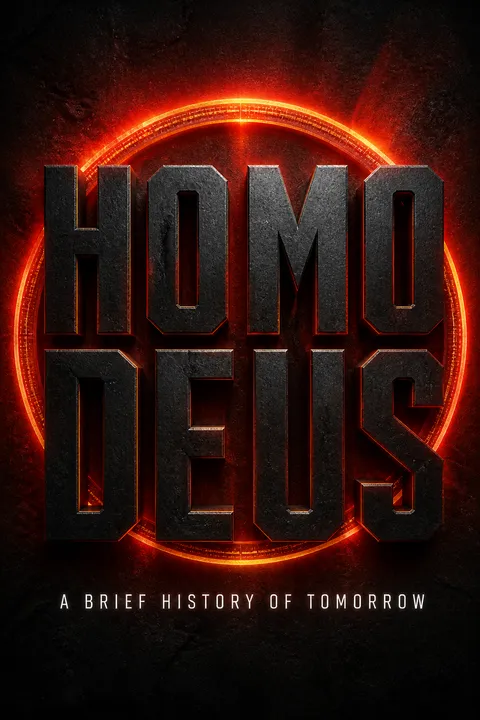
Homo Deus: A Brief History of Tomorrow explores humanity's future, examining themes like immortality, happiness, and artificial intelligence. Harari's engaging writing style and thought-provoking ideas receive praise, though some readers find the book less compelling than its predecessor, Sapiens. Critics appreciate Harari's analysis of humanism and technology's impact on society but question some of his predictions and interpretations of religious concepts. The book's discussions on free will, consciousness, and the potential rise of "dataism" spark both fascination and concern among readers.
People Also Read



Glossary
Anthropocene
Human-shaped planetary epochHarari uses Anthropocene for the period in which Homo sapiens became a major force reshaping global ecology. Human settlement, hunting, farming, and trade altered landscapes and moved organisms between once-separated regions. The term highlights humanity’s planetary influence, including the extinction of wild species and the spread of domesticated animals.
intersubjective reality
Shared belief made consequentialAn intersubjective reality exists through communication and shared belief among many people, rather than independently of human minds or within one person alone. Money, corporations, and nations are examples. They have no physical essence equivalent to their social status, yet shared recognition gives them real power to shape behavior and institutions.
imagined orders
Shared rules treated as naturalImagined orders are collectively accepted systems of rules and categories that help strangers cooperate. They are not physical laws, but people often treat them as fixed and inevitable. Ideas about social rank, rights, nations, or money can coordinate large societies because people expect others to follow the same rules.
Modern covenant
Power exchanged for meaningThe Modern covenant is Harari’s description of the modern bargain: people give up belief in a prewritten cosmic purpose and pursue greater power through science and economic growth. Modern life assumes that human limits can be overcome through knowledge, even as it leaves people responsible for creating meaning without a guaranteed cosmic plan.
humanism
Human experience as authorityHumanism is the modern creed that treats human experience as the primary source of meaning and authority. Rather than deriving value from God or an external cosmic order, it asks people to consult human feelings, needs, and judgments. Harari distinguishes liberal, socialist, and evolutionary forms, which interpret human experience differently.
experiencing self
Self that feels each momentThe experiencing self is the stream of sensations and emotions felt as events happen. In Harari’s account, it undergoes the duration and details of an experience but does not preserve a complete record of it. It can therefore value an event differently from the self that later remembers and evaluates it.
narrating self
Self that builds life storiesThe narrating self organizes selected memories into accounts of the past and plans for the future. Harari argues that it often gives disproportionate weight to intense moments and endings while neglecting duration and ordinary details. Its stories create a sense of personal continuity, but may misrepresent the experience they describe.
WEIRD
Western research participant profileWEIRD stands for Western, educated, industrialized, rich, and democratic. Harari uses the term for populations that dominate much psychological research, especially university students in Western countries. Findings based mainly on these groups may not represent the mental lives of other societies, historical populations, or species.
techno-humanism
Technology for human upgradingTechno-humanism is a future-oriented creed that retains human beings as the central source of value but seeks to upgrade their bodies and minds. It imagines using genetic engineering, brain-computer interfaces, and other technologies to create more capable humans who can compete with increasingly powerful non-conscious algorithms.
Dataism
Information flow as highest valueDataism is the worldview that treats the universe as data flows and evaluates entities by their contribution to information processing. It regards organisms as algorithms and favors connecting more things to a shared network. In its religious form, Dataism makes the free flow of information a supreme value and challenges human experience as the main source of authority.
FAQ
What's Homo Deus: A Brief History of Tomorrow about?
- Exploration of Future Challenges: The book examines humanity's future, focusing on how we manage historical challenges like famine, plague, and war, and what new issues may arise.
- Humanism and Technology: Harari explores the rise of humanism and its impact on life, happiness, and power, suggesting that technological advancements may lead us to seek immortality and divinity.
- Anthropocene Epoch: The concept of the Anthropocene is introduced, highlighting humans as the most significant force in altering the planet's ecology, raising questions about our responsibilities.
Why should I read Homo Deus: A Brief History of Tomorrow?
- Insightful Predictions: The book offers thought-provoking insights into humanity's future, essential for understanding the implications of technological advancements.
- Interdisciplinary Approach: Harari combines history, philosophy, and science, providing a comprehensive view of human development and future possibilities.
- Cultural Reflection: It encourages readers to reflect on their values and beliefs in light of historical and future trends, prompting critical thinking about humanity's direction.
What are the key takeaways of Homo Deus: A Brief History of Tomorrow?
- Control Over Nature: Humanity has transformed famine, plague, and war from uncontrollable forces into manageable challenges, raising questions about new emerging challenges.
- Technological Power: Advancements in biotechnology and information technology provide unprecedented power, leading to potential quests for immortality and happiness.
- Humanism's Future: The potential decline of humanism is discussed as we seek to upgrade ourselves into god-like beings, leading to ethical dilemmas.
What are the best quotes from Homo Deus: A Brief History of Tomorrow and what do they mean?
- "Famine, plague and war...": This quote emphasizes that while progress has been made, these issues are not eradicated and still pose threats.
- "The era when humankind...": Harari suggests humanity can manage epidemics but warns of new threats from our actions.
- "If we are indeed bringing...": This raises questions about future priorities and challenges as we overcome historical struggles.
How does Homo Deus: A Brief History of Tomorrow address the concept of humanism?
- Humanism as a Dominant Ideology: Harari discusses humanism as the prevailing worldview, emphasizing human value and agency.
- Critique of Humanism: The book critiques humanism, suggesting that the quest for immortality may undermine its principles.
- Future of Humanism: Harari posits a potential decline in humanism as technology advances, leading to new forms of existence.
What is the Anthropocene, as defined in Homo Deus: A Brief History of Tomorrow?
- Human Impact on Ecology: The Anthropocene is described as the epoch where humans are the most significant agents of ecological change.
- Mass Extinctions: Human actions have led to the extinction of numerous species, highlighting our responsibility for ecological balance.
- Global Ecosystem: The planet operates as a single ecological unit, with human activities affecting ecosystems worldwide.
What role does technology play in Homo Deus: A Brief History of Tomorrow?
- Technological Advancements: Harari discusses how AI and biotechnology reshape human capabilities and societal structures.
- Potential Risks: Advancements could lead to a future where humans lose control over their lives, raising ethical questions.
- Human Control: As technology evolves, humans may become subjects of algorithms and data-driven decisions.
How does Homo Deus: A Brief History of Tomorrow address the concept of free will?
- Critique of Free Will: Harari challenges free will, suggesting decisions are influenced by biochemical processes.
- Experiencing Self vs. Narrating Self: Individuals have both an experiencing and narrating self, complicating personal agency.
- Implications for Society: This critique raises questions about accountability and moral responsibility in a tech-driven world.
What is Dataism as described in Homo Deus: A Brief History of Tomorrow?
- New Paradigm: Dataism prioritizes data flow over human experiences, suggesting all phenomena can be understood through data.
- Functional Approach: It evaluates entities based on their contribution to data processing, challenging traditional humanist values.
- Future Implications: As Dataism gains traction, human experiences may be deemed less valuable than data efficiency.
How does Homo Deus: A Brief History of Tomorrow explore the relationship between humans and animals?
- Human Superiority: The book questions the belief in human superiority, highlighting ethical implications.
- Animal Consciousness: Growing recognition of animal consciousness challenges traditional views and calls for reevaluation.
- Interconnectedness of Life: Understanding our relationship with animals can inform our approach to future technologies and ethics.
What are the implications of losing economic and military usefulness as discussed in Homo Deus: A Brief History of Tomorrow?
- Redefining Value: As technology advances, many may lose economic and military value, leading to societal shifts.
- Emergence of a New Elite: A new elite of upgraded individuals may emerge, exacerbating social inequalities.
- Challenges to Liberalism: This shift challenges liberal ideologies, potentially leading to a reevaluation of societal norms.
How does Homo Deus: A Brief History of Tomorrow envision the future of humanity?
- Technological Integration: Humans and technology may become deeply integrated, leading to enhanced capabilities and ethical dilemmas.
- Potential for New Religions: New techno-religions may emerge, focusing on technology and data rather than spiritual values.
- Uncertain Outcomes: The future remains uncertain, with potential for both advancements and challenges as humanity navigates complexities.
About the Author
Other books by Yuval Noah Harari



Download PDF
Download EPUB
.epub digital book format is ideal for reading ebooks on phones, tablets, and e-readers.








