

Key Takeaways
Make your way of working the advantage competitors cannot copy
Products get copied. In a connected marketplace, features, prices, and processes spread quickly. Seidman argues that the more durable difference lies in human conduct: how reliably people keep promises, collaborate, treat customers, and take responsibility. He calls this opportunity to outperform through behavior outbehaving the competition.
A UPS driver, Angel Zamora, discovered that a customer’s overnight package had gone missing. Rather than treat the delivery as someone else’s problem, he tracked it through the warehouse and arranged a special delivery. The package itself was ordinary. The initiative and care surrounding it made the experience memorable, and enlisted others to help fulfill the promise. The practical point is not to add niceness on top of work. It is to make the way the work gets done part of its value.
The argument usefully shifts competitive strategy from assets that can be purchased or imitated to patterns of interaction that accumulate over time. It also connects customer experience to operational design: Angel could act because his workplace allowed him to solve a problem rather than wait through layers of approval. Yet conduct is not a substitute for a sound product. A gracious experience cannot rescue a defective service indefinitely. The strongest version of the claim is that behavior multiplies the value of competent work, especially where customers can readily compare alternatives.
Design for connection, because cheap information makes collaboration the scarce advantage
From hoarding to sharing. Seidman sketches a historical shift from land, to capital, to information as the main source of economic power. Land and capital are limited resources; information can be shared without being used up. The information age therefore rewards organizations that make knowledge accessible and let people combine it, rather than keeping it inside departments and hierarchies.
But connection alone does not guarantee understanding. Global teams may work across cultures, time zones, and communication channels that strip away tone and context. A brief message can be read as brusque or suspicious when its sender intended efficiency. Organizations must therefore build the human connections that let information travel accurately: shared purpose, accessible knowledge, and ways to resolve misunderstandings. The image of a company as an ecosystem captures the challenge: its many independent participants must interact to thrive.
This distinction between information abundance and meaningful coordination remains important. Digital tools lower the cost of distributing facts, but they do not automatically create shared interpretation, psychological safety, or good judgment. In communication research, channel richness matters: sensitive or ambiguous topics often benefit from richer interaction than a terse message can provide. The book’s strongest practical implication is to treat communication design as organizational infrastructure, not etiquette. Its limitation is that openness needs boundaries. Confidentiality, security, and legitimate privacy are also conditions of trustworthy collaboration.
Ask what should be done, not merely what rules permit
Rules are imperfect proxies. Rules turn broad aims, such as fairness or safety, into instructions that can be applied consistently. But they are written in response to past problems, cannot anticipate every situation, and may reward people for finding loopholes. Seidman argues that rules can set a minimum standard while unintentionally discouraging judgment beyond it. Values give people a reason to act well in situations the rulebook did not foresee.
The University of Michigan Health System chose to train doctors to acknowledge errors and apologize to patients. In the three years after introducing the approach, malpractice claims and lawsuits fell by nearly half, as did the cost of defending remaining cases. The institution concluded that patients often reacted more strongly to concealment than to an honest admission of a mistake. Its example shows how a values-based response can be both humane and practically effective, though rules still matter for clear, enforceable protections.
The distinction between legality and ethical judgment is useful because rules cannot encode every relevant feature of a human situation. The hospital example also suggests that candor can interrupt escalation by repairing a damaged relationship. Still, an apology is not inherently sufficient: it must be paired with accountability, repair, and changes that reduce the chance of recurrence. Nor should values replace regulation where people face unequal power or serious harm. A durable system needs both clear external protections and room for principled judgment where rules run out.
Guard attention by removing small signals of disrespect and contradiction
Small slights consume focus. Seidman calls minor acts that communicate disrespect microinequities. Checking a phone while someone speaks, mocking a colleague’s suggestion, or making people navigate needless approvals can pull attention away from shared work and toward self-protection. The book also uses dissonance for the mental strain created when an organization’s actions contradict its stated values. A company that claims to trust employees but requires several signatures for a trivial expense sends conflicting signals.
Such moments can accumulate into cynicism, making people less willing to contribute or believe leadership. The author’s examples range from dismissive meeting behavior to the bakery that refuses to cut a roll despite keeping a bread knife in plain view. The details differ, but the effect is similar: people spend energy interpreting the contradiction instead of doing the work. Managers can reduce this friction by making policies consistent with the trust and respect they say they value.
This account gives leaders a useful lens for noticing costs that do not appear neatly in budgets: diverted attention, guarded communication, and lost initiative. It resembles the concept of psychological safety, the shared sense that people can speak up without humiliation or retaliation. Such safety supports learning, but it does not mean avoiding disagreement or discomfort. The challenge is to distinguish productive candor from needless disrespect. A respectful workplace can still hold people to demanding standards; in fact, clear standards are easier to accept when daily interactions communicate fairness.
Be transparent before the network exposes what you hoped to hide
The audience can compare notes. Cheap, fast communication makes it harder for companies to control how others describe their products and behavior. Kryptonite learned this when cyclists posted that a popular bicycle lock could be opened with a common pen. A demonstration video spread online, reached major news outlets, and became a serious reputational crisis. The company’s slow response gave the story time to grow.
Seidman distinguishes technological transparency, the exposure created by connected systems, from interpersonal transparency, the choice to be open and candid with others. The second can turn the first into an advantage. In a job interview, an applicant named Sig Berven acknowledged that his grades were not exceptional rather than inventing an excuse. His directness helped the interviewer see him more clearly. Transparency is not indiscriminate disclosure; it is an active effort to communicate honestly, especially when doing so is uncomfortable.
The online product failure illustrates how customers can become rapid distributed testers, not merely passive recipients of company claims. Early acknowledgment can preserve credibility because it demonstrates responsiveness before outsiders conclude that the organization is evasive. Yet transparency is not a universal good in unlimited form. Personal data, security details, and confidential deliberations deserve protection. The more precise principle is accountable openness: disclose what stakeholders need to assess a decision, correct false impressions quickly, and avoid using transparency as a performance staged for favorable publicity.
Extend trust to lower costs, but verify behavior without punishing everyone
Trust can make exchange cheaper. A New York street vendor named Ralph let customers pay and make their own change. One observer saw him serve customers about twice as quickly as nearby vendors. The arrangement worked because most customers reciprocated his trust, and the faster line helped build regular business.
A study of nearly 350 buyer-supplier relationships among automakers in the United States, Japan, and South Korea found that the least-trusting buyer incurred procurement costs six times higher than the most-trusting buyer. Trust can encourage partners to share useful information and invest in joint work, but it is not blind faith. Seidman’s approach is to trust people with responsibility while checking selectively for misconduct. If one employee cheats, investigate and address that employee rather than imposing burdensome new rules on the whole group.
Trust is not merely a pleasant feeling in this account; it is a way to reduce monitoring, negotiation, and delay. The distinction between selective verification and blanket surveillance is especially valuable. It preserves accountability while avoiding the message that every worker is presumed dishonest. The reported business findings are persuasive as examples, though trust and performance can reinforce each other in both directions, making simple causal claims difficult. Trust should therefore be calibrated to the stakes, the evidence, and the possibility of harm, not treated as a virtue that requires ignoring warning signs.
Build reputation one consistent interaction at a time
Reputation travels ahead. Seidman describes reputation as the accumulated record of what others can expect from a person or organization: its promises, conduct, and treatment of people. In Antwerp’s diamond trade, high-value stones have long changed hands through close relationships, a handshake, and a shared understanding that a deal will be honored. The community’s ability to trade depends on the cost of a bad reputation.
In a controlled eBay experiment cited in the book, buyers paid an average of 8.1 percent more for identical postcards from a high-reputation seller than from a newly created seller identity. A favorable history can therefore carry concrete economic value. It also creates expectations: if a company’s current behavior conflicts with its reputation, people notice the gap. Seidman’s advice is to earn reputation through repeated, ordinary acts rather than treat it as an image that public relations can manufacture.
The diamond market and online marketplace show how reputation substitutes for some of the information and safeguards that strangers otherwise need. It is a form of social capital, but it is unevenly distributed: newcomers may struggle to establish credibility even when they behave well. The book’s emphasis on consistent conduct helps explain why trust is built gradually and lost quickly. Still, a reputation score or public narrative can be inaccurate. Good judgment requires treating reputation as evidence, not proof, and leaving room for correction, context, and second chances.
Put shared values inside the culture, not just rules above employees
Culture is daily behavior. Seidman groups workplace cultures into four broad patterns: lawlessness, blind obedience, informed acquiescence to rules, and values-based self-governance. Most organizations contain elements of several. The key question is whether people act only because a boss or rule requires it, or because they understand and share the principles behind the work.
At GE’s Durham aircraft-engine plant, small teams organized much of their own work, and technicians participated in councils covering areas such as training and materials. The plant reported cutting assembly costs by more than 50 percent and quality defects by over 75 percent across five years. Its example illustrates how autonomy can work when people have skills, information, responsibility, and a common commitment to safety and quality. Self-governance is not the absence of standards. It is the effort to make standards meaningful enough to guide action without constant supervision.
The culture framework is valuable because it makes organizational character visible in routine decisions: who receives information, who can act, and what conduct is rewarded. It also highlights a neglected management problem: incentives can quietly reward caution or rule-following while leaders publicly demand initiative. Self-governance, however, is not equally easy in every setting. High-risk work may require strict procedures, and autonomy without training or resources can become abandonment. The model works best when clear non-negotiable safeguards coexist with meaningful discretion over how to meet shared goals.
Lead by turning a meaningful vision into shared, repeatable action
Leadership is not a title. Seidman frames leadership as a set of behaviors available to anyone: envision a better outcome, communicate and enlist others, take responsibility, plan and implement, and build continuity so the work survives beyond one person. He uses President Kennedy’s 1961 commitment to a moon landing to show how a public vision can align many people around a difficult undertaking.
The broader Leadership Framework adds persistence through obstacles, comfort with complexity, principled choices, attention to present realities, reflection, passion, optimism, and a purpose larger than personal success. David Toms, a professional golfer, withdrew from a major tournament after doubting that he had followed a rule correctly. No official required it. He chose the action that let him continue playing with a clear conscience. The lesson is to make integrity part of the work, not an emergency pose when others are watching.
The framework turns a broad moral argument into observable leadership practices, especially the often-overlooked task of building continuity rather than becoming indispensable. Its strongest test is whether the vision changes how resources, authority, and recognition are distributed, not merely how inspiring a speech sounds. The model also rightly gives leadership to people without formal rank. A useful qualification is that passion and optimism can become pressure to persist in a failing plan. Reflection and rigorous attention to evidence must keep commitment from hardening into denial.
Analysis
How is a business book about conduct, but its deeper argument concerns the design of cooperation. Seidman begins with a simple spectacle: one person starts a stadium wave, but the crowd and the conditions around it determine whether the energy spreads. The image links individual behavior to organizational structure. A frontline employee may show initiative, but that initiative has little reach if information is hoarded, decisions require endless approvals, or colleagues distrust one another.
The book’s central progression is coherent. As information becomes easier to copy and compare, products and processes lose some of their power to distinguish. Behavior, trust, reputation, and culture become more consequential because they shape whether people will collaborate and whether others will believe the organization’s claims. The move from rules to values is the most practical hinge: rules establish necessary boundaries, while shared principles help people act in situations no rule anticipated. The argument does not require abandoning compliance. It asks whether compliance is the ceiling or only the floor.
The strongest evidence comes from concrete organizational cases. The University of Michigan hospital’s apology practice, GE’s Durham plant, and Sewell Automotive show ways that trust and discretion can be translated into routines, authority, and results. The weaker passages are those that treat complicated neuroscience or evolutionary explanations as direct proof of a broad managerial prescription. Oxytocin, altruism, or brain activity cannot by themselves establish that a particular workplace policy will work. The examples support a plausible theory, not a universal law.
The book also underestimates the importance of power. Shared values can empower employees, but leaders may define those values selectively, and appeals to trust can be used to discourage legitimate scrutiny. Self-governance therefore needs fair safeguards, reliable information, and real recourse when authority is abused. Its enduring insight is not that good intentions replace systems. It is that systems shape conduct, and that conduct is itself a strategic asset. The practical question is whether everyday incentives make the desired behavior easier to enact than its opposite.
Review Summary
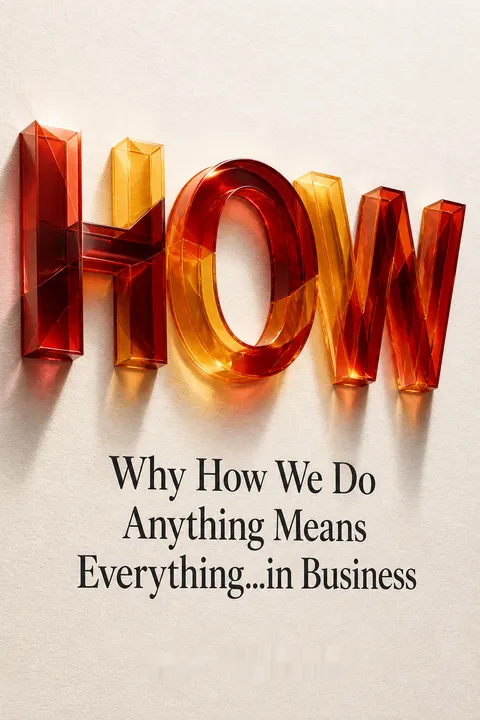
How explores the importance of values, ethics, and principled behavior in business and leadership. Seidman argues that in today's interconnected world, how we do things matters more than what we do. The book emphasizes transparency, trust, and self-governance as keys to success. While some readers found it insightful and inspiring, others felt it was repetitive or lacked concrete advice. Many appreciated the real-world examples and anecdotes, though some criticized the dated references and corporate focus. Overall, reviewers saw it as a thought-provoking exploration of ethical leadership in the modern business landscape.
People Also Read








Glossary
HOW
Conduct behind the workSeidman uses HOW to mean the human conduct through which work is done: how people communicate, make decisions, keep promises, collaborate, and treat others. It is distinct from WHAT, the product, service, or result. The book argues that in a connected and transparent economy, conduct can become a lasting source of value because competitors can copy outputs more readily than a deeply embedded way of working.
Certainty Gap
Distance from felt securityThe Certainty Gap is the distance between a person’s desired sense of security and predictability and the uncertainty actually present in life or work. Seidman argues that shocks, rapid change, and exposure can widen this gap, making people seek reassurance. Trust, consistent conduct, and shared values can help people act despite uncertainty rather than retreat into defensive behavior.
Hills of Knowledge paradox
Confusion before masteryThis model describes learning as a journey from basic understanding, through a confusing stage, toward deeper mastery. A learner may move beyond initial competence and temporarily feel less clear, not because learning has failed, but because prior assumptions are being challenged. The crucial distinction is between remaining at comfortable, partial understanding and working through confusion toward integrated judgment.
TRIP
Trust-to-progress sequenceTRIP names a sequence in which trust makes risk-taking possible, risk-taking enables innovation, and innovation contributes to progress. Seidman presents the sequence as a reinforcing path for people and organizations operating amid uncertainty. Trust is not treated as a soft extra, but as a condition that can make experimentation and cooperation more feasible.
Spectrum of Culture
Four organizational patternsThe Spectrum of Culture describes four broad ways groups govern behavior: lawlessness, blind obedience to authority, informed acquiescence to rules, and values-based self-governance. Real organizations may combine these patterns. The model helps identify where authority sits, how information moves, why people comply, and whether shared values guide choices that written rules do not cover.
Values-based self-governance
Values guide independent actionValues-based self-governance is an organizational approach in which people use shared principles to guide their own decisions and hold one another accountable. It relies on meaningful access to information, individual responsibility, and education in judgment rather than on rules and supervision alone. It does not mean an absence of standards; it means people internalize the reasons behind them and act accordingly.
Leadership Framework
Behaviors for shared leadershipThe Leadership Framework is Seidman’s model for putting values into daily action. Its core includes envisioning a better future, communicating and enlisting others, taking responsibility, planning and implementing, and building continuity. It also emphasizes principled judgment, reflection, persistence, and purpose. The framework presents leadership as a disposition anyone can practice, rather than a privilege attached only to formal rank.
microinequities
Small acts of disrespectMicroinequities are minor behaviors that signal disregard or exclusion, such as interrupting someone, dismissing a contribution, or dividing attention during a conversation. Seidman argues that these moments can distract people, weaken trust, and consume energy that would otherwise support shared work. Their effects may be subtle individually, but repeated signals can shape how safe and respected people feel.
Download PDF
Download EPUB
.epub digital book format is ideal for reading ebooks on phones, tablets, and e-readers.








