

Key Takeaways
Make fee arithmetic your first investment screen
Small costs compound. Allan Roth introduces his son Kevin to investing with a claw machine: after losing several quarters trying to win a toy, Kevin recognizes the machine favors its owner. Roth argues that high investment fees work similarly. If a market earns 10 percent and an investor gives up 2 percent in costs, 8 percent remains. A low-cost fund charging 0.2 percent leaves about 9.8 percent. In Roth's example, that difference nearly doubles a dollar's value over 40 years.
Fees are a hurdle. William Sharpe's arithmetic of active management says the average actively managed dollar must trail the average passive dollar after costs. That does not prove every active manager lacks skill. It does mean an investor needs evidence that skill can overcome fees, taxes, and trading costs before paying for it.
The strongest part of the argument is its asymmetry: fees are visible in principle and reliably reduce returns, while outperformance is uncertain. That makes cost control a more dependable lever than forecasting. The claw story also makes an abstract percentage feel like repeated payments for a game with unfavorable odds. The limit is that the headline fee may not capture every cost, and a low-cost product can still be poorly matched to an investor's needs. Cost is a powerful screen, not a complete financial plan.
Own broad markets instead of betting on tomorrow's winners
Kevin's portfolio is deliberately plain. At age eight, he chose three broad funds: 60 percent U.S. stocks, 30 percent international stocks, and 10 percent U.S. bonds. The stock funds spread ownership across thousands of companies, rather than concentrating his savings in familiar names such as Walmart or McDonald's. Roth reminds readers that once-dominant companies such as Kmart and Pan Am did not remain invincible.
Diversification is inside the fund. Owning many funds does not guarantee broad exposure if they all hold similar stocks. A total-market fund already spans large, medium, and small companies, reducing the need to assemble and rebalance many narrow funds. Kevin's percentages are an illustration for a child with a long horizon, not a universal prescription; Roth says investors should adjust the stock-bond mix to fit their circumstances.
The child-centered story turns diversification from a technical formula into a practical response to uncertainty: no one knows which company or country will dominate next. Broad ownership also reduces the number of forecasts an investor must get right. The three-fund structure is memorable because it simplifies implementation without pretending markets are simple. Its limits deserve equal clarity: total-market funds still carry market risk, and a globally diversified portfolio can lose value for years. Diversification spreads risk; it does not erase it.
Judge performance against the right market, after costs and taxes
A benchmark can mislead. Roth describes managers claiming to beat the market by comparing a globally diversified portfolio with the S&P 500, an index of large U.S. companies. Some comparisons also use the S&P 500's price change without including dividends, even though dividends are part of an investor's total return. This is not an even contest: the portfolios differ in both geography and holdings.
Compare like with like. A useful benchmark should reflect the portfolio's mix of U.S. stocks, international stocks, and bonds. It should include dividends and account for fees, taxes, deposits, and withdrawals. Otherwise, an investor may mistake a flattering comparison for evidence of skill, or conclude that a sound strategy failed because it was measured against the wrong yardstick.
Benchmarking is a form of measurement design: the question being asked determines what counts as success. The book's critique is especially useful because a technically correct number can still produce a false impression when its comparison is mismatched. A good benchmark also disciplines the investor, not just the adviser, by making results auditable. One caution is that no single benchmark captures every personal goal, such as reliable spending or a short time horizon. Performance comparison needs context, not merely a more convenient index.
Treat superior-manager claims as a low-probability wager
The odds shrink with time. Roth built a Monte Carlo simulation comparing active funds with lower-cost index funds. Using assumptions of roughly 2 percent annual costs for active funds and 0.23 percent for index funds, his model found the chance of an active fund beating an index declined over longer periods. In a version that included investor timing behavior, a portfolio of about 10 active funds had roughly a 1 percent chance of beating the index over 25 years.
This is a model, not a law. Roth's point is that selecting several winners in advance is harder than finding a fund with a good past record. His example of Fidelity Magellan shows how an exceptional early run can remain prominent in a long-term record even after later underperformance. Investors who arrive after the success may capture little of the celebrated period.
The useful question is not whether skilled managers exist, but whether a typical investor can identify them beforehand and stay invested through changing results. That distinction separates a theoretical possibility from a repeatable strategy. Roth's simulation makes costs and selection compound across time, but its percentages depend on its assumptions and should not be treated as universal odds. The broader lesson survives that caveat: recent winners are easy to recognize retrospectively, while persistent, accessible skill is difficult to establish in advance.
Stop letting fear and hindsight turn investing into market timing
People often buy high and sell low. Roth explains loss aversion, the tendency for a loss to feel more painful than an equal gain feels pleasurable. During the dot-com boom, investors bought after prices had risen sharply; after the subsequent decline, many sold when stocks were cheaper. The book cites research estimating that investors' timing decisions reduced returns by about 1.5 percent a year compared with the funds they held.
Mental stories hide the full result. One client focused on stocks yielding 14 percent but overlooked a 12 percent decline in their prices. The dividends felt like a win, although total return was far weaker than a broad stock portfolio's. Hindsight, overconfidence, and selective memory can all make a decision seem wiser than it was. Roth's practical defense is to make a plan before market stress arrives.
This section treats investor behavior as a predictable source of friction, not a character flaw. That distinction matters: people can design rules around emotional tendencies rather than rely on becoming perfectly rational. Total return also counters mental accounting, since income and price changes belong in the same calculation. The book's advice should not be reduced to ignoring all new information, however. A portfolio may need adjustment when a person's goals, income, or obligations change. The key is to distinguish genuine life changes from reactions to headlines.
Choose stock exposure by both your needs and your nerves
Risk has two dimensions. Roth separates willingness to take risk from the need to take it. A person with ample savings and modest spending needs may not need to pursue the highest possible return. Someone far behind on a goal may need more growth, although investing more aggressively cannot guarantee the goal will be met. Kevin's lunch-money example makes the point: a tempting bet is not worth taking if losing means going without lunch.
A paper loss can provoke a real mistake. Roth notes that even a 60 percent stock, 40 percent bond portfolio historically lost more than 21 percent in a single year. Investors who cannot tolerate such declines may sell at the worst time. He recommends selecting a durable allocation and rebalancing by selling some holdings that have risen and buying those that have fallen.
The distinction between capacity and comfort is valuable because risk questionnaires often treat preference as the whole story. Financial capacity depends on spending needs, time horizon, and available resources; emotional tolerance affects whether the plan can actually be maintained. Rebalancing converts a chosen allocation into a rule for acting against the crowd. The challenge is that fixed percentages are not automatically right for every household, particularly when near-term expenses or unusual liabilities matter. The plan must fit the life it is meant to support.
Use bonds for stability, not as a yield-chasing contest
Bonds carry two main risks. Default risk is the possibility that a borrower will not repay. Interest-rate risk is the decline in a bond's market value when rates rise, especially for longer-term bonds. Higher yields generally compensate investors for taking more of one or both risks. That can undermine bonds' job as a portfolio stabilizer.
A near-cash label can conceal danger. Roth points to the Schwab YieldPlus Ultra-Short Bond Fund, marketed as a safe alternative to money-market funds, which lost more than 30 percent during the subprime crisis after taking exposure to mortgage-related securities. He favors diversified, low-cost bond funds over a handful of individual bonds, whose trading spreads can be costly. His core warning is to compare bonds of similar quality and maturity, not just their yields.
The shock-absorber metaphor clarifies why a bond portfolio should be judged by the risk it offsets, not only by income it produces. A higher yield can be compensation for hidden credit or duration exposure, not a bargain. Diversified funds also spare smaller investors the difficulty and transaction costs of assembling many bonds. Yet bond funds are not guaranteed to preserve principal, and interest-rate movements can still produce losses. The relevant question is whether the bond holding behaves as intended within the whole portfolio.
Check insured CDs when the yield gap pays for your effort
The book identifies a small-investor opportunity. In Roth's 2009-era example, a five-year federally insured certificate of deposit paid 5 percent, while a comparable Treasury yield after state-tax adjustment was 2.63 percent. The difference reflected a market in which individual deposits could receive government-backed insurance within applicable limits, while large institutions could not easily insure billions of dollars the same way.
The extra yield requires attention. Roth advises verifying insurance directly with the FDIC or NCUA, checking early-withdrawal penalties, confirming the rate, staying within deposit limits, and marking maturity dates to avoid an unwanted renewal at a lower rate. Rates, insurance rules, and available terms change, so the example is historical, not a current offer or guarantee that every CD is worthwhile.
This is a useful example of looking for structural advantages rather than trying to forecast securities. The return difference is visible before purchase, unlike promised market-beating skill. The trade-off is administrative: limits, renewal dates, and reduced liquidity can erase some of the appeal if overlooked. A CD's stated rate also does not settle whether it fits a particular cash need or inflation exposure. The strategy is most compelling when the investor understands the contract and values the added yield more than flexibility.
Place investments where the tax code takes the smallest bite
Account location can change after-tax wealth. Roth distinguishes asset allocation, the mix of investments, from asset location, the accounts in which those investments are held. Broad stock index funds tend to generate fewer taxable distributions than frequently traded funds, while bond interest is generally taxed as ordinary income in taxable accounts. He therefore suggests, where circumstances allow, holding tax-efficient stock funds in taxable accounts and tax-inefficient bonds or CDs in tax-deferred accounts.
The illustration depends on assumptions. In one hypothetical 20-year example, a $200,000 portfolio split between stocks and fixed income ended at $629,000 after tax when assets were located efficiently, versus $571,000 under the reverse arrangement. The result depends on the book's tax rates and return assumptions. Employer matches, liquidity, and individual tax circumstances still matter.
Asset location shows that portfolio design includes the tax system, not just financial markets. The investor may improve the amount retained without taking additional market risk, which makes this a different kind of return enhancement from chasing a high-performing fund. Its precision is also its limitation: account rules and tax treatment can change, and a neat general rule may not dominate every household's situation. The durable principle is to compare after-tax outcomes across the entire portfolio rather than optimize each account in isolation.
Fix cash, debt, and fees before reaching for extra returns
Some gains do not depend on the market. Roth calls these opportunities low-hanging fruit. One couple held substantial cash earning 1 percent while carrying a mortgage at 5 percent; paying down debt or finding a better cash rate could improve their finances without predicting stock prices. In another example, Roth estimates that a household could save $6,224 a year by using cash and lower-cost borrowing to address expensive credit-card and auto debt.
Check the whole trade-off. A low-cost index fund may also be preferable to a more expensive fund tracking the same index. But decisions involving debt must account for liquidity, tax deductions, interest-rate changes, and the risk that a lender may reduce available credit. Roth's point is to inspect these routine leaks before searching for a clever investment.
The low-hanging-fruit idea broadens investing beyond securities selection. Paying less interest or correcting a needless fee can be more reliable than seeking uncertain market outperformance. The examples also reveal a behavioral obstacle: people may resist a mathematically favorable change because the familiar arrangement feels safer or more adult. Still, a positive rate spread is not the whole decision. Cash provides resilience, debt can have contractual and tax features, and available credit is not identical to cash in hand.
Make every investment pass a second-grader smell test
Complexity can conceal who benefits. Roth describes an equity-indexed annuity advertisement that appeared to promise market participation without losses. After examining the terms, he calculated that the product might deliver only about a quarter of the market's return. He argues that investors should ask how a product works, how its sellers are paid, and how difficult it is to exit. Insurance can protect against risks a household cannot afford, but an insurance wrapper is not automatically a good investment.
Precommit before temptation strikes. Roth recommends writing an investment policy that sets an allocation, limits tinkering, and defines when rebalancing is allowed. He permits a small, explicitly labeled gambling portfolio for investors who want excitement, provided they can afford to lose it. Money's purpose, he concludes, is to support life beyond investing.
The smell test is a compact defense against products that exploit information gaps and emotional promises. Asking who earns revenue, what the exit costs, and whether the mechanism can be explained makes sales pressure slower and more visible. A written policy adds commitment at the moment when judgment is most vulnerable. Simplicity should not become automatic rejection of every complex tool, however. Some people need insurance or specialized planning. The test is whether complexity solves a real problem at a fair cost.
Analysis
Roth's central argument is not simply that index funds are good. It is that ordinary investors should concentrate effort where they can plausibly influence outcomes: costs, diversification, taxes, risk exposure, and their own behavior. The second-grader conceit gives that argument a narrative engine. Kevin's advantage is not precocious financial insight so much as freedom from adult status games, market commentary, and the urge to convert every uncertainty into an action.
The book's most durable contribution is its distinction between a repeatable edge and a seductive story. Lower fees are a relatively knowable advantage; finding a manager who will persistently outperform is a much harder claim to verify. Broad funds and a written allocation reduce the number of decisions an investor must make, which matters because decision frequency itself creates opportunities for error. In this sense, simplicity functions as a behavioral safeguard, not merely an aesthetic preference.
The argument also has boundaries. A diversified portfolio can still suffer deep losses, and an index fund cannot guarantee a household's spending goals. The book's model probabilities, return examples, fee comparisons, product judgments, and deposit rules are tied to its 2009 setting and assumptions. They should not be mistaken for current rates, universal forecasts, or individualized advice. Its projections that small improvements could advance financial independence by many years are illustrations of compounding, not promises that every investor can capture the same gain.
The most useful reading is therefore neither blind acceptance nor dismissal. The book offers a strong default: minimize avoidable drag, own broadly, and avoid making market predictions the center of a financial life. Its practical test is whether a strategy remains understandable during a downturn, when the investor's need for reassurance is greatest. The goal is not to make investing exciting or perfectly safe. It is to make a sound plan easier to keep than to abandon.
Review Summary
How a Second Grader Beats Wall Street receives mostly positive reviews, praised for its simple, accessible approach to investing. Readers appreciate the author's storytelling and clear explanations of complex concepts. The book advocates for a passive investment strategy using low-cost index funds, which many find revolutionary and practical. Some critics find it repetitive or oversimplified, but most agree it's an excellent introduction to investing for beginners. The book's core message of keeping investments simple and focusing on long-term goals resonates with many readers.
People Also Read







Glossary
Second-Grader Portfolio
Three broad index fundsRoth's simple example portfolio for his son Kevin: 60 percent total U.S. stocks, 30 percent international stocks, and 10 percent U.S. bonds. Its defining features are broad diversification and low costs, not those exact percentages for every investor. Roth presents the allocation as suitable to Kevin's long time horizon and advises adults to adjust risk to their own needs.
Magellan effect
Past success outlasts skillRoth's label for the way a fund's unusually strong early performance can keep its long-term record looking exceptional even if later results disappoint. Investors who buy after the early success may miss the gains that created the reputation. The term warns that a long historical record can conceal when returns occurred and whether newer investors actually benefited.
SpongeBob Strategy
Ignore market-show noiseRoth's playful name for resisting financial television, market predictions, and promotional messages that encourage frequent trading. Kevin prefers cartoons to investment shows, illustrating how less exposure to market noise can reduce pressure to react. The strategy is not a claim that all financial information is useless; it is a reminder to avoid treating commentary as reliable short-term guidance.
Asset Location
Choose the account for each assetThe placement of investments among taxable, tax-deferred, and tax-free accounts. Roth argues that broad stock index funds can be relatively tax-efficient in taxable accounts, while interest-producing bonds and CDs may fit tax-deferred accounts better. The appropriate arrangement depends on taxes, account rules, liquidity needs, and a household's circumstances.
Low-Hanging Fruit
Easy financial improvementsRoth's term for financial improvements available without forecasting market returns, such as reducing avoidable fees, earning a better rate on cash, addressing expensive debt, and locating investments more tax-efficiently. These opportunities can be overlooked because they are less exciting than selecting a winning stock, yet may produce more dependable benefits.
Timing and selection penalty
Return lost by investor behaviorThe shortfall that occurs when investors choose funds after strong performance and sell or abandon them after weak performance. The fund's reported return can therefore exceed the return its average investor actually experiences. Roth uses the concept to show how performance chasing can impose an additional drag beyond fund expenses and taxes.
SECOND acronym
Six rules for simple investingRoth's closing memory aid for his approach: Simple, Emotionless, Costs matter, Obvious, Nasty stuff, and Diversified. It recaps the book's practical priorities: keep the plan understandable, limit emotional reactions, control expenses, question sales claims, avoid opaque products, and spread investments broadly rather than chasing popular sectors.
FAQ
What's How a Second Grader Beats Wall Street about?
- Simple Investing Principles: The book demonstrates that basic investing principles can outperform complex Wall Street strategies. It uses the author's son, Kevin, as an example to show that even a child can succeed in investing by following simple rules.
- Focus on Costs: A major theme is the importance of keeping investment costs low. High fees can significantly reduce returns, so the author advocates for low-cost index funds.
- Behavioral Finance Insights: The book explores common psychological pitfalls like fear, greed, and overconfidence, which often lead to poor investment decisions.
Why should I read How a Second Grader Beats Wall Street?
- Accessible Financial Education: The book simplifies complex financial concepts, making them understandable for readers of all backgrounds. It empowers individuals to manage their financial futures without needing a finance degree.
- Real-Life Examples: The author uses relatable anecdotes, particularly involving his son, to illustrate key points, making the lessons memorable and engaging.
- Proven Strategies: Readers will learn effective investment strategies that have been shown to outperform many traditional methods, providing a clear roadmap for building a successful investment portfolio.
What are the key takeaways of How a Second Grader Beats Wall Street?
- Investing is Simple: Successful investing doesn't have to be complicated. By following basic principles like diversification and low costs, anyone can achieve financial success.
- Avoid High Fees: Minimizing investment fees is crucial. High fees can significantly erode returns over time, so choosing low-cost options is essential.
- Long-Term Perspective: A long-term investment strategy is key. Staying invested through market fluctuations helps achieve financial goals.
What are the best quotes from How a Second Grader Beats Wall Street and what do they mean?
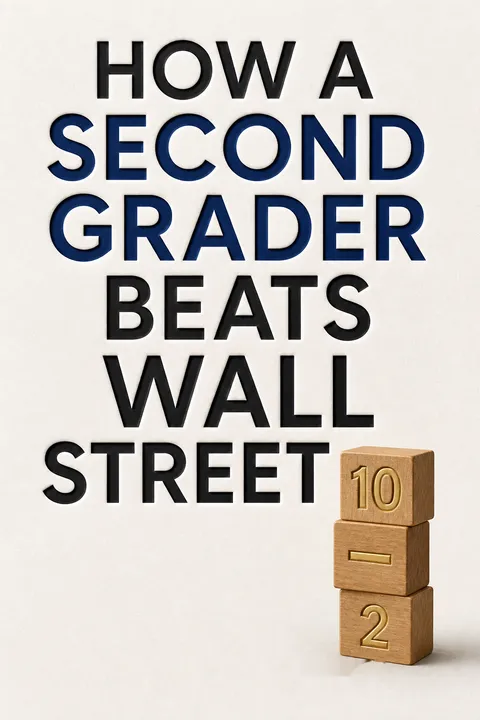
- “10 − 2 = 8”: This quote highlights the importance of understanding investment costs. High fees reduce the returns investors actually receive, emphasizing the need for low-cost options.
- “Paying Wall Street is a loser’s game”: This statement critiques the traditional financial industry, suggesting that expensive financial advisors often lead to poorer outcomes.
- “Common sense isn’t all that common”: This reflects the author's belief that many investors overlook basic principles due to emotional biases and misinformation.
How does the second grader's portfolio outperform Wall Street?
- Diversification Across Asset Classes: Kevin's portfolio includes a mix of U.S. stocks, international stocks, and bonds, reducing risk and improving returns.
- Low-Cost Index Funds: The portfolio uses low-cost index funds, which have historically outperformed actively managed funds due to lower fees.
- Long-Term Investment Strategy: By maintaining a long-term perspective and avoiding emotional reactions, the portfolio is designed to weather market volatility.
What are the behavioral finance concepts discussed in How a Second Grader Beats Wall Street?
- Fear and Greed: These emotions can lead investors to buy high and sell low, harming financial outcomes. Recognizing these feelings is crucial.
- Overconfidence Bias: Many investors believe they can outperform the market, leading to excessive trading and poor decisions.
- Confirmation Bias: Investors often seek information that supports their beliefs, ignoring contradictory evidence, which can lead to poor decisions.
How can I apply the lessons from How a Second Grader Beats Wall Street to my own investing?
- Focus on Low Costs: Evaluate the fees associated with your investments and transition to low-cost index funds to maximize returns.
- Diversify Your Portfolio: Spread investments across different asset classes, including U.S. stocks, international stocks, and bonds.
- Adopt a Long-Term Mindset: Commit to a long-term strategy and avoid reacting to short-term market fluctuations.
What is the second grader's portfolio composition?
- 60% U.S. Stock Index Fund: This portion allows for broad exposure to the U.S. stock market, capturing the performance of various companies.
- 30% International Stock Index Fund: This allocation provides diversification by investing in global markets.
- 10% Total Bond Market Index Fund: Including bonds helps stabilize the portfolio and reduce overall volatility.
How does Allan S. Roth suggest we avoid common investing mistakes?
- Understand Your Costs: Know what you are paying for your investments and ask for a clear breakdown of all fees.
- Stay Informed but Skeptical: Be cautious of financial media and marketing that may create illusions about investment performance.
- Stick to Your Strategy: Develop a clear investment strategy and adhere to it, even during market volatility.
What alternatives to the second grader's portfolio does Allan S. Roth discuss?
- Real Estate Investment Trusts (REITs): Adding a small percentage of REITs can enhance diversification and provide exposure to the real estate market.
- Precious Metals and Mining Stocks: These can provide a hedge against inflation but are volatile, so caution is advised.
- Alternative Asset Classes: Exploring other asset classes like commodities or emerging markets can offer diversification benefits.
How does How a Second Grader Beats Wall Street address emotional investing?
- Emotional Control: Emotions can lead to poor decisions, such as panic selling. A rational approach is encouraged.
- Behavioral Biases: Understanding biases like overconfidence and loss aversion can help improve decision-making.
- Staying the Course: A disciplined strategy focused on long-term goals is emphasized over reacting to short-term market movements.
What is the role of costs in investing according to How a Second Grader Beats Wall Street?
- Impact on Returns: High fees can significantly erode returns over time. Low-cost index funds often outperform higher-cost counterparts.
- Cost Efficiency: Choosing investments with low expense ratios is crucial for maximizing net returns.
- Tax Efficiency: Tax-efficient investments can further enhance returns, so both costs and taxes should be considered.
Download PDF
Download EPUB
.epub digital book format is ideal for reading ebooks on phones, tablets, and e-readers.








