

Key Takeaways
Save one fish today to build a net that catches two tomorrow.
Productivity begins with sacrifice. Able, Baker, and Charlie can each catch only enough fish by hand to eat for the day. Able gives up a day’s meal to weave a net. The risk pays off: he can catch two fish in less time, leaving room to make clothes, build shelter, or develop other skills. The net is capital, a tool used to produce something people want. The story’s central claim is that lasting growth comes from producing more, not simply wishing for more.
Surplus makes growth possible. Once Able can catch more than he needs, his extra fish become savings. Those savings can sustain investment, lending, or emergencies. Without spare resources, the island has no way to build beyond bare survival.
The fish story makes a difficult point unusually tangible: machines and tools embody yesterday’s labor, allowing today’s labor to produce more. This resembles the role of capital deepening in standard accounts of economic growth. Yet the parable also makes individual sacrifice look simpler than it often is. People with little income may be unable to save, and public institutions can help pool resources for projects no single person can afford. The useful distinction is not sacrifice versus spending, but whether current resources create durable capacity or merely disappear in consumption.
Lend toward new productive capacity, not borrowed consumption.
Credit moves saved resources. Able lends fish to Baker and Charlie so they can eat while building nets. If the nets work, they can catch enough to repay him with interest. If they fail, Able bears the loss. In the book’s model, credit does not conjure new resources. It transfers savings from someone who has postponed consumption to someone who wants to invest.
Not every loan does the same job. A business loan can expand production. A vacation loan adds no new capacity, so repayment may require borrowers to consume less later. An emergency loan can still be worthwhile: if illness prevents someone from working, temporary support may preserve their ability to produce again. The key question is what the loan makes possible, and who carries the risk.
The distinction between productive, consumptive, and emergency borrowing gives readers a practical way to ask what debt is for. It also clarifies why repayment capacity matters more than a loan’s stated purpose. A business can fail despite a sound plan, while consumer borrowing can sometimes support education or mobility that raises future income. The fish allegory correctly foregrounds scarce resources and risk, but its categories are not automatic verdicts. Evaluating a loan requires considering uncertain future benefits, not just labeling its immediate use.
Let productivity lower prices and widen access to ordinary goods.
Efficiency can make goods cheaper. Duffy initially needs four days to build a canoe, while other islanders need five. By specializing, he can sell below their cost of making one themselves. Later, he saves fish to build canoe-making tools, cuts production time further, and lowers the selling price. More islanders can now afford a canoe, while Duffy can make and sell more of them.
The book challenges fear of deflation. It argues that when improved production lowers prices, consumers gain purchasing power. It points to U.S. prices falling over much of the period from the late 1700s to 1913, alongside substantial growth, and to cars and computers becoming cheaper as production improved. Falling prices from productivity, the authors argue, need not mean economic collapse.
This is a valuable correction to the reflex that every price decline signals distress. Productivity-driven price cuts can spread the gains from innovation to consumers, as the canoe example shows. The important qualification is that not all deflation has the same cause. When prices fall during a slump, debts fixed in dollars can become harder to repay, deepening financial stress even as goods become cheaper. The book’s distinction between productive efficiency and monetary or demand shocks is essential, but its broad defense of falling prices can understate those debt effects.
Let savings, not political targets, anchor borrowing costs.
Banks connect savers and borrowers. Max Goodbank stores islanders’ savings, assesses business proposals, and charges borrowers according to risk. When savings are plentiful, the bank can lend more readily and rates tend to fall. When savings are scarce, it offers better returns to attract deposits and charges borrowers more carefully. Higher rates can slow investment, but they can also encourage saving and signal that resources are limited.
The book’s criticism of the Fed is that politically influenced low interest rates can make borrowing seem cheaper than it really is. Businesses may then invest in projects that depend on future demand that has not actually been saved for. The authors call the resulting poor allocation of capital “malinvestment.” A boom built on misleading signals, they argue, sets up a painful correction.
Interest rates do more than set the price of a loan. They help coordinate decisions about whether resources are used now or preserved for later, and they influence which projects appear viable. That makes the Goodbank story a helpful account of why credit conditions affect investment quality. Its limitation is the assumption that decentralized lending always produces a reliable signal. Banks can herd into the same risks, and markets can misjudge uncertainty. Central banks also face genuine stabilization problems, even if policy cannot replace careful risk assessment.
Fund infrastructure only when its future output exceeds its cost.
A useful project raises capacity. Able V proposes a water system that requires 182,500 fish to support 250 workers for two years. A bank lends only because enough savings exist to sustain the project, and the completed system provides water, supports farming, and frees time for other work. The point is not that infrastructure is wasteful, but that its long-term benefits must justify the labor and resources taken from other uses.
Jobs alone do not prove value. The book contrasts the working water system with a hypothetical useless bridge. Both could employ workers, but only one leaves the island more productive. It also links Usonia’s constitutional design to limits on government power, arguing that taxes and public programs should remain accountable to those who fund them.
The water system makes opportunity cost visible: workers and materials committed to one project cannot be used elsewhere. That is a stronger test than counting jobs created or money spent. Infrastructure can also generate benefits that are hard for a private lender to capture, such as improved access for whole communities, so public financing may be justified even when direct profits are limited. The relevant question is not simply public versus private ownership. It is whether a project’s wider benefits, costs, and risks are honestly assessed.
Watch loan guarantees turn huts into leveraged bets.
Subsidized credit changes incentives. In Usonia, the Senate guarantees hut loans through the fictional agencies Finnie Mae and Fishy Mac. Banks face less risk, down payments shrink, and interest rates fall. Buyers can borrow more, while tax advantages and rising prices encourage people to treat huts as investments. Owners borrow against their rising hut values, adding yet more spending without adding productive capacity.
Prices outrun incomes. The book cites U.S. home prices rising an average of 19.4 percent annually from 1997 to 2006, compared with 3.4 percent annually over the preceding century. When prices turn, borrowers with little equity can walk away, lenders and guarantors absorb losses, and industries tied to housing lose business. The allegory presents the 2008 crash as the predictable consequence of distorted incentives and easy credit.
The hut boom illustrates a classic incentive problem: when lenders can pass much of the downside to a guarantor, they may accept risks they would otherwise reject. Rising prices then become mistaken evidence that the underlying investment is sound. This is a persuasive account of how credit policy can amplify a bubble. Still, housing is both an asset and a basic need, so expanding access is not inherently reckless. The sharper issue is whether affordability comes from greater household income and housing supply, or from ever-larger loans.
Treat trade deficits as financing arrangements, not free lunches.
Exports and savings cross borders. Sinopia sends fish and manufactured goods to Usonia and keeps the Fish Reserve Notes it receives. Usonians get goods while borrowing against foreign savings; Sinopians work hard but consume relatively little of what they make. The authors use this imbalance to explain how foreign purchases of U.S. assets helped support American borrowing and low interest rates.
The arrangement depends on continued confidence. The book reports that the U.S. trade deficit averaged about $600 billion annually in the first decade of the 2000s and reached $763 billion in 2006. It argues that the dollar’s reserve-currency role sustained demand for U.S. notes, while warning that foreign lenders could eventually redirect their savings. In the allegory, that change leaves Usonia short of both goods and financing.
The story usefully reveals that a trade deficit is also a financial relationship: one country’s net purchases are matched by claims held elsewhere. That framing discourages the easy assumption that imports are either pure harm or a costless gift. The book is less convincing when it treats the relationship mainly as one-sided dependence. Foreign savers may benefit from secure, liquid assets, while domestic consumers benefit from imports. The vulnerability lies in concentration and reliance, not in trade itself.
Measure recovery by useful production, not spending alone.
Spending can disguise misallocation. After the hut market collapses, Usonian leaders try to revive activity with bailouts, easier loans, tax incentives, and public projects. Later programs fund llamas, new cart paths, and incentives to replace carts. These measures can create visible work, but the book asks whether they direct scarce labor and savings toward what people need. It argues that spending is a measure of transactions, not proof that society is producing greater value.
A downturn can reveal old errors. When buyers stop borrowing, excess huts and housing-related businesses cannot be sustained. The authors argue that propping them up prevents workers and capital from shifting into more useful activities. They oppose stimulus that simply restores the old pattern of consumption and debt, rather than rebuilding savings and productive capacity.
The distinction between activity and value is central to reading economic statistics responsibly. Money spent on a project tells little about whether the project solves a real problem or produces benefits greater than its cost. At the same time, a sharp slump can leave workers and equipment idle, and temporary support may prevent needless destruction while demand recovers. The book’s strongest challenge is to ask what stimulus produces. Its weakest implication is that market correction alone guarantees a quick or painless path to better uses.
Inflation can repay debt on paper while erasing savings.
Printing changes who bears the loss. In the island story, the Senate issues more Fish Reserve Notes than it can redeem with real fish. Officials disguise the shortfall by shrinking the fish backing each note. At first, spending continues, but prices rise and savings buy less. When foreign buyers stop accepting the notes, the currency plunges, imports disappear, and Usonia’s productive base has been depleted.
The book defines inflation as expansion of the money supply, with rising prices as a possible consequence. It argues that governments can use monetary expansion to meet nominal debt obligations while reducing the currency’s purchasing power. The authors say the U.S. dollar lost more than 95 percent of its value over the century they examine. Their warning is that postponing fiscal choices can shift the eventual burden onto savers and wage earners.
The fish notes dramatize an important distinction between paying a debt in nominal units and preserving what those units can buy. Inflation can redistribute wealth from creditors and cash holders toward debtors, which helps explain its political appeal. But the story treats money creation as the dominant cause of inflation and the path to collapse as unusually direct. In actual economies, supply shocks, expectations, production, and policy credibility also matter. The allegory is strongest as a warning about concealed losses, not as a precise forecast.
Analysis
The book is an explicitly Austrian-school argument delivered as a fable: three fishers move from bare subsistence to tools, savings, lending, banks, trade, political money, a credit boom, and collapse. That narrative gives the reader a durable accounting intuition. Nets, roads, factories, and skills are real productive capacity; currency and credit are claims on what an economy can produce. When claims multiply faster than capacity, prosperity may be only apparent.
The fish economy is useful precisely because it strips away financial abstraction. A loan cannot feed the island unless someone has saved fish, and a project that consumes labor without creating future value has an opportunity cost. The same simplification, however, limits the model. Real money is not literally fish, and a fiat currency can support payments, coordinate expectations, and prevent a panic from destroying otherwise viable firms. These functions do not abolish resource constraints, but they complicate the book’s sharp division between saving and money creation.
The narrative also treats recessions chiefly as corrections to earlier malinvestment. That captures an important possibility, especially when cheap credit has encouraged overbuilding. But a downturn can also suppress demand, employment, and investment in ways that reinforce one another. If prices and wages adjust slowly, waiting for reallocation may impose costs beyond the liquidation of bad projects. Public infrastructure and social insurance likewise can produce benefits that are not fully visible in a private lender’s return.
The book is most persuasive as a warning against confusing nominal spending, asset prices, or easy borrowing with durable prosperity. It is less persuasive as a complete theory of macroeconomic stabilization. Its allegory helps readers ask what is being produced, what resources are being consumed, and who absorbs a loan’s downside. Those questions remain useful even when the book’s policy conclusions are treated as arguments rather than settled economic laws.
Review Summary
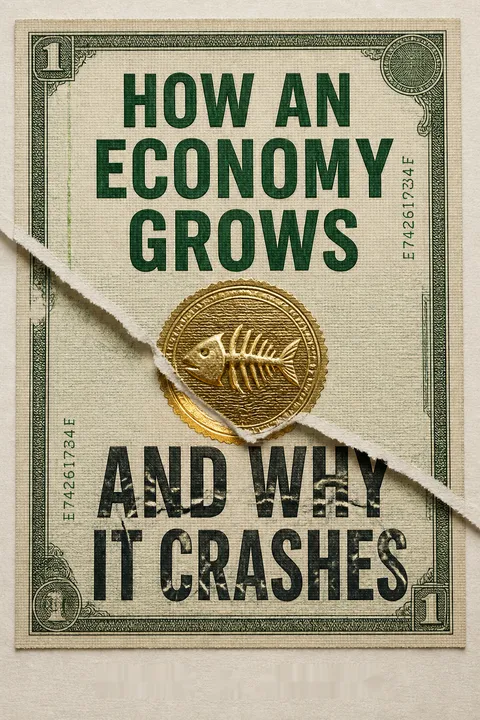
How an Economy Grows and Why It Crashes presents economic concepts through a simple, engaging story about a fictional island. Readers appreciate its accessibility and humor, though some criticize oversimplification. The book explains basic economic principles, challenges Keynesian economics, and critiques US economic policies. While many find it enlightening, others note its biased perspective. The cartoon-style illustrations and straightforward narrative make complex ideas understandable for a general audience. Overall, readers find it thought-provoking, albeit with limitations in addressing more complex economic issues.
People Also Read

Glossary
Capital
Tools for producing goodsIn the book, capital means equipment created not mainly for its own enjoyment, but to help produce something people want. Able’s net is capital because it helps him catch fish more efficiently. Savings, innovation, and investment allow people to build such tools and expand what their labor can produce.
Underconsumption
Postponing consumption to investUnderconsumption is the choice to consume less now in order to save resources for a project that may increase future production. Able practices it when he goes without a day’s fish to make a net. The book presents this sacrifice, and the risk that the investment may fail, as a source of economic growth.
Austrian School
School stressing saving and marketsThe Austrian School is an economic tradition associated in the book with Ludwig von Mises. The authors emphasize savings, individual decisions, market-set interest rates, and the risk that artificially cheap credit encourages unsound investment. They contrast this with Keynesian approaches that support public spending and monetary expansion during downturns.
malinvestments
Capital sent to poor usesThe book uses malinvestments for projects encouraged by distorted economic signals, especially artificially low interest rates. Borrowers may invest in ventures that appear profitable because credit is unusually cheap, even though the underlying savings or future demand is inadequate. When the error becomes clear, resources must be shifted or written off.
Fish Reserve Notes
Paper claims on fishIn the allegory, Fish Reserve Notes are paper currency issued by Usonia’s government and initially promised to be redeemable for real fish held in a bank. Officials issue more notes than their fish reserves can support, then reduce the amount of fish backing each note. The fictional currency represents the book’s criticism of expandable, government-issued money.
Fishflation
Price rises from shrinking fishFishflation is the allegory’s term for rising prices as official fish become smaller and less valuable. Because fish serve both as food and money on the island, each purchase requires more fish. The story uses this process to illustrate how expanding currency and declining purchasing power can affect prices and savings.
Hut fish extractions
Loans against rising hut valuesHut fish extractions are loans that let hut owners borrow more against a property whose market value has risen. In the story, borrowers receive extra fish without adding productive capacity, while lenders rely on continued hut-price increases. The practice resembles extracting home equity during a housing boom and becomes dangerous when property values fall.
FAQ
What's "How an Economy Grows and Why It Crashes" about?
- Allegorical Tale: The book uses a simple allegory involving three men on an island to explain complex economic principles. It illustrates how economies grow and the factors that can lead to economic crashes.
- Economic Concepts: It covers fundamental economic concepts such as savings, investment, credit, and inflation through the story of the islanders.
- Critique of Keynesian Economics: The book critiques Keynesian economic policies, arguing that they lead to unsustainable growth and eventual economic collapse.
- Historical Context: It draws parallels between the allegory and real-world economic events, particularly focusing on U.S. economic history.
Why should I read "How an Economy Grows and Why It Crashes"?
- Simplified Economics: The book simplifies complex economic theories, making them accessible to readers without a background in economics.
- Engaging Storytelling: Through its allegorical narrative, it provides an engaging way to understand how economies function and the impact of government policies.
- Critical Perspective: It offers a critical perspective on modern economic policies, particularly those influenced by Keynesian economics.
- Practical Insights: Readers gain practical insights into the importance of savings, investment, and the dangers of excessive government intervention.
What are the key takeaways of "How an Economy Grows and Why It Crashes"?
- Savings and Investment: Economic growth is driven by savings and investment, not by consumption alone.
- Role of Government: Excessive government intervention and manipulation of money supply can lead to economic instability.
- Inflation and Deflation: The book highlights the dangers of inflation and the benefits of deflation in a healthy economy.
- Free Market Principles: It advocates for free market principles and limited government as the foundation for sustainable economic growth.
How does the allegory in "How an Economy Grows and Why It Crashes" explain economic growth?
- Basic Economy: The story begins with three men on an island who catch fish by hand, representing a basic economy with no savings or investment.
- Innovation and Risk: One man, Able, creates a net, representing innovation and risk-taking, which leads to increased productivity.
- Capital and Savings: The net allows for savings and the creation of capital, which are essential for economic expansion.
- Complex Economy: As the story progresses, the island's economy becomes more complex, illustrating the benefits of specialization and trade.
What is the critique of Keynesian economics in "How an Economy Grows and Why It Crashes"?
- Complexity vs. Simplicity: The book argues that Keynesian economics unnecessarily complicates simple economic principles.
- Government Intervention: It criticizes the Keynesian focus on government intervention and deficit spending as solutions to economic problems.
- Inflationary Policies: The book highlights the dangers of inflationary policies advocated by Keynesians, which can lead to economic bubbles and crashes.
- Austrian School Perspective: It presents the Austrian School's view that recessions are necessary corrections for previous economic excesses.
How does "How an Economy Grows and Why It Crashes" explain the role of credit?
- Business Loans: Credit is essential for business expansion, allowing entrepreneurs to invest in capital and increase productivity.
- Consumption Loans: The book warns against using credit for consumption, as it does not lead to increased productive capacity.
- Emergency Loans: It acknowledges the role of credit in emergencies, providing a safety net for unforeseen circumstances.
- Credit Market Distortions: The book discusses how government intervention can distort credit markets, leading to inefficient allocation of resources.
What lessons does "How an Economy Grows and Why It Crashes" offer about inflation?
- Definition of Inflation: Inflation is defined as an expansion of the money supply, not just rising prices.
- Consequences of Inflation: Inflation erodes savings and purchasing power, leading to economic instability.
- Inflation vs. Deflation: The book argues that deflation, or falling prices, is beneficial as it increases purchasing power and encourages savings.
- Government's Role: It criticizes government policies that create inflation to cover deficits and avoid making hard economic choices.
How does "How an Economy Grows and Why It Crashes" address the concept of trade?
- Mutual Benefits: Trade allows countries to specialize in what they do best, benefiting all parties involved.
- Comparative Advantage: The book illustrates how islands trade goods they produce efficiently for those they cannot, increasing overall wealth.
- Trade Imbalances: It warns against persistent trade imbalances, which can lead to economic dependency and instability.
- Currency and Trade: The book discusses how currency manipulation can distort trade relationships and lead to economic problems.
What are the implications of government spending in "How an Economy Grows and Why It Crashes"?
- Infrastructure Spending: While infrastructure can boost productivity, it must be justified by long-term benefits exceeding costs.
- Stimulus Spending: The book criticizes stimulus spending as a short-term fix that can lead to long-term economic problems.
- Government Debt: Excessive government debt, financed by printing money, can lead to inflation and economic collapse.
- Private vs. Public Sector: It argues that the private sector is more efficient in allocating resources than government-directed spending.
How does "How an Economy Grows and Why It Crashes" explain the concept of economic bubbles?
- Hut Market Bubble: The allegory uses a hut market bubble to illustrate how easy credit and government incentives can inflate asset prices.
- Unsustainable Growth: Bubbles create the illusion of prosperity but are unsustainable and eventually burst, causing economic downturns.
- Role of Speculation: Speculation and the belief in ever-rising prices contribute to the formation of bubbles.
- Government's Role: The book highlights how government policies can exacerbate bubbles by encouraging excessive borrowing and risk-taking.
What are the best quotes from "How an Economy Grows and Why It Crashes" and what do they mean?
- "Savings are the lifeblood of a healthy economy." This quote emphasizes the importance of savings in providing the capital needed for investment and growth.
- "Inflation is a hidden tax on savings." It highlights how inflation erodes the value of savings, effectively taxing those who save.
- "Government cannot create wealth, only redistribute it." This underscores the book's argument that government spending does not create new wealth but merely reallocates existing resources.
- "Deflation is not the enemy; it is the reward of increased productivity." The book argues that deflation, resulting from increased efficiency, benefits consumers by lowering prices.
What is the overall message of "How an Economy Grows and Why It Crashes"?
- Free Market Advocacy: The book advocates for free market principles and limited government intervention as the foundation for sustainable economic growth.
- Critique of Interventionism: It criticizes government intervention and Keynesian policies as short-term fixes that lead to long-term problems.
- Importance of Savings: Emphasizes the role of savings and investment in driving economic growth and stability.
- Economic Education: Aims to educate readers on fundamental economic principles through an engaging and accessible allegory.
About the Author
Other books by Peter D. Schiff

Download PDF
Download EPUB
.epub digital book format is ideal for reading ebooks on phones, tablets, and e-readers.








