

Key Takeaways
Treat collapse as a prolonged breakdown of essentials, not an apocalypse
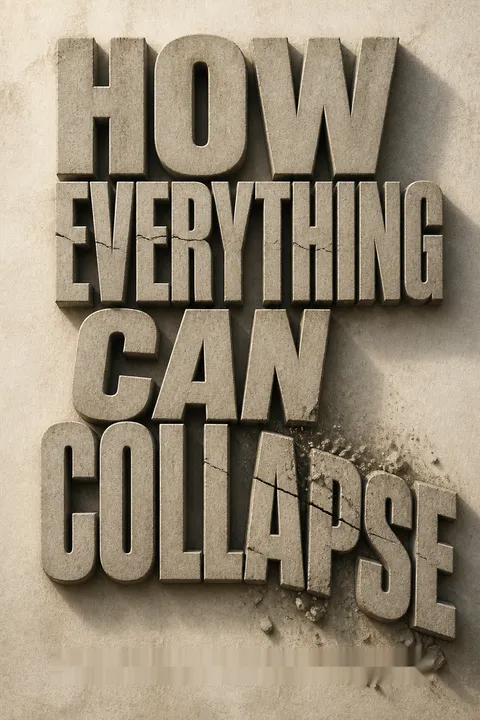
Define the feared event. Collapse means a process in which public services can no longer provide most people with essentials such as food, water, housing, and energy at a reasonable cost. It is not necessarily a sudden end to humanity, a single disaster, or the disappearance of every institution. The authors use the term for a broad, lasting breakdown in the systems that support ordinary life. Its timing, geography, and severity may differ from place to place.
Look at the whole pattern. The book argues that climate disruption, biodiversity loss, resource pressures, financial instability, and political tensions can reinforce one another. A food shock, for example, can become a social and economic shock when transport and health services are already strained. The point is not that every crisis guarantees collapse, but that treating each as an isolated problem can hide the cumulative danger.
A practical definition matters because vague apocalypse imagery can either paralyze people or invite easy dismissal. Defining collapse through the failure of essential services shifts attention to measurable dependencies: food distribution, water systems, energy, and public health. It also makes room for uneven outcomes, since different communities depend on different institutions and have unequal buffers. The caution is that a broad definition can become elastic. Analysts need to specify which services fail, for whom, and for how long, or the term risks explaining every severe disruption after the fact.
Exponential growth hides the cliff until visible damage arrives
Growth outruns intuition. A steadily growing quantity feels manageable, but exponential growth accelerates as it compounds. The book illustrates this with a cloth folded repeatedly: after only a few dozen folds, its theoretical thickness would exceed the distance between Earth and the Moon. In a finite ecosystem, however, growth eventually meets a carrying capacity, the maximum load an environment can sustain.
Overshoot changes the ending. A population may stabilize below that capacity, fluctuate around it, or exceed it and damage the conditions it needs to survive. The authors argue that industrial society has followed the third path: humanity has continued expanding its material demands even as ecological systems weaken. Climate and biodiversity are not separate side effects. Their disruption can undermine food production, water supplies, and the stability of other systems.
The strength of the exponential-growth argument is psychological as much as mathematical. People tend to extrapolate linearly from recent experience, so compounding danger can appear modest until it becomes hard to reverse. The carrying-capacity model gives readers a useful question: is growth approaching a ceiling, or eroding the ceiling itself? Yet the metaphor should not be mistaken for a precise forecast. Human societies can change consumption, technology, and distribution, but those changes have political costs and may arrive too slowly to prevent ecological damage.
Track energy surplus, not just fuel reserves or new technology
Net energy sustains society. Energy return on investment, or EROI, compares the energy delivered by a source with the energy required to obtain it. A large reserve is not automatically useful if extraction consumes much of its energy. The authors contrast early American oil, estimated in the book at roughly 100 units returned for each unit invested, with a contemporary estimate near 11 to 1. They also cite estimates placing the energy return needed to sustain modern social services around 12 to 13 to 1, though these figures are contested.
Finance depends on energy. The book links energy availability to economic activity and credit: expensive oil can squeeze consumers and trigger recession, while weak prices can discourage investment in future production. It argues that unconventional fuels and renewables cannot quickly replace the whole fossil-fuel system, because their production also depends on energy, materials, and infrastructure.
EROI adds a useful physical dimension to debates often framed only in prices, investment, or engineering efficiency. It asks how much usable surplus remains after the energy system supports itself, a question relevant to every energy transition. But a single threshold should not be treated as a universal cliff: the energy quality required depends on technology, infrastructure, and the services a society chooses to preserve. The book's historical estimates also reflect its publication era. Its durable insight is the need to assess whole-system dependencies, not to treat any one ratio as settled fact.
A more connected civilization can fail from a smaller shock
Efficiency can erase slack. Global finance, transport, food, and manufacturing rely on long, tightly linked networks. Companies often use just-in-time delivery to avoid storing goods, while essential infrastructure depends on continuous flows of fuel, electricity, and information. The book uses the 2011 Thailand floods to show how damage to one region disrupted hard-drive production, car factories, and other industries around the world.
Small interruptions cascade. During a 2000 truckers' blockade in Britain, fuel shortages spread within days to supermarkets, schools, postal deliveries, and hospital operations. The episode shows how a local stoppage can become a national problem when stocks are low and services depend on one another. The authors argue that highly connected systems may absorb small disruptions at first, then transmit later shocks rapidly across the network.
This is a classic resilience problem: optimizing a network for speed and cost can remove the buffers that make it robust. Redundancy, spare capacity, local suppliers, and inventories may look inefficient during normal times, yet they act like shock absorbers. The same logic applies to ecological systems, where diversity can prevent the loss of one species from destabilizing an entire web of interactions. The challenge is not to reject connection altogether. Trade and specialization bring real benefits. It is to notice when efficiency has become dependence without a backup.
Do not demand a collapse date before preparing for instability
Complex systems resist calendars. The book distinguishes measurable risk from uncertainty that cannot be assigned a reliable probability. A turkey fed every day might infer that the future will remain abundant, until the pattern abruptly ends. The analogy warns against treating a long record of stability as proof that a system is safe. The authors also describe femtorisks, seemingly tiny events that can trigger effects vastly larger than their apparent causes.
Signals help, but do not guarantee. In ecology, a system approaching a tipping point may take longer to recover from small disturbances, a pattern called critical slowing down. Yet warning signs can appear without collapse, and collapse can occur without clear warning. The book therefore recommends combining evidence with informed judgment and taking plausible catastrophic outcomes seriously, rather than waiting for scientific certainty that complex systems cannot provide.
This is a strong argument for precaution when potential losses are severe and difficult to reverse. It also avoids pretending that better data can eliminate uncertainty. Still, acting as though a disaster is certain can impose costs of its own, from panic to poorly targeted spending. A sound response separates preparation from prediction: strengthen essential services and reduce known vulnerabilities without claiming to know the date or exact form of failure. That approach respects both the limits of forecasting and the value of evidence.
Expect uneven decline, not one synchronized end of the world
Models reveal mechanisms. The HANDY model explores how resource use and inequality can shape a society's stability. In its unequal scenarios, elites can continue consuming while ordinary people lose the health and security needed to maintain society. In one pathway, people are depleted before resources; in another, the environment is exhausted first. The model is deliberately simplified, so it illustrates possible dynamics rather than predicting a specific society's fate.
World3 tests the whole system. The World3 model links population, industry, food, pollution, and nonrenewable resources. Its business-as-usual scenario projected a decline in production and population during the twenty-first century. The book cites a comparison showing historical data tracking that scenario more closely than many alternatives. Neither model provides a reliable collapse date. Together, they emphasize that resource use, inequality, pollution, and growth interact, and that outcomes may vary across regions and social groups.
The models are most valuable as structured thought experiments. HANDY makes distribution visible, while World3 makes feedback between sectors harder to ignore. Their shared lesson is that a society can appear prosperous while hidden costs accumulate unevenly. A model's output, however, depends on its assumptions and cannot capture every innovation, policy choice, or shock. The appropriate question is not whether a curve predicts the future exactly, but whether it identifies a mechanism worth monitoring and a preventable vulnerability worth addressing.
Build mutual aid before a crisis makes trust urgent
Disaster does not automatically mean panic. The authors challenge the popular image of crowds instantly turning violent when order breaks down. Research on disasters, as presented in the book, often finds people helping neighbors, organizing rescue efforts, and acting calmly. The account of Hurricane Katrina also shows how false reports of widespread violence helped prompt an armed response that contributed to real harm.
Relationships are infrastructure. Buildings, roads, and institutions matter, but social ties can help communities organize when those structures fail. The book argues that local trust and cooperation are practical sources of resilience, especially when supply chains or public services are disrupted. This does not mean every emergency produces solidarity, or that communities can withstand prolonged conflict without resources. It means preparedness should include the human networks that make coordination possible, not only equipment and emergency plans.
Treating social connection as infrastructure is a valuable correction to preparedness models focused on physical assets. A neighborhood that knows how to communicate, share resources, and identify vulnerable residents may respond more effectively than one with better supplies but weaker relationships. The Katrina example also shows that stories about danger can shape the danger itself: fear-driven intervention can intensify a crisis. Mutual aid is not a substitute for competent public services, though. It works best when communities are supported rather than left to compensate for institutional failure.
Make emotional honesty and shared stories part of preparedness
Facts land emotionally. The authors describe audiences responding to environmental evidence with grief, anger, fear, and relief, not simply with analysis. They connect this process to mourning: people may resist, bargain, feel despair, and gradually accept the loss of a future they had assumed was guaranteed. The stages are not a fixed timetable, but naming emotions can help people discuss difficult realities without being isolated by them.
Stories shape action. The book argues that narratives of inevitable progress or universal selfishness can narrow what people imagine. It points to transition groups that use films, local projects, and imagined futures to make a lower-energy life feel concrete rather than merely deprived. Shared stories can support action, but they should not replace clear evidence. Their purpose is to help people face hard information and see a role for themselves in responding.
The emotional dimension matters because information does not translate automatically into behavior. Grief can make a threat more psychologically real, while shared stories can give collective action a sense of possibility. The useful distinction is between hope as confidence in a guaranteed outcome and hope as commitment to meaningful action under uncertainty. Mourning frameworks can help, but they should not turn complicated reactions into a compulsory sequence. People process loss differently, and communities need room for disagreement as well as shared purpose.
Grow local resilience without mistaking adaptation for a guaranteed rescue
Start building alternatives now. The book highlights transition initiatives involving local food, renewable-energy cooperatives, urban agriculture, and cooperative economies. It points to Cuba's shift toward agroecology during its severe economic disruption as an example of alternatives gaining scale when public policy supports them. Such efforts can reduce dependence on distant supply chains and preserve practical skills, but they cannot by themselves control global climate or financial forces.
Keep fairness and democracy central. The authors see transition as preparing communities for shocks while inventing ways to live with less energy and material throughput. They also discuss rationing as a possible policy for distributing scarce essentials fairly, drawing on wartime examples. These strategies raise hard questions about who decides, whose consumption is reduced, and how rights are protected. The aim is neither business as usual nor a fantasy of total self-sufficiency, but collective capacity to adapt without abandoning solidarity.
Local resilience is strongest when it connects practical self-reliance with wider coordination. Food, energy, transport, and water systems cross municipal boundaries, so local projects need supportive institutions and fair rules to scale. The book's emphasis on solidarity also guards against a bunker mentality in which security belongs only to those who can purchase it. Adaptation has limits: community gardens and cooperative energy cannot substitute for reducing systemic emissions or repairing public infrastructure. Their value is to make communities less brittle while broader change remains contested.
Analysis
The book's central achievement is not a dated forecast, but a change of scale. It asks readers to stop treating climate disruption, resource constraints, economic instability, and social conflict as separate emergencies. The metaphor of an accelerating vehicle gives these risks a shared structure: some are hard limits, some are ecological thresholds, and some arise because the steering and brakes are locked into inherited institutions. The result is a civilization that can become more powerful while also becoming more exposed to shocks.
Its strongest analytical move is to connect physical and social systems. Energy is not merely another commodity when transport, agriculture, finance, and public services all depend on it. Likewise, inequality is not just an ethical concern when concentrated wealth can insulate decision makers from early harm and weaken the people and institutions on which collective adaptation depends. The discussion of disaster behavior adds an important counterweight to bleak forecasting: social cooperation is not an exception to human nature, and may be a resource that ordinary preparedness overlooks.
The book's limits are also important. It was published in 2015, and many numerical claims, energy estimates, and near-term projections reflect that period. Its scenarios should not be mistaken for current forecasts. HANDY and World3 clarify mechanisms but simplify political choice, innovation, and uneven regional change. The case for systems interdependence is stronger than any claim that collapse has one inevitable timetable or global form.
The most useful reading is therefore neither prophecy nor dismissal. Treat the book as a warning about compounded vulnerability and a prompt to examine dependencies, buffers, and unequal exposure. Its practical conclusion is modest but demanding: strengthen local capacity, protect cooperation, and pursue systemic change without waiting for certainty. That is not a promise of rescue. It is a way to make severe disruption less likely to become needless suffering.
Review Summary
How Everything Can Collapse is widely praised as an accessible yet comprehensive introduction to collapsology, exploring potential societal collapse scenarios. Readers appreciate its well-researched content, clear explanations, and thought-provoking insights. While some find it alarmist or outdated, many consider it essential reading for understanding global challenges. The book's balanced approach, discussing both collapse risks and potential for resilience, resonates with readers. Some criticize its writing style or lack of detailed solutions, but overall, it's viewed as a valuable contribution to discussions on sustainability and societal fragility.
People Also Read




Glossary
collapsology
Interdisciplinary collapse studiesA proposed transdisciplinary study of how industrial civilization might break down, what conditions could contribute to that process, and what social, psychological, and political consequences may follow. The book presents it as a way to connect research across fields, distinguish evidence from apocalyptic imagery, and support informed discussion of responses.
EROI
Energy returned per energy investedEnergy return on investment compares the energy obtained from a source with the energy used to find, extract, process, and deliver it. A high ratio leaves more energy available for other social needs; a declining ratio means more of society's energy must be spent maintaining energy supply. The book uses EROI to question whether alternatives can support current levels of complexity.
planetary boundaries
Earth-system safety thresholdsA framework that identifies major Earth-system processes and estimates thresholds beyond which human activity may push the planet into less stable conditions. The book discusses climate, biodiversity, freshwater, land use, and nutrient cycles among these processes. Crossing a boundary does not specify a precise disaster date, but signals increased risk to ecosystems and societies.
sociotechnical lock-in
Systems resistant to alternativesA condition in which technologies, infrastructure, markets, institutions, and habits reinforce one another, making an established system difficult to replace. Roads and car use, for example, can expand together through public investment and consumer dependence. Lock-in can preserve useful arrangements, but it can also block lower-impact alternatives even when they become credible.
femtorisks
Small triggers, outsized consequencesA term used for apparently minor events that may set off disproportionately large disruptions in tightly connected systems. The term emphasizes that the size of a trigger does not reliably indicate the size of its possible effects. Such events are difficult to identify through conventional risk assessment because their consequences depend on complex interactions.
critical slowing down
Slower recovery before tippingA possible warning pattern in which a system takes progressively longer to recover from small disturbances as it approaches a tipping point. Researchers can look for changes in recovery time and other statistical signals. The pattern may indicate declining resilience, but it is not a guaranteed forecast, and warning signs can be incomplete or arrive too late.
HANDY
Inequality and resource modelThe Human and Nature Dynamics model explores how resource use, population, wealth, and inequality can affect the stability of fictional societies. Its scenarios show how a society may collapse when people are depleted by unequal distribution or when environmental resources are exhausted. It is a simplified model for exploring mechanisms, not a precise forecast of any real civilization.
World3
Global limits simulation modelA computer model developed for the Limits to Growth research that represents interactions among population, industrial production, food, pollution, services, and nonrenewable resources. Its scenarios explore how growth and feedback can produce different long-term outcomes. The book emphasizes that World3 is not a calendar predicting a specific collapse, but a tool for examining systemic behavior and the risks of business as usual.
FAQ
What's "Comment tout peut s'effondrer" about?
- Overview: "Comment tout peut s'effondrer" by Pablo Servigne and Raphaël Stevens explores the concept of collapsology, which is the study of the potential collapse of our industrial civilization.
- Themes: The book discusses environmental, economic, and social factors that could lead to a systemic collapse, emphasizing the interconnectedness of these crises.
- Purpose: It aims to provide a comprehensive understanding of the risks and challenges facing modern society, encouraging readers to consider the implications of a potential collapse.
- Structure: The book is divided into three parts, covering the harbingers of collapse, the timing of potential collapse, and the concept of collapsology itself.
Why should I read "Comment tout peut s'effondrer"?
- Awareness: The book raises awareness about the potential risks and vulnerabilities of our current civilization, which are often overlooked in mainstream discourse.
- Interdisciplinary Approach: It combines insights from various fields, including ecology, economics, and sociology, to provide a holistic view of the challenges we face.
- Actionable Insights: While it presents a grim outlook, the book also offers ideas for building resilience and adapting to potential changes.
- Thought-Provoking: It challenges readers to rethink their assumptions about progress and sustainability, encouraging a deeper reflection on the future.
What are the key takeaways of "Comment tout peut s'effondrer"?
- Systemic Vulnerability: Our industrial civilization is highly interconnected and vulnerable to multiple crises, including environmental degradation, resource depletion, and economic instability.
- Collapse is Possible: The book argues that a collapse is not only possible but likely if current trends continue, urging readers to consider this scenario seriously.
- Need for Resilience: Building local resilience and transitioning to sustainable practices are crucial to mitigating the impacts of potential collapse.
- Role of Inequality: Economic and social inequalities exacerbate vulnerabilities and can accelerate the collapse process.
What is collapsology according to "Comment tout peut s'effondrer"?
- Definition: Collapsology is the transdisciplinary study of the collapse of industrial civilization and what might succeed it, using both reason and intuition.
- Focus Areas: It examines environmental, economic, and social factors that contribute to systemic vulnerabilities and potential collapse.
- Purpose: The goal is to understand the dynamics of collapse to better prepare for and adapt to potential future scenarios.
- Approach: Collapsology combines scientific research with intuitive insights to provide a comprehensive understanding of the risks we face.
How does "Comment tout peut s'effondrer" define collapse?
- Definition: Collapse is described as a process where basic needs (water, food, housing, energy) can no longer be provided to a majority of the population at a reasonable cost.
- Characteristics: It is a large-scale, irreversible process that affects the stability and sustainability of societies.
- Historical Context: The book draws parallels with past civilizations that have collapsed due to similar factors, such as resource depletion and social inequality.
- Implications: A collapse would lead to significant disruptions in social, economic, and political systems, with long-lasting consequences.
What are the harbingers of collapse mentioned in "Comment tout peut s'effondrer"?
- Environmental Degradation: The book highlights issues like climate change, biodiversity loss, and pollution as key environmental factors leading to collapse.
- Resource Depletion: The depletion of non-renewable resources, such as fossil fuels and minerals, poses a significant threat to industrial civilization.
- Economic Instability: The fragility of the global financial system and the reliance on debt-driven growth are identified as major economic vulnerabilities.
- Social Inequality: Rising economic and social inequalities exacerbate vulnerabilities and can accelerate the collapse process.
What does "Comment tout peut s'effondrer" say about the timing of collapse?
- Uncertainty: The book acknowledges the difficulty in predicting the exact timing of a collapse due to the complexity and interconnectedness of contributing factors.
- Warning Signs: It discusses the importance of recognizing early warning signs, such as critical slowing down and increased volatility in systems.
- Models and Scenarios: The book explores various models and scenarios, including the HANDY model and the World3 model, to understand potential timelines and outcomes.
- Urgency: Despite the uncertainty, the authors emphasize the urgency of addressing these issues to prevent or mitigate a collapse.
How does "Comment tout peut s'effondrer" address the role of inequality in collapse?
- Economic Disparities: The book argues that economic inequalities discourage innovation and erode social cohesion, increasing the risk of collapse.
- Social Instability: Inequality leads to social tensions and conflicts, which can destabilize societies and accelerate the collapse process.
- Historical Examples: The authors draw on historical examples, such as the fall of the Roman Empire, to illustrate how inequality has contributed to past collapses.
- Solutions: Reducing inequalities and promoting fair distribution of resources are seen as crucial steps in building resilience and preventing collapse.
What are the best quotes from "Comment tout peut s'effondrer" and what do they mean?
- "The more powerful our civilization grows, the more vulnerable it becomes." This quote highlights the paradox that increased complexity and interconnectedness make our civilization more susceptible to collapse.
- "Collapse is not the end but the beginning of our future." It suggests that while collapse may be inevitable, it also presents an opportunity for renewal and transformation.
- "To save the engine of our industrial civilization, we have to cross more and more boundaries." This emphasizes the unsustainable nature of our current trajectory and the need for radical change.
- "The utopian is whoever believes that everything can just keep going as before." This challenges the notion of perpetual progress and calls for a realistic assessment of our situation.
How does "Comment tout peut s'effondrer" suggest we prepare for a potential collapse?
- Building Resilience: The book advocates for building local resilience through sustainable practices, community cooperation, and decentralized systems.
- Transition Initiatives: It highlights the importance of transition movements that focus on reducing dependence on fossil fuels and promoting sustainable living.
- Rethinking Growth: The authors call for a reevaluation of economic growth models and a shift towards more equitable and sustainable systems.
- Embracing Change: Preparing for collapse involves accepting the inevitability of change and adapting to new realities with flexibility and creativity.
What does "Comment tout peut s'effondrer" say about the psychology of collapse?
- Denial and Cognitive Dissonance: The book explores why people often deny or ignore the possibility of collapse, citing cognitive barriers and societal myths.
- Emotional Responses: It discusses the range of emotional responses to the idea of collapse, from fear and anxiety to acceptance and hope.
- Mourning Process: The authors liken the psychological transition to a process of mourning, involving stages of denial, anger, bargaining, depression, and acceptance.
- Role of Stories: The book emphasizes the power of storytelling in shaping perceptions and encouraging collective action towards a more resilient future.
What are the implications of "Comment tout peut s'effondrer" for future generations?
- Legacy of Choices: The book suggests that the choices made by previous generations have set the stage for current and future challenges, emphasizing the need for responsible decision-making.
- Opportunities for Renewal: While acknowledging the potential for collapse, the authors also highlight opportunities for renewal and transformation in the aftermath.
- Intergenerational Responsibility: It calls for a sense of responsibility towards future generations, urging current societies to take action to mitigate the impacts of collapse.
- Vision for the Future: The book encourages envisioning a future that prioritizes sustainability, resilience, and cooperation, offering hope for a better world beyond collapse.
Download PDF
Download EPUB
.epub digital book format is ideal for reading ebooks on phones, tablets, and e-readers.








