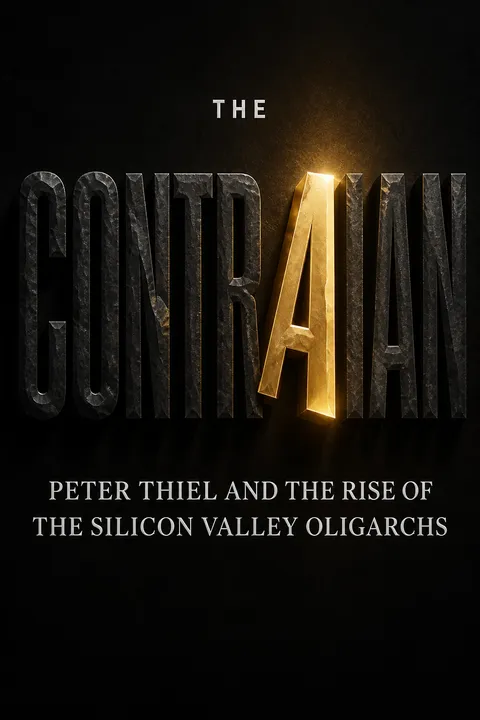


Key Takeaways
Treat contrarianism as a method of gaining power, not proof of independent thought
A role can become a strategy. As a boy, Thiel liked being the dungeon master in Dungeons & Dragons, the player who controlled the rules and narrated the world. At Stanford, he found a larger stage: the conservative Stanford Review, where he turned campus disputes into stories about liberal persecution. The book traces the same oppositional posture through PayPal, Palantir, and national politics. Its central argument is that Thiel's contrarianism is less a stable doctrine than a way to distinguish himself, recruit allies, and shift power toward himself and his companies.
Contradictions are part of the method. Thiel backed libertarian projects that aimed to weaken government control, then built a company selling data tools to government agencies. He criticized big tech while helping create its dominance. The pattern is not simply inconsistency; the author argues that opposing the prevailing view gives Thiel leverage, regardless of which view he adopts.
What's striking is how contrarianism can function as both inquiry and branding. In social psychology, people often use visible disagreement to signal identity and attract a like-minded group; the signal can become valuable even when the underlying beliefs shift. That does not make dissent inherently cynical. Institutions need people willing to challenge consensus. The useful test is whether a dissenter applies the same standards to allies and opponents, and whether evidence can change the position. In this portrait, the harder question is not whether Thiel disagrees, but who gains power when he does.
Back founders who see overlooked uses, then build networks around their success
An early bet became a network. In 1998, Thiel met young cryptographer Max Levchin, heard his idea for secure communication on handheld computers, and quickly invested about $250,000. That first product did not take off. The pair redirected Levchin's encryption work into digital payments, and PayPal found a crucial audience among eBay buyers and sellers who wanted a faster alternative to mailing money orders. Thiel's edge was not technical invention. It was recognizing a founder's capacity, changing direction when the first idea stalled, and organizing people around a promising opportunity.
Success multiplied through relationships. Former PayPal colleagues went on to build or fund companies including LinkedIn, YouTube, and Yelp, while Thiel backed Facebook and SpaceX. This informal network, later called the PayPal Mafia, gave him access to founders, capital, and new ventures. It also concentrated influence among people whose loyalties and careers overlapped.
This is a strong example of network effects outside the product itself. A successful investment can create trust, information advantages, and repeated access to talented founders, making later investments easier to source. The pattern resembles a professional ecosystem more than a lone genius story. Yet a close-knit network can also mistake familiarity for merit and reinforce its own blind spots. PayPal's early workforce was notably homogeneous. The same ties that speed decisions can narrow who gets invited into the room, and whose ideas are recognized as promising.
Let growth outrun safeguards, and market dominance shifts costs onto everyone else
PayPal made growth the scoreboard. The company paid users to join and refer friends, and its user count rose from thousands to one million in roughly three months. It spent about $20 million on incentives after raising $28 million, despite having no meaningful revenue and losing money on transactions. It also made account creation easy before building strong identity checks, leaving it vulnerable to fraud. Engineers later developed CAPTCHA and the Igor fraud-detection system, but those fixes followed risks created by the company's permissive growth strategy.
Scale changed the bargain. Once PayPal became difficult for eBay sellers to avoid, it began charging fees and pursued profitable gambling transactions, while lobbying against rules that could restrict its business. The company treated regulatory uncertainty as room to move quickly. The result was a model that inspired later startups to pursue market dominance first and confront public costs afterward.
The case illustrates a familiar problem in platform economics: users create value for one another, so the service that reaches critical mass can become hard to replace. That can justify early investment and temporary losses, but it can also turn consumer dependence into pricing power. The book's sharpest point is that rule-breaking was not merely an accidental side effect of PayPal's speed. It was presented as part of the competitive advantage. Still, early experimentation can be socially useful. The question is whether firms face accountability when experimentation exposes customers and the public to risks they did not choose.
Follow the data tool: fraud detection can become state surveillance infrastructure
A payment problem became an intelligence pitch. PayPal's Igor system helped analysts map suspicious accounts and identify fraud networks. After the September 11 attacks, Thiel asked whether similar tools could help intelligence agencies connect scattered records and detect threats. The resulting company, Palantir, sold data-analysis software to government clients, with early support from the CIA's investment arm. Its name came from Tolkien's seeing stones, objects that could reveal distant events but were also dangerous instruments of surveillance and manipulation.
Safeguards did not settle the question. Palantir's Gotham software logged searches so clients could, in theory, audit access to sensitive information. Yet former employees described customers making questionable searches without being stopped. The company later provided tools used in immigration enforcement, including systems supporting arrests and deportations. Its alleged role in the hunt for Osama bin Laden became part of its mystique, although the book stresses that the extent of its contribution is disputed.
The transition from fraud analytics to intelligence software shows how a tool's social meaning changes with its customer and purpose. A network map can help identify stolen credit cards, but the same ability to connect people and records can expand state scrutiny. In technology ethics, this is a dual-use problem: capabilities built for legitimate protection can also enable coercion. Logging access is valuable, but accountability requires someone independent to review the logs and impose consequences. Without that, a safeguard may reassure buyers more than it constrains them.
Turn grievance into a coalition by portraying influence as persecution
Campus conflict supplied a template. At Stanford, Thiel's conservative newspaper framed curriculum changes and criticism of its writers as signs that liberal institutions silenced conservatives. His book, The Diversity Myth, presented disputed campus incidents as evidence of a broader assault on free speech and traditional culture. The author argues that the story of persecution was politically useful even when conservatives at Stanford were outspoken and well connected. It helped Thiel attract donors, media attention, and allies who saw themselves as outsiders confronting an entrenched elite.
The frame traveled beyond campus. Thiel's political network later connected anti-immigration activists, online provocateurs, and candidates who attacked political correctness. He saw the Ron Paul movement not simply as a libertarian cause, but as a base of young people drawn to anti-establishment rebellion. The book traces how that appetite for confrontation helped make Donald Trump an attractive bet, even though Thiel's own politics did not fit neatly into one party or doctrine.
Grievance can unite people who disagree on policy by giving them a shared antagonist. Political sociology calls attention to this coalition-building function: a group can grow through a common account of exclusion, not just a shared program. That account may reveal genuine institutional failures, especially when dissent is punished. It can also magnify minor slights into proof of systemic oppression. A useful reader's question is whether the alleged silencing is measurable and applied consistently, or whether the claim mainly protects allies from criticism while granting them a louder platform.
Sell rebellion as mentorship, then ask who receives real support
The fellowship promised an exit. Thiel argued that expensive universities were a poor deal and offered young people up to $100,000 to leave school and build companies. In its first cohort, 22 men and two women were selected. The program generated attention and gave fellows unusual access to investors, but the support was thin: there were few structured lessons, limited mentoring, and little help with the ordinary needs of teenagers living far from home. Some fellows felt they had been given money and a slogan instead of a community.
The idea traveled farther than the program. Thiel's Stanford startup course drew a large audience, and notes circulated online through his protégé Blake Masters. The fellowship and course helped present Thiel as a guide to ambitious young outsiders. The book suggests that this influence could outlast the practical value of the program itself, while also functioning as a powerful public-relations project for its benefactor.
This distinction resembles the difference between a scholarship and an institution. Money can remove one barrier, but young founders also need feedback, social connection, and room to change direction. A program that celebrates independence may accidentally define requests for support as weakness. The fellowship's media success shows that a bold educational challenge can become a credential of its own, even when it rejects conventional credentials. That does not erase the fellows who benefited. It does suggest evaluating mentorship by what participants can reliably access, not by the founder's rhetoric or the program's visibility.
Convert private capital into government access, contracts, and political reach
The 2016 bet opened doors. Thiel endorsed Trump, donated to his campaign, and joined the transition team. He proposed a long list of possible appointees, many aligned with his hostility to regulation and established agencies; only a fraction secured posts. Yet his influence extended beyond staffing. He brought major technology executives to meet Trump after the election, helping establish a working relationship between the incoming administration and an industry that had largely opposed the candidate.
Business and politics overlapped. Palantir had been fighting the Army over a major software contract, and the company later won large government deals, including work with the Army, immigration agencies, and the pandemic response. The book documents close access and outcomes that benefited Thiel's companies, but those facts do not prove every contract was politically arranged. They do show why billionaire influence raises a hard governance question: when private companies help shape public priorities, who checks that the public interest is being served?
This is a case study in the boundary between access and capture. Political science distinguishes ordinary advocacy, where interests seek to influence policy, from capture, where regulators or institutions become unusually responsive to the industry they oversee. The distinction is difficult to establish from proximity alone, and the book's evidence should not be flattened into a claim that every award was corrupt. Still, concentrated wealth can buy attention, expertise, and repeated opportunities to define the problem. Transparent procurement and independent review matter precisely because good intentions are not an adequate safeguard.
Secretly bankroll lawsuits, and personal retaliation can become a public warning
A private grudge found a legal vehicle. After Gawker publications repeatedly criticized Thiel and disclosed that he was gay, he secretly funded a campaign of lawsuits against the media company. The strongest case came from wrestler Hulk Hogan, whose sex tape Gawker had published. Hogan's privacy complaint had merit, and Gawker's handling of the video was widely criticized. A Florida jury nevertheless awarded $140 million, an amount Gawker could not withstand. The company later settled for $31 million and shut down its flagship site.
The secrecy changed the stakes. Gawker's journalists did not know a billionaire was financing the case until the verdict was reached. Thiel described the campaign as a public service and a deterrent against bad journalism. Critics saw a much broader danger: a wealthy person could select a target, fund litigation at a scale the target could not match, and call the result accountability.
The difficult point is that Gawker's misconduct and Thiel's method can both be criticized. Privacy violations are real harms, and a free press does not receive immunity from law. But secret, unusually well-funded litigation can chill reporting even when the plaintiff has a legitimate claim. This resembles the broader problem of strategic lawsuits against public participation, where legal pressure itself becomes punishment. The case invites a distinction between seeking proportionate redress and using financial asymmetry to make an institution disappear.
Hedge wealth, citizenship, and alliances so no single future can trap you
Thiel repeatedly kept an exit open. He left PayPal after its sale, shifted toward hedge-fund investing, and sold much of his Facebook stock after the company went public. His Clarium fund correctly anticipated the coming financial crisis, but poor execution and mistimed trades erased much of its gains. The book portrays a recurring pattern: when a position became uncertain, Thiel looked for a way to reduce exposure rather than simply double down.
The hedge was political as well as financial. He obtained New Zealand citizenship after spending only 12 days there, despite the usual residence requirement described in the book as 1,350 days. Sources estimated that his Roth IRA had grown to at least $3.5 billion, largely through early private-company investments; the tax strategy drew scrutiny but did not result in a sanction. Thiel also backed shifting political candidates and causes. The pattern suggests option-preservation, though motive cannot be inferred from each decision alone.
Hedging is a rational response to uncertainty, and financial markets reward people who keep multiple outcomes open. The ethical complication appears when the person managing risk has unusual power to transfer costs to others. A billionaire can diversify across countries, companies, and political patrons in ways unavailable to ordinary citizens. That makes personal resilience a public question: are exit options a legitimate form of independence, or do they weaken shared institutions when those with the most resources can leave their consequences behind?
Test claims of progress against the people who absorb its costs
The future has beneficiaries and casualties. Thiel's companies helped transform payments, social media, data analysis, and private spaceflight. The same growth-first model also supported gig work with fewer traditional protections, pervasive data collection, and government tools used in immigration enforcement. The book asks readers to look past the language of disruption and examine who receives the gains, who bears the risk, and whether those people had a meaningful choice.
His life-extension ideal makes the question personal. Thiel funded research into aging and described death as a problem worth fighting. Yet in the book's account, he remained aligned with Trump through the COVID-19 crisis, while his companies gained pandemic-related government contracts. The contrast does not prove that his interest in longevity was insincere. It does sharpen the book's final test: do proclaimed values guide choices when the stakes are immediate, or mainly when they build a compelling identity?
The book's strongest closing move is to compare futurist ambition with present-day obligations. A promise to defeat death can inspire research, but it can also direct attention toward spectacular long-range projects while preventable harms accumulate now. This resembles a tension in public ethics between innovation and distribution: progress is not only a question of what becomes possible, but of who benefits and who is exposed. The evidence does not let readers see fully into Thiel's private motives. It does let them judge the consistency of public commitments against observable choices.
Analysis
The Contrarian is a reported biography with the architecture of a power study. Chafkin follows Thiel from an isolated, intensely competitive student to a financier who helped shape major technology firms, surveillance contracts, and Republican politics. The through-line is not a single coherent philosophy. It is the conversion of outsider identity into leverage: Thiel backs founders, builds loyalty networks, uses public controversy to distinguish allies from opponents, and keeps financial and political options open.
The book's most important contribution is its refusal to treat Silicon Valley as politically neutral. PayPal's aggressive growth tactics, Palantir's government work, Facebook's influence over news, and Thiel's political activity appear not as separate episodes but as parts of an ecosystem where private technology firms increasingly govern public life. The story also complicates the familiar founder myth. Thiel is not principally a lone inventor; he is a selector, strategist, investor, and broker. His influence often operates through other people, which can make cause and responsibility difficult to pin down.
That difficulty is also a limitation to keep in view. The narrative relies extensively on former colleagues and anonymous sources, many describing private conversations and motives that cannot be independently observed. Chafkin generally signals uncertainty, but a vivid pattern can make circumstantial evidence feel more conclusive than it is. A critical reader should distinguish documented acts, such as investments and public speeches, from interpretations about hidden intent or political causation.
The larger analytical question is institutional. Contrarian thinking can challenge complacent organizations, and technology can solve problems that government has failed to address. But when the same investor finances companies, cultivates political allies, and attacks critics, ordinary checks on power become harder to apply. The book's warning is not simply that one billionaire is unusually influential. It is that a culture celebrating speed, founder control, and rule-breaking can normalize private authority before the public has decided what limits it wants. The best test of this model is not whether it creates impressive tools, but whether those affected by them can contest their use.
Review Summary
The Contrarian receives mixed reviews, with critics praising its investigative depth and insights into Silicon Valley's power dynamics, while detractors argue it's biased and lacks nuance. Readers appreciate the book's exploration of Thiel's influence and controversial views but question Chafkin's objectivity. Some find it well-researched and enlightening, while others see it as a one-sided hit piece. The book's portrayal of Thiel as a complex, often contradictory figure sparks debate among readers, with opinions divided on its accuracy and fairness.
People Also Read








Glossary
Thielverse
Thiel's influence networkAn informal network of Thiel's employees, former PayPal colleagues, founders, investors, advisers, and political allies. Its members are connected through funding, jobs, mentorship, and shared ideas. The term captures more than a business circle: it describes a community in which Thiel's approval and worldview can shape opportunities across technology, finance, and politics.
PayPal Mafia
Former PayPal insidersThe informal network of former PayPal founders and employees who went on to start, lead, or invest in other influential technology companies. Members included people associated with LinkedIn, YouTube, Yelp, and Tesla, alongside Thiel and Max Levchin. Their shared professional history created a durable channel for capital, talent, and influence across Silicon Valley.
World Domination Index
PayPal's user-growth counterAn internal PayPal display that tracked new account registrations and celebrated rising user totals with a bell sound. It made growth visible to employees as a running score. The name reflected the company's ambition to dominate online payments, even as rapid sign-ups, referral bonuses, fraud, and transaction costs created serious financial risks.
mimetic desire
Desire learned through imitationRené Girard's idea that people often want things because other people want them, rather than because they independently judged them valuable. Girard argued that imitation can produce rivalry and envy, which societies manage by directing blame toward scapegoats. Thiel encountered the theory at Stanford and treated it as a guide to understanding competition and social conflict.
growth hacking
Rapid, unconventional user growthA startup approach that uses aggressive, sometimes ethically questionable methods to attract users quickly. PayPal's referral payments and tactics for recruiting eBay sellers exemplified this approach. The strategy treats scale as an urgent competitive objective, often before profitability or regulatory compliance is settled, on the assumption that a large user base can later become a durable advantage.
blitzscaling
Prioritize speed to dominateA strategy, associated in the book with Reid Hoffman, of growing a company very rapidly to capture a market before competitors can catch up. It can require heavy spending and tolerance for operational disorder. The book emphasizes how some founders turned this business method into a broader moral argument for disruption, even when workers, users, or regulators bore the costs.
seasteading
Settlements beyond state controlA proposal to establish communities on floating platforms in international waters, outside the ordinary jurisdiction of national governments. Its advocates hoped such settlements could allow experiments in governance and regulation. Thiel supported the project as a practical expression of libertarian exit: rather than persuade existing governments to change, people could attempt to build alternatives beyond their reach.
competitive governance
Governments competing for residentsAn idea advanced by Patri Friedman and discussed in Thiel's circle. It treats governments as systems that people might choose among, much as consumers choose among businesses. Rather than relying primarily on voting or reforming an existing state, people could leave and establish a competing jurisdiction with different rules.
kayfabe
Maintaining a public performanceA professional-wrestling term for preserving the appearance of a scripted contest as real. In the book, it describes the carefully staged tension between technology leaders and political figures who publicly disagree while privately seeking access or cooperation. The concept helps explain how companies can signal resistance to an administration while still negotiating with it.
FAQ
What is The Contrarian: Peter Thiel and Silicon Valley’s Pursuit of Power by Max Chafkin about?
- Comprehensive biography and analysis: The book is a detailed biography of Peter Thiel, chronicling his rise from a socially awkward youth to a billionaire investor and political influencer.
- Intersection of tech and politics: It explores Thiel’s role in shaping Silicon Valley, his business ventures like PayPal and Palantir, and his influence on American politics, especially through his support for Donald Trump and far-right causes.
- Contrarian philosophy and impact: The narrative delves into Thiel’s contrarian worldview, examining how his ideology has influenced Silicon Valley culture, conservative politics, and debates about technology’s role in society.
Why should I read The Contrarian by Max Chafkin?
- Insight into Silicon Valley power: The book provides a rare, in-depth look at the hidden power dynamics and ideological currents that have shaped the tech industry and modern American politics.
- Understanding a complex figure: Readers gain a nuanced portrait of Peter Thiel, revealing his contradictions, strategic thinking, and the consequences of his actions across business and politics.
- Relevance to current events: The book contextualizes issues like surveillance, misinformation, and the rise of nationalist politics, making it essential for anyone interested in technology’s societal impact.
What are the key takeaways from The Contrarian by Max Chafkin?
- Thiel as a contrarian power broker: Thiel consistently positions himself against mainstream norms, using his wealth and network to back disruptive technologies and controversial political causes.
- Strategic political investments: His support for Trump and other populist figures was both ideological and pragmatic, aiming to reshape American politics toward nationalism and anti-globalism.
- Moral ambiguity and contradictions: Thiel’s career is marked by paradoxes—championing free speech while silencing critics, advocating privacy while funding surveillance, and pursuing life extension while supporting policies that cause suffering.
How did Peter Thiel’s early life and education shape his worldview, according to The Contrarian?
- Conservative upbringing and alienation: Thiel’s childhood in a conservative, predominantly white suburb and his family’s Republican leanings fostered a contrarian mindset and sense of social isolation.
- Stanford activism and ideology: At Stanford, Thiel founded the conservative Stanford Review, challenging liberal orthodoxy and developing his anti-multicultural, anti-political correctness stance.
- Philosophical influences: Thinkers like Ayn Rand and René Girard shaped Thiel’s views on competition, control, and the nature of society, fueling his later business and political strategies.
What role did PayPal play in Peter Thiel’s career, as described in The Contrarian?
- Founding vision and growth: Thiel co-founded PayPal with the aim of undermining government control over money, embodying his libertarian ideals and contrarian approach.
- Aggressive tactics and culture: The company grew rapidly through “growth hacking,” referral bonuses, and a fiercely loyal, male-dominated culture, despite attracting fraud and regulatory scrutiny.
- Power struggles and legacy: Thiel’s ousting of Elon Musk as CEO and the eventual sale to eBay made him a billionaire and established the influential “PayPal Mafia” network.
How did Peter Thiel’s political views and activities evolve, according to The Contrarian?
- From libertarianism to nationalism: Thiel’s early libertarian ideals shifted post-9/11 toward more nationalist and reactionary positions, including skepticism of democracy and support for the Iraq War.
- Support for far-right causes: He funded anti-immigration groups, aligned with neo-reactionary thinkers, and strategically backed politicians like Ron Paul, Ted Cruz, and Donald Trump.
- Intertwining business and politics: Thiel’s political activities became deeply connected to his business interests, using his influence to shape government policy and technology’s role in society.
What was Peter Thiel’s role in the campaign against Gawker Media, as detailed in The Contrarian?
- Secret funding of lawsuits: Thiel covertly financed multiple lawsuits against Gawker Media, seeking retribution after being outed as gay by the outlet.
- Strategic legal approach: He used intermediaries and focused on privacy and defamation suits, culminating in the $140 million Hulk Hogan judgment that bankrupted Gawker.
- Broader implications: The campaign raised concerns about the power of billionaires to silence the press and set a precedent for using litigation as a weapon against media organizations.
How did Peter Thiel influence Silicon Valley’s relationship with the military-industrial complex, according to The Contrarian?
- Bringing defense contracts to tech: Thiel was instrumental in integrating companies like Palantir into U.S. intelligence and military operations, shifting Silicon Valley toward establishment power.
- Unconventional sales strategies: Palantir targeted mid-level military commanders with free trials, creating grassroots demand that led to major government contracts.
- Ethical controversies: Palantir’s work raised significant privacy and civil liberties concerns, reflecting Thiel’s tolerance for ethical ambiguity in pursuit of influence.
What is the Thiel Fellowship, and what impact did it have as described in The Contrarian?
- Program for young entrepreneurs: The Thiel Fellowship offers $100,000 grants to teenagers to drop out of college and start companies, challenging traditional education.
- Mixed results and criticism: Many fellows struggled with isolation and lack of support, leading to criticism that the program was more PR than substance.
- Ideological influence: The fellowship helped cultivate a network of young libertarian and contrarian entrepreneurs, furthering Thiel’s vision of shaping future leaders outside mainstream institutions.
How does The Contrarian by Max Chafkin describe Peter Thiel’s relationships with other Silicon Valley figures like Elon Musk and Mark Zuckerberg?
- Tense dynamics with Musk: Thiel’s relationship with Elon Musk was marked by mutual distrust and power struggles, especially during their time at PayPal.
- Mentorship of Zuckerberg: Thiel was an early investor and mentor to Mark Zuckerberg, helping him consolidate control over Facebook and influencing its political direction.
- The “PayPal Mafia” network: Thiel’s ability to build and leverage a network of former PayPal executives and investors exemplifies his strategic approach to business and influence.
What is the “Thiel ideology” or worldview as explained in The Contrarian by Max Chafkin?
- Technological progress obsession: Thiel champions relentless innovation, often disregarding societal costs, and views tech founders as near-mythical figures.
- Libertarianism and monopolies: He advocates for shifting power from traditional institutions to startups and billionaires, seeing monopolies as beneficial.
- Nationalism and contrarianism: Thiel’s ideology blends tech optimism with nationalist and reactionary politics, often challenging mainstream liberal values and embracing controversial stances.
What are the major controversies surrounding Palantir and Clearview AI in The Contrarian by Max Chafkin?
- Palantir’s surveillance role: The company’s contracts with ICE and the military, and its involvement in deportation and intelligence operations, sparked protests and internal dissent.
- Clearview AI’s facial recognition: Thiel’s investment in Clearview, which scraped billions of social media photos for law enforcement, raised significant privacy and ethical concerns.
- Broader tech culture wars: These companies became central to debates about technology’s role in authoritarianism, privacy violations, and the rise of far-right politics, highlighting the moral complexities of Thiel’s influence.
Download PDF
Download EPUB
.epub digital book format is ideal for reading ebooks on phones, tablets, and e-readers.








