

Key Takeaways
When your explanation stops working, change the lens before the plan.
A frame shapes what you notice. A frame is a mental model that helps organize confusing information and guide action. The book’s four organizational lenses focus on structure, people, competing interests, and shared meaning. Because each reveals some facts and hides others, leaders need to shift perspectives when a familiar explanation fails.
Two turnarounds, two habits. Ron Johnson brought a successful Apple retail formula to JCPenney, removed its sales rituals without testing customer response, and lost the CEO job after seventeen months. At IBM, Lou Gerstner began with strategy and analysis, but also listened to customers, studied the company’s history, and reconsidered its culture. The contrast is not simply that one leader was smarter. One kept learning; the other stayed attached to his initial story.
What's striking is how easily confidence can masquerade as diagnosis. Cognitive science describes perception as partly predictive: people interpret new information through expectations they already hold. That can make expertise fast, but it can also make contrary evidence feel irrelevant. The four lenses offer a practical interruption, not a guarantee of correctness. A useful test is to ask what each perspective would predict, then look for evidence that could disconfirm the preferred explanation. Reframing is most valuable when it changes what the leader is willing to notice.
Design roles around the work, not around a fashionable org chart.
Structure should fit its setting. The structural frame examines goals, roles, authority, work processes, and coordination. UPS uses carefully specified routes and routines for package delivery, where consistency and speed matter. McDonald’s similarly standardizes much of restaurant work, while allowing some local adaptation. Harvard, by contrast, relies on greater autonomy because research and teaching are less predictable and depend heavily on professional judgment.
Match the design to the task. Structure also depends on an organization’s size, age, technology, goals, environment, and workforce. A team planning a complex assignment may benefit from broad participation, then need clear authority during rapid execution. Baseball, football, and basketball illustrate different patterns of interdependence: independent roles, coordinated plays, and constant mutual adjustment. No arrangement is best for every kind of work.
This is a contingency view of organizations: a design succeeds when it fits the demands it faces. The same principle appears in engineering, where a system optimized for one operating condition can fail under another. The book’s examples usefully resist the idea that bureaucracy is always wasteful or decentralization always liberating. Still, fit is difficult to determine in advance, especially when work changes quickly. Leaders should treat structures as hypotheses, monitor where coordination breaks down, and revise without mistaking short-term disruption for proof that redesign has failed.
Treat employee capability as an investment, not a line item to squeeze.
People and organizations need one another. The human resource frame asks whether employees’ needs and abilities align with the work. At Semco, Ricardo Semler moved beyond command-and-control after stress and poor morale showed the limits of tighter systems. The company experimented with open financial information, self-managing teams, internal promotion, job development, and employee participation in decisions. Its annual turnover fell below 1 percent, according to the book.
Investment can pay operationally. Henry Ford’s 1914 decision to raise daily wages and shorten the workday drew criticism, but productivity rose and turnover fell. Men’s Wearhouse trained staff as wardrobe advisers, promoted from within, and rewarded store performance. These examples make people practices more than a question of kindness: training, discretion, and trust can improve service and retain experience. The approach still requires clear expectations and accountability.
The argument connects employee experience to operational quality: workers who understand a process and have room to act can solve problems closer to where they occur. That resembles high-involvement work design, in which information, skills, incentives, and decision authority reinforce one another. But empowerment is not automatically fair or effective. Self-management can transfer risk downward, and profit sharing does not erase unequal bargaining power. The practical question is whether people gain meaningful influence and resources, not merely whether an organization adopts the language of trust.
Ask for feedback, then say the uncomfortable part clearly.
Good intentions can conceal bad communication. Ellen, a manager, offered Don a promotion while privately doubting his listening skills and judgment. Because she avoided naming those concerns, he heard reassurance rather than useful feedback. The book calls this pattern skilled incompetence: familiar ways of acting that produce the opposite of what someone intends. A better conversation pairs advocacy, stating a concern or expectation clearly, with inquiry, asking questions that test understanding and invite new information.
Silence can become dangerous. In a fatal aircraft approach described in the book, a copilot voiced indirect hints about altitude and terrain before stating the danger plainly, too late to prevent a crash. The stakes at work are usually lower, but the lesson transfers: specific feedback is more useful than vague approval, and concerns should be raised early. Leaders can invite feedback, listen without punishing candor, and describe observable behavior rather than attack character.
The chapter anticipates a central problem in organizational learning: people often protect relationships in the moment by withholding information, only to make later failure more likely. Psychological safety, the shared sense that speaking up will not invite humiliation or retaliation, helps explain why asking for feedback is not enough. Leaders must also respond constructively when they receive it. Directness, however, is not a license for bluntness. Candor works best when tied to concrete observations, clear consequences, and genuine curiosity about the other person’s view.
Map interests and allies before asking a good idea to win.
Organizations contain competing interests. The political frame treats conflict as a normal result of different priorities and limited resources, not simply as personal bad behavior. Its practical tools include clarifying an agenda, mapping who has influence and what they want, building relationships and coalitions, and negotiating. At Xerox, Anne Mulcahy faced creditors, customers, employees, and directors with different concerns. She traveled to rebuild confidence, recruited allies, and negotiated for the time and financing needed to restructure.
Evidence needs a path to power. At WorldCom, internal auditor Cynthia Cooper investigated suspicious accounting despite pressure from senior executives to stop. She worked discreetly with colleagues who could access the records, then brought documented findings to the board’s audit committee. The political lesson is not to manipulate people. It is to understand who can block or support action, and to build enough credibility and backing for facts to matter.
Political analysis is valuable because organizations distribute authority unevenly, while formal charts rarely show who can actually mobilize support. It complements evidence-based decision making by asking how a sound proposal can survive contact with competing interests. The ethical boundary matters: coalition building can broaden participation, but it can also become patronage or exclusion. A useful check is whether the process makes relevant interests visible and gives affected parties a fair chance to respond, rather than merely securing victory for the best-connected group.
Choose whether to cool conflict or intensify it before acting.
Leaders need more than one conflict stance. A peacemaker lowers the temperature through patience, listening, and structured discussion. A warrior raises pressure when goals are incompatible or an opponent will not engage constructively. Steve Jobs and Disney chief Michael Eisner turned a business negotiation into a personal feud over Pixar. After Bob Iger became Disney CEO, he repaired relationships and reached a deal to acquire Pixar, recognizing the value it brought to Disney’s films.
Match the response to the problem. Some conflicts are technical: expertise and established procedures can resolve them. Others are adaptive: people disagree about values, priorities, or what a satisfactory outcome would be. Such conflicts usually require discussion and adjustment, not a unilateral order. Before escalating, leaders should know what they want, what a win costs, what resources they have, and whether the relationship must continue.
The distinction between cooling and escalation is a useful alternative to treating all conflict as either a nuisance or a virtue. Negotiation research similarly distinguishes creating mutual value from claiming a fixed share, and the two approaches can coexist. Yet a leader’s choice is rarely fully discretionary: power differences, deadlines, and the other party’s conduct constrain the options. Peacemaking should not become avoidance when harm needs to be stopped, while a warrior posture can destroy trust long after the immediate dispute is settled.
Give work a shared meaning people can experience, not just repeat.
Culture lives in everyday signals. The symbolic frame focuses on stories, rituals, history, and values that help people interpret what their work means. At Starbucks, Howard Schultz worried that efficiency measures had weakened the experience of coffee and the role of the barista. He closed 7,100 U.S. stores for training, then convened leaders to revisit the company’s mission and history. A later gathering brought 10,000 managers to New Orleans for company events and community service.
Teams need belonging as well as plans. The Eagle Group, a Data General engineering team, built a computer under intense pressure. Its cohesion drew on shared language, stories, humor, informal mentors, and rituals that marked membership and progress. These practices helped members sustain a demanding effort. Symbols cannot compensate for poor work design or unfair treatment, but when they express values people recognize in practice, they can connect routine tasks to a common purpose.
Rituals and stories can coordinate behavior by making a group’s priorities memorable and emotionally legible. This is close to social identity theory, which explains how shared membership can increase cooperation and commitment. The Starbucks example also shows why symbols must be embodied: training and redesigned equipment supported the message about craft. There is a real risk of turning culture into theater that conceals bad conditions. A credible ritual gives people a way to experience a value, while an empty one merely asks them to perform belief.
Treat change as four problems: skill, structure, power, and loss.
Change disrupts more than routines. The book’s four lenses identify distinct barriers: people may lack confidence or skill, roles may become unclear, competing groups may resist, and familiar sources of meaning may disappear. Each requires a different response: coaching and training, redesigned responsibilities, forums for negotiation, and rituals or stories that acknowledge what is ending. Addressing only one barrier leaves the others free to undermine the effort.
Alan Mulally applied several lenses at Ford. After the company’s severe losses, he simplified its management structure and created regular business reviews with shared reporting. He negotiated with the union, communicated directly with employees, and used Ford’s history to frame a renewed common direction. By contrast, 3M’s adoption of Six Sigma improved process measures but also weakened some conditions that had supported experimentation. A borrowed method can help, but its effects depend on local priorities and culture.
This change model is strongest as a diagnostic checklist. It prevents leaders from treating resistance as a personality defect when it may reflect missing skills, threatened authority, or genuine grief. Organizational change also resembles transition in personal life: ending an old arrangement and building a new one are different tasks. The framework does not predict which reforms will succeed, and its categories overlap in practice. Its value lies in prompting leaders to test for multiple causes before prescribing a single fix.
Make the leadership story answer to evidence and declared values.
Leaders and organizations carry stories. A leader arrives with beliefs about how the world works, what matters, and what kind of person the leader is. An organization has its own history and identity. Leadership involves joining those narratives into a direction people can understand, then testing that direction against results. Alan Mulally connected Ford’s future to its founder’s history and used a unifying message to support concrete changes. Ron Johnson brought a compelling retail vision to JCPenney but did not test it against customers’ habits or the company’s circumstances.
A story also reveals ethical priorities. During the Tylenol poisoning crisis, Johnson & Johnson CEO James Burke recalled the company’s commitment to patients and removed the product from shelves. Medtronic reinforced its patient mission through employee ceremonies and acted against a senior executive who violated company values. A mission statement matters only when decisions, incentives, and consequences give it substance.
Narratives help people connect past choices to future action, making them powerful tools for coordination and motivation. They also invite scrutiny: a coherent story can explain a strategy, but coherence is not proof that the strategy is right. The JCPenney case illustrates the danger of treating a leader’s identity as evidence, while the ethics cases show that values become credible through costly decisions. A robust leadership narrative should therefore remain revisable, measurable, and accountable to people affected by its promises.
Analysis
The book’s central contribution is not simply a four-part taxonomy of organizations. It is a discipline for noticing the limits of any single explanation. Structure clarifies roles and coordination, attention to people reveals needs and capabilities, political analysis exposes interests and power, and symbolic thinking explains identity and meaning. Used together, these lenses make leadership less like applying a universal recipe and more like diagnosing a changing system.
That strength also defines the model’s limits. The frames are broad interpretive categories, not independent variables that reliably predict outcomes. A failed initiative can be redescribed as a structural mismatch, a motivation problem, a political defeat, or a cultural misreading. The framework becomes useful when it generates testable questions and directs attention to evidence, not when the labels substitute for evidence. The authors’ case studies make complex dynamics vivid, but dramatic turnarounds can obscure luck, market conditions, and the many contributors whose work never becomes a leadership story.
The book’s examples also imply that the four lenses are not ethically equivalent tools. A leader can use political skill to expose fraud or to secure personal advantage; a strong culture can sustain purpose or enforce conformity. The ethical chapter addresses this by connecting leadership to excellence, care, justice, and significance. The practical implication is that effectiveness needs an external standard: who benefits, who bears the costs, and whether declared values constrain decisions when doing so is inconvenient.
The most useful practice is therefore iterative. Form an initial explanation, compare it with other plausible explanations, seek information from people who see different parts of the system, act on a limited plan, and revise in light of results. This approach preserves the book’s confidence in leadership while avoiding the fantasy that leaders control every outcome. Reframing does not guarantee success. It improves the odds that a leader will see what the first story left out.
Review Summary
How Great Leaders Think receives mixed reviews, with an average rating of 3.82/5. Readers appreciate its insights on leadership frames (structural, human resource, political, symbolic) and practical applications. Some find it helpful for navigating organizations and reflecting on leadership styles. Critics argue it oversimplifies ideas and lacks depth. Positive reviews highlight its readability and real-world examples, while negative reviews cite repetitive content and outdated concepts. Overall, the book is seen as a useful tool for understanding different leadership perspectives, though opinions vary on its effectiveness.
People Also Read









Glossary
Reframing
Changing interpretive perspectivesReframing is the practice of examining a situation through different mental models rather than relying on one explanation. In this book, leaders shift among structural, human resource, political, and symbolic perspectives to identify overlooked causes and possible responses. The practice includes questioning assumptions and revising a diagnosis when circumstances or evidence do not fit.
Structural frame
Roles, goals, and coordinationThe structural frame views an organization as a designed system of goals, roles, authority, policies, technology, and coordination. Its central concern is whether this arrangement fits the work and its context. Leaders using this frame clarify responsibilities, allocate work, and adjust structures when changing tasks or conditions make existing arrangements ineffective.
Human resource frame
People and organizational fitThe human resource frame views organizations as communities of people with needs, feelings, abilities, and limits. It asks how well individuals and the organization fit together, and how work can support both human development and organizational performance. Leaders emphasize listening, training, participation, empowerment, and relationships that help people contribute effectively.
Political frame
Interests, power, and negotiationThe political frame treats organizations as settings where individuals and groups with different interests compete for limited resources and influence. It directs leaders to clarify goals, identify stakeholders, assess power, build alliances, and negotiate. Conflict is expected, so political skill means navigating it constructively rather than assuming that formal authority or good evidence alone will prevail.
Symbolic frame
Culture, stories, and meaningThe symbolic frame focuses on the meanings people attach to events, work, and membership in an organization. Shared values, stories, history, rituals, and ceremonies help create culture and a sense of purpose. Leaders use this perspective to interpret experience, connect change to an organization’s identity, and make collective commitments tangible.
Skilled incompetence
Habits that defeat intentionsSkilled incompetence describes practiced ways of interacting that produce outcomes opposite to what people intend. A manager may try to encourage an employee while avoiding the concerns that employee needs to hear. Because the behavior feels familiar and socially safe, both parties can maintain it without recognizing that it prevents learning and leaves problems unresolved.
Leadership kite
A leader’s frame preferencesA leadership kite is a profile of a leader’s relative orientation toward the four frames. The book uses the image to show that leaders may be strong in some perspectives and comparatively weak in others. The profile is not a measure of overall leadership quality; it helps identify likely blind spots and whether collaborators could provide complementary perspectives.
Hot groups
High-intensity, mission-driven teamsHot groups are teams that become unusually energized and focused on demanding work. Their performance depends on more than individual talent or formal structure. Shared purpose, intense commitment, group identity, and the cultural practices that help members work together contribute to their distinctive cohesion and effort.
FAQ
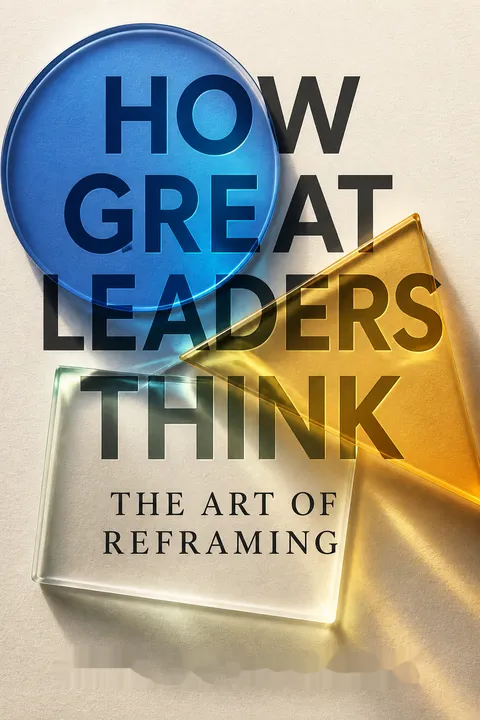
What is How Great Leaders Think: The Art of Reframing by Lee G. Bolman about?
- Multiframe leadership model: The book introduces a four-frame model—structural, human resource, political, and symbolic—that helps leaders interpret and address complex organizational challenges.
- Reframing as a core skill: Bolman emphasizes the importance of shifting perspectives (reframing) to generate new insights and avoid leadership pitfalls.
- Integration of culture and ethics: The book explores how leaders can build soulful, ethical organizations by attending to culture, values, and meaning.
- Real-world application: Through storytelling and case studies, the book demonstrates how great leaders think and act using these frames.
Why should I read How Great Leaders Think by Lee G. Bolman?
- Comprehensive leadership toolkit: The book provides practical frameworks and scenarios for handling diverse leadership challenges, going beyond traditional advice.
- Learn from real leaders: Case studies of leaders like Howard Schultz, Alan Mulally, Lou Gerstner, and Ron Johnson offer actionable lessons grounded in real experiences.
- Avoid common leadership failures: Bolman explains why even smart, experienced leaders fail and how reframing can prevent such mistakes.
- Focus on ethical and soulful leadership: The book addresses the spiritual and ethical dimensions of leadership, helping readers create meaningful organizations.
What are the key takeaways from How Great Leaders Think by Lee G. Bolman?
- Reframing is essential: Leaders must learn to view situations from multiple perspectives to make better decisions and avoid cognitive traps.
- Four leadership frames: Understanding and applying the structural, human resource, political, and symbolic frames is crucial for effective leadership.
- Multiframe thinking leads to success: Research and case studies show that leaders who use multiple frames are more effective and adaptable.
- Ethics and culture matter: Building organizations with strong values, culture, and meaning is as important as strategy and structure.
What is the concept of "reframing" in How Great Leaders Think by Lee G. Bolman?
- Definition of reframing: Reframing is the ability to shift mental models or frames to see situations differently, enabling leaders to better understand complex realities.
- Avoiding narrow thinking: It helps leaders break out of fixed perspectives and creatively redefine problems.
- Practical application: The book uses real-world scenarios to show how reframing leads to more effective leadership decisions.
- Leadership impact: Leaders who reframe can adapt to changing circumstances and avoid being "clueless" in challenging situations.
What are the four leadership frames in How Great Leaders Think by Lee G. Bolman and what do they mean?
- Structural frame: Focuses on roles, goals, policies, and organizational design; leaders act as architects to create efficient systems.
- Human resource frame: Centers on people’s needs, skills, and relationships; leaders empower and support individuals for growth and commitment.
- Political frame: Views organizations as arenas of competing interests and power; leaders build coalitions, manage conflict, and negotiate.
- Symbolic frame: Emphasizes culture, meaning, and inspiration; leaders use stories, rituals, and vision to unite and motivate.
How does multiframe thinking improve leadership effectiveness in How Great Leaders Think by Lee G. Bolman?
- Comprehensive understanding: Using multiple frames helps leaders develop a fuller, more accurate picture of organizational challenges and opportunities.
- Avoids leadership blind spots: Leaders who rely on a single frame risk missing critical aspects, leading to poor decisions and failures.
- Evidence-based results: Research cited in the book shows that multiframe leaders are more effective and adaptable.
- Enhanced problem-solving: Multiframe thinking enables leaders to diagnose problems better and choose appropriate actions.
How does How Great Leaders Think by Lee G. Bolman describe the role of symbolic leadership?
- Creating meaning and culture: Symbolic leaders use stories, rituals, and symbols to create shared meaning and a strong organizational culture.
- Inspiring through vision: They embody values and communicate compelling visions that give people purpose and belonging.
- Case study example: Howard Schultz’s revival of Starbucks is highlighted as a model of symbolic leadership, reconnecting employees and customers to the company’s heritage.
- Sustaining organizational soul: Symbolic leadership helps organizations develop a deep identity and sense of mission.
What is the "curse of cluelessness" in How Great Leaders Think by Lee G. Bolman, and how can leaders avoid it?
- Definition: The curse of cluelessness refers to smart leaders failing because they misread situations and persist in ineffective actions.
- Real-world examples: The book contrasts Ron Johnson’s failure at JCPenney with Lou Gerstner’s success at IBM to illustrate this concept.
- Solution through reframing: Developing reframing skills and multiframe thinking helps leaders see what’s really going on and avoid cognitive ruts.
- Continuous learning: Leaders must remain open to feedback and willing to shift perspectives to overcome cluelessness.
How does How Great Leaders Think by Lee G. Bolman address building and sustaining great teams?
- Soulful teams concept: Successful teams share a deep spirit or soul, nurtured through shared culture, rituals, and stories.
- Leadership roles in teams: Leaders build great teams by managing membership rituals, encouraging diverse contributions, and sustaining symbolic activities.
- Case study: The Data General Eagle Group’s success is attributed to leadership diversity, humor, and informal cultural players who fostered cohesion.
- Beyond skills and structure: Team spirit and shared identity are as important as technical skills and formal roles.
What political skills does How Great Leaders Think by Lee G. Bolman say leaders need to succeed?
- Agenda setting: Leaders must clarify their goals and develop strategies that balance competing interests.
- Political mapping: Understanding key players, their power, and interests is essential for navigating organizational politics.
- Networking and negotiation: Building coalitions, persuading stakeholders, and bargaining effectively are crucial skills.
- Case study: Anne Mulcahy’s turnaround of Xerox demonstrates the importance of political acumen in leadership.
What ethical perspectives and leadership values are discussed in How Great Leaders Think by Lee G. Bolman?
- Four-frame ethics: Each frame embodies a core ethical value—structural (excellence), human resource (caring), political (justice), and symbolic (faith).
- Case studies of ethics: The book contrasts ethical leadership at Johnson & Johnson and Medtronic with lapses at JCPenney.
- Soul and spirit in organizations: Ethical leadership requires clarity of values and courage to act on them, fostering organizations with deep identity and purpose.
- Building ethical organizations: Leaders contribute these gifts to create meaningful, just, and sustainable organizations.
How do stories and worldviews shape leadership in How Great Leaders Think by Lee G. Bolman?
- Leader’s worldview: Leaders’ thinking is shaped by their concepts, beliefs, values, and self-image, influencing how they interpret situations.
- Interplay of stories: Personal stories interact with organizational narratives, shaping shared vision and guiding collective action.
- Examples of storytelling: Alan Mulally’s “One Ford” story and Lou Gerstner’s use of IBM’s history illustrate the power of storytelling in leadership.
- Risks of poor storytelling: Ineffective or mismatched stories, as seen with Ron Johnson at JCPenney, can lead to leadership failure.
What are the best quotes from How Great Leaders Think by Lee G. Bolman and what do they mean?
- “Good thinking is the starting point for good leadership.” This highlights the book’s core message that effective leadership begins with how leaders perceive and interpret situations.
- “If you only have a hammer, every problem looks like a nail.” This quote underscores the danger of relying on a single frame or perspective.
- “Organizations are not machines; they are temples, jungles, and families.” Bolman uses this metaphor to illustrate the four frames and the complexity of organizational life.
- “The soul of leadership is the courage to reframe.” This emphasizes the importance of adaptability and perspective-shifting in successful leadership.
About the Author
Other books by Lee G. Bolman
Download PDF
Download EPUB
.epub digital book format is ideal for reading ebooks on phones, tablets, and e-readers.








