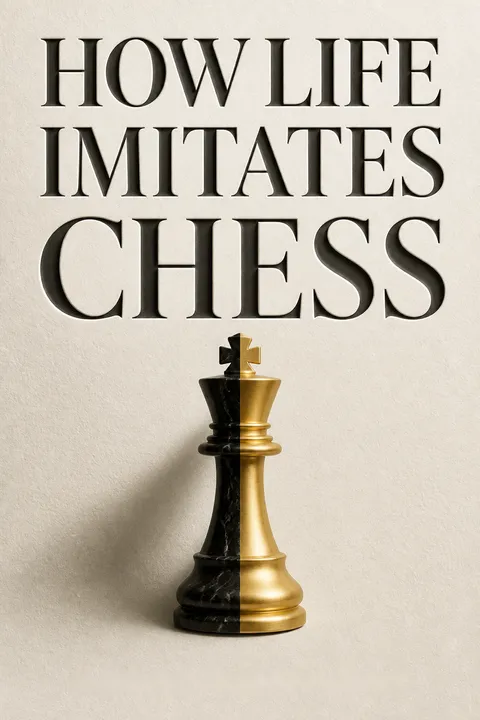


Key Takeaways
Use chess's clear feedback to expose your real-world decision habits
A match became a mirror. In 1984, twenty-one-year-old Kasparov fell four losses behind Anatoly Karpov in their world championship match. His instinctive aggression had become predictable, and Karpov knew how to exploit it. Kasparov shifted to a cautious strategy, then studied not only Karpov's play but his own thinking. He identified overconfidence and a habit of sacrificing material for attacks. The match was eventually canceled, but the lesson endured: improving requires tracing results back to the decisions that produced them.
Chess is a laboratory. Its fixed rules and visible consequences make it easier to inspect a decision than in politics or business, where motives and outcomes are murkier. The point is not to copy chess moves into life. It is to borrow the habit of examining how choices are made, and to use each result as evidence about that process.
What's distinctive is the separation of outcome from method. A win can conceal a fragile process, while a loss can reveal a correctable weakness. This is close to the logic of a clinical case review: examine the sequence of judgments, not just the final result. The chessboard makes that review unusually concrete, but real-world feedback is noisier and less immediate. A decision journal can help preserve what the decision-maker believed at the time, before hindsight edits the story into something more flattering.
Give tactics a destination by asking why each move matters
Strategy sets direction. Kasparov distinguishes strategy, the longer-term objective, from tactics, the immediate actions used to pursue it. Belarusian player Alexei Fedorov attacked Kasparov's king early in a 2001 tournament game, but had neglected to develop his pieces or establish conditions that could make the attack work. Kasparov defended, countered elsewhere, and won quickly. The attack had energy but no credible route to success.
Ask what success requires. A goal such as finding a better job is too vague to guide decisions until its reasons and conditions are clear. More pay may not solve the real problem. Kasparov recommends repeatedly asking why a choice serves the larger aim, and working backward from the desired future to the steps needed now. Tactics matter, but without a destination they become reactive motion.
This distinction is useful because urgent work often masquerades as important work. A clear strategic aim gives teams a criterion for deciding which interruptions deserve attention and which can be handled without abandoning direction. The framework also exposes a danger: a goal can be coherent yet based on a mistaken assumption about what will satisfy it. Asking why should therefore include testing the goal itself, not merely checking whether each action supports it.
Value choices through material, time, and quality, not price alone
Three factors shape value. Kasparov's MTQ framework means material, time, and quality. Material is what can be counted, such as money, staff, or chess pieces. Time includes both clock time and board time, the number of moves needed to reach an objective. Quality is the usefulness or power of resources in their particular position. A bishop blocked by its own pawns has the same nominal value as any other bishop, but less practical utility.
Trade-offs depend on context. Against Karpov, Kasparov gave up pawns to gain attacking time, while Karpov later offered material to improve his defense. Kasparov kept the pressure up until Karpov ran out of clock time. Neither material nor speed has a fixed value: the right exchange depends on whether the position rewards immediate action or durable assets.
MTQ corrects a common accounting error: treating what is easy to measure as what matters most. The same cash reserve, skill, or hour can have sharply different value depending on where it is deployed and what it enables. The framework is especially strong as a prompt to compare unlike resources. Its limitation is that quality can be difficult to quantify, and the categories interact. A useful evaluation therefore needs explicit assumptions, not a false impression of numerical precision.
Let calculation test intuition, not bury it under endless branches
Choose lines with discipline. Kasparov says strong calculation does not mean examining every possible move. He first evaluates the position, selects two or three plausible candidate moves, and follows the most promising lines. In a complicated game, four or five moves per player is often a practical depth. Less useful branches should be pruned, and analysis should stop when further thought is unlikely to repay its cost.
Time pressure revealed a limit. In a 2004 game against Veselin Topalov, Kasparov missed a winning move while rushing through variations. He had imagined an illegal queen check and chose the wrong knight move. Later analysis showed the quieter alternative won. The error was not simply insufficient calculation: anxiety and indecision had disrupted his judgment. Calculation needs a clear evaluation and enough confidence to act.
The key insight is that more analysis is not automatically better analysis. Under uncertainty, attention is a scarce resource, and an expanding list of possibilities can obscure the decisive comparison. A practical safeguard is to state what evidence would change the choice before investigating further. Still, the optimal stopping point varies with stakes and reversibility. A routine, recoverable decision can be made quickly; a choice with irreversible consequences may justify a deeper search.
Train intuition by reviewing meaningful patterns, not memorizing everything
Experts remember structure. Psychologist Adriaan de Groot tested chess players' ability to reproduce positions. Stronger players recalled positions from real games much better than beginners, but when pieces were arranged randomly, their advantage disappeared. A 1973 study by Bill Chase and Herb Simon found the same pattern. Masters were not simply equipped with photographic memories; they recognized meaningful arrangements, or chunks, and stored them as familiar patterns.
Experience needs review. Pattern recognition helps a player notice what a position resembles and retrieve relevant knowledge without calculating from scratch. Kasparov urges people to examine their work regularly: what happened, what was learned, and what pattern might recur? He also describes creative experimentation, including trying unfamiliar approaches, as a way to expand the patterns available to intuition. Repetition builds competence; deliberate reflection helps experience become useful knowledge.
The research gives a precise account of expertise: memory works best when information has an organized meaning. This helps explain why deliberate practice is more than accumulating hours. Review can reveal which details predict a useful outcome and which merely happened to be present. There is a caution, however. Familiar patterns can become stereotypes when the setting changes. Good intuition remains provisional, ready to be checked against the features of the present situation.
Preparation converts talent into performance when effort fits your nature
Work has different forms. Kasparov contrasts José Capablanca, a naturally gifted player who disliked study, with Alexander Alekhine, whose intense preparation helped him defeat Capablanca for the world title. Neither story proves that one style suits everyone. Kasparov credits his own disciplined routines to his mother and his teacher Mikhail Botvinnik, who treated analysis, rest, and physical preparation as parts of competitive work.
Consistency beats imitation. Kasparov's research sometimes produced ideas that were never used, or proved flawed, yet the work still built knowledge and confidence. He argues that preparation should be judged by what it enables, not by whether every prepared idea appears in public. People differ in how long they can work effectively and what motivates them. A sustainable regimen should match those differences while still requiring steady effort.
This account expands the meaning of talent: the capacity to organize effort can matter as much as an obvious gift. It also avoids treating a champion's schedule as a universal prescription. In practice, preparation has value when it improves capability, confidence, or readiness, even if its immediate product is discarded. The challenge is to distinguish useful groundwork from ritualized busyness. A routine needs feedback about results, otherwise its consistency can become a refuge from changing methods.
Adapt to the battlefield without changing plans on every setback
Flexibility is not flailing. As a young player, Kasparov struggled against Viktor Korchnoi, who kept steering games away from the attacking positions Kasparov preferred. Kasparov eventually stopped forcing his favorite style and played the strongest moves available in quieter positions. The adjustment helped him win. By contrast, against Vladimir Kramnik in 2000, Kasparov failed to adapt to the Berlin variation, which steered play toward the kind of slow maneuvering he disliked.
Change for a reason. Kasparov warns that switching strategy whenever results turn bad produces no stable direction. First ask whether conditions have changed, whether the objective has changed, or whether a tactical adjustment is enough. A strong approach can survive a setback; a changing environment may require a new one. The task is to distinguish discomfort from evidence that the plan no longer fits.
This is a valuable distinction between strategic stability and tactical rigidity. A durable aim can coexist with changes in method, especially when an opponent controls the setting or a market shifts. The difficult part is diagnosis: persistence can be courage, or it can be sunk-cost thinking. Regularly naming the assumptions behind a plan makes revision less personal. It also prevents every disappointing result from being misread as proof that the whole strategy has failed.
Take initiative by creating pressure, not by attacking blindly
Pressure changes the choices. In chess, initiative is the ability to create threats that force an opponent to respond. Kasparov calls this the attacker's advantage: the player setting problems often controls the pace and narrows the opponent's options. But attacking is not the same as making reckless moves. In his account, effective aggression means taking action, creating multiple points of pressure, and exploiting a real advantage without demanding more than the position can support.
A threat can redirect effort. Kasparov uses the Allied deceptions before the D-Day invasion to show how pressure and misdirection can occupy an opponent's attention away from the decisive point. In chess, a threat in one area may force a defense that opens an opportunity elsewhere. The principle is to keep initiative alive through flexibility, rather than fixating on a single attack that can be contained.
The strategic value of initiative lies partly in shaping what the other side must consider. This applies to negotiations and competition, where framing the next decision can matter as much as possessing more resources. Yet aggression is context-sensitive. Chess is a contest with an opponent, while many organizations depend on cooperation among people who are not adversaries. Initiative is most constructive when it creates movement toward a shared objective, rather than turning every relationship into a contest for control.
Question success before it hardens into complacency
Winning can hide weaknesses. Kasparov entered his 2000 title match against Kramnik after a run of exceptional results and believed his form made him difficult to beat. Kramnik chose positions that exploited Kasparov's discomfort with slow, queenless play. Kasparov was slow to recognize the danger and lost the title. He calls this the gravity of past success: good outcomes can make a person less willing to inspect vulnerabilities or prepare for a different challenge.
Invite demanding feedback. Kasparov points to Judit Polgar, who developed by competing against the strongest players rather than limiting herself to women's events. He also urges leaders to welcome contradiction instead of surrounding themselves with supporters. The goal is neither endless dissatisfaction nor constant change. It is to examine what worked, what nearly failed, and what a competitor might exploit before success becomes a reason to stop learning.
Success creates an information problem: praise is abundant, while disconfirming evidence becomes socially costly to deliver. Inviting critics can improve the signal, especially when they are asked to identify specific failure modes rather than offer vague opposition. But challenge alone is not learning. Feedback needs a setting where people can revise a view without being punished for admitting error. Competition can sharpen performance, yet poorly calibrated pressure can also discourage experimentation.
Change mental gears as a project moves from launch to finish
Each phase asks for different thinking. Kasparov describes chess through an opening, where players shape the contest; a middle game, where conflict and tactical possibility intensify; and an endgame, where fewer pieces remain and precision dominates. These phases have no exact boundary, but each rewards different skills. Memorizing opening moves without understanding why they work leaves a player stranded when familiar sequences end.
Transitions invite mistakes. In a 2002 game against Christopher Lutz, the position looked like a technical endgame, but Kasparov saw an attack on the king. Lutz stayed in endgame mode and failed to respond to the danger. Kasparov also admits that he once relaxed in a winning endgame against Nigel Short and missed a chance to finish accurately. A good plan includes not only the current task, but what the next phase will demand.
Phase awareness is a useful antidote to carrying one successful mode of thought into every situation. Launching a project, handling its active competition, and closing it out are distinct problems, even when they belong to one effort. The analogy also highlights transition risk: routines that work in one phase can become liabilities in another. Real projects may not announce a clean phase change, so teams need observable signals for when assumptions, roles, or priorities should be reconsidered.
Use machines to extend judgment, not outsource it
Tools change the contest. Kasparov's Advanced Chess paired human players with computers during play, combining human strategic judgment with machine calculation. In a later online freestyle tournament, a team of amateur players using several computers beat stronger players and machines. Their advantage came from coordinating the people and tools effectively, not from having the strongest individual player or computer.
Process decides what tools deliver. Kasparov's experience against IBM's Deep Blue also showed the psychological cost of facing an unfamiliar system under intense pressure. He misread a drawn position as lost after assuming the machine could not have made a mistake. A computer can calculate quickly, but its recommendations still need interpretation. The useful question is not simply which tool is most powerful, but how its strengths and limitations fit the human decision process.
The example anticipates a central problem in human-computer decision-making: automation can improve analysis while encouraging deference. A tool's output is evidence, not a verdict, particularly when the user cannot inspect its assumptions. Strong collaboration requires knowing which tasks the machine handles well and where human context matters. The amateur team's result makes coordination visible as a skill in its own right. Still, success in a tournament does not guarantee that the same division of labor suits every domain.
When crisis arrives, spend resources on the move that matters
A crisis is a turning point. Kasparov defines it not merely as disaster, but as a moment when stakes are high, the outcome is uncertain, and choices may close off alternatives. Detecting such moments is harder than solving a clearly stated problem. The decision-maker must notice when a quiet situation is becoming consequential and reserve extra attention for the choices that can change the result.
Seville tested the principle. In 1987, after losing the penultimate game of his title match with Karpov, Kasparov needed to win the final game or lose his crown. Rather than exhaust himself with frantic preparation, he and his team settled on a basic plan, played cards, and slept. He then created persistent pressure; Karpov eventually resigned. Kasparov's account emphasizes preparation, recovery, and concentration on the decisive problem, not panic-driven activity.
The episode offers a useful model of resource allocation under pressure: conserve attention when additional analysis has little expected value, then spend it intensely where the outcome can turn. This resembles triage, in which urgency and consequence determine what receives scarce effort. There is no universal signal for a crisis, however. People can overreact to dramatic but reversible events, or miss quiet risks that compound. A habit of monitoring changing conditions is therefore as important as courage once danger is obvious.
Analysis
The book's deepest contribution is not a claim that life follows chess rules. Kasparov explicitly treats chess as a controlled laboratory for examining decisions, then asks readers to carry its habits of evaluation into messier settings. That distinction matters. Chess has visible rules, a shared objective, and unusually direct feedback. Business, politics, and private life contain multiple goals, hidden information, shifting alliances, and outcomes partly governed by chance. The transfer is therefore strongest at the level of process: clarify aims, inspect assumptions, notice trade-offs, and review decisions. It is weaker when chess's winner-loser logic is used to describe relationships that depend on trust or mutual gain.
The book also anticipates a modern problem in decision science: outcome bias. A successful result can make a flawed process look wise, while a sound choice can end badly because of luck. Kasparov's repeated call to analyze both wins and losses is a practical defense. A decision record can strengthen it by preserving what was known, what was uncertain, and why a choice seemed reasonable before the result arrived. That record makes later review less vulnerable to hindsight.
His emphasis on intuition is persuasive when expertise has been built from meaningful patterns and tested experience. It is not a license to trust every strong feeling. In unfamiliar environments, confidence can reflect habit or status rather than insight. The book's own balance between calculation, evaluation, and intuition suggests a useful rule: treat intuition as a fast proposal, then ask what evidence would confirm or overturn it.
Finally, the attacker's advantage is best understood as initiative, not aggression for its own sake. Taking action can create options and shape an opponent's response, but in cooperative systems, adversarial pressure may destroy the trust needed to achieve the objective. The adaptable decision-maker is not always the attacker. The larger discipline is to identify the kind of game being played, and to choose a style that fits its real incentives.
Review Summary
How Life Imitates Chess receives mixed reviews. Many praise Kasparov's insights on strategy and decision-making, drawing parallels between chess and life. Readers appreciate the chess anecdotes and historical examples. However, some find the self-help aspects lacking depth or originality. Chess enthusiasts generally enjoy the book more than general readers. Critics note that the book sometimes feels disjointed, trying to appeal to both chess players and business audiences. Overall, it's considered an interesting read, particularly for those interested in chess or Kasparov's perspective on life and strategy.
People Also Read

Glossary
MTQ: Material, Time, Quality
Three factors for evaluationKasparov's framework for evaluating a position or decision through material, time, and quality. Material means tangible resources, time means both clock duration and the moves needed to reach an objective, and quality means the utility or power of those resources in context. The framework focuses attention on trade-offs rather than assuming that more money, speed, or assets are automatically better.
board time
Moves needed for an objectiveA chess player's measure of time as the number of moves required to reach a goal, distinct from clock time, which measures the time available to think. Board time captures who is acting, who is reacting, and whether one side can achieve an objective before the other can respond. Kasparov uses the distinction to explain why a move can be valuable even when no material is gained.
chunks
Recognized meaningful patternsIn the cited studies of chess expertise, chunks are familiar, meaningful groupings of pieces that experienced players recognize and remember as patterns. They help explain why masters reproduce realistic game positions more accurately than beginners, without showing the same advantage for randomly arranged pieces. Kasparov uses the concept to argue that expert memory depends on organized experience, not simply raw recall.
initiative
Ability to create threatsThe capacity to make threats that force an opponent to respond, thereby influencing the course and pace of a chess game. A player with the initiative can restrict the opponent's choices and create opportunities elsewhere on the board. Kasparov extends the term to business, negotiation, and politics, while stressing that pressure must be sustained and supported by a sound position.
Advanced Chess
Human-computer chess collaborationA chess format developed by Kasparov in which players use computers during the game. The human supplies strategic judgment and context, while the machine assists with calculation and stored game information. Kasparov presents it as a test of collaboration: results depend not only on the abilities of the human and computer, but on how effectively their different strengths are coordinated.
fantasy
Imaginative chess possibilityKasparov's term for the imaginative leap that helps a player escape familiar patterns and consider unusual possibilities in a chess position. Fantasy can produce a surprising move when calculation alone seems unable to resolve the situation. It is not a substitute for evaluation: an imaginative idea still needs to be checked against the position, since an attractive move can also be a beautiful mistake.
FAQ
What's "How Life Imitates Chess" about?
- Author's Perspective: The book is written by Garry Kasparov, a world chess champion, who draws parallels between chess and decision-making in life and business.
- Core Theme: It explores how the strategies and tactics used in chess can be applied to personal and professional decision-making.
- Chess as a Metaphor: Kasparov uses chess as a metaphor to discuss broader concepts of strategy, preparation, and intuition.
- Practical Application: The book aims to provide readers with tools to analyze and improve their thinking and decision-making processes.
Why should I read "How Life Imitates Chess"?
- Unique Insights: Gain insights from one of the greatest chess players on how to apply chess strategies to real-life situations.
- Decision-Making Skills: Learn how to enhance your decision-making skills by understanding the strategic elements of chess.
- Self-Improvement: The book encourages self-awareness and continuous improvement in both personal and professional contexts.
- Broader Perspective: It offers a broader perspective on how to approach challenges and opportunities in life.
What are the key takeaways of "How Life Imitates Chess"?
- Strategy and Tactics: Understanding the difference between strategy (long-term goals) and tactics (short-term actions) is crucial.
- Self-Awareness: Being aware of your decision-making process is essential for improvement.
- Adaptability: The ability to adapt to changing circumstances is a key component of success.
- Continuous Learning: Constantly questioning and learning from both successes and failures is vital.
How does Garry Kasparov relate chess to decision-making?
- Chess as a Laboratory: Kasparov views chess as a laboratory for decision-making, requiring a synthesis of calculation, creativity, and desire for results.
- Strategic Thinking: He emphasizes the importance of strategic thinking, which involves setting long-term goals and working backward to achieve them.
- Pattern Recognition: Recognizing patterns in chess is akin to identifying trends and opportunities in life and business.
- Intuition and Analysis: Balancing intuition with analysis is crucial for making effective decisions.
What is Kasparov's advice on strategy from "How Life Imitates Chess"?
- Develop a Clear Strategy: Always have a clear objective and plan your moves accordingly.
- Adaptability: Be prepared to adapt your strategy when circumstances change.
- Avoid Complacency: Constantly question your strategy, even when things are going well.
- Balance Strategy and Tactics: Ensure that your day-to-day decisions align with your long-term goals.
How does Kasparov suggest improving decision-making skills?
- Self-Teaching: Better decision-making cannot be taught but can be self-taught through self-awareness and practice.
- Questioning Success: Regularly question your successes to avoid complacency and to identify areas for improvement.
- Learning from Mistakes: Analyze your mistakes to understand where your decision-making process went wrong.
- Continuous Evaluation: Constantly evaluate and refine your decision-making process.
What role does intuition play in "How Life Imitates Chess"?
- Intuition as a Tool: Intuition is a powerful tool that combines experience and knowledge to make quick decisions.
- Developing Intuition: It can be developed through practice and by challenging oneself with new experiences.
- Balancing Intuition and Analysis: While intuition is important, it should be balanced with thorough analysis.
- Trusting Your Instincts: Kasparov emphasizes the importance of trusting your instincts, especially in high-pressure situations.
What are the phases of the game according to Kasparov?
- Opening Phase: This is where the battle lines are drawn, and the foundation for the game is set.
- Middle Game: Characterized by creativity and tactical play, where the forces become engaged.
- Endgame: A technical phase where precision and calculation are key, often determining the outcome.
- Transition Between Phases: Understanding the transition between these phases is crucial for strategic planning.
How does Kasparov view the concept of risk in decision-making?
- Risk as Opportunity: Kasparov sees risk as an opportunity for growth and learning.
- Evaluating Risk: Proper evaluation of risk involves understanding the potential rewards and consequences.
- Taking Calculated Risks: He advocates for taking calculated risks rather than avoiding them altogether.
- Learning from Risk: Each risk taken provides valuable lessons, regardless of the outcome.
What are some of the best quotes from "How Life Imitates Chess" and what do they mean?
- "Success is the enemy of future success." This quote highlights the danger of complacency and the importance of continuous improvement.
- "The attacker always has the advantage." It emphasizes the benefits of taking initiative and being proactive.
- "Better decision-making cannot be taught, but it can be self-taught." This underscores the importance of self-awareness and personal growth in improving decision-making skills.
- "We know more than we understand." It suggests that intuition is based on deep-seated knowledge and experience.
How does Kasparov address the balance between material, time, and quality?
- Material: Refers to tangible assets or resources, which are fundamental but not the only consideration.
- Time: Involves both clock time and board time, emphasizing the importance of timing in decision-making.
- Quality: Represents the value or power of a position, often more important than material or time.
- Balancing MTQ: Successful decision-making requires balancing these three elements to achieve the best outcome.
How can "How Life Imitates Chess" be applied to business and leadership?
- Strategic Planning: Use chess strategies to develop long-term business plans and objectives.
- Adaptability in Leadership: Be prepared to adapt to changing market conditions and competition.
- Decision-Making Framework: Apply the decision-making framework from chess to business challenges.
- Continuous Improvement: Encourage a culture of continuous learning and improvement within the organization.
About the Author

Download PDF
Download EPUB
.epub digital book format is ideal for reading ebooks on phones, tablets, and e-readers.








